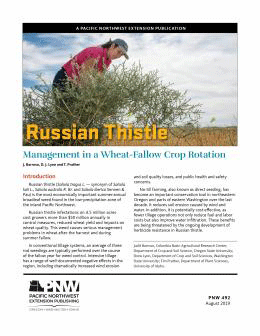
Russian Thistle: Management in a Wheat-Fallow Crop Rotation
Reviews Russian thistle biology as it relates to management, including seed dormancy and longevity in soil, seed distribution, seed germination and emergence, plant growth after establishment, crop competition, and resistance to herbicides. Outlines key considerations for managing for 3 crop years and 1 fallow year. Describes results from a residue management experiment designed to determine how to reduce tillage while maintaining winter wheat production.
Page Count: 10
Published: November 1995
Revised: August 2019
Reviewed: January 2023
Hurry! Only left in stock.
Related publications
-
Manipuladores de plaguicidas y la norma de protección (Pesticide Handlers and the Worker Protection Standard)
View this video here! Este video explica las normas de protección del trabajador y su aplicación a los manejadores de pesticidas.
Authors: -
Identifying and Managing Mountain Beaver Damage to Forest Resources
The mountain beaver is a medium-sized rodent of the western Pacific Northwest. Mountain beavers cause damage to forest regeneration by clipping or girdling seedlings or saplings or both, and undermini ...
- Published:
- July 2013
- Reprinted:
- January 2021
- SKU:
- EM9063
Authors: -
Identification and Habits of Key Ant Pests in the Pacific Northwest
This publication describes the 12 most common ants characterized as structural pests in Washington, Idaho, and Oregon. Drawings and descriptions follow an introduction to ants and their general biology.
Authors: -
Controlling Root and Crown Diseases of Small Grain Cereals
This publication describes fundamental practices to manage and minimize losses from root and crown diseases of wheat and barley grown in the Pacific Northwest. Includes tables that list the hosts, ran ...
- Published:
- November 2012
- SKU:
- PNW639