Description
Table of Contents
- Joining 4-H!
- 4-H Livestock Projects
- Club Enrollment
- Getting Along with Each Other
- Managing 4-H Livestock Projects
- What Happens before the Fair or Show?
- Ownership Dates, Weigh-ins, and Ear Tagging
- Quality Assurance Training, Market Health Record Forms, and Biosecurity
- Entering (or Pre-registering) Livestock Projects
- Other Educational Events Available to 4-H Members
- At the Fair or Show!
- Judging of Animals and Youth
- Market Animal Evaluation
- Fitting and Showmanship
- Herdsmanship
- Market Livestock Sale
-
Responsibilities of the Livestock Sales Committee
- Livestock sales committees may:
Raising a 4-H market livestock animal (beef, lamb, swine, or goat), can be an overwhelming experience, particularly for the first-time family. There are several steps and actions the 4-H member, leader, and family will take throughout the year to complete this project experience. Carefully reading this publication and following the provided guidance will help 4-H members, leaders, and families successfully navigate the many steps involved with raising a market livestock project from start to finish.
Joining 4-H!
4-H is the premier youth development program for Washington State University Extension. Washington State 4-H policy (WSU Extension 2019b) requires youth to be enrolled in 4-H if they participate in 4-H livestock projects. Youth must be 8 years old by October 1st of the current 4-H year to be enrolled in beef, swine, lamb and market goat projects. Youth may continue to enroll in 4-H if they have not reached their 19th birthday by October 1st of the current 4-H year. Special Education youth may participate in 4-H until the age of 21 if approved by their local Extension office.
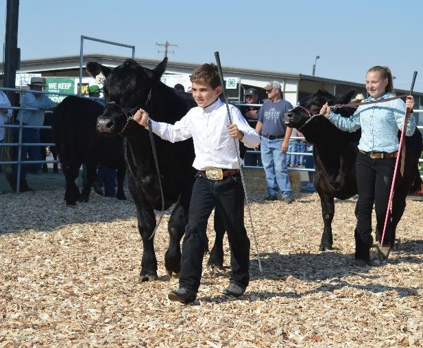
The purpose of the 4-H Market Livestock program is to provide an opportunity for the personal growth and development of youth (Figure 1). In the process of raising a market animal livestock project, youth are also learning animal agriculture and how to raise a food animal for human consumption. At fairs and junior livestock shows (shows), 4-H members are showcasing food animals to the general public. The hands-on process of selecting, feeding, managing and fitting livestock projects encourages 4-H members to develop positive life skills that will help them now and later in life.
All 4-H members, parents, and volunteer leaders must treat animals in an ethical manner and raise them humanely. 4-H members cannot use unethical methods to feed or prepare an animal that will be shown or sold as a 4-H livestock project. Examples of unethical livestock practices include misrepresenting the age of an animal; feeding an animal supplements that are not approved by the U.S. Food and Drug Administration (FDA); and not following withdrawal times on medications. The National Show Ring Code of Ethics (IAFE 2019) provides guidance on the ethical treatment of market animal livestock projects.
Counties may have additional policies that are more restrictive, but not less restrictive, than State 4-H policies. There is a Memorandum of Understanding between 4-H and the Washington State FFA Organization stating that youth may not exhibit the same project animal in both 4-H and FFA in the same 4-H year (October–September).
Youth with residency in another state may enroll in Washington State 4-H, as long as they follow their own state’s minimum age policies. Youth may not be simultaneously enrolled in the same 4-H project in another club, county, or state. For example, youth may not be enrolled in the 4-H Market Beef project in both Oregon and Washington. Contact local county Extension offices when planning to enroll from another county or state.
4-H Livestock Projects
In order for 4-H members to show and sell livestock animals at fairs or shows, youth must join and actively participate in 4-H clubs that offer that livestock project area. Volunteer 4-H leaders in clubs must be willing to lead the project area that youth plan to enroll in. Some families have the necessary knowledge and experience to successfully raise livestock projects on their own from start to finish. However, if the family does not have this skill set, make sure that they are enrolled in a 4-H club that has leaders that will provide the knowledge and support necessary to help the 4-H member successfully complete all aspects of the livestock project.
Club Enrollment
It is preferred that members participate in their 4-H club for the entire 4-H year that starts October 1st and ends September 30th. Washington State 4-H has a state 4-H enrollment fee for all members, and counties may also have an additional county fee to help support local 4-H programming. Youth may join a club and participate in 4-H club activities once their application is accepted online by the main club leader and the local Extension office. In order to participate in fairs or shows, many counties will have a specific date that youth must be enrolled in 4-H (for example, by March 1st for an August fair or show).
When enrolling in 4-H, it is very important that youth enroll in all the possible 4-H projects that they plan to participate in and exhibit in fairs or shows.
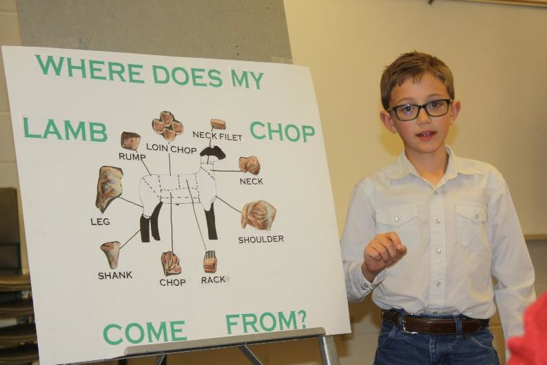
4-H clubs will usually have participation requirements in order for a member to show and sell a 4-H livestock project. Some clubs require attendance at a minimum number of club meetings (for example, ten club meetings per 4-H year) as well as participation at other events and community service projects. Clubs may also require that each of their members give a club or county demonstration, complete a record book, and create an educational poster. Specific club requirements and expectations should be discussed with the club leader before youth enroll in that club.
Getting Along with Each Other
4-H is a large, diverse youth development program that is available to youth in every county in Washington State. As with any large and diverse program, there is occasional conflict between club members, families, leaders, and program staff. Conflict should be managed at the local or club level whenever possible. Concerns at the local club level should be brought first to the attention of club leaders. Major concerns should be brought to the attention of local WSU Extension staff. Conflicts or concerns with fair board members, livestock sales committee members, and other entities should also be brought to the attention of local WSU Extension staff. Raising a 4-H livestock project can be stressful at times, and conflict management procedures should be discussed at club meetings before the start of the 4-H season.
Managing 4-H Livestock Projects
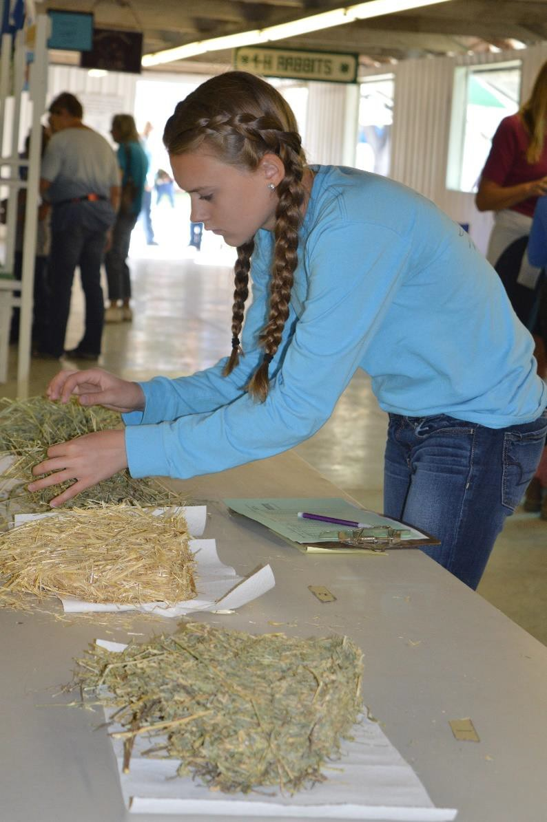
Youth enrolled in 4-H livestock projects are expected to purchase and raise their own livestock projects. They are also expected to provide shelter, feed (Figure 2), train, prepare, show, and help market their own 4-H livestock project. While volunteer leaders may be there to assist 4-H members, it is ultimately the responsibility of youth and their families to raise quality livestock projects. Though younger in age, 4-H livestock members are still livestock producers whose animals will become part of the food chain.
Before livestock are purchased, it is important to review all requirements for purchase, ownership, participation in a fair or show, and selling a market livestock project at a 4-H livestock sale. Review all health guidelines and make sure that youth have the proper paperwork to transport animals across state lines. 4-H livestock projects are NOT exempt from rules for transporting livestock across state lines. The Washington State Department of Agriculture and local veterinarians can help answer questions regarding regulations for transporting animals from other states into Washington. Livestock brought into Washington from other states require a Certificate of Veterinary Inspection (known as a CVI).
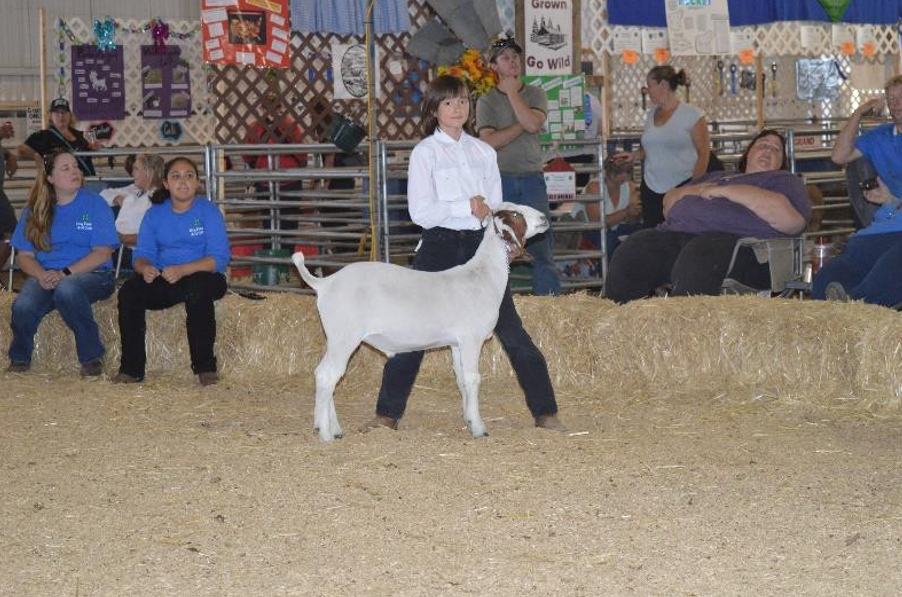
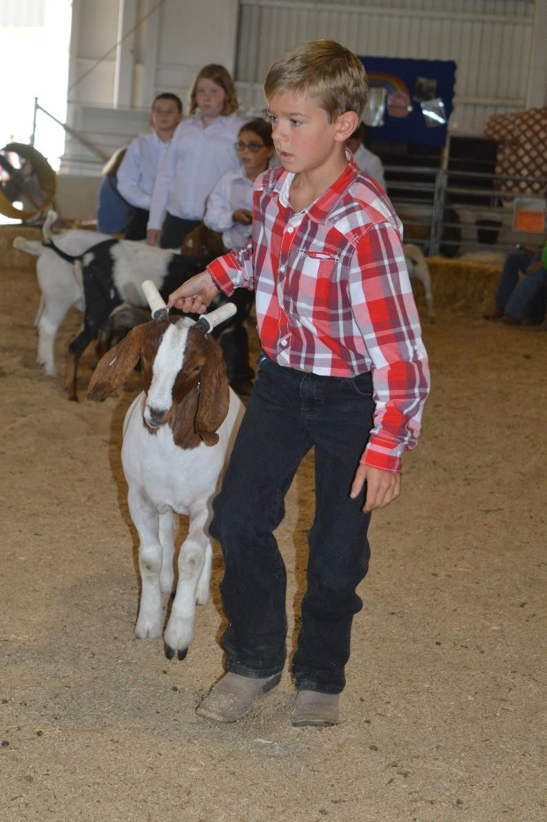
All beef cattle entering or leaving Washington State require a WSDA Brand Inspection (even if the cattle are not branded) and a Haul Slip to be in compliance with state regulations. Market beef animals also require a bill of sale. Scrapie tags or other acceptable forms of identification are required for all lambs and goats that are to be exhibited at a fair or show. Breeding animals of all species need to be current on all required vaccinations. The Washington State 4-H policy addresses the requirements for showing horned animals and unaltered male breeding animals. Youth exhibitors (Figure 3 and Figure 4) and parents need to be familiar with the Washington State 4-H policies for livestock. Local county policy may be stricter regarding the showing of horned animals compared to the Washington State 4-H policy.
It is the responsibility of the 4-H member, parents, and leaders to ensure that animals are raised in a safe, humane manner and are of the proper weight and health to enter the food chain. If the animal is not market-ready, do not expect the animal to go through the 4-H market livestock sale. A market-ready animal is one that is at the recommended weight and fat cover to meet industry standards for that species. Each fair or show will have specific weight requirements for each species that are established to help guide youth to bring a quality product to the fair or show. The purpose of a 4-H livestock project is to provide 4-H members a learning environment that helps them develop life skills to use now and later in life. One of the most valuable life skills is working through disappointment (e.g., an animal not making weight or receiving a white ribbon that may make it ineligible to sell).
What Happens before the Fair or Show?
| Animal | Age at Fair or Show | Minimum Weight | Maximum Weight |
|---|---|---|---|
| Market Beef | 13-20 months | 1,050 lb | 1,500 lb |
| Market Goats | 6-10 months | 70 lb | 130 lb |
| Market Lambs | 6-9 months | 110 lb | 170 lb |
| Market Swine | 6-8 months | 230 lb | 300 lb |
Raising 4-H livestock projects or animals is a learning experience for both youth and their families. There are many requirements and activities that must be completed before the animal is shown and sold.
Selecting a market animal can be one of the biggest challenges for beginning families. Success will depend on 4-H members selecting animals that are the proper age and weight. Animals that are too young will have difficulty gaining enough finish (or external fat cover) to be market-ready, even if fed properly. Producers, leaders, and other parents can help beginning families select an animal that has a high probability of being market ready at fairs or shows. Resources included in this publication can help parents and youth understand how to select a market livestock animal. Table 1 lists the recommend ages and weight ranges for each 4-H market livestock project. Individual counties may have different minimum and maximum weight requirements.
Ownership Dates, Weigh-ins, and Ear Tagging
According to the Washington State 4-H Policy and Procedure Handbook (WSU Extension 2019b), animals must be under 4-H members’ regular care and management for specific time periods prior to the official county activity, such as fairs or shows (Table 2).
| 4-H Market Livestock Project | Care and Management Days |
|---|---|
| Market Beef | 120 days |
| Market Goats | 60 days |
| Market Lambs | 60 days |
| Market Swine | 60 days |
A county may require livestock projects to be in the care of 4-H members longer than the state guidelines. Most events will also require all 4-H market livestock projects to be officially weighed-in and ear tagged for identification before the required possession date in order to be eligible to be shown and sold at that fair or show. 4-H members need to be aware of specific weigh-in dates and tagging requirements for the fair or show that they are entering.
If the state veterinarian or local conditions do not allow animals to be comingled for a weigh-in, then other procedures may be required. Currently, swine in some areas are not comingled at an initial weigh-in to prevent the spread of diseases, and events may require swine to be pre-tagged by the exhibitor before the final weigh-in at the fair or show. Good biosecurity should always be practiced when weighing and tagging market swine.
Quality Assurance Training, Market Health Record Forms, and Biosecurity
Washington State 4-H recommends that 4-H market livestock members annually complete quality assurance training before exhibiting animals at a fair or show. Quality assurance training focuses on food safety, animal well-being, ethics, and character development. Youth for the Quality Care of Animals (YQCA) is a national quality assurance training program that many counties require in the State of Washington (YQCA 2019). Get additional information about the YQCA program. Contact local county Extension offices regarding quality assurance training requirements.
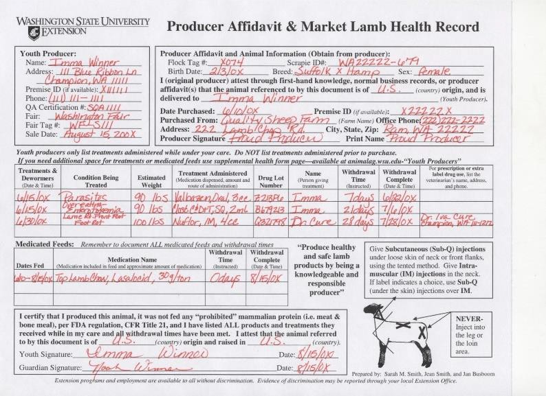
Most counties in Washington require 4-H members selling market animal projects to turn in a completed “Market Health Record” form (WSU Extension 2019a) during the final weigh-in. Market Health Record forms are specific to each market species (beef, goat, lamb, and swine) and require the breeder to provide information about the animal and verify that it was born in the United States. Youth should take Market Health Record forms with them when they purchase and pick up animals so that they can get all of the necessary information from the livestock breeder. The form requires youth to write down any medications, vaccines, or medicated feeds that have been given to the animal since they began caring for it. Finally, both youth and their parents sign off that all of the information provided on the form is correct. The Market Health Record form (Figure 5) for each species is available online at WSU Extension’s Youth Producers website.
Entering (or Pre-registering) Livestock Projects
Each county has a system in place to enter or pre-register animals and other 4-H projects into the fair or show. 4-H members must enter all classes that they intend to participate in at the fair or show, including market and feeder classes, fitting and showing, breeding classes, posters, educational displays, and demonstrations. Each county has a fair or show registration deadline as well as required paperwork or an online entry system. Popular online entry systems include FairEntry and ShoWorks. Each fair or show will also have an exhibitor handbook, available in hardcopy or online, that has all the details and entry information for that event. It is the responsibility of the parents and 4-H members to read the exhibitor handbook.
Other Educational Events Available to 4-H Members
There are many other educational events available to 4-H members with livestock projects. Many counties offer livestock judging events before and during the fair or show. Participation in livestock judging at the event may be mandatory. If 4-H members do well in county contests, such as livestock judging, they may qualify to compete at the state level. Individuals who place high at the state level may qualify for national competitions. Other events that may be available to youth include Skill-A-Thons, Quiz Bowls, Youth Livestock Field Days, and Jackpot Shows. Ask county Extension staff about other livestock educational opportunities available in your area.
At the Fair or Show!
Showing a 4-H livestock project is a learning experience for both youth and their families. There are requirements on how to bring animals onto the grounds as well as how to house, feed, and water animals at the fair or show. These requirements are stated in the exhibitor handbook. Speak with 4-H volunteer leaders or the barn superintendent if you have additional questions.
At the event, 4-H members have the opportunity to demonstrate what they have learned during the past several months regarding their livestock project as well as teach the general public about how their food is raised and cared for. With that being said, it can be a stressful and challenging time for parents who attend to support their 4-H youth. The following are some of the activities that will occur during the fair or show.
Judging of Animals and Youth
Washington 4-H members are evaluated using the “Danish Merit System” of judging (Black 2017). The 4-H exhibitor is evaluated during Fitting and Showing (Showmanship) while the exhibitor’s animal is evaluated during the market class by a judge who has training and experience evaluating 4-H youth livestock projects. Ribbons are awarded based on accepted criteria (Table 3 and Table 4).
Other awards may include Champion, Reserve Champion, and purple ribbons, which are given to youth who are ranked at the top of their class or division.
| Exhibitor Awards | Description |
|---|---|
| Blue Ribbon in Fitting and Showing | Indicates exhibitor performed at a high level, well within the ability level of most exhibitors. |
| Red Ribbon in Fitting and Showing | Indicates exhibitor performed at a satisfactory level, with room for improvement. |
| White Ribbon in Fitting and Showing | Indicates exhibitor performed at an acceptable level, but below the ability or quality of most, and there is need for considerable improvement. |
| Animal Awards | Description |
|---|---|
| Blue Ribbon in a Market Class | Indicates animal has high acceptability when evaluated against industry standards for that species for meat production and consumer preferences. |
| Red Ribbon in a Market Class | Indicates animal has acceptable quality when evaluated against industry standards for that species, with room for improvement. |
| White Ribbon in a Market Class | Indicates animal has unacceptable quality when evaluated against industry standards for that species, with considerable room for improvement. |
Source: Adapted from: The Danish Merit System for Judging (pdf), Oregon State University (Black 2017).
Market Animal Evaluation
During the Market Animal classes, the animals are evaluated against industry standards for each species. This is also referred to as an animal being “market ready.” Animals are judged on their degree of muscling, fat cover, structure, and eye appeal. Some fairs and shows will include a minimum rate-of-gain requirement as part of their evaluation process. Grand and Reserve Champion animals sell first in most market livestock sales, followed by animals that received blue and red ribbons. Animals that receive a white ribbon for not being market ready may not be allowed to be sold at the market livestock sale.
Fitting and Showmanship
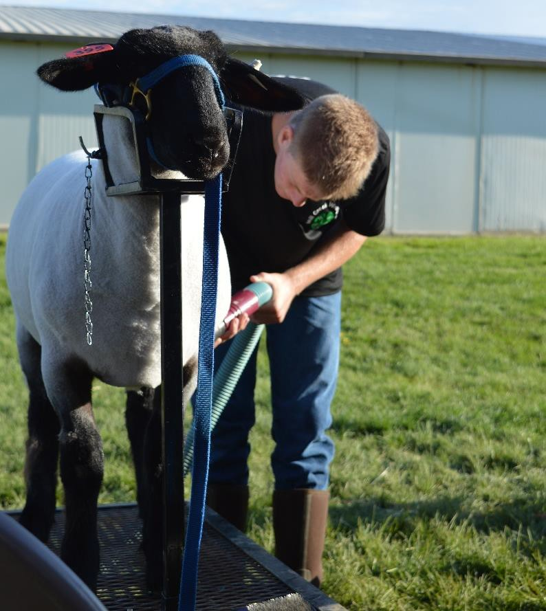
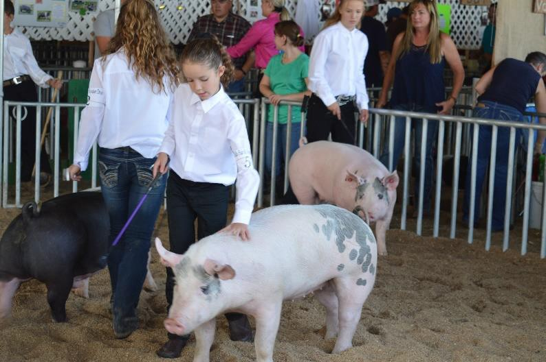
All 4-H members exhibiting market livestock projects must fit and prepare their own animal. Parents may assist younger members in getting animals to and from the fitting area for safety, but the 4-H member must do their own work preparing their animal. Older 4-H members may assist younger members outside the show ring. Preparing an animal to be exhibited at a fair or show is a learning process and it is not expected that a first- or second-year exhibitor will be as proficient fitting an animal compared to youth with more experience. During showmanship, 4-H members are evaluated on how they trained their animal prior to the event, how they fit their animal (Figure 6), and how they present their animal to the judge during the showmanship class (Figure 7). Judges may ask youth questions about their livestock project and the livestock industry as they evaluate them during the class.
Herdsmanship
4-H members need to present a positive image of their livestock projects to the public. All 4-H members exhibiting market livestock projects must properly care for, feed, water, and keep their pen clean for the duration of the fair or show. Usually, members of a 4-H club will take turns being on “herdsmanship duty” for a few hours each day. Herdsmanship duty is a great opportunity for youth to answer questions from the general public about how their animals are raised and cared for as well as the benefits of joining 4-H.
Market Livestock Sale
The market livestock sale is usually held after 4-H members have competed in both the market evaluation and showmanship classes. Prices received at the market sale are usually higher than the price that a livestock producer or rancher would receive for selling a similar animal. Livestock buyers at fairs and shows are paying a premium price to support youth and the hard work that they invested in raising their 4-H market livestock project—not because a 4-H animal is of better quality or is more desirable than an animal raised by a local livestock producer or rancher.
At most fairs and shows, 4-H exhibitors may sell only one market livestock animal per year in the livestock market sale.
Classes qualifying for the sale will come from steer, swine, goat, and lamb market classes. Some events will also sell poultry and rabbits. At some fairs and shows, 4-H market livestock animals receiving white ribbons are not eligible to sell at the market sale; parents must arrange for transportation and seek out potential buyers for the noneligible animals once they are done being exhibited at the fair or show.
There are basically two types of buyers at the market sale of fairs and shows. Buyers may purchase an animal and have it processed at a local butcher. Some fairs and shows will call individuals that purchase animals for home consumption “take out buyers.” Take out buyers pay for the entire price of the animal as well as the cost to process the animal at a local butcher.
Market sale supporters may also purchase an animal at the market sale auction and then “turn it” to another buyer known as a “turn buyer.” The market sale buyer pays anything above the floor price (turn price) at the market livestock sale. The market sale buyer that “turns” an animal does not receive any meat for home consumption. The turn buyer will purchase the animal at the current market price that a local farmer or rancher would receive for a similar type of animal.
The livestock sales committee that helps to organize the market sale works hard to encourage potential buyers to attend the sale, but the committee does not guarantee a specific price for each animal. Prices will be different for each youth that sells an animal through the market sale. As in life, there is no guarantee that a 4-H member will make money on their market livestock project. Some youth may not recoup their investment of the cost of the animal, feed, and supplies.
Responsibilities of the Livestock Sales Committee
In many counties, a committee of volunteers will organize and conduct the 4-H and FFA market livestock sale. Members of the sales committee may include members of local livestock organizations (for example, Cattlemen or Swine Producers), local business members, agricultural producers, Extension staff, FFA advisors, 4-H volunteer leaders, and other individuals that support local youth.
The sales committee’s role and IRS tax status will vary between counties. The committee will usually withhold a percentage of the money collected from the sale of each animal to cover the market sale costs and make improvements to future sales. This percentage will be different at each event, depending on costs associated with selling animals, barn rental fees, and livestock transportation costs.
Livestock sales committees may:
- Coordinate the initial and final weigh-in and tagging of animals.
- Promote the market sale and invite potential buyers to the sale.
- Arrange for “turn buyers” to purchase animals that will not be processed for consumption by the buyers.
- Arrange for an auctioneer, sale photographer, PA system, and sale supplies.
- Maintain relationships with local processing facilities and coordinate the hauling of sale animals after the event.
- Process any “add-on” or additional money given to youth above the sales price to support their market sale animal.
- Invoice sale buyers and write checks to youth after money has been collected.
- File paperwork with the IRS if they are a non-profit organization.
- Forward beef, swine, and lamb check-off fees to national beef, swine and lamb commodity groups that promote the sale of meat products and educate consumers about livestock industry.
After the Fair or Show
It is very important that the 4-H member write thank you notes to individuals and businesses that financially supported their livestock project as well as to anyone that provided special awards or made their project possible. Counties may require that youth provide proof that their thank you notes have been written before they receive their market animal sale check.
Sale checks are made available to youth as soon as possible after the fair or show, as money needs to be collected by the sales committee from buyers and supporters before checks are written. After receiving the check for the livestock project, it is very important to make sure that youth have paid all of their project expenses, including any money still owed to local feed stores, veterinarians, or other individuals. The method used to distribute sale checks to youth will vary by county.
After the fair or show, 4-H members may also receive premium. Premium money is additional money that fairs or shows provide to 4-H project exhibitors based on a points system and the color of ribbon they received for each 4-H class entered. Finally, after the fair or show is a great time to personally thank everyone who helped to make your livestock project possible. This includes 4-H leaders, livestock breeders, neighbors, and family. Good luck with your 4-H livestock project!
Market Livestock Calendar
Monthly
- Participate in 4-H Club business meetings, project or handling meetings, educational programs, fundraisers, and community service projects.
- Explore county and state 4-H events.
- Consider leadership opportunities.
- Watch 4-H enrollment and project deadline for participation in fairs and shows.
- Be aware of and follow fair and show guidelines and deadlines.
- Record 4-H Record Book project entries.
More Than Four Months before Fair or Show
- Remember October 1 marks the beginning of the 4-H year.
- Enroll or re-enroll (annually) in a 4-H Club, include all projects for the 4-H year.
- Create a calendar for 4-H club and members including all projects and events.
- Review goals and plans for the 4-H year. Set personal goals for livestock project.
- Note and adhere to any county-specific guidelines for upcoming events.
- Locate and buy market livestock.
- Research breeds and crosses that perform well at market sales at fairs and shows.
- Discuss the cost of raising a market livestock project, develop an expense budget, and explore possible loan sources if assistance is needed to purchase animals, feed, or equipment.
- Study the optimum purchase date and correct age of livestock at purchase time.
- Check that hoof care and other routine maintenance is up-to-date.
- Learn about appropriate vaccinations and worming schedules.
- Plan rations and how much feed each animal should receive.
- Determine how to check if animals are on schedule to meet final target weights.
- Begin holding practice judging activities or skill-a-thons.
- Review proper methods for safely transporting animals to fairs or shows.
- Keep animals cool in the summer to help reduce stress, maximize gain, and improve feed efficiency.
- Learn fly control practices and implement if needed.
- Assemble a barn emergency kit for animals and humans.
- Discuss the importance of exercise and why all animals need exercise.
- Research and implement a good biosecurity program for animals.
- Participate in Youth Quality Assurance training.
- Attend field days and clinics to learn more about market animal projects.
- Encourage members to prepare and give a demonstration or speech at club or county level.
- Practice low-stress animal handling techniques.
Three to Four Months before Fair or Show
- Attend weigh-in and ear tagging days according to fair and show guidelines.
- Arrange for animals’ hooves to be trimmed if needed.
- Continue recording rate-of-gain and monitor for market livestock target end weights.
- Hold a project tour to see how animals are progressing.
- Assess rations and how much feed each animal is receiving and determine if animals are on schedule to meet final target weights.
- Weigh or tape animals to monitor rate of gain.
Two to Three Months before Fair or Show
- Study the exhibitor handbook and enter classes.
- Continue training animals to lead, tie, and practice setting them up.
- Arrange for a field day with other projects to practice judging and skill-a-thons.
- Reassess rations and how much feed each animal is receiving and determine if animals are on schedule to meet final target weights.
- Discuss how to carefully adjust rations and exercise to achieve target weight of animal.
- Report on rate-of-gain.
- Plan and conduct a community service activity.
- Review signs of illness and medicine to have on hand.
- Discuss biosecurity and disease prevention.
Zero to Two Months before Fair or Show
- Double check fair and show entries before the deadline.
- Collect and organize all the items needed for the fair or show (halters, show sticks, feed, show clothes, and fitting supplies).
- Plan and create club educational displays for fairs or shows.
- Discuss project record completion and other requirements for showing or selling.
- Advise members of “due dates” on project records and any other paperwork that is required for entry at the fair or show.
- Review all relevant sections of exhibitor handbook.
Further Resources
- 4-H Showmanship Guide (pdf) (Montana State University 2017)
- Exploring Beef Health and Husbandry
- Meating the Grade: Raising Market-Ready 4-H Lamb Projects (forthcoming)
- Meating the Grade: Raising Market-Ready 4-H Beef Project FS048E (Heitstuman 2011)
- National 4-H Curriculum Units
- Beef
- Goats
- Sheep
- Swine
- Preparing Youth for the Sale of Their Market Livestock Project FS112E (Kerr 2015)
- Selecting a 4-H/FFA Meat Goat Project Animal
- Welcome to 4-H: New Member’s Information EM4487E
- WSU 4-H Project website
- WSU 4-H Youth Development Program
- WSU Extension Publications Online Store
- WSU Carcass Calculator App: A Quick and Easy Way to Calculate Carcass Merit FS317E (Smith et al. 2018)—available IOS or Android
References
- Black, L. 2017. The Danish Merit System for Judging (pdf). Oregon State University Extension Service Publication. Oregon State University.
- Heitstuman, M. 2019. Personal conversation. Recommended Age and Weight for 4-H Market Livestock Projects. Washington State University.
- Heitstuman, M. 2011. “Meating the Grade” Raising Market-Ready 4-H Beef Projects. Washington State University Extension Publication FS048E. Washington State University.
- IAFE (International Association of Fairs and Expositions). 2019. National Show Ring Code of Ethics.
- Kerr, S. 2015. Preparing Youth for the Sale of Their Market Livestock Project. Washington State University Extension Publication FS112E. Washington State University.
- Montana State University. 2017. 4-H Showmanship Guide (pdf), Large Animal.
- Smith, S.M., J.R. Busboom, and N. Moffit-Hemmer. 2018. WSU Carcass Calculator App: A Quick and Easy Way to Calculate Carcass Merit. Washington State University Extension Publication FS317E. Washington State University.
- WSU Extension. 2019a. Animal Agriculture: Youth Producers. Washington State University.
- ———. 2019b. Washington 4-H Policies and Procedures 2019-2020. Washington State University Extension Publication EM0758. Washington State University.
- WSU Veterinary Extension. 2019. 4-H & Fair.
- YQCA (Youth for the Quality Care of Animals). 2019. A New Option for Youth Livestock Education.
By
Debbie M. Williams, Youth and Family Faculty, WSU/Walla Walla County Extension, Washington State University
Mark D. Heitstuman, Community and Economic Development Faculty, WSU/Asotin and Garfield County Extension, Washington State University
Janet L. Schmidt, Youth and Family Faculty, WSU/Whitman County Extension, Washington State University
FS339E
Copyright © Washington State University
WSU Extension publications contain material written and produced for public distribution. Alternative text descriptions for select complex images were generated using ChatGPT (OpenAI), then reviewed and adapted to ensure compliance with Web Content Accessibility Guidelines (WCAG) accessibility standards.
Issued by Washington State University Extension and the US Department of Agriculture in furtherance of the Acts of May 8 and June 30, 1914. Extension programs and policies are consistent with federal and state laws and regulations on nondiscrimination regarding race, sex, religion, age, color, creed, and national or ethnic origin; physical, mental, or sensory disability; marital status or sexual orientation; and status as a Vietnam-era or disabled veteran. Evidence of noncompliance may be reported through your local WSU Extension office. Trade names have been used to simplify information; no endorsement is intended.