Cover Crops for Home Gardens West of the Cascades (Home Garden Series)
Description
This WSU fact sheet is one of a three-part series on cover crops for home gardeners. It focuses on choosing the best cover crops for gardens in Washington and Oregon, west of the Cascades.
This fact sheet is one of a three-part series on cover crops for home gardeners. It focuses on choosing the best cover crops for gardens in Washington and Oregon, west of the Cascades. A companion fact sheet, Cover Crops for Home Gardens East of the Cascades, focuses on choosing the best cover crops for gardens in Washington and Oregon, east of the Cascades. The third fact sheet in this series, Methods for Successful Cover Crop Management in Your Home Garden, covers the management of garden cover crops, including planning, planting, managing nutrients, and terminating plants.
How to Choose a Cover Crop?
You should choose cover crops based on which benefits are most important to you and which cover crops best fit into your garden plan. The following information will help you chose the right cover crops.
Cold-hardy cover crops
Gardeners usually plant these species in the fall as winter cover crops, but they can be grown in the summer as well. When choosing species, decide which crop functions are most important to you. Legumes are the clear choice if you want to add nitrogen to your soil, and grasses are a good choice if you want plants that compete with weeds, establish quickly (reducing erosion), or capture available nitrogen left over at the end of the growing season. Grasses are often used in combination with legumes to reap the benefits of both these types of cover crops.
Cereal grains and other grasses
Grasses can include perennials, but most grass cover crops are annuals, such as annual ryegrass and cereal grains like rye, wheat, barley, and oats. These cover crops grow vigorously and can provide quick groundcover, even when the weather is cool. Their extensive root systems grow deep, capturing soil nitrogen that might otherwise be lost to leaching. They also yield large amounts of aboveground plant material when planted and terminated at the proper times. It is important to note that cereals may reduce the availability of nitrogen to subsequent crops if they are planted alone, especially if they mature to the point of flowering or seed set before termination. However, they are very effective at reducing weed survival through competition because they establish themselves very quickly.
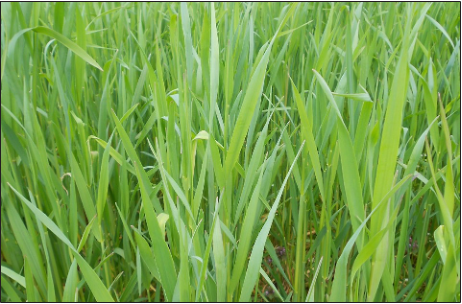
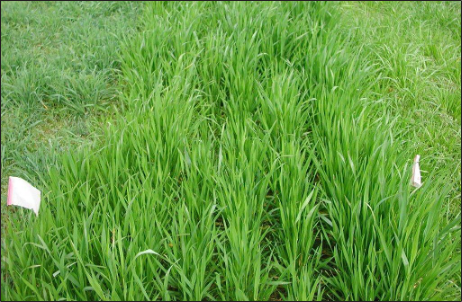
- Cereal rye (Secale cereale) is one of the most commonly grown cover crops in the Northwest (Figure 1). This crop is vigorous, very cold hardy, and can germinate and establish in cool weather. When planted by early September, rye will capture some of the available nitrogen in the soil and recycle it for the next crop. Rye grows rapidly in the spring, so it can become difficult to turn under by the time gardeners are ready to work their gardens. Thus, mowing or weed whacking may be necessary before incorporating a heavy cover crop of cereal rye.
- Winter wheat (Triticum aestivum) is most suitable for mid- to late-season planting. Planting winter wheat before late September makes it more susceptible to disease and premature death. Wheat covers the ground quickly in the fall but does not grow as vigorously as rye in the early spring, making it a good choice for late-planted gardens. Wheat is more herbaceous than rye, so it may decompose faster when it is turned back into the soil.
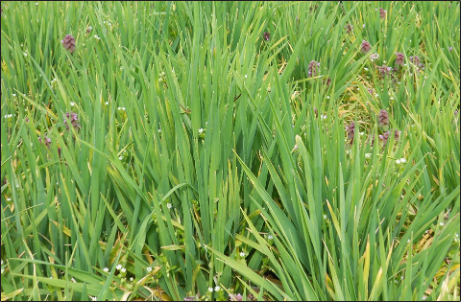
- Oats (Avena sativa) are a good choice for an early cover crop because they grow vigorously when the soil is warm (Figure 2). Oats also tolerate wet and heavy soils better than many other cover crops. Spring oats (i.e., the varieties Cayuse and Monida) should be planted by early September in the Puget Sound area to get good growth. They may experience winterkill, depending on location and weather, but with enough fall growth, killed spring oats can still provide soil-protecting mulch that is then easy to reincorporate in the spring. Winter oats (i.e., the varieties Amity and Walken) are more winter hardy than spring oats and can be planted in early spring, and they are unlikely to experience winterkill.
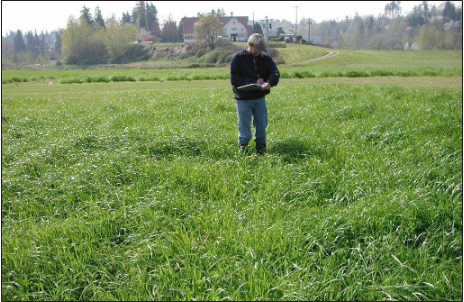
- Barley (Hordeum vulgare) (Figure 3) is similar to oats in growth characteristics. It produces a large number of leaves, but most of its growth comes late in the spring; although, spring varieties are susceptible to occasional winterkill. Barley uses less water in later growth stages compared to other cereals, which reduces the need for irrigation if it is grown as a summer cover crop.
- Annual ryegrass (Lolium multiflorum) is a turfgrass rather than a cereal grass (Figure 4). It has a vigorous root system that is effective at reducing soil erosion, and it is reasonably tolerant of short-term flooding. However, once it is established, annual ryegrass can be harder to till under compared to cereals. Annual ryegrass regrows readily after mowing, but it can also persist like a perennial, making it a potential weed when used as a winter cover crop.
Legumes
The most important benefit of legumes is their ability to fix nitrogen from the atmosphere. This is different from grasses, which can only take up nitrogen already available in the soil. Legumes fix nitrogen in association with bacteria called Rhizobia. These bacteria form nodules on legume roots, which when active are pink inside. When legumes are turned under and decompose, some of the fixed nitrogen is released for use by future crops.
Rhizobia are present in the soil and are ready to inoculate legume plants and begin fixing nitrogen immediately. Occasionally, the proper Rhizobium is not present, and nitrogen fixation will not occur. In these cases, the inside of the root nodules will be white or green rather than pink. If you have not grown a particular legume in your garden before, you should buy the Rhizobium species that is compatible with your legume, and mix it with seed before planting. Buying Rhizobia is not always necessary, but it is an inexpensive way to ensure the formation of active nodules. Additionally, many seed companies offer pre-inoculated or coated cover crop seed that comes with the correct Rhizobia.
Legumes generally grow more slowly than cereal grains in cool weather, but they grow rapidly when the weather is warm. Because they establish slowly in cool weather, they may not provide good winter cover when grown alone, unless they are established early enough in the fall. Most legumes are not well suited to wet soils and perform poorly in soils deficient in phosphorus and potassium, as well as soils with low pH.
- Hairy vetch (Vicia villosa) is one of the more aggressive legumes. When the weather warms in the spring, hairy vetch will grow quickly. Its tendrils help the plant climb up the stems of other plants, making it a particularly good companion crop for cereals. However, the tendrils can also wrap around tiller tines, making it more difficult to turn the crop under with a rototiller. Hairy vetch should be terminated before it sets seed to prevent it from becoming a weed.
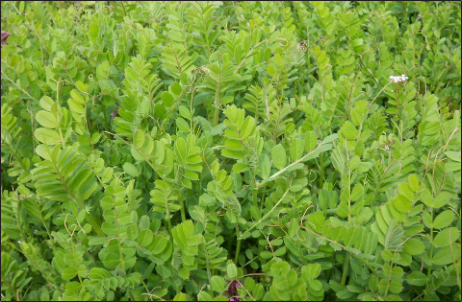
- Common vetch (Vicia sativa) (Figure 5) is similar to hairy vetch but is less winter hardy, although it generally overwinters well west of the Cascades. It also has fewer tendrils than hairy vetch, which makes it easier to till back into the soil.
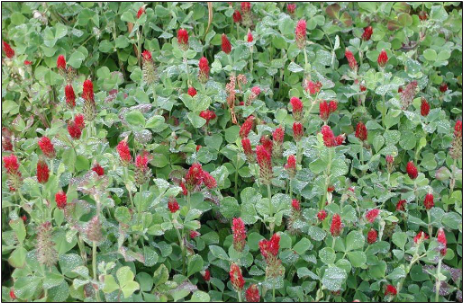
- Crimson clover (Trifolium incarnatum) (Figure 6) is easier to turn under, and it is less likely to become a weed compared to vetches. It is a good option for areas where early crops will be planted the following year, but it does not compete well with weeds. It also does not compete as well with cereals and is often grown alone or with annual ryegrass. It grows best when planted in the first half of September.
- Austrian winter pea (Pisum sativum) is a cover crop that can be grown alone or mixed with cereal rye. It competes poorly with winter weeds, which can choke it out during mild winters. Gardeners who raise animals can graze them on the Austrian winter pea before turning the crop back into the soil. Some winter pea varieties have the added benefit of producing delicious pea shoots early in the spring.
- Fava or bell bean (Vicia faba) is a good legume for October plantings because it grows faster during cool weather compared to other legumes. It is not as winter hardy as many other legumes, but planting later decreases the risk of winterkill. Fava beans can be grown alone or mixed with rye or wheat. When grown as a summer cover crop, fava beans compete well with weeds. Small-seeded fava beans (also called bell beans) are most commonly used for cover crops, rather than the large-seeded varieties grown primarily as a food crop.
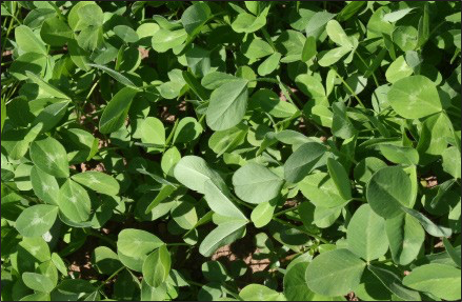
- Red clover (Trifolium pretense) (Figure 7) is a short-lived perennial cover crop, but it is sometimes used in annual crop rotations when there is a longer window for cover cropping. For example, red clover is a good crop to plant in July or August for termination the following spring. Red clover also tolerates some shade and foot traffic, so it can do well when relay-seeded into a late-season vegetable crop, such as late sweet corn, peppers, or tomatoes. Red clover consistently overwinters well west of the Cascades, but it establishes more slowly than many annual legumes.
Other Broadleaf Crops
- Phacelia (P. tanacetifolia) is a winter annual native to the southwestern United States and Mexico. It is a non-legume broadleaf plant in the Boraginaceae family. Phacelia can survive most winters south of Salem, Oregon, but can be killed by hard freezes when planted further north, especially if the plant is more than 3 or 4 inches tall during a cold snap. Their stems are hollow, and the plant is easily killed if the stem is broken, making it fairly easy to incorporate back into the soil in the spring. Phacelia produces beautiful blue flowers, which are not only attractive in a garden but can provide an important spring source of pollen and nectar for honeybees, native pollinators, predators, and other beneficial insects. Phacelia grows well with other cover crops and is often grown in combination with legumes.
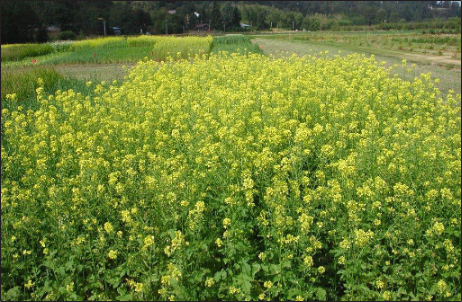
- Brassica family cover crops are crops that include mustards (Figure 8), oilseed radish, and canola. These crops have variable winter tolerance and are more often grown as short-season summer cover crops, similar to buckwheat. They are very effective at smothering weeds, and their residues can inhibit weed seed germination and some diseases, but they can become troublesome weeds themselves if allowed to go to seed. They can also harbor club root, an important soilborne disease in brassica vegetables. Growing these cover crops is restricted in areas where commercial brassica seed (such as cabbage seed) is grown. Restricted areas include parts of northwest Washington, Oregon’s Willamette Valley, parts of central Washington, and central and eastern Oregon, thus limiting their use in the Northwest.
Cold-sensitive cover crops
The following cold-sensitive cover crop species can only be grown during the summer. However, they can provide cover for a garden space that is not planted in the current year, or they can be part of a planned garden rotation. These crops can break up soil compaction, help suppress weeds, and improve the tilth of a new garden. The use of both summer and winter cover crops further reduces weed problems in a new garden space by interfering with weed lifecycles.
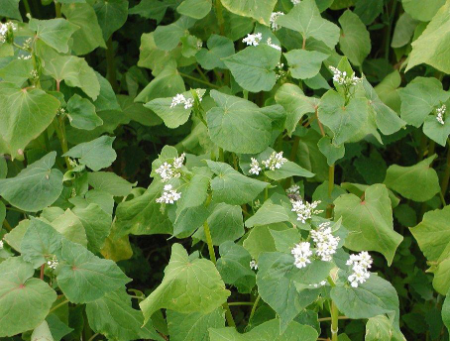
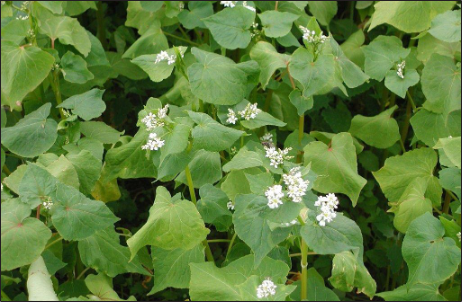
- Buckwheat (Fagopyrum esculentum) is a very popular summer cover crop and is well suited to the Northwest (Figure 9). It grows quickly in warm weather and in a wide range of soils. Buckwheat begins flowering in 4 to 6 weeks and is usually ready to turn under in 30–50 days. It is possible to grow several crops of buckwheat in a single summer. Buckwheat can go to flower within 20–30 days of seeding and can set mature seeds within 40 days. However, if crops are drought stressed, growth may be restricted. Termination must occur before seed is set to avoid reseeding. Although buckwheat is a broadleaf cover crop, it does not fix nitrogen. Its prolific growth will smother weeds, and it has been shown to suppress weed emergence for short periods after being turned back into the soil. But if allowed to grow too large, it becomes difficult to turn under and may begin to produce seed. If planted after days begin to shorten in July, it flowers before producing much plant material. Buckwheat is sensitive to frost, so it should not be planted in the spring until the danger of frost has passed. The white flowers attract pollinators, predators, parasitoids, and other beneficial insects.
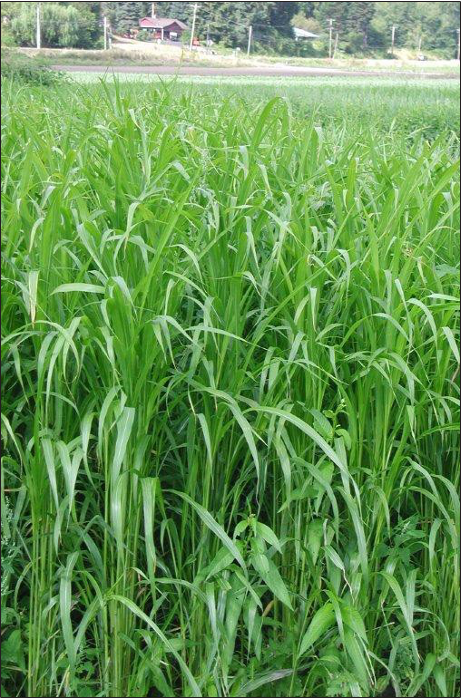
- Sorghum-Sudangrass (Sorghum bicolor) hybrids (Figure 10) are hot weather, drought-tolerant relatives of corn that can provide good mid-summer cover and weed suppression. These hybrids need soil temperatures in the 60s or higher to establish good germination, and they do best when planted in June or early July. They have vigorous root growth and will produce large quantities of plant material if they have adequate heat, nutrients, and water. Although summers west of the Cascades are cooler than is ideal for sorghum-sudan hybrids, these hybrids have been reliable in the Puget Sound region of Washington. Sorghum-sudan hybrids do not grow as quickly in and around the Puget Sound as they do in warmer regions, but they still produce enough plant material to make them difficult to incorporate back into the soil. Because they are sensitive to frost, they are sometimes left to freeze. The killed plants provide a weed-suppressing mulch over the winter, and in the following spring, they are easier to incorporate back into the soil.
Cover crop mixtures
Cover crops are commonly grown as mixtures, which can provide a wider range of benefits. Many seed companies sell mixtures, but the content of these mixtures and the ratios of their constituents should be reviewed carefully.
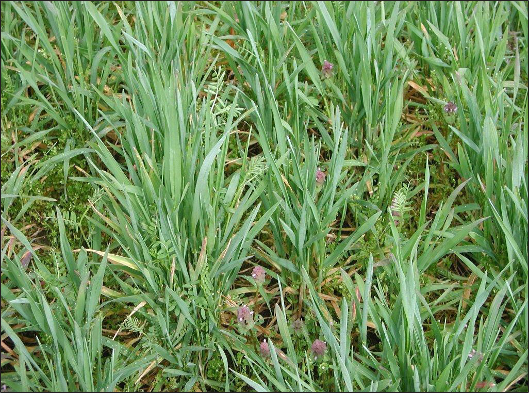
One commonly grown mixture contains a cereal grain and a legume. Cereals, such as rye and oats, typically germinate and grow readily through the fall and into the winter. They can be planted with legumes, such as vetch, which establish more slowly but can fix atmospheric nitrogen. By planting a mixture of a cereal and legume, the cereal’s soil-covering and nitrogen-scavenging abilities are combined with the legume’s nitrogen-fixing ability. A summer mixture of sorghum-sudangrass and vetch provides similar benefits.
Another commonly grown mixture is cereal rye and hairy vetch (Figure 11), typically planted in the garden at a seeding rate of 1/4 cup rye and 3/4 cup vetch per 100 sq ft. The vetch will germinate in the fall, but it grows slowly until spring. In spring, it will use the upright rye as a structure on which to grow. See Tables 1 for a list of planting rates for various cover crop mixtures.
How to Plan for Cover Crops?
Cover crops are more likely to perform well if you include them in your garden plan, rather than planting them as an afterthought. It is important to have seed available before you are ready to sow cover crops, or you are unlikely to get them established at the right time. By planning ahead, you will be ready to plant and turn under cover crops at the appropriate times.
Tables 2 and 3 show a range of planting dates for different cover crops. Crops that are planted earlier recover more nutrients, cover the soil more quickly, and produce more organic matter. By capturing more nutrients and covering the soil, these crops also protect water quality by reducing nutrient leaching, soil erosion, and water runoff. Cover crops planted later in the season are much less effective and must be planted within the recommended timeframe if they are to be useful at all. If you plant beyond the recommended time, the cover crop may not establish itself. Even if it does get established, it will not provide much soil protection over the winter, although it may develop some biomass if allowed to grow in April and May.
Table 1. Examples of planting rates for cover crop mixtures west of the Cascades in Washington and Oregon.
| Mixture | Rate (Cups/100ft2) |
|---|---|
| Cereal rye + hairy vetch | 1/4 + 3/4 |
| Winter oats + common vetch | 1/2 + 3/4 |
| Annual ryegrass + crimson clover | 1/4 + 3/8 |
| Cereal rye + winter pea | 1/4 + 3/4 |
Table 2. Recommended planting rates and dates for winter cover crops.
| Crops | Class | Benefits | Planting Rate Cups/100 ft2 | Comments | Planting Dates |
|---|---|---|---|---|---|
| Cereal Rye | Grass | Nitrogen scavenger, quick cover, rapid spring growth, and competes with weeds | 1 | Hardy and reliable |
|
| Winter Wheat | Grass | Nitrogen scavenger, soil builder, quick cover, rapid spring growth | 1 | - |
|
| Winter Oats | Grass | Nitrogen scavenger, quick cover, rapid spring growth, competes with weeds | 1.5 | - |
|
| Annual Ryegrass | Grass | Nitrogen scavenger, soil builder, quick cover, rapid spring growth | 1/2 | Tolerates wet soils |
|
| Spring Barley | Grass | Nitrogen scavenger, quick cover, rapid spring growth, erosion fighter, competes with weeds | 1 | May winterkill |
|
| Spring Oats | Grass | Nitrogen scavenger, quick cover, rapid spring growth, competes with weeds | 1.5 | Winterkill likely |
|
| Hairy Vetch | Broadleaf | Legume nitrogen source, soil builder | 1/2 | Reliable legume |
|
| Common Vetch | Broadleaf | Legume nitrogen source, soil builder | 1/2 | - |
|
| Lana/Woolypod Vetch | Broadleaf | Legume nitrogen source, soil builder | 1/2 | - |
|
| Crimson Clover | Broadleaf | Legume nitrogen source, soil builder, erosion fighter | 1/4 | Easy to incorporate |
|
| Red Clover | Broadleaf | Legume nitrogen source, soil builder, competes with weeds | 1/8 | Good for poor soils |
|
| Austrian Winter Pea | Broadleaf | Legume nitrogen source, erosion fighter, quick growth | 1 | Not for wet soils |
|
| Fava Bean | Broadleaf | Legume nitrogen source, soil builder | 1 | - |
|
| Phacelia | Broadleaf | Attracts pollinators | 1/8 | Beneficial insects |
|
Table 3. Recommended planting rates and dates for summer cover crops.
| Crops | Class | Benefits | Planting Rate Cups/100 ft2 | Comments | Planting Dates |
|---|---|---|---|---|---|
| Buckwheat | Broadleaf | Competes with weeds, quick growth | 1 | Short-season cover |
|
| Brassicas | Broadleaf | Soil builder, erosion fighter, competes with weeds | 1/8 | Short-season cover |
|
| Crimson Clover | Broadleaf | Legume nitrogen source, soil builder, erosion fighter | 1/4 | Prefers cooler weather |
|
| Fava Bean | Broadleaf | Legume nitrogen source, soil builder | 1 | Prefers cooler weather |
|
| Sorghum-Sundangrass | Grass | Nitrogen scavenger, soil builder, erosion fighter, competes with weeds | 1/8 | Prefers hot weather |
|
You can plant cover crops in your garden by section, planting the earliest cover crops (as soon as harvest is complete) in the earliest parts of your garden. Many gardeners are still harvesting some parts of their garden into October or November. Since this is too late for planting cover crops, these sections of the garden are better mulched with straw or compost. If enough space is available, gardeners can plant cover crops between rows of late crops.
Gardeners terminate winter cover crops before planting in the spring, either by turning them under with a shovel or tiller, or mowing them and leaving the surface residue for mulch. Earlier termination means less plant material and more succulent tissue which will decompose more quickly thus avoiding nitrogen immobilization. Later termination increases plant material but delays garden planting until later in the spring. It is important to terminate winter or summer cover crops before they go to seed.
The following guidelines will help gardeners use cover crops successfully in their gardens:
- Purchase seed early. Some cover crop seeds are harder to find and may need to be ordered. Excess seed can be stored for a year in a cool, dry area, free of pests.
- Develop a plan well before you plant cover crops. This plan should include decisions on how to terminate the cover crops and what crops will follow.
- Start with a cover crop that is easy to grow and manage. For example, crimson clover does not produce excessive plant material and is easy to incorporate back into the soil. A rye-vetch mixture is quite reliable, but be prepared to terminate it in the spring before it gets too mature.
- Plant your cover crop in a smaller area of your garden, so the results can be compared to the rest of the garden.
- Try another cover crop that fits in a different niche of your garden plan after you have successfully used one cover crop. Then, when you gain experience, you can experiment with other cover crops, both those listed here and others that might work well in your garden.
For more information on planting, managing, and terminating cover crops (e.g., organic matter, nitrogen, runoff protection, weed suppression, etc.) refer to the third fact sheet in this series, WSU Extension publication FS119E Methods for Successful Cover Crop Management in Your Home Garden.
References
- Cogger, C., C. Benedict, N. Andrews, S. Fransen, and A. McGuire. 2014. Cover Crops for Home Gardens East of the Cascades. Washington State University Extension Publication FS117E.
- Cogger, C., C. Benedict, and N. Andrews. 2014. Methods for Successful Cover Crop Management in Your Home Garden. Washington State University Extension Publication FS119E.
- USDA-NIFA Sustainable Agriculture Research and Education Program. Managing Cover Crops Properly, 3rd ed. 2007. College Park: University of Maryland.
By,
Craig Cogger, Extension Soil Specialist, WSU Puyallup Research and Extension Center; Chris Benedict, Regional Extension Specialist, WSU Whatcom County Extension; Nick Andrews, Metro-Area Small Farms Extension Agent, OSU North Willamette Research and Extension Center; and Andy McGuire, Regional Extension Specialist, WSU Grant County Extension.

FS111E
Use pesticides with care. Apply them only to plants, animals, or sites as listed on the label. When mixing and applying pesticides, follow all label precautions to protect yourself and others around you. It is a violation of the law to disregard label directions. If pesticides are spilled on skin or clothing, remove clothing and wash skin thoroughly. Store pesticides in their original containers and keep them out of the reach of children, pets, and livestock.
Copyright 2014 Washington State University
WSU Extension bulletins contain material written and produced for public distribution. Alternate formats of our educational materials are available upon request for persons with disabilities. Please contact Washington State University Extension for more information.
You may download copies of this and other publications from WSU Extension.
Issued by Washington State University Extension and the U.S. Department of Agriculture in furtherance of the Acts of May 8 and June 30, 1914. Extension programs and policies are consistent with federal and state laws and regulations on nondiscrimination regarding race, sex, religion, age, color, creed, and national or ethnic origin; physical, mental, or sensory disability; marital status or sexual orientation; and status as a Vietnam-era or disabled veteran. Evidence of noncompliance may be reported through your local WSU Extension office. Trade names have been used to simplify information; no endorsement is intended. Published February 2014. This publication replaces EB1842.