Drip Irrigation for the Yard and Garden
Description
This publication discusses how to set up a drip irrigation system for a small yard or garden space. ...
Table of Contents
This publication provides an overview of drip irrigation systems, including the benefits and costs, the various components, and the basics of design and operation of such systems.
Drip irrigation has many advantages over sprinklers. The application efficiency of sprinklers varies widely, but is typically about 70%. This means that while 70% of the water that leaves the sprinkler nozzle ends up in the soil for potential use by plants, 30% is lost to wind drift and evaporation. Drip irrigation is 90–95% efficient. The 5–10% water loss comes from water evaporation from the small soil surface area that gets wet.
Another benefit is that because only a small surface area gets wet, fewer weed seeds germinate. Drip irrigation also allows a plant’s leaves to stay dry, reducing the risk of plant diseases that thrive in wet conditions. Drip irrigation typically allows a much higher degree of control over the soil water content. And, unlike flood irrigation or sprinkler irrigation, drip systems are suitable to any soil type or slope. A drip system can also simplify irrigation management since once it is set up, irrigating via drip is simply a matter of opening a valve.
Drip irrigation does have drawbacks. It costs more per unit of irrigated area to set up than any of the other irrigation system alternatives, and the potential for plugging of drip emitters can be a major concern. To achieve slow application rates, the water must travel through a very small orifice (opening). Consequently, tiny bits of dirt or organic material in the water will plug the drip emitters. When that happens, the plants around that particular emitter may get no water at all.
Drip Irrigation System Components
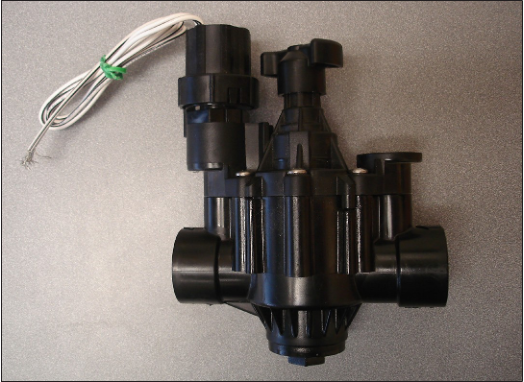
The following are components of typical drip irrigation systems. Starting at the water source (typically a spigot), a drip system (Figure 1) consists of (1) a control valve to turn the water on and off; (2) a backflow prevention/ anti-siphon device; (3) a pressure regulator; (4) a filter or filtration system; (5) air- and vacuum-release valves; (6) a main line, submains, and laterals; (7) drip emitters; and (8) a flush mechanism. Not all components are required in every landscape or garden situation and the functions of some components may be combined into a single device. All of these components can be found at an irrigation supply store or many hardware stores.

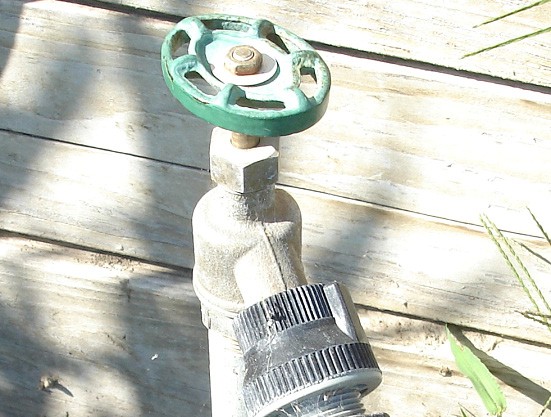
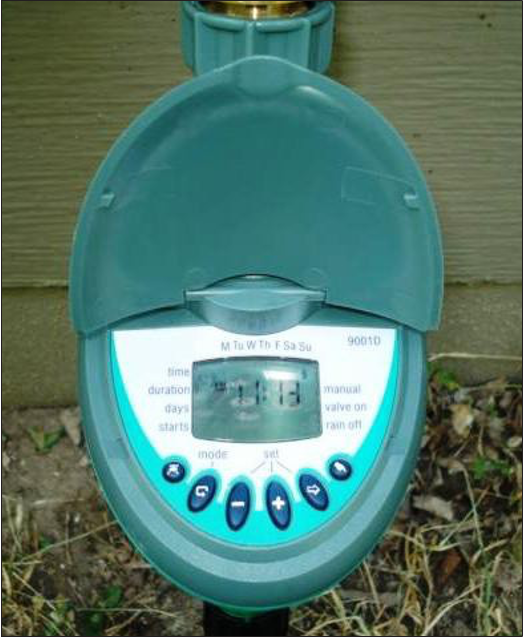
- Control valves. (See Figure 2.) Valves are often set up to be opened and closed automatically by a timer or other irrigation control device. Hose-end timers (Figure 3) combine a timer and a battery-operated automatic valve in one device. They are manufactured by many different companies and offer a practical alternative for simple irrigation systems that are typical of smaller yards and gardens.
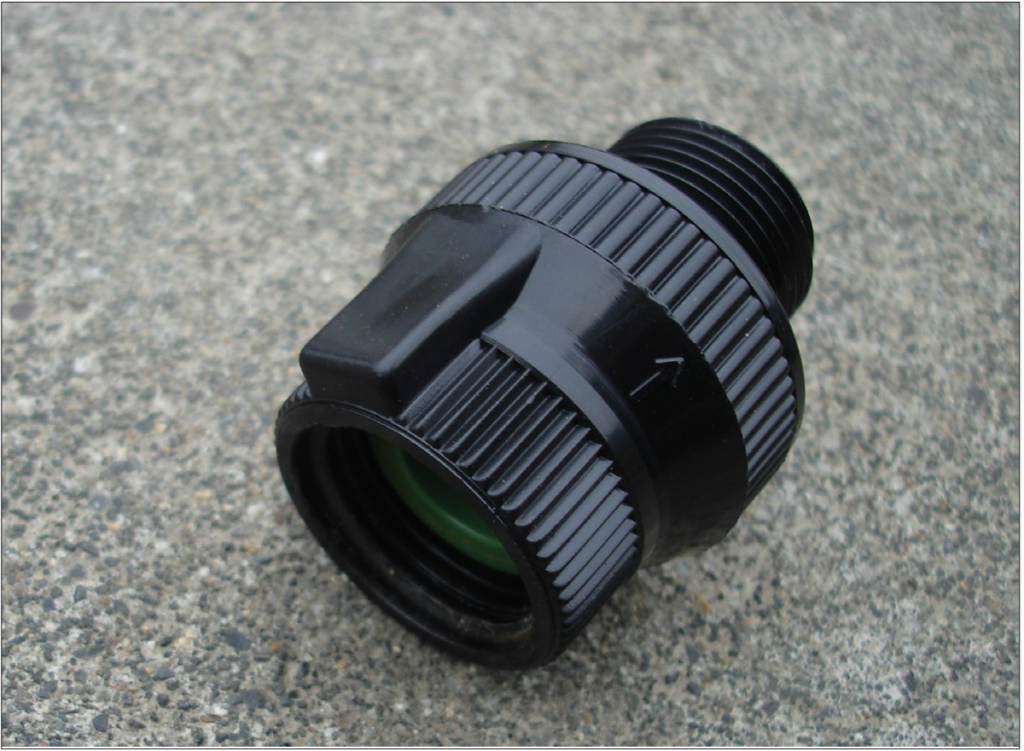
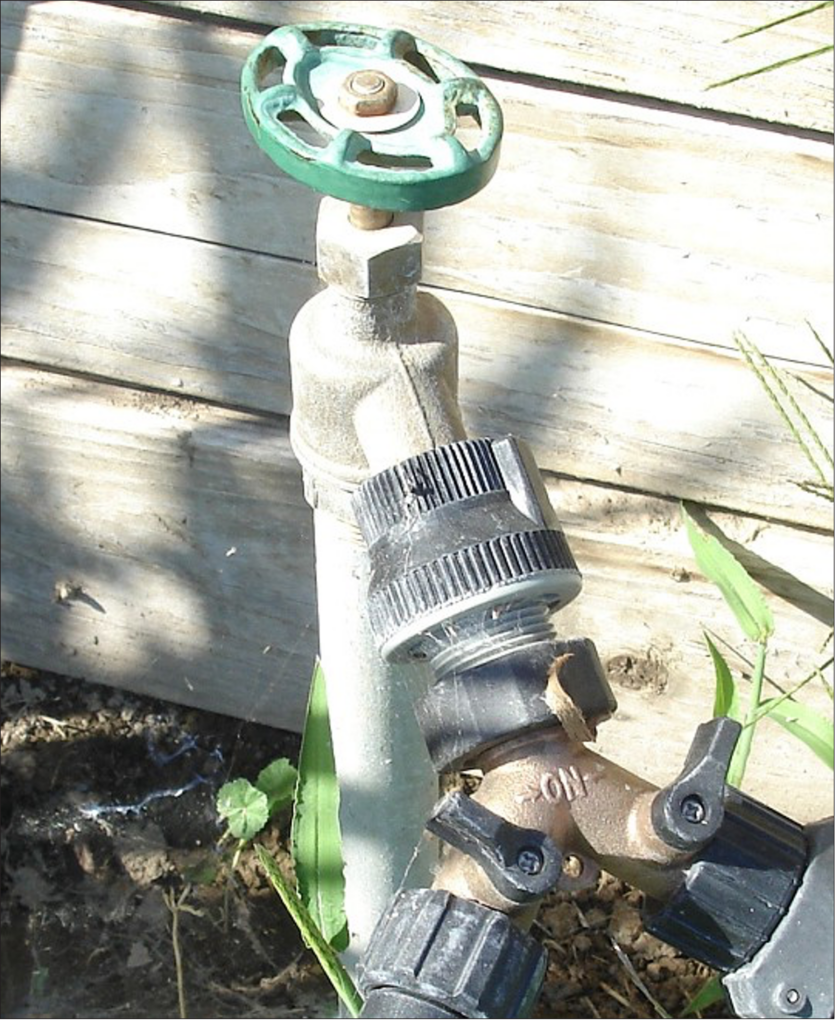
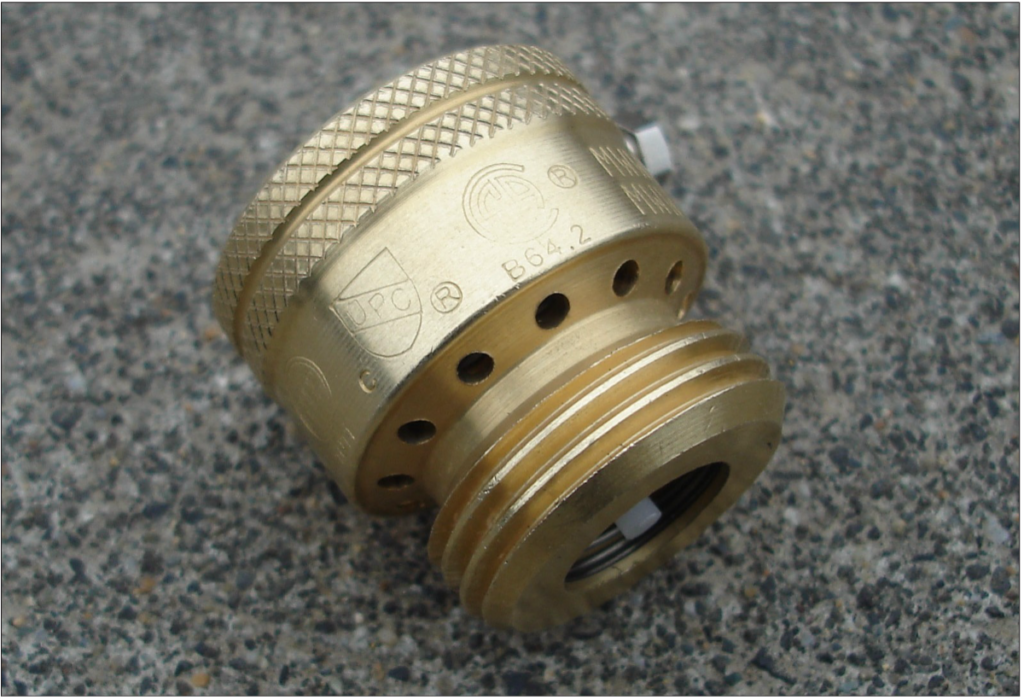
- Backflow preventer or anti-siphon device. (See Figure 4.) This device is required to protect the integrity of the water supply. They are required by law in many municipalities and are always a good idea to prevent contaminated water from reentering the domestic water system after the water has been shut off. They can be simply mounted at the spigot (Figure 5).
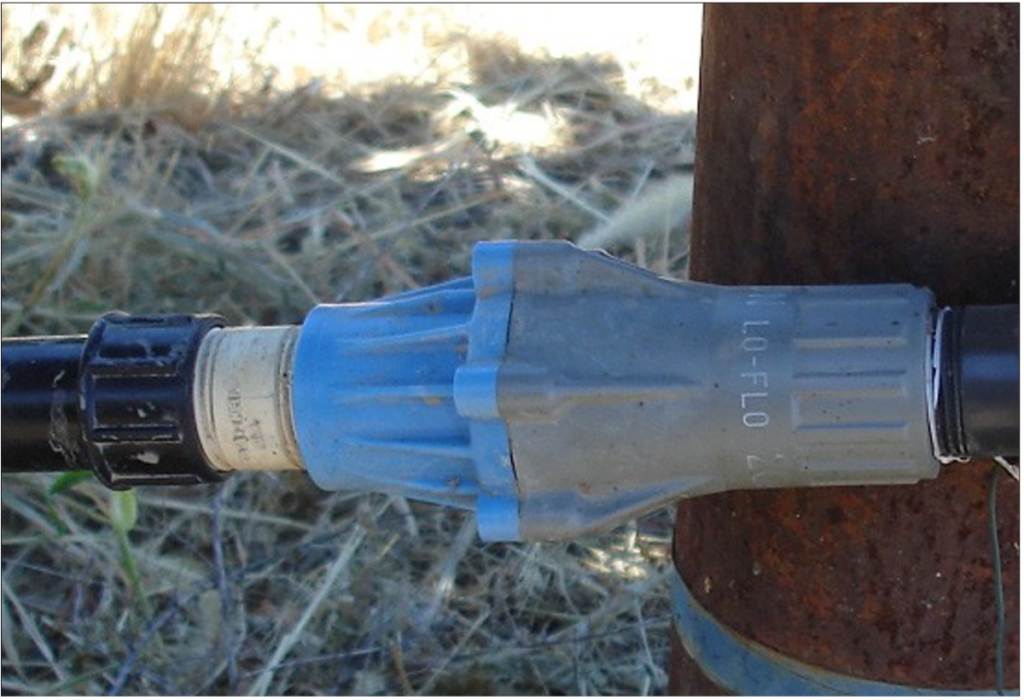
- Pressure regulators. (See Figure 6.) These are required if your water source produces pressures that are higher than what the drip system components are rated for. Excessive pressure may cause components to come apart, leak, or not function correctly. Pressure regulators will reduce the pressure to what is specified by the regulator.
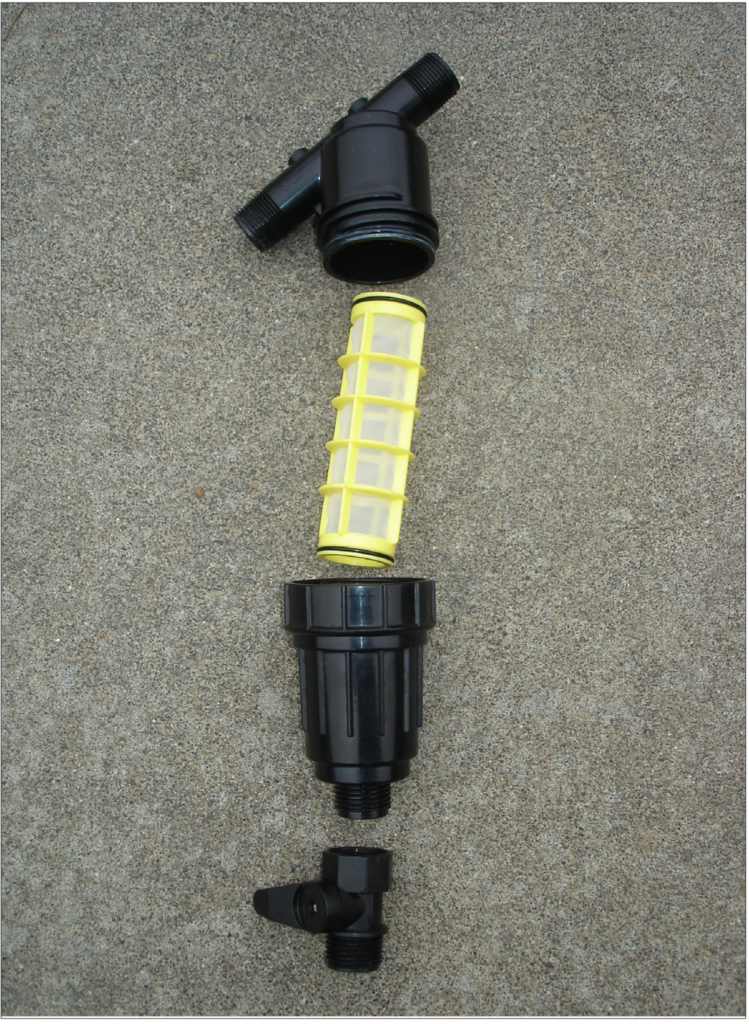
- Filter system. Plugging is the biggest problem of drip irrigation. To combat this, good filtration is an absolute necessity. In fact, the filtration system should be considered the most important part of the whole system. Most home drip systems use a simple screen filter (Figure 7) to remove small particles of debris from the water. The maximum opening size of the screen should be smaller than the size of the drip emitter’s orifice. These screen filters need to be cleaned out periodically, either manually or through some sort of back-flush system. Greater volume water users will want to consider sand-media filters, disk filters, separators, or a combination of these.
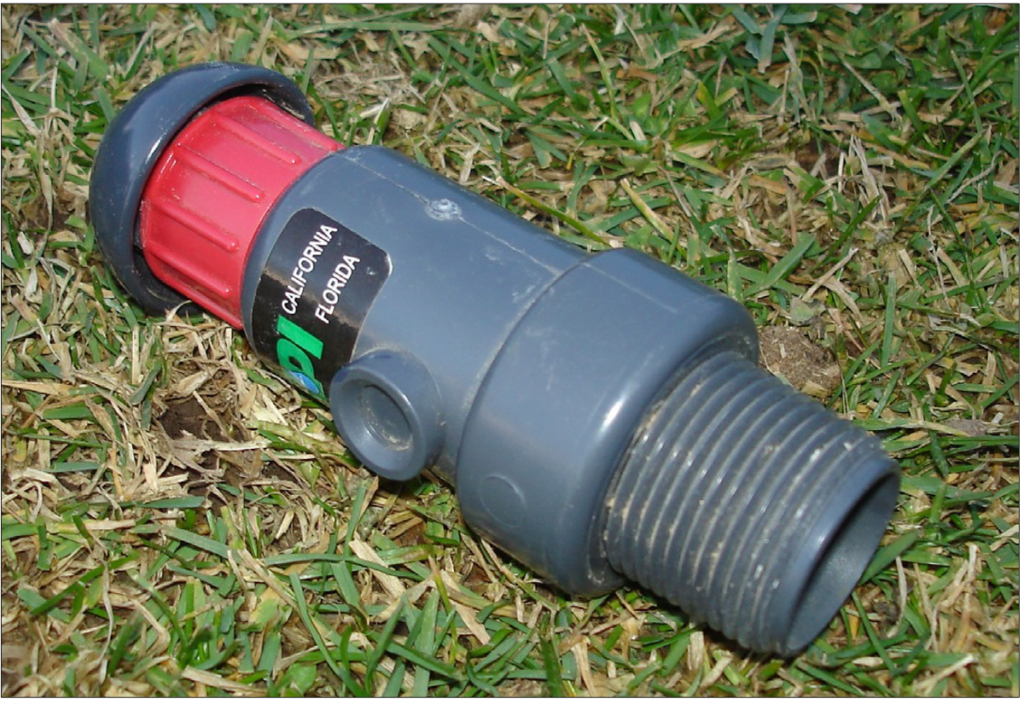
- Air- and vacuum-release valves. (See Figures 8 and 9.) These allow air to escape the system as it fills with water, and allow air back into the system after the water is turned off. These should be placed at the highest elevation points and/or at the end of long runs in the system (places where air would accumulate as the system fills with water).
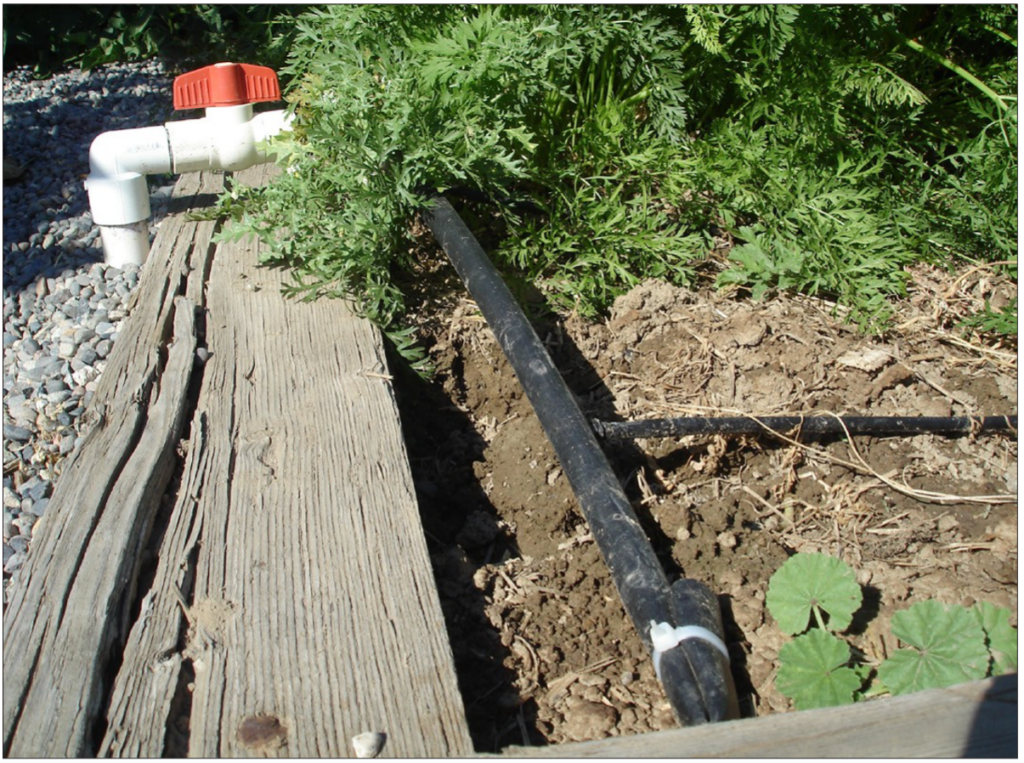
- Mainline, submains, and lateral lines. Depending on the complexity of the drip system, there may be a mainline and sub-mains (Figure 10) that distribute water to the heads of the laterals. Laterals carry the water to the individual emitters where the water is applied to plant root zones. Most mainlines are made of PVC, while submains and the laterals are most often made from polyethylene. Drip laterals can be buried in the soil or covered by mulch. This will help to protect the laterals from sun, insect, and traffic damage. The only draw-back in covering the laterals is that it then may be difficult to find and fix problems such as plugged emitters.
- Emitters. There are many different types of emitters that operate on different principles and are made by a wide number of manufacturers. The two most common types are orifice emitters and turbulent flow emitters.
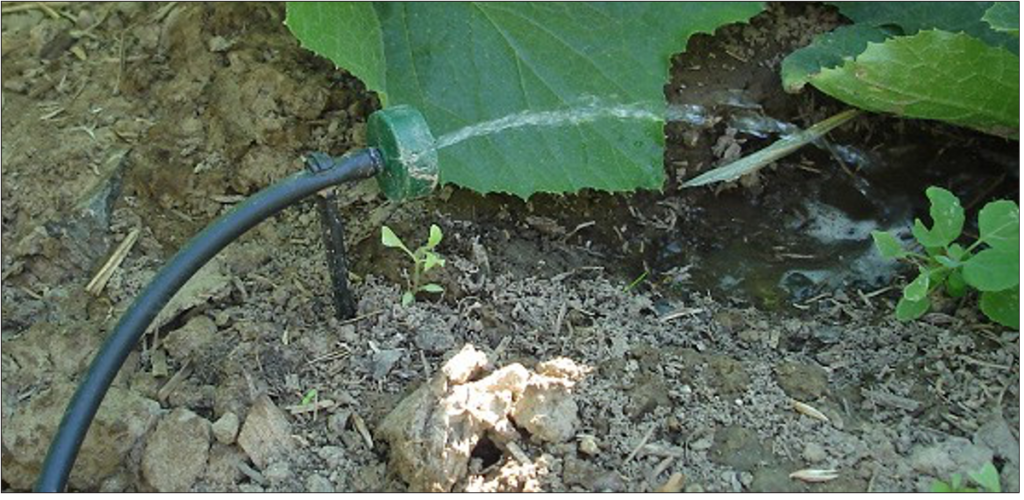
Orifice emitters (Figure 11) are simply a small hole that the water flows through. Although these are the least expensive, they are the most prone to plugging since the flow rate is determined by the size of the orifice, and this must be small to create the slow dripping action required.
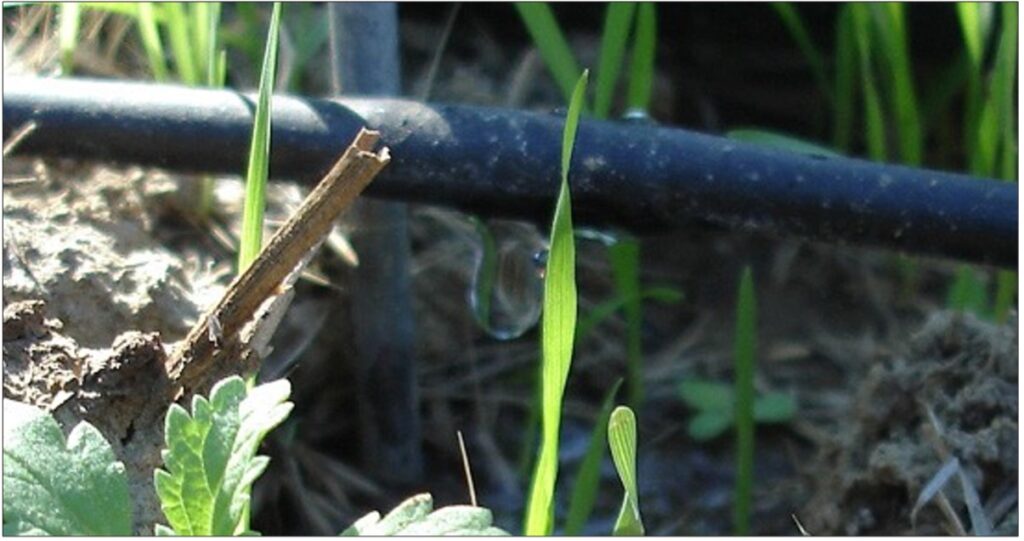
Turbulent-flow emitters (Figure 12) force the water through a tortuous path before it is released out to atmospheric pressure. Because all of the pressure is dissipated through friction as it travels through the labyrinth inside the emitter, larger diameter passageways can be used and they are less prone to plugging.
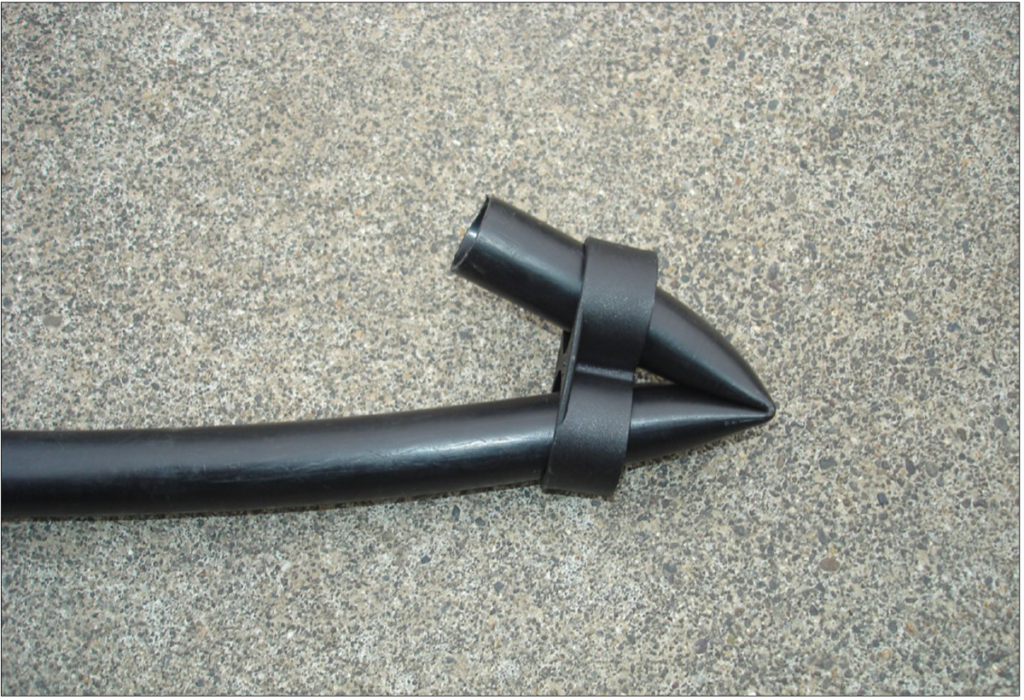
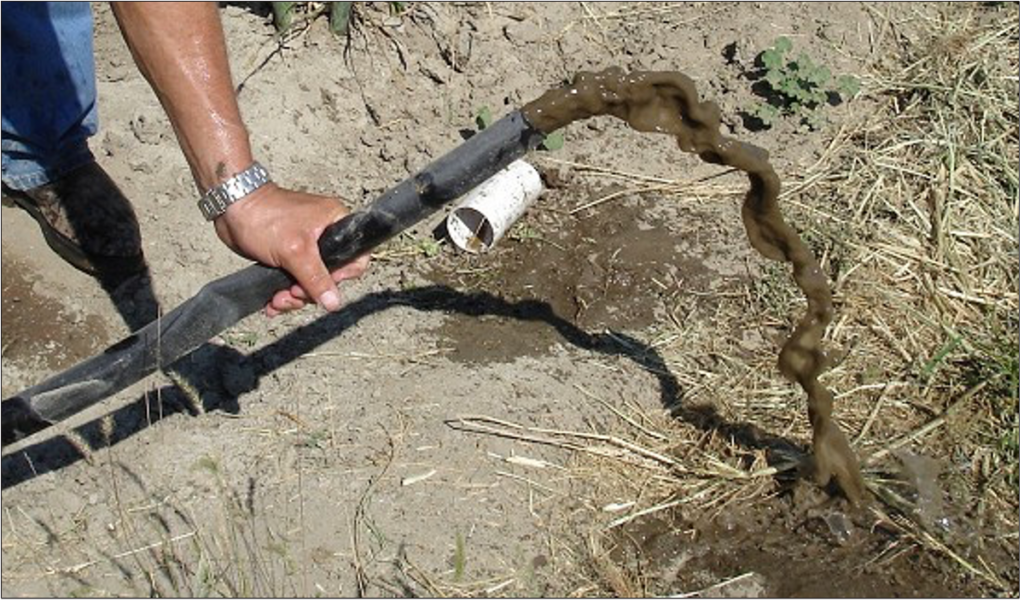
Emitters are typically rated in units of gallons per hour (gph) with 0.2 to 4 gph being typical. If there are large pressure differences along the drip line due to very long laterals, or if the drip lines go up and down steep slopes, then pressure-compensating emitters are available that help ensure the same amount of water comes out of each emitter regardless of the pressure at that point in the line. - Flush mechanism or port. To help combat plugging, it is a good idea to have a way to open up the end of each drip lateral to periodically flush out any particles in the system (Figures 13 and 14). This should be done before use in the spring and then periodically throughout the season as required.
Drip System Design
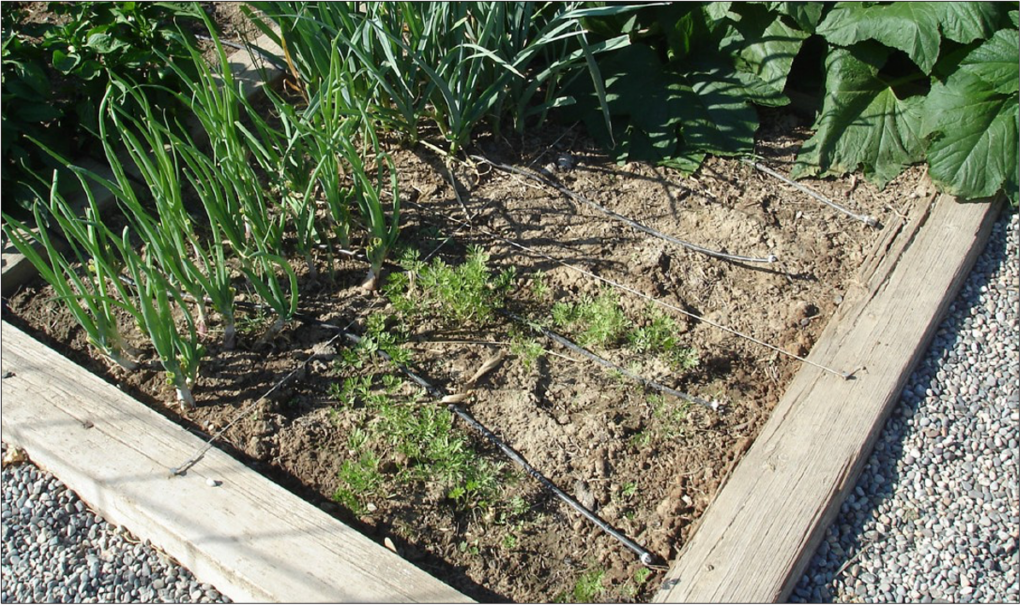
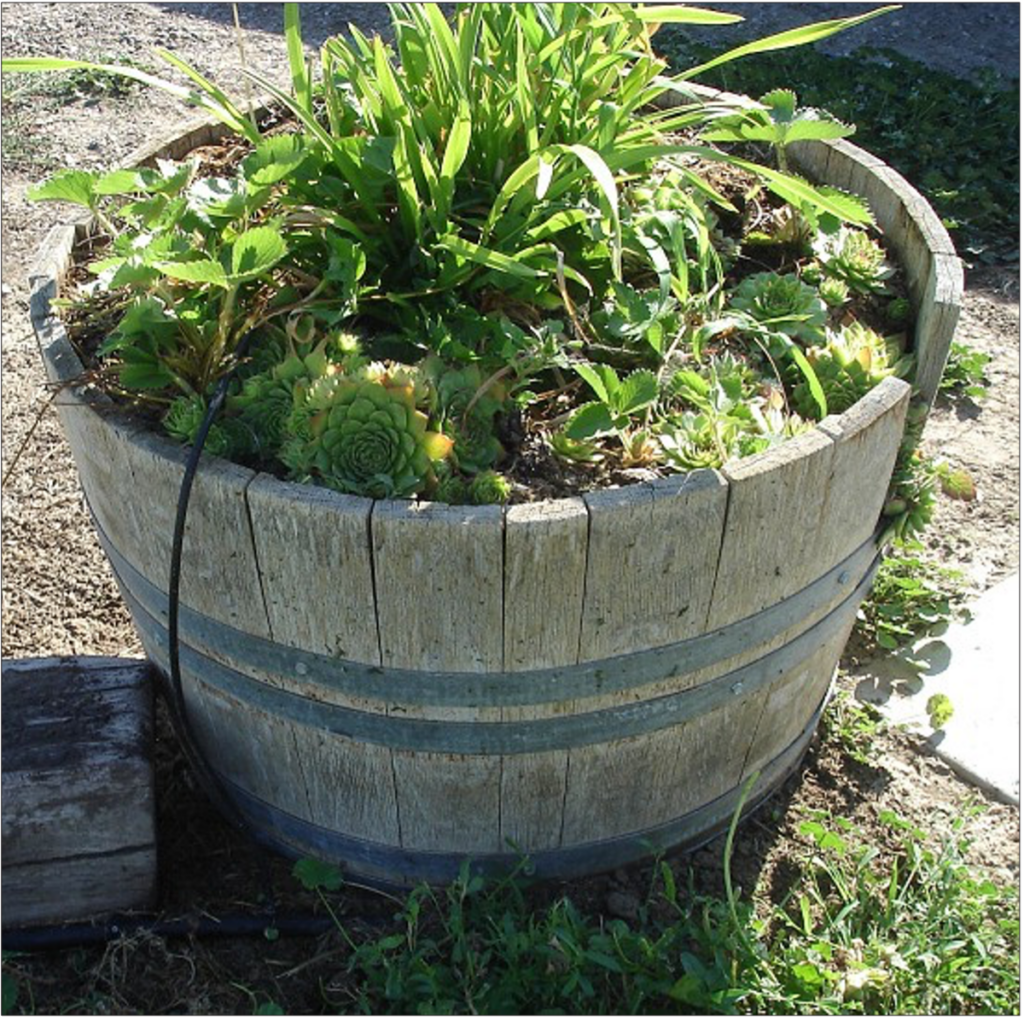
Drip systems can essentially be grouped into two categories: line-source and point-source systems. A line-source system has drip emitters spaced at regular intervals along the line (Figure 15). Water can be considered to be coming from the line as if it were one continuous source instead of a series of drippers. Drip tubing with pre-installed emitters, drip tape, and soaker hoses can all be considered line-source. Point-source systems consist of individual emitters that are placed so that water is emitted precisely in discrete locations such as right at the base of a plant (Figure 11), or into a single pot (Figure 16).
Line-source systems are a good option for lawns and gardens while point-source systems fit better with irregularly shaped flower beds, potted plants, and individual, isolated plants.
The limited movement of water from a dripper can be both a negative and a positive thing. It is negative in that not a very large area is irrigated, but can be positive in that water can be closely controlled to leave certain areas in a garden dry. This means that fewer weeds will germinate and grow in areas that are not meant to grow plants, such as garden pathways or areas between plants.
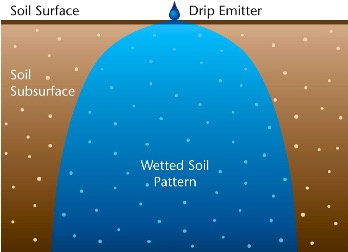
As water drips onto the soil surface, it moves into the soil in an inverted dome-shaped pattern (Figure 17). The soil pulls on this water moving it both vertically (as gravity and the soil draw it down) and horizontally (as it is drawn to the sides by the soil). Often the water’s sideways movement in the soil is not visible to the eye because it happens below a dry soil surface. This means that each drip emitter may irrigate a much larger area than it appears to. How far water moves horizontally in a soil depends mostly on the soil’s texture and the drip flow rate. Clay soils will move water 2½–4 feet away from the emitter. This would create a circular wetted diameter of 5 to 8 feet, although maybe not on the soil surface where it is visible. Loams and silt loams will move the water 1½–3 feet horizontally, and sandy soils can only move water 1–2 feet horizontally through the soil. To see how far the water has moved horizontally in your particular soil, dig next to an emitter after a long irrigation event. This will give you an idea of where the water is in the soil, and consequently where emitters should be placed and how many to use.
The number of emitters per plant should be chosen so that at least ¾ of each plant’s root zone area is covered by the wetting pattern of the dripper (including below-surface water movement). Therefore, on sandier soils more emitters will be required per plant than on clay or loam soils. In general, one emitter apiece should be adequate for small plants, including annuals and herbaceous perennials. For trees and shrubs, keep in mind that the active root zone is usually two to three times the diameter of the crown. This means that most large shrubs and trees would require so many emitters as to make point-source drip irrigation impractical. Determine the flow rate (and thus which emitters to buy) based on the water requirements of the plant, the weather-induced water demands, and on how you wish to operate the system.
Just like for sprinkle irrigation, drip irrigation designs should be divided into “zones” or areas, based on the water needs of the plants in each zone. For example, it would make sense to put the flower beds in a different zone, separate from the vegetable garden or lawn. An area of the yard with larger shrubs and trees may need to be in a different zone from small flowers in a bed in the front yard. It may also make sense to break up a vegetable garden into different zones based on the varying water demand rates and growing times of different vegetables. For example, since cool season vegetables such as carrots, radishes, and lettuce germinate and grow in cooler temperatures and are planted, grown, and harvested earlier than warm season vegetables like corn, beans, and tomatoes, the two groups should be in separate zones, if possible.
System Operation
Knowing when to turn the system on and how long to leave it on is important. Drip irrigation systems can just as easily be mismanaged as flood or sprinkler irrigation systems.
Plant water use changes greatly over the growing season: plants use much less water in the spring and in the fall than during the hot parts of the summer. Typically, irrigation water requirements in April and October are less than half that of the same plants in July and August. The summers in Washington are also the time of year with the lowest precipitation. It is important to adjust watering schedules accordingly.
Timers should be adjusted at least once a month. It is also important to know how much water is being applied and when the best time to apply the water is. This can be done by measuring or estimating soil moisture content, or by doing a checkbook style irrigation scheduling. For more help on this, contact your local county Extension office.
A website is available (https://irrigation.wsu.edu/) with information on how to do irrigation scheduling and soil moisture testing. On-line calculators are also available for irrigation-related questions requiring more math skills for tasks such as determining application rates for line-source drip irrigation systems, and how much water to apply to individual plants.
When irrigation management is done right, both the environment and the gardener are better off. The gardener can have healthier, more vigorous plant growth with less effort while using less water. More water is left for alternative uses, and fertilizers and pesticides stay in gardens and fields where they are wanted, and stay out of groundwater, streams, rivers, and water bodies where they may cause environmental damage.
Benefits to gardeners using drip irrigation include: money saved from using less water, simplified irrigation management, more control over where water is applied in a garden or landscape, improved plant health and growth, and improved environmental stewardship through better management of a limited resource (water).
By R. Troy Peters, Extension Specialist/Associate Scientist, Washington State University Prosser IAREC.
Use pesticides with care. Apply them only to plants, animals, or sites as listed on the label. When mixing and applying pesticides, follow all label precautions to protect yourself and others around you. It is a violation of the law to disregard label directions. If pesticides are spilled on skin or clothing, remove clothing and wash skin thoroughly. Store pesticides in their original containers and keep them out of the reach of children, pets, and livestock.
Copyright 2011 Washington State University
WSU Extension bulletins contain material written and produced for public distribution. Alternate formats of our educational materials are available upon request for persons with disabilities. Please contact Washington State University Extension for more information.
You may order copies of this and other publications from WSU Extension at 1-800-723-1763 or online.
Issued by Washington State University Extension and the U.S. Department of Agriculture in furtherance of the Acts of May 8 and June 30, 1914. Extension programs and policies are consistent with federal and state laws and regulations on nondiscrimination regarding race, sex, religion, age, color, creed, and national or ethnic origin; physical, mental, or sensory disability; marital status or sexual orientation; and status as a Vietnam-era or disabled veteran. Evidence of noncompliance may be reported through your local WSU Extension office. Trade names have been used to simplify information; no endorsement is intended. Published April 2011.