Vole Management in Home Backyards and Gardens (Home Garden Series)

SKU:
FS094E
Pages:
4
Published:
March 2013

Description

Voles that inhabit home backyards and nearby areas belong to the genus Microtus. They are commonly found throughout North America and are often mistaken for other small rodents such as mice (because they physically resemble one another) or moles (because the words mole and vole sound so similar).

Although not a mouse, voles are sometimes called “meadow mice” based on their close resemblance. The two species most often responsible for vole-related backyard and garden damage in Washington are the Townsend’s vole (west of the Cascade Mountains) and the Montane vole (east of the Cascade mountains).

These voles prefer succulent grasses, forbs, roots, and bulbs but will also readily feed on the bark and roots of woody plants during winter when other food sources are scarce.
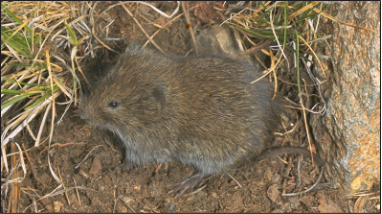
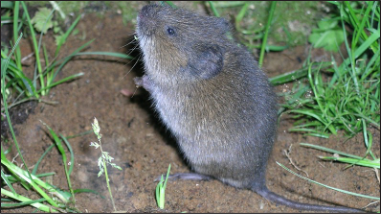
Vole standing on its hind legs

Townsend’s vole

Habitat
Lawns
Open grasslands
Gardens
Farms
Orchards
Meadows
Cropped areas
Young forested plantations
Montane vole

Montane vole

Habitat
Lawns
Open grasslands
Gardens
Farms
Orchards
Meadows
Cropped areas
Young forested plantations

Photo by Roger W. Barbour, courtesy of the Smithsonian’s National Museum of Natural History
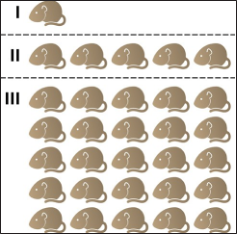
Vole birth chart

Vole Birth Chart

One pregnant female births an average of five female offspring in the first litter (28-day gestation). Those in turn can produce 25 more females, then populations jump to 125, then 625 and can end up at 3,125 females within 4.6 months, if none die.

Backyards and gardens that share borders with open grasslands, fields, and forests may experience high vole population pressures. There are periodic vole population explosions in these open areas, commonly occurring every 3 to 5 years, where populations may number more than 1,000 voles per acre. Irruptions such as these are usually followed by a population crash.

Symptoms and Damage

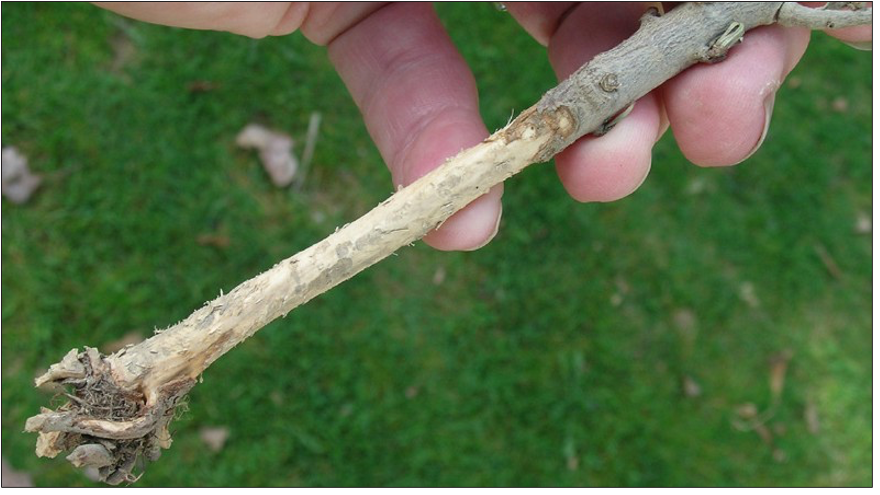
Tooth marks on a plant stem
Voles will feed on a variety of garden vegetables and ornamental plants, both above and below ground. Tooth scars, as seen here, are generally 1/16 inch wide and appear in a crisscross pattern on the damaged woody plants. Herbaceous plants are cropped just above the soil surface.

Photo shows damage on fir Christmas tree.
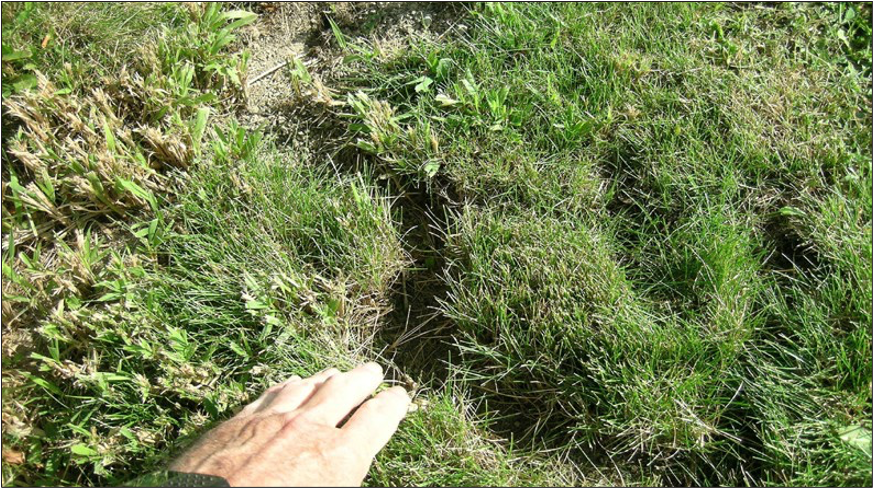
Vole runways in a lawn
Voles cut runways through grass, feeding on vegetation as they move. This damage is especially common in areas with extended snow cover.

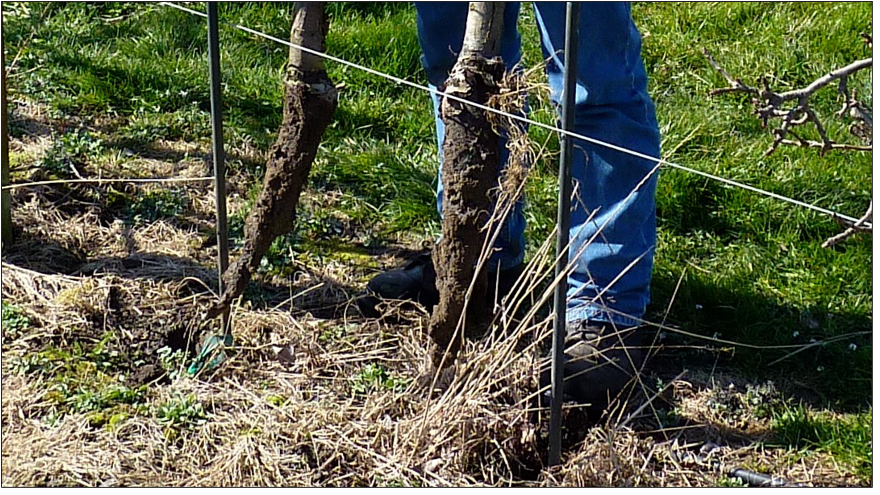
Voles generally construct shallow burrow systems throughout their territories, although Montane voles are known to tunnel as deeply as 30 inches.

Tunnel entrances remain open unless they are also occupied by moles or gophers.

Photo of damaged roots of semi-dwarf apple trees WWFRF Fruit Garden WSU Mount Vernon.
Tall grass is the primary food and home for voles
Tall grass is the primary food and safe harborage for these rodents, so grass must be kept mowed short around gardens and between trees subject to attack. Vegetation-free buffers of thinly mulched (no more than 1 or 2 inches) soil around the perimeters of gardens and around trees and shrubs help reduce migration of new rodents. Avoid applying thick layers of organic mulch or weed-barrier cloth, which can encourage vole tunneling. Crushed rock is a suitable vole-resistant mulch in some situations. Reduce accumulations of thatch, which allow voles to hide from predators.

Management Options

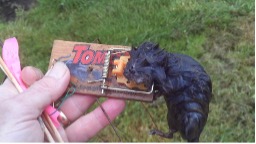
Vole caught in a mouse trap

Traps

Common mouse traps, baited with apple pieces or peanut butter, or used un-baited, are legal in Washington State. Traps should be set at right angles to vole runways and tunnels to manage small populations. Cover the traps to prevent harming birds. Use at least one trap per 100 sq. feet. For large backyards and gardens, it may take 80 or more traps per acre to effectively reduce the numbers of rodents. Check traps at least once a day and remove any captured voles. Carcasses should be buried.

Photo of Townsend’s vole in mouse trap.
Cartoon of a dead vole

Rodenticides

There are no home-use rodenticides registered for voles in yards and gardens.
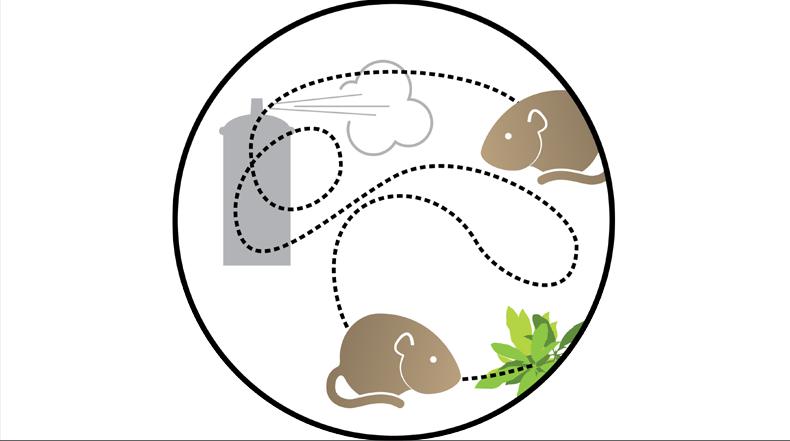
Cartoon of two voles being sprayed with a repellant

Repellents

Few data are available concerning the effectiveness of vole repellents to deter damage.

Homeowners who are willing to test repellents to see how well they perform under local conditions should use the highest label rates of products containing blood meal and/or castor oil.
Cartoon of two voles being sprayed with a repellant

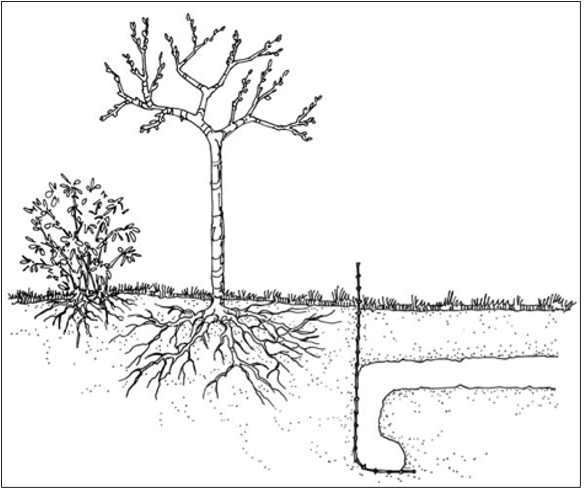
Exclusion

Solid barriers or fences or cylinders of ¼ inch hardware cloth installed around gardens or individual plants can reduce root damage when vole populations are not extreme, but tunneling species may still gain access to vulnerable plants. The fence should be about 12 inches high and the bottom should be buried 6 to 10 inches in the ground. A vegetation-free, lightly-mulched barrier around the outside will increase effectiveness.

Image credit: WDFW. Drawing by Jenifer Rees.
Cartoon of two voles being sprayed with a repellant

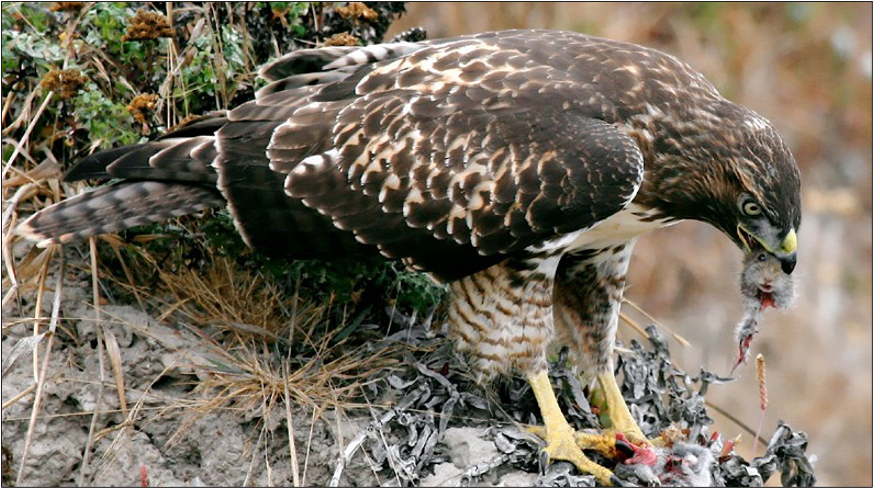
Biological

Creating habitat (nest boxes, roosts, and brush piles) for hawks, owls, and other predators is a nice gesture, but predators rarely keep vole populations below damaging levels. Predation simply cannot keep up with the breeding rate and predators seldom hunt in home gardens. Domestic cats often will kill large numbers of voles but also destroy other wildlife and don’t provide adequate control.

Photo courtesy of Wikimedia Commons.

By carefully managing the habitat and dealing with voles BEFORE they reach damaging populations, gardeners can minimize damage to their gardens and landscapes.


Further Reading

Andrews, P. Orchard Floor Management in Organic Apple Orchards. Washington State University.

Hygnstrom, S.E., R.M. Timm, and G.E. Larson, eds. 1994. Prevention and Control of Wildlife Damage. University of Nebraska-Lincoln.

Ingles, L. G. 1965. Mammals of the Pacific States: California, Oregon and Washington. Palo Alto, CA: Stanford University Press.

Integrated Pest Management for Blueberries: A Guide to Sampling and Decision Making for Key Blueberry Pests in Northwestern Washington—Voles. WSU Extension Whatcom County.

Oregon Dept. of Fish and Wildlife. 1998. Final IPM Plan, 1998. Vertebrate Pests.

Salmon, T.P. and W.P. Gorenzel. 2002. Voles (meadow mice). Pest Notes Publ. 7439. U.C. Agriculture and Natural Resources.

Sullivan, T. 2006. Vole Populations, Tree Fruit Orchards, and Living Mulches. Center for Sustaining Agriculture and Natural Resources. Washington State University.

Tobin, M. E. and M.E. Richmond. 1993. Vole Management in Fruit Orchards. Biological Report 5. U.S. Dept. of Interior Fish and Wildlife Service.

Verts, B. J. and L.N. Carraway. 1998. Land Mammals of Oregon. Berkeley, CA: University of California Press.

Witmer, G. W., A. Hakim, and B. Moser. 2001. Investigations of Methods to Reduce Damage by Voles. Proceedings of the Eastern Wildlife Damage Control Conference 9:357–365.

Witmer, G. W., N. P. Snow, L. Humberg, and T. Salmon. 2009. Vole Problems, Management Options, and Research Needs in the United States. Proceedings of the Wildlife Damage Management Conference 13:235-249.

By Dave Pehling, Extension Educator, WSU Snohomish County, Everett, WA.

Photos in this publication are by Dave Pehling unless otherwise noted.

WSU Peer Reviewed logo.

FS094E

Washington State University Extension Cougar Logo.

Copyright © Washington State University

WSU Extension publications contain material written and produced for public distribution. Alternative text descriptions for select complex images were generated using ChatGPT (OpenAI, GPT-5.2), then reviewed and adapted to ensure compliance with Web Content Accessibility Guidelines (WCAG) 2.1, Level AA accessibility standards.

Issued by Washington State University Extension and the US Department of Agriculture in furtherance of the Acts of May 8 and June 30, 1914. Extension programs and policies are consistent with federal and state laws and regulations on nondiscrimination regarding race, sex, religion, age, color, creed, and national or ethnic origin; physical, mental, or sensory disability; marital status or sexual orientation; and status as a Vietnam-era or disabled veteran. Evidence of noncompliance may be reported through your local WSU Extension office. Trade names have been used to simplify information; no endorsement is intended.