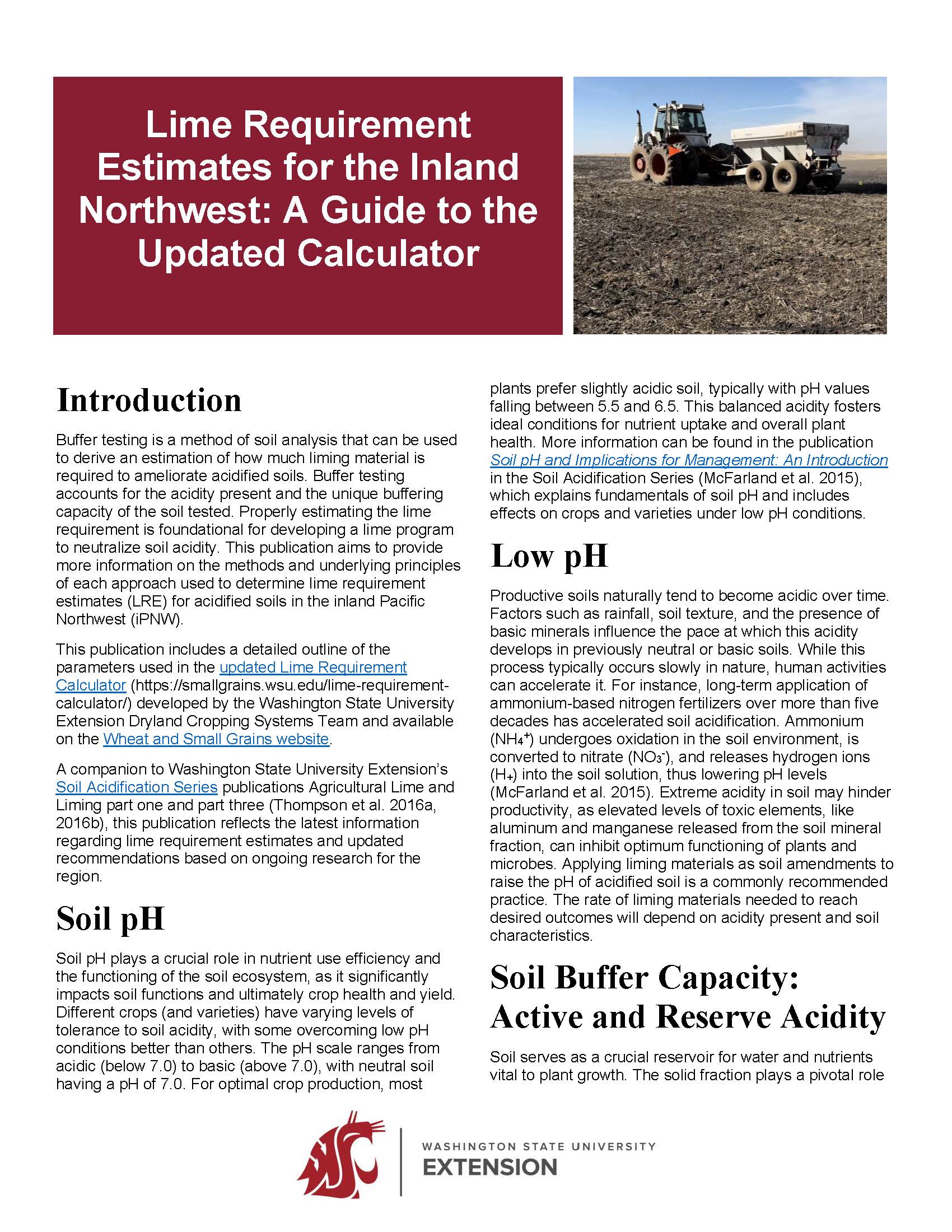
Lime Requirement Estimates for the inland Northwest: A guide to the updated Calculator
This publication offers region-specific lime recommendations and links to the Lime Requirement Calculator, which helps growers more accurately determine how much lime is needed to correct acidic soils to improve crop yields, protect soil health, and maximize returns.
Page Count: 6
Published: June 2025
Hurry! Only left in stock.
Related publications
-
Invertebrate Pest Management for Pacific Northwest Pastures
A well-managed pasture has several ecological and economic benefits. However, several species of arthropods (insects, mites and garden symphylans), and gastropods (slugs) inhabit pastures of the Pacific Northwest of the United States and can diminish…
- Pages:
- 32
- Published:
- August 2020
- Reviewed:
- January 2024
- SKU:
- PNW750
-

Best Management Practices for Managing Herbicide Resistance
Learn to manage herbicide-resistant weeds on your farm using the most effective methods, also known as best management practices (BMPs).
- Pages:
- 12
- Published:
- December 2020
- SKU:
- PNW754
-
Soil-Biodegradable Plastic Mulch: Suitability for Sustainable and Organic Agriculture
Polyethylene mulch is environmentally harmful and expensive to dispose of. Discover soil-biodegradable plastic mulch and learn more about it as a viable alternative.
- Published:
- April 2018
- Revised:
- May 2026
- SKU:
- FS103E
-
Methods for Sampling X-Disease Colladonus spp. (Hemiptera: Cicadellidae) Leafhopper Vectors in Orchards
X-disease, caused by the phytoplasma Candidatus Phytoplasma pruni, is an increasing threat to the Pacific Northwest stone fruit industry, producing small, bitter, and unmarketable fruit. Leafhoppers are the only known vectors. To manage the spread…
- Pages:
- 13
- Published:
- July 2025
- SKU:
- FS400E
Authors: