Preparing Youth for the Sale of their Market Livestock Project
Description
This fact sheet was developed for 4-H leaders, parents, FFA advisors, or other adults who support youth raising market livestock. Youth must be educated about and prepared for what will happen to thei ...
By its very definition, a 4-H market livestock project is terminal, ending within or at the end of a 4-H project year. Not every youth has the temperament to raise and sell a market animal, nor should they be expected to do so. There are many non-terminal project options for youth who are interested in raising livestock, including breeding projects, fiber animal projects, draft or pack animal projects, and self-determined projects. However, for youth who enroll in a market livestock project for the first time, it is essential for adults to prepare them for the fate of the project animal.
Are They Ready?
When youth express interest in enrolling in a market livestock project, leaders and parents must assess the suitability of the project to the child’s capabilities, resources, and living situation. They must also determine the youth’s capacity to handle the sale of the project animal and ability to handle this perceived loss.
Key questions to ask before enrolling youth in a market livestock project:
Is the family able to afford the animal, its feeding, and care?
Can the family handle the economic impact of the loss of the animal if it dies before the sale, does not meet weight requirements, or cannot be sold for other reasons?
Will the animal have a safe place to be housed?
Does the youth have enough time to care for and work with the animal?
Is the youth able to be safe around the animal and vice versa?
Will the youth have proper supervision and guidance from a knowledgeable adult?
Does the youth understand basic concepts of quality assurance of human food products?
Does the youth understand the project animal will be slaughtered and used for human food?
Assessing Understanding
Although many youth have some regret and sadness at the conclusion of their market project (less so with age and experience), there is no reason the terminal nature of the project should take youth by surprise.
Before the project animal is even selected, parents and leaders must ensure each youth is emotionally prepared to part with the animal they will care for during the project. This is particularly important the first time a youth enrolls in a market project, regardless of age.
Simple, clear, and age-appropriate questions and instructions should be used in discussions with the youth. It may be helpful to have a general discussion about where meat comes from before specifically addressing the fate of the project animals. Discussion points could include:
“You need to understand that if you want to have a market animal, at the end of the project it will be humanely killed and made into meat.”
“Do you understand we won’t be bringing ‘Pork Chop’ home from the fair?”
“At the end of the show, ‘Pork Chop’ will be sold and become meat for people to eat.”
Young children may not understand the terms “butchered,” “processed,” or “slaughtered;” however, they will understand the word “killed.” Youth who are upset by this discussion are not ready for a market project, and may indeed never be suited for one. This is fine, because there is a variety of 4-H projects suitable for every interest and ability.
First-time market project youth can also be confused by jackpot shows. Jackpot shows allow market animals to compete in market, fitting, and showmanship classes, and return home after the event. This can sometimes take place multiple times. Eventually there will be a terminal show for each jackpot animal, and the youth must be prepared for how they will feel when their animal doesn’t come home with them.
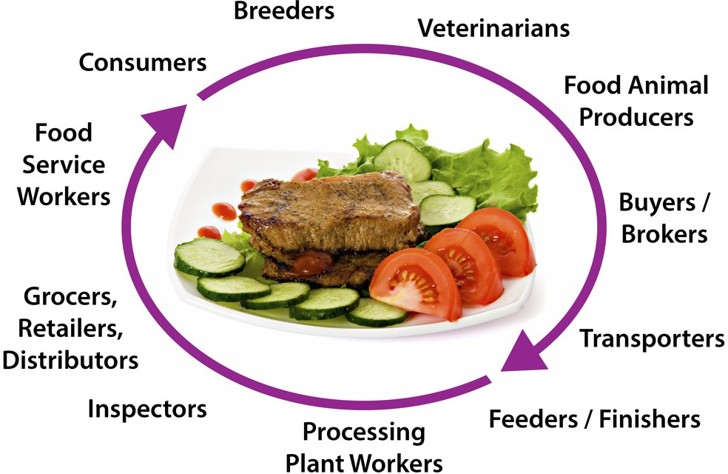
Occasionally, a family will decide to bring a market steer, barrow, or wether home and make it a family pet, but this should be agreed upon in advance. However, this decision should not be encouraged for a variety of reasons. If treated as pets, some market livestock can experience serious health issues as they age, such as obesity and urinary tract blockage. Also, when a market livestock project animal is properly fed, grown, finished, and sold, its job is done, and the youth producer’s job is done as well. The animal is ready to go to the next person in the food production cycle so that person can do his or her job, too, as shown in Figure 1.
Figure 1. The Food Production Cycle. Everyone must do his or her part to ensure that only safe, wholesome, and delicious food products end up on consumers’ plates.
Understandable Feelings
Youth should truly care about their project animal and many bond with their animal during the months of caretaking, so it is not uncommon to see some tears when a project animal is sold and loaded on to a truck for transport to processing. Other concurrent issues can lower a youth’s resiliency to stress, change, and loss. These can include fatigue after a long show or fair; anxiety about returning to school; sadness over separation from summertime friends; tragic events in the news, etc. Tears of loss and sadness are understandable, but the fate of a market animal should not take the youth by surprise.
Support Systems for Youth
Club members and youth who have experience with market livestock are a natural support system for children who have difficulty separating from their market animal. Club leaders can help club members prepare for their feelings in a pre-fair club meeting. Club members can be instructed to watch each other for signs of difficulty, giving hugs and words of encouragement as needed.
Youth who are struggling with feelings of loss may want to talk to a friend who is a good listener; others may need some time to process their feelings, but will appreciate the support of friends during this time.
Besides selling market animals, youth can also experience feelings of loss when a project animal dies, is given away, goes missing, or when the youth moves away for college or work. Again, preparing for these feelings and discussing them with a caring adult before and after the event will help youth process, learn, and recover from the experience.
Parting Inevitable
Humans live much longer than animals, so we eventually have to part with all our pets and livestock. Regardless of the animal’s purpose or length of life, caretakers are obligated to make sure each animal is cared for humanely and has a high quality of life. It is normal and understandable to experience feelings of loss and sadness when we have to part with animals for any reason, but it is a comfort to know animals had an excellent home and proper care, and we made their lives the best they could be.
Guiding Questions
These questions may be helpful to guide discussion during a club meeting prior to a market sale.
Can someone describe what will happen to your project animals after the sale?
Does anyone have any questions about what will happen to your project animals after the sale?
How do you think you will feel at that time?
If you are sad, what can you do to deal with your feelings?
Why is it important to learn how to manage and express your feelings?
What are signs someone is having trouble with feelings of sadness after the sale of his or her animal?
How can we support someone who is feeling sad after the sale of his or her animal?
How would you like others to show they care about you when you are sad?
What other things have you cared about and lost? How did you feel and how did you cope with these feelings?
Whom can you talk with when you are sad?
Suggested Activities
These activities will help youth prepare for the upcoming sale of their market animal. Encourage market livestock youth to:
Interview older youth who have sold their animals at market stock sales. Ask them about their experiences and how they felt.
Create a scrapbook of the project year. Looking back on favorite photos will bring back happy memories after some time has passed.
Create skits about different feelings and reactions to the sale of project animals.
Predict how they might react to the sale of their animal and write or draw these thoughts on paper.
Discuss their goals and plans for the money they will earn from their project.
Talk with someone who had a favorite animal die. Ask them to describe how they felt and what helped get them through that difficult time.
Have a group barbecue and discuss the origin of the meat served, which will help make the connection between 4-H market livestock and food overt.
Conduct a hands-on field day where youth learn where meat cuts are located on a live animal.
“Mom, I’ve been thinking about it and ‘Arya’ and ‘Roren’ had a job to do and they did a great job. Their job was to be market livestock and I raised them to be ready to sell at fair time and I did my job. I will miss Arya so much, but I can’t be sad, because she did her job really well.”
-Brayden, age 10, 4-H youth, 2012
These experienced market livestock youth would be good mentors for first-time market livestock youth as they process any feelings of loss.
By Dr. Susan Kerr, WSU Northwest Regional Livestock and Dairy Extension Specialist
Copyright 2015 Washington State University.
WSU Extension bulletins contain material written and produced for public distribution. Alternate formats of our educational materials are available upon request for persons with disabilities. Please contact Washington State University Extension for more information.
Issued by Washington State University Extension and the U.S. Department of Agriculture in furtherance of the Acts of May 8 and June 30, 1914. Extension programs and policies are consistent with federal and state laws and regulations on nondiscrimination regarding race, sex, religion, age, color, creed, and national or ethnic origin; physical, mental, or sensory disability; marital status or sexual orientation; and status as a Vietnam-era or disabled veteran. Evidence of noncompliance may be reported through your local WSU Extension office. Trade names have been used to simplify information; no endorsement is intended. Published December 2013. Reviewed July 2015.
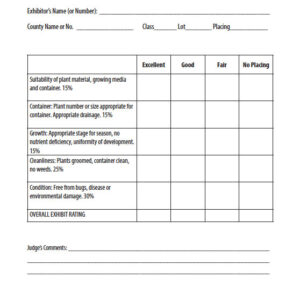
This scorecard is to be used in gardening or plant science departments for the evaluation of container/dish gardens or houseplants. Judges have the option of either a numerical score or using the chec ...
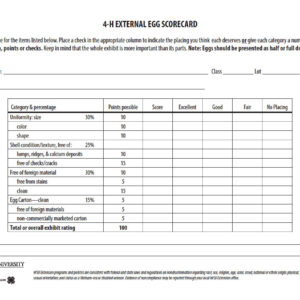
This scorecard is to be used in poultry or still-life departments. It may be used for chicken, duck, geese or eggs from other poultry/fowl. Number of eggs entered to be determined by each fair’s pr…
This publication briefly introduces the concept of dressage, terminology, levels of competition, how to ride a test, how the test will be judged, and equipment and general rules used in competitions.