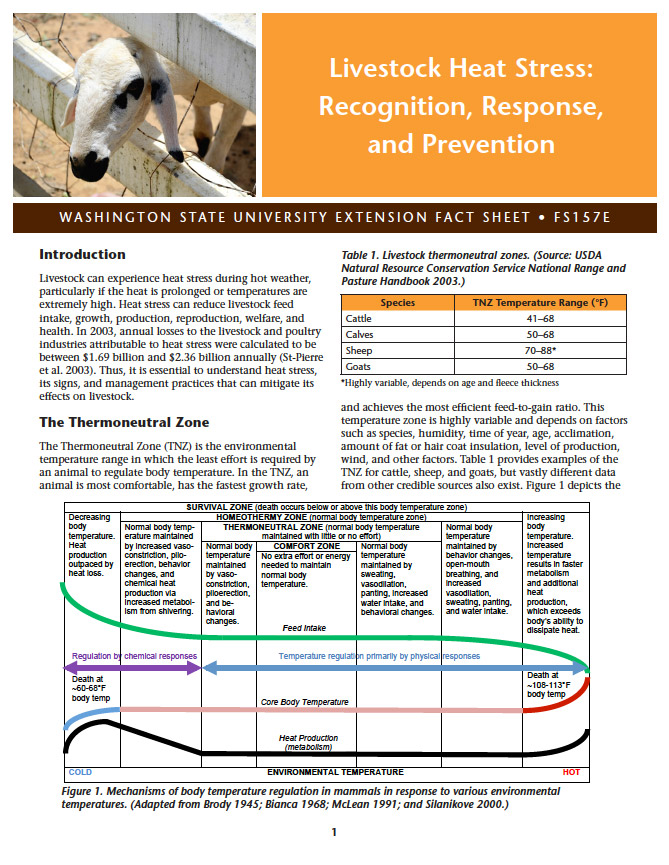
Archived - Management Practices to Mitigate Livestock Heat Stress
Notice: The following publication has been archived and may not meet WCAG 2.1 accessibility standards. If you need an accessible copy, please contact us.
Livestock can experience heat stress during hot weather, particularly if the heat is prolonged or temperatures are extremely high. Heat stress can reduce livestock feed intake, growth, production, rep …
Published: April 2015
Hurry! Only left in stock.
Related publications
-

-
Advances in Dryland Farming in the Inland Pacific Northwest (PNW) (REACCh Handbook)
This item is free, just pay for shipping. Individual chapters available for viewing. See below. Table of Contents (pdf) Introduction (pdf) Chapter 1 (pdf) Chapter 2 (pdf) Chapter 3 (pdf) Chapter 4 (pdf) Chapter…
Authors:- Rakesh Awale
- Kirti Rajagopalan
- Kristy Borrelli
- Kurt Schroeder
- Laurie Houston
- Nicole Tautges
- Nilsa Bosque-Perez
- Paul Carter
- Prakriti Bista
- Rajan Ghimire
- Kendall Kahl
- Sanford Eigenbrode
- Silvia I. Rondon
- Stephen Machado
- Susan Capalbo
- Tabitha Brown
- Tai Maaz
- Timothy Murray
- Timothy Paulitz
- Xianming Chen
- Edward Bechinski
- Arash Rashed
- Bertie Weddell
- Bill Pan
- Bradley Stokes
- Chad Kruger
- Clark Seavert
- David R. Huggins
- David W. Crowder
- Donald J. Wysocki
- Andy Bary
- Elizabeth Allen
- Elizabeth Kirby
- Frank Young
- Georgine Yorgey
- Haiying Tao
- John Abatzoglou
- John Antle
- Kate Painter
Select options This product has multiple variants. The options may be chosen on the product page -
2022 Cost Estimates of Producing and Packing Fresh- Market Anjou Pears in Wenatchee River Valley, Washington State
Growers can compare cost estimations with various ranges of price and yield to determine if their Anjou pear operation would be profitable, all in this newly revised pub.
- Pages:
- 7
- Published:
- July 2011
- Revised:
- December 2022
- SKU:
- FS031E
-
A Guide to Washington State's Urban Tree Canopy
More than 80% of the nation’s population lives in urban areas. The urban tree canopy (UTC) is an essential part of an urban areas’ infrastructure—an ecosystem characterized by trees and other vegetati ...
- Published:
- December 2016
- SKU:
- EM107E
Authors: