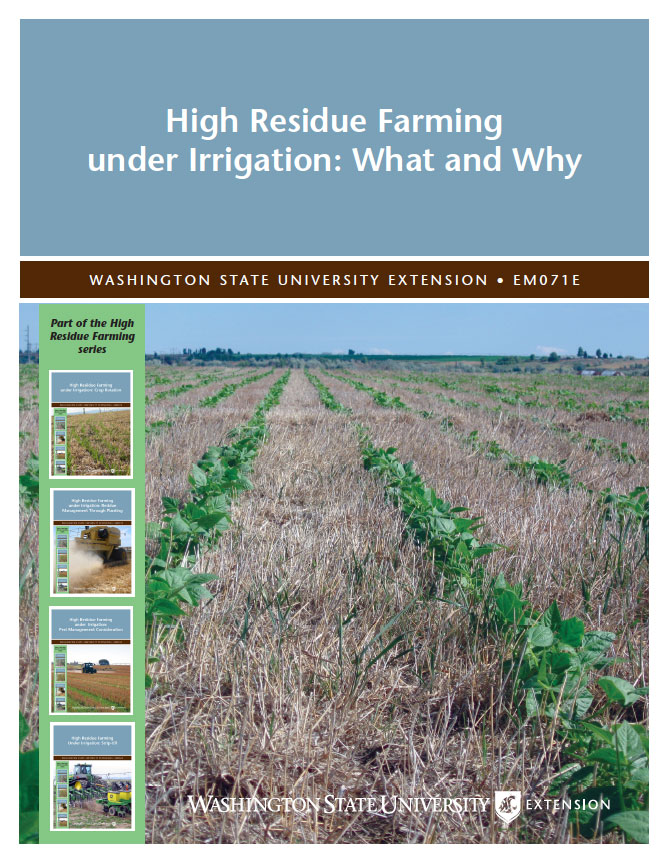
Archived - High Residue Farming Under Irrigation: What and Why (1 in a series of 5)
Notice: The following publication has been archived and may not meet WCAG 2.1 accessibility standards. If you need an accessible copy, please contact us.
“High Residue Farming” is an umbrella term for cropping systems in which less tillage is used in order to keep crop residue on the surface of a field. That crop residue provides many benefits to the s …
Published: September 2014
Hurry! Only left in stock.
Related publications
-
A Guide to Washington State's Urban Tree Canopy
More than 80% of the nation’s population lives in urban areas. The urban tree canopy (UTC) is an essential part of an urban areas’ infrastructure—an ecosystem characterized by trees and other vegetati ...
- Published:
- December 2016
- SKU:
- EM107E
Authors: -

-
A Mayweed Chamomile Growing Degree Day Model for the Inland Pacific Northwest
Providing an accurate prediction tool (Growing Degree Day Model) for mayweed chamomile to more effectively manage this increasing problem in the iPNW.
- Published:
- August 2018
- SKU:
- FS306E
-
A Gardener’s Primer to Mycorrhizae: Understanding How They Work and Learning How To Protect Them (Home Garden Series)
Mycorrhizae are symbiotic associations between many plants and the beneficial fungi that colonize their roots. Gardeners are often unaware of these relationships and may inadvertently injure or kill t ...
- Published:
- July 2017
- SKU:
- FS269E
Authors: