Exploring Organic Grain and Forage Production as a Profitable Enterprise for Palouse Farmers
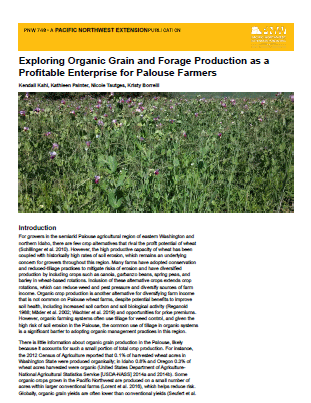
Demand for organic grain has outpaced actual US grain production in recent years. Yet little is known about organic grain production in the Palouse, likely because it comprises a small portion of total crop production. This study takes a closer look. It examines crop productivity under reduced-tillage conditions, provides estimates of field-scale costs, determines the benefits of crop rotation, and describes the principal factors that determine profitability within cropping systems. The verdict: organic grain and forage production can be a profitable niche enterprise within a traditional Palouse nonorganic wheat farm.
Published: November 2020
Hurry! Only left in stock.
Related publications
-
Lingonberry Production Guide for the Pacific Northwest
Lingonberries are native to Scandinavia, Europe, Alaska, and northeastern Canada, but are not widely cultivated. Known commercial lingonberry acreage is less than 100 acres worldwide, and one-third ...
Authors: -
Sweet Cherry Cultivars for the Fresh Market
Describes dark red and blush sweet cherry cultivars, including harvest timing, color when ripe, suggested pollinizers and rootstocks, size, firmness, yield potential, and other traits.
- Published:
- January 2021
- Reviewed:
- January 2025
- SKU:
- PNW604
Authors: -
Aquatic and Riparian Weeds of the West
This is a practical guide to the identification and biology of submerged, floating-leaved, and emergent aquatic and riparian weeds.
Price: $30.80 -
Blueberry Cultivars for the Pacific Northwest
This publication describes northern highbush, southern highbush, rabbiteye, lowbush, and half-high blueberry cultivars. It includes information on commercial value and identifies which cultivars wo ...
- Published:
- February 2014
- Reviewed:
- January 2018
- SKU:
- PNW656
Authors: