Home Garden and Lawn Fertilizer Calculator (Home Garden Series)
Description
Gardens, lawns, single plants, or short rows: how much fertilizer to add for each? This fertilizer calculator (for both organic and conventional) makes it easy. ...
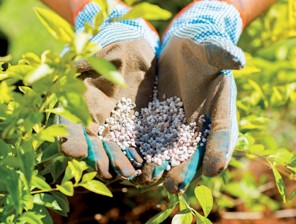
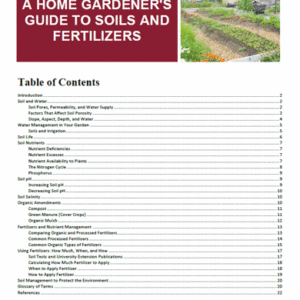
These worksheets calculate fertilizer application rates for gardens, garden beds, lawns, single plants, and short rows, based on fertilizer recommendations. It is a companion to A Home Gardener’s Guide to Soils and Fertilizers, WSU Extension publication EM063E.
These worksheets do the calculations described in the “Fertilizer Calculation and Use” section of A Home Gardeners Guide to Soils and Fertilizers and can be used for any garden fertilizer calculation, including for both organic and conventional fertilizers.
Calculating Fertilizer Amounts
To calculate the amount of fertilizer to use, you need the following:
1. A fertilizer recommendation
Garden and lawn fertilizer recommendations are typically given in pounds of nutrient per 1,000 square feet. Most recommendations range from one to four pounds N, and zero to three pounds P2O5 and K2O per 1,000 square feet, depending on the crop and any soil test results. Some recommendations are given in ounces nutrient per plant or per short length of row.
Recommendations come from A Home Gardener’s Guide to Soils and Fertilizers, other Extension publications, or soil test results.
2. Type of fertilizer you are using: organic or conventional
Most conventional fertilizers are fast-release and have 100% availability of nitrogen. Organic fertilizers release nitrogen more slowly, and only a portion of the nitrogen is available during the growing season. This spreadsheet estimates N availability for organic fertilizers, based on the amount of nitrogen they contain. These estimates are based on research done at Washington State University and Oregon State University. See A Home Gardener’s Guide to Soils and Fertilizers for details and references on organic N availability.
3. N-P-K in fertilizer products
The concentration of the primary nutrients, nitrogen (N), phosphorus (P), and potassium(K) are shown prominently on the fertilizer bag or box.
P concentration is actually expressed as “phosphate” (P2O5) and K as “potash” (K2O), but these units are already accounted for in fertilizer recommendations, so we do not need to be concerned about them here.
4. Area of garden or lawn
Measure and calculate the area of the lawn, garden, or beds to receive fertilizer.
Choosing Which Worksheet to Use
The calculator has two independent pages:
One for gardens, beds, and lawns where the recom-mendation is in pounds per 1,000 square feet, and one for individual plants or short rows where the recommendation is in ounces per plant or ounces per row length.
Each page has two worksheets:
One for conventional fertilizers, and one for organic (slow-release) fertilizers.
The conventional calculator assumes 100% quick availability of nitrogen, while the organic calculator assumes nitrogen availability ranging from 0% to 75% during the growing season, based on the nitrogen concentration of the fertilizer.
Choose the appropriate worksheet based on what your fertilizer recommendation is for—whether garden or lawn vs. individual plant(s) or short rows—and type of fertilizer (organic vs. conventional).
Inputting Your Information into a Worksheet
Input the required information into the blue boxes in the appropriate worksheet: fertilizer N-P-K, fertilizer recommendation, and area to fertilize. Press “Enter” to calculate.
The calculations are based on the recommended nitrogen amounts. The Garden and Lawn Worksheets also show the amount of phosphorus and potassium supplied when you apply the fertilizer at the recommended nitrogen rate.
Craig Cogger, Extension Soil Scientist Emeritus, WSU Puyallup Research and Extension Center, Washington State University

FS324E

Copyright © Washington State University
WSU Extension publications contain material written and produced for public distribution. Alternative text descriptions for select complex images were generated using ChatGPT (OpenAI), then reviewed and adapted to ensure compliance with Web Content Accessibility Guidelines (WCAG) accessibility standards.
Issued by Washington State University Extension and the US Department of Agriculture in furtherance of the Acts of May 8 and June 30, 1914. Extension programs and policies are consistent with federal and state laws and regulations on nondiscrimination regarding race, sex, religion, age, color, creed, and national or ethnic origin; physical, mental, or sensory disability; marital status or sexual orientation; and status as a Vietnam-era or disabled veteran. Evidence of noncompliance may be reported through your local WSU Extension office. Trade names have been used to simplify information; no endorsement is intended.