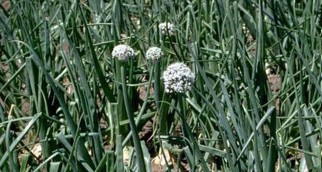
Bolting
Symptoms: Plants send up flower stalks
Corrective Action: Plant small sets for bulb production; use plants from large sets for green onions.
It’s not difficult to grow onions in Washington gardens, but understanding how they grow is key to success. This publication provides information to Washington gardeners on the basics of growing bulb ...
Sets should be planted in spring from March to early April. For dry bulb onions, plant sets 1 inch deep and 3–4 inches apart. If planting in rows, space rows 12–15 inches apart. If planting in wide rows or beds, place the sets using 4-inch centers. If you want small green onions, plant sets 1.5–2 inches deep and about 1 inch apart; farther apart if you desire larger green onions.
Onions can also be planted from seed or as transplants and typically are available in specific cultivars, giving the gardener more choices. When using seed, sow as early as possible once the danger of hard frost is past.
Plant seed 1/2 to 1 inch deep and 1.5 to 2 inches apart. When seedlings reach 3 inches tall, thin them to the desired spacing. Don’t allow the seed bed to dry out.
Seeds can also be started indoors and then transplanted to the garden when the seedlings are 3 inches tall. When starting them indoors, sow seed 4 to 8 weeks before planting outdoors.
Onion roots are shallow, so keep the soil evenly moist. If the soil becomes too dry, the onions will form bulbs prematurely, resulting in small bulbs. Plantings should be kept as weed-free as possible because onions don’t compete well with weeds. Be careful when cultivating around the plants because of their shallow roots. An organic mulch can help control weeds and maintain even soil moisture.
Onions require large amounts of nitrogen, but excess nitrogen can cause problems, such as late maturity, soft bulbs, large necks, and shorter storage life. Before applying fertilizer, it’s advisable to test your garden soil to determine nutrient levels. Organic gardeners should incorporate nitrogen-rich organic matter into the soil prior to planting.
The most common insect problems are onion thrips and onion maggots.
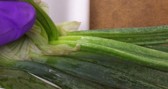
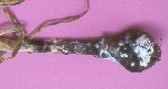
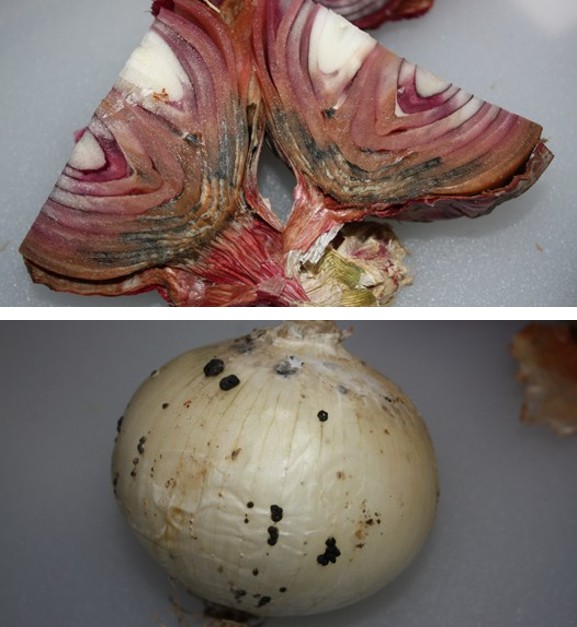
The most common disease problem is white rot. In 1986, the Washington State Department of Agriculture initiated a quarantine (WAC 16-470-300 through 340) on onion sets coming into commercial onion-growing areas in the Columbia Basin counties of Adams, Franklin, and Grant. Sets must be certified disease-free to protect these areas from white rot, a devastating fungus disease that remains in the soil for 25 years or more. If you live in these counties, purchase only certified disease-free onion sets from a reputable local nursery.
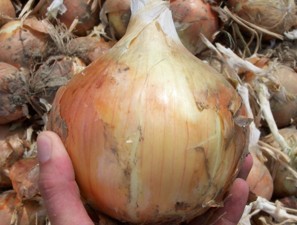
Dry onions grown from sets take three to four months to complete their growth. You will know they’re ready to harvest when most of the necks and tops have fallen over. Once this happens, the onions will not get any larger and should be pulled and allowed to dry in a shaded area with good air circulation. After the outer skin becomes dry and crispy, they can be stored in mesh bags in a cool, dry location. This should only take a few days if the weather is warm and dry. Sweet onions do not store well, but yellow onions, followed by red and white types, are best for storage.
Never try to encourage bulbing by knocking over the tops of onions yourself. This won’t stimulate bulb development or growth and can bruise the neck and lead to rot.
Bulbing onions may be used fresh or stored. Bulbing onions and green onions can be chopped and frozen or dehydrated.
The University of Georgia hosts the National Center for Home Food Preservation website, which offers research-based recommendations for most Methods of Home Food Preservation.
By Marianne Ophardt, WSU Benton County Extension.
Photos by author or as noted, by Tim Waters, WSU Franklin County Extension; and Gary Pelter, WSU Grant County Extension (retired).
Use pesticides with care. Apply them only to plants, animals, or sites as listed on the label. When mixing and applying pesticides, follow all label precautions to protect yourself and others around you. It is a violation of the law to disregard label directions. If pesticides are spilled on skin or clothing, remove clothing and wash skin thoroughly. Store pesticides in their original containers and keep them out of the reach of children, pets, and livestock.
Copyright 2013 Washington State University.
WSU Extension bulletins contain material written and produced for public distribution. Alternate formats of our educational materials are available upon request for persons with disabilities. Please contact Washington State University Extension for more information.
You may download copies of this and other publications from WSU Extension.
Issued by Washington State University Extension and the U.S. Department of Agriculture in furtherance of the Acts of May 8 and June 30, 1914. Extension programs and policies are consistent with federal and state laws and regulations on nondiscrimination regarding race, sex, religion, age, color, creed, and national or ethnic origin; physical, mental, or sensory disability; marital status or sexual orientation; and status as a Vietnam-era or disabled veteran. Evidence of noncompliance may be reported through your local WSU Extension office. Trade names have been used to simplify information; no endorsement is intended. Published December 2013.