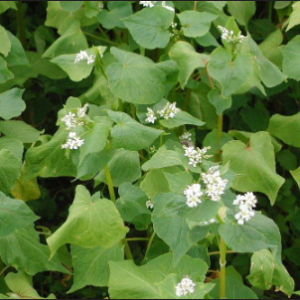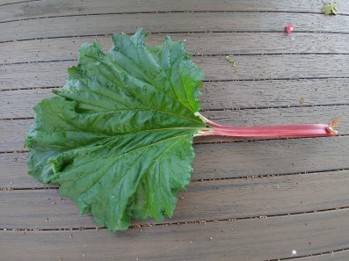
Figure 2. Rhubarb leaf and petiole. Photo by Linda Chalker-Scott.
Get ready to grow rhubarb! This pub describes the best methods for growing and sustaining healthy rhubarb plants in your home garden.
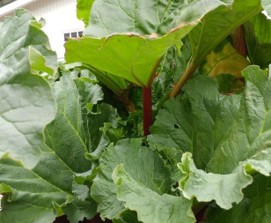
Culinary rhubarb (Rheum × cultorum, Foust and Marshall, 1991) is an herbaceous perennial that is grown for its petiole (the stalk connecting the leaf to the stem) and is perhaps the only commonly grown vegetable treated as a fruit in the kitchen. This publication describes the best methods for growing and sustaining healthy rhubarb plants in the home garden.
Rhubarb (Rheum) species are native to parts of Europe and Asia and have been widely cultivated as culinary crops in temperate areas all over the world. The short stems of these herbaceous perennials (Figure 1) are hidden by long, sturdy petioles (commonly referred to as stalks) bearing large leaves (Figure 2). Rhubarb is a temperate crop—that is, it requires cold temperatures during the winter to stimulate growth in the spring (Schrader 2000). Once established, rhubarb is a vigorous crop that can live for years and produces “stalks” that are cheaper and of better quality than store-bought (Miles 2013).
Figure 2. Rhubarb leaf and petiole. Photo by Linda Chalker-Scott.
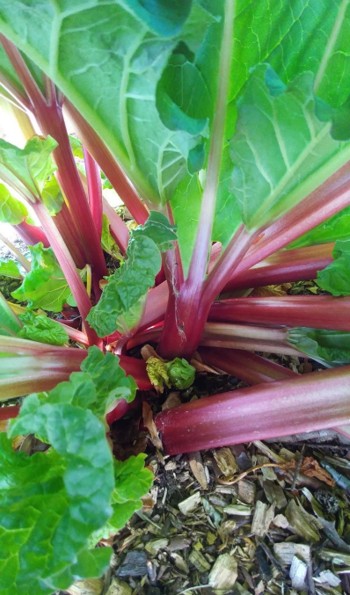
Figure 1. The stem of this plant, where young leaves are emerging, is barely visible among the mature leaves. Photo by Linda-Chalker-Scott.
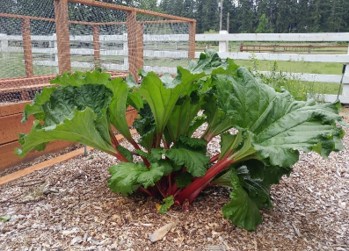
Because rhubarb is a perennial plant and will increase in size each year, it is best to grow it as a landscape plant rather than in an annual bed. Once planted, it should not be disturbed unless crown divisions are being made. The diameter of a single rhubarb plant can reach eight feet or more (Figure 3), so give each plant plenty of space in full sun for best production. Like most landscape plants, rhubarb performs best in a well-drained, aerated soil. Avoid planting in areas where drainage problems are known to exist.
If you have not had a soil test done for nutrient and organic matter levels, you should do one before planting any perennial. Many home gardens and landscapes have excessive levels of nutrients, and this information will aid you in knowing whether you need to add fertilizer, compost, or any other source of nutrients. University and governmental soil testing laboratories are recommended, as they will provide objective data and recommendations relevant to your home garden situation.
Rhubarb is usually purchased as a crown division, so these clonal plants will be identical to the parent. Seeds are also available, but since they are genetically variable, a packet of seeds might result in plants with stalks ranging from green to pink speckled to red. Such color variants have been propagated vegetatively to develop the many cultivars available to gardeners (Table 1).
| Green | Pink Speckles | Red |
|---|---|---|
| ‘Riverside Giant’ | ‘German Wine’ | ‘Canada Red’ |
| - | ‘MacDonald’ | ‘Cherry Red’ |
| - | ‘Strawberry’ | ‘Crimson Cherry’ |
| - | ‘Victoria’ | ‘Crimson Red’ |
| - | - | ‘Crimson Wine’ |
| - | - | ‘Tilden’ |
| - | - | ‘Valentine’ |
As with other perennials, rhubarb will do best when planted in the fall when the plant is dormant. However, roots will be available in garden stores and through mail order stores during the winter and early spring. This means that root reserves will be directed to root growth and establishment, because roots do not go dormant. This is also the best time of year to make crown divisions. Planting or dividing in the spring when new leaves are emerging will result in reduced resources for root growth and subsequent water stress for new and existing leaves.
All container media should be removed from purchased roots, either by shaking it off or soaking the root ball in a container of water. Place the exposed root mass in a hole that is no deeper than the root mass and at least as wide. The planting hole will be shallow and wide, like a saucer. Place the root mass in the hole and backfill with the same soil that came out of the hole. Do not add amendments of any sort; your goal is to get the roots in contact with the native soil, and amendments interfere with this activity. Add water and more soil as needed, while adjusting the plant if needed to keep the crown above grade. Do not press or stomp the soil during planting. Let water move through the soil naturally to create a continuous medium (this is sometimes called “mudding in”). Plants growing in containers are also available from garden stores in early spring. Planting hole preparation will be the same as bare root starts but retain the container soil mix around the root when planting.
After planting, add about four inches of coarse organic mulch to the soil surface up to, but not covering, the crown (Figure 3). Arborist wood chips, available from tree services, or straw are excellent choices as they allow for oxygen and water movement, suppress weeds, and moderate soil temperatures (Chalker-Scott 2015). Do not add any transplant supplements, including fertilizers, unless you have soil test results showing a nutrient deficiency. Rhubarb will thrive for many years as long as the mulch layer is maintained and sufficient water is provided during the growing season.
Once established, rhubarb requires little care other than maintaining a mulch layer and irrigation. Because rhubarb is a cool season plant, it will experience stress as summer temperatures rise. Leaf production is best when daily temperatures are in the mid-70s and evening temperatures in the mid-50s (Schrader 2000). Once temperatures exceed 90°F, leaf production will slow; during this time it is especially important to provide sufficient water or the plant might enter summer dormancy.
With the onset of cold fall evenings, rhubarb leaves will senesce and should be removed once they have turned brown. Before winter, be sure to add additional wood chip mulch to the root zone to maintain a four-inch depth. This will prevent weed establishment over the winter.
As your plant matures, it may become too large for its space. Dividing the plant in the fall will renew the vigor of the remaining crown, and the divisions can be planted elsewhere.
Rhubarb suffers from few insect or disease problems, and many of these can be avoided by proper landscape management. Growing rhubarb as an individual plant in a diverse landscape rather than as a monoculture means that you have a host of beneficial organisms, including predators, that can reduce pest insects. Aphid species may be present that can transmit viruses (Pantoja et al. 2010). Use a garden hose to reduce aphid populations on rhubarb leaves to minimize this possibility. Reported diseases, especially root rots caused by Phytophthora, Pythium, Rhizoctonia, and Botrytis, can be avoided by planting in well-drained soils (Schrader 2000). Avoid the use of pesticides and unnecessary fertilizers when possible.
If problems do occur on leaves or stalks, be sure to take samples to your county Master Gardener office for help in identifying the problem and treating it appropriately.
Rhubarb can be harvested as soon as there is vigorous leaf production. Wait until the second season before harvesting. You don’t want to harvest too much at any one time, as this will decrease the plant’s vigor. When leaves begin to lie horizontally, this is a good indication that they are ready to be removed, as they are being displaced by new leaves (Figure 4).
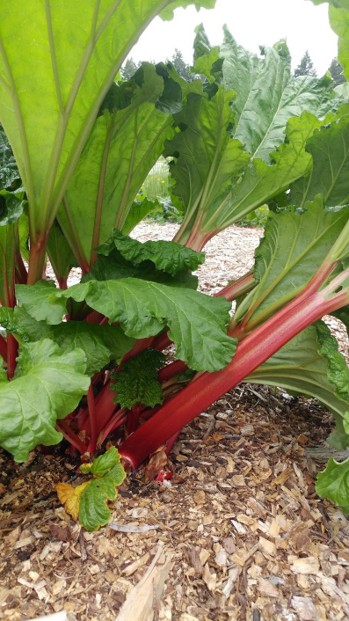
Figure 4. Basal leaves become more horizontal as new leaves emerge. Photo by Linda Chalker-Scott.
Harvest the largest stalks first. To remove a stalk, grasp the base firmly (Figure 5) and pull while rocking your hand side to side. This should result in the entire stalk being removed (Figure 6). Avoid breaking or cutting the stalks, as these cut surfaces could allow pathogens and pests to enter. A rhubarb plant may produce one or more stalks that produce large white flowers. These will have poor quality and should be harvested and discarded so the plant does not expend resources on these stalks.
Next, remove the leaf from the stalk. The leaf has toxic levels of oxalic acid, and its consumption should be avoided. Cut the top of the stalk away from the entire leaf (Figure 7) and discard. The leaves can be safely composted as oxalic acid will not affect microbes. The stalk can now be sliced and used for cooking. For storage, slice the stalks and refrigerate for a few weeks, or freeze indefinitely.
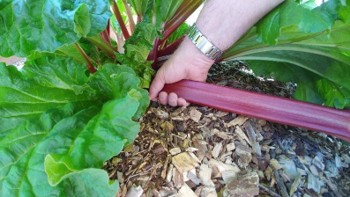
Figure 5. Firmly grasp the petiole as close to the base as possible. Photo by Linda Chalker-Scott.
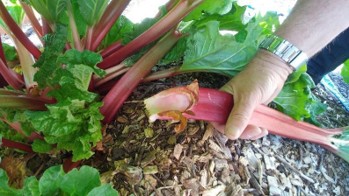
Figure 6. Successful removal of the petiole avoids breakage or tearing. Photo by Linda Chalker-Scott.
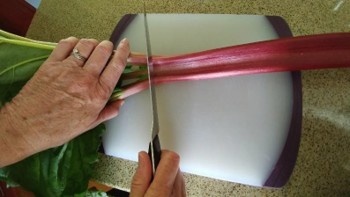
Figure 7. Remove the entire leaf from the petiole and discard. Photo by Linda Chalker-Scott.
Harvest rhubarb throughout the growing season, but retain some leaves on the plant in the summer and fall to allow the roots to extract and retain nutrition from those leaves for next year’s growth. The leaves and stalks die back once freezing temperatures arrive, and they can be discarded once they have detached themselves from the stalk. The quality of freeze-damaged petioles is poor, and it is best to discard them, but the belief that freeze-damaged leaves release oxalic acid into the stalks is not supported by any published research.
Rhubarb is best used in cooking, not as raw juice. While rhubarb stalks contain low levels of oxalic acid, oxalic acid is concentrated in rhubarb juice (Siener et al. 2016). Rhubarb stalks, particularly red ones, contain high levels of anthocyanins, which are powerful antioxidants. To maintain both color and antioxidant activity, baking and slow stewing are the recommended methods of preparing rhubarb (McDougall et al. 2010).
By Linda Chalker-Scott, Professor and Extension Specialist, Department of Horticulture, Washington State University
Copyright © Washington State University
WSU Extension publications contain material written and produced for public distribution. Alternate formats of our educational materials are available upon request for persons with disabilities. Please contact Washington State University Extension for more information.
Issued by Washington State University Extension and the US Department of Agriculture in furtherance of the Acts of May 8 and June 30, 1914. Extension programs and policies are consistent with federal and state laws and regulations on nondiscrimination regarding race, sex, religion, age, color, creed, and national or ethnic origin; physical, mental, or sensory disability; marital status or sexual orientation; and status as a Vietnam-era or disabled veteran. Evidence of noncompliance may be reported through your local WSU Extension office. Trade names have been used to simplify information; no endorsement is intended. Published August 2021.