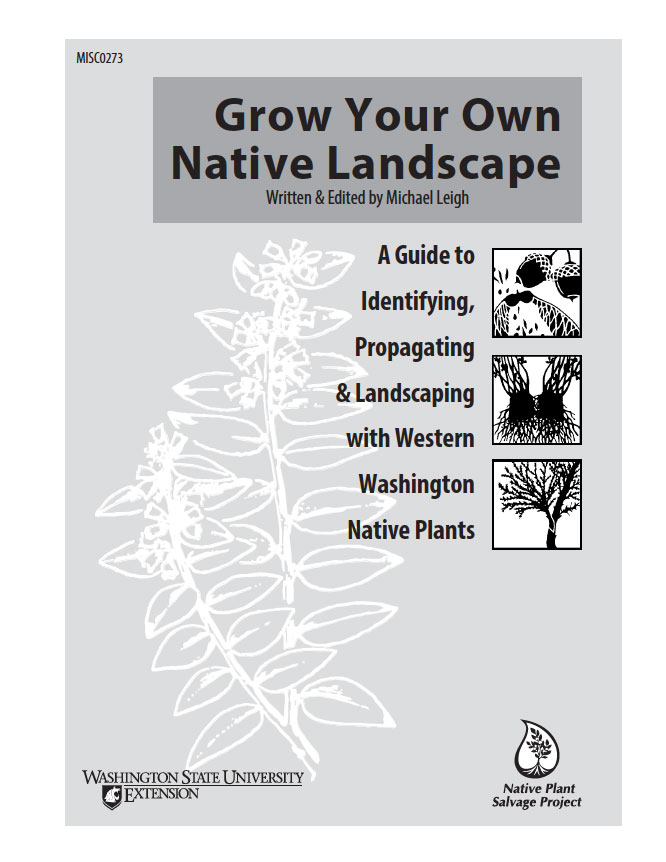
Archived - Grow Your Own Native Landscape: A Guide to Identifying, Propagating & Landscaping with W.WA Native plants
Notice: The following publication has been archived and may not meet WCAG 2.1 accessibility standards. If you need an accessible copy, please contact us.
Working with native plants can have many great advantages for gardeners. A large part of this clearly organized guide is devoted to descriptions of native plants.
Page Count: 124
Revised: January 2013
Related publications
-

Accepted Here! Food Access Programs at Washington State Farmers Markets
The Supplemental Nutrition Assistance Program (SNAP) and the Farmers Market Nutrition Program (FMNP) are designed to provide individuals and families in need with access to food and a more healthful d ...
- Published:
- November 2017
- SKU:
- TB44E
-
2022 Cost Estimates of Establishing, Producing and Packing Organic Gala Apples in Washington
Using these inputs, costs, and yields considered typical of a well-managed orchard, learn if producing Gala apple is feasible within your operation.
- Pages:
- 10
- Published:
- June 2016
- Revised:
- May 2023
- SKU:
- TB19E
Authors: -
A Mayweed Chamomile Growing Degree Day Model for the Inland Pacific Northwest
Providing an accurate prediction tool (Growing Degree Day Model) for mayweed chamomile to more effectively manage this increasing problem in the iPNW.
- Published:
- August 2018
- SKU:
- FS306E
-
4-H Record Book, Level 1
For beginning members. Includes instructions, calendar, and pages to record project plans, diary, and 4-H story.
- Published:
- September 1989
- Revised:
- March 1992
- Reviewed:
- July 2014
- Reprinted:
- December 1995
- SKU:
- C0932