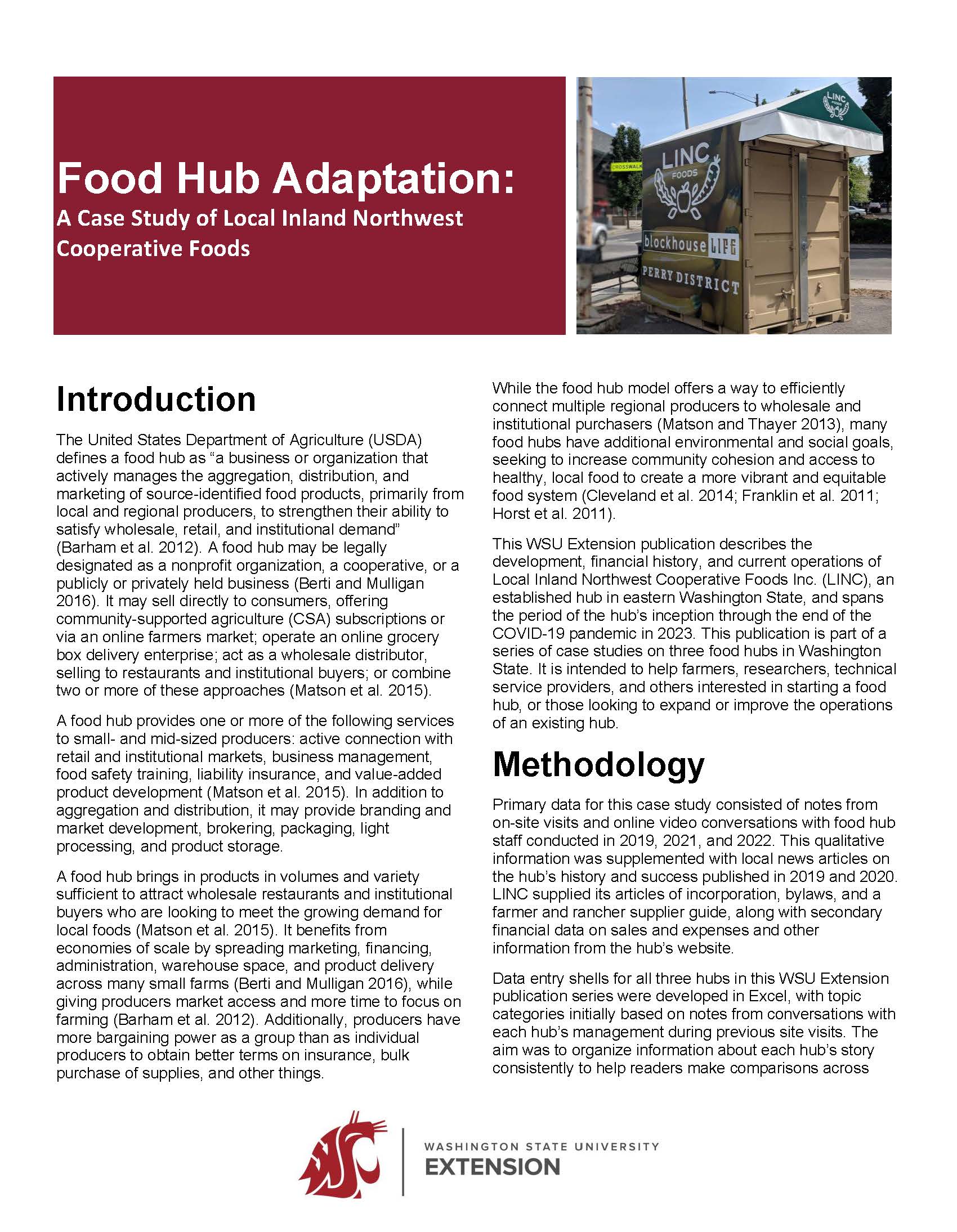
Archived - Food Hub Adaptation: A Case Study of Local Inland Northwest Cooperative Foods
Notice: The following publication has been archived and may not meet WCAG 2.1 accessibility standards. If you need an accessible copy, please contact us.
Farmers, researchers, technical service providers, and others interested in starting a food hub or expanding or improving the operations of an existing food hub can learn about this established hub in eastern Washington state, its development, financial history, and current operations.
Page Count: 15
Published: November 2024
Hurry! Only left in stock.
Related publications
-
Agricultural Lime and Liming, Part 3: Aglime Product Selection and Comparison Calculator User Guide (Soil Acidification Series)
Agricultural Lime and Liming is a three-part publication that introduces the basic principles of how and why calcareous amendments are land applied to elevate the pH of acid soils. Part 3 is a user’s ...
- Published:
- June 2016
- SKU:
- FS213E
-
Paterson's Curse (Echium plantagineum) in the Pacific Northwest
Paterson's Curse is a weed that is a major problem in Australia, but currently has only limited distribution in the Pacific Northwest. This weed has the potential to severely degrade agricultural h ...
- Revised:
- October 2007
- SKU:
- PNW602E
Authors: -
A Mayweed Chamomile Growing Degree Day Model for the Inland Pacific Northwest
Providing an accurate prediction tool (Growing Degree Day Model) for mayweed chamomile to more effectively manage this increasing problem in the iPNW.
- Published:
- August 2018
- SKU:
- FS306E
-
2022 Cost Estimates of Producing and Packing Fresh- Market Anjou Pears in Wenatchee River Valley, Washington State
Growers can compare cost estimations with various ranges of price and yield to determine if their Anjou pear operation would be profitable, all in this newly revised pub.
- Pages:
- 7
- Published:
- July 2011
- Revised:
- December 2022
- SKU:
- FS031E