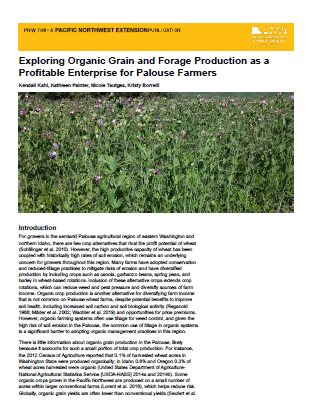
Exploring Organic Grain and Forage Production as a Profitable Enterprise for Palouse Farmers
Demand for organic grain has outpaced actual US grain production in recent years. Yet little is known about organic grain production in the Palouse, likely because it comprises a small portion of total crop production. This study takes a closer look. It examines crop productivity under reduced-tillage conditions, provides estimates of field-scale costs, determines the benefits of crop rotation, and describes the principal factors that determine profitability within cropping systems. The verdict: organic grain and forage production can be a profitable niche enterprise within a traditional Palouse nonorganic wheat farm.
Published: November 2020
Hurry! Only left in stock.
Related publications
-
Hard Cider Production and Orchard Management in the Pacific Northwest
Making hard cider for both commercial and private enjoyment is the target of renewed interest in areas that are well suited to growing apples. This bulletin provides guidance for making hard (fermented) cider as well…
Authors:Price: $11.00 -
Integrated Management of Feral Rye in Winter Wheat
This publication discusses identification and management of feral rye.
- Pages:
- 8
- Published:
- April 2014
- Revised:
- April 2025
- SKU:
- PNW660
Authors: -
Estimating Plant-Available Nitrogen Release from Cover Crops
This publication describes how cover crops benefit subsequent crops by supplying PAN and how you can take best advantage of this transfer. A site-specific method with step-by-step instructions is prov ...
- Published:
- November 2012
- SKU:
- PNW636
Authors: -
Root-lesion Nematodes: Biology and Management in Pacific Northwest Cropping Systems
To help Washington, Oregon, and Idaho wheat growers reduce the estimated $51 million annual loss to the region from root-lesion nematodes, PNW617 provides detailed results from the latest research ...
- Pages:
- 14
- Published:
- October 2015
- Revised:
- September 2019
- Reviewed:
- January 2023
- SKU:
- PNW617
Authors: