Emerald Ash Borer and Its Implications for Washington State
Description
This publication is intended for Extension professionals, master gardeners, public agency personnel, tree care professionals, and those who are interested in an in-depth review of the current state of knowledge about EAB and the implications for potential damage and mitigation strategies in Washington State.
Table of Contents
Introduction
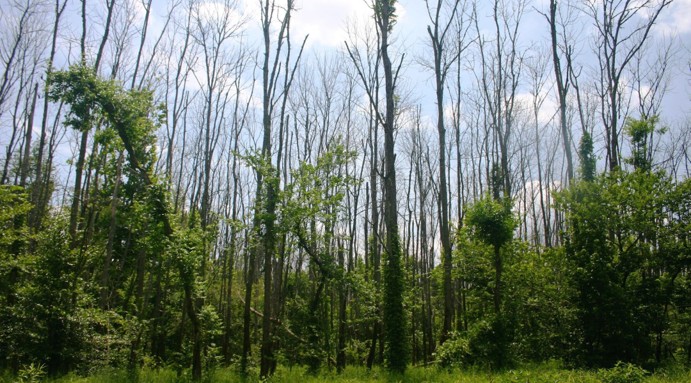
The emerald ash borer (EAB), Agrilus planipennis Fairmaire (Coleoptera: Buprestidae), is a destructive invasive insect native to eastern Asia that was accidentally introduced to North America in the Detroit, Michigan, area in the 1990s. Since then, EAB has caused almost 100% ash mortality (Figure 1) in the areas it has spread in North America (Knight et al. 2013). Despite quarantine and control measures, EAB continues to spread across the US and parts of Canada.
In June 2022, EAB was found in northwest Oregon near the Washington border. Oregon ash (Fraxinus latifolia), the Pacific Northwest’s (PNW) only native ash species, is highly susceptible to EAB and could experience significant mortality throughout the region. Susceptible ash species native to Europe and eastern North America are commonly used as ornamentals in Washington cities, so urban and community forests could also be significantly impacted.
This publication is intended for Extension professionals, Master Gardeners, public agency personnel, tree care professionals, and those who are interested in an in-depth review of the current state of knowledge about EAB and the implications for potential damage and mitigation strategies in Washington State. A separate publication, Managing Emerald Ash Borer in Washington State (Zobrist et al. 2023), is available for readers looking for a summary of EAB identification, distribution, impacts, and management recommendations.
EAB Biology
Adult Description
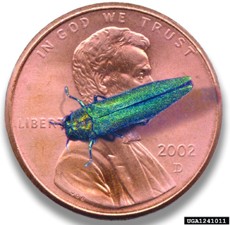
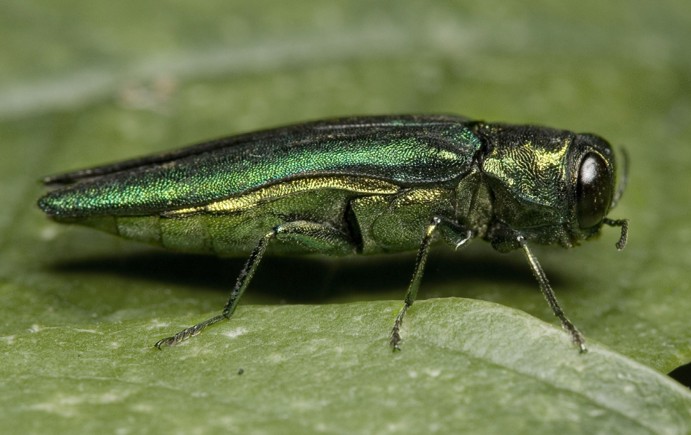
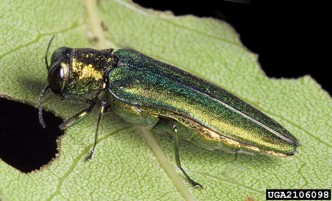
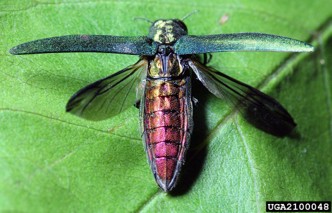
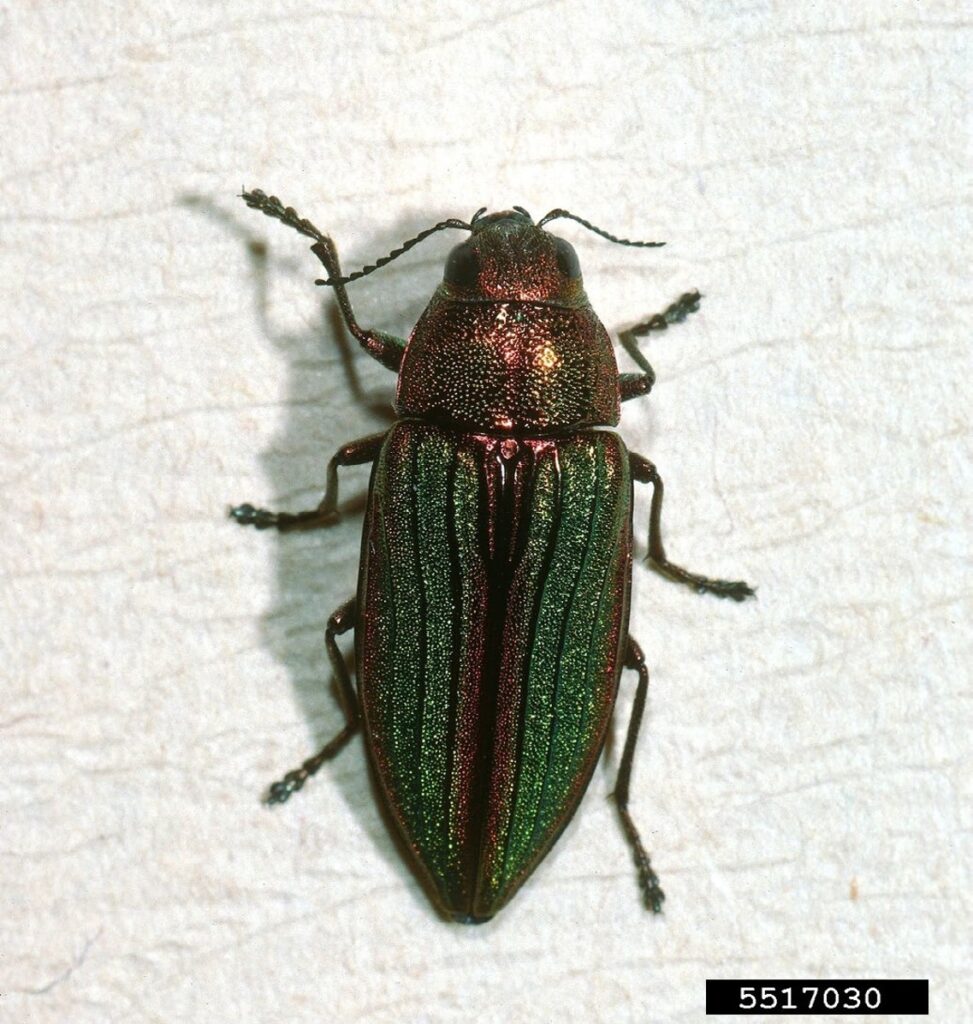
The EAB is a member of the metallic wood-boring beetle insect family Buprestidae. Adults are about 1/2-inch (13 mm) long and are a bright, metallic-looking, emerald-green color (Figure 2 and Figure 3). When its wings are raised, the upper side of its abdomen shows a purplish-red hue (Figure 4). EAB is narrower and more elongated compared to other buprestids (Parsons 2008; McCullough et al. 2015b).
Several insects native to Washington resemble EAB, so correct identification is important. One of the most notable look-alikes in the PNW is the golden buprestid beetle (Buprestis aurulenta) (Figure 5), which, despite its common name, is mostly green in color. The Washington Invasive Species Council has an emerald ash borer look-alike guide (pdf) that compares EAB to similar-looking insects in the PNW. EAB look-alikes do not bother ash trees. However, there are several native pests of ash trees in the PNW that occasionally cause similar symptoms of EAB infestation (Shaw et al. 2023), so it is important to investigate for signs of EAB (see Recognizing an EAB Infestation section below).
Life Cycle
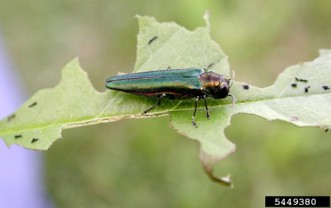
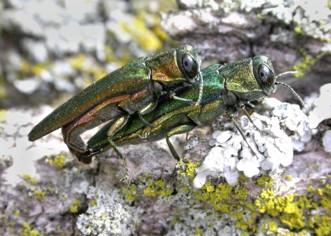
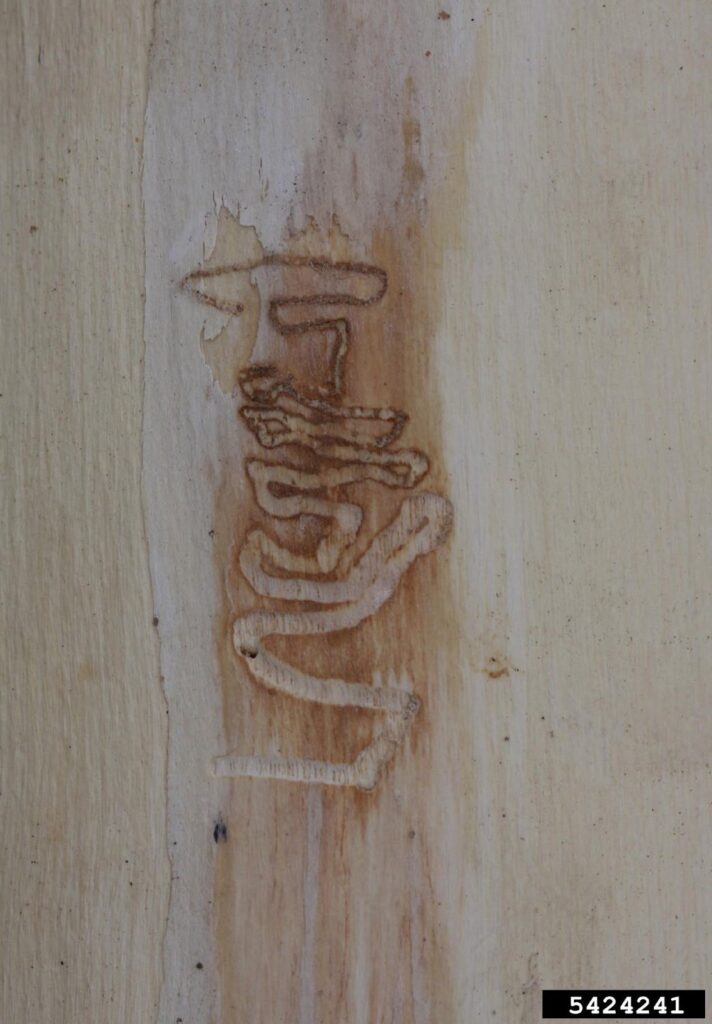
Wang et al. (2010) describe the general life cycle of EAB. Adults begin to emerge from their host trees and fly in May. Peak flight is in June or July and is usually over by September. Adults feed on ash foliage (Figure 6), but this does not cause significant damage to the tree. Adults feed for at least five to seven days before mating. They mate on leaf, bark, or branch surfaces (Figure 7), after which the mated females feed for another five to seven days before laying eggs in crevices in the bark (Figure 8). The eggs are tiny and very difficult to find. Eggs usually hatch into larvae about 15 days after they are laid (Figure 9) and immediately begin chewing through the bark and entering the phloem tissue. The larvae feed on the phloem and gradually bore into the cambium, creating serpentine galleries as they feed (Figure 10) (Wang et al. 2010).
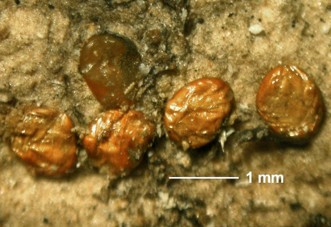
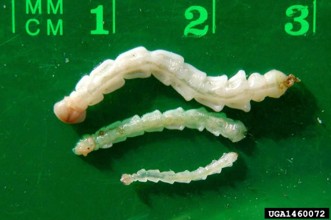
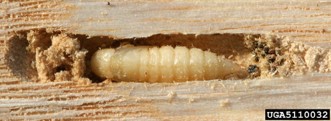
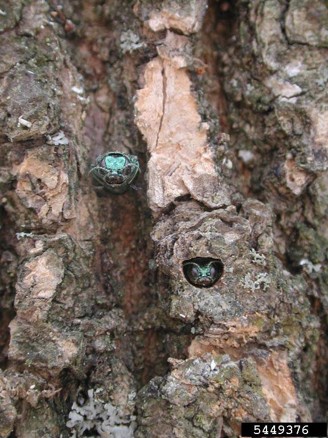
EAB larvae develop through four instars (Chamorro et al. 2012; Wang et al. 2010), which are periods between moltings, the shedding of the outer layers of their bodies as they grow. The larvae continue burrowing deeper into the tree, creating overwintering chambers in the tree’s xylem tissue in late summer or fall (Wang et al. 2010). Mature larvae become prepupae and then become pupae, the last stage before adulthood (Figure 11). Once they reach adulthood, the mature insects chew through the bark and emerge (Figure 12), creating characteristic D-shaped exit holes, and the cycle starts anew.
EAB can have a one-year life cycle (univoltine) or a two-year life cycle (semivoltine), depending on conditions. EAB tends to have a one-year life cycle in warmer climates or if trees are stressed, and a two-year life cycle in colder climates or if trees are healthy (Wei et al. 2007; Villari et al. 2016). In cut logs and firewood, EAB likely requires two years to complete its life cycle (Petrice and Haack 2007).
With a one-year life cycle, an EAB will overwinter as a fourth instar larva, develop into a prepupa in late winter or early spring, then become a pupa, and finally emerge as an adult in late spring (Wang et al. 2010). With a two-year life cycle, an EAB first overwinters as an early instar, feeds internally on the tree for a second summer, then overwinters again, this time as a fourth instar, before becoming a prepupa, pupa, and then emerging as a mature adult in the second spring (Tluczek et al. 2011). It is not yet known whether EAB that establish in Washington will need one or two years to complete their life cycle and spread to new trees.
EAB Damage
Tree Damage
The damage done to the host tree by adult EAB feeding on the foliage is negligible. The serious damage to the tree is done under the bark by the larvae. By burrowing in the phloem, cambium, and xylem tissues, the larvae disrupt the water, nutrient, and energy flows in the tree. When the tree becomes heavily infested, EAB feeding becomes so extensive that the larvae essentially girdle the tree, causing its decline and eventual death.
Susceptible Tree Species
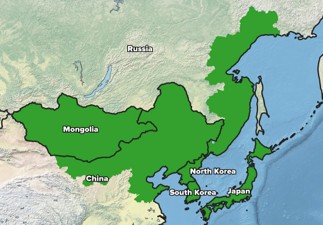
EAB almost exclusively attacks ash trees, which compose the Fraxinus genus in the olive family (Oleaceae). Six ash species are native to the EAB’s native range (Kelly et al. 2020), which covers Mongolia, northwest China, the Russian Far East, the Korean Peninsula, and Japan (Figure 13) (Haack et al. 2015; Orlova-Bienkowskaja and Volkovitsh 2018). These species coevolved with EAB and developed natural resistance to the insect. As such, EAB is a secondary pest of these trees, attacking those that are stressed and weakened by other factors such as age, disease, or other insects (Villari et al. 2016). In contrast, North American ashes are novel hosts because they did not coevolve with EAB, and they are highly vulnerable since they lack natural resistance (Herms 2015).
Sixteen species of ash are native to North America (Jensen 2020; Wagner and Todd 2015), all of which are susceptible to EAB. These species have different levels of susceptibility, but all are significantly more susceptible than their Asian counterparts (Kelly et al. 2020; Rebek et al. 2008; Villari et al. 2016). The most susceptible North American species include black ash (Fraxinus nigra), white ash (Fraxinus americana), green ash (Fraxinus pennsylvanica), and Oregon ash (Fraxinus latifolia) (Herms 2015; Kelly et al. 2020). Oregon ash is the only ash tree that is native to Washington. The other three are native to the eastern US, but they are commonly used in urban forests throughout the country, including Washington (Jacobson 1996).
With North American ashes, EAB exhibits a preference for attacking stressed trees (McCullough 2020). EAB adults also seem to prefer feeding on trees that are grown in full sun, possibly because increased light exposure changes the physical or chemical properties of the leaves to make them more palatable or nutritious (Chen and Poland 2009). However, these preferences do not mean that vigorous or shaded trees are not susceptible. Increasing ash tree vigor is not a successful management strategy in North America, as EAB will readily attack and kill healthy trees in its invasive range (McCullough 2020; MacQuarrie 2019). While neither the preference for stressed trees nor the preference for trees in full sunlight will impact EAB spread or ash mortality in North America, these preferences may have implications for selecting trap locations as part of a detection strategy.
Similar to North American ashes, European ashes did not coevolve with EAB and are highly susceptible to the pest (Baranchikov et al. 2008; Volkovitsh et al. 2021). In addition to having implications for EAB damage in Europe, this also has implications in North America where cultivars of European species, such as European ash (Fraxinus excelsior) and narrowleaf ash (Fraxinus angustifolia), are widely used as ornamentals (Jacobson 1996).
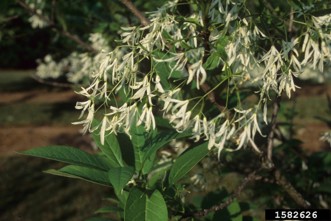
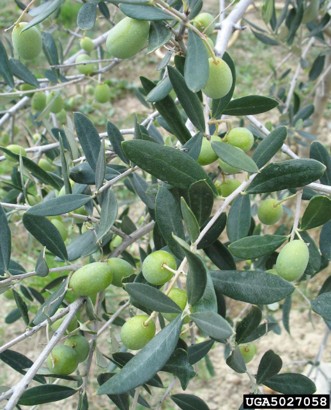
Two closely related species of non-ash trees in the olive family are also susceptible: the white fringetree (Chionanthus virginicus) (Figure 14) (Ragozzino et al. 2021; Peterson and Cipollini 2020; Thiemann et al. 2016) and the common olive tree (Olea europaea) (Figure 15) (Cipollini et al. 2017; Peterson and Cipollini 2020). The white fringetree is native to the southeastern US but is used in other areas as an ornamental (Cipollini and Rigsby 2015). The susceptibility of cultivated olive trees to EAB has caused concern in California where commercial olive crops could be threatened (Lyle 2021).
Overall Impact in the United States
Because of the high susceptibility of North American ash trees to EAB, there has been close to 100% mortality of most ash species in forested and urban areas in the eastern US that have been invaded by EAB (Knight et al. 2013; Klooster et al. 2014), and there is potential for similar damage in Washington. Flower et al. (2013) estimate that there are almost nine billion ash trees in the lower 48 states, representing about 2.5% of the aboveground forest carbon mass. Hundreds of millions of these trees have already been killed by EAB (McCullough 2020; Wagner and Todd 2015). The annual cost of EAB damage in the US is in the billions of dollars (Cappaert et al. 2005; Kovacs et al. 2010).
The most significant costs may be in urban areas where rapidly killed ash trees leave streets lined with standing, dead trees (Figure 16). Dead ash trees are subject to brittleness and decay, posing significant safety hazards (Alexander et al. 2020; Held et al. 2021; McCullough 2020). Most of the costs of hazard tree removal are borne by local governments and residential property owners, who face further costs in the form of lost ecosystem services and lower property values (Aukema et al. 2011).
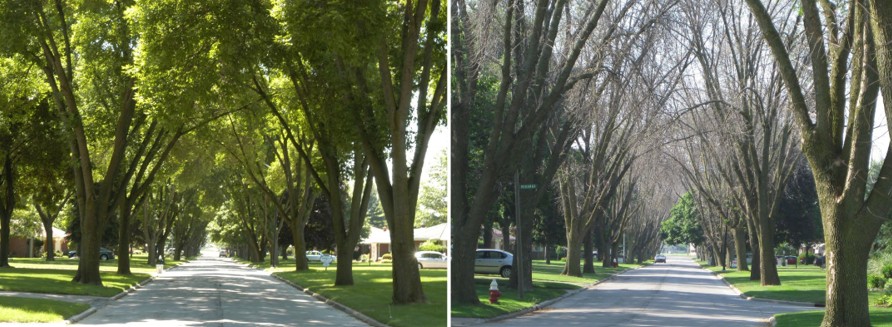
The ecological damage from EAB is also a concern. EAB significantly impacts forest ecosystems, resulting in altered forest structure and the potential spread of invasive weeds into areas opened by ash mortality (Wagner and Todd 2015). Ash trees, including Oregon ash, tend to be associated with sensitive riparian and wetland areas (National Audubon Society 2021; Wagner and Todd 2015). A variety of arthropods rely specifically on ash such that the loss of these trees could cause cascading ecological impacts (Gandhi and Herms 2010; Wagner and Todd 2015).
Ash Trees in Washington
Oregon Ash
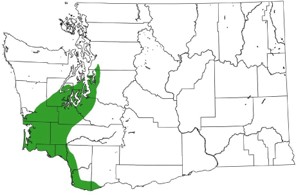
Oregon ash (Fraxinus latifolia) is the only ash species native to Washington (Zobrist 2014a). “Latifolia” translates from Latin as “broad-leaved.” Oregon ash is a low-elevation species growing from southern California north to the central Puget Sound region. In Washington, Oregon ash occurs naturally predominantly in the southwest part of the state but reaches as far north as Snohomish County (Figure 17) (Ellenwood et al. 2015). Isolated outlier populations may exist in other areas of the state.
Oregon ash is associated with wetlands and riparian areas around streams and lakes, as it is tolerant of wet soils, wind, and periodic flooding (Arno and Hammerly 2007). It has moderate shade tolerance, prefers growing in open areas, and can live up to 250 years (Owston 1990). Oregon ash can grow to more than 80 feet (24 m) tall (Jensen 2020).
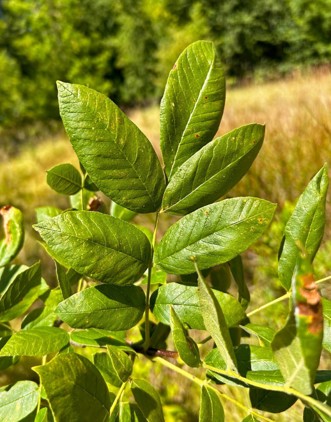
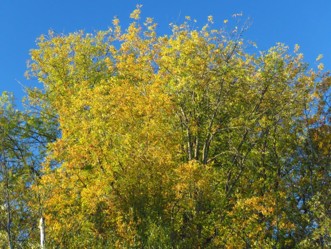
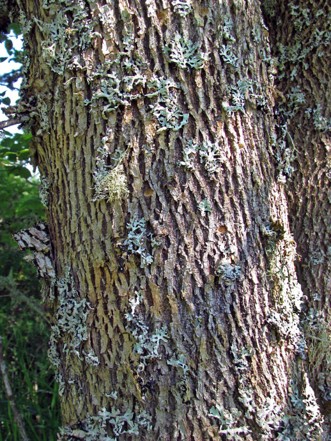
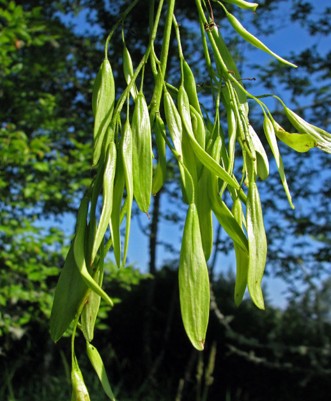
Oregon ash has pinnately compound leaves composed of two to four opposite pairs of leaflets and a single leaflet at the tip (Figure 18). Leaves are arranged as opposite pairs on the twigs. The leaves are bright green during the growing season and turn bright yellow in the fall (Figure 19). The bark has a crisscrossing lattice pattern (Figure 20). Oregon ash is dioecious with separate male and female trees. The females produce clusters of curved, canoe-shaped samaras as fruit (Figure 21).
Oregon ash has human uses and provides ecological functions. Although it has limited commercial value, it is used for tool handles and baseball bats (Jensen 2020). It is also a desirable species for firewood because it splits easily and has high heat value (Owston 1990). It provided Native American communities with a source of strong wood for canoe paddles and digging sticks (Moerman 1998). Deer and elk feed on the leaves and branches and the seeds are eaten by birds and squirrels, making Oregon ash an important wildlife food source (Arno and Hammerly 2007). Oregon ash is an important component of riparian forests in southwest Washington, providing shade and hydrologic functions for salmon and other aquatic species. In addition to its natural habitat, Oregon ash is also grown ornamentally in urban forests in Washington (Owston 1990) such that the loss of this tree would affect communities as well as ecosystems.
Ornamental Ashes
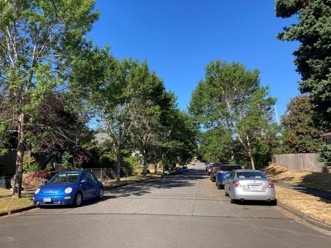
Ash cultivars became popular urban trees in the US beginning in the 1940s and are now common components of urban forests along streets and in yards and parks (MacFarlane and Meyer 2005). Washington’s native Oregon ash, cultivars of ash that are native to eastern North America, and cultivars of European ash are all found in Washington’s urban forests (Figure 22). All these species have high susceptibility to EAB (Kelly et al. 2020). The percentage of ash trees varies from city to city, but even when the percentage of ash trees is low, the number of ash trees can be in the thousands. For example, vulnerable ash species account for:
- 495 (4.4%) of inventoried trees in Bellevue (Mer-ryn Hearn, personal communication)
- 2,034 (35.2%) of inventoried trees in Lacey (City of Lacey 2021)
- 222 (9.5%) of inventoried trees in Olympia (Bruce Moulton, personal communication)
- 787 (0.7%) of inventoried trees in Renton (Ian Gray, personal communication)
- 4,331 (2.5%) of inventoried trees in Seattle (City of Seattle GIS Program 2022)
- 1,782 (1.9%) of inventoried trees in Spokane (Katie Kosanke, personal communication)
- 455 (2.4%) of inventoried trees in Tacoma (City of Tacoma, n.d.)
- 471 (4%) of inventoried trees in Vancouver (City of Vancouver, WA, n.d.)
- 581 (7.3%) of inventoried trees in Walla Walla (ArborPro, Inc 2021)
Common Name Confusion
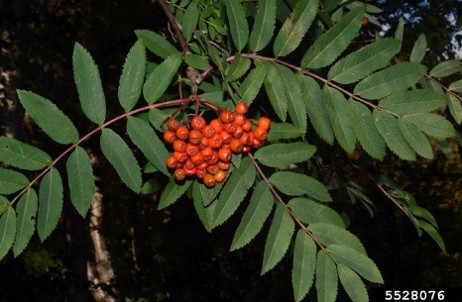
Trees in the Sorbus genus are commonly known as mountain ashes. Sitka mountain ash (Sorbus sitchensis) is a PNW native shrub that grows at high elevations in Washington (Pojar and MacKinnon 2004). European mountain ash (Sorbus aucuparia) (Figure 23) is a common ornamental tree planted in Washington. The Sorbus genus is in the rose family (Rosaceae) and has no relation to the Fraxinus species in the olive family. As such, these species are not susceptible to EAB. Similarly, a plant called Russian olive (Elaeagnus angustifolia) that is invasive in Washington has no relation to the common olive or the olive family and thus is also not susceptible to EAB.
The figures above are conservative estimates of the total number of ash trees, as these inventories may not include all trees. Some city inventories only include trees in parks, and others only include street trees. Trees on private property are generally not included.
The Spread of Emerald Ash Borer
Introduction to North America
EAB was first detected in North America in Detroit, Michigan, and across the Canadian border in Windsor, Ontario, in the summer of 2002 (Cappaert et al. 2005). However, subsequent analyses indicate that the actual introduction occurred in the 1990s and there was a lag period before EAB caused enough damage to be detected (Siegert et al. 2014). By the time EAB was detected, it had already spread to Ohio and other parts of Michigan via infested nursery stock and people moving firewood. By the end of 2002 officials found that five to seven million ash trees were affected in southeastern Michigan (Cappaert et al. 2005). EAB likely first arrived in the Detroit area from Asia via infested solid wood shipping material, such as crating, pallets, or dunnage (Cappaert et al. 2005; Poland and McCullough 2006).
Introduction to Europe
EAB was detected in Moscow in 2003 and quickly spread outward causing widespread ash mortality throughout European Russia (Baranchikov et al. 2008; Haack et al. 2015). In addition to affecting North American ash trees planted ornamentally in Europe, EAB has also caused significant mortality to the native European ash. EAB reached Ukraine by 2019 and has continued to spread to the borders of the European Union and Kazakhstan (Davydenko et al. 2022; Volkovitsh et al. 2021). There is concern that EAB could threaten olive crops in southern Europe and the Middle East (Orlova-Bienkowskaja and Bienkowski 2022). In addition, European ashes are threatened by ash dieback caused by the invasive fungus Hymenoscyphus fraxineus, also from east Asia. The combination of EAB and this fungal pathogen could be devastating to ash trees worldwide (Davydenko et al. 2022; Semizer-Cuming et al. 2019). Hymenoscyphus fraxineus is not yet present in North America, but North American ash species, including Oregon ash, are susceptible to this pathogen (Nielsen et al. 2017). Scientists are recognizing that threats to ash species from invasive pests and pathogens are a global issue that will require international cooperation to address (Semizer-Cuming et al. 2019).
Earlier Origins
Most of the focus of the EAB invasion has been on the accidental introductions in Detroit and Moscow that likely occurred in the 1990s. However, the story may have actually started a century earlier. North American ash trees were first introduced into China in the late 1800s and early 1900s, and they were introduced more widely as plantation trees in the 1960s (Dang et al. 2022; Wei et al. 2007). Both Dang et al. (2022) and Orlova-Bienkowskaja and Volkovitsh (2018) note that the introduction of North American ashes into eastern Asia resulted in outbreaks of EAB, which had previously been a rare and obscure pest. These outbreaks included events in 1982 and 1998 in Tianjin and Hebei, China. The elevated populations of EAB increased the likelihood of an otherwise rare insect reaching other parts of the world via infested shipping materials to invade new areas. The arrival of EAB in North America and Europe followed the outbreak in China in the 1990s (Dang et al. 2022; Orlova-Bienkowskaja and Volkovitsh 2018). Genetic analysis of North American EAB specimens suggests that the infestation most likely originated from populations in the Tianjin and Hebei areas (Bray et al. 2011). Thus, it was likely that the introduction of North American ashes to Asia ultimately precipitated the introduction of the Asian EAB to North America (Dang et al. 2022; Orlova-Bienkowskaja and Volkovitsh 2018).
Natural Spread
While the natural rate of spread of EAB depends on many variables, it is usually only a few miles per year (Siegert et al. 2015). Natural spread occurs when EAB adults emerge from infested trees and fly to new host trees where they lay eggs. Most mated females do not fly far, with 90% laying eggs on trees within 330 feet (100 m) of their point of emergence (Mercader et al. 2009). However, about 1% of mated females will fly more than 12 miles (20 km) (Taylor et al. 2010).
Human-Facilitated Spread
Long-distance spread of EAB is caused by humans moving EAB-infested ash material. For instance, EAB was carried from Michigan to Ohio, Maryland, and Virginia via infested nursery stock (Muirhead et al. 2006). People moving infested firewood for recreational purposes like camping is one of the most significant vectors of spread (Cappaert et al. 2005). EAB can hitchhike with people and in vehicles (Haack et al. 2015; Selikhovkin et al. 2022), and it can be spread by rail (Short et al. 2020). Some instances of spread have not been explained (Muirhead et al. 2006).
Establishing quarantines has been a state and federal policy tool to limit human spread of EAB. Michigan immediately imposed a quarantine after EAB was discovered in 2002, and in 2003 the USDA Animal and Plant Health Inspection Service (APHIS) imposed a federal quarantine prohibiting the movement of ash materials from areas known to be infested with EAB (Cappaert et al. 2005). Quarantine efforts have not been successful at stopping the spread of EAB. By 2021 EAB was present in 35 US states and five Canadian provinces (Cooperative Emerald Ash Borer Project 2021). Ward et al. (2020) described a major westward jump that occurred in 2013, when EAB was found in Boulder County, Colorado, 500 miles (800 km) from the nearest instance of EAB that was known at the time. They predicted that the heavily populated areas of northwestern Washington were the most at risk for future invasion, with arrival as early as 2022. In June 2022, EAB was found in declining ash trees in Forest Grove, Oregon, which is only 30 miles from Vancouver, Washington (Oregon Department of Forestry 2022).
Recognizing that the federal quarantine had not effectively prevented the spread of EAB, the Federal Register announced in 2020 that federal domestic quarantine regulations would be removed effective January 2021. This allows USDA APHIS to reallocate resources from regulatory enforcement activities to management and containment activities. This only affects the federal quarantine; states can still have their own quarantines (Federal Register 2020).
Recognizing an EAB Infestation
Signs and Symptoms of Infestations
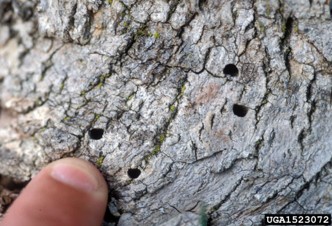
Early visual detection of EAB is difficult. Cappaert et al. (2005) and McCullough (2020) note that trees do not usually show symptoms in the beginning stages of infestation. It can take up to two years for larvae to mature and for the characteristic D-shaped exit holes (Figure 24) to appear, and the first exit holes are difficult to observe because infestations usually start at the top of the tree. It can take four to six years for visible indicators of EAB to appear, and by this time the tree is already heavily infested and considerable damage has been done (Cappaert et al. 2005; McCullough 2020). In Oregon, EAB is thought to have arrived three to five years before it was detected in 2022 (USDA APHIS 2022). A possible earlier sign of infestation could be delayed budbreak and flowering (Mwangola et al. 2023).
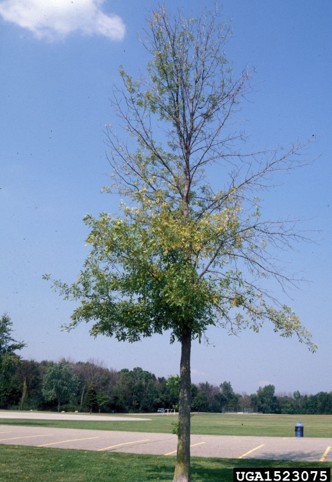
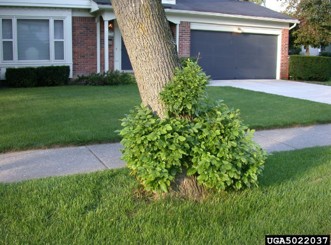
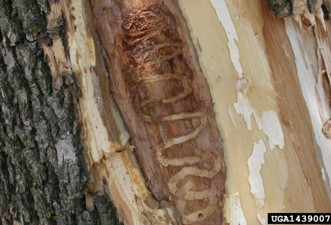
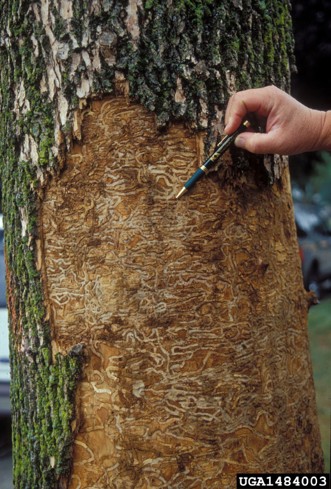
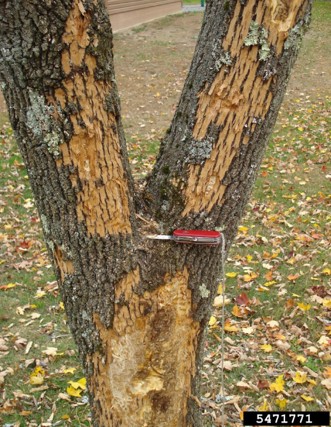
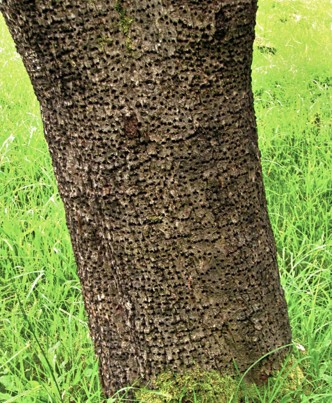
Late infestation tree symptoms include crown dieback (Figure 25) and epicormic shoots at the base of the tree (Figure 26). Epicormic shoots may also appear farther up the trunk or within the crown of the tree. Epicormic shoots are tender, green shoots emerging from hidden, dormant buds underneath the bark and are provoked by damage to emerge. They will look very out of place. In addition to the D-shaped exit holes, signs of EAB infestation can include vertical bark cracks with larval galleries underneath (Cappaert et al. 2005; McCullough 2020). EAB galleries are distinctively serpentine (S-shaped), especially during the early stages of infestation (Figure 27), but with increased EAB activity over multiple years the galleries will start to overlap and become more meandering, which could partially obscure the serpentine pattern (Figure 28) (De Groot 2006; Minnesota Department of Agriculture, n.d.). The galleries will still be readily recognizable, though, as there are no other pests of ash in Washington that would make similar galleries. Extensive damage to the outer bark from woodpecker foraging, known as blonding or wood pecks, may also be an indicator of infestation (Figure 29) (McCullough 2020). Small holes (Figure 30) created by a type of woodpecker known as a sapsucker are not indicative of EAB or other insect activity (Zobrist 2014b). Citizens who observe these signs and symptoms on ash trees in Washington should report the observations (see Management Recommendations for Citizens section).
EAB Traps
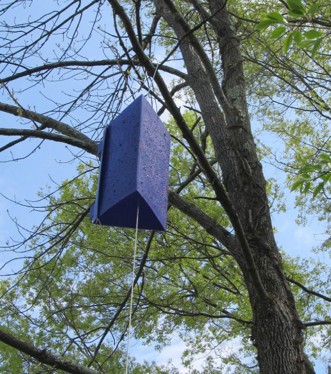
Since signs and symptoms of EAB are not visible in the early infestation period, traps are an important early detection tool. A common trap used to capture adult EAB is a prism trap, which is a piece of corrugated plastic that is folded to make a three-sided structure, coated with a sticky substance, and hung vertically in the tree canopy (Figure 31). EAB are particularly attracted to the colors purple (Francese et al. 2005) and green (Crook et al. 2009). Green tends to attract more males because it is similar to ash foliage, whereas purple tends to attract more females because the light wavelength is similar to ash bark where the females go to oviposit (Poland et al. 2019). Traps of either color are highly effective for detecting EAB (Poland and McCullough 2014).
Multifunnel traps are also effective at capturing EAB. These traps comprise vertically aligned funnels with a collection cup at the bottom (Figure 32). These traps can be hung in the tree canopy similar to prism traps. Francese et al. (2013) found that large multifunnel traps with at least 12 funnels are more effective than smaller ones, green traps catch more EAB than purple ones, and the traps work better when a slippery coating is applied. Multifunnel traps are more expensive than prism traps, but they can be reused because they are not coated with a sticky substance (Poland et al. 2019).
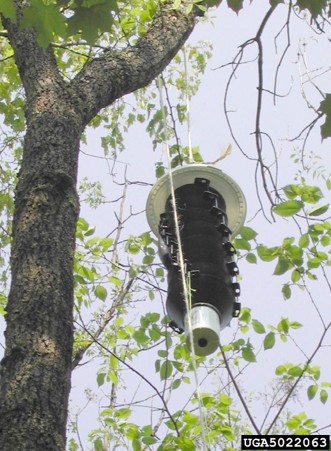
EAB traps are more effective when they are baited with an attractant. EAB does not appear to have a long-range sex pheromone that could be used as bait, since the adult males locate mates visually and the females emit a contact pheromone once the males land on them (Lelito et al. 2007; Rodriguez-Soana et al. 2007; Silk et al. 2009). EAB are attracted to volatile compounds emitted by ash trees, including the green leaf volatile (Z)-3-hexenol and bark volatiles given off by stressed ash trees that can be mimicked with phoebe oil and manuka oil (Grant et al. 2011). Of these three baits, (Z)-3-hexenol is more effective, more consistent, less expensive, and more readily available than phoebe oil or manuka oil (Grant et al. 2010, 2011; Poland et al. 2019).
Poland et al. (2011) developed a double-decker trap system specifically for EAB detection. These traps are mounted on a ten-foot (3 m) long, four-inch (10 cm) diameter PVC pipe set over a five-foot (1.5 m) T-post anchored in the ground. Two prism traps are attached vertically to the PVC pipe. Each prism trap is two feet (60 cm) tall and 16 inches (40 cm) wide. One of the prism traps is mounted at the top of the pipe, ten feet (3 m) above the ground. The second trap is mounted two feet below the first trap at six feet (1.8 m) above the ground. This double-decker trap design was found to be more effective than other types of traps, especially when baited with (Z)-3-hexenol (Poland et al. 2011).
Poland and McCullough (2014) found that purple double-decker traps attracted more EAB than green ones, but both had a 100% detection rate. Poland et al. (2019) found two-color double-decker traps with a dark green upper prism and a light purple lower prism to be even more effective than having two prisms of the same color, as the bicolor design better mimics the profile of a young ash tree. They found the bicolor double-decker traps to be the most consistently effective type of trap, followed by dark green multifunnel traps. Prism traps hung in the canopy were effective, but not as much as the other two types. The ground-mounted double-decker traps have the further advantage of avoiding the logistical challenges of having to hang and retrieve the traps from the canopy. The double-decker traps can be set up easily out in the open or on the edge of a stand, and a suitable host tree is not necessary. Overall, Poland et al. (2019) recommend a bicolor double-decker trap set up in the sun and baited with (Z)-3-hexenol as the most effective EAB detection system across all infestation levels, including very low levels where early detection is otherwise difficult.
Trap Trees
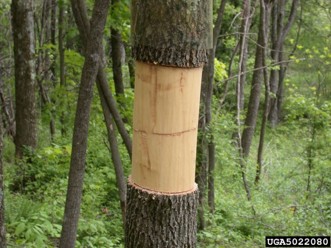
While EAB will readily attack healthy North American ash trees, they are particularly attracted to stressed trees (McCullough 2020; Tluczek et al. 2011). Girdling ash trees in spring or summer makes them highly attractive to EAB such that they can serve as trap trees (Figure 33) that can then be checked for EAB galleries in the fall or winter as part of a detection strategy (McCullough 2020). EAB also prefers trees grown in full sunlight (Chen and Poland 2009), so girdled trees in full sun conditions might make particularly good trap trees. Infested trap trees should be removed and destroyed to reduce the local EAB population (Mc-Cullough et al. 2015a, 2016). The presence of a trap tree could have a spillover effect, increasing EAB presence in the ash trees surrounding the trap tree, and this potential risk should be considered when managing EAB populations (McCullough 2020).
Pesticide Options
Integrated Pest Management and Pesticide Safety
Insecticides work best when used in combination with other methods as part of an integrated pest management (IPM) strategy. Other IPM methods can include biological control (biocontrol), which is the use of natural predators and parasites to manage pest populations, removing infested trees as mechanical control, and cultural control strategies like planting alternative tree species. For personal safety, environmental protection, product effectiveness, and compliance with state and federal laws, it is critical that insecticides are only applied in accordance with the product label. The label will dictate the rate, method, and frequency of application; necessary protective equipment; cleanup and storage protocols; and other key information.
According to the pesticide laws and safety in Washington state, pesticides must be registered for use in Washington by the Washington State Department of Agriculture (WSDA). Please note that pesticide product brand names are subject to change. It is the reader’s and applicator’s responsibility to ensure they are using a pesticide product that is currently registered by WSDA. This publication is not a substitute for obtaining, reading, and following pesticide label directions.
Emamectin Benzoate Stem Injection
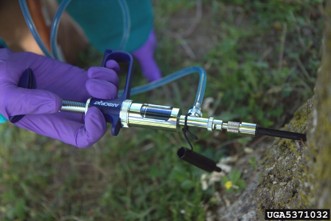
Stem injections of the systemic insecticide emamectin benzoate (Figure 34) have consistently proven to be the most effective insecticide treatment for managing EAB. These injections provide almost complete control of EAB for up to three years, even at the lowest application rate (Bick et al. 2018; de Andrade et al. 2021; Herms et al. 2019). Emamectin benzoate is currently sold under brand names such as TREE-äge, Mectinite, and Arbormectin, which are available to professional applicators (Herms et al. 2019).
Emamectin benzoate injections require specialized injection equipment such as the Arborjet TREE I.V. and QUIK-jet systems, the Brandt enTREE EB system, Chemjet tree injectors, and the Rainbow Ecoscience Q-Connect system. Costs range from a few hundred dollars for the simplest devices to more than two thousand dollars for larger, more advanced systems. Sadof et al. (2022) found that systems that use a higher number of injection ports, such as the TREE I.V. and Q-Connect systems that use 16 ports per meter of tree circumference, provide more uniform insecticide delivery and control EAB for three years, whereas systems with fewer ports only provide control for two years.
Because they offer multiyear protection, emamectin benzoate injections greatly reduce costs and logistical issues compared to annual insecticide treatments (McCullough et al. 2011) and are far less costly than replacing the trees (Kovacs et al. 2014; McCullough 2020). When treating trees with emamectin benzoate, Mercader et al. (2015) found that increasing the number of trees treated in an area significantly decreased EAB population growth whereas focusing treatment on large trees instead of smaller trees did not. Thus, the number of trees treated is more important for EAB management than the size of the trees treated.
McCullough et al. (2016) found that leaves of emamectin benzoate treated trees are highly toxic to EAB adult beetles, and the beetles will feed just as readily on treated trees as untreated trees. EAB often die after only one or two bites from a treated tree, and most are dead within 24 hours (McCullough et al. 2016). By killing adult beetles, emamectin benzoate prevents egg-laying, which protects not only the treated tree but can potentially also provide some protection to immediately adjacent trees (de Andrade et al. 2021). Emamectin benzoate also kills EAB larvae, providing comprehensive control in treated trees (Smitley et al. 2010).
The ideal time to do emamectin benzoate injections is mid to late spring after trees have flowered and leafed out but before EAB lay eggs. Protection does not last as long when injections are done in the fall (Herms et al. 2019). Flower et al. (2015) emphasize that emamectin benzoate is most helpful to trees when applied before any symptoms develop. If symptoms have begun to develop but the decline is in the early stages, treatment can still help stabilize and improve the health of the tree. If more than 50% of the canopy has declined, insecticide treatment is far less successful at saving the tree (Flower et al. 2015).
Herms et al. (2019) and McCullough et al. (2016) discuss several advantages of emamectin benzoate injections. Because the pesticide is injected directly into the tree, it is taken up and translocated quickly. It can be applied when soil conditions are not conducive to soil-applied products. It also minimizes the exposure to the applicator and the environment and reduces the potential for harm to non-target species, especially compared to cover sprays that involve a larger volume of insecticide and are subject to drift (Herms et al. 2019; McCullough et al. 2016). Tree injury and decay resulting from the injections is not a significant issue (Tanis and McCullough 2016). Ash trees have short-lived flowers that are pollinated by wind and do not provide nectar for bees, so it is unlikely that pollinators would be negatively affected by applying stem-injected pesticides to ash trees (Hahn et al. 2011).
McCullough (2020) notes that emamectin benzoate is compatible with biological control methods and thus can be used as part of an integrated pest management strategy. Since woodpeckers only feed on living EAB larvae, and insects that parasitize EAB also must have live hosts, the use of emamectin benzoate injections to kill EAB larvae has little negative effect on these biocontrol agents. Instead, these agents will shift their focus to the live larvae in untreated trees, concentrating their efforts, and perhaps improving their effectiveness as predators on untreated trees (McCullough 2020).
Lethal Trap Trees
McCullough et al. (2016) suggest creating a lethal trap tree by injecting a tree with emamectin benzoate and then girdling it a few weeks later after the insecticide has had a chance to be translocated throughout the tree. EAB will be attracted to the girdled tree and subsequently killed by the insecticide. As long as it does not pose a safety hazard, a lethal trap tree would not need to be removed and destroyed like a non-lethal trap tree would, as there will be no surviving EAB that could spread to other trees. Creating lethal trap trees while also treating nearby non-girdled ash trees with emamectin benzoate injections could be particularly effective at managing EAB (McCullough et al. 2016).
Other Stem Injections
Azadirachtin (brand name Azasol) is another systemic, stem-injected insecticide available to professional applicators that is effective against EAB. Herms et al. (2019) report that azadirachtin is not as effective on adults feeding on leaves compared to emamectin benzoate, but it provides good management of larvae for up to two years. If EAB pressure is high, azadirachtin should be applied annually, mid to late spring after trees have leafed out (Herms et al. 2019). Imidacloprid (brand name Imicide Systemic Insecticide) is a neonicotinoid insecticide that can also be used as a stem injection in mid to late spring, but results have been mixed (Herms et al. 2019; McCullough et al. 2011).
Basal Sprays
Dinotefuran is a neonicotinoid systemic insecticide that can be applied by a licensed pesticide applicator as a basal spray by spraying directly onto the lower five to six feet of the trunk using a calibrated sprayer. Brand names include Safari (20SG), Transect (70WSP), and Zylam Liquid Systemic Insecticide. The insecticide is absorbed through the bark and translocated throughout the tree. Basal sprays should be applied in the spring after trees have leafed out, and basal spraying is most effective when done annually at the highest rate permitted by the label (Herms et al. 2019). McCullough et al. (2011) report that basal spraying has had variable results and provides 50–70% reduction of EAB compared to more than 99% reduction from emamectin benzoate applications. Surfactants do not improve the performance of basal sprays (McCullough et al. 2011).
Soil Applications
Dinotefuran and imidacloprid can be used as systemic insecticides by applying them to the soil around the tree. The insecticide is taken up by the tree roots and translocated throughout the tree. Soil applications are not as effective as stem injections, especially injections of emamectin benzoate (Smitley et al. 2010). Soil applications are most effective when done annually at the highest rate permitted by the label (Bick et al. 2018; Herms et al. 2019).
Soil applications can be done as a soil injection, a drench, or with granules that are watered in. Soil injections should be applied two to four inches (5–10 cm) below the soil within 18 inches (46 cm) of the base of the tree at multiple spots around the tree. Drenches can be applied using a bucket or watering can at the base of the tree where many of the fine roots are located. Herms et al. (2019) caution that mulch and leaf litter should be moved aside before applying a drench. Soil applications should be done when the soil is moist, not dry or saturated. Follow the specific product label instructions. Any flowering plants around the base of the tree must be removed before any type of soil application is done so that there is no possibility of the plants taking up the insecticide and exposing it to pollinators. If flowering plants cannot be removed, the tree should be treated with a stem injection instead of a soil-applied product (Herms et al. 2019).
Some soil-applied insecticides are available to homeowners including Bioadvanced 12 Month Tree and Shrub Protect and Feed Concentrate II (active ingredients clothianidin and imidacloprid), Bioadvanced 12 Month Tree and Shrub Insect Control Concentrate (active ingredient imidacloprid), Bonide Annual Tree and Shrub Insect Control with Systemaxx (active ingredient imidacloprid), and Monterey Once a Year Insect Control II (active ingredient imidacloprid). These products are designed to be applied as a soil drench. Be sure to follow all product label instructions.
Other soil-applied products are available to licensed professional applicators and can be applied as a soil injection or a drench. These include the imidacloprid-based products Merit (75WP, 75WSP, 2F) and Xytect (2F, 75WSP), which can be applied early to mid-spring or mid-fall, and the dinotefuran-based products Safari (20SG), Transect (70WSP), and Zylam Liquid Systemic Insecticide which can be applied mid to late spring (Herms et al. 2019). A combination of imidacloprid and dinotefuran products is not more effective than applying one by itself (Bick et al. 2018).
Cover Sprays
Several cover sprays are labeled for management of EAB. However, these are not recommended because they are ineffective and can potentially harm non-target species like pollinators and insects that parasitize EAB (Herms et al. 2019; McCullough 2020).
Biological Control
Parasitoid Wasps
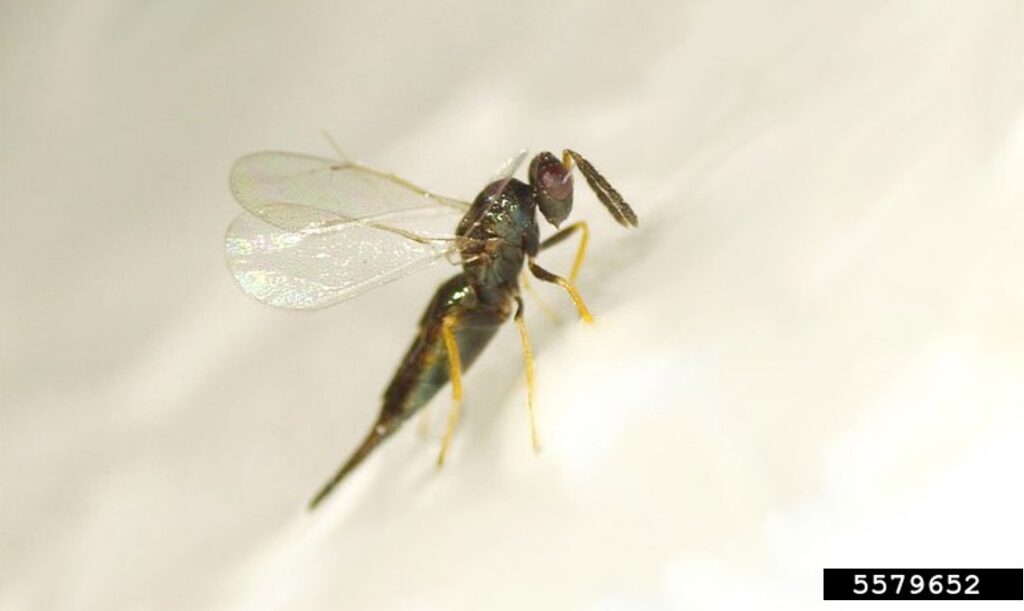
EAB is susceptible to several species of very small, stingless wasps. The female wasps use their ovipositors to lay eggs on or inside EAB larvae or eggs. When the wasp eggs hatch, the wasp larvae attack and kill EAB larvae or eggs. So far, no parasitoid wasps native to North America have been found to have a significant impact on EAB (Duan et al. 2009, 2015). Several parasitoid wasps that are from EAB’s native range in Asia and specialize on EAB show promise. Duan et al. (2018) describe four parasitoid wasp species that are approved for use in the US for biocontrol of EAB. Tetrastichus planipennisi Yang (Eulophidae) (Figure 35), Spathius agrili Yang (Braconidae) (Figure 36), and Oobius agrili Zhang and Huang (Encyrtidae) are native to China and were first released in the US in 2007. Spathius galinae Belokobylskij (Braconidae) is a parasitoid from the Russian Far East that was approved for use in 2015 (Duan et al. 2018). Tetrastichus planipennisi, S. agrili, and S. galinae parasitize EAB larvae (Figure 37), and O. agrili is an egg parasitoid (Figure 38). Results from the releases of these parasitoids show promise for long-term biological control of EAB that can help with ash recovery (Duan et al. 2022; Quinn et al. 2022; Duan et al. 2023).
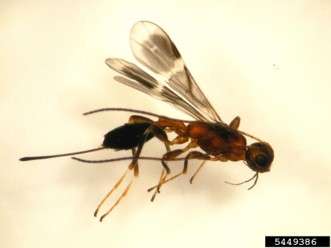
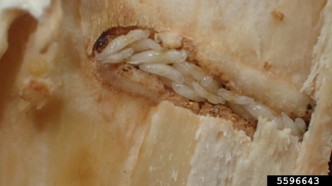
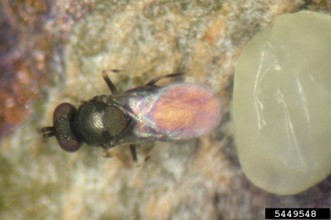
Several challenges are associated with these biocontrol candidates. Tetrastichus planipennisi can only parasitize EAB larvae in small trees because its ovipositor is too short to go through the thicker bark found on large trees (Duan et al. 2017; McCullough 2020). Spathius agrili did not successfully establish in the northern US because the climate is too cold; it is only used in the southern US below the 40th parallel (Aker et al. 2022; Bauer et al. 2015; Duan et al. 2018). Additionally, the warmer climate in the southern US shortens the EAB life cycle such that the larval stages of EAB could end up out of sync with parasitoid activity (Duan et al. 2018). Spathius galinae, on the other hand, established successfully in the northern US, has a longer ovipositor that can penetrate the thick bark of large ash trees, and readily attacked EAB populations (Aker et al. 2022; Duan et al. 2022; Quinn et al. 2022). Oobius agrili, which parasitizes EAB eggs, does not have as large of an impact on EAB as the larval parasitoids but could be used together with other egg parasitoids to supplement the larval parasitoids (Duan et al. 2017, 2018). These biocontrol agents may not be as effective for controlling EAB in white fringetree as they are for controlling EAB in ash (Hoban et al. 2018).
While parasitoids can reduce EAB populations and slow the rate of spread, they are inadequate to stop the EAB outbreak and spread and thus are unlikely to save mature ash trees (Gould et al. 2022). However, once the majority of mature ash trees have died and the EAB population collapses, established parasitoids could keep the EAB population suppressed to allow ash trees to successfully regenerate (Duan et al. 2015, 2017; Gould et al. 2022). Parasitoids can also be used together with insecticides for greater impact (Davidson and Rieske 2016; McCullough 2020).
Woodpeckers
Woodpeckers and other bark foraging birds, like the red-breasted nuthatch and the brown creeper, can significantly prey upon EAB larvae, providing another type of biological control (Flower et al. 2014). Woodpeckers have caused high EAB mortality in parts of the eastern US, but they tend to show up after an EAB infestation is established and prefer to forage on heavily infested trees (Jennings et al. 2013). As such, they are not effective at preventing damage or stopping the spread of EAB. However, woodpecker activity can serve as an early warning indicator of infestation when signs and symptoms are not yet readily apparent (McCullough 2020). Maintaining snags around ash trees may attract woodpeckers and encourage EAB predation (Flower et al. 2014). Heavy woodpecker foraging does not impact parasitism rates by biocontrol parasitoids (Murphy et al. 2018).
Tree Removal
Preemptive Tree Removal
If EAB activity is nearing, ash trees could be preemptively removed from urban forests in an effort to ease the burden on impacted municipalities by spreading the cost of tree removal out over a longer period of time. Removing a live, healthy tree may be less costly than removing a dead, hazardous tree (Gorman et al. 2022). Preemptive tree removal over time would also mitigate the logistical challenge that would occur if a large number of EAB-killed trees needed to be removed all at once. However, deploying emamectin benzoate treatments may be less costly and more effective at slowing the spread of EAB compared to preemptive tree removal, and treatment rather than removal maintains the ecosystem services provided by the trees (Kovacs et al. 2014; Mercader et al. 2011; Sadof et al. 2017).
Infested Tree Removal
Trees in later stages of decline (more than 50% canopy loss) are unlikely to be saved by insecticide treatments, including emamectin benzoate injections (Flower et al. 2015). It may be desirable to remove the trees at this point. To destroy EAB larvae, one option is heat-treating infested material to a core temperature of at least 133°F (56°C), maintained for at least 30 minutes (Haack and Petrice 2022). Incineration of infested wood is another option, and air curtain burners have the advantage of portability and minimization of particulate pollution (Lee and Han 2017). A third option is to grind or chip infested material into pieces no larger than one inch (2.5 cm) in two dimensions, which can be achieved by using a horizontal wood grinder with a one-inch screen (McCullough et al. 2007).
The inner wood from infested ash trees can be used for lumber as long as the bark and outer inch of underlying wood are removed and destroyed first (Oregon Department of Agriculture 2022). Lumber and firewood can be heat-treated per the specifications above to destroy any EAB larvae.
Future Directions
Fungal Control
Entomopathogenic species of fungi can parasitize insects and serve as a biopesticide. Johny et al. (2012) identified several strains of the naturally occurring fungus Beauveria bassiana that can cause over 90% mortality to EAB, and they isolated one particularly vigorous strain that shows promise as a biocontrol agent for EAB. However, Lyons (2015) notes several challenges in using entomopathogenic fungi for this purpose. For instance, the fungi could potentially impact non-target species. The introduced EAB parasitoids S. agrili and T. planipennisi have no significant susceptibility to B. bassiana, so they could potentially be used in combination with B. bassiana to manage EAB. However, several native insect species are susceptible to B. bassiana at high exposure levels. This off-target exposure could be mitigated by auto-contamination traps designed to specifically attract EAB (Lyons 2015). Srei et al. (2020) developed an auto-contamination device called FraxiProtec that exposes EAB to the B. bassiana fungus. Initial tests found that this device significantly controlled EAB population growth (Srei et al. 2020). Other species of fungi likely exist that could help with the management of EAB (Held et al. 2021). Entomopathogenic fungi could play an important role in future biocontrol efforts if deployment and off-target exposure issues can be resolved.
RNA Interference
RNA interference (RNAi) is a process that introduces double-stranded RNA (dsRNA) into an organism to silence a particular gene. This can be used to cause mortality and work as a pesticide. EAB has the necessary biological traits such that an RNAi-based insecticide could be used to control it (Zhao et al. 2015). Application of an RNAi-based insecticide has been tested on ash trees using topical application to the foliage and systemic application through root absorption. Both methods were found to be feasible and effective at controlling EAB (Pampolini et al. 2020). There is potential for RNAi-based insecticides that can target either EAB larvae or adults (Fan et al. 2022; Rodrigues et al. 2017, 2018). This is an emerging pest control tool that may be part of future EAB control strategies.
Genetic Resistance
In areas where ash trees have been decimated by EAB in the eastern US, a small number of surviving, healthy ash trees have somehow persisted while the other ash trees around them have succumbed. Some of these surviving trees have evidence of past EAB infestation while others do not. Known as “lingering ash,” these trees may just be the last to die, or they may have some sort of genetic mutation that imparts tolerance or resistance to EAB (Knight et al. 2012; Villari et al. 2016). Researchers are working to see if cross-pollination of these lingering ash trees produce progeny that are genetically resistant to EAB (Koch et al. 2012). Genetically resistant planting stock could allow for the recovery of North American and European ash species.
Hybridization could also produce genetically resistant ash trees. Researchers are working on breeding North American ash species with Asian ashes to create hybrids, with the hope that these hybrids will inherit EAB resistance from their Asian parental line (Koch et al. 2012). If successful hybrids get established before native ashes are wiped out, they could support native arthropods that are dependent on ash trees (Perry et al. 2022). Resistant hybrids may be a good option for reintroducing ash trees to urban forests.
EAB Detection Technology
One of the challenges in controlling the spread of EAB has been that EAB is often not detected until it has been established for several years. This allows for unchecked EAB populations to build, increasing EAB dispersal and tree mortality. Technology may allow for better early detection. For instance, stress from an EAB infestation can change the pigmentation in the tree foliage which can be detected using a field spectrometer (Moley et al. 2022).
Technology could also aid in preventing inadvertent transport of EAB. CT-scanning (tomodensitometry), for example, could potentially be used to ensure that exported wood products do not contain EAB or other invasive insect larvae that could cause accidental introductions in new areas (Martel et al. 2022).
Management Recommendations
SLow Ash Mortality (SLAM)
Stopping the spread of EAB may be unrealistic, and regulated management is not anticipated at the state level in Washington. SLow Ash Mortality (SLAM) is an integrated approach to slowing the spread of EAB into new areas, giving communities more time to plan and respond (Poland and McCullough 2010). The management recommendations in this publication are strategies that can slow EAB spread in Washington to mitigate community impacts.
Management Recommendations for Agencies and Municipalities
Be Vigilant
Emerald ash borer will cause economic challenges in municipalities. Agencies and municipalities should prepare for its arrival beforehand by conducting tree inventories and identifying vulnerable areas. Municipalities should develop response plans to apply control measures, provide resources, or consider preemptive tree removal in vulnerable areas. Stakeholders should be vigilant and monitor their ash resources carefully for signs, symptoms, and other indicators of EAB infestation. Where possible, strategically setting up bicolor double-decker traps can help with early detection.
Apply Control Measures
Injections of emamectin benzoate are a highly effective control method if done every two to three years. Agencies and municipalities should consider treating high-value ash trees in urban forests near areas where EAB has been found. Begin treatment when EAB is detected within 30 miles. Even treating a few trees can significantly mitigate the impact of EAB, but the more trees that are treated in an area, the more effective this strategy will be (Mercader et al. 2016). Creating lethal trap trees by treating a few sacrificial trees with emamectin benzoate and girdling them a few weeks later can help suppress the EAB population in an area. Specific insecticide product and timing recommendations are provided in the Pesticide Options section.
Timely release of parasitoid biocontrol agents, particularly T. planipennisi and S. galinae, can help control the spread and impact of EAB, especially when used in combination with insecticide treatments. Release sites should be naturally wooded areas that are at least 40 acres in size, composed of at least 25% ash trees ranging in size from seedlings to mature trees, and not slated for harvest or development for at least the next five years (Gould et al. 2021).
Public land managers can request parasitoids from USDA APHIS by email at or by phone 1-866-322-4512. USDA APHIS (PDF file) has additional information about EAB and on requesting and releasing parasitoids (PDF file).
Plant Alternative Species
Avoid planting European or North American ash species, their cultivars, or other host species. Remove these species from recommended planting lists. If an ash species is strongly desired, Manchurian ash is resistant to EAB (Whitehill et al. 2011). Avoid using Oregon ash in riparian restoration projects. Alternatives include black cottonwood (Populus trichocarpa), Pacific willow (Salix lucida var. lasiandra), red alder (Alnus rubra), shore pine (Pinus contorta var. contorta), western redcedar (Thuja plicata), and others (Kral and Shaw 2023).
Remove and Dispose of Infested Trees
When removing infested trees, destroy EAB larvae in the infested wood by heat-treating, incinerating, or chipping or grinding into pieces no larger than one inch (2.5 cm) in two dimensions.
Evaluate Preemptive Tree Removal Options
Preemptive removal of existing healthy ash trees that are not infested with EAB can have cost and logistical advantages compared to removing a large number of dead trees all at once. However, preemptive removal is not effective at controlling the overall spread of EAB, and treatment with emamectin benzoate injections may be less expensive, less environmentally damaging, and a more effective strategy than preemptive removal. For existing unhealthy ash trees that are not infested with EAB but are in decline due to another issue, it may be appropriate to remove those trees now and replace them with non-ash species.
Ultimately, any preemptive tree removal strategy should be planned thoughtfully, with consideration for costs, logistics, workload capacity, tree values, risk tolerance, and treatment alternatives. Planning for preemptive tree removal should be done in advance before the arrival of EAB in the vicinity. Planning should include identification of high-value trees and trees that would pose significant safety hazards if killed by EAB.
Trees should be removed between October 1 and March 31, the dormant period for EAB (Gorman et al. 2022). Trees slated for removal could first be girdled in the spring and then removed in the fall or winter, allowing them to serve as trap trees. This could help both detect EAB activity and reduce local EAB populations.
Conduct Education and Outreach
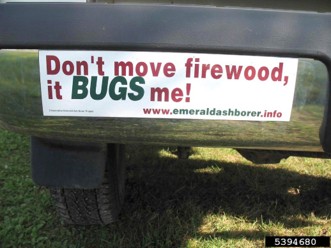
Public education and outreach will be an important part of an EAB response strategy. Educational topics could include:
- Identification of ash trees and EAB
- Threats posed by EAB
- The importance of not moving firewood (Figure 39)
- Treatment and prevention options
Provide Resources
Successful management of EAB requires control measures to be applied on both public and private property. Private property owners may not have the resources to protect healthy trees or properly dispose of infested trees in a way that destroys EAB larvae in the infested wood. Assisting with the cost and logistics of treatment and disposal on private property will help control the spread of EAB on public property and mitigate the impact on the community. Another essential resource will be trainings for public and private tree care professionals on EAB identification and treatment. It is especially important to offer training materials on the use of emamectin benzoate injections to ensure that adequate professional assistance is readily available for private property owners and public land managers.
Collaborate
One of the most important things agencies and municipalities can do is work together. Interagency collaboration, communication, and partnerships can increase capacity, improve response, and provide consistent, unified messaging to the public (Alexander et al. 2020). Coordinated management of ash trees on both public and private lands across multiple jurisdictions using an aggregated budget is more impactful and cost effective than jurisdictions working independently with disparate budgets or only operating on public lands (Kovacs et al. 2014).
Management Recommendations for Citizens
Be Vigilant
One of the most important things citizens can do to mitigate the spread and impact of EAB is to be vigilant and consistently monitor their ash trees. Symptoms of EAB infestation include top-down crown dieback (Figure 25) and epicormic shoots at the base or elsewhere along the main stem of the tree (Figure 26). Signs of EAB include D-shaped exit holes (Figure 24) and serpentine galleries under cracked bark (Figure 27 and Figure 28). Adults may be present on the bark and foliage in the late spring and summer. Watch for unusually high woodpecker activity on ash trees.
Suspected occurrences of EAB can be reported several ways:
- Report it to the Washington Invasive Species Council
- Report it to the Washington State Department of Agriculture (WSDA) Pest Program or by phone at 1-800-443-6684.
- Report it to USDA APHIS
If you find an insect that you suspect is EAB, try to capture a specimen to assist local authorities with identification. Captured EAB can be sealed in a jar or plastic bag and placed in the freezer to kill and preserve them. A high-quality photo could also be used for identification if capturing a specimen is not feasible. Photos should be high-resolution, in sharp focus, and as close up as possible. For help with insect identification, contact your local WSU Extension office or the WSU Plant & Insect Diagnostic Laboratory.
Do Not Move Firewood
Movement of infested recreational firewood has been one of the primary vectors of EAB spread. While EAB will only infest ash firewood, no firewood should be moved to other locations, as it has the potential to spread other types of invasive pests. Instead, you should “buy it where you burn it.” When going camping, do not bring firewood from home. Instead, buy the firewood at or near the campground when you arrive. The website Don’t Move Firewood is a good resource for more information.
Apply Preventative Insecticide
Treating ash trees with an appropriate insecticide can prevent damage from EAB. Several products are available to homeowners that can be applied annually as a soil drench. These products are listed above in the pesticide section. These soil drench products provide moderate protection when applied annually. For better protection, hire a qualified tree care professional to administer stem injections of emamectin benzoate every two to three years. Begin insecticide treatment when EAB is detected within 30 miles. When applying an insecticide, ensure that the product and application method is legal in Washington, and carefully read and follow all product label instructions.
Have Infested Trees Treated or Removed
A tree in the early stages of EAB infestation can be treated with an emamectin benzoate injection to eradicate EAB from the tree and prevent further damage and decline for up to three years. A tree in a later stage of EAB infestation, as indicated by more than 50% crown dieback, is unlikely to be saved by emamectin benzoate treatment. In this case, the tree should be removed and destroyed. Dead ash trees pose safety hazards and should be removed by a qualified professional. Infested wood can be destroyed by burning if it is safe and legal to do so or by chipping or grinding into pieces smaller than one inch (2.5 cm) in two dimensions. Adequate heat treatment can also kill infesting EAB. Since EAB only damages the outer portion of the wood, the inner wood of dead ash trees can be utilized for lumber if the outer portion is removed and destroyed.
Plant Alternative Species
Existing ash trees that are not infested with EAB do not need to be removed preemptively. However, planting new ash trees should be avoided if they are susceptible to EAB. In natural areas, native species like black cottonwood (Populus trichocarpa), Pacific willow (Salix lucida var. lasiandra), red alder (Alnus rubra), shore pine (Pinus contorta var. contorta), and western redcedar (Thuja plicata) may work well on wet sites where Oregon ash is typically found. Oregon State University Extension publication Alternatives to Ash in Western Oregon: With a Critical Tree Under Threat, These Options Can Help Fill Habitat Niche lists a variety of Oregon ash alternatives based on soil type and moisture levels (Kral and Shaw 2023).
For streets and landscapes, numerous other tree species can be used to replace ash trees. Your local WSU Extension office, local Conservation District, or the Washington State Department of Natural Resources Urban and Community Forestry Program can help with choosing an appropriate species in both natural and urban environments. Your city or county may also have recommendations.
Recommended Additional Reading
- A Visual Guide to Detecting Emerald Ash Borer Damage (Canadian Forest Service publication)
- Biology and Control of Emerald Ash Borer (PDF file) (USDA Forest Service Publication)
- Emerald Ash Borer Biological Control Release and Recovery Guidelines (PDF file)
- Emerald Ash Borer Information Network
- Guidelines to Slow the Growth and Spread of Emerald Ash Borer (PDF File) (Minnesota Department of Agriculture publication)
- Managing Emerald Ash Borer in Washington State (Washington State University Extension publication FS384)
- Recommendations for Emerald Ash Borer Response in Washington Communities (PDF file)
- USDA APHIS Emerald Ash Borer website
- Washington Invasive Species Council Urban Forest Pest Readiness Playbook (PDF file)
- What to Do about Emerald Ash Borer: Recommendations for Tree Protection in EAB-Infested Areas (Oregon State University Extension)
Glossary
- arthropod: A general term used to encompass many organisms thought of as insects. Arthropods can include insects, such as beetles, ants, flies, and bees, as well as arachnids, such as spiders and mites.
- basal spray: Direct pesticide application to the bark of plant stems or trunks at or just above the ground.
- biological control (or biocontrol): An integrated pest management (IPM) approach which uses living organisms to suppress pest organisms. These may be naturally occurring or introduced.
- biopesticide: Pesticides that use microorganisms or naturally occurring substances as the active ingredient.
- blonding: The visual phenomenon that occurs when woodpeckers fleck off the outer, darker tree bark to reveal lighter bark beneath while looking for EAB larvae in ash trees.
- cambium: The plant tissue of actively dividing cells between the xylem and the phloem. This tissue leads to secondary growth and thickening in woody plants.
- cover spray (also known as a broadcast spray): A uniform application of a pesticide over an entire area such as the canopy of a tree.
- cross-pollination: The process where pollen from one flower comes in contact with a different flower. Cross-pollination can be achieved through wind, insects, or animals depending on the plant species, or it can be done artificially.
- cultivar: A plant of the same species which has unique traits that can be passed to future generations. Cultivars are often bred for their desired traits.
- cultural control: An integrated pest management (IPM) approach which modifies the growing environment to reduce the prevalence of pest organisms.
- drench: Direct application of pesticides diluted with water to the soil surface. The water moves the pesticides to the roots of the plant for uptake.
- drift: The movement of pesticide spray droplets, dusts, or vapors through the air beyond the intended spray area.
- entomopathogenic: Typically refers to fungi or nematodes. An organism that can infect and usually kill insects.
- epicormic shoots (also known as suckers): A plant stem (shoot) growing from different types of buds of many deciduous trees; often either at the base of the plant or from the main stem. Shoots typically grow in response to stressors.
- exit hole: The hole created as an adult insect leaves the woody tissue of a plant. Exit holes can be diag-nostic as different groups of wood boring insects have differently shaped heads. For instance, insects that have round heads create a round exit hole while a flat-headed insect such as emerald ash borer creates a D-shaped exit hole.
- gallery (pl. galleries): Tracks or tunnels created by the feeding activity of insect larvae and adults. Emerald ash borer larvae typically create S-curved galleries when they are early instars.
- girdle: Damage to the bark all the way around a woody tissue, such as a branch, stem, or trunk. Girdling a tree trunk below the live branches typically kills the tree.
- host: A plant or animal being affected by a pest, pathogen, or parasite.
- hybridization: When pollen of one species fertilizes the flowers of a different species.
- instars: Various growth stages of insect development.
- insecticide: A pesticide that is used to control, mitigate, prevent, or destroy an insect or mite.
- integrated pest management: Pest management that values and utilizes multiple control strategies to reduce the impact or presence of a pest. Integrated pest management includes using cultural control methods, biological control methods, and chemical control methods (pesticides).
- mechanical control: An integrated pest management (IPM) approach which controls pests through physical means.
- molting: The shedding of the insect exoskeleton (external skeleton, sometimes thought of as a “shell”) as the insect develops into different instars.
- neonicotinoid: A group or class of insecticide active ingredients that are chemically similar or related to nicotine. These insecticides act on the neurological system of insects, are often water soluble, and can be systemic.
- non-target species: Organisms that the applied pesticide was not intended to contact.
- novel host: A plant (referred to as a host) that has not previously encountered or been encountered by a pest or pathogen.
- ovipositor: A tube-like structure on female insects, and other animals, for laying eggs.
- parasitoid: An organism that invades or attaches to a host organism’s body, feeding on it until the host dies.
- parasitize: To live on or infest another organism causing a negative impact on the host organism.
- phloem: Vascular tissue of a woody plant that moves sugars and nutrients. Contrast with xylem.
- prepupae: The mature larva insect developmental stage (instar) prior to becoming (molting) a pupa.
- pupa (pl. pupae): An intermediate stage of development for insects that undergo complex metamorphosis. Insects do not feed during the pupal stage. Usually involves a chrysalis or cocoon.
- RNA interference: Using RNA (genetic material similar to DNA) molecules to suppress a genetic trait in a target organism.
- secondary pest: Pests that infrequently or occasionally cause damage but rarely stress or kill their host plants; secondary pests are usually less important than key pest species.
- semivoltine: Insects that take more than one year to complete their life cycle. Compare to univoltine.
- signs: Physical damage caused by a pest (e.g., galleries, exit holes, chewed leaves) or the visibility of the pest itself.
- snag: A standing dead tree, typically taller than six feet (1.8 m) and greater than eight inches (3 cm) in diameter.
- soil injection: Injection of a liquid pesticide below the soil surface into the root zone of the tree.
- symptoms: A tree’s reaction to a pest attack (e.g., crown dieback, epicormic shoots).
- systemic insecticide: An insecticide (type of pesticide) that is absorbed and moved through the plant. Application to one area of the plant will result in movement and protection to nearby plant areas or throughout the entire plant (translocated).
- translocation: Movement of a systemic pesticide within a plant. The pesticide may move through the phloem or through the xylem.
- trap tree: A tree that is intentionally damaged or girdled so that the damaged tree is attractive to pests. Trap trees can be used to attract a pest away from desirable trees or the trap tree can be treated with a pesticide so that it is lethal to the pest.
- univoltine: Insects that complete their life cycle in one year.
- urban forests: Trees, shrubs, and the associated vegetation in an urban area. This includes yards, green spaces, transportation corridors, street trees, parks, wetlands, nature preserves, shelters, and gardens.
- xylem: Vascular tissue that moves water absorbed by the roots up through the stems to the leaves of the plant. Contrast with phloem.
References
- Aker, S.A., R.B. de Andrade, J.J. Duan, and D.S. Gruner. 2022. Rapid Spread of an Introduced Parasitoid for Biological Control of Emerald Ash Borer (Coleoptera: Buprestidae) in Maryland. Journal of Economic Entomology 115 (1): 381–86.
- Alexander, K., M. Truslove, R. Davis, S. Stephens, and R. Zentz. 2020. A Collaborative Approach to Preparing for and Reacting to Emerald Ash Borer: A Case Study from Colorado. Forestry 93 (2): 239–53.
- ArborPro, Inc. 2021. Urban Forestry Management Plan City of Walla Walla, Washington.
- Arno, S.F., and R.P. Hammerly. 2007. Northwest Trees: Identifying and Understanding the Region’s Native Trees. Anniversary Edition. Seattle, WA: Mountaineers Books.
- Aukema, J.E., B. Leung, K. Kovacs, C. Chivers, K.O. Britton, J. Englin, S.J. Frankel, et al. 2011. Economic Impacts of Non-Native Forest Insects in the Continental United States. PLoS ONE 6 (9): e24587.
- Baranchikov, Y., E. Mozolevskaya, G. Yurchenko, and M. Kenis. 2008. Occurrence of the Emerald Ash Borer, Agrilus planipennis in Russia and Its Potential Impact on European Forestry. EPPO Bulletin 38 (2): 233–38.
- Bauer, L.S., J.J. Duan, J. Gould, and R. Van Driesche. 2015. Progress in the Classical Biological Control of Agrilus planipennis Fairmaire (Coleoptera: Buprestidae) in North America. The Canadian Entomologist 147 (3): 300–317.
- Bick, E.N., N.J. Forbes, C. Haugen, G. Jones, S. Bernick, and F. Miller. 2018. Seven-Year Evaluation of Insecticide Tools for Emerald Ash Borer in Fraxinus pennsylvanica (Lamiales: Oleaceae) Trees. Journal of Economic Entomology 111 (2): 732–40.
- Bray, A.M., L.S. Bauer, T.M. Poland, R.A. Haack, A.I. Cognato, and J.J. Smith. 2011. Genetic Analysis of Emerald Ash Borer (Agrilus planipennis Fairmaire) Populations in Asia and North America. Biological Invasions 13 (12): 2869–87.
- Cappaert, D., D.G. McCullough, T.M. Poland, and N.W. Siegert. 2005. Emerald Ash Borer in North America: A Research and Regulatory Challenge. American Entomologist 51 (3): 152–65.
- Chamorro, M.L., M.G. Volkovitsh, T.M. Poland, R.A. Haack, and S.W. Lingafelter. 2012. Preimaginal Stages of the Emerald Ash Borer, Agrilus planipennis Fairmaire (Coleoptera: Buprestidae): An Invasive Pest on Ash Trees (Fraxinus). PLoS ONE 7 (3): e33185.
- Chen, Y., and T.M. Poland. 2009. Biotic and Abiotic Factors Affect Green Ash Volatile Production and Emerald Ash Borer Adult Feeding Preference. Environmental Entomology 38 (6): 1756–64.
- Cipollini, D., and C.M. Rigsby. 2015. Incidence of Infestation and Larval Success of Emerald Ash Borer (Agrilus planipennis) on White Fringetree (Chionanthus virginicus), Chinese Fringetree (Chionanthus retusus), and Devilwood (Osmanthus americanus). Environmental Entomology 44 (5): 1375–83.
- Cipollini, D., C.M. Rigsby, and D.L. Peterson. 2017. Feeding and Development of Emerald Ash Borer (Coleoptera: Buprestidae) on Cultivated Olive, Olea europaea. Journal of Economic Entomology 110 (4): 1935–37.
- City of Lacey. 2021. City of Lacey Urban Forest Management Plan.
- City of Seattle GIS Program. 2022. Trees.
- City of Tacoma. n.d. Treeplotter Inventory.
- City of Vancouver, WA. n.d. Treeplotter Inventory.
- Cooperative Emerald Ash Borer Project. 2021. Initial County EAB Detections in North America. USDA APHIS.
- Crook, D.J., J.A. Francese, K.E. Zylstra, I. Fraser, A.J. Sawyer, D.W. Bartels, D.R. Lance, and V.C. Mastro. 2009. Laboratory and Field Response of the Emerald Ash Borer (Coleoptera: Buprestidae), to Selected Regions of the Electromagnetic Spectrum. Journal of Economic Entomology 102 (6): 2160–69.
- Dang, Y., K. Wei, X. Wang, J.J. Duan, D.E. Jennings, and T.M. Poland. 2022. Introduced Plants Induce Outbreaks of a Native Pest and Facilitate Invasion in the Plants’ Native Range: Evidence from the Emerald Ash Borer. Journal of Ecology 110 (3): 593–604.
- Davidson, W., and L.K. Rieske. 2016. Establishment of Classical Biological Control Targeting Emerald Ash Borer Is Facilitated by Use of Insecticides, with Little Effect on Native Arthropod Communities. Biological Control 101: 78–86.
- Davydenko, K., Y. Skrylnyk, O. Borysenko, A. Menkis, N. Vysotska, V. Meshkova, Å. Olson, M. Elfstrand, and R. Vasaitis. 2022. Invasion of Emerald Ash Borer Agrilus planipennis and Ash Dieback Pathogen Hymenoscyphus fraxineus in Ukraine—A Concerted Action. Forests 13 (5): 789.
- de Andrade, R.B., K. Abell, J.J. Duan, P. Shrewsbury, and D.S. Gruner. 2021. Protective Neighboring Effect from Ash Trees Treated with Systemic Insecticide against Emerald Ash Borer. Pest Management Science 77 (1): 474–81.
- De Groot, P. 2006. A Visual Guide to Detecting Emerald Ash Borer Damage. Sault Ste. Marie, Ont.: Great Lakes Forestry Centre.
- Duan, J.J., L.S. Bauer, K.J. Abell, M.D. Ulyshen, and R.G. Van Driesche. 2015. Population Dynamics of an Invasive Forest Insect and Associated Natural Enemies in the Aftermath of Invasion: Implications for Biological Control. Journal of Applied Ecology 52 (5): 1246–54.
- Duan, J.J., L.S. Bauer, and R.G. Van Driesche. 2017. Emerald Ash Borer Biocontrol in Ash Saplings: The Potential for Early Stage Recovery of North American Ash Trees. Forest Ecology and Management 394: 64–72.
- Duan, J.J., L. Bauer, R. Van Driesche, and J. Gould. 2018. Progress and Challenges of Protecting North American Ash Trees from the Emerald Ash Borer Using Biological Control. Forests 9 (3): 142.
- Duan, J.J., R.W. Fuester, J. Wildonger, P.B. Taylor, S. Barth, and S.E. Spichiger. 2009. Parasitoids Attacking the Emerald Ash Borer (Coleoptera: Buprestidae) in Western Pennsylvania. Florida Entomologist 92 (4): 588.
- Duan, J.J., J.R. Gould, N.F. Quinn, T.R. Petrice, B.H. Slager, T.M. Poland, L.S. Bauer, C.E. Rutledge, J.S. Elkinton, and R.G. Van Driesche. 2023. Protection of North American Ash against Emerald Ash Borer with Biological Control: Ecological Premises and Progress toward Success. BioControl 68 (2): 87–100.
- Duan, J.J., R.G. Van Driesche, J. Schmude, R. Crandall, C. Rutledge, N. Quinn, J. Gould, and J.S. Elkinton. 2022. Significant Suppression of Invasive Emerald Ash Borer by Introduced Parasitoids: Potential for North American Ash Recovery. Journal of Pest Science 95 (3): 1081–90.
- Ellenwood, J.R., F.J. Krist Jr., and S.A. Romero. 2015. National Individual Tree Species Atlas (PDF file). Technical Bulletin FHTET-15-01. Fort Collins, CO: USDA Forest Service, Forest Health Technology Enterprise Team.
- Fan, Z., Z. Zhang, X. Zhang, X. Kong, F. Liu, and S. Zhang. 2022. Five Visual and Olfactory Target Genes for RNAi in Agrilus planipennis. Frontiers in Genetics 13: 835324.
- Federal Register. 2020. Removal of Emerald Ash Borer Domestic Quarantine Regulations. Federal Register 85 (241): 81085–95.
- Flower, C.E., J.E. Dalton, K.S. Knight, M. Brikha, and M.A. Gonzalez-Meler. 2015. To Treat or Not to Treat: Diminishing Effectiveness of Emamectin Benzoate Tree Injections in Ash Trees Heavily Infested by Emerald Ash Borer. Urban Forestry & Urban Greening 14 (4): 790–95.
- Flower, C.E., K.S. Knight, and M.A. Gonzalez-Meler. 2013. Impacts of the Emerald Ash Borer (Agrilus planipennis Fairmaire) Induced Ash (Fraxinus spp.) Mortality on Forest Carbon Cycling and Successional Dynamics in the Eastern United States. Biological Invasions 15 (4): 931–44.
- Flower, C.E., L.C. Long, K.S. Knight, J. Rebbeck, J.S. Brown, M.A. Gonzalez-Meler, and C.J. Whelan. 2014. Native Bark-Foraging Birds Preferentially Forage in Infected Ash (Fraxinus spp.) and Prove Effective Predators of the Invasive Emerald Ash Borer (Agrilus planipennis Fairmaire). Forest Ecology and Management 313: 300–306.
- Francese, J.A., M.L. Rietz, and V.C. Mastro. 2013. Optimization of Multifunnel Traps for Emerald Ash Borer (Coleoptera: Buprestidae): Influence of Size, Trap Coating, and Color. Journal of Economic Entomology 106 (6): 2415–23.
- Francese, J.A., V.C. Mastro, J.B. Oliver, D.R. Lance, N. Youssef, and S.G. Lavallee. 2005. Evaluation of Colors for Trapping Agrilus planipennis (Coleoptera: Buprestidae). Journal of Entomological Science 40 (1): 93–95.
- Gandhi, K.J.K., and D.A. Herms. 2010. North American Arthropods at Risk Due to Widespread Fraxinus Mortality Caused by the Alien Emerald Ash Borer. Biological Invasions 12 (6): 1839–46.
- Gorman, A., C. Hedstrom, K. Ripley, W. Williams, C. Buhl, S. Altenhoff, C. Benemann, et al. 2022. What to Do about Emerald Ash Borer: Recommendations for Tree Protection in EAB-Infested Areas. 2022.
- Gould, J., M.K. Fierke, and M. Hickin. 2022. Mortality of Emerald Ash Borer Larvae in Small Regenerating Ash in New York Forests. Journal of Economic Entomology 115 (5): 1442–54.
- Gould, J., T. Murphy, B. Slager, L.S. Bauer, J. Duan, and T. Petrice. 2021. Emerald Ash Borer Biological Control Release and Recovery Guidelines 2021 (PDF file). USDA.
- Grant, G.G., T.M. Poland, T. Ciaramitaro, D.B. Lyons, and G.C. Jones. 2011. Comparison of Male and Female Emerald Ash Borer (Coleoptera: Buprestidae) Responses to Phoebe Oil and (Z)-3-Hexenol Lures in Light Green Prism Traps. Journal of Economic Entomology 104 (1): 173–79.
- Grant, G.G., K.L. Ryall, D.B. Lyons, and M.M. Abou-Zaid. 2010. Differential Response of Male and Female Emerald Ash Borers (Col., Buprestidae) to (Z)-3-Hexenol and Manuka Oil. Journal of Applied Entomology 134 (1): 26–33.
- Gray, I. n.d. Urban Forestry and Natural Resources Manager. City of Renton.
- Haack, R.A., Y. Baranchikov, L.S. Bauer, and T.M. Poland. 2015. Emerald Ash Borer Biology and Invasion History (PDF file). In Biology and Control of Emerald Ash Borer, edited by R.G. Van Driesche and R.C. Reardon, 1–12. Technical Bulletin FHTET 2014-09. Morgantown, WV: USDA Forest Service Forest Health Technology Enterprise Team.
- Haack, R.A., and T.R. Petrice. 2022. Mortality of Bark-and Wood-Boring Beetles (Coleoptera: Buprestidae, Cerambycidae, and Curculionidae) in Naturally Infested Heat-Treated Ash, Birch, Oak, and Pine Bolts. Journal of Economic Entomology 115 (6): 1964–75.
- Hahn, J., D.A. Herms, and D.G. McCullough. 2011. Frequently Asked Questions regarding Potential Side Effects of Systemic Insecticides Used to Control Emerald Ash Borer. Multi-State Extension Bulletin.
- Hearn, M. n.d. Street Tree Program Arborist. City of Bellevue Parks and Community Services.
- Held, B.J., S. Simeto, N.N. Rajtar, A.J. Cotton, D.N. Showalter, K.E. Bushley, and R.A. Blanchette. 2021. Fungi Associated with Galleries of the Emerald Ash Borer. Fungal Biology 125 (7): 551–59.
- Herms, D.A. 2015. Host Range and Host Resistance (PDF file). In Biology and Control of Emerald Ash Borer, edited by R.G. Van Driesche and R.C. Reardon, 16–37. Technical Bulletin FHTET 2014-09. Morgantown, WV: USDA Forest Service Forest Health Technology Enterprise Team.
- Herms, D.A., D.B. McCullough, D.R. Smitley, C.S. Sadof, F.D. Miller, and W. Cranshaw. 2019. Insecticide Options for Protecting Ash Trees from Emerald Ash Borer. 3rd Edition. North Central IPM Center Bulletin.
- Hoban, J.N., J.J. Duan, and P.M. Shrewsbury. 2018. Host Utilization and Fitness of the Larval Parasitoid Tetrastichus planipennisi Are Influenced by Emerald Ash Borer’s Food Plants: Implications for Biological Control. Biological Control 127: 85–93.
- Jacobson, A.L. 1996. North American Landscape Trees. Berkeley, CA: Ten Speed Press.
- Jennings, D.E., J. Gould, J.D. Vandenberg, J.J. Duan, and P.M. Shrewsbury. 2013. Quantifying the Impact of Woodpecker Predation on Population Dynamics of the Emerald Ash Borer (Agrilus planipennis). PLoS ONE 8 (12): e83491.
- Jensen, E.C. 2020. Trees to Know in Oregon and Washington. 70th anniversary edition. EC 1450. Corvallis, OR: Oregon State University Extension Service.
- Johny, S., G. Kyei-Poku, D. Gauthier, K. van Frankenhuyzen, and P.J. Krell. 2012. Characterization and Virulence of Beauveria spp. Recovered from Emerald Ash Borer in Southwestern Ontario, Canada. Journal of Invertebrate Pathology 111 (1): 41–49.
- Kelly, L.J., W.J. Plumb, D.W. Carey, M.E. Mason, E.D. Cooper, W. Crowther, A.T. Whittemore, S.J. Rossiter, J.L. Koch, and R.J.A. Buggs. 2020. Convergent Molecular Evolution among Ash Species Resistant to the Emerald Ash Borer. Nature Ecology & Evolution 4 (8): 1116–28.
- Klooster, W.S., D.A. Herms, K.S. Knight, D.P. Herms, D.G. McCullough, A. Smith, K.J.K. Gandhi, and J. Cardina. 2014. Ash (Fraxinus spp.) Mortality, Regeneration, and Seed Bank Dynamics in Mixed Hardwood Forests Following Invasion by Emerald Ash Borer (Agrilus planipennis). Biological Invasions 16 (4): 859–73.
- Knight, K.S., J.P. Brown, and R.P. Long. 2013. Factors Affecting the Survival of Ash (Fraxinus spp.) Trees Infested by Emerald Ash Borer (Agrilus planipennis). Biological Invasions 15 (2): 371–83.
- Knight, K.S., D. Herms, R. Plumb, E. Sawyer, E. Pisarczyk, B. Wiggin, R. Kappler, and K. Menard. 2012. Dynamics of Surviving Ash (Fraxinus spp.) Populations in Areas Long Infested by Emerald Ash Borer (Agrilus planipennis). In Proceedings of the Fourth International Workshop on the Genetics of Host-Parasite Interactions in Forestry: Disease and Insect Resistance in Forest Trees, edited by R.A. Sniezko, A.D. Yanchuk, J.T. Kliejunas, K.M. Palmieri, J.M. Alexander, and S.J. Frankel, 143–52. Albany, CA: USDA Forest Service Pacific Southwest Research Station.
- Koch, J.L., D.W. Carey, K.S. Knight, T. Poland, D.A. Herms, and M.E. Mason. 2012. Breeding Strategies for the Development of Emerald Ash Borer-Resistant North American Ash. In Proceedings of the Fourth International Workshop on the Genetics of Host-Parasite Interactions in Forestry: Disease and Insect Resistance in Forest Trees, 235–39. Albany, CA: USDA Forest Service Pacific Southwest Research Station.
- Kosanke, K. n.d. Urban Forester. City of Spokane Parks and Recreation.
- Kovacs, K.F., R.G. Haight, D.G. McCullough, R.J. Mer-cader, N.W. Siegert, and A.M. Liebhold. 2010. Cost of Potential Emerald Ash Borer Damage in U.S. Commu-nities, 2009–2019. Ecological Economics 69 (3): 569–78. https://doi.org/10.1016/j.ecolecon.2009.09.004
- Kovacs, K.F., R.G. Haight, R.J. Mercader, and D.G. McCullough. 2014. A Bioeconomic Analysis of an Emerald Ash Borer Invasion of an Urban Forest with Multiple Jurisdictions. Resource and Energy Economics 36 (1): 270–89.
- Kral, G., and D.C. Shaw. 2023. Alternatives to Ash in Western Oregon: With a Critical Tree Under Threat, These Options Can Help Fill Habitat Niche. Oregon State University Extension Publication EM9396. Oregon State University.
- Lee, E., and H. Han. 2017. Air Curtain Burners: A Tool for Disposal of Forest Residues. Forests 8 (8): 296.
- Lelito, J.P., I. Fraser, V.C. Mastro, J.H. Tumlinson, K. Böröczky, and T.C. Baker. 2007. Visually Mediated “Paratrooper Copulations” in the Mating Behavior of Agrilus planipennis (Coleoptera: Buprestidae), a Highly Destructive Invasive Pest of North American Ash Trees. Journal of Insect Behavior 20 (6): 537–52.
- Lyle, S. 2021. California Establishes Quarantine to Prevent the Introduction of the Emerald Ash Borer into California. California Department of Food and Agriculture News Release 21-049.
- Lyons, D.B. 2015. What’s Killing the Green Menace: Mortality Factors Affecting the Emerald Ash Borer (Coleoptera: Buprestidae) in North America? The Canadian Entomologist 147 (3): 263–76.
- MacFarlane, D.W., and S.P. Meyer. 2005. Characteristics and Distribution of Potential Ash Tree Hosts for Emerald Ash Borer. Forest Ecology and Management 213 (1): 15–24.
- MacQuarrie, C.J.K. 2019. The Effect of Host Condition on Adult Emerald Ash Borer (Agrilus planipennis) Performance. Forestry 93 (2): 305–15.
- Martel, V., S. Bélanger, R. Lavallée, and C. Hébert. 2022. Tomodensitometry as a Tool to Detect and Study Two Agrilus (Coleoptera: Buprestidae) Species. Forests 13 (7): 1092.
- McCullough, D.G. 2020. Challenges, Tactics and Integrated Management of Emerald Ash Borer in North America. Forestry 93 (2): 197–211.
- McCullough, D.G., R.J. Mercader, and N.W. Siegert. 2015a. Developing and Integrating Tactics to Slow Ash (Oleaceae) Mortality Caused by Emerald Ash Borer (Coleoptera: Buprestidae). The Canadian Entomologist 147 (3): 349–58.
- McCullough, D.G., T.M. Poland, A.C. Anulewicz, P. Lewis, and D. Cappaert. 2011. Evaluation of Agrilus planipennis (Coleoptera: Buprestidae) Control Provided by Emamectin Benzoate and Two Neonicotinoid Insecticides, One and Two Seasons after Treatment. Journal of Economic Entomology 104 (5): 1599–1612.
- McCullough, D.G., T.M. Poland, D. Cappaert, E.L. Clark, I. Fraser, V. Mastro, S. Smith, and C. Pell. 2007. Effects of Chipping, Grinding, and Heat on Survival of Emerald Ash Borer, Agrilus planipennis (Coleoptera: Buprestidae), in Chips. Journal of Economic Entomology 100 (4): 12.
- McCullough, D.G., T.M. Poland, and P.A. Lewis. 2016. Lethal Trap Trees: A Potential Option for Emerald Ash Borer (Agrilus planipennis Fairmaire) Management: Lethal Trap Trees for Emerald Ash Borer. Pest Management Science 72 (5): 1023–30.
- McCullough, D.G., N.F. Scheenberger, S.A. Katovich, and N.W. Siegert. 2015b. Pest Alert Emerald Ash Borer. NA-PR-02_04. Newton Square, PA: USDA Forest Service Northeastern Area State and Private Forestry.
- Mercader, R.J., D.G. McCullough, A.J. Storer, J.M. Bedford, R. Heyd, T.M. Poland, and S. Katovich. 2015. Evaluation of the Potential Use of a Systemic Insecticide and Girdled Trees in Area Wide Management of the Emerald Ash Borer. Forest Ecology and Management 350: 70–80.
- Mercader, R.J., D.G. McCullough, A.J. Storer, J.M. Bedford, R. Heyd, N.W. Siegert, S. Katovich, and T.M. Poland. 2016. Estimating Local Spread of Recently Established Emerald Ash Borer, Agrilus planipennis, Infestations and the Potential to Influence It with a Systemic Insecticide and Girdled Ash Trees. Forest Ecology and Management 366: 87–97.
- Mercader, R.J., N.W. Siegert, A.M. Liebhold, and D.G McCullough. 2009. Dispersal of the Emerald Ash Borer, Agrilus planipennis, in Newly-Colonized Sites. Agricultural and Forest Entomology 11 (4): 421–24.
- Mercader, R.J., N.W. Siegert, A.M. Liebhold, and D.G. McCullough. 2011. Simulating the Effectiveness of Three Potential Management Options to Slow the Spread of Emerald Ash Borer (Agrilus planipennis) Populations in Localized Outlier Sites. Canadian Journal of Forest Research 41 (2): 254–64.
- Minnesota Department of Agriculture. n.d. A Reference for Recognizing Insect Galleries in Ash Trees in Minnesota (PDF file). Minnesota Department of Agriculture Plant Protection.
- Moerman, D.E. 1998. Native American Ethnobotany. Portland, OR: Timber Press.
- Moley, L.M., D.G. Goodin, and W.P. Winslow. 2022. Leaf-Level Spectroscopy for Analysis of Invasive Pest Impact on Trees in a Stressed Environment: An Example Using Emerald Ash Borer (Agrilus planipennis Fairmaire) in Ash Trees (Fraxinus spp.), Kansas, USA. Environments 9 (4): 42.
- Moulton, B. n.d. Arborist. Parks Maintenance, City of Olympia.
- Muirhead, J.R., B. Leung, C. Overdijk, D.W. Kelly, K. Nandakumar, K.R. Marchant, and H.J. MacIsaac. 2006. Modelling Local and Long-Distance Dispersal of Invasive Emerald Ash Borer Agrilus planipennis (Coleoptera) in North America. Diversity and Distributions 12 (1): 71–79.
- Murphy, T.C., J.R. Gould, R.G. Van Driesche, and J.S. Elkinton. 2018. Interactions between Woodpecker Attack and Parasitism by Introduced Parasitoids of the Emerald Ash Borer. Biological Control 122: 109–17.
- Mwangola, D.M., A.M. Kees, D.M. Grosman, and B.H. Aukema. 2023. The Impact of Systematic Insecticides against Emerald Ash Borer on Phenology of Urban Ash Trees. Journal of Economic Entomology 116 (2): 478–85.
- National Audubon Society. 2021. National Audubon Society Trees of North America. New York: Alfred A. Knopf.
- Nielsen, L.R., L.V. McKinney, A.M. Hietala, and E.D. Kjær. 2017. The Susceptibility of Asian, European and North American Fraxinus Species to the Ash Dieback Pathogen Hymenoscyphus fraxineus Reflects Their Phylogenetic History. European Journal of Forest Research 136 (1): 59–73.
- Oregon Department of Agriculture. 2022. Emerald Ash Borer Temporary Quarantine.
- Oregon Department of Forestry. 2022. Forest Facts: Emerald Ash Borer (EAB) Agrilus planipennis Fairmaire (PDF file). Oregon Department of Forestry.
- Orlova-Bienkowskaja, M.J., and A.O. Bienkowski. 2022. Southern Range Expansion of the Emerald Ash Borer, Agrilus planipennis, in Russia Threatens Ash and Olive Trees in the Middle East and Southern Europe. Forests 13 (4): 541.
- Orlova-Bienkowskaja, M.J., and M.G. Volkovitsh. 2018. Are Native Ranges of the Most Destructive Invasive Pests Well Known? A Case Study of the Native Range of the Emerald Ash Borer, Agrilus planipennis (Coleoptera: Buprestidae). Biological Invasions 20 (5): 1275–86.
- Owston, P.W. 1990. Fraxinus latifolia Benth. Oregon Ash. In Silvics of North America Vol. 2 Hardwoods, edited by R.M. Burns and B.H. Honkala. Agricultural Handbook 654. Washington, DC: USDA Forest Service.
- Pampolini, F., T.B. Rodrigues, R.S. Leelesh, T. Kawashima, and L.K. Rieske. 2020. Confocal Microscopy Provides Visual Evidence and Confirms the Feasibility of dsRNA Delivery to Emerald Ash Borer through Plant Tissues. Journal of Pest Science 93 (4): 1143–53.
- A Guide to Identification and Comparison to Similar Species. Department of Entomology, Michigan State University.
- Perry, K.I., C.B. Riley, F. Fan, J. Radl, D.A. Herms, and M.M. Gardiner. 2022. The Value of Hybrid and Nonnative Ash for the Conservation of Ash Specialists Is Limited Following Late Stages of Emerald Ash Borer Invasion. Agricultural and Forest Entomology 24 (3): 355–70.
- Peterson, D.L., and D. Cipollini. 2020. Larval Performance of a Major Forest Pest on Novel Hosts and the Effect of Stressors. Environmental Entomology 49 (2): 482–88.
- Petrice, T.R., and R.A. Haack. 2007. Can Emerald Ash Borer, Agrilus planipennis (Coleoptera: Buprestidae), Emerge from Logs Two Summers after Infested Trees Are Cut? The Great Lakes Entomologist 40 (1 & 2): 92–95.
- Pojar, J., and A. MacKinnon. 2004. Plants of the Pacific Northwest Coast: Washington, Oregon, British Columbia & Alaska. Revised edition. Vancouver, BC, Canada: Lone Pine.
- Poland, T.M., and D.G. McCullough. 2006. Emerald Ash Borer: Invasion of the Urban Forest and the Threat to North America’s Ash Resource. Journal of Forestry 104 (3): 118–24.
- Poland, T.M., and D.G. McCullough. 2010. SLAM: A Multi-Agency Pilot Project to Slow Ash Mortality Caused by Emerald Ash Borer in Outlier Sites. Newsletter of the Michigan Entomological Society 55 (1 & 2): 4–8.
- Poland, T.M., and D.G. McCullough. 2014. Comparison of Trap Types and Colors for Capturing Emerald Ash Borer Adults at Different Population Densities. Environmental Entomology 43 (1): 157–70.
- Poland, T.M., D.G. McCullough, and A.C. Anulewicz. 2011. Evaluation of Double-Decker Traps for Emerald Ash Borer (Coleoptera: Buprestidae). Journal of Economic Entomology 104 (2): 517–31.
- Poland, T.M., T.R. Petrice, and T.M. Ciaramitaro. 2019. Trap Designs, Colors, and Lures for Emerald Ash Borer Detection. Frontiers in Forests and Global Change 2: 80.
- Quinn, N.F., J. Gould, C.E. Rutledge, A. Fassler, J.S. Elkinton, and J.J. Duan. 2022. Spread and Phenology of Spathius galinae and Tetrastichus planipennisi, Recently Introduced for Biocontrol of Emerald Ash Borer (Coleoptera: Buprestidae) in the Northeastern United States. Biological Control 165: 104794.
- Ragozzino, M., J.J. Duan, and S. Salom. 2021. Responses of Two Introduced Larval Parasitoids to the Invasive Emerald Ash Borer (Coleoptera: Buprestidae) Infesting a Novel Host Plant, White Fringe Tree: Implication for Biological Control. Biological Control 160: 104672.
- Rebek, E.J., D.A. Herms, and D.R. Smitley. 2008. Interspecific Variation in Resistance to Emerald Ash Borer (Coleoptera: Buprestidae) among North American and Asian Ash (Fraxinus spp.). Environmental Entomology 37 (1): 242–46.
- Rodrigues, T.B., J.J. Duan, S.R. Palli, and L.K. Rieske. 2018. Identification of Highly Effective Target Genes for RNAi-Mediated Control of Emerald Ash Borer, Agrilus planipennis. Scientific Reports 8 (1): 5020.
- Rodrigues, T.B., L.K. Rieske, J.J. Duan, K. Mogilicherla, and S.R. Palli. 2017. Development of RNAi Method for Screening Candidate Genes to Control Emerald Ash Borer, Agrilus planipennis. Scientific Reports 7 (1): 7379.
- Rodriguez-Soana, C.R., J.R. Miller, T.M. Poland, T.M. Kuhn, G.W. Otis, T. Turk, and D.L. Ward. 2007. Behaviors of Adult Agrilus planipennis (Coleoptera: Buprestidae). The Great Lakes Entomologist 40: 1–16.
- Sadof, C., C. Gula, L. Purcell, and M. Ginzel. 2022. Factors Affecting Efficacy of Trunk-Injected Emamectin Benzoate to Manage Emerald Ash Borer. Arboriculture & Urban Forestry 48 (3): 165–75.
- Sadof, C.S., G.P. Hughes, A.R. Witte, D.J. Peterson, and M.D. Ginzel. 2017. Tools for Staging and Managing Emerald Ash Borer in the Urban Forest. Arboriculture & Urban Forestry 43 (1): 15–26.
- Selikhovkin, A.V., D.L. Musolin, B.G. Popovichev, S.A. Merkuryev, M.G. Volkovitsh, and R. Vasaitis. 2022. Invasive Populations of the Emerald Ash Borer Agrilus planipennis Fairmaire, 1888 (Coleoptera: Buprestidae) in Saint Petersburg, Russia: A Hitchhiker? Insects 13 (2): 191.
- Semizer-Cuming, D., K.V. Krutovsky, Y.N. Baranchikov, E.D. Kjær, and C.G. Williams. 2019. Saving the World’s Ash Forests Calls for International Cooperation Now. Nature Ecology & Evolution 3 (2): 141–44.
- Shaw, D.C., J.W. Pscheidt, and A. Gorman. 2023. Oregon Ash: Insects, Pathogens, and Tree Health. Oregon State University Extension Publication EM9380. Oregon State University.
- Short, M.T., K.D. Chase, T.E. Feeley, A.M. Kees, J.T. Wittman, and B.H. Aukema. 2020. Rail Transport as a Vector of Emerald Ash Borer. Agricultural and Forest Entomology 22 (1): 92–97.
- Siegert, N.W., D.G. McCullough, A.M. Liebhold, and F.W. Telewski. 2014. Dendrochronological Reconstruction of the Epicentre and Early Spread of Emerald Ash Borer in North America. Diversity and Distributions 20 (7): 847–58.
- Siegert, N.W., R.J. Mercader, and D.G. McCullough. 2015. Spread and Dispersal of Emerald Ash Borer (Coleoptera: Buprestidae): Estimating the Spatial Dynamics of a Difficult-to-Detect Invasive Forest Pest. The Canadian Entomologist 147 (3): 338–48.
- Silk, P.J., K. Ryall, D.B. Lyons, J. Sweeney, and J. Wu. 2009. A Contact Sex Pheromone Component of the Emerald Ash Borer Agrilus planipennis Fairmaire (Coleoptera: Buprestidae). Naturwissenschaften 96 (5): 601–8.
- Smitley, D., J. Doccola, and D. Cox. 2010. Multiple-Year Protection of Ash Trees from Emerald Ash Borer with a Single Trunk Injection of Emamectin Benzoate, and Single-Year Protection with an Imidacloprid Basal Drench. Arboriculture & Urban Forestry 36 (5): 206–11.
- Srei, N., C. Guertin, R. Lavallée, M. Lajoie, C. Brousseau, R. Bergevin, F. Miller, K. McMillin, and R. Trudel. 2020. Microbial Control of the Emerald Ash Borer (Coleoptera: Buprestidae) Using Beauveria bassiana (Hypocreales: Cordycipitaceae) by the Means of an Autodissemination Device. Journal of Economic Entomology 113 (6): 2657–65.
- Tanis, S., and D.G. McCullough. 2016. Evaluation of Xylem Discoloration in Ash Trees Associated with Macroinjections of a Systemic Insecticide. Arboriculture & Urban Forestry 42 (6).
- Taylor, R.A.J., L.S. Bauer, T.M. Poland, and K.N. Windell. 2010. Flight Performance of Agrilus planipennis (Coleoptera: Buprestidae) on a Flight Mill and in Free Flight. Journal of Insect Behavior 23 (2): 128–48.
- Thiemann, D., V. Lopez, A.M. Ray, and D. Cipollini. 2016. The History of Attack and Success of Emerald Ash Borer (Coleoptera: Buprestidae) on White Fringetree in Southwestern Ohio. Environmental Entomology 45 (4): 961–66.
- Tluczek, A.R., D.G. McCullough, and T.M. Poland. 2011. Influence of Host Stress on Emerald Ash Borer (Coleoptera: Buprestidae) Adult Density, Development, and Distribution in Fraxinus pennsylvanica Trees. Environmental Entomology 40 (2): 357–66.
- USDA APHIS (Animal and Plant Health Inspection Service). 2022. USDA Statement of Confirmation of Emerald Ash Borer in Oregon. USDA APHIS.
- Villari, C., D.A. Herms, J.G.A. Whitehill, D. Cipollini, and P. Bonello. 2016. Progress and Gaps in Understanding Mechanisms of Ash Tree Resistance to Emerald Ash Borer, a Model for Woodboring Insects That Kill Angiosperms. New Phytologist 209 (1): 63–79.
- Volkovitsh, M.G., A.O. Bienkowski, and M.J. Orlova-Bienkowskaja. 2021. Emerald Ash Borer Approaches the Borders of the European Union and Kazakhstan and Is Confirmed to Infest European Ash. Forests 12 (6): 691.
- Wagner, D.L., and K.J. Todd. 2015. Ecological Impacts of Emerald Ash Borer (PDF file). In Biology and Control of Emerald Ash Borer, edited by R.G. Van Driesche and R.C. Reardon, 15–64. Technical Bulletin FHTET 2014-09. Morgantown, WV: USDA Forest Service Forest Health Technology Enterprise Team.
- Wang, X., Z. Yang, J. Gould, Y. Zhang, G. Liu, and E. Liu. 2010. The Biology and Ecology of the Emerald Ash Borer, Agrilus planipennis, in China. Journal of Insect Science 10 (128): 1–23.
- Ward, S.F., S. Fei, and A.M. Liebhold. 2020. Temporal Dynamics and Drivers of Landscape-Level Spread by Emerald Ash Borer. Journal of Applied Ecology 57 (6): 1020–30.
- Wei, X., Y. Wu, R. Reardon, T. Sun, M. Lu, and J. Sun. 2007. Biology and Damage Traits of Emerald Ash Borer (Agrilus planipennis Fairmaire) in China. Insect Science 14 (5): 367–73.
- Whitehill, J.G.A., A. Popova-Butler, K.B. Green-Church, J.L. Koch, D.A. Herms, and P. Bonello. 2011. Interspecific Proteomic Comparisons Reveal Ash Phloem Genes Potentially Involved in Constitutive Resistance to the Emerald Ash Borer. PLoS ONE 6 (9): e24863.
- Zhao, C., M.A. Alvarez Gonzales, T.M. Poland, and O. Mittapalli. 2015. Core RNAi Machinery and Gene Knockdown in the Emerald Ash Borer (Agrilus planipennis). Journal of Insect Physiology 72: 70–78.
- Zobrist, K.W. 2014a. Native Trees of Western Washington: A Photographic Guide. Pullman, WA: Washington State University Press.
- Zobrist, K.W. 2014b. Recognizing Sapsucker Damage to Your Trees. Washington State University Extension Publication FS057E. Washington State University.
- Zobrist, K.W., R.A. Bomberger, M.N. Darr, J.R. Glass, J.M. Hulbert, and E.S. Roberts. 2023. Managing Emerald Ash Borer in Washington State. Washington State University Extension Publication FS384. Washington State University.


Authors:
- Kevin W. Zobrist, Professor, Extension Forestry, Washington State University
- Rachel A. Bomberger, Department of Entomology, Washington State University
- Molly N. Darr, Forest Health Extension Specialist, Department of Entomology, Washington State University
- Jenny R. Glass, Diagnostic Plant Pathologist, Washington State University
- Joseph M. Hulbert, Postdoctoral Research Associate, Department of Plant Pathology, Washington State University
- Emily S. Roberts, Urban Forestry Technician, Washington Department of Natural Resources
Cover Photo: Adult emerald ash borer. Photo: D. Cappaert, Bugwood.org.
College of Agricultural, Human, and Natural Resource Sciences
Use pesticides with care. Apply them only to plants, animals, or sites listed on the label. When mixing and applying pesticides, follow all label precautions to protect yourself and others around you. It is a violation of the law to disregard label directions. If pesticides are spilled on skin or clothing, remove clothing and wash skin thoroughly. Store pesticides in their original containers and keep them out of the reach of children, pets, and livestock.

Copyright © Washington State University
WSU Extension publications contain material written and produced for public distribution. Alternative text descriptions for select complex images were generated using ChatGPT (OpenAI), then reviewed and adapted to ensure compliance with Web Content Accessibility Guidelines (WCAG) accessibility standards.
Issued by Washington State University Extension and the US Department of Agriculture in furtherance of the Acts of May 8 and June 30, 1914. Extension programs and policies are consistent with federal and state laws and regulations on nondiscrimination regarding race, sex, religion, age, color, creed, and national or ethnic origin; physical, mental, or sensory disability; marital status or sexual orientation; and status as a Vietnam-era or disabled veteran. Evidence of noncompliance may be reported through your local WSU Extension office. Trade names have been used to simplify information; no endorsement is intended.