Understanding ELAP: Emergency Assistance for Honey Bee Producers
Description
WSU Extension has a new resource for beekeepers facing colony and hive losses, as well as financial losses from providing excess feed: Learn about the USDA Emergency Assistance for Livestock, Honeybees and Farm-Raised Fish Program and its eligibility requirements.Table of Contents
- Introduction
- The Four P’s
- Helpful Terms and Definitions
- Purpose of the Emergency Assistance for Livestock, Honeybees and Farm-Raised Fish Program (ELAP)
-
ELAP Eligibility and Ineligibility
- Eligibility Criteria
Introduction
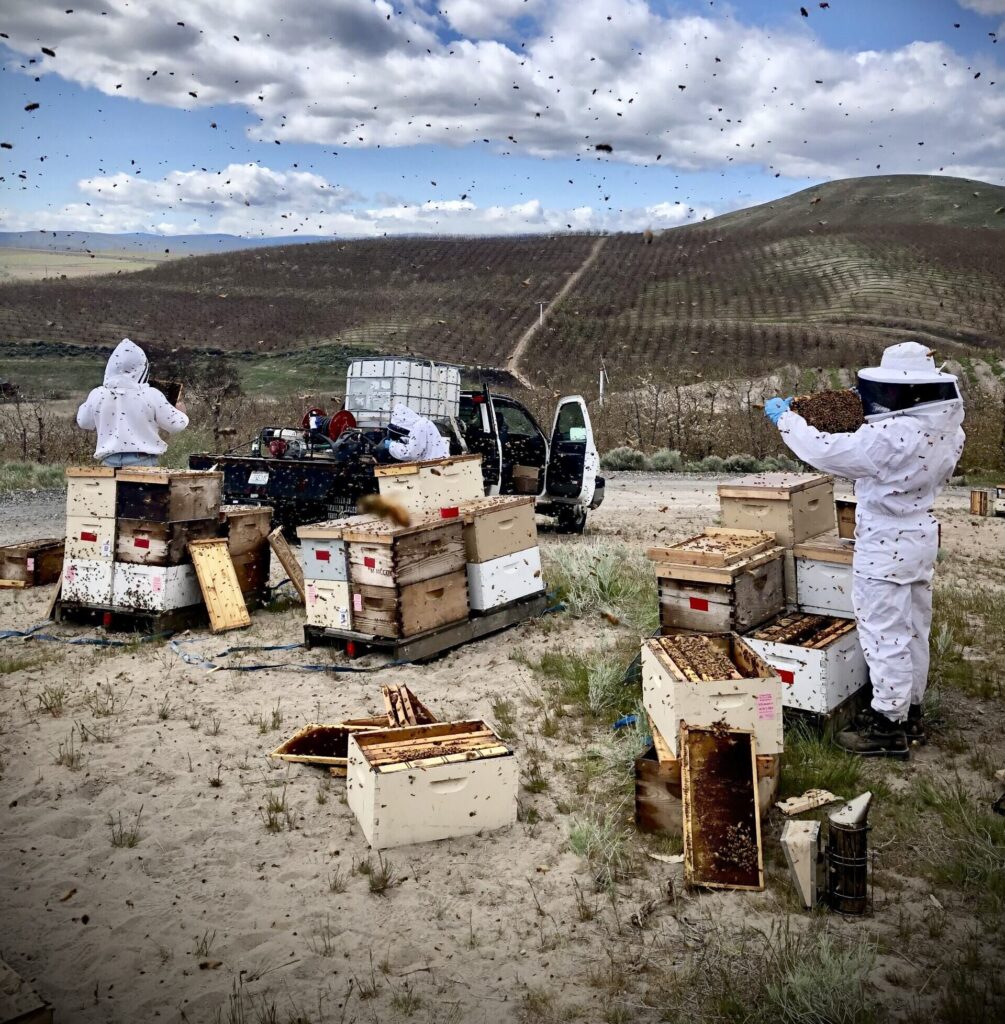
Mass honey bee (Apis mellifera) colony mortality initially made news headlines in 2007 with the emergence of colony collapse disorder (CCD). Nearly two decades later, commercial beekeepers continue to face devastating losses (Bruckner et al. 2023). In the 2015–2016 season, Washington, Oregon, and Idaho commercial beekeepers experienced a colony mortality rate of 38% (Nearman et al. 2025), which is 21.5% higher than the acceptable loss rate anecdotally reported by beekeepers (16.5%) (Bruckner et al. 2023). Between June 2024 and March 2025, US-based commercial beekeepers saw an average colony loss rate of 62% (Project Apis m. 2025). Even as colony mortality remains high, demand for honey bee pollination services remains strong in many crop systems (Bond et al. 2021). From 2024 to 2025, the average replacement cost, not including the cost of labor, feed, or miticide treatments, was around $200 per colony, and the beekeeping industry lost an estimated $224.8 million from honey bee colony mortality alone (Honey Bee Health Coalition 2025).
Parasites or pests, pathogens, pesticides, and poor nutrition, also known as the “Four P’s” (vanEngelsdorp et al. 2009; Shanahan 2022), are major contributors to high colony losses each year. Impacts from these contributors can be minimized through proper beekeeping management practices, such as applying seasonally appropriate miticides, treating colonies with antibiotics, quarantining infected equipment, euthanizing sick colonies, communicating with growers to avoid direct pesticide exposure, and supplying colonies with supplemental sugar syrup and protein patties in times of resource dearth. Many of these stressors are unpredictable and unavoidable, however good beekeeping management is necessary to mitigate their effects.
The Four P’s
Parasites or pests: Varroa destructor, also referred to as the varroa mite, is a well established and invasive ectoparasite of honey bees. Mite infestations reduce colony health (Le Conte et al. 2010), increase colony mortality, and vector devastating viruses (van Dooremalen et al. 2012).
Pathogens: Infectious agents, such as Melissococcus plutonius, the causative agent of European foulbrood, Paenibacillus larvae, the causative agent of American foulbrood, Ascosphaera apis, the causative agent of chalkbrood, and Nosema spp., a microsporidian, are known to negatively impact colonies throughout the year and increase mortality if left unmanaged (Nekoei et al. 2023).
Pesticides: Acute and chronic exposure to pesticides can alter honey bee gut microbiota, impair honey bee cognitive abilities, and cause mortality at different exposure levels (Motta et al. 2018; Guez 2013; Tsvetkov et al. 2017). Colonies used for commercial pollination are often at a higher risk of pesticide exposure (Zhang et al. 2024).
Poor nutrition: Lack of available forage or specific macro- and micronutrients in the forage landscape (Brodschneider and Crailsheim 2010) can reduce colony size and make populations more susceptible to other stressors (DeGrandi-Hoffman et al. 2015).
Extreme weather conditions, such as sudden heat waves, droughts, and floods, can threaten colony health and longevity and are often unpredictable and beyond the beekeeper’s control. Due to high honey bee colony mortality and the economic strain associated with these losses, along with the increasing demand for pollination services, the USDA Farm Service Agency (FSA) offers financial aid for commercial beekeepers who experience specific honey bee colony, hive, or feed loss under certain qualifying conditions (USDA FSA, n.d.[a]). This program is titled the “Emergency Assistance for Livestock, Honeybees and Farm-Raised Fish Program” or ELAP. It is important to note that not all causes of colony loss are covered by this program, and documentation of proper management practices must be provided to receive benefits. The purpose of this Extension publication is to further define the ELAP program, explain beekeeper eligibility and ineligibility criteria, and provide readers with additional information and resources regarding ELAP and how to apply.
Helpful Terms and Definitions
The USDA defines the following terms as follows:
apiculture: The raising and care of honey bees for agricultural crop production purposes, including but not limited to, honey production, collection of pollen and wax, and breeding purposes.
colony: A group of honey bees housed in a managed hive used for apiculture, which does not include wild or feral honey bees.
hive: A shelter constructed in accordance with good farming practices for housing a colony of honey bees, also referred to as a beehive (USDA RMA 2021).
honey bees: Bees of the species Apis mellifera sp. which produce and store honey.
Purpose of the Emergency Assistance for Livestock, Honeybees and Farm-Raised Fish Program (ELAP)
The Emergency Assistance for Livestock, Honeybees, and Farm-Raised Fish Program (ELAP) provides funds to producers who experience livestock and financial losses due to specific, qualifying events. This program was initiated by the Agriculture Improvement Act of 2018 with funds provided by the Commodity Credit Corporation (USDA FSA, n.d.[b]). Qualifying events include livestock mortality caused by colony collapse disorder and adverse weather conditions or natural disasters (USDA FSA, n.d.[b]). ELAP also partially reimburses livestock feeding costs that exceed normal levels due to adverse weather events (USDA FSA, n.d.[a]; USDA FSA 2025). For apicultural adverse events covered under ELAP, beekeepers are eligible for partial reimbursement for honey bee colony, hive, and feed losses. Only a percentage of the market value of losses above the set normal mortality rate will be awarded for eligible adverse events (see Loss Rates and Payment section below and Notice ELAP-27) (USDA FSA, n.d.[a]).
ELAP Eligibility and Ineligibility
Eligibility Criteria
Beekeepers eligible for ELAP aid must have experienced colony or hive losses above 15% annually due to colony collapse disorder (CCD), weather, or other qualifying events. Beekeepers may also qualify if adverse weather required supplementary feeding beyond standard practice (USDA FSA, n.d.[a]). According to the USDA Agricultural Research Service (ARS) (2007), the five symptoms of CCD are:
- Loss of the live queen or drone bee populations inside the hive.
- Rapid decline of adult worker bee population outside the hive, leaving brood poorly or completely unattended.
- Absence of dead adult bees inside the hive and outside the entrance of the hive.
- Absence of robbing in collapsed colonies.
- Varroa mite and Nosema populations that, at the time of colony collapse, are below levels known to cause economic injury or population decline.
To receive aid for losses caused by CCD, beekeepers must show producer certification of colonies demonstrating three of the five symptoms and proof of proper management, including mite treatments, disease treatments, proper supplemental nutrition, and maintenance of hive equipment (see the Record Keepingsection below) (USDA FSA 2025).
Controversy over “Colony Collapse Disorder” Causes
Although the definition for CCD is strict under the ELAP guidelines, the causes of this condition are still debated among honey bee scientists. The three leading theories on CCD causes can be labeled as the ecological conservation narrative, the reductionist regulatory narrative, and the sociological complexity narrative (Watson and Stallins 2016). In the ecological conservation narrative, CCD is explained by the effects industrial agriculture has on all pollinator species. With the increase in monocropping and pesticide use, and the subsequent decrease in natural or seminatural forage available, all pollinators are seeing declines because of modern day agricultural practices. In the reductionist regulatory narrative, proponents argue that CCD is due to singular causes, such as noenicitinoid use, Varroa mites, or mite-vectored pathogens. Lastly, the sociological complexity narrative argues that the cause of colony collapse is a synergistic effect of all components adverse to honey bee health, such as the 4 P’s.
Other adverse natural events that may qualify for colony or hive loss reimbursement include earthquakes, extreme or sustained cold, winter storms, excessive wind, flooding, hurricanes, lightning, tidal surges, tornadoes, volcanic eruptions, and wildfire. Additionally, times of early frost, eligible drought, excessive rain, and late spring rain are circumstances in which non-standard supplemental feedings are eligible for ELAP benefits. Documentation of these events must be provided when applying for ELAP benefits (USDA FSA 2025) (see the Recordkeeping section below). To determine if your loss is eligible for reimbursement, please visit the honey bee assistance website (FarmRaise, n.d.).
Ineligibility Criteria
Beekeepers’ eligibility for ELAP aid depends on proper documentation; further, negligence or mismanagement of colonies disqualifies beekeepers from ELAP eligibility (USDA CCC, FSA 2025). Beekeepers can use the honey bee assistance website (FarmRaise, n.d.) for guidance on practices that provide the best opportunity for colony survival.
Proper management techniques are divided into three seasonal periods of beekeeping: spring, fall, and winter (FarmRaise, n.d.):
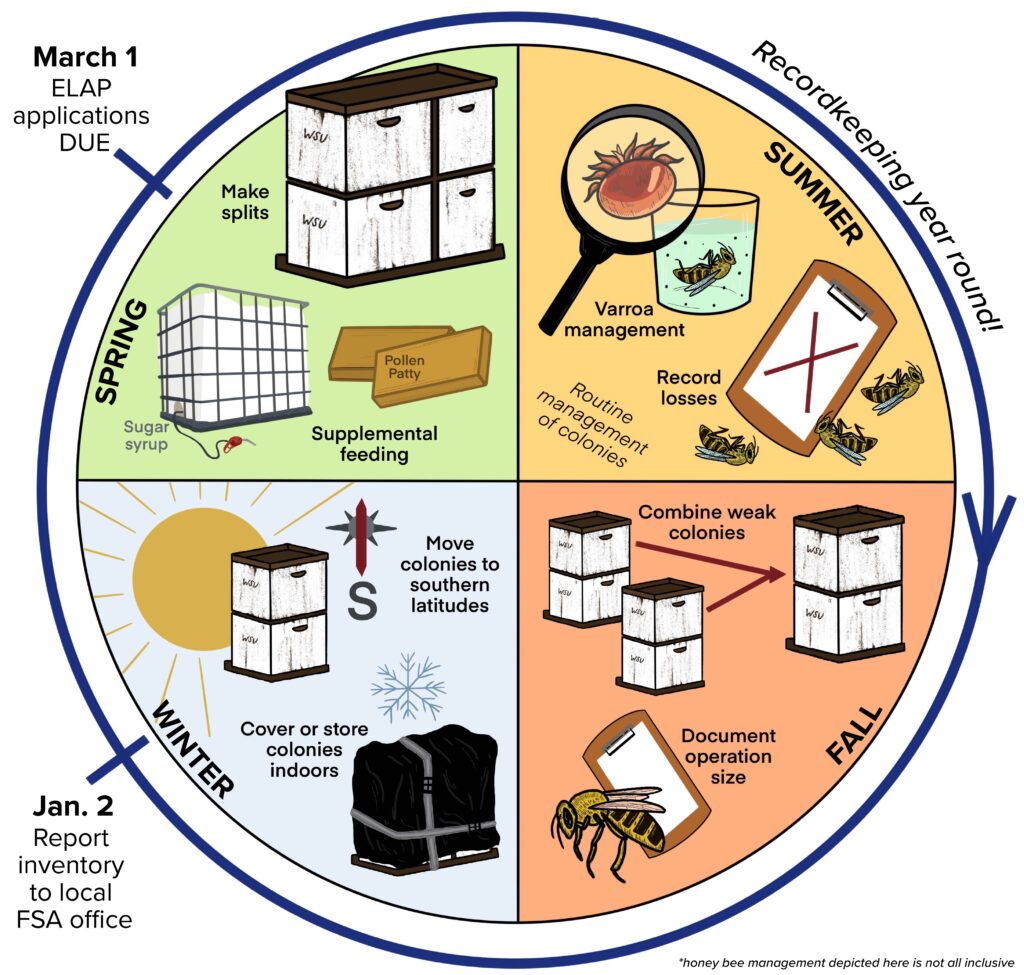
- Spring management begins with preparing colonies for the pollination season. This includes but is not limited to colony maintenance, such as scraping bottom boards, population assessments, mite load checks and treatments, and supplemental feeding.
- Fall management includes but is not limited to additional mite checks or treatments and supplemental feedings. Note: Standard cost of feeding is ineligible and considered a good management practice. Only feed purchases above normal caused by qualifying conditions are eligible for compensation (USDA FSA 2025).
- Winter management includes preparing colonies for cold weather conditions.
A list of good management practices suggested by FarmRaise (n.d.) can be found at the honey bee assistance website.
Additionally, ELAP does not cover losses addressed by other disaster assistance programs authorized by the 2014 Farm Bill. Examples include the Livestock Forage Disaster Program and the Livestock Indemnity Program (USDA FSA 2025).
Recordkeeping
During the ELAP calendar year (January 1–December 31), all losses and expenses, including colony and hive losses and the cost of additional feed outside of standard practice, must be recorded in accordance with regulations set by your local FSA office (FarmRaise, n.d.). New packages or colony purchases, as well as losses to an operation, must be reported within 30 days of the addition or noticed loss. Self-created splits must also be reported but are not initially considered viable and cannot be included in inventory until 30 days after their creation. Implementation of recordkeeping standards vary greatly across different FSA jurisdictions. For local assistance or support visit the Find Your Local USDA Service Center website. Ultimately, your local FSA office is responsible for approving ELAP applications, and maintaining polite, professional relationships with them can aid in the application process.
It is strongly recommended to check with local FSA offices for specific documentation needs. While the following is not an exhaustive list of the records needed for ELAP registration, FSA offices typically require the following forms of documentation:
- Operation inventory of colonies or hives or invoices for colonies or bee packages that are bought or sold.
- All colony additions, including packages and splits, reductions, and colony movement between counties or states, documented with bills of lading.
- Seasonal hive inventories in maintained yard lists.
- Written records, whether generated by the beekeeper or a third party, of Varroa mite levels during the year to document proper mite management.
- Commercial receipts, records, invoices, main yard lists, and pollination invoices from the same year in which the losses occurred and the ELAP application was submitted.
All records submitted to your FSA office must be verifiable and include dates. In addition, all documentation submitted in the ELAP application must be under the same name, employer identification number, or social security number. Receipts that are handwritten and cash payments are not verifiable or reliable on their own. To be considered an eligible record, they must be accompanied by verifiable records or logs showing payment transfer between two parties (USDA 2025).
Records submitted for losses caused by supplemental feeding above the standard practice must include documentation of the qualifying weather event (see Eligibility section) that necessitated the extra feed. Documentation can include images from weather forecasts. For drought-related feeding, use the ELAP Drought Eligibility Dashboard to determine if your colonies were in a drought eligible location.
Loss Rates and Payment
ELAP offers partial reimbursement for colony losses (when a colony dies but the woodenware remains), hive losses (when a colony and its woodenware are destroyed), and feed provided in excess of standard practices. As of July 2025, the ELAP program set the normal mortality for honey bee colonies at 15%. This number was chosen to provide consistency across states and fiscal years (American Bee Journal 2025). Check the ELAP regularly for any changes to the program. If a beekeeper has experienced a colony mortality rate above 15%, they could be eligible for payments at a specified rate (USDA FSA, n.d.[b]).
Standard: Beekeepers are eligible for a minimum of 75% of their experienced losses (USDA FSA 2025).
Special circumstances: Those certified as one of the following are eligible for a minimum of 90% of their experienced losses (USDA FSA 2025).
- New beekeepers: Beekeepers that have been operating for less than 10 years (USDA, n.d.).
- Veterans: Beekeepers who served in the US military are eligible for a minimum of 90% of their losses.
- Those with limited resources: Beekeepers defined as those with “with direct or indirect gross farm sales not more than the current indexed value in each of the previous two years, and who has a total household income at or below the national poverty level for a family of four, or less than 50 percent of county median household income in each of the previous two years” (USDA NRCS, n.d.[a]).
- Those who are socially disadvantaged: Beekeepers defined as having “been subjected to racial or ethnic prejudices because of their identity as a member of a group without regard to their individual qualities. This term means a farmer or rancher who is a member of a socially disadvantaged group. Specifically, a group whose members have been subjected to racial or ethnic prejudice because of their identity as members of a group without regard to their individual qualities. Those groups include African Americans, American Indians or Alaskan natives, Hispanics, and Asians or Pacific Islanders” (USDA NRCS, n.d.[b]).
Payments are based on the number of colonies and hives lost above the normal loss rate times the payment rate (75% or 90%) times the fair market value for that year. In 2025, the fair market value for a colony and hive were appraised by ELAP at $120 and $260, respectively (USDA FSA 2025). Beekeepers are eligible for reimbursement of at least 60% of the cost of feed purchased above standard feeding practice (USDA FSA 2025). Lastly, if the adjusted gross income (AGI) is above $900,000, the payment limitation may be waived if at least 75% of your income comes from farming, ranching, or forestry and you receive an approved waiver (American Bee Journal 2025). Beekeepers can create an account at Farmers.gov to track payments received for the FSA, NRCS, and USDA loan information.
How to Apply for ELAP
- Step 1: Eligible beekeepers must submit a notice of loss form to their local FSA office (USDA FSA, n.d.[b]). Losses must be appropriately documented, including the number of colonies or hives lost along with the cause of loss or cause of supplementary feeding in excess of standard practice.
- Step 2: Beekeepers must make an appointment with and submit a formal application to their local FSA office; ELAP applications are submitted for the losses experienced over the duration of one calendar year (January 1–December 31) (USDA FSA, n.d.[b]). Reporting total yearly losses for the ELAP application is different from the losses that must be reported within 30 days of the loss.
Keep in mind, each local FSA office has different requirements for proper documentation, and beekeepers must adhere to the specific documentation requirements of their local offices. For instance, some FSA offices require an annual report detailing the colony management by season for the year, showing that the colonies lost were properly cared for. When operating in multiple states or counties, beekeepers have the option to work with one or multiple county FSA representatives overseeing the areas in which the colonies are located. Before making an appointment at your local FSA office, use the FarmRaise ELAP Decision Tool to help identify proper documentation and information regarding applications for ELAP benefits. To identify a specific FSA jurisdiction, use the USDA Service Center Locator resource.
As part of the application, beekeeper inventory must be reported by January 2 of every year (FarmRaise, n.d.), and the final date to file a notice of loss to the FSA office is March 1 for the previous program year (Figure 1) (USDA FSA, n.d.[b]).
Conclusion
ELAP provides beekeepers partial reimbursement for colony, hive, and feed losses incurred over the course of a calendar year. Losses must align with specific eligibility criteria, must be appropriately documented and reported, and can be partially reimbursed if they exceed 15%. ELAP is a government-sponsored program, and rules and regulations are subject to change; check the USDA ELAP website for rates and eligibility conditions. In addition, beekeepers can sign up for USDA email and text updates for information relevant to their state and county regarding information on programs, eligibility requirements, and future deadlines.
Acknowledgements
We would like to thank Tim Hyatt, Kimberly Lott, and other reviewers for their contributions to the development of this Extension publication.
References
American Bee Journal. 2025. AHPA Legislative Update.
Bond, J.K., C. Hitaj, D. Smith, K. Hunt, A. Perez, and G. Ferreira. 2021. Honey Bees on the Move: From Pollination to Honey Production and Back (ERR-290). US Department of Agriculture, Economic Research Service.
Brodschneider, R., and K. Crailsheim. 2010. Nutrition and Health in Honey Bees. Apidologie 41(3): 278–294.
Bruckner, S., M. Wilson, D. Aurell, et al. 2023. A National Survey of Managed Honey Bee Colony Losses in the USA: Results from the Bee Informed Partnership for 2017–18, 2018–19, and 2019–20. Journal of Apicultural Research 62(3): 429–443.
DeGrandi-Hoffman, G., Y. Chen, and E. Huang. 2015. Nutrition, Immunity and Viral Infections in Honey Bees. Current Opinion in Insect Science 10: 170–176.
FarmRaise. n.d. ELAP—Honey Bees. FSA Educational Hub.
Guez, D. 2013. A Common Pesticide Decreases Foraging Success and Survival in Honey Bees: Questioning the Ecological Relevance. Frontiers in Physiology 4: 37.
Honey Bee Health Coalition. 2025. Survey Reveals Over 1.1 Million Honey Bee Colonies Lost, Raising Alarm for Pollination and Agriculture.
Le Conte, Y., M. Ellis, and W. Ritter. 2010. Varroa Mites and Honey Bee Health: Can Varroa Explain Part of the Colony Losses? Apidologie 41(3): 353–363.
Motta, E.V.S., K. Raymann, and N.A. Moran. 2018. Glyphosate Perturbs the Gut Microbiota of Honey Bees. Proceedings of the National Academy of Sciences of the United States of America 115(41): 10305–10310.
Nearman, A., C.L. Crawford, M.M. Guarna, et al. 2025. Insights from U.S. Beekeeper Triage Surveys Following Unusually High Honey Bee Colony Losses 2024–2025. Science of the Total Environment 1003: 180650.
Nekoei, S., M. Rezvan, F. Khamesipour, C. Mayack, and M.B. Molento. 2023. A Systematic Review of Honey Bee (Apis mellifera, Linnaeus, 1758) Infections and Available Treatment Options. Veterinary Medicine and Science 9(4): 1848–1860.
Project Apis m. 2025. New Data Confirm Catastrophic Honey Bee Colony Losses, Underscoring Urgent Need for Action.
Shanahan, M. 2022. Honey Bees and Industrial Agriculture: What Researchers Are Missing, and Why It’s a Problem. Journal of Insect Science 22(1): 14.
Tsvetkov, N., O. Samson-Robert, K. Sood, et al. 2017. Chronic Exposure to Neonicotinoids Reduces Honey Bee Health Near Corn Crops. Science 356(6345): 1395–1397.
USDA (United States Department of Agriculture). n.d. How to Start a Farm: Beginning Farmers and Ranchers.
USDA (United States Department of Agriculture). 2025. Supplemental Agricultural Assistance Programs (90 FR 5493). Federal Register.
USDA ARS (United States Department of Agriculture, Agricultural Research Service). 2007. Colony Collapse Disorder Action Plan.
USDA CCC, FSA (US Department of Agriculture Commodity Credit Corporation & Farm Service Agency). 2025. Supplemental Agricultural Assistance Programs (Final Rule, 90 FR 5493). Federal Register.
USDA FSA (United States Department of Agriculture, Farm Service Agency). n.d.(a). Emergency Assistance for Livestock, Honeybees, and Farm-Raised Fish (ELAP).
USDA FSA (United States Department of Agriculture, Farm Service Agency). n.d.(b). Emergency Assistance for Livestock, Honeybees and Farm-Raised Fish Program (ELAP) fact sheet.
USDA FSA (United States Department of Agriculture, Farm Service Agency). 2025. ELAP—Honeybee Assistance.
USDA NRCS (US Department of Agriculture, Natural Resources Conservation Service). n.d.(a). Limited Resource Farmer or Rancher definition. Self Determination Tool.
USDA NRCS (US Department of Agriculture, Natural Resources Conservation Service). n.d.(b). Socially Disadvantaged Farmer or Rancher definition. Self Determination Tool.
USDA RMA (US Department of Agriculture, Risk Management Agency). 2021. United States Department of Agriculture Federal Crop Insurance Corporation Rainfall Index Apiculture (API) Crop Provisions.
van Dooremalen, C., L.J.M. Gerritsen, B. Cornelissen, J.J.M. van der Steen, F. van Langevelde, and T. Blacquière. 2012. Winter Survival of Individual Honey Bees and Honey Bee Colonies Depends on Level of Varroa destructor Infestation. PLoS ONE 7(4): e36285.
vanEngelsdorp, D., J.D. Evans, C. Saegerman, et al. 2009. Colony Collapse Disorder: A Descriptive Study. PLOS ONE 4(8): e6481.
Watson, K., and J.A. Stallins. 2016. Honey Bees and Colony Collapse Disorder: A Pluralistic Reframing. Geography Compass 10(5): 222–236.
Zhang, G., R.W. Kuesel, R. Olsson, R. Reed, X. Liu, and B. Hopkins. 2024. Pesticide Exposure Patterns in Honey Bees During Migratory Pollination. Journal of Hazardous Materials 480: 135910.
By,
Taydin Macon, PhD Candidate, Department of Entomology, Washington State University
Briana Price, Extension Coordinator, Department of Entomology, Washington State University
Brandon Hopkins, Associate Professor, Department of Entomology, Washington State University

FS412E

Copyright © Washington State University
WSU Extension publications contain material written and produced for public distribution. Alternative text descriptions for select complex images were generated using ChatGPT (OpenAI), then reviewed and adapted to ensure compliance with Web Content Accessibility Guidelines (WCAG) accessibility standards.
Issued by Washington State University Extension and the US Department of Agriculture in furtherance of the Acts of May 8 and June 30, 1914. Extension programs and policies are consistent with federal and state laws and regulations on nondiscrimination regarding race, sex, religion, age, color, creed, and national or ethnic origin; physical, mental, or sensory disability; marital status or sexual orientation; and status as a Vietnam-era or disabled veteran. Evidence of noncompliance may be reported through your local WSU Extension office. Trade names have been used to simplify information; no endorsement is intended.