Are Native Trees and Shrubs Better Choices for Wildlife in Home Landscapes?
Description
Do native trees and shrubs offer a better ecological choice for providing habitat to wildlife in home landscapes? It all depends. Find out more... ...
Overview
Many gardeners prefer to use native plants in their landscapes. Part of this preference is the widespread belief that native species are better ecological choices, especially in providing habitat for native wildlife. Most published research demonstrates that the native status of trees and shrubs has little influence on biodiversity. This publication provides a more practical, science-based approach that will enhance both wildlife biodiversity and the aesthetic appeal of home landscapes.
Introduction
Gardeners increasingly seek out native plant species for their gardens and landscapes. Many believe that native plants are better choices because they are adapted to local conditions. The U.S. Environmental Protection Agency (EPA), among other federal, state, and local agencies, perpetuates this belief by making many unscientific statements about native plant benefits. Among these claims are that native plants are superior to introduced species in their ability to withstand local climate conditions, to resist pests and disease, and to require less water, fertilizer, and other forms of maintenance (EPA 2017). None of these claims have been supported in published research relevant to home gardens and landscapes.
In addition to their preference for native plants, gardeners also welcome beneficial, native wildlife species who serve as pollinators and natural pest controls in the landscape. They believe that native plants provide the greatest benefits to native wildlife, as the populations coevolved with one another. While there is certainly some evidence to support this belief, especially with specialist insects who require a particular food source, the popular belief extends far beyond the documented evidence.
It stands to reason that trees and shrubs with the greatest chance to survive and thrive will provide the greatest benefits to associated native wildlife. Therefore, we need to consider the realities of typical home landscapes and their impacts on plant survival. How closely do urban and suburban areas mirror the environmental conditions that native plants require? For instance, consider these facts about home landscapes:
- Soils often consist of abrupt layers of “topsoil” and other materials, creating poor drainage and low oxygen levels.
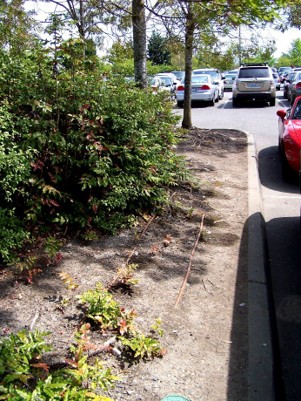
- There is significant soil compaction as a result of foot and vehicular traffic and the lack of protective mulches (Figure 1).
- Leaching of lime from concrete can increase soil pH, which may exceed the pH tolerances of native plants.
- Improper fertilizer application can result in nutrient imbalances.
- Lack of adequate water in summer months can harm species adapted to a forest environment (Figure 2).
- Hardscape surfaces reflect both heat and light that can affect survival of trees. and shrubs adapted to cooler, shadier environments.
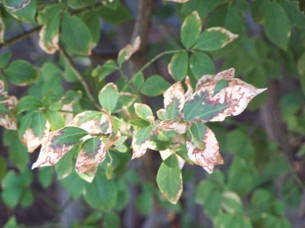
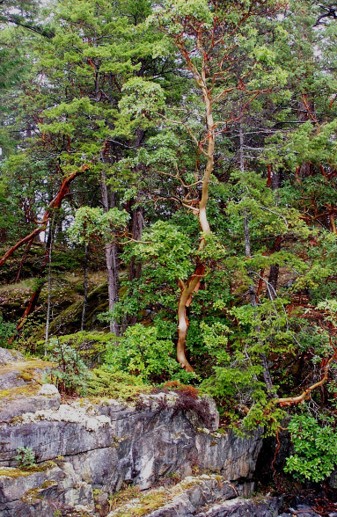
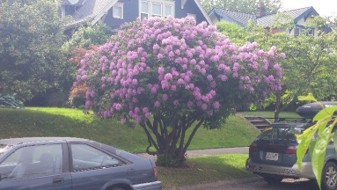
It is clear that urban and suburban environmental conditions are unlikely to resemble whatever existed prior to development. This means that many native woody species will not thrive in an urban or suburban landscape (Figure 3). With these environmental realities in mind, let’s consider a research question: does the use of nonnative woody species reduce the food and shelter available to beneficial wildlife?
Scientific Analysis
In 2015, I published an analysis of the scientific literature which provides the content for this publication (Chalker-Scott 2015). (Readers can access this original article (pdf) for more information.) Specifically, I wanted to discover whether woody plant nativeness would influence animal biodiversity. I focused on trees and shrubs planted in urban or suburban landscapes. I found over 120 articles from 30 different countries that studied the biodiversity of birds, insects, mammals, and reptiles.
My literature analysis revealed that, with few exceptions, the native status of trees and shrubs had no impact on wildlife biodiversity. Researchers identified woody plant structure, function, and diversity as the most important characteristics for enhancing wildlife biodiversity. Native woody species can be part of this scenario but may not be a major component. The ability of native trees and shrubs to live in our home landscapes is determined by the environment—not by their genetics.
Gardeners should realize that wildlife will adapt to new food and habitat sources as they become available.
The fact that many exotic, invasive plant species are spread by birds, who ingest and release the seeds, demonstrates that resource adaptation occurs. The same phenomenon occurs with most wildlife, with the exception of those with very specific resource requirements.
Site Conditions and Plant Choices
As you think about your landscaping choices, consider these research-based suggestions.
- Site considerations should always dictate plant selection. Determine the potential environmental stresses your trees and shrubs may experience.
- Native, temperate forest trees and shrubs generally do well in larger landscapes with neutral-to-acidic, well-drained soils.
- Instead of using space-loving larger trees in smaller sites, use smaller trees or shrubs that can be arborized (Figure 4).
- If your landscape soils are alkaline, poorly drained or otherwise dissimilar to native soils, choose woody species adapted to those conditions regardless of their nativity.
- For sites with higher levels of reflected sunlight or heat, choose woody species adapted to hot, dry climates.
- Determine the food and nesting habitat needed for your wildlife species of interest.
Action Items for Gardeners
Gardeners can enhance wildlife diversity in their home landscapes in a number of science-supported ways:
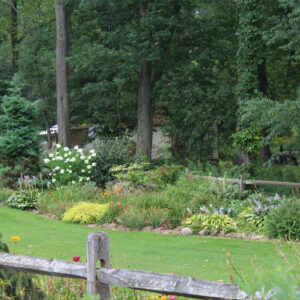
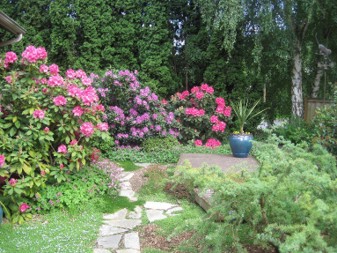
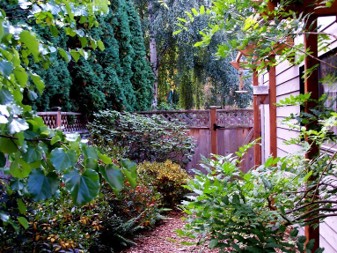
- Reduce open lawn and replace it with vertically diverse vegetation (Figure 5). Keep lawns where they serve a purpose, such as play space for children or pets.
- Remove known invasive woody species and replace with comparable native or noninvasive species. Be sure to do this during the appropriate season, when invasives are not being used for nesting and foraging.
- Increase shrub and tree cover, especially if your landscape is distant from forested areas. Wildlife will seek out protected vertical spaces for food and shelter.
- Check state and national invasive species list before purchasing plants. While plants may not yet appear on your state’s list, the national list will show you where they are currently a problem.
- Select site-tolerant trees and shrubs to increase plant diversity and aesthetics.
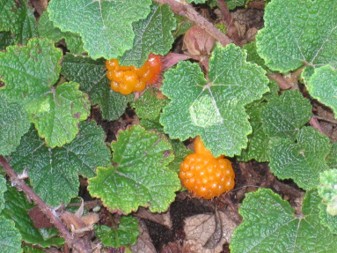
- Plant fruit-bearing trees and shrubs, for consumption by you and your wildlife (Figure 6). Be cautious with such plantings in areas of commercial orchard crop production, due to the potential for pest and disease management issues.
- Enhance landscape edges by leaving them alone! Don’t mow or apply any pesticides to these biologically rich environments.
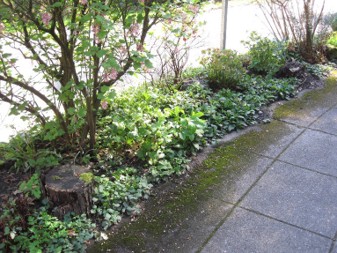
- Retain dead trees (“snags”), stumps, logs, and piles of branches whenever possible. They provide critical habitat for certain beneficial birds and insects (Figure 7). If snags or other woody debris pose a hazard to people or property, they should be removed.
- Protect soils with coarse, woody mulch, especially where compaction occurs. The combination of woody mulches and protected soils improves habitat for insects, reptiles and small mammals (Figure 8).
- Eliminate the unnecessary use of pesticides. Utilize good Integrated Pest Management (IPM) practices where pesticides are a last resort.
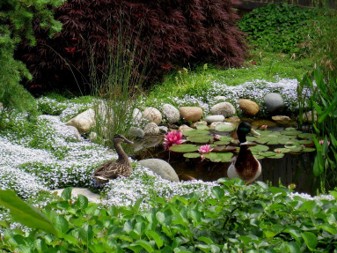
- Add a permanent water feature, when feasible, taking into account potential management issues (such as mosquito breeding). Don’t force your garden wildlife to hunt elsewhere for this critical necessity (Figure 9).
Finally, biodiverse landscapes are important for you, the gardener! They have been linked to self-reported well-being of gardeners and their neighbors (Luck et al. 2011).
Additional Resources
- Chalker-Scott, L. 2015. Using arborist wood chips as a landscape mulch. WSU Extension Fact Sheet FS160E.
- James, D.G. 2014. Beneficial insects, spiders and mites in your garden: who they are and how to get them to stay. WSU Extension Manual EM067E.
- Reichard, S.H., and C.W. Hamilton. 1997. Predicting invasions of woody plants introduced into North America. Conservation Biology 11:193–203.
- USDA PLANTS database. 2017. Introduced, invasive, and noxious plants. Accessed 10/11/2017. Washington State Noxious Weed Control Board. 2017. Accessed 10/11/2017.
References
- Chalker-Scott, L. 2015. Nonnative, noninvasive woody species can enhance urban landscape biodiversity (pdf). Arboriculture and Urban Forestry 41(4):173-186.
- Environmental Protection Agency (EPA). 2017. Landscaping tips. Accessed 10/11/2017.
- Luck, G.W., P. Davidson, D. Boxall, and L. Smallbone. 2011. Relations between urban bird and plant communities and human well-being and connection to nature. Conservation Biology 25:816–826.
Dr. Linda Chalker-Scott, Associate Professor and Extension Specialist, Department of Horticulture, Washington State University
Copyright © Washington State University.
WSU Extension publications contain material written and produced for public distribution. Alternate formats of our educational materials are available upon request for persons with disabilities. Please contact Washington State University Extension for more information.
Issued by Washington State University Extension and the US Department of Agriculture in furtherance of the Acts of May 8 and June 30, 1914. Extension programs and policies are consistent with federal and state laws and regulations on nondiscrimination regarding race, sex, religion, age, color, creed, and national or ethnic origin; physical, mental, or sensory disability; marital status or sexual orientation; and status as a Vietnam-era or disabled veteran. Evidence of noncompliance may be reported through your local WSU Extension office. Trade names have been used to simplify information; no endorsement is intended. Published April 2018.