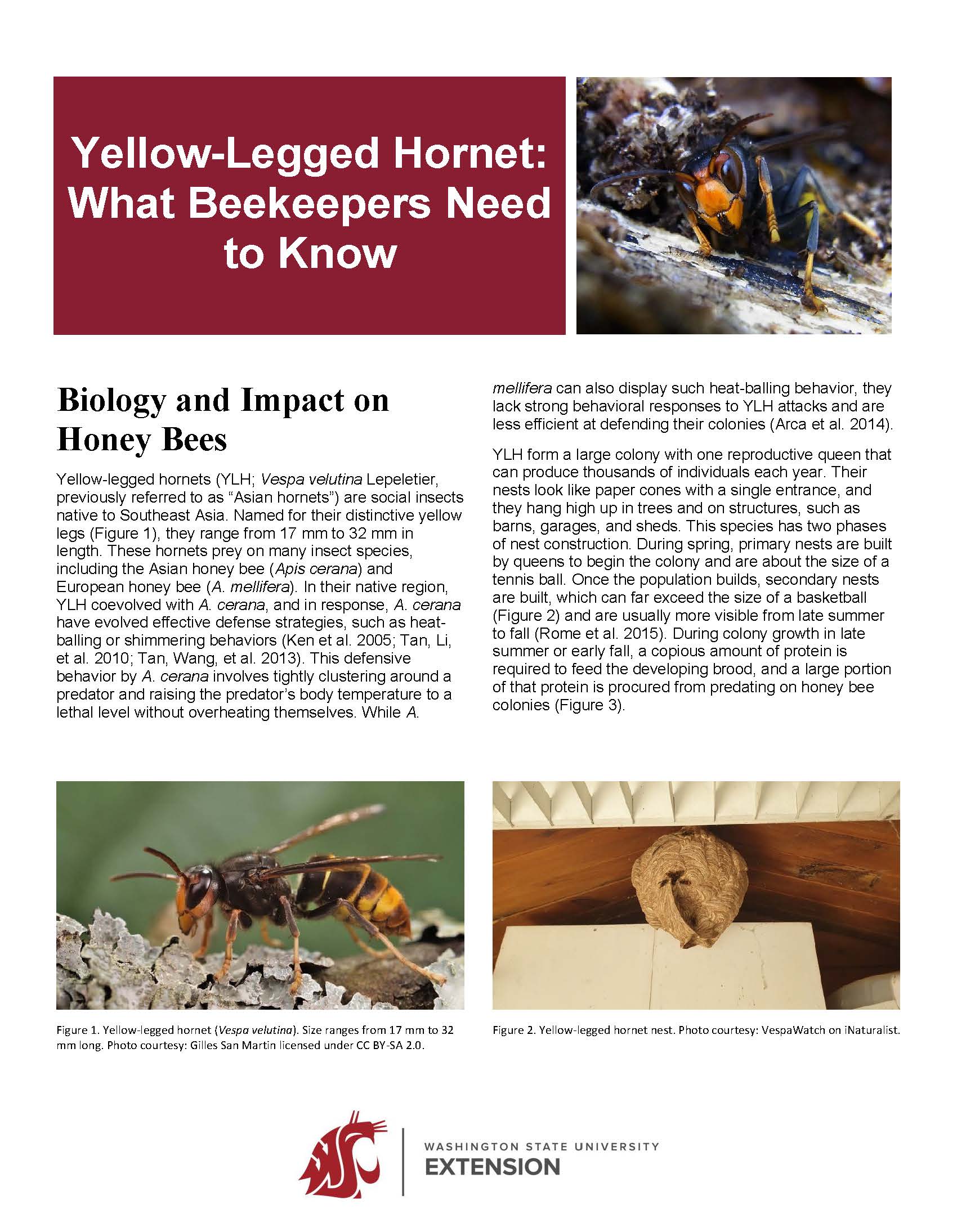
Yellow-Legged Hornet: What Beekeepers Need to Know
Posing a threat to US honey bees, the yellow-legged hornet is an invasive predator native to Southeast Asia. Climate models suggest the Pacific Northwest will increasingly resemble its native range. This WSU Extension publication provides information for beekeepers and the public on the hornet’s biology, behavior, and how to monitor and prepare.
Page Count: 7
Published: July 2025
Hurry! Only left in stock.

Related publications
-
Methods for Sampling X-Disease Colladonus spp. (Hemiptera: Cicadellidae) Leafhopper Vectors in Orchards
X-disease, caused by the phytoplasma Candidatus Phytoplasma pruni, is an increasing threat to the Pacific Northwest stone fruit industry, producing small, bitter, and unmarketable fruit. Leafhoppers are the only known vectors. To manage the spread…
- Pages:
- 13
- Published:
- July 2025
- SKU:
- FS400E
Authors: -
Manipuladores de plaguicidas y la norma de protección (Pesticide Handlers and the Worker Protection Standard)
View this video here! Este video explica las normas de protección del trabajador y su aplicación a los manejadores de pesticidas.
Authors: -
A Citizen Science Guide to Wild Bees and Floral Visitors in Western Washington (Home Garden Series)
This easy-to-use field guide provides helpful tools to identify and monitor wild bees and pollinators in western Washington. Great for gardeners, farmers, conservationists, or anyone curious about floral visitors.
- Pages:
- 11
- Published:
- April 2017
- Revised:
- September 2025
- SKU:
- EM110E
Authors: -
Soil Compaction in Annual Crop Production Causes, Impacts, and Solutions
Commonly recognized as a serious concern for agricultural production and environmental health, soil compaction leads to poor soil structure, restricted water movement, and reduced biological activity. Explore the causes, impacts, and practical solutions for healthier,…
- Pages:
- 14
- Published:
- April 2025
- SKU:
- FS396E
Authors: