Description
The Horse
The Breeds
There are many breeds of horses. Following are brief descriptions of some of the more common or notable breeds. For more information, visit one of the many websites on horse breeds.
Light Horses
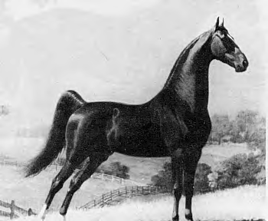
American Saddlebred
The American Saddlebred, also called the American Saddlehorse, was developed in America in colonial times from a Thoroughbred sire, Denmark, bred to a pacer. Riders needed a horse that could give a fast, easy ride over long distances.
The mature American Saddlehorse is between 15 and 16-2 hands in height and weighs from 1,000 to 1,200 pounds. These horses are usually one solid color with white markings. The predominant colors are chestnut, bay, brown, black, and gray. The natural stride of this breed is free and open with great animation. This is naturally a three-gaited breed, but it is easily trained to rack and slow-gait as well. They are noted for a high head carried on a long graceful neck, a level croup, and a high-set tail. They are most widely used for showing in saddle seat and fine harness classes and riding on bridle paths.
Arabian
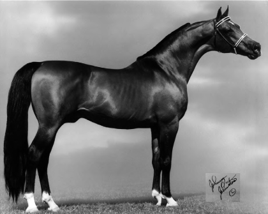
Arabians are one of the first breeds of livestock domesticated by humans. All breeds of light horses and some of the heavy horses were developed from this breed.
The head is triangular with a wide forehead and small muzzle. The forehead is convex, but the profile is usually somewhat dished. The neck is long, naturally arched, and the back is very short. The Arabian is very compact; mature animals usually weigh from 850 to 1,100 pounds and are from 14 to 15 hands high. Preferred colors are bay, gray, and chestnut with white markings common on the head and legs. The versatile Arabians are used in pleasure riding, ranch work, and parades. Arabians or half-Arabians have been noted for endurance and speed in competitive trail rides and are popular at horse shows.
Morgan
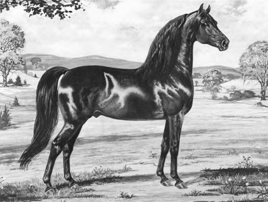
Morgan horses are known for versatility, stylish action, stamina, and ease of handling. They are the oldest breed originating in America. All Morgans trace back to a stallion named Figure, born in 1789 in Springfield, Massachusetts, and acquired by Justin Morgan, a Vermont teacher and horseman. This stallion became the founding sire of the Morgan breed.
Characteristics of the breed are an upright head carriage, well-crested neck, fine muzzle, broad forehead, small ears, wide chest, and short back. Morgans average 14-2 to 15-2 hands high and weigh about 1,000 pounds (with individual exceptions under and over). Colors allowed within the breed are bay, black, brown, chestnut, palomino, creme, dun, and buckskin.
Morgans are highly versatile and may be used for pleasure and driving as well as jumping, dressage, reining, and endurance.
American Quarter Horse
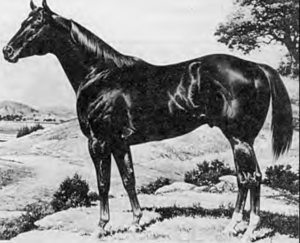
The American Quarter Horse originated during the colonial period, primarily in Virginia and the Carolinas. Settlers crossed Andalusian mares with English stallions that were like Thoroughbreds. They are called “Quarter Horse” because originally they were raced for about a quarter of a mile.
Quarter Horses are characterized by heavier muscling than other breeds, particularly in the thigh, gaskin, and forearm. The racing Quarter Horse carries considerable Thoroughbred blood, though it is usually a little heavier in muscling and not quite as angular as the Thoroughbred. Mature horses usually stand from 14-3 to 16 hands high, though they may be taller, and usually weigh from 1,100 to 1,300 pounds. The predominant colors are sorrel, chestnut, bay, black, and dun. Animals with excessive white markings may be eligible for registry, but there are stringent American Quarter Horse Association (AQHA) guidelines.
Quarter Horses are used widely in the West for range and rodeo work. They are known for their speed over a short distance and for what cowboys refer to as “cow sense.” They also are popular for pleasure riding and Quarter Horse racing.
Foundation Quarter Horse
The Foundation Quarter Horse must have bloodlines that are at least 80 percent Quarter Horse. The association looks back 11 generations or to the first introduction of Thoroughbred blood to determine if a horse is eligible.
The most important attribute of a Foundation Quarter Horse is that it be versatile. Historically, this horse could work cows, run races, work in harness, and was an outstanding trail horse. The horse is quiet, willing, and intelligent. It is medium-size, heavily muscled, with sturdy bones and feet. The length of the leg should not be longer than the depth of the heart girth. The head is short with a large jaw, the eyes are set far apart, and the neck is medium length. Color standards are the same as for the American Quarter Horse.
American Paint Horse
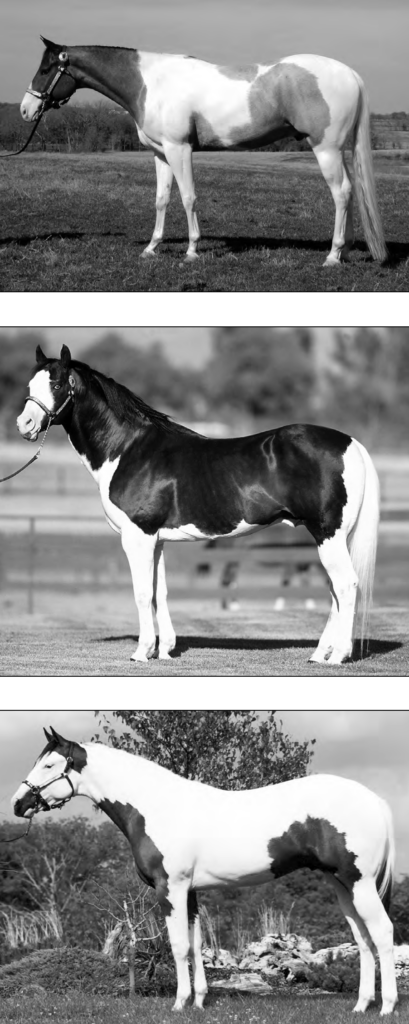
American Paint Horse foundation breeding was basically a crossing of pinto mares to Quarter Horse stallions. To be registered as a paint, the horse must meet minimum color requirements, and the horse must come from stock registered with the American Paint Horse Association (APHA), the American Quarter Horse Association, or the Jockey Club (Thoroughbred).
Like Quarter Horses, Paints are stockier and more heavily muscled than some other light horse breeds. They show marked refinement about the head.
Paints can be registered with a tobiano, overo, or tovero color pattern. Tobianos (toe-be-AN-o) tend to have solid-color heads with usual white markings (star, stripe, snip, etc.). They have regular oval spots with dark hair usually covering one or both flanks. Their legs are usually white, and their tail is often two-color. Overos (o-VER-o) usually have dark legs and bold white head markings (often bald-faced). They have irregular white markings, but the white does not usually cross the back between the withers and the tail. Their tail is usually one color.
Toveros (toe-VER-o) have dark pigmentation around their ears and mouth. One or both eyes are blue. They have spots of varying sizes on their chest and flanks which may extend up the neck, across the barrel, or over the loin.
Tennessee Walking Horse
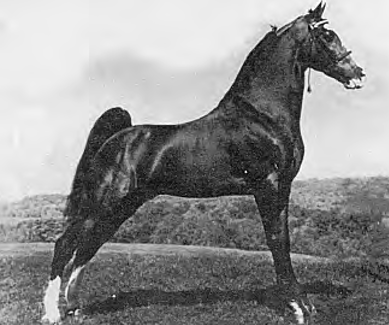
Tennessee Walking Horses are the product of Thoroughbred and Standardbred blood crossed with Morgan and Canadian Pacers. The stallion that contributed the most to the breed was named Allen. Tennessee Walking Horses are distinguished by their running walk, a fast four-beat gait in which the hind feet leave imprints beyond the forefeet. The running walk averages 6 to 12 miles per hour. Other special gaits are the “flat-foot walk,” a slow even gait, and the “canter,” a refined gallop with a slow, high, rolling motion.
Tennessee Walking Horses have long, arched necks, pronounced withers, flat croups, and high-set tails. Their manes and tails are left long and flowing. Mature horses stand from 15 to 16 hands high and usually weigh from 1,000 to 1,200 pounds.
Color varies from sorrel or chestnut to various shades of bay and brown with black, roan, white, and gray being common. Frequently there are white markings on the feet and legs.
This breed is used as a show horse and for pleasure riding.
Thoroughbred
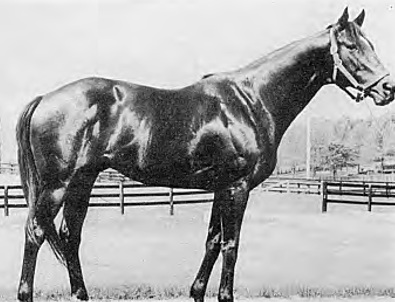
Thoroughbreds were developed in England for racing.
The three foundation sires (the Byerly Turk, the Darley Arabian, and the Godolphin Arabian) were brought to England and bred to native horses. The result is a horse that can carry weight over extended distances.
The Thoroughbred is usually taller and more angular than other breeds. The average height is over 16 hands. Thoroughbreds have long, straight necks; prominent withers; long backs; and long, sloping shoulders. Their abdomens are tucked up, and they have slender legs with long pasterns. They have very fine skin which tends to show the veins underneath. Colors are bay, brown, chestnut, black, or gray, with occasional white markings.
Thoroughbreds are used in both flat and jump racing, and they are popular as hunters, saddle horses, and polo ponies.
Standardbred
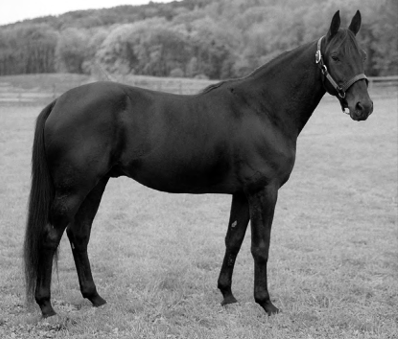
The Standardbred originated in the early 1800s in the vicinity of New York and Philadelphia as a road driving and harness racing horse. The breed was derived mainly from Thoroughbred blood. Hambletonian 10 is considered the foundation sire of the breed. The name Standardbred was used because horses were bred to trot 1 mile or better in a standard speed of 2½ minutes.
The Standardbred resembles the Thoroughbred but is not as tall and has a longer body. Heights range from 15 to 16 hands and weights from 900 to 1,150 pounds. Preferred colors are bay, chestnut, brown, and black. Blaze faces and white stockings are not typical of the breed.
Standardbred harness races are popular in the East. Standardbreds either trot or pace, and there are harness races for both.
Ponles
Pony of the Americas
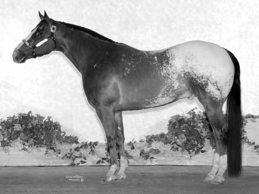
The Pony of the Americas (POA) originated in Iowa about 1955 when an Appaloosa mare was bred to a Shetland stallion. They now have the characteristics of Arabians and Quarter Horses in miniature, with Appaloosa coloring. They must be between 46 and 56 inches in height. They have a slightly dished face, mottled skin, and striped hooves. POAs are used as larger Western-type riding ponies for children. They also are shown English and in harness.
Shetland
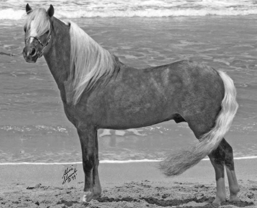
Shetland ponies are natives of the Shetland Isles north of Scotland. Their natural hardiness may be due to the harsh environment in which they developed. They are recognized as the strongest equine relative to their size. The breed registry recognizes two types: Moderns and Classics. Moderns are very refined, stylish harness ponies with animated gaits. Classics are refined pleasure ponies with an easy way of going.
In Shetland shows, classes are divided into two height divisions: under 43 inches, and 43 to 46 inches. Shetlands weigh from 300 to 400 pounds. They may be any color. The Shetland is used as a mount for children; for harness racing; and for pleasure, roadster, and fine harness driving.
Welsh
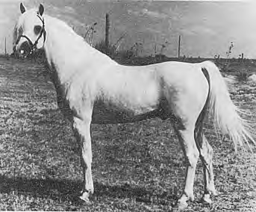
Welsh ponies originated in Wales. They have since been refined with Hackney (which gives them their lively action) and Arabian blood.
Their withers are slightly pronounced, and they have a short back with a slight depression toward the croup. Any color except piebald and skewbald is acceptable. A Welsh pony cannot exceed 14.2 hands. They usually are mounts for small children and sometimes are used in harness.
Color Breeds
Appaloosa
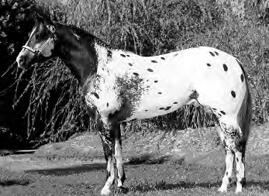
Appaloosa horses are of ancient origin, but the ancestors of the modern Appaloosa were introduced into Mexico by the Spanish explorers. Eventually the Nez Perce Indians in the Pacific Northwest prized and developed the color patterns. Because they were from the Palouse region of the Northwest, white settlers called them “a Palouse horse,” which became slurred into “Appaloosa.”
There are six variations of coat color: snowflake, leopard, frost, marble, spotted blanket, and white blanket. All have striped hooves; obvious sclera; and short, sparse manes and tails. They have mottled skin, especially around the nostrils and lips. The minimum height is 14 hands, and they usually weigh from 950 to 1,200 pounds. They are used as pleasure horses and working stock horses.
Pinto
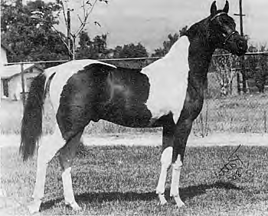
The Pinto Horse Association (PtHA) is a color registry for pinto horses with at least one parent registered in any light horse breed (Appaloosa and Draft breeds are not allowed). Pinto comes from the Spanish word “pintado” meaning painted.
Minimum color requirements are basically 75 square inches for one body spot, and 15 square inches each for three or more spots on the body. Only color visible from a normal standing position is considered. Horses with black as the darker color are called Piebald. Skewbalds have anything but black as the darker color. The two registered colors are tobiano and overo (see “Pinto colors,” page 15, for descriptions). Since Pintos are bred for color and can be almost any breed, there are no consistent conformation traits. Four types of animals are registered: stock type (Quarter Horse); hunter type (Thoroughbred); pleasure type (Arabian or Morgan); and saddle type (Saddlebred, Hackney, or Tennessee Walking Horse).
Ponies 14-2 hands and under are covered by similar rules.
Palomino
The Palomino cannot be an established breed because its distinctive color cannot be passed on from generation to generation. The body color of a Palomino is described as that of a “newly minted gold coin,” but it can vary from light to dark. The forelock, mane, and tail are lighter than the coat color and can have no more than 15 percent dark hairs. Stars and stripes are permitted on the face, and white markings are allowed on the lower legs. They stand 14 to 17 hands tall depending on their breed.
Buckskin
The modern Buckskin (Dun), technically a color breed, actually has a strong, ancient heritage. In the West, horses of the buckskin, dun, red dun, and grulla (grew-ya) hues trace to the Mustang–Spanish Barb descendants which originated in Spain as the Sorraia. Other Buckskins brought to this country can be traced to the Norwegian Dun, descendants of the nearly extinct Tarpan horses. Along with a mixture of other bloods, Buckskins can be found in most breed types.
The American Buckskin Registry Association (ABRA) has limitations on how much white is permitted. Horses with a solid body coat color are accepted. Horses with a body coat pattern (Paints or Appaloosas) are not. (See “Colors and Markings,” page 15, for more information on dun coloring, points, and markings.)
ABRA registers light horses only. Horses with draft blood are not eligible.
Draft Horses
Belgians
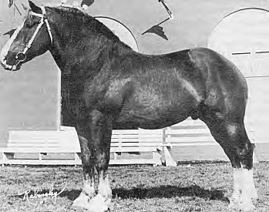
The Belgian is known as the widest, deepest, most compact, most massive, and lowest set draft breed. It is extremely quiet, docile, and patient. Its action is powerful, but less springy than the Clydesdale or Percheron. Mature stallions stand 15-2 to 17 hands and weigh from 1,900 to over 2,200 pounds. Originally mainly a bay breed, today the majority of Belgians are chestnuts. Many have flaxen manes and tails and white-blazed faces.
In the United States, Belgians far outnumber all other draft breeds.
Clydesdale
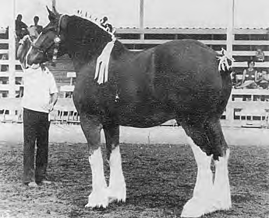
The Clydesdale was named after the valley of the River Clyde in Scotland, where it originated. It was imported from Scotland and Canada in the early 1870s.
More rangy and lighter than other draft breeds, the stallions average from 1,700 to 1,900 pounds and stand 16 to 17 hands high. Clydesdales have a broad face with a straight or convex profile. Their necks are long and broad at the base with prominent withers, and they have wide, deep chests. Their hind legs are frequently cow-hocked. Bay, black, and brown with white markings are common colors. They have much feathering with flowing hair about the fetlocks. The Scots placed particular emphasis on style and action, and the animals make a very pretty picture in parades and exhibitions.
Percheron
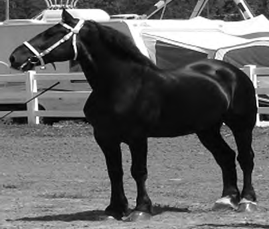
The Percheron was the most popular of all breeds during the draft horse era. It originated in France in the La Perche district. It was developed from Flemish stock that contained Arab blood. Imports to the United States began in the 1840s.
Percherons have handsome, clean-cut heads that are small in relation to the size of their bodies. They have short, muscular necks with a slight arch. Their withers are moderately prominent, their backs are sometimes slightly hollow, and their croups are wide and rounded. They have light feathering. About 90 percent of Percherons are black or gray. Stallions stand 16-1 to 16-3 hands and weigh from 1,900 to 2,100 pounds.
Percherons have been used in the development of heavy hunters. They are noted for good action, excellent temperament, and long life spans.
Shire
The Shire is the tallest horse in the world, usually standing 17 to 18 hands. The largest of the draft breeds, they weigh more than 2,000 pounds, but they are docile and good-natured.
Although the origin is not fully known, the Shire is a very old breed from the central counties in England. They are thought to have descended from the Great Horse, a medieval charger that was used in jousting.
The Shire has immense power, with its thick, powerful hindquarters and well-muscled forequarters. Its face is nearly convex, and it has a long, crested neck. Its legs have fine, silky feathering. Most Shires are dark with white markings. Black is the preferred color.
Suffolk
The Suffolk is the smallest of the draft breeds, with an average height of 16-1 hands. It takes its name from Suffolk County, England, where it was developed exclusively for farm use.
The Suffolk has great pulling power. It has a short head with a straight profile, massive neck and shoulders, and short legs with little feathering. The horse matures early and is long-lived. Suffolks are always chestnut-color, although they vary from dark liver to light sorrel. Usually there are no white markings.
Warmbloods
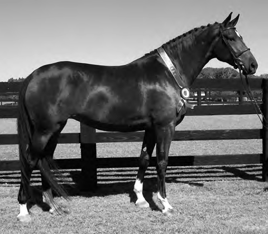
Warmbloods are a relatively recent development in horse breeding and are quite new in the United States. They were bred for competitive equestrian sports such as 3-day eventing, dressage, and show jumping. Various breeds were formed in individual European countries by crossing the local draft breed (cold blood) with Thoroughbreds (hot blood). They often are named for the country in which they originated. The Dutch Warmblood, Swedish Warmblood, Swiss Warmblood, Danish Warmblood, British Warmblood, and German Warmblood are all successful competition horses.
In general, Warmbloods have long heads that show a straight or slightly convex profile. They have long, muscular necks with pronounced withers. Their backs are long and straight, and their shoulders are long and sloping. Legs are strong and well-muscled. They are mainly solid colors.
Four German Warmbloods are worthy of particular note.
- The Trakehner, developed in East Prussia with lots of Thoroughbred and Arabian blood, is the most elegant and lightest in type of the German Warmbloods. Its great stamina and extravagant, free action make it much in demand for dressage and eventing.
- The Hanoverian is Germany’s top Warmblood and is frequently used to improve other breeds. Bred in Hanover and lower Saxony, it’s a slightly heavier type with tremendous power in its shoulders and quarters that have helped it become Germany’s most successful competition horse. The Hanoverian has a distinctive, elegant tail-carriage.
- The Holsteiner, bred in Holstein, Germany, has a slightly heavier frame than the Hanoverian. It was first bred in the 14th century as a heavy war horse; recently, Thoroughbred, Trakehner, and Cleveland Bay blood have been added. The result is excellent sports horses with good action.
- The Oldenburg has one of the oldest traceable lineages of any Warmblood, dating back to the mid 1600s. It is the biggest and heaviest of the modern Warmbloods. Originally used as a carriage horse, today it is a top competitor in all equine sport disciplines.
Other Breeds
Andalusian
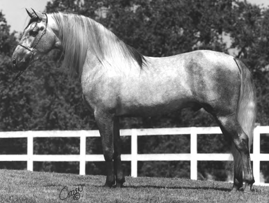
The Andalusian was developed in the Spanish province of Andalusía by crossing the Iberian horse with the Barb.
Andalusians were brought to the Americas by the Spanish explorers, and they have since influenced almost all American breeds.
Andalusians stand 15 to 16 hands. They have proud heads with an almost convex profile; strong, arched necks; and unusually short backs. They have a broad, deep chest, and their thick, wavy tail is low-set. They often are gray, but also can be white, bay, roan, or chestnut. They are very athletic and fiery, but they are calm enough to use for dressage.
Lipizzaners
Lipizzaners are most famous for the haute école (High School dressage) performed by members of the Spanish Riding School in Vienna, Austria. The breed was developed near the village of Lipizza in the early 1700s from a Kladruber mixed with Arabian and Andalusian blood.
A Lipizzaner’s build is strong, compact, and elegant. It has a large, straight or slightly convex head; a crested neck; short, strong legs; and a full, fine mane and tail. It stands 15-1 to 16 hands high. Lipizzaners are usually gray, but they may be black, bay, roan, or white. They are highly intelligent and have a calm temperament.
Miniature
A Miniature should look like the smallest possible perfect horse. Whether it looks like a tiny Quarter Horse, Arabian, Thoroughbred, or draft horse, it should be sound; well-balanced; and possess correct conformation, strength, and symmetry. All colors are possible.
Miniatures are a “height” breed. They are measured from the last hairs at the base of the mane to the ground. The American Miniature Horse Association registers horses 34 inches and under. The American Miniature Horse Registry recognizes Division A horses with a maximum height of 34 inches, and Division B horses 34 to 38 inches high. In 4-H, Miniatures can be shown in showmanship, driving, ground training, and costume. At breed shows, they also are shown in trail-in-hand and jumper-in-hand.
Miniatures often are kept as pets and are used in therapeutic programs for the disabled and aged.
Mustangs
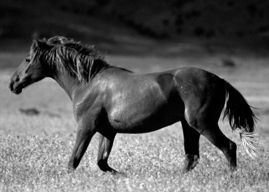
Mustangs are feral horses that live in the western United States. They derive from horses brought to the New World by the Spanish which escaped, reproduced, and reverted to the wild. They crossbred with other loose horses, including draft breeds, French blood, and Friesians. Today, only a few isolated herds, such as the Kiger Mustang and Cerat Mustang, show pure Spanish-type blood. There is little breed uniformity, as environmental factors often play a large role in development. Typically, the Mustang stands 14 to 15 hands high. They usually have a heavy head, low withers, a wide chest, short back, and straight shoulders. They can be any color.
The large herds of Mustangs that once roamed the West were reduced drastically in the early 1900s as ranchers shot them to leave more grazing for cattle. The Wild Free-Roaming Horse and Burro Act, passed by Congress in 1971, now protects these animals. The “Adopt-A-Horse” program began in 1973 as a way to control the growing population. Individuals can adopt a captured Mustang for a fee, and after 1 year of demonstrating proper care, the horse becomes legally theirs. Mustangs require an experienced handler, but they are strong, sure-footed, have remarkable endurance, and are highly intelligent.
Norwegian Fjord
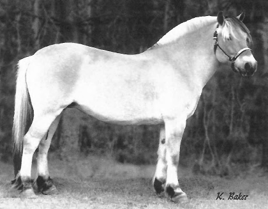
The Norwegian Fjord is one of the the world’s oldest breeds. It is believed that the original Fjord horse migrated to Norway and was domesticated over 4,000 years ago.
The gentle disposition of the Fjord horse is its most outstanding quality. They are hardy, long-lived, agile, sure-footed, and willing. They learn fast and have an amazing ability to retain what they learn, even after long periods of inactivity. Their cool temperament and graceful, balanced gaits, both under saddle and in harness, make them the ideal family horse.
Approximately 90 percent of all Fjord horses are dun in color. The other 10 percent are red dun, gray, white, or yellow dun. The Fjord retains the “wild” dun color of the original horse as well as the primitive markings which include zebra stripes on the legs and a dorsal stripe that runs from the forelock down the neck and back and into the tail. The center hair of the mane is dark (usually black) while the outer hair is white. The mane is cut short so it will stand erect, and trimmed to emphasize the graceful curve of the neck.
The head is medium-size and well-defined with a broad, flat forehead and a straight or slightly dished face. The eyes are large. Ears are small and alert. The neck of the Fjord is well-muscled and crested. The body is short-coupled with good depth, large heart girth, and well-developed muscles. The legs are powerful, with substantial bone and excellent feet which are black in color. Fjords generally range in size from 13-2 to 14-2 hands and weigh from 900 to 1,200 pounds at maturity.
Friesian
The Friesian is one of the oldest domesticated European breeds. It comes from the province of Friesland in northern Netherlands, where it was a popular war horse during the Middle Ages. It is used for light agricultural work, in harness, and in circuses. It is an excellent trotting horse and, together with the Hackney, has contributed to the development of all competitive trotting horses.
Today, the Friesian is often used as a dressage horse. Its appearance and high action make it noticeable in the show ring.
Friesians are always black with only a white star allowed. Their manes and tails are very long, often reaching to the ground. They have a compact build with a short, low-set neck that is carried vertically. They stand approximately 15 hands high and have feathering on the lower leg.
Hackney
The Hackney originated in Great Britain. It is a spirited harness horse, known for its high-stepping trot and far-reaching action.
Hackneys have small heads, long muscular necks, low withers, long quarters, slender legs, and tucked-up abdomens. Their tails are high-set and often are cropped. They can be bay, brown, black, or chestnut, and frequently have white head and leg markings.
Hackney ponies look just like the horses except for their size: if the animal is 14-2 hands or under, it is registered as a Hackney pony.
Paso Fino and Peruvian Paso
The Paso Fino and the Peruvian Paso have the same origin. Horses blended of Barb, Andalusian, Friesian, and Spanish Jennet were brought to the New World by the Spanish conquistadors. The horses that went to Puerto Rico, Colombia, and Cuba developed into the Paso Fino. Horses that went to Peru were isolated for several centuries with no outside blood introduced; they became the Peruvian Paso.
The Peruvian Paso tends to be a bit larger, both in height and in muscling, than the Paso Fino. Both can be any color.
These horses are distinguished by three unique, smooth gaits. The paso fino is the slowest gait, the paso corto is the smoothest, and the paso largo is the fastest. All are natural, four-beat gaits that are lateral rather than diagonal, making it easy for the rider to maintain a balanced seat. The Peruvian Paso also has a natural action called termino, in which the forelegs roll to the outside as the horse strides forward. The movement is graceful and flowing. Both breeds also walk and canter.
Gaited Horses
Gaited horses come in many varieties. Most gaited breeds require that the performance of that breed’s unique gait be natural from birth. Most breeds’ conformation type gives the horse a predisposition to perform its natural gait. Some conformation attributes specific for gaiting include a higher neck placement from the withers, a steeper shoulder angle, and being somewhat cowhocked so the horse can drive from the rear by dropping its hindquarters.
A well-bred gaited horse initiates its gait when asked for the intermediate gait (a four-beat lateral or diagonal gait). Depending on the breed, the intermediate gait may be called a running walk, pleasure gait, medium tölt, foxtrot, or sobreandando. Each individual horse has a different quality of gait, just as individual trotting horses of the same breed have different qualities of trot.
Gaited horses include Mountain Horses, Icelandics, Tennessee Walking Horses, Gaited Morgans, Paso Finos, Peruvian Pasos, Missouri Foxtrotters, and Spotted Saddle Horses.
Donkeys, Mules, and Hinneys
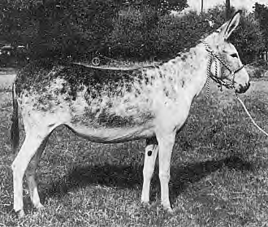
A donkey (or burro) is technically an ass. The male is called a jack and the female a jenny. The first donkey jack to enter the United States was probably the one presented by the King of Spain to George Washington in 1787.
A donkey is smaller than a horse, has longer ears, and has shorter, coarse hairs on the mane and tail. The hooves are smaller and deeper. It is less subject to founder or injury, and is hardier than the horse. It makes a loud, harsh sound called a bray.
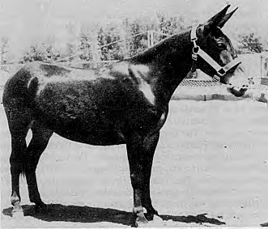
A mule is a hybrid, a cross between a horse mare and a donkey jack. It resembles its sire, the jack, more than the mare. Until mechanization, the mule was the main source of animal power in the South.
Compared to a horse, the mule can withstand higher temperatures and adapt better to changes in feed, and has less foot trouble and fewer accidents. Good conformation qualities are identical to the horse, except that more stress is placed upon the size and quality of the ears and the size of the animal. Its natural tendency is to be lazy, so more energetic stock is popular.
A male mule that has been gelded is called a john. (Although male mules are sterile, they can have stallion tendencies and are almost always gelded at a young age.) A male mule that has not been gelded is called a jack mule. It is very rare to find a jack mule.
A female mule is called a molly. A molly comes into heat as a mare does, but she rarely conceives (mollies are almost always sterile).
A hinney is also a hybrid, a cross between a stallion horse and a jenny (female donkey).
Colors and Markings
Colors
The five basic coat colors of horses are:
- Bay—Mixture of red and tan. It includes many shades, from a light tan (light bay) to a dark, rich shade that is almost brown (dark bay). A bay horse has black points (mane, tail, and lower portion of the legs).
- Black—Completely black, including the muzzle and flanks. Fine tan or brown hairs indicate the horse is not a true black but a seal brown.
- Brown—Almost black but has fine tan or brown hairs on the muzzle or flanks.
- Chestnut (sorrel)—Basically red, from a light yellow (light chestnut) to a dark liver color (dark chestnut). Between these come the brilliant red-gold and copper shades. The mane and tail are usually the same color as the body. If they are light, they are called flaxen.
- White—Horse is born white and remains white throughout life. Has pink skin and brown eyes (rarely blue).
Five major variations to these coat colors are:
- Gray—Mixture of white and black hairs on black skin. They may appear black at birth, but lighten with age. Grays are often dappled. Dapples are small spots of a lighter or darker color.
- Palomino—Golden color with white, silver, or ivory manes and tails.
- Pinto—May be any of the coat colors, but it has irregular colored and white areas. Two color patterns are recognized: tobiano and overo.
The tobiano’s head is usually marked like a solid color horse with a blaze, star, etc. All four legs are white, spots are regular and distinct, and there is usually dark color in the flank area. It may be predominantly white or colored.
The overo usually has at least one dark leg, a bald face, a one-color tail, and a calico (splashy) coat pattern with no white crossing the back. It, too, may be mainly white or colored. - Roan—Mixture of white hairs with one or more base colors. White with bay is red roan, white with chestnut is strawberry roan, and white with black is blue roan.
- Dun—To be in the family of dun horses, the color must be buckskin, dun, red dun, or grulla (grew-ya). Following are descriptions of these colors. Points on a dun horse refers to mane, tail, legs, and ear frames.
- Buckskin. The body coat is some shade of tan, from very light (creme) to very dark (bronze). Points are black or dark brown. A dorsal stripe is not required.
- Dun. The body coat is some shade of tan, from very light (creme) to a dull or smutty brown (earth tone). Points, dorsal stripe, and other dun factor markings (see below) are dirty black or smutty brown. A dorsal stripe is required.
- Red Dun. The body coat is a reddish tan without the range of shade seen in the other colors. Mane and tail are red or reddish brown, cream, or mixed. Points and dun factor markings are a reddish brown and must show a contrast with the body coat. A dorsal stripe is required.
- Grulla. The body coat is slate color (bluish gray like the blue heron) from light blue gray to a brownish shade. Points and dun factor markings are black. A dorsal stripe is required.
Dun factor markings
Dun horses exhibit some or all of primitive markings known as dun factors. These include dark ear frames, frosted forelock, cobwebbing under forelock, face masking, mottled or striped neck, frosted mane, shoulder stripe and rib barring, shoulder mottling, dorsal stripe, leg barring and mottling, and frosted tail. Consult the ABHRA for details.
Markings
White markings on the horse’s head and/ or legs are a good way to identify individual animals. Descriptions of markings are used on registration papers and veterinary documents. Therefore, it is important to use proper terminology when describing markings.
The Five Basic Head Markings

Star

Stripe

Blaze

Snip

Bald
Leg Markings

Coronet

Pastern

Ankle

Half Stocking (sock)

Stocking

Full Stocking

White Spot on Heel
White does not cover entire coronet band

Distal Spots
Whorls are patches of hair that swirl in the opposite direction to the surrounding hair. Often called “cow licks,” they can be found anywhere on the body, but are often on the forehead, neck, or in front of the stifle. They are valuable for identification purposes.
Parts of the Horse
You need to learn the correct names for the parts of the horse to be able to converse with other horse people. Also, if the horse is injured, it is helpful to be able to tell the veterinarian the specific location of the injury. You also should be able to identify the skeletal parts of the horse (see next page).

- Forehead
- Nostril
- Muzzle
- Lower lip
- Chin
- Cheek, jaw
- Poll
- Crest
- Neck
- Throatlatch
- Point of shoulder
- Chest
- Shoulder
- Upper arm
- Forearm
- Knee
- Cannon
- Fetlock joint
- Pastern
- Coronet
- Hoof
- Elbow
- Barrel
- Belly
- Flank
- Sheath
- Stifle
- Haunch
- Gaskin
- Hock
- Chestnut
- Ergot
- Point of buttock
- Dock
- Croup or rump
- Point of hip
- Coupling
- Loin
- Back
- Heart girth
- Withers

- Skull (maxilla)
- Mandible (jaw)
- Shoulder joint
- Humerus (arm)
- Elbow joint
- Radius and ulna (forearm)
- Carpal joint (knee)
- Cannon bone
- Fetlock joint
- First phalanx
- Second phalanx
- Coffin joint
- Navicular bone
- Point of elbow
- Coffin bone
- Pastern joint
- Proximal sesamoid bone
- Tarsal joint (hock)
- Tibia and fibula
- Stifle joint
- Patella (knee cap)
- Femur (thigh)
- Point of buttock
- Hip joint
- Pelvis
- Point of hip
- Scapula (shoulder blade)
- Spine
- Vertebrae of neck
Horse Psychology and Behavior
Understanding the Horse
Horses are very sociable herd animals. Originally, they lived on open plains and walked many miles each day as they grazed. Because horses evolved as prey animals, their body, mind, and spirit are attuned to one basic focus: survival. A horse’s slogan is “Act first and think later.”
The horse has survived extinction by developing instincts based on hiding, flight (running away), or fighting (kicking and biting), and adapting to constantly changing conditions. The development of sight, hearing, touch, smell, memory, and the flight instinct have all equipped horses to escape from their predators.
Sight
A horse has a unique sense of vision that developed for a life of grazing. Horses use both monocular and binocular vision. Monocular vision allows the horse to see on each side. Binocular vision (like in humans) allows the horse to see in front. The size and position of the eyes along with the width of the head give the horse its large field of vision.
Range of vision is adjusted by raising and lowering the head. Most horses cannot see objects closer than a few feet to them without moving their heads. When the horse is in grazing position, the field of vision is about 320 to 340 degrees, which allows the horse to see its best. A horse must raise its head to see close objects.
Horses have difficulty focusing clearly on objects, but they are very good at detecting movement. They can move their eyes and see things on both sides of them at the same time. Horses have two blind spots. They cannot see directly behind them, and they cannot see directly below their heads.
It takes time for a horse to adjust its eyesight to changes in light, such as going from daylight into a dark trailer or from a dark barn to the sun outside. Be patient and give the horse time to adjust.
Horses also have no depth perception. They perceive objects as flat instead of three-dimensional. This can adversely affect them when going through water.
Hearing
The horse’s hearing is better than its sight. Because of this, the eyes and ears always work together. First, the ears point toward a sound so the horse can hear it better. Then, the horse tries to see what is making the sound. A long neck and rotating ears on a movable head enhance a horse’s hearing.
Because horses’ hearing is so acute, they are sensitive to sound. Horses respond well to a soft voice. Voice commands work best when combined with gentle leg cues, light hands, and shifts in rider weight.
Touch
The horse has a well-developed sense of touch. Through its skin, the horse senses hot, cold, hard, soft, and pain. The most sensitive spots on a horse’s body are the mouth, eyes, ears, nose, lower legs, flanks, neck, and shoulders.
Touch is the horse’s most important sense for responding to cues from the rider. A horse responds readily to shifts in a rider’s weight. Along with cues from your legs and hands, you can ask a horse to stop, turn, and go forward by slightly shifting your body weight.
A horse’s mouth and sides must be kept sensitive through the correct and careful use of the rider’s hands and legs. Bitting should be done with care and reins handled with light hands. A rider who jerks on the horse’s mouth or constantly kicks the horse in the ribs will have an unresponsive horse.
Improperly fitting saddles can place undue pressure on the sensitive withers and back. This can cause injury and/or behavior problems.
Horses vary in their skin sensitivity, but most enjoy grooming and having their backs scratched. Comfortable, safe touch is critical to the horse’s peace of mind. Smart handlers use this knowledge as a primary factor in their training methods.
Smell
Horses do a lot of sniffing and tasting to determine whether they are in danger. A horse may flare its nostrils; or it may lift its head, raise its upper lip, and compress its nostrils in what is called a flehman response. Dilated nostrils can reflect interest, curiosity, or apprehension.
A horse’s sense of smell is superior to that of humans and is inherent to its well-being. Mares and foals identify each other using smell as the primary sense. Stallions can identify mares in heat for great distances. Because their sense of smell is so acute, be sure to keep horses’ quarters clean, especially of urine and feces.
Memory
Horses have wonderful memories that can enhance or harm their training. It is important to reinforce good behavior and stop bad behavior before it becomes a dangerous habit.
Horses learn through repetition, and while a horse’s intelligence in solving problems may not be very high, its learning ability is. If they do something repeatedly, it will become a habit. For example, if you let a horse walk off as you mount it a few times in a row, the horse is likely to develop this as a habit.
Horses also learn by association, which means the horse remembers if a similar experience was pleasurable or unpleasant and responds to that memory. Horse handlers should make training sessions positive and be concerned with long-term well-being more than winning a battle. It is important to work through a horse’s fears rather than punish it for its basic nature.
Flight Instinct
Horses are generally curious and like to explore their environment. Since their vision isn’t acute and they have virtually no depth perception, their natural instinct is to run when they feel threatened. Horses see every experience in life as something either to fear and flee, or not to fear and therefore ignore. The running from fear is called their flight instinct.
Some horses may be fine at home but require more patience in unfamiliar surroundings. Young or inexperienced horses might run from certain sights, sounds, and smells that later in life they would ignore.
Horse Behavior
A person’s strength is no match for that of a horse, so we must learn to understand their behavior and natural instincts for a successful relationship with them. We try to interpret (or read) the horse’s behavior under different conditions and learn to understand the horse’s actions.
To read a horse, it is important to learn its body language and understand its mood. A horse’s body language includes a flick of an ear, pawing of a foot, shaking of the head, or swishing of the tail. Observing these gestures daily teaches us to read our horses and communicate with them.
It is important to remember that each horse has its own set of characteristics and its own individual temperament. Training history and environment can influence the horse’s behavior and help create the horse’s personality.
Three factors can affect the horse’s character: genetic makeup, effects of past experiences, and present circumstances. A horse’s character or behavior can be changed, but it takes time and good horsemanship skills.
Horses are herd animals that look for a leader, so they are easily dominated. As the handler, it is important that your horse see you as its leader. When a horse lowers its head and licks its lips, it is a sign that it is being submissive and allowing you to be the leader. Always remember that dominance does not mean cruelty.
When working with horses, remember their basic fears: loss of balance, fear of falling, fear of water, injury to the poll area, and fear of an object that they haven’t had experience with. It is always better to work through the horse’s fears in a calm, quiet manner than to use force. Never rush the horse into something it is not ready and willing to try. Before a horse can learn, it has to know that everything is safe. When it feels safe, a horse is adaptable, versatile, and willing to submit.
Stable Vices
A stable vice is any abnormal behavior a horse acquires. Vices can affect the horse’s health and performance, in addition to being frustrating for its caretaker. Most vices are a result of improper management because the owner doesn’t understand horse behavior and psychology. Because horses evolved as free-roaming herd animals, over confinement, isolation, and poor feeding techniques often cause behavior problems. The more natural a horse’s lifestyle, the less its chance of developing a stable vice. Wild horses almost never exhibit vices.
Cribbing
One of the best-known stable vices is cribbing. When a horse cribs, it grabs a solid object with its incisor teeth, arches its neck, and sucks in air. This behavior can lead to chipped and worn-down teeth, poor appetite, weight loss, and serious digestive problems. Also, cribbers cause substantial damage to property.
A horse often starts cribbing because it is bored. Once a horse learns to crib, it is
extremely difficult to stop it. Each time a horse cribs, its body releases endorphins (natural pleasure-producing chemicals) to which it becomes addicted. Soon the horse would rather crib than eat.
Cribbing collars can help prevent a horse from cribbing. The collar fastens tightly around the throatlatch. Then, when the horse arches its neck to crib, the collar becomes uncomfortable or restricts breathing.
Wood Chewing
Often confused with cribbing, wood chewing is another common stable vice. Wood chewers gnaw on anything wooden (fences, stall walls, trees, doors, feeders, posts) but do not suck in air as a cribbing horse does. Most wood chewers do not swallow what they chew, but they can get slivers in their mouths or lips and the chewing wears down their incisor teeth. Wood chewing can also cause colic, and it is destructive to the facility.
Horses can become wood chewers for several reasons. Too much confinement and boredom are common causes, but dietary deficiencies and parasites can also lead to this vice.
Solutions include making sure the horse gets plenty of exercise and a well-balanced diet, including plenty of roughage. It is also helpful to protect all wood by covering it with metal or painting it with a commercial product safe for horses to ingest. You might have to protect trees and fences with electric wire.
Weaving and Stall Walking
Weaving and stall walking are two other common stable vices. Weaving is a rhythmic movement in which the horse swings its head from side to side and shifts its weight back and forth on its front legs. Stall walkers continually walk in circles around their stalls, often wearing tracks in the floor.
Both of these vices put stress on the horse’s legs and cause fatigue. They are caused by the horse being confined too much and getting bored. Both vices can be alleviated by letting the horse have time outside and giving it frequent small meals to keep it occupied.
Sometimes, getting a companion stallmate (such as a goat) can help a stall walker, while a weaver may enjoy a toy such as a ball hanging from the ceiling.
Other vices include pawing and wall kicking, which can loosen shoes and cause joint and other physical problems.
Mule Behavior
A mule’s nature is different from that of a horse. Mules tend to be wiser than horses when it comes to their own welfare. When mules get frustrated or uncertain, they stop and think it over. (For this reason, people often label mules as “stubborn.”) Unlike horses, mules rarely overeat or founder, and they seldom run into obstacles when running away. Horses have a flight instinct, but mules stop and think first.
Mules tend to be hardier than horses. Mules can stand heat and cold better than horses. Mules usually eat more slowly than horses, so feed them in a place where they can take their time to finish.
Choosing a Horse
It is important to choose a horse that is the right match for you. There are many types and breeds to choose from, and you need to know what to look for and what each is capable of doing. Also, like humans, horses have individual dispositions or temperaments which are as important as any other factor in making your choice.
The first step in choosing a horse is to make a list of your requirements, taking into account all the factors listed below. If you know what you are looking for, you won’t waste time going to see horses that don’t meet your needs.
Perhaps the most important thing to do when choosing a horse is to seek expert advice. The wrong choice can be a frustrating, dangerous, unhappy affair. Even an experienced person can benefit from another point of view.
Before you begin looking at horses, consider the following factors.
Rider’s Experience and Horse’s Level of Training
A “green” horse and a “green” rider are those who do not have much experience. A young horse and an inexperienced rider do not “learn together,” and the combination often results in disappointment or accidents. The rider may become discouraged or frightened and lose interest in horses completely.
The less experienced a rider you are, the more dependable and well-trained the horse should be. A trained horse may cost more money than a young, unbroke, or spoiled horse, but it is the best choice. If you are a more experienced rider, you may want more of a challenge—but be careful not to overestimate your ability.
Rider’s Size and Age
The rider’s size affects his or her ability to make the horse perform. Even experienced riders may have trouble on a horse that is too big for them, as their legs may not be long enough to provide proper cues.
Ideally, if the horse is the right size for the rider, the stirrups will be nearly level with the bottom of the heart girth. This gives a secure seat and allows for effective use of leg aids. Generally, a horse should not be asked to carry more than 20 percent of its body weight. Therefore, if the horse weighs 1,000 pounds, the rider should not weigh more than 200 pounds. Since it can be hard to find a horse exactly the right size, it is better to buy a horse that is too big than one that is too small.
Many children begin with a pony, which can give several years of pleasure under saddle or in harness. Ponies also cost less to feed and require less space than a horse. Before buying a pony, be sure to think about how long the child can ride it before it is outgrown.
Horse’s Age
The horse’s age should be consistent with what the rider desires the horse to do. Horses from 6 to 18 years of age are best for most purposes. Horses under the age of 5 usually are not fully trained (finished), and they may be unpredictable at times.
For more experienced members, choosing a yearling or 2-year-old and doing the training can be very satisfying.
Horse’s Gender
A stallion is a male horse able to sire (or father) a foal. Stallions over 12 months old may not be shown in 4-H. It takes an experienced handler to control one.
A mare is a mature female, 3 years or older. Mares are easier than stallions to manage, though they can become moody when in heat. If one of your goals is to raise a foal, a mare is your only choice.
A gelding is a male horse that has been castrated. A gelding is generally considered to be the most even-tempered and dependable horse. Geldings are often preferred for novice and youth riders.
A female horse under the age of 3 is called a filly, and a young male is called a colt. An unweaned horse is a foal.
Breed and Intended Use
Study the characteristics of various breeds and note those suited to the type of riding you wish to do (or if you want to use the horse for pleasure, showing, sport, or breeding). Some breeds are better adapted to Western riding, some to dressage, some to jumping, etc. It is not practical to expect a horse to do well at an event that it is not bred to do.
A registered purebred horse is usually more expensive than a grade horse (a horse of mixed origins, not purebred). A crossbred horse sometimes combines desired characteristics of both parent breeds and makes a good riding horse that is less expensive.
Color
Unless you are looking for a specific color breed to show outside of 4-H, such as a Buckskin or Paint, the horse’s color should be one of your last considerations. Limiting yourself to a certain color decreases the pool of horses you can choose from.
Conformation
Good conformation is especially important if the horse will be used for showing, breeding, jumping, or other athletic work. Look for an overall balanced appearance and a smooth blending of all the parts. Learn to recognize common unsoundnesses. Don’t worry about blemishes that do not affect serviceability.
Refer to PNW 575, the Horse Judging Manual, for detailed information on conformation.
Lease Agreement
If you decide to lease a horse or other animal instead of to buy one, you must have a lease agreement with the owner. All leases should include the following:
- Names of lessor and lessee
- Description of the horse (or other animal)
- Length of time you are to lease the horse
- What you will pay to lease the horse
- What you can use the horse for, and limitations on use of the horse
- Facility requirements
- What the horse needs in the way of shoeing, feeding, and health care (including who pays for what)
- What happens in case of the horse’s death or injury
- Other considerations as needed
Buying a Horse
Before you buy a horse, make sure you can make the commitment necessary to take proper care of the horse. A horse is a significant investment of time and money. If you are unsure whether you have the time and/or resources to own a horse, you might want to try leasing a horse first.
When you try out horses, be sure you have someone knowledgeable with you. Have the owner ride the horse or watch someone else ride it. You should ride the horse two or three different times, making sure you try everything you want the horse to do. Arrive early, so you can watch the horse being caught and tacked up. If possible, take the horse to a different setting to see how it behaves. Ask specific questions. Don’t be rushed into buying something. There are a lot of good horses out there!
The horse’s price depends on its age, training, and condition. The owner’s eagerness to sell, the time of the year, and the availability of that type of animal are also factors. Often horses are less expensive in the fall, because owners don’t want to bear the cost of keeping the horse over the winter.
The price may include tack and/or transportation home. Be sure this is agreed upon in advance and in writing.
When you have decided you are interested in a horse, arrange for a prepurchase exam by an independent veterinarian. Tell the veterinarian what you want to use the horse for. That way, she or he will know whether any problems found will make the horse unsuitable for your needs.
Once you’ve agreed to buy the horse, ask for a sales contract. This contract should include all of the following:
- Names of the seller and buyer
- Name of the horse with a detailed description
- Price, what is included in the price (tack, feed, transportation, etc.) and payment schedule
- Warranties on health and training, or “as is”
- List of known vices
- Statement that seller has the right to sell the horse
- Signatures of seller and buyer
- Date
- Return or void option
Do not pay in cash unless you get a written, signed receipt. Papers on a registered horse should be transferred at the time the final payment is made. You will need to check with the appropriate breed association for specific criteria on how to make this transfer.
Check to see if a brand inspection is required in your state or area.
The Horse’s Health
The Normal Horse
It is important to know what the normal appearance and habits of a horse are so that you can tell if something is not right. Each horse is different, so you need to be aware of what is normal for your horse. Many illnesses begin with very subtle symptoms. The better you know your horse, the faster you will notice any changes and be able to tell when something is wrong. Get in the habit of checking your horse every day. Watch it when it comes into the barn. Watch it eat for a few minutes. Groom daily. All these will help you to spot trouble early.
Also, practice taking your horse’s vital signs—temperature, pulse, and respiration (TPR)—so that you can do this quickly and accurately when needed. Be sure you know your horse’s normal TPR. To establish a baseline, take readings twice a day for a week (preferably at the same times each day) and calculate the average. Then, if your horse shows signs of a problem, you will quickly be able to determine if a vital sign is abnormal.
The following are signs of a normal, healthy horse.
- Contentment—Looks unworried when resting
- Alertness—Has a bright-eyed attitude and perks up its ears for the slightest reason
- Good appetite—Is eager and demand-ing while feed is being rationed, and eats readily
- Sleek coat—Hair is shiny and smooth, with a healthy “bloom.” Skin is pliable and elastic, not dry and tight (hidebound). Pinch a fold of skin on the neck; it should take only 1 or 2 seconds to flatten.
- Bright eyes—Eyes are clear with pink membranes under the lower lid. Fluid is clear.
- Normal feces and urine—Consistency of feces (manure) varies with the diet but usually is firm, not dry. Both feces and urine should be passed without effort and contain no blood, mucus, or pus. A horse should produce multiple piles of stool and one or two puddles of urine daily.
- Intestinal sounds—Gurgles, squeaks, and rumbles are signs that the stomach is moving food normally.
- Normal temperature—Ranges from 99 to 101°F. To take a horse’s temperature, use an animal thermometer with a string tied to the end. Shake the mercury down (or use a digital thermometer, which is faster). Lubricate the thermometer with lubricating jelly. Stand alongside the hip facing to the rear of the horse, gently pull the tail toward you, and insert the thermometer into the rectum; hold for at least 3 minutes. Remove it gently and quickly wipe it clean without touching the bulb end. Read the temperature. If the temperature is 102°F or above when the horse is at rest, the horse is probably ill and may need a veterinarian.
- Normal pulse—Ranges from 32 to 48 beats per minute. Find the artery at the jawbone where it winds around from the inner side, and feel the pulse with the tips of your index and middle fingers. Using a watch’s second hand, count the beats for 15 seconds and then multiply by four. If the pulse rate is above 50, the horse may be in distress or suffering from overexertion or abdominal pain (colic). Keep in mind that pulse rates are somewhat higher on young, small, or nervous animals. Rates are also higher when the horse is excited or is being exercised.
- Normal respiration—Rate can range from 8 to 20 breaths per minute at rest. Place your hand on the horse’s flank and count the rise and fall rate for 15 seconds, then multiply by four. A horse in good health will pause as though it is holding its breath, but a sick animal may breathe at 30 or more respirations per minute. Exercise, excitement, or hot weather may increase the rate. Breath should smell sweet. Mucous membranes in the nostrils and gums should be a normal pink color and moist.
To avoid horse health problems, start with a management program to prevent illness, parasites, injury, and accidents. Work with one veterinarian so he or she can become familiar with your horse and its health history. Ask your veterinarian to recommend an immunization and deworming schedule.
First Aid and When to Call the Veterinarian
First Aid
An equine first-aid kit is a necessity for all barns. Keep it in a dry, clean place and check it frequently to make sure it contains complete, fresh supplies. Post the veterinarian’s phone number by the phone.
All first-aid kits should contain the following:
- Veterinary thermometer and lubricating jelly
- Antiseptic ointment
- Antiseptic spray
- Scissors
- Sterile, nonstick dressings
- Roll of cotton
- Bandages or vet wrap
- Sponges
- Latex gloves
Other useful items to have on hand include:
- Iodine
- Alcohol
- Butazolidin tablets or paste
- Epsom salts
- Eye wash or ointment
- Twitch
- Medicine boot
- Stethoscope
- Hydrogen peroxide
- Syringes and needles (disposable)
- Tweezers
- Watch with second hand
Calling the Veterinarian
The decision whether to call a veterinarian when a horse is ill or injured depends on each individual’s level of experience and knowledge of first aid treatment. Learn which situations require a veterinarian’s care, and know what you can do before a veterinarian arrives. You can treat minor injuries and some illnesses, but contact a veterinarian immediately if you have any doubts or questions. Prompt and proper treatment can mean the difference between a minor incident and a disaster.
Following are examples of times to call a veterinarian:
- The horse’s temperature is 102°F or higher.
- The horse appears to be in shock (symptoms of shock are on page 28).
- A pressure bandage on a wound does not stop the bleeding.
- The horse is very lame.
- A wound is a deep puncture.
- A wound is deeper than the skin and is near the eyes, mouth, joints, or tendon sheaths.
- Infection appears in any wound.
- The horse shows signs of colic.
- The horse’s appetite decreases or it is off its feed for 12 to 24 hours.
- The horse has a cough that steadily worsens, is wheezy, or seems painful.
- You suspect a broken bone.
- The horse is choking with excessive salivation.
- The horse has persistent diarrhea.
- A mare is having difficulty foaling.
While waiting for the veterinarian to arrive, do not put any medication on wounds, do not feed or water the horse unless you have been instructed to do so, restrain the horse from injuring itself, and keep calm.
When the veterinarian arrives, have the following information ready, if you can:
- Detailed medical history, including normal TPR and vaccination schedule
- Horse’s temperature
- Horse’s heart rate (especially if you suspect colic)
- Duration of the illness/problem
- Changes in routine or environment
- Changes in feed or feeding habits
While the veterinarian is working on the horse, help by holding the horse firmly by the halter. Stand on the same side as the doctor. Remain quiet while the doctor uses the stethoscope to check the stomach and respiration.
Control the horse with as little restraint as possible. It is better not to tie it up. Begin by scratching the withers or forehead and giving the command “Whoa.” Try a light, steady tap on the forehead with a finger. When a leg is being treated, hold up another foot to help keep the horse from stamping. If the horse won’t keep still, try using a chain lead shank over the nose.
Holding a fold of skin on the neck firmly just above the shoulder can also be effective. A firm hold and slight twist of the ear also can control the horse, but be careful not to damage cartilage.
A twitch is a common device used to control a horse. It can be a loop of rope or a chain attached to a stick, or a clamp-type “humane” twitch. To apply the twitch, reach through the loop or clamp with your hand and grasp the horse’s upper lip. Fold the lip edges together, slip the loop over the lip, and quickly twist or tighten it. Do not tighten it more than is necessary to keep it from slipping, and release it as soon as possible.
If all other methods fail, a veterinarian may use a tranquilizer to quiet the horse.
Write down all instructions for the horse’s care, and follow them exactly. Never stop prescribed treatment just because the horse seems better.
Wounds
Gently clean abrasions to remove all debris from the wound. Use a cold water hose. Pat dry and apply antiseptic. Large wounds may require stitching.
For severe bleeding, apply a pressure bandage, not a tourniquet. Be sure the pressure is applied evenly on and around the wound. Do not panic if the blood loss seems great. The average horse can lose up to 4 gallons of blood without severe stress. After 15 to 30 minutes, remove the bandage. Call the veterinarian if the bleeding does not stop.
A common aftermath of wounds is proud flesh, a red lumpy mound filling the wound. Healthy new tissue should be pink and velvety. Proud flesh may develop in areas of high motion or over joints if the wound was not cleaned thoroughly; irritating, harsh soap or medications were used; or the bandage was too tight. Proud flesh prevents normal tissue from forming and must be stopped early. If you suspect proud flesh is developing, or the wound in any other way looks unhealthy, contact a veterinarian.
Punctures
Punctures are deep wounds with small openings that tend to close quickly. These easily become infected if they are not cleaned thoroughly and treated. The key is to keep the puncture open so that it can drain.
Punctures to the sole of the foot are common and often lead to abscesses. Skin punctures may be caused by fence wire or wood splinters.
Tetanus bacteria in a puncture wound is a serious concern. Be sure your horse is current with its vaccination. If its last booster was more than 5 to 6 months ago, give it another one.
Rope Burns
Tying a horse on a long line to graze or tying it with too long a lead rope often results in rope burns, especially on the rear pasterns. The wound may have cut to the bone or merely scraped off the hair, but all rope burns should be treated depending on severity (see wounds) to avoid lameness and a slow-healing injury.
Watery Eyes
Weeping and squinting may be caused by a cut or scrape of the eyeball, an allergy, a bruise, a bit of dirt or seed under the eyelid, or irritation by flies. Other irritants may be dusty feed, ash, pollen, or other material in the environment. A simple eye wash may clear this up. If the watery eyes persist longer than 24 hours, contact a veterinarian.
Bruises and Swelling
Bleeding under the skin causes a bruise. Immediately apply an ice pack or cold water directly from a hose to help stop the swelling. Continue treatment for at least 20 minutes and repeat in an hour. If the swelling persists or increases, call a veterinarian.
When normally active horses are kept stalled without exercise, they may develop swelling in the legs. This is known as stocking-up and is most common in the hind legs. Exercise and proper wrapping of the legs help reduce the swelling.
Shock
Shock is the result of extreme stress from disease or injury. Call the veterinarian immediately. Signs of shock include depression, rapid breathing, pale gums, low temperature, cold lower legs, and shallow and/or rapid pulse.
While waiting for the veterinarian, keep the horse warm and quiet. Noise can cause more stress. Handle the horse gently and calmly.
Colic
Colic is a general term for any abdominal pain in a horse. Due to its extremely sensitive, unique digestive system, the horse is quite susceptible to colic; and colic can be fatal.
There are several types of colic, ranging from mild to severe. Because the signs are similar, it is hard to tell whether a horse has a mild case or whether the situation is life-threatening. Call a veterinarian immediately when you suspect colic.
Signs of colic may include any of the following:
- Looking at the abdomen
- Nipping or kicking at belly
- Rolling violently
- Getting up and down frequently
- Sweating
- Abdomen abnormally quiet
- Pawing and/or grunting
- Increased pulse rate (over 60 beats per minute)
- Abdominal distention
- Depression
- Off feed
While waiting for the veterinarian to arrive, do not give the horse any food or water. Also, do not give the horse any medication, as this may mask pain and other signs that could aid the veterinarian in determining the type of colic and treatment needed. It is rare for rolling to cause an intestine to twist, but if the horse tries to roll excessively, walk it slowly. Otherwise, it is best to let the horse stand or lie quietly; overwalking will tire it and may cause it to go into shock.
Many things can cause colic, and some horses are more susceptible than others. Any of the following may be factors that lead to colic:
- Parasites
- Sudden changes in diet
- Not chewing food properly (bolting food)
- Eating too much at one time
- Poor quality feed (too coarse or moldy)
- Irregular feeding
- Lack of water, or too much icy water when the horse is hot
- Working on a full stomach
- Poor dental health
- Ingesting sand
- Stress
- Gas
The type of colic determines the method of treatment. Types of colic include spasmodic colic, impaction colic, displacement colic, and excessive fermentation.
Spasmodic colic is the most common type. It usually is not life-threatening. Muscular spasms of the intestinal tract cause mild to moderate pain. Sudden changes in diet and overexcitement are common causes. An anti-inflammatory drug or other pain relief medication is usually enough to relieve the horse.
Impaction colic occurs when there is a blockage in the intestine, and the contents of the intestines stop moving. This happens most often in the large colon. The blockage can be caused by poorly digested food, sand, an enterolith (a hard lump produced by the concretion of mineral salts), or swallowed foreign matter. It is sometimes possible to use fluids or stool softeners to lubricate the blockage and move it along. Other times, surgery is necessary.
In displacement colic, a part of the intestine is twisted or becomes trapped in other abdominal structures. This is extremely serious, and surgery usually is required to save the horse’s life. It must be done promptly, or the affected section of intestine may die.
Excessive fermentation (or tympanitic colic) occurs when the contents of the stomach ferment more rapidly than they can be eliminated, forming a large quantity of gas. This often happens when a horse eats too much grain. Chemical changes decrease the flow of blood to the hooves, which can cause founder and even death. This type of colic is difficult to treat. Medicine may not relieve the gas pressure, and surgery is not always successful.
Prevention
There are several things you can do to help prevent colic. Deworm your horse regularly, as parasites are the leading cause of colic. Make sure clean, fresh water is always available. Provide regular dental care to make sure your horse can chew its food properly. Make any changes in routine or environment gradually to save the horse from stress.
Proper feeding is crucial in preventing colic. Feed high-quality foods, and feed often in small amounts. Make feed changes gradually over the course of about 2 weeks. Feed in a manger rather than on the ground, as the horse can ingest sand and/or parasites. Horses that are kept on pasture all the time seldom have colic.
Lameness
Most lameness occurs in the front legs, because they carry two-thirds of the horse’s weight. Also, most lameness problems occur from the knee or hock down—almost 90 percent of all lameness is caused by a problem in the feet.
If a horse becomes lame, check its legs for wounds and carefully inspect the hooves for imbedded rocks or nails, puncture wounds, or loose shoes. If the lameness is worse on rough ground, suspect a problem in the hoof.
Learn to tell which leg is lame. Have someone trot the horse, and watch its head movement from the side. At a normal trot, the head has very little up-and-down motion. But if the horse limps or favors a front leg, the head will drop as it puts extra weight on the sound leg. Trotting in a circle on the longe line puts more strain on the inside legs. If the lameness doesn’t show in one direction, reverse.
If the horse seems to be lame in a rear leg, have someone trot it directly away from you and watch the hips. The hip on the sound leg will dip, but the hip on the lame side will stay higher and seem to bounce upward. In severe cases, you may see some head movement as well.
After you have identified the lame leg, test each part to find the sore spot. Encircle the leg with your hands, and squeeze each area very firmly until the horse reacts. Feel for swelling and heat. Test the opposite leg for comparison. Be very careful with the hind legs to avoid being kicked. Try bending each joint and holding it for 30 seconds, then release it and have the horse trotted away. Again, do each side for comparison.
Treatment depends on what has caused the lameness. Some lameness can be treated easily with cold water or time off; some requires a veterinarian’s care.
Alternative Therapies
Many people are using alternative methods of treatment for their horses, especially when the horse is not responding to traditional care. These therapies should not replace standard veterinary medicine, but can be used with traditional treatments in an integrated approach to healing the horse. Your veterinarian should still be your first contact for an equine health issue. Always consult your veterinarian before you begin an alternative treatment, and get a recommendation for a licensed and reputable practitioner.
One of the most common alternative therapies is chiropractic treatment. A chiropractor manipulates the horse’s spine to correct misalignments and restore the spine to its normal position. This reduces back pain, improves flexibility, and increases the range of motion. Be sure you use a licensed practitioner, because the spine can be damaged if the treatment is not done properly.
Massage is also a popular alternative therapy. Massage manipulates the soft tissues by rubbing and kneading with fingers and elbows. Massage can loosen tight muscles, ease spasms, stimulate blood flow, and restore or increase range of motion. Massage is also a good way to relax the horse and relieve stress. One caution: if the horse is very sore, massage may make the condition worse.
Another alternative is acupuncture, an ancient Chinese medicine which may relieve a horse’s pain, especially arthritis pain. Acupuncture stimulates certain points with needles. The stimulation increases the flow of blood to the area which helps in the healing process. The needles also trigger the release of endorphins, pain-relieving proteins naturally produced by the body. There are usually no side effects to acupuncture, though extremely sensitive horses may develop some inflammation at the needle insertion site.
The use of magnet therapy in treating horses is gaining support. Blood contains electrically charged particles, and placing magnets over the sore area is believed to attract more blood to the spot. The increased circulation hastens healing. For best results, the magnets are supposed to stay in place for some time, so they are often found sewn into blankets, boots, or pads.
Homeopathy uses tiny amounts of natural substances to treat horses. While there is not much scientific evidence to support this type of therapy, it does not harm the horse. Nor will it mask signs as drugs often do. You must use care, though, because larger amounts of these substances can actually cause disease.
Other types of alternative therapies include herbology, which uses plant material instead of drugs; electric stimulation, in which a machine delivers an electrical current to muscles or nerves; and radiant energy, which uses light or sound waves to increase the horse’s circulation.
Diseases
Prevention
Biosecurity
Any time you go to a show or other equine event, there is always a risk of your horse contracting a disease. But, there are many things you can do to minimize that risk. It is usually cheaper to prevent disease than to treat a sick animal. The routines and practices used to help prevent the spread of infectious diseases are known as biosecurity measures.
You can help prevent the spread of disease at home and at shows by doing the following:
- Keep your horse’s immune system healthy by maintaining its general health. This means making sure it is clean and groomed and has a balanced diet, appropriate vaccinations and deworming, sufficient exercise, and proper foot and teeth care.
- Make sure your horse is current on its vaccinations at least 2 weeks before going to an event. Your horse will not be protected from disease if it is vaccinated the day before you leave. Moreover, your horse may not perform at its best if it is having a reaction to the vaccine.
- Keep the animal’s quarters clean. When moving into a facility, make sure the entire stall you use is thoroughly cleaned and disinfected before you put your horse in it. Once your horse is established, do not rotate it from stall to stall.
- Do not loan or borrow any grooming supplies, tack, or equipment. If you must share something, make sure it is cleaned and disinfected. Remove any organic matter, then wash with soap. Rinse with water, allow time to dry, and then apply a disinfectant. (Bleach is a common disinfectant. Use 1 part bleach to 10 parts water.)
- Limit horse-to-horse contact. In particular, don’t let your horse touch noses with other horses. Nasal discharge is a common way to spread germs.
- Wash your hands between handling different horses. It’s easy for people to spread disease by touching an infected horse and then transferring pathogens (disease-causing agents) when they touch the next horse.
- Never share feed or water buckets. Sanitize buckets periodically, and always after a horse has been ill.
- Don’t take your horse to communal water or grazing areas.
- Do not submerge hoses when filling water buckets. Pathogens on the hose are easily spread in water.
- Properly dispose of all manure.
- Good ventilation helps reduce the circulation of pathogens and relieves any stress on the respiratory tract.
- At a show, listen and watch for signs of sick horses around you. Report any problems to the show office immediately.
- Isolate your horse if it becomes sick.
- When you return home, change your clothes and shower before you handle horses that didn’t travel to the event.
- If possible, isolate horses returning from a show for a short time.
Remember that animals can carry germs that make people sick, too. Wash your hands with soap and water after handling your horse. Don’t eat or drink in the animal areas. Young children, older people, and people with weakened immune systems should be especially careful.
Vaccination
A vaccination program is extremely important in preventing disease. Vaccination protocols vary depending on your location and individual veterinarian preference. You should talk with your veterinarian about a vaccination schedule for each horse you own, and follow the vaccination program recommended by your veterinarian. This schedule should include which vaccinations to give, when to give them, and what type they are (for example, subcutaneous, intramuscular, or nasal). Your veterinarian also can teach you how to give shots correctly and safely.
For up-to-date vaccination recommen-dations, you may also consult the AAEP (American Association of Equine Practitioners) schedule of “Guidelines for Vaccination of Horses.” You can find this on their website, or ask your veterinarian.
Equine Encephalomyelitis
Commonly called sleeping sickness, equine encephalomyelitis is a viral infection that causes inflammation of the brain. It is contagious to humans. Three strains are commonly recognized: Eastern equine encephalomyelitis (EEE), Western equine encephalomyelitis (WEE), and Venezuelan equine encephalomyelitis (VEE).
All types are spread by insects. Mosquitoes are the main carrier, but mites, ticks, and lice also may transmit the disease. The insect bites an infected animal, usually a wild bird or rodent, and then bites and feeds on a horse, spreading the disease.
Signs are the same for all three strains and usually appear 7 to 21 days after a bite from an infected mosquito. The first signs are fever, depression, and loss of appetite. The horse may grind its teeth and have trouble swallowing. Later, problems with the central nervous system appear. There may be ataxia (poor coordination), and the horse may circle, walk aimlessly, or appear blind. Convulsions or tremors may occur. Eventually, the horse may show paralysis or go into a coma.
WEE has the lowest mortality rate, at 20 to 50 percent. VEE has a mortality rate of 40 to 80 percent, while EEE has a mortality rate of 75 to 90 percent. Horses that survive often have lasting neurological effects such as clumsiness or depression.
Vaccination is the best prevention for this disease. Horses need annual boosters in the spring before the mosquito season. Insect control also can help prevent the spread of the disease. Use repellents on your horse, and eliminate any standing, stagnant water where mosquitoes can breed.
Equine Infectious Anemia
Equine infectious anemia (EIA) is a viral disease of horses, donkeys, and mules. It is sometimes called swamp fever. The disease is spread when blood from an infected horse is transferred to another horse, most commonly by horseflies and deerflies. However, the virus also may be spread by unsterile hypodermic needles or from a pregnant mare to her fetus.
Cases may be acute or chronic. In an acute case, the horse may have a high fever, depression, swelling in the belly and legs, and yellow, inflamed mucous membranes. About one-third of infected horses die within a month.
Horses that recover remain infected all their lives. They show chronic symptoms, such as anemia, weight loss, and exhaustion, and they become carriers of the disease. Stress can trigger an acute attack at any time.
Currently, there is no cure for EIA, nor is there any vaccine to prevent it. The only control is screening for the virus by performing a Coggins test. This blood test must be done by a state-approved laboratory. A horse will test positive if there are EIA antibodies in its blood, which means the horse is an infected carrier of the disease. Most states, countries, horse shows, and race tracks require recent negative Coggins tests before allowing horses to enter. Any horse that tests positive must be reported to state and federal authorities. Such animals usually are euthanized.
Equine Influenza
Equine influenza (flu) is a viral respiratory disease. It is one of the most common horse diseases and is extremely contagious, often becoming an epidemic.
The virus is found in a horse’s nasal discharge and spreads easily from horse to horse. It can be transmitted by direct contact, by a horse coughing up to 100 feet away, or by the wind carrying droplets up to 4 miles away. Handlers’ clothing and skin, grooming supplies, and blankets all can be contaminated and spread the virus. It can also spread by indirect contact (such as with buckets and mangers), as the virus can live in the environment for 2 days.
Most infected horses show symptoms within 1 to 5 days. Typically, the horse has a fever, a dry, hacking cough, and clear nasal discharge. After a few days, the cough becomes moist and the nasal discharge thick and colored. The horse may be lethargic and easily tired. Loss of appetite is also a common symptom.
The main treatment for equine influenza is rest. Do not work the horse for 3 weeks, so the lining of the respiratory tract can heal. With rest and good nursing care, most horses recover completely within a few weeks.
Vaccinations are effective in preventing this disease, but the vaccine’s protection only lasts 3 to 4 months. High-risk horses, such as those that travel to many shows or that are in contact with many other horses, may need to be vaccinated two to four times per year. Horses that have very little chance of exposure to the virus may only require a yearly booster.
Equine Protozoal Myeloencephalitis (EPM)
EPM is a degenerative disease of the central nervous system. It is the primary cause of serious, permanent neurological problems in a horse. EPM has been reported in almost all parts of the country, and it is estimated that over 50 percent of horses in the United States have been exposed. EPM is caused by the protozoal organism Sarcocystis neurona found in opossums. The horse is infected when it eats feed or drinks water that has been contaminated by opossum feces. As with West Nile virus, horses are “dead-end” hosts and cannot transmit the disease to others.
Signs of EPM vary widely in severity and depend on where the damage to the nervous system has occurred. They are almost always asymmetrical (not the same on both sides of the body). Signs include ataxia, weakness, muscle loss or atrophy, difficulty swallowing, and paralysis of the eye, face, or mouth muscles. The way a horse responds to infection also varies. Some horses seem to have an effective immune response and fend off the disease. Some carry the infection for years before developing symptoms, while others succumb rapidly, especially if under stress. Three factors appear to affect the progression of the disease: the number of organisms the horse ingested, the amount of time the horse was infected before treatment began, and the location in the brain or spinal cord where the damage occurs.
EPM is difficult to diagnose because the signs are similar to many other diseases. A Western Blot analysis on blood or cerebrospinal fluid is used to diagnose EPM, but this only tells you if the horse has been exposed to S. neurona and has developed antibodies. It does not tell you if the horse has or will develop the disease.
Early diagnosis and treatment give a horse the best chance for recovery from EPM, and 60 to 70 percent of horses do recover fully. Treatment may include broad-spectrum antimicrobials, NSAIDS (nonsteroidal
anti-inflammatory drugs), and antiprotozoal medications. These medications may rid the horse of the protozoa, but they cannot repair damage to the nervous system that was done before treatment began.
You can help prevent EPM by limiting the horse’s exposure to opossum feces. Keep opossums out of hay storage areas, and keep grain bins tightly sealed. Use feeders that minimize spills, and keep water tanks clean.
Maintaining your horse’s health and fitness will help it fend off infection.
Equine Rhinopneumonitis
Equine rhinopneumonitis is caused by the equine herpes virus (EHV). There are two distinct types.
EHV-4 (snots) is common in young horses, particularly foals and yearlings. Signs include fever, depression, loss of appetite, gold-color nasal discharge, and swollen lymph glands. The horse may be sick for several weeks, but the death rate is quite low. Mature horses usually develop an immunity to this type.
EHV-1 is the more serious type, causing abortion in pregnant mares. It can also cause respiratory disease and paralysis. Horses do not develop immunity to this form of the disease.
Rhino vaccines provide only short-term immunity. Pregnant mares should be vaccinated in their 5th, 7th, and 9th months of pregnancy. Foals and young horses often are vaccinated at 2- to 3-month intervals. Older horses should be vaccinated every 2 to 12 months depending on the risk.
Pigeon Fever
Pigeon fever is the common term for an infection with Corynebacterium pseudotuberculosis. It is called pigeon fever because the abscesses it forms cause swellings on the chest that look like a pigeon’s breast. Abscesses can also form along the bottom of the barrel of the horse. The horse can have a fever and will be sore where the abscesses are. A more severe form of the disease occurs if the abscesses are located internally. A veterinarian can drain the abscesses, but the horse must be isolated while the abscesses heal to prevent transmitting the disease to other horses.
The organism lives in dry soil and manure and enters the horse through open wounds or insect bites. It occurs most often in late summer and fall during hot, dry weather. Insect control can help prevent the spread of this disease.
Potomac Horse Fever
Potomac horse fever (PHF) is a disease caused by the parasite Ehrlichia risticii. This disease is most common in the eastern United States, but it does occur elsewhere. (Recently, a disease known as the “Shasta River Crud” in California was found to be caused by the same organism.) PHF is a seasonal disease, and the majority of cases occur in the summer.
It had been thought that PHF was spread by ticks, but current research indicates that freshwater snails might be the carriers. If this is true, keeping horses away from water where the snails live would prevent the disease.
The signs of PHF are fever, severe diarrhea, mild colic, loss of appetite, and depression. Laminitis can be a serious complication. Antibiotics are used in treatment, but the success rate varies.
Vaccinate horses that live in or are traveling to areas where this disease has been confirmed.
Rabies
Rabies affects all warm-blooded animals. Horses rarely get rabies, but when they do, it is 100 percent fatal. It can also be spread to humans, so call the veterinarian as soon as possible.
Signs of rabies vary greatly, but the number one symptom of rabies in horses is excessive salivation. Horses may get extremely agitated and become unmanageable. Behavior may be bizarre, changing from depression to aggression. Colic, lameness, and muscle spasms are also common. Death usually occurs in 4 to 5 days.
Vaccinate horses kept in areas where rabies is found, especially those exposed to wildlife.
Strangles
Strangles is an upper respiratory disease caused by the bacterium Streptococcus equi. It is very contagious, and the bacteria may survive in a barn or paddock for up to 2 months.
Discharges from the nose and burst abscesses spread the disease. This can happen through direct contact or through contamination of equipment such as water buckets, brushes, or tack.
The most common sign of strangles is swollen lymph glands under the jaw or at the throatlatch. Severe swelling restricts the air passages, causing the horse to have difficulty breathing and creating a “strangled” sound. Abscesses may form, which usually break and drain pus in 10 to 14 days. Fever, loss of appetite, listlessness, and nasal discharge are other signs of strangles.
Isolate affected horses immediately. Disinfect all feed and water containers, stall walls, grooming supplies, and tack. Abscesses may need to be lanced and drained. Rest is the most important treatment. Most horses recover from strangles, but they should stay isolated and rest for up to 3 months.
Whether or not to vaccinate for strangles remains controversial. Current vaccines do not completely protect a horse from getting strangles, and many problems are reported with reactions to the vaccine. Therefore, many adult horses are not vaccinated for this disease unless they are in a high-risk environment. Consider vaccinating young horses or any horse that is going to a site where strangles has recently occurred.
Tetanus
Tetanus is a serious disease caused by the bacterium Clostridium tetanus, which is found in soil. The bacteria usually enter the horse’s body through a puncture wound. They multiply and produce a powerful toxin that affects the horse’s nervous system.
Signs include lameness, a stiff-legged gait, muscle spasms, and a stiff, held-out tail. The third eyelid may cover the front of the eye. Swallowing becomes difficult and the horse is unable to eat (which gives this disease its common name, lockjaw).
The horse is the most susceptible animal to tetanus. Treatment is difficult, expensive, and not often successful; tetanus is fatal in more than 80 percent of cases. For this reason, vaccinations are important to prevent this disease. Annual boosters are recommended. Horses also must receive a booster following lacerations or puncture wounds if their last booster was more than 5 to 6 months previous.
West Nile Virus
This mosquito-borne virus causes encephalitis (inflammation of the brain). It was first detected in the United States in 1999, in New York. It has since spread to almost every state. Horses are affected more than any other domestic animal. Most horses usually recover fully from the disease, but one-third of infected horses die.
Horses are incidental or “dead-end” hosts to the virus. This means that infected animals do not pass the disease on to other animals. There is no horse-to-horse or horse-to-human transmission. Mosquitoes get the virus from infected birds (crows and jays are common carriers), then transmit the virus when they feed on a horse.
In horses, signs of the virus appear 5 to 15 days after infection. These signs include ataxia, depression, weakness of limbs, partial paralysis, muscle twitching or tremors, wandering or circling, altered gait, convulsions, and loss of appetite. There is usually no fever.
There is no specific treatment for West Nile virus, only the standard veterinary care used for any viral infection. Horses are euthanized when the infection is so severe that the horse is not able to recover.
All horses should be vaccinated against this disease. The initial vaccine is given in a series of two injections that must be 3 weeks apart. Yearly boosters then are required, which should be given before peak mosquito season.
Practice mosquito control. Eliminate standing water where mosquitoes can breed, and clean water troughs weekly. Keep horses inside during dawn and dusk, as this is when mosquitoes tend to be the most active. You can also treat your horse with a mosquito repellent.
Parasites
The word parasite refers to animals that live in or on the bodies of other animals, called hosts. Parasites may be internal or external. Control of parasites is a vital part of any horse health care program.
Internal Parasites
Internal parasites are a major threat to a horse’s health. It is estimated that 50 percent of deaths in horses may be related to internal parasites. Young horses suffer the greatest damage, usually in the first 2 years of their lives.
Internal parasites can affect the growth, reproduction, performance, and overall health of a horse. Many respiratory and digestive problems are caused by parasites, and they are the greatest single cause of colic. Diarrhea, weight loss, chronic cough, and anemia are all signs of parasitic infection.
The amount of damage a horse suffers depends on several factors: the type and number of parasites involved, the horse’s age and resistance, and the length of time the horse has been infected. Most of the damage is done during the migratory phase of the parasite’s life cycle.
Internal parasites may live in practically every tissue and cavity of the horse’s body, but most of them are in the digestive system, lungs, or bloodstream. More than 150 types of internal parasites can infect horses. The five main ones are large strongyles, small strongyles, ascarids, pinworms, and bots. Threadworms and tapeworms also are common.
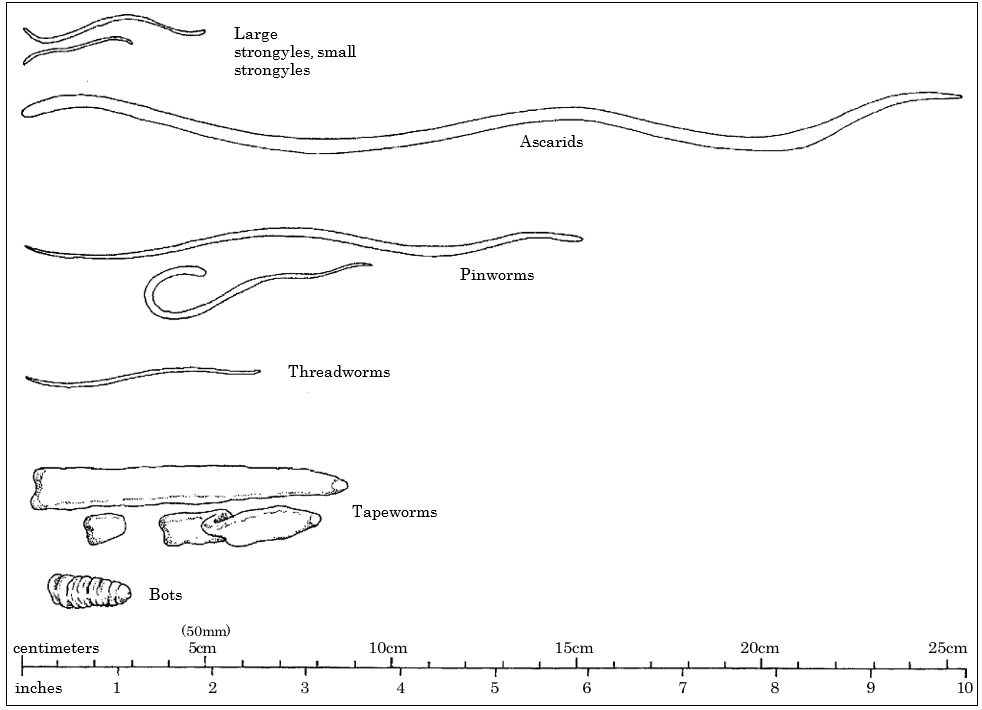
Large Strongyles (Bloodworms)
Large strongyles are the most common internal parasite and are also the most harmful. While the adults remain in the large intestine, the larvae migrate extensively through many of the horse’s organs, and severe tissue damage can result.
The adults are long, fat worms, reddish in color (because they feed on their host’s blood). They bite off pieces of the large intestine and actively suck blood. This causes anemia in the horse, as well as weakness, diarrhea, and weight loss.
The life cycle of large strongyles begins when the horse swallows eggs in its feed. The larvae migrate through various organs, ending up as adults in the large intestine. The adults lay thousands of eggs daily which are expelled in feces and contaminate the feed.
There are three significant species of large strongyles: Strongylus vulgaris, Strongylus endentatus, and Strongylus equinus. S. vulgaris is by far the most dangerous. Causing up to 90 percent of all colic cases, this parasite is sometimes known as “the Killer.” The larvae penetrate the walls of arteries that provide blood to the intestines. This disruption of blood flow in the digestive tract causes colic. S. endentatus and S. equinus are not as dangerous as S. vulgaris. Their larvae migrate only within the liver before returning to the large intestine to mature.
Small Strongyles
The damage done by small strongyles is much less severe than that done by large strongyles. They do not migrate beyond the lining of the intestine, they are only loosely attached to the intestinal wall, and usually they do not suck blood.
An infestation of small strongyles may cause colic, and diarrhea is common. Weight loss and ulcers in the colon also may occur. Signs include anemia, dark or black feces, and soft feces with a foul odor.
The life cycle of small strongyles begins when horses feed on grass contaminated with larvae. After they are ingested, the larvae migrate to the large intestine, where they mature into adults and begin laying eggs. The eggs of adult small strongyles are expelled in feces. Larvae develop and contaminate grass, and the cycle begins again.
Ascarids (Roundworms)
larvae. After they are ingested, the larvae migrate to the large intestine, where they mature into adults and begin laying eggs. The eggs of adult small strongyles are expelled in feces. Larvae develop and contaminate grass, and the cycle begins again.
AscArIds (roundWorms)
Ascarids (Parascaris equorum) are the largest of the five main internal parasites. They look like large, white earthworms, up to 22 inches long and ½ inch wide.
Ascarids mainly affect foals and young horses. Mature horses that have been exposed to roundworms over time usually develop an immunity and are not affected.
During larval migration, the liver and lungs can become inflamed and scarred. Adult worms can cause intestinal blockage, which leads to colic. The main danger of an ascarid infestation is rupture of the small intestine. A rupture may cause peritonitis, which can be fatal.
Signs of a horse with ascarids are a pot belly, rough coat, slow growth, diarrhea, nasal discharge, and cough.
The life cycle of ascarids takes about 3 months to complete. The horse swallows eggs found on feed or in water. The eggs hatch in the small intestine, and the larvae burrow into the intestinal wall. There they enter the bloodstream, migrate through the liver and heart, and finally reach the lungs. In the lungs, they move to the respiratory passages, where they are coughed up and reswallowed. They return to the small intestine where they mature and lay eggs.
An adult roundworm can produce 200,000 eggs per day. The thick-shelled eggs are extremely resistant to freezing or drying. In a pasture or stall, they can remain infective for years. Because the eggs are almost always present, roundworms are very common. It is important to deworm foals every 2 months through their first year.
Pinworms
Pinworms (Oxyuris equi) are the least harmful of the common internal parasites. Mainly, they irritate the area around the tail. The horse rubs this area to get relief, and can suffer hair loss and wounds as a result.
Adult pinworms are thin and usually 3 to 6 inches long. They are common in foals but are seldom found in mature horses.
A pinworm’s life cycle has no migratory phase. The eggs are ingested and develop in the colon. The adults live in the colon and rectum. Eggs are laid around the anus, where they cause irritation. The eggs drop off and contaminate the feeding area. The entire life cycle takes about 5 months.
Bots
Bots refers to the larvae of the bot fly, which looks like a honey bee. In summer and early fall, the fly lays yellow eggs on the horse’s hair, especially on the legs. As the horse licks the eggs, they hatch, and the small larvae attach to the tongue and burrow in the mouth. In about 3 weeks, a second larval stage is swallowed and attaches to the lining of the stomach. After another 9 months, the larvae are expelled in the manure, where they pupate into flies.
The entire cycle takes 1 year. The larvae winter in the horse’s stomach, are expelled in the spring, and develop into adult flies in the summer. Therefore, the time to deworm for bots is mid- to late summer and after a killing frost.
Bots affect horses of all ages. They usually cause little damage, but a large infestation can damage the stomach wall, even causing a rupture.
The best prevention is to remove all bot eggs from the horse’s hair. Do this where the horse does not graze, so eggs do not contaminate the feed.
Threadworms
Threadworms (Strongyloides westeri) mainly affect young foals. The foal usually gets the larvae in the dam’s milk, although larvae in the bedding may also penetrate its skin. The larvae migrate through the lungs and the small intestine. The entire life cycle of the threadworm takes less than 2 weeks.
The main complication of a threadworm infection is diarrhea, which can be severe enough to cause dehydration. Foals quickly develop an immunity, and threadworms generally disappear by the time the foal is 6 months old.
Tapeworms
Tapeworms affect horses of all ages.
Tapeworms are not found in all areas, because they require an intermediate host: the orbatid mite. A horse swallows the mite, and the tapeworm matures 2 to 4 months later.
There are two common species of tapeworm. Anoplocephala perfoliata is the most common. It is the smaller of the two and is found in the cecum see “The Digestive System,” page 60). Anoplocephala magna is larger and is found in the small intestine.
Tapeworms can cause digestive problems, including intestinal blockage and colic. They can also cause ulcers.
Controlling Internal Parasites
All horses have parasites. You can never completely get rid of them, but you can keep them under control through proper management techniques. The key is to interrupt the life cycle of the worms. There are several methods to do this; manure cleanup, pasture rotation, and deworming are the main ones.
Manure Cleanup
Parasites are spread mainly through manure. Therefore, if you dispose of manure properly, you can greatly decrease the number of worms.
Clean stalls regularly, removing all manure and wet bedding.
It is best to feed in a manger and disinfect it periodically. This prevents manure from coming into contact with the horse’s feed. Also, be sure to keep manure out of any water source.
Do not spread fresh manure on pastures. Instead, compost the manure, making sure it gets hot enough to destroy parasite eggs.
Pick manure out of small paddocks or corrals every few days. Drag pastures during hot, dry weather. This breaks up the droppings and exposes eggs to the sun’s ultraviolet rays.
Pasture Rotation
Rotate pastures every 2 months. Avoid overgrazing, because there are more parasites on the lower parts of the grass. Also, do not overcrowd pastures. The more horses on a pasture, the more eggs deposited.
Most internal parasites live in only one species of animal. Therefore, rotating species on pastures can help break the worms’ life cycles. For example, alternate sheep or cows with horses on a pasture. It is important to note that grazing different animals together at the same time does not help to reduce parasites; they must alternate time on the pasture.
Deworming
The purpose of deworming is to kill mature parasites before they lay eggs. No single schedule of deworming fits all horses. The horse’s age, the season, climate, and the number of horses in the area all make a
difference in how often deworming is needed. Most veterinarians agree, though, that horses should be dewormed at least four times per year. Current research shows that deworming treatments need not be evenly spaced. It is more effective to deworm more frequently in autumn through spring and not necessary to deworm in the summer.
The most common type of dewormer is paste, but sometimes powders and stomach tubes are used. Daily dewormers are also available and are becoming more popular.
Whatever type of dewormer you choose, it is important to know what its active ingredient is. Different drugs are effective on different parasites, so you need to choose the proper drug for the type of worm your horse may have. Also, parasites can become resistant to drugs, so it is important to rotate the type you use. Be sure to look at the chemical family of the dewormer’s active ingredient listed on the package, not just the brand name. New drugs are developed constantly, so check with your veterinarian for the latest deworming advice.
While deworming is an integral part of parasite control, the use of drugs alone cannot solve parasite problems. You must use all of the management techniques to keep parasites at bay.
External Parasites
There are many external parasites that affect horses. They can cause considerable irritation to the horse, and they can transmit serious diseases. In addition, they can cause a dull coat, anemia, weight loss, and a generally unthrifty condition.
Most external parasites (flies and mosquitoes, for example) are more of a problem in the summer, because they need higher temperatures to hatch and reproduce. Some, like lice, are more common in winter when horses spend more time inside.
There is a variety of ways to protect your horse from external parasites. Some of these methods work better on certain parasites than on others (see chart). It is usually necessary to use a combination of methods.
| Parasite | Description | Characteristics | Control |
|---|---|---|---|
| Horn Fly | Very small (about ¼ inch long). Gray with two stripes on thorax. Has piercing proboscis. | A biting fly found where cattle are present. Tends to swarm. The proboscis pierces skin, and the flies suck blood. Crust around wound attracts more flies. Sores can get infected. Feeds hanging downward. Often found on the horse’s belly. | Insecticides, sprays, dusts. Spray horse and barn area. Separate from cattle. |
| Housefly | Small; about 3⁄8 inch long. Four dark stripes on back. | Nonbiting fly. Larvae develop in manure. Carrier of both bacterial and viral diseases. Can transmit stomach worms. Associated with summer sores. | Good sanitation. Cover or dispose of manure. Sprays and baits are effective. |
| Stable fly | Small, grayish-black fly. Looks similar to house fly but doesn’t have stripes on back. Has proboscis. | Has painful bite. Feeds on animal’s blood. Prefers to feed on horse’s legs and lower body. Breeds in wasted, damp hay and decaying vegetation. Often rests on sunny walls or fences. Intermediate host for stomach worms. Associated with summer sores. | Eliminate development sites. Use repellents on horse. Premise sprays can help. |
| Face fly | Small black fly. Looks like house fly but larger and darker. Males have orange to yellow abdomen. | Nonbiting but annoying fly. Found where cattle are present, as eggs are laid in cow manure. Feeds on secretions from the horse’s eyes and mouth. Tends to be found in large numbers. | n/a |
| Deer fly | ¼ to 3⁄8 inch long, usually yellow to orange. Wings have dark markings and brilliant green or golden eyes with zigzag stripes. | Has painful bite. Only females feed on animals. Most active on warm, sunny days with no wind. Usually only out for 4 to 5 weeks in June or July. Attracted to moving and/or dark objects. Lays eggs in damp areas. | No satisfactory way to eliminate flies. Minimize breeding areas and use repellents. |
| Horsefly | Often confused with deer flies, but much larger (¾ to over 1 inch long). Has a heavy body with a large head. Brown, black, or gray with clear wings. | Very painful bite. Only females feed on animals. Most active on warm, sunny days with no wind. Short season is usually 3 to 4 weeks in August. Attracted to shiny surfaces and warmth. Lays eggs in damp areas. | Some traps are successful in small areas. Reduce breeding areas and use repellents. Keep horse in stall during peak activity. |
| Bot fly | Looks like a bumble bee. | Doesn’t sting or bite. Lays eggs on horse that horse ingests. (See “Bots,” page 36.) | Remove eggs from horse. Deworm in fall with drug specific for bots. |
| Mosquito | Slender body, long legs, and long proboscis. Usually around ½ inch in length. | Females are biting, blood-sucking insects. Most active at dusk and early evening. Can cause significant blood loss. Transmits many diseases, including West Nile, EIA, and sleeping sickness. Larvae grow in standing water. | Eliminate standing water to reduce larvae habitat. Specific mosquito repellents are available. Place safe dunks in tanks or ponds. |
| Lice | Tiny, flat, white wingless insects. Tiny eggs. Adults move through hair; eggs and nits attach to hair. | Feed on dandruff, hair, and skin. Cause severe itching, bare patches, and scabs. More common in winter when horse’s hair is long. Most often found on horse’s head, neck, mane, and tail. Spread by contact. Not transferable to humans. | Routine grooming. If found, use insecticide on horse, equipment, and barn. Follow-up treatment required in 10 to 14 days. |
| Mite | Microscopic, burrowing arthropod. Round with four pairs of segmented legs. Hind legs are long. | Fairly uncommon in horses. More prevalent in horses in poor condition. Feed on skin and tissue fluid causing itchy, scabby condition known as mange. Horse will often get secondary infections. Spread by contact with infected animal or contaminated equipment such as saddles, pads, or brushes. | Do not share equipment. Use insecticide on horse, equipment, and barn as directed. Quarantine infected animals. |
| Tick | Close relative of mites, but larger (can be seen with the naked eye). Small, hard, and flat before feeding, the engorged tick can be ½ inch long and looks inflated. There are many species of ticks. | Sucks blood. Heavy tick infestation can lead to anemia, weakness, and poor condition that leaves horse susceptible to disease. Can spread diseases to other animals or humans, including Lyme disease. | To find ticks, ruffle back horse’s hair to expose the skin. Remove carefully by hand or with tweezers, or swab the tick with alcohol. |
| Blow fly | Fly’s body metallic in appearance, usually blue, green, or black. Larvae are soft, wormlike, pale insects. | Eggs are laid on dead, decaying animals or in wounds on living animals. Maggots infest wounds and feed on skin surface. Animals rapidly become weak and feverish and lose weight. | Thoroughly clean and treat fresh wounds. Dust infected wounds with insecticide. Burn or bury dead animals. Use fly traps, baits, or repellents. |
| Warbles (grubs) | Larvae of flies. Appear as firm bump under the skin. | Flies may lay eggs in small sacs under the horse’s skin, causing bumps. The larvae develop under the skin and emerge as flies. Usually located on the horse’s back. Most common in the spring and early summer. | Use repellents. Individual warbles may be removed either surgically or by pressing them out of the skin during the winter. If they are under the saddle area, they should be removed to prevent irritation and infection. |
Manure Cleaup
There is no substitute for good sanitation.
Cleaning up manure is the most important thing you can do to cut down on external parasites (especially flies). In fact, without manure cleanup, none of the other methods of protection will be very effective. Clean stalls daily, knock manure piles apart in paddocks and pastures, and compost your manure pile.
Repellents
Repellents discourage flies or other pests from landing on a horse. The most common kinds are sprays or wipes, but they also come as dusting powders, lotions, or roll-ons. They can be oil-, water-, or alcohol-based. Oil-based last longer, but they attract dirt. Alcohol-based dry quickly, but also dry out the skin and coat. Water-based repellents do not attract dirt and they don’t dry the coat, but they need to be reapplied often. Read the label and follow the directions carefully.
Vegetation Control
Many parasite species breed in vegetation or use it for shaded resting places during the day. Mow areas where growth is high. Eliminate brush to help control ticks.
Protective Flywear
Sheets and face masks can help protect your horse from flies and mosquitoes. Make sure they fit properly. Remove them once a day to check for any problems, such as sores or hair loss from rubbing. Clean them regularly to prevent skin diseases and eye damage. Remove masks at night.
Premise Sprays
These chemical insecticides are sprayed over the entire facility. They kill adult flies for up to 2 weeks. You must take care that no water or feed supply is contaminated, and you must remove horses before spraying. Use insecticides with extreme caution, as they can harm horses, humans, and the environment. Insect resistance is also becoming more of a problem.
Traps and Baits
These come in a wide variety of types. All use some method to attract and kill adult flies. Some are disposable, and some need to be emptied and restocked. They can be smelly and unsightly.
Parasitic Wasps (Fly Predators)
These small, nonstinging wasps are harmless to horses and humans, but they can help control fly populations. They lay their eggs in fly pupae, killing them before they can hatch. Release these predators early in the fly season and then approximately every 2 weeks throughout the summer. It may take a long time before you see results.
Daily Feed-Through Fly Control
Feed-throughs prevent flies from developing in the horse’s manure. While these can be effective, the chemicals in them may also kill beneficial microorganisms, such as those that decompose manure.
Eliminate Standing Water and Control Moisture
To reduce breeding areas, keep feed areas clean of wasted hay or grass that retains moisture. Make sure there is no water standing in tires, barrels, puddles, or ditches. Empty water tanks once a week. Repair leaky faucets, clean rain gutters, and make sure all areas have good drainage.
Turnout Times
Certain parasites are more active at certain times of the day. For example, mosquitoes are most active at dusk and in the early evening. Adjust your horse’s turnout time according to which parasite is the most troublesome.
The Equine Hoof
A well-known saying among horsemen is “no foot, no horse.” Since the majority of lameness problems arise from something wrong in the feet, taking care of your horse’s hooves is critical. Your farrier can help you set a hoof care schedule.
Parts of the Hoof
You should know the names of the various parts of the foot so that you can talk