Oxalic Acid Options for Controlling Varroa destructor
Oxalic Acid
Oxalic acid is a widely used tool in IPM for Varroa control. This natural chemical has been used for several decades to manage Varroa, and there have been no reports of miticide resistance to date (Maggi et al. 2017). The mode of action for oxalic acid is not yet fully understood, but contact with oxalic acid kills Varroa, and since adult bees groom more often in presence of oxalic acid, increased grooming may aid in dislodging mites from adult honey bees (Schneider et al. 2011; Jack and Ellis 2021). Oxalic acid will not penetrate through capped brood cells and reach mites, so it is most effective during broodless periods. Several reapplications over a period of multiple weeks may be required to align with the development time of emerging bees from brood cells to expose the mites during the dispersal phase. Through commercially available products, oxalic acid can legally be applied in several ways: vaporization, a solution method also referred to as dribbling, spraying, or via fiberboard strips.
Please note that oxalic acid is only one management option and should be used in combination with additional cultural or mechanical IPM tools and rotation of other chemicals with different modes of action to reduce chances of developing resistant mite populations. For more comprehensive Varroa management guidance, please use the Honey Bee Health Coalition’s Tools for Varroa Management Guide.
Application Methods
Oxalic acid can legally be applied to honey bee colonies using products registered by the EPA in several ways: solution method, often referred to as dribbling (Figure 1A), fiberboard strips (Figure 1B), vaporization (Figure 1C), and spraying (Figure 1D). These methods should not be used concurrently. Application methods for each product are described below, but adherence to the EPA-approved label is required when applying each product.
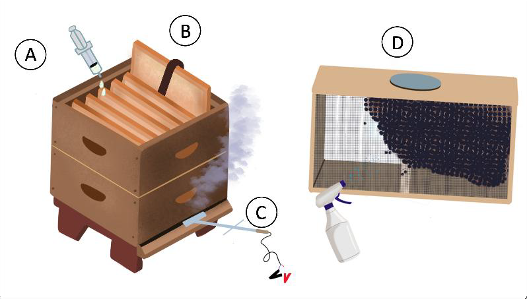
Dribbling oxalic acid (Api-Bioxal or EZ-OX) requires preparation of oxalic acid and sugar syrup, filling a syringe with the solution, and slowly squirting the solution between hive frames (Figure 1A). Oxalic acid fiberboard strips (VarroxSan) are designed to drape over the top of frames (Figure 1B) and slowly release oxalic acid for periods long enough to cover several life cycles of Varroa. The strips should be folded in half and draped over a frame inside the brood area or the bee cluster and left inside the hive from 42 days to 56 days. Oxalic acid vaporization (Api-Bioxal or EZ-OX) requires a specialized tool, a power source, and a respirator (Figure 1C). Oxalic acid vaporization uses heat to turn oxalic acid from a solid to a gas to fumigate the entire hive space. Once vaporized, oxalic acid recrystallizes and adheres to surfaces inside the hive. Beekeepers place a vaporizer in between the bottom board and entrance, seal off any openings, and use a 12-or 110-volt power source to heat the device containing oxalic acid, according to the vaporizer manufacturer’s instructions. Lastly, packages of bees (Figure 1D) can be treated with oxalic acid by first spraying them with sugar syrup, then spraying an oxalic acid and sugar syrup solution on them with a squirt bottle before installing them into hive boxes. Spraying with plain sugar syrup before coating them with the oxalic acid and sugar syrup cocktail minimizes consumption of the oxalic acid spray.
Oxalic Acid Registered Products
All oxalic acid options are most effective during times when the colony’s brood rearing is decreased, such as early spring, fall, or winter. As of June 2025, there are three oxalic acid products registered by the EPA for Varroa control: Api-Bioxal, EZ-OX, and VarroxSan (Table 1). As products and product labels are often revised and updated, it is essential that beekeepers check the current label for accurate directions for use for each product and application method, safety information, application timing, use with honey supers, required personal protective equipment (PPE), and product storage and disposal recommendations.
Api-Bioxal is 97% oxalic acid dihydrate and 3% inert ingredients. It can be used as a sugar syrup solution drip (a.k.a., dribbling, drench, or solution method), fumigation, or as a spray on bee packages. For the most recent Api-Bioxal label information, visit the EPA’s Details for API-BIOXAL site.
EZ-OX is 97% oxalic acid dihydrate and 3% inert ingredients. It can be used as a sugar syrup drip (a.k.a., dribbling, drench, or solution method), fumigation, or as a spray on packaged bees. This product comes in powder form or one-gram tablets. Tablets are only permitted for use with the vaporization method. For the most recent EZ-OX label information, visit the EPA’s Details for EZ-OX Tablets site.
VarroxSan is a sustained-release or extended-release fiber strip that contains 18.42% oxalic acid dihydrate and 81.58% inert ingredients. These strips are draped over the hive frames. For the most recent VarroxSan label information, visit the EPA’s Details for VARROXSAN site.
Table 1. Currently available commercial oxalic acid options that are approved for Varroa destructor control in the United States by the Environmental Protection Agency (EPA).
| Product & Application | Material | Maximum Amount per Colony |
|---|---|---|
| Api-Bioxal Solution (dribble) | Powder | 50 ml of solution (prepare solution by dissolving 35 g oxalic acid into 1 L 1:1 sugar:water [weight:volume]) |
| Api-Bioxal Vaporization | Powder | 4 g per brood chamber |
| Api-Bioxal Spray (packages) | Powder | 0.1 fl oz (3.0 mL) of 2.8% oxalic acid solution per 1,000 bees (prepare solution by dissolving 35 g oxalic acid into 1 L 1:1 sugar:water [weight:volume]) |
| EZ-OX Solution (dribble) | Powder | 50 mL of solution (prepare solution by dissolving 2 g oxalic acid in 59 mL1:1 sugar:water [weight:volume]) |
| EZ-OX Vaporization | Powder or 1 g tablets | 2 g per brood chamber or deep hive box |
| EZ-OX Spray (packages) | Powder | 0.1 fl oz (3.0 mL) of 2.8% oxalic acid solution per 1,000 bees (prepare solution by dissolving 2 g oxalic acid in 59 mL 1:1 sugar:water [weight:volume]) |
| VarroxSan | Fiberboard strips | 4 strips per brood chamber |
Importance of an Extended-Release Oxalic Acid Option
Oxalic acid works most effectively when colonies have little to no capped brood, since reproducing mites are protected from the treatment while under the wax cappings. Thus, oxalic acid dribble or vaporization methods require repeated applications when capped brood are present, which is labor-intensive and may yield inconsistent mite control. It is possible to eliminate the capped brood by caging the queen for a period of 14 to 21 days to increase the efficacy of a single oxalic acid application (Gregorc et al. 2017). Berry et al. (2022) demonstrated that after seven repeated applications of oxalic acid vaporization at a dose of 1 g per brood chamber every five days that this frequent reapplication of oxalic acid was ineffective in controlling Varroa populations during brood rearing periods. Additionally, beekeepers living in warmer regions may have colonies with a longer brood rearing season and might not have periods without brood production, reducing oxalic acid effectiveness.
To provide an efficient Varroa control strategy for beekeepers in the United States, an extended-release oxalic acid option, VarroxSan, was approved and registered by the EPA in September 2023. Label information indicates this product slowly releases doses of oxalic acid lethal to the mite for about 42 to 56 days in the colony; during this time, mites are exposed to oxalic acid as they emerge from capped brood cells, and this reduces the need for multiple reapplication treatments. The Washington State University Honey Bees + Pollinators Program tested this product’s efficacy for mite control, toxicity to honey bees, and residues in honey over multiyear field trials (2021 to 2023) in summer and fall. Field trials performed at WSU found VarroxSan to be highly effective during fall and early summer applications. There were no significant residues of oxalic acid in the honey, and VarroxSan had negligible effects on egg eclosion in comparison to control colonies, indicating that VarroxSan is nontoxic to developing honey bees (David 2024).
Personal Protective Equipment Required
Personal protective equipment (PPE) is required while using oxalic acid regardless of application method; always check the product’s label for the most up-to-date information and recommendations. All oxalic acid applications require users to wear a National Institute for Occupational Safety and Health-approved particulate filtering facepiece respirator, eye protection (goggles or face shield), chemical-resistant gloves, long sleeves, long pants, socks, and shoes. Follow each product’s manufacturer instructions for cleaning and maintaining PPE.
Reducing Resistance Development
Commonly used synthetic acaricides for Varroa control include the organophosphorus compound coumaphos, the formamide amitraz, and pyrethroids tau-fluvalinate and flumethrin. Organic compounds (containing carbon), including formic acid, oxalic acid, thymol, and hop beta acids, are also used to control Varroa. Varroa have developed resistance in some regions to all of these aforementioned synthetic chemical treatments. Resistance to coumaphos (Elzen and Westervelt 2002; Pettis 2004), fluvalinate (Elzen and Westervelt 2004; González-Cabrera et al. 2016; Higes et al. 2020), and amitraz (Elzen et al. 1999; Rinkevich 2020) has been documented. Resistance has likely developed because beekeepers overused products with these active ingredients. Although oxalic acid breaks down in the hive faster than these synthetic chemical treatments, if used repeatedly, mite populations may develop resistance.
Integrated pest management incorporates multiple practices throughout a season based on pest population levels and the pests’ biology. According to IPM principles, it is important to monitor mite populations and treat when the population(s) have reached established damaging thresholds (such as 3 mites per 100 bees in fall). The use of cultural or mechanical controls, such as using hygienic queen stock (Boecking and Spivak 1999), screened bottom boards (Liu et al. 2020), robbing screens (Kulhanek et al. 2021), and removing drone brood (Calderone 2005), can help slow mite population buildup. Additionally, it is imperative that beekeepers rotate treatments with different active ingredients to minimize the chances of the development of miticide resistance. Ignoring IPM principles can lead to fewer and less effective options for control of Varroa destructor.
For more comprehensive Varroa management guidance, a good resource is the Honey Bee Health Coalition’s Tools for Varroa Management Guide. Some beekeepers may be using products containing pesticide active ingredients (e.g., oxalic acid, formic acid, amitraz, and thymol) that are not registered products by the EPA or using the registered products improperly to manage Varroa populations. It is best to use products that have been thoroughly researched, tested, and approved for use at the state or federal level.
A current list of federally registered pesticide products for Varroa control in the United States can be found at the EPA-Registered Pesticide Products Approved for Use Against Varroa Mites in Bee Hives website.
A current list of state registered pesticide products for Varroa control in Washington State can be found at WSU’s Pesticide Information Center OnLine Database website.
References
Berry, J.A., L.J. Bartlett, S. Bruckner, et al. 2022. Assessing Repeated Oxalic Acid Vaporization in Honey Bee (Hymenoptera: Apidae) Colonies for Control of the Ectoparasitic Mite Varroa destructor. Journal of Insect Science 22(1): 15.
Boecking, O., and M. Spivak. 1999. Behavioral Defenses of Honey Bees Against Varroa jacobsoni Oud. Apidologie 30: 141–158.
Calderone, N. 2005. Evaluation of Drone Brood Removal for Management of Varroa destructor in Colonies of Apis mellifera in the Northeastern United States. Journal of Economic Entomology 98(3): 645–650.
David, I.A. 2024. Fall and Summer Seasonal Evaluation of a Stabilized Oxalic Acid Formulation (VarroxSan™) for Control of Varroa Mites (Varroa destructor): Efficacy, Toxicity and Residue. Master’s thesis, Washington State University, ProQuest Dissertations & Theses.
Elzen, P.J., J.R. Baxter, M. Spivak, and W.T. Wilson. 1999. Amitraz Resistance in Varroa: New Discovery in North America. American Bee Journal 139(5): 362.
Elzen, P.J., and D. Westervelt. 2002. Detection of Coumaphos Resistance in Varroa destructor in Florida. American Bee Journal 142(4): 291–292.
Elzen, P., and D. Westervelt. 2004. A Scientific Note on Reversion of Fluvalinate Resistance to a Degree of Susceptibility in Varroa destructor. Apidologie 35: 519–520.
González-Cabrera, J., S. Rodríguez-Vargas, T.E. Davies, et al. 2016. Novel Mutations in the Voltage-Gated Sodium Channel of Pyrethroid-Resistant Varroa destructor Populations from the Southeastern USA. PLOS ONE 11(5): e0155332.
Gregorc, A., M. Alburaki, C. Werle, P.R. Knight, and J. Adamczyk. 2017. Brood Removal or Queen Caging Combined with Oxalic Acid Treatment to Control Varroa Mites (Varroa destructor) in Honey Bee Colonies (Apis mellifera). Apidologie 48: 821–832. DOI: 10.1007/s13592-017-0526-2.
Han, B., J. Wu, Q. Wei, et al. 2024. Life-History Stage Determines the Diet of Ectoparasitic Mites on Their Honey Bee Hosts. Nature Communications 15(1): 725.
Higes, M., R. Martín-Hernández, C.S. Hernández-Rodríguez, and J. González-Cabrera. 2020. Assessing the Resistance to Acaricides in Varroa destructor from Several Spanish Locations. Parasitology Research 119: 3595–
3601 (2020).
Honey Bee Health Coalition. 2022. Tools for Varroa Management: A Guide to Effective Varroa Sampling & Control, 8th edition. Keystone Policy Center.
Jack, C.J., and J.D. Ellis. 2021. Integrated Pest Management Control of Varroa destructor (Acari: Varroidae), the Most Damaging Pest of (Apis mellifera L. (Hymenoptera: Apidae)) Colonies. Journal of Insect Science 21: 6.
Kulhanek, K., A. Garavito, and D. vanEngelsdorp. 2021. Accelerated Varroa destructor Population Growth in Honey Bee (Apis mellifera) Colonies Is Associated with Visitation from Non-Natal Bees. Scientific Reports 11: 7092.
Liu, F., X. Xu, Y. Zhang, H. Zhao, and Z.Y. Huang. 2020. A Meta-Analysis Shows That Screen Bottom Boards Can Significantly Reduce Varroa destructor Population. Insects 11(9): 624.
Maggi, M.D., N. Damiani, S.R. Ruffinengo, et al. 2017. The Susceptibility of Varroa destructor Against Oxalic Acid: A Study Case. Bulletin of Insectology 70(1): 39–44.
Pettis, J.S. 2004. A Scientific Note on Varroa destructor Resistance to Coumaphos in the United States. Apidologie 35(1): 91–92.
Ramsey, S.D., R. Ochoa, G. Bauchan, et al. 2019. Varroa destructor Feeds Primarily on Honey Bee Fat Body Tissue and Not Hemolymph. Proceedings of the National Academy of Sciences of the United States of America 116: 1792–1801.
Rinkevich, F.D. 2020. Detection of Amitraz Resistance and Reduced Treatment Efficacy in the Varroa Mite, Varroa destructor, Within Commercial Beekeeping Operations. PLOS ONE 15(1): e0227264.
Schneider, S., D. Eisenhardt, and E. Rademacher. 2011. Sublethal Effects of Oxalic Acid on Apis mellifera (Hymenoptera: Apidae): Changes in Behavior and Longevity. Apidologie 43: 218–225.
Warner, S., L.R. Pokhrel, S.M. Akula, et al. 2024. A Scoping Review on the Effects of Varroa mite (Varroa destructor) on Global Honey Bee Decline. Science of The Total Environment 906: 167492.
By
Briana Price, Bee Program Extension Coordinator, Department of Entomology, Washington State University
Brandon Hopkins, Associate Professor, Department of Entomology, Washington State University
Cameron Jack, Assistant Professor, Department of Entomology and Nematology, University of Florida

FS403E

Copyright © Washington State University
WSU Extension publications contain material written and produced for public distribution. Alternative text descriptions for select complex images were generated using ChatGPT (OpenAI, GPT-5.2), then reviewed and adapted to ensure compliance with Web Content Accessibility Guidelines (WCAG) 2.1, Level AA accessibility standards.
Issued by Washington State University Extension and the US Department of Agriculture in furtherance of the Acts of May 8 and June 30, 1914. Extension programs and policies are consistent with federal and state laws and regulations on nondiscrimination regarding race, sex, religion, age, color, creed, and national or ethnic origin; physical, mental, or sensory disability; marital status or sexual orientation; and status as a Vietnam-era or disabled veteran. Evidence of noncompliance may be reported through your local WSU Extension office. Trade names have been used to simplify information; no endorsement is intended.