Honey Bee Colonies That Fail to Overwinter Have a Tale to Tell
Description
There are many reasons why a honey bee colony may not survive the winter. While not always obvious, beekeepers in the Pacific Northwest can use the diagnostic tool within this publication to help determine the cause of colony failure.Table of Contents
- Common Causes Why Honey Bees Fail to Survive the Winter Months
-
How to Look for Symptoms of Potential Deadouts in Fall
- What Does a Healthy Colony Look Like in the Fall Season?
- What Can You Do If Your Colony is Not Well?
Common Causes Why Honey Bees Fail to Survive the Winter Months
There are numerous reasons a honey bee colony could fail to overwinter, meaning they died during or shortly after winter. The primary cause of death may not always be obvious since there are many stressors that honey bee colonies face.
In the Pacific Northwest, many backyard beekeepers lose their colonies over winter due to a combination of factors that reduce survival chances including:
- Weak colony. Small or poorly populated colonies often lack the resources and workforce needed to maintain warmth and survive through winter.
- Starvation. Insufficient honey stores or inability to access food during prolonged cold spells can lead to colony death.
- Varroa destructor infestations. Infestations from ectoparasitic mites (Varroa) are one of the most serious and common threats to honey bee colonies. Varroa feed on adult bees and developing brood that can spread harmful viruses, which significantly reduces colony health and survival.
- Bacterial or fungal infection(s). Honey bees are vulnerable to several bacterial (e.g., European foulbrood or American foulbrood, sacbrood) and fungal (e.g., chalkbrood, Nosema spp.) diseases that can weaken colonies and, in severe cases, cause colony death. European foulbrood (EFB), is caused by Melissococcus plutonius and typically affects young larvae, especially during periods of stress, such as poor nutrition. One of the most serious bacterial diseases is American foulbrood (AFB), caused by Paenibacillus larvae. AFB primarily affects developing larvae, killing them before they mature and leaving behind highly persistent spores that can spread easily between colonies. Fungal diseases like chalkbrood, caused by Ascosphaera apis, infects bee larvae and causes them to harden into chalk-like mummies. While chalkbrood rarely kills entire colonies, it can significantly reduce brood production. Microsporidia Nosema spp. infections colonize the honey bee gut, interrupting digestion and nutrient absorption, which can have cascading impacts on colony health and lifespan.
- Excessive moisture buildup. Poor ventilation can cause condensation inside the hive, chilling bees and promoting mold growth.
- Adverse weather conditions. Extended cold snaps, sudden temperature fluctuations, or storms can stress colonies beyond recovery.
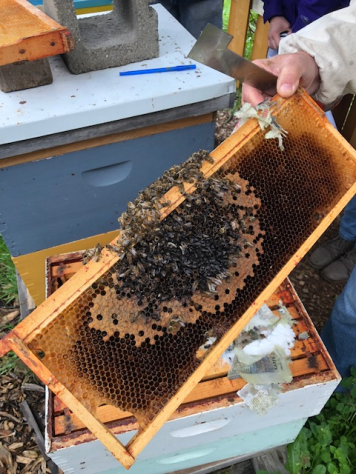
Beekeepers can perform a necropsy on dead colonies, often referred to as “deadouts,” and try to determine possible reasons for overwintering mortality (Figure 1). Doing a necropsy on a deadout will likely show multiple causes of death, and beekeepers can only reasonably make inferences based on what they see to deduce possible causes. Proper education about honey bee stressors and how they may impact overwintering will guide decision-making in honey bee colony management. Most often, colony death occurs because beekeepers make management mistakes or fail to observe signs of honey bee health issues during inspections and intervene quickly enough (Caron 2021). This publication aims to help Pacific Northwest beekeepers recognize symptoms that may contribute to winter colony losses and improve overwintering success. It also offers a diagnostic tool to help ascertain why colonies may have failed to overwinter.
How to Look for Symptoms of Potential Deadouts in Fall
What Does a Healthy Colony Look Like in the Fall Season?
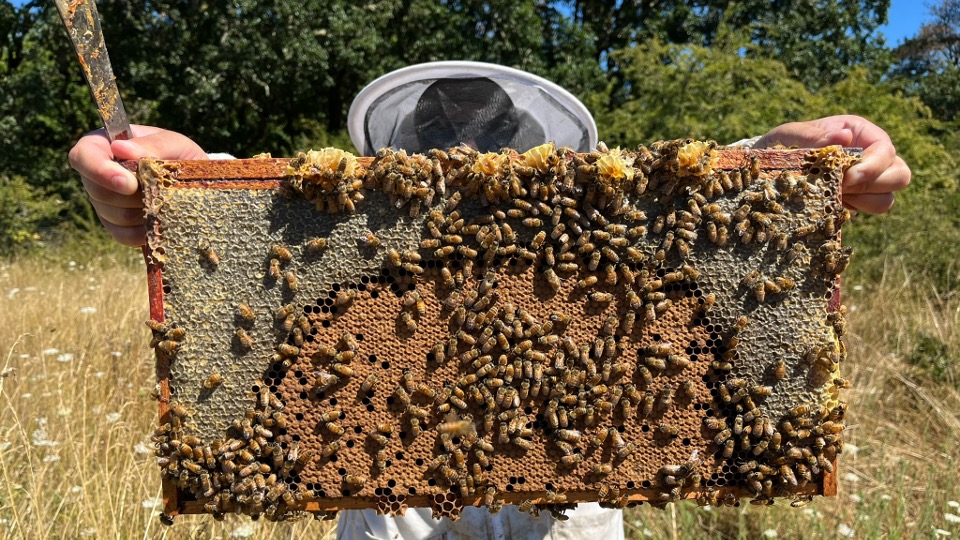
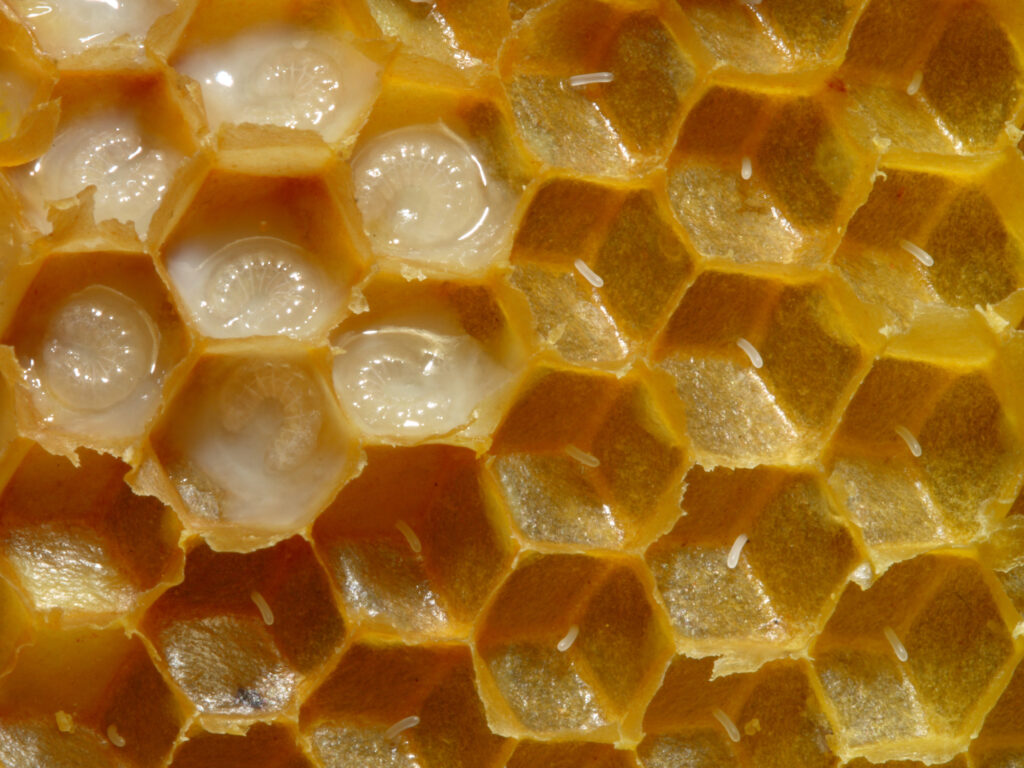
Signs of a healthy colony in early fall include a collective, continuous capped brood pattern, bee bread stores right outside of the capped brood area and plentiful honey stores (Figure 2). There should be evidence of a viable queen by visually observing her or seeing eggs and larvae in various stages. Developing larvae (open brood cells) should be present, surrounded by adequate brood food, a jelly-like substance that is typically milky in color (Figure 3). The colony’s population should be robust and cover at least eight frames, and the bee’s temperament should be relatively calm but not lethargic or overly defensive. Adult bees should have few or no visible malformations, like deformed wings or greasy-looking bodies; such symptoms may indicate high viral infection levels.
What Can You Do If Your Colony is Not Well?
Support colony populations in late summer and early fall by providing reliable access to plenty of nectar and pollen in the landscape and managing pest or parasite pressures. The colony should also have an adequate amount of stored honey; this depends on your region and size of hive equipment used. In the absence or limitation of pollen and nectar in the landscape, you should provide supplemental feeding to the colony as needed. If a colony’s health is diminishing in fall, you may see a smaller population of adults that may not cover the entire brood area, a spotty capped brood pattern or possible uncapping of brood by adult bees, Varroa frass buildup on honeycombs, dying brood that are a greyish color, or cannibalized brood. If you are noticing these symptoms in the fall, it is best to intervene and attempt to strengthen the colony before winter.
Interventions can include combining a smaller colony with a larger colony, chemically treating for Varroa or Nosema infestations, and ensuring access to enough frames of honey to prevent starvation. Nosema can be managed by using prophylactic antibiotics, replacing comb regularly, ensuring good ventilation, and maintaining strong colonies. Varroa can be managed a wide variety of ways; refer to the Honey Bee Health Coalition’s Varroa Management Resources webpage for more information. In the absence of natural forage, adequate supplemental nutritional management of colonies is crucial. Supplemental proteins can also be fed but note that there are certain advantages to feeding colonies non-pollen-based protein supplements during the fall. Refer to the Honey Bee Health Coalition’s Honey Bee Nutrition: A Review and Guide to Supplemental Feeding for more information.
What to Do If You Have a Deadout
If you have a deadout, remove it from your apiary as soon as practical. Best management practices from deadouts include culling and freezing or sanitizing equipment before reusing it or introducing it to living colonies (Steinhauer et al. 2020). After removing deadout(s) from your apiary, clean using the following recommendations:
- Clean off and repair necessary hive boxes, lids, and bottom boards, assuming there was not a serious infection, such as American foulbrood disease, causing the deadout. Remove frames and bang them against a flat board or table to dislodge any dead honey bees. Using your hive tool, scrape the burr comb off the top, sides, bottom, and ears of the frame.
- Cull old frames. While drawn comb is a beekeeper’s most valuable resource, it can hold pathogens, pesticides, or be structurally unusable or old. Food stores and wax from deadouts may also have pathogens or pesticide residues that can adversely affect the health of your colonies (de Guzman et al. 2019; Tokach et al. 2023). If wax on frames has become dark brown or black, or the hexagonal cells are becoming smaller and more circular, scrape or cull the frame. Colonies with newer frames (one to three years old) have higher fitness, longevity, and productivity (Taha and Al-Kahtani 2020).
- Take care of pest invasions. If your frames have an infestation of storage pests, such as wax moths or small hive beetles, be sure to freeze everything for a minimum of 48 hours to kill all life stages of these pests.
- Take care of honey frames. Any honey left in the deadout is an invitation for robbing by other nearby colonies, and moisture will likely build up inside, which encourages mold and fermentation of honey. If you see grey mold on your frames, it is likely that the bees can clean the mold without issue (Snowdon and Cliver 1996), but if it is determined that the likely cause of death was due to pathogens or pesticides, it is best to scrape the frame and sanitize. Frames with honey should be stored in the freezer until you are ready to use them. Any uncured honey or moisture can cause fermentation, which becomes toxic to bees. If the honey smells of alcohol, then it has fermented, and should not be used.
- Sanitize hive components. You can scrape and clean with a soapy solution (1 tbsp dishwashing liquid to 1 gal water). Rinse well, then use a bleach (3 tbsp bleach to 1 gal water) or vinegar (1:1 vinegar to water) solution to do a final wash, then let it air-dry before storing and reusing. For more resilient pathogens, such as foulbroods, more thorough sanitization methods, such as using ozone or UV, could be considered (James 2011; Al-Rajhi 2022).
Diagnostic Tool: Why Did Your Colonies Die?
This self-questionnaire is designed to help Pacific Northwest beekeepers assess potential reasons for colony loss. It has five parts. Beekeepers simply answer Yes (Y) or No (N) to the questions in each section for each dead colony, then total the responses to help identify possible causes of winter colony loss.
Part 1. Was your honey bee colony too weak to survive the winter?
- Did your colony start as a split or nucleus hive before mid-May, allowing adequate time to build population and stores?
Yes/No - Did the colony complete drawing comb from foundation by early spring (before April), rather than late in the season?
Yes/No - Was the newly established colony fed at installation and supplemented at least three additional times as needed?
Yes/No - By fall, were there at least 12 fully drawn frames, with at least half of those frames containing honey stores?
Yes/No - Are you confident the colony did not undergo queen replacement (supersedure or emergency replacement) during the season?
Yes/No - Was excessive moisture absent (no heavy mold and no large accumulation of dead bees on the bottom board)?
Yes/No
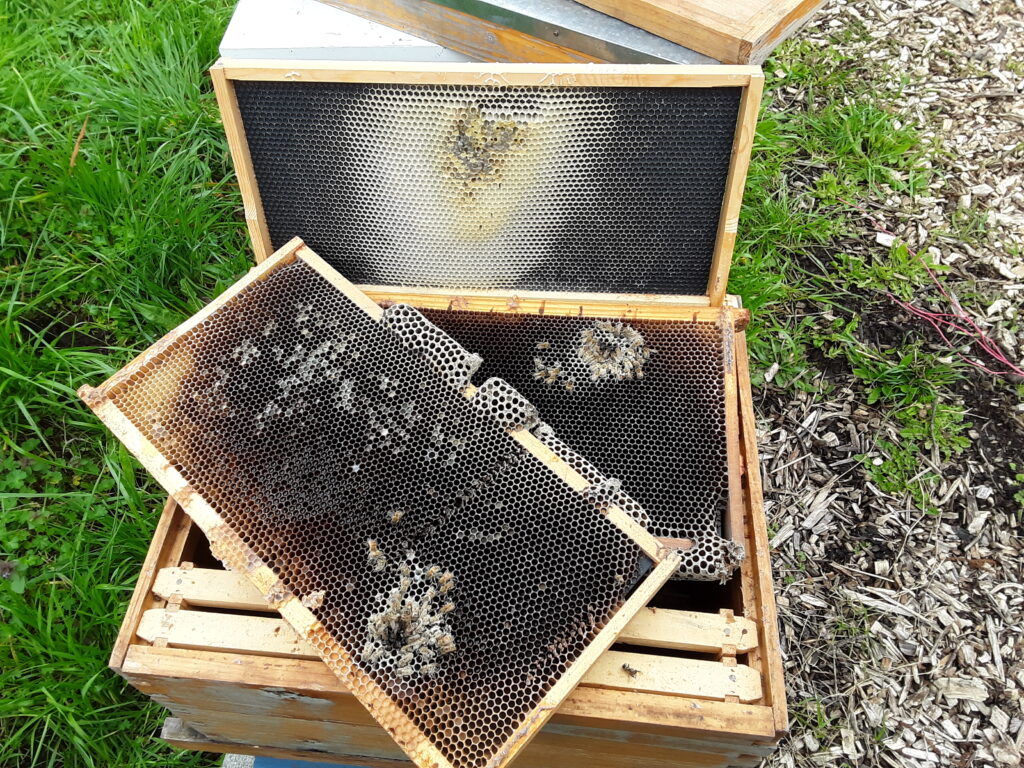
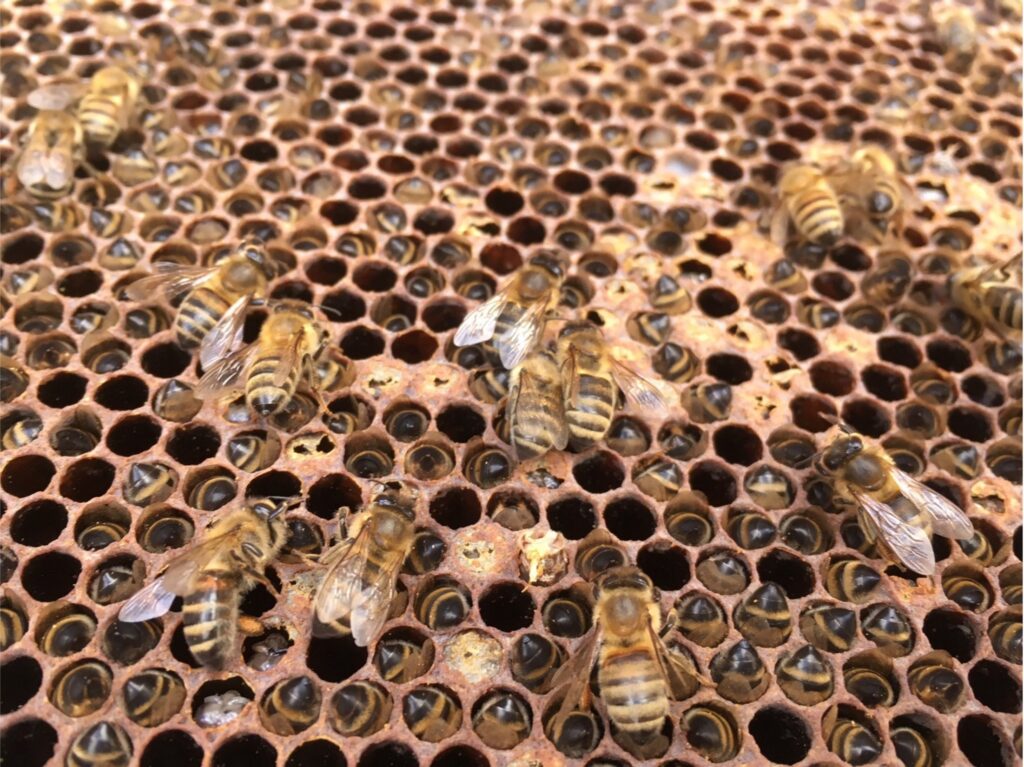
If three or more No responses were selected in Part 1, the colony was likely too weak to survive winter and may have died due to inadequate population size, insufficient stores, or poor early establishment. A handful or more of dead bees may be present on the bottom board, along with a small dead cluster (Figure 1). Honey bees may also appear headfirst in cells (Figure 4) surrounding a small patch of dead, capped brood on one or two brood frames. Signs of queen replacement may include the presence of queen cells or capped drone cells in worker-sized cells. Some regions in the Pacific Northwest are moisture-heavy, such as western Washington and Oregon.
If you answered Yes to question 6, the colony experienced excess exposure to moisture. You may then observe dead clusters of honey bees that are moldy, and a large pile of dead honey bees on the bottom board. Examine the inner cover and lid over the frames for water staining. These two signs indicate an excess amount of moisture in the colony that might have contributed to colony loss.
Part 2. Could bacterial or fungal infection have been the reason for colony loss?
- Was the colony free of obvious brood disease symptoms (spotty brood pattern, dead larvae, discoloration, or sunken or perforated cappings) at your last fall assessment?
Yes/No - Was the colony housed in a hive with movable frames (Langstroth or Layens) that allowed routine inspection, sanitation, and removal of diseased comb?
Yes/No - Were fall and winter weather conditions typical or mild for your bee yard location (not unusually cold, wet, or prolonged)?
Yes/No - Was the colony adequately protected from adverse weather and provided sufficient ventilation to prevent excess moisture buildup in the hive?
Yes/No - Did the colony enter winter with a sufficiently large cluster capable of maintaining brood care and hygienic behaviors?
Yes/No - Were there minimal or no adult bees exhibiting signs commonly associated with internal disease (persistent crawling, wandering at the hive entrance, “K‑wing,” or greasy or swollen abdomens)?
Yes/No
If you noted three or more No responses in Part 2, the colony likely died from bacterial or fungal infection. Note that these questions are intended to help rule out environmental and management factors that would typically help suppress bacterial or fungal infection. Bacterial and fungal infections in honey bees are usually opportunistic and are most likely to contribute to colony death when colonies are stressed, hygiene is compromised, moisture is excessive, or bees are kept in inadequate conditions.
Part 3. Could your colony have starved?
- Was little to no honey harvested from the colony to avoid overharvesting food needed for overwintering?
Yes/No - Was the colony fed sugar syrup a minimum of three times after September 1, if natural nectar stores were inadequate?
Yes/No - Was the dead winter cluster located across three or more frames, or were many dead bees present on the bottom board?
Yes/No - Was capped honey present on most frames immediately adjacent to the dead cluster of bees?
Yes/No
If one or more No response(s) were selected in Part 3, the colony may have died from insufficient food stores or lack of access to food. You might find the honey was robbed by honey bees from another stronger colony as evidenced by bits and pieces of light wax scattered within cells and on bottom board. With death resulting from starvation, the dead honey bee cluster will be located across three or more frames, with individual honey bees headfirst into cells beneath the cluster (Figure 4). Capped honey will be absent closer to the dead honey bees and there may be limited honey in more distant frames. You may see a patch of capped brood cells that may have punctures in their capping. Note that a weak colony, with an insufficient overwintering cluster, can starve due to limited access honey frames. Depending on the region, the colony size, and the particular season, sufficient honey must be stored for honey bees to successfully overwinter.
Part 4. Could Varroa and associated viruses have been the reason for colony loss?
- Was the colony still alive at the end of March, indicating successful overwintering?
Yes/No - Was the colony housed in a hive with movable frames (Langstroth or Layens), allowing routine inspection and mite monitoring?
Yes/No - Did you monitor Varroa mite levels at least four times during the calendar year using an accepted sampling method (alcohol or soapy water wash, or powdered sugar shake)?
Yes/No - Did you attempt to reduce mite populations using cultural controls such as drone brood trapping or a brood interruption or break?
Yes/No - Did you apply at least one labeled Varroa control treatment and follow label directions for timing, dosage, and conditions of use?
Yes/No - Were there few or no adult bees with deformed wings observed, and were mites rarely or never seen on adult bees during inspections?
Yes/No
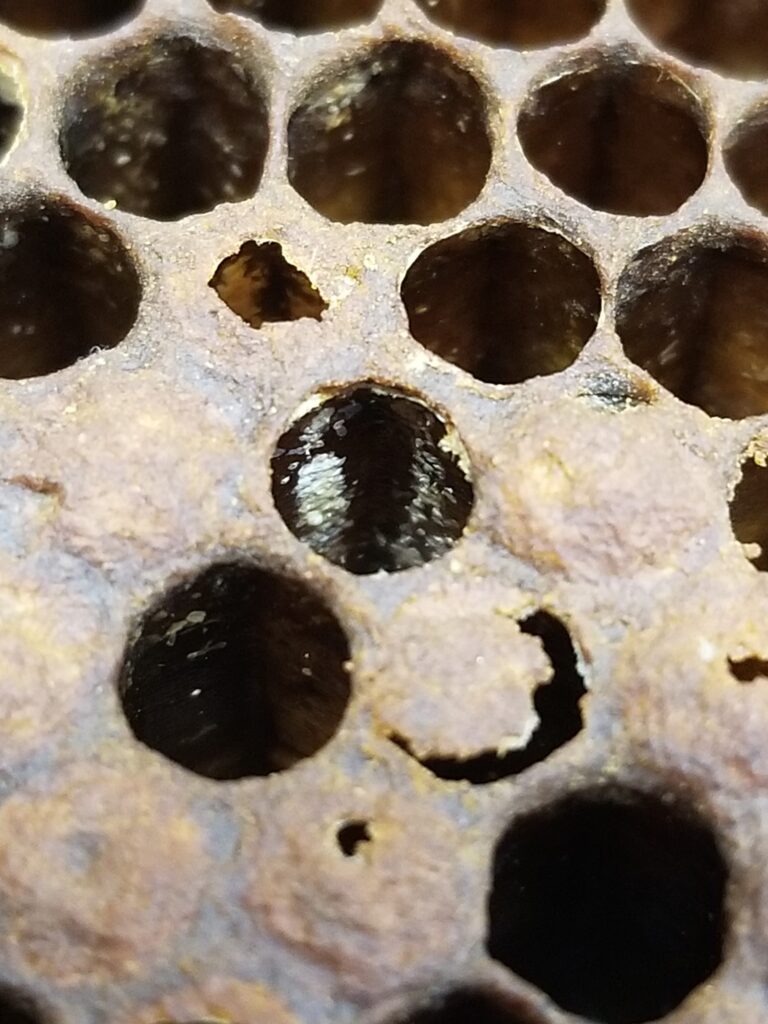
If three or more No responses were recorded in Part 4, the colony likely died from a Varroa infestation, and associated viruses may have been a significant contributing factor in colony loss (often referred to as parasitic mite syndrome, or PMS). You may or may not see dead bees on the bottom board. A large cluster of dead bees with bees headfirst in cells would be less common. There will most likely be scattered, capped brood cells, many with holes in the cappings. Former brood cells may contain a bright white “stain” on the upper cell wall; this is Varroa feces (Figure 5).
If all three previous sections point to possible causes of colony death, Varroa infestation(s) (Part 4) are the most likely cause, especially if the answers indicated that mites were not sampled or controlled in the fall.
Part 5. Could weather have been the reason for colony loss?
- Was the colony still alive and stable at your last fall assessment?
Yes/No - Was the colony housed in a hive with movable frames (e.g., Langstroth or Layens), allowing inspections and seasonal management adjustments?
Yes/No - Were fall and winter temperatures and precipitation typical or mild for your bee yard location (not unusually cold, wet, or prolonged)?
Yes/No - Was the colony adequately protected from adverse weather and provided sufficient ventilation to prevent excess moisture buildup?
Yes/No - Was the colony able to overwinter without emergency carbohydrate feeding (such as fondant or dry sugar)?
Yes/No - Did the colony enter winter with a large enough overwintering cluster to maintain warmth during extended cold periods?
Yes/No
If three or more No responses were selected in Part 5, your colony likely died from adverse fall or winter weather conditions coupled with an overwintering cluster too small to stay warm. Separating adverse weather conditions as the sole cause of colony death is difficult, especially when combined with weak colonies, moisture build up, or limited food access. Dead bees may or may not be present on the bottom board. Finding large numbers of dead bees headfirst in cells is less likely, unless starvation also occurred. If you answered No to Question 5, starvation may have compounded weather stress, necessitating emergency feeding.
Additional Resources
The Pacific Northwest Honey Bee Survey is an innovative regional effort to better understand factors contributing to the large losses of honey bee colonies, particularly among small-scale beekeepers. Under the leadership of Dr. Dewey Caron, emeritus professor of apiculture and entomology at the University of Delaware, the program works with local beekeeping organizations to gather data from individual beekeepers in Oregon and Washington. The survey team collects and analyzes data from individual beekeepers on more than 20 variables to identify relationships and trends among various microclimates, forages, and methods of bee husbandry. The more beekeepers who participate, the more thorough and useful the results will be. If you keep bees in Oregon and Washington, please participate—and encourage others to do so as well.
References
Al-Rajhi, M.A.I. 2022. Evaluation the UV Sterilization of Paenibacillus larvae on Beehive Building Materials. Turkish Journal of Food and Agriculture Sciences 4(1): 25–28.
Caron, D.M. 2021. Necropsy of a Hive. In Honey Bee Medicine for the Veterinary Practitioner, eds. T.R. Kane and C.M. Faux.
de Guzman, L.I., M. Simone-Finstrom, A.M. Frake, and P. Tokarz. 2019. Comb Irradiation Has Limited, Interactive Effects on Colony Performance or Pathogens in Bees, Varroa destructor and Wax Based on Two Honey Bee Stocks. Insects 10(1): E15.
James, R.R. 2011. Potential of Ozone as a Fumigant to Control Pests in Honey Bee (Hymenoptera: Apidae) Hives. Journal of Economic Entomology 104(2): 353–359.
Snowdon, J.A., and D.O. Cliver. 1996. Microorganisms in Honey. International Journal of Food Microbiology 31(1–3): 1–26.
Steinhauer, N., D. VanEngelsdorp, and C. Saegerman. 2020. Prioritizing Changes in Management Practices Associated with Reduced Winter Honey Bee Colony Losses for US Beekeepers. Science of the Total Environment 753: 141629.
Taha, E., and S.N. Al-Kahtani. 2020. The Relationship Between Comb Age and Performance of Honey Bee (Apis mellifera) Colonies. Saudi Journal of Biological Sciences 27(1): 30–34.
Tokach, R., Smart, A. and Wu-Smart, J. 2023. Re-Using Food Resources from Failed Honey Bee (Apis mellifera L.) Colonies and Their Impact On Colony Queen Rearing Capacity. Scientific Reports 13, 18127.
By,
Dewey Caron, Emeritus Professor of Entomology & Wildlife Ecology, University of Delaware, Affiliate Professor, Department of Horticulture, Oregon State University
Briana E. Price, Extension Coordinator, Washington State University
Priyadarshini Chakrabarti, Assistant Professor of Pollinator Health and Apiculture, Washington State University

FS408E

Copyright © Washington State University
WSU Extension publications contain material written and produced for public distribution. Alternative text descriptions for select complex images were generated using ChatGPT (OpenAI), then reviewed and adapted to ensure compliance with Web Content Accessibility Guidelines (WCAG) accessibility standards.
Issued by Washington State University Extension and the US Department of Agriculture in furtherance of the Acts of May 8 and June 30, 1914. Extension programs and policies are consistent with federal and state laws and regulations on nondiscrimination regarding race, sex, religion, age, color, creed, and national or ethnic origin; physical, mental, or sensory disability; marital status or sexual orientation; and status as a Vietnam-era or disabled veteran. Evidence of noncompliance may be reported through your local WSU Extension office. Trade names have been used to simplify information; no endorsement is intended.