Have You Seen Me? Identifying Soilborne Wheat Mosaic Virus (SBWMV)
Description
Soilborne wheat mosaic virus was first documented in Whitman County, Washington, in 2026 and can reduce wheat yields while persisting in soils for many years. Learn how to limit its spread and manage affected fields in this new publication.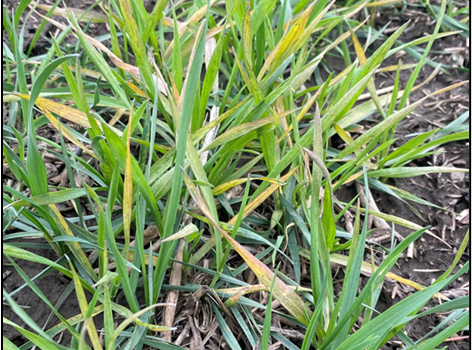
Introduction
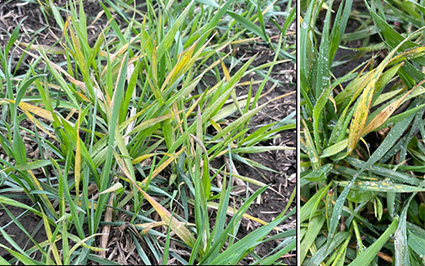
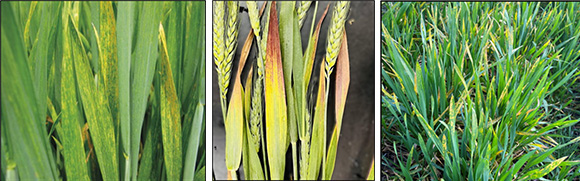
Soilborne wheat mosaic virus (SBWMV) was documented for the first time in Whitman County in spring 2026, when molecular analysis confirmed it in 11 fields in the southeastern part of the county. Previously reported locations include Idaho and Nez Perce Counties, the Walla Walla Valley, and Umatilla and Hermiston Counties. Timely tissue sampling and testing are the only forms of confirmation. Scouting should begin when winter wheat (Triticum aestivum) breaks dormancy (Feekes 4—“green up”). Testing is not as effective as plants age, and plants may even appear to “grow out” and become healthy again. Infected plants exhibit splotchy leaves with green, yellow, and sometimes red or purple discoloration (Figure 1). Streaks are parallel to leaf veins. Infected plants have fewer tillers than healthy plants, and SBWMV is associated with significant losses in yield (40%), biomass, (37%), and heads (34%) in the Pacific Northwest (Kroese et al. 2020). Areas of infection may range from a few feet across to multiple acres. Growers should also be aware of other conditions that can cause similar symptoms (Figure 2).
Conditions Favoring Disease
SBWMV is vectored by a parasitic, fungus-like protist, Polymyxa graminis, which infects the roots via motile swimming spores (Kanyuka et al. 2003). The protist forms resting spores that can survive in the soil for many years. It requires free moisture to infect, and that is why symptoms are usually found in plants in low-lying areas with wet soil. Once the virus is present in the soil, the only treatment is to plant or blend resistant varieties.
Virus Transmission and Movement
Once infection has occurred, planting and tillage equipment can spread infested soil within a field, often expanding infested areas in the direction of equipment travel. Infested soil can also be moved from field to field on boots, tires, and farm equipment. Infected wind-blown soil is another proposed dispersal mechanism, potentially explaining how the virus reaches new, geographically separate locations. Winter wheat is most susceptible, but spring wheat can also be affected. A resistant variety list can be found in Table 1. More information can be found on the WSU Wheat and Small Grains website.
Table 1. Resistant varieties based on ongoing screening by Washington State University, University of Idaho, and Oregon State University. Genetic testing was conducted in summer 2026 at WSU Pullman using Kompetitive Allele-Specific PCR (KASP) on all 139 lines in the winter wheat variety testing program. Only 14 varieties had the Sbm1 (resistance gene) present. Consult local variety testing data to find a suitable blend-partner to mitigate yield loss in susceptible varieties.| Variety | Class | Variety | Class |
|---|---|---|---|
| AP Iliad | SWW | AP503 CL+ | HRW |
| Resilience CL+ | SWW | Esperia | HRW |
| SY Dayton | SWW | LCS Aymeric | HRW |
| SY Ovation | SWW | LCS Nessie AX | SWW |
| UI/WSU Huffman | SWW | SY Touchstone | HRW |
| Ladd | SWW | WB4303 | HRW |
| LCS Shark | SWW | WB4640 | HRW |
| Puma | SWW | Whetstone | HRW |
| Pritchett | WC | Whistler | HRW |
| TMC M-Press | SWW | TMC M-Pire | SWW |
Notes: SWW = soft white winter. WC = winter club. HRW = hard red winter.
Look-Alikes
Mosaic symptomology of wheat in the PNW can easily be confused with other diseases (Figure 2).
Submitting a Sample
The following labs can diagnose SBWMV via DNA testing:
Oregon State University Hermiston Agricultural Research and Extension Center, 2121 S 1st St Hermiston, OR 97838
WSU SBWMV testing
Call the Whitman County Extension Office: 509-397-6290
Email: morgan.menaker@wsu.edu
Drop-off: 310 N Main St, Rm 209, Colfax, WA 99111. Office on second floor of public services building.
U of I Parma Research and Extension Center
29603 U of I Ln, Parma, ID 83660
References
Kanyuka, K., E. Ward, and M.J. Adams. 2003. Polymyxa graminis and the Cereal Viruses It Transmits: A Research Challenge. Molecular Plant Pathology 4: 393–406.
Kroese, D., L. Schonneker, S. Bag, K. Frost, R. Cating, and C. Hagerty. 2020. Wheat Soil-Borne Mosaic: Yield Loss and Distribution in the US Pacific Northwest. Crop Protection 132: 105102.
By,
Morgan S. Menaker, Regional Extension Specialist, Agronomy, WSU Extension

FS413E

Copyright © Washington State University
WSU Extension publications contain material written and produced for public distribution. Alternative text descriptions for select complex images were generated using ChatGPT (OpenAI), then reviewed and adapted to ensure compliance with Web Content Accessibility Guidelines (WCAG) accessibility standards.
Issued by Washington State University Extension and the US Department of Agriculture in furtherance of the Acts of May 8 and June 30, 1914. Extension programs and policies are consistent with federal and state laws and regulations on nondiscrimination regarding race, sex, religion, age, color, creed, and national or ethnic origin; physical, mental, or sensory disability; marital status or sexual orientation; and status as a Vietnam-era or disabled veteran. Evidence of noncompliance may be reported through your local WSU Extension office. Trade names have been used to simplify information; no endorsement is intended.