Description
Abstract
Are you thinking about using manure to fertilize your farm but want more information? Properly managed manure applications recycle nutrients to crops, improve soil quality, and protect water quality. From deciding whether manure is right for your farm to learning how to calibrate manure applications, this publication takes you through the process of fertilizing with manure and other organic amendments.
Quick Facts
Manure nutrient management is a cyclic process that includes:
- determining crop nutrient need,
- choosing a nutrient source,
- selecting and calibrating a manure application rate to deliver a target nutrient rate,
- monitoring crop performance and soil test values, and
- adjusting future application rates based on crop and soil monitoring.
Manures are unbalanced in nutrient content. When applied to meet crop nitrogen need, they usually will supply more phosphorus and potassium than is necessary for crops. Monitoring phosphorus and potassium via soil testing every three to five years is recommended to avoid excessive accumulation.
Unlike fertilizer, manure has variable nutrient content, depending upon site-specific factors (e.g., bedding, moisture, and storage or composting). See Table 2 for typical values.
For the current growing season, apply manure based on its ability to supply plant-available nitrogen to meet, but not exceed crop needs. Keep in mind that over-application of some products can damage plants with too much soluble salt.
Composts are lower in plant-available nitrogen than are most raw manures. Composting raw manure kills weed seeds and pathogens, facilitates storage, and makes a more uniform material that is easier to apply. For typical compost nutrient analyses, see Table 3.
Byproducts from cities and food processing facilities have nutrient value and are sometimes available for use on farms. See Table 4 for examples.
Manures and specialty products that contain more than 4% total nitrogen should be applied at low rates based on plant-available nitrogen supplied. See Table 5.
Use published values for manure nutrient content (Tables 2–5) with caution. Laboratory analyses of manure can improve the accuracy of manure nutrient application rates. For best results, send samples to laboratories that have demonstrated proficiency in performing manure analyses. Under Additional Resource, see the Lists of Laboratories and Consultants section of this publication for more information. Other organic materials can be analyzed for nutrient content using the same laboratory methods used for manure.
Calibration worksheets for manure spreaders that provide several options for monitoring manure application rates are included in this publication. Keeping records of manure nutrient application rates on a field-by-field basis can assist in evaluating and modifying manure application programs.
This publication is written for both organic farmers and other farmers who use manure. For details on organic farming standards, refer to the National Organic Standards in Additional Resources.
Overview
Manure is a good source of plant nutrients and organic matter. Properly managed manure applications recycle nutrients to crops, improve soil quality, and protect water quality. Although the focus of this publication is on animal manures and manure composts, the same principles apply for other waste-derived organic amendments, such as peppermint hay (leaves and stems that have been heated to remove peppermint oil), fish waste, and composted yard debris and food waste.
Is Manure a Good Choice for Your Farm?
Consider the following questions before applying animal manure on your farm:
- Are there local sources of manure?
- What is the quality of local manure sources?
- Where does manure fit in your crop rotation?
- Will your crops respond to added nutrients?
- What are the environmental and food safety risks and how can you mitigate them?
Local Sources of Manure
If you raise livestock, or if you have neighbors who do, you will likely have plenty of manure available nearby. If you have to import manure from more distant sources, transportation can greatly increase costs. You will need to decide if it makes economic sense if you are considering importing manure. Other organic materials may also be locally available, such as peppermint hay in parts of the Willamette Valley and the Columbia Basin, or shrimp and crab waste if processing facilities are nearby.
Quality of Manure Sources
Manure quality varies considerably, as discussed later in this publication. You will need to compare the quality of available manure sources (nutrient supply, ease of handling, odor, and risk of weed seeds or pathogens) with your farming needs. See Table 1 for a comparison of composted and uncomposted manure sources.
Crop Rotations
Manure use is compatible with most crops and crop rotations. Remember that crop nutrient needs vary and manure applications should be consistent with the nutrient needs of your crops. Soil test results and Extension publications are good sources of information on crop nutrient needs.
Fresh manure is not a good choice for salad and root crops that are eaten raw because of food safety concerns. For more information, see the section titled Using Manure Safely.
Soil Fertility
Manure provides the most benefits on soils with deficient to adequate levels of nutrients. Soils with high to excessive levels of nutrients are not a good choice for manure use because the nutrients in manure are less likely to benefit crops and more likely to leach into groundwater or run off into surface water. If you have excessive levels of nutrients in your soil, limit applications of those nutrients to recommended starter levels and use an alternative source of organic matter input, such as growing cover crops.
Composted vs. Uncomposted Manure
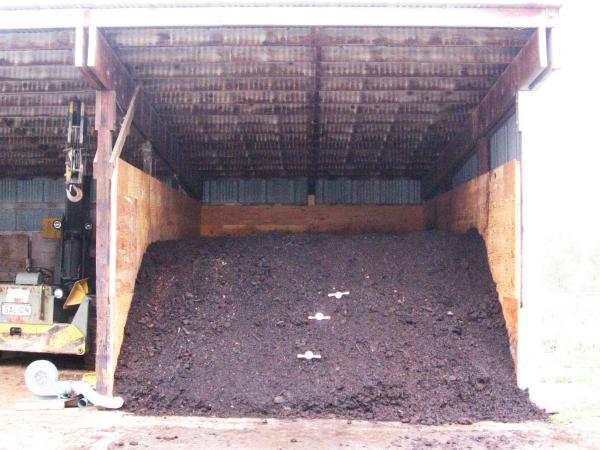
Composting is more than just piling the material and letting it sit. Composting is the active management of manure and bedding to aid the decomposition of organic materials and destruction of pathogens by microorganisms under controlled conditions (Figure 1). For more information on composting, refer to the Additional Resources section.
What are the benefits and detriments of using uncomposted or composted manure? In some cases, they have comparable properties, and in other ways, they are quite different. Table 1 compares the two materials.
| Compost | Manure |
|---|---|
| Slow release of nutrients. Often best as a soil builder. | Usually higher nutrient content. Often used as a fertilizer. |
| Easier to spread. | Sometimes difficult to spread. |
| Lower potential to degrade water quality. | Higher potential to degrade water quality. |
| Less likely to contain weed seeds. | More likely to contain weed seeds. |
| Higher investment of time or money. | Lower investment of time or money. |
| Reduced pathogen levels (e.g., Salmonella and E. coli). | Potential for higher pathogen levels. |
| More expensive to purchase. | Less expensive to purchase. |
| Fewer odors (although poor composting conditions can create foul odors). | Odors sometimes. |
| Improves soil tilth. | Improves soil tilth. |
| More stabilized carbon; a greater fraction ends up as stable organic matter. | Less stabilized carbon; more is lost to microbial decomposition. |
How to Determine the Nutrient Content of Manure
Not knowing the nutrient content of manure can lead to large errors in nutrient application rates. We strongly advise you test the manure you plan to use (Figure 2). If you buy manure from a commercial source, they should be able to provide you with nutrient test values, and you would not need to do further testing. In the absence of test values, use the published values in Table 2 (manure) and Table 3 (manure composts) as a starting point. For other organic amendments, use the values in Table 4.

Organic Fertilizers vs. Soil Builders
Manure and other organic amendments that supply large amounts of nutrients are organic fertilizers. They are applied at rates estimated to meet crop nutrient needs. Some manures and amendments (including most composts) supply smaller amounts of nutrients and are used as soil builders. Farmers can apply these amendments at higher rates to build soil organic matter quickly without risk of over-applying nutrients.
Since manure application rates are usually based on nitrogen, much of the difference between organic fertilizers and soil builders depends on the concentration and availability of nitrogen. In general, manure that contains more than 2% nitrogen on a dry-weight basis is used as a fertilizer, while manure with less than 2% nitrogen has low enough nitrogen availability to be a soil builder. Most composts have low enough nitrogen availability to be used as soil builders. During composting, most of the easily decomposable or mineralizable forms of nitrogen are converted to more stable organic forms or lost as ammonia gas.
See the section on Nitrogen Availability for Crop Growth for background on release and availability of nitrogen from organic amendments. Tables 2–5 provide estimates of nitrogen concentration and availability from a variety of manures, composts, and other amendments.
Laboratory Analysis
Laboratory analysis measures the nutrients in manure instead of just estimating them based on table values. Using testing laboratories requires proper sampling techniques and timely delivery of the sample to the laboratory.
The main components you should have measured are total nitrogen, ammonium nitrogen, total phosphorus, total potassium, electrical conductivity, and dry matter. If the manure is old or has been composted, you may also want to test for nitrate-N. Electrical conductivity is a measure of soluble salts. It is an important factor in arid regions where salts can accumulate in the soil and harm crop growth. Dry matter is used to convert lab results from a dry-weight to an as-is basis.
TABLE 2
TABLE 3
TABLE 4
Choosing a Laboratory
Choose a laboratory that routinely tests animal manure or other organic amendments and participates in a proficiency testing program. Proficiency testing programs are quality assurance and control programs where a third party submits samples and reviews results. See the Additional Resources section for information on choosing a laboratory and on proficiency testing programs.
Questions to ask when choosing a lab:
- Does the lab routinely analyze manure or other organic amendments?
- How many manure samples do they analyze in a year?
- Can they perform the tests you need?
- Are the results reported in the form you need?
- How are the samples handled before analysis? Do they thoroughly mix the samples? Do they dry the samples before analysis? (Drying samples prior to analyzing for ammonium nitrogen results in loss of most of the ammonium nitrogen from the sample. )
- Can the laboratory supply quality control information to you? Do they participate in a regional, national, or university proficiency testing program?
Laboratories report results on an as-is or a dry-weight basis. The as-is results are most helpful when determining application rates. The dry-weight results can be used to compare analyses over time and from different manure sources.
If you are not sure what reporting basis the lab is using, contact them for clarification. It is a good idea to ask for a sample reporting sheet before you choose a lab to make sure you can interpret their results (Figure 3).
To convert manure analyses reported on a dry-weight basis (in percentages) to an as-is basis (in lb/wet ton), multiply by 20 to convert the dry-weight percentage to lb/ton; then multiply by the decimal equivalent of the dry matter content.

Example
For beef manure at 23% solids and 2. 4% nitrogen (N) on a dry-weight basis:
- Step 1. 4% × 20 = 48 lb N/ton dry weight
- Step 2. 48 lb N/ton dry weight × 0.23 = 11 lb N/ton as-is.
Sampling Manure
A nutrient analysis is only as good as the sample you take. Samples must be fresh and representative of the manure. Follow these steps carefully:
- Ask the laboratory what type of containers they prefer. Also, make sure the laboratory knows when your sample is coming. Laboratories should receive samples within 48 hours of collection. Plan to collect and send your sample early in the week so the sample does not arrive at the lab on a Friday or a weekend.
- If you have a bucket loader and a large amount of manure, use the loader to mix the manure before sampling.
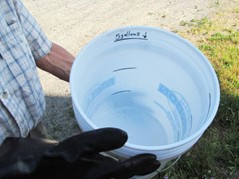
- Take 10 to 20 small samples from different parts and depths of the manure pile to form a composite sample. The composite sample should be about five gallons. The more heterogeneous your pile, the more samples you should take.
- With a shovel or your gloved hands, thoroughly mix the composite sample. You may need to use your hands to ensure complete mixing. Wear waterproof gloves when mixing manure samples with your hands.
- Collect about one quart of manure from the composite sample and place in an appropriate container.
- Freeze the sample if you are mailing it. Use rapid delivery to ensure that it arrives at the laboratory within 24 to 48 hours. You can refrigerate the sample if you are delivering it directly to the lab.
See the Additional Resources section for more information on manure and compost sampling.
Published Values
Tables 2 and 3 show typical published values for livestock manure and compost. These values may not accurately represent your situation. The nutrient content of manure varies widely with the amount and type of bedding used, storage conditions, age of manure, manure handling, and animal diet. Nutrient values can vary by a factor of two or more from the values listed in the tables.
For example, leaving manure piles uncovered west of the Cascades will reduce manure nutrient content by leaching. The use of bedding reduces manure nutrients by dilution. The amount of reduction from either of these factors is difficult to determine without laboratory testing.
Analysis of horse manure samples collected from 3 7 farms in King County, Washington, illustrates the variability in nitrogen concentration among manure sources (Figure 4). Only about one-third of the samples with wood chip bedding had nitrogen concentrations similar to the mean of 1.3%, while the remainder had nitrogen concentrations less than 1% or greater than 1.5%. These differences would have a large effect on nitrogen availability, as described below. Dry matter also varied considerably among sources, ranging from 19% to 53%.
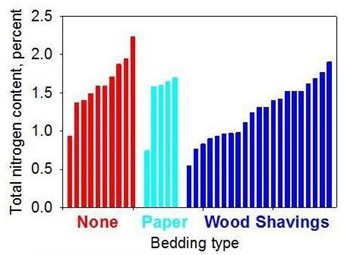
The bar chart compares total nitrogen content (percent) across three bedding types: None, Paper, and Wood Shavings. The y-axis ranges from 0 to 2.5 percent nitrogen. Bars for “None” (red) show the highest nitrogen levels, increasing from about 1.0% to just over 2.2%. “Paper” (teal) shows moderate values, roughly 0.7% to 1.7%. “Wood shavings” (blue) display the widest spread, from about 0.5% up to nearly 1.9%, generally lower than “None” but overlapping with “Paper.” Overall, bedding type influences nitrogen content, with no bedding producing the highest concentrations.
Nitrogen Availability for Crop Growth
Manure application rates are usually nitrogen-based because nitrogen is usually the nutrient needed in the largest quantity for crop growth. Manure is not like commercial fertilizer in that it does not come with a guaranteed nitrogen availability. Nitrogen availability from manure varies greatly, depending on the type of animal, type and amount of bedding, and age and storage of manure.
Manure contains nitrogen in the organic and ammonium forms. The organic form releases nitrogen slowly, while ammonium-N is immediately available for crop growth. Ammonium-N can be lost to the atmosphere as ammonia gas when manure is applied to the soil surface. Most solid manures contain most of their nitrogen in the organic form, but poultry manure contains substantial ammonium-N.
Herbicides in Manure and Compost
Herbicides that are applied to forage and pasture crops can pass through animals into their manure, leaving a small amount of herbicide residue in the manure. In most cases, the levels of herbicide in manure are inconsequential and have no effect on the crops or soil where manure is applied.
A few herbicides that are active at very low concentrations and persist in the environment can cause problems in manure or manure compost. These include clopyralid and aminopyralid, herbicides that are used to kill broadleaf weeds in grass, grain, and some other crops. Residues from aminopyralid and clopyralid persist in manure and compost and have ruined sensitive crops, such as legumes (e.g., beans and peas), and nightshades (e.g., tomatoes, potatoes, peppers). The labels for these herbicides now stipulate that manure from animals eating treated forage should not be used on sensitive crops.
If you raise animals and plan on using, selling, or giving away manure or compost for vegetable production or home gardens, make sure that forages you grow or purchase have not been treated with these herbicides. If you obtain manure from a farmer or composter, ask them if they know that their forages are free of these materials. Refer to the Additional Resources section for more information on herbicides in manure and compost.
Poultry and other manures that contain a large proportion of ammonium-N may lose substantial nitrogen to the atmosphere if they are not tilled into the soil the same day they are spread. Ammonia loss is greater in warm, dry, and breezy conditions; less in cool, wet weather. Incorporating poultry manure immediately after incorporation with a harrow or disc is the best way to reduce ammonia loss. Irrigation immediately after application can also reduce ammonia loss.
There is no simple test to determine nitrogen availability for an individual manure sample. Use Tables 2 and 3 to estimate nitrogen availability from different manures and composts.
The nitrogen availability numbers in the Tables 2–5 are approximate ranges for each type of material. Use the lower part of the ranges if manure contains a large proportion of ammonium-N, such as poultry manure, and it is not tilled into the soil soon after application. Also, use the lower part of the ranges if the manure contains large amounts of bedding, or if the measured nitrogen content is lower than typical values. Use the higher part of the ranges if the manure contains less bedding or if the measured nitrogen content is higher than typical values.
Thorough composting generally reduces the rate of release of manure nitrogen by incorporating the nitrogen into more biologically resistant forms (Table 3 ). This may not be the case for material sold as composted poultry litter, however. Poultry litter (from broiler production) is a mixture of manure and wood shavings. Dry-stacked poultry litter will heat to high temperatures, but the composting process is often limited by insufficient moisture in the pile. Materials sold as “composted poultry litter” are frequently incompletely composted and have similar nitrogen availability as fresh poultry litter.
Incompletely composted poultry litter will have a strong ammonia odor and will have ammonium-N analyses above 2000 ppm (0. 2% ammonium-N on a dry-weight basis).
Other Organic Fertilizers and Soil Builders
Other waste-derived organic amendments include recycled bulk agricultural and food processing wastes, such as peppermint hay, shrimp waste, and yard and food waste composts (Table 4). The bulk materials are similar to animal manure in that they can vary in nutrient concentration and handling characteristics. They may be either fresh or composted. Follow the guidelines for manure in this publication when choosing, analyzing, and applying these materials.
High nitrogen specialty products such as dried feather meal and fish meal are usually processed commercially to kill pathogens and render them into a form that is convenient to use (Table 5). They are typically sold as fertilizers, and their nutrient concentrations are on the product label. Use them as you would normally use fertilizers, calculating appropriate application rates and doing periodic soil testing. These materials can be applied using drop spreaders rather than manure spreaders.
TABLE 5
Horse manure or other manures with lots of woody bedding may temporarily reduce nitrogen availability rather than supply nitrogen for crop growth. Woody materials contain little nitrogen, and the microorganisms that break down the carbon in the wood will take available nitrogen from the soil to meet their nutrient needs. This process is called immobilization, and it reduces nitrogen availability to plants. Separated dairy manure solids are also low in nitrogen and can temporarily immobilize nitrogen after application to land. Expect at least a short-term nitrogen immobilization from manures and amendments containing less than 1.5% nitrogen.
If you have been applying manure to the same field for several years, residual organic nitrogen from past applications will contribute to the supply of nitrogen available to crops. You will need to reduce the manure application rate for fields that receive repeated manure applications.
Calculating the Application Rate
Now that you have determined the nutrient content and estimated the nitrogen availability of the manure you will be using, you are ready to determine the application rate. Application rates of manure are usually based on providing adequate nitrogen for crop growth. In most cases, supplying sufficient nitrogen will also provide adequate phosphorus and potassium for crop growth.
First, you will need to know the amount of nutrients your crop requires. Nutrient requirements for specific crops can be found in Extension production guides or from soil test recommendations.
Once you know the amount of nitrogen needed for your crop and the nutrient content of the manure, you can estimate the amount of manure to apply using a few simple calculations. See Worksheet C for help calculating application rates.
Observe the performance of your crops to help fine-tune your application rate. If you have a complicated nutrient management program, you may need to consult with a professional agronomist. See the Additional Resources section for a list of laboratories and professional agronomists or contact your local Extension office.
Applying Manure
Manure Spreaders
The best of manure application estimates will not be useful if you don’ t know how much you’ re applying once you get to the field. You will need a spreader appropriate to the size of your farm, and you will need to calibrate it so you have confidence in your application rates.
Equipment
There are several ways to spread manure. For small amounts, you can use buckets or apply it from the back of a pickup truck. Using a mechanical manure spreader is easier and more effective for spreading large amounts of manure. Contracting with a commercial application service may be a good option for some farms.
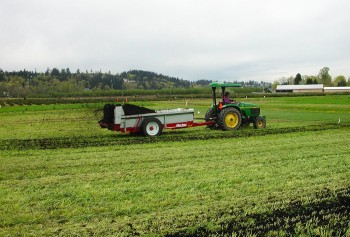
There are three general types of solid manure spreaders: rear-delivery, side-delivery, and specialty spreaders. Rear-delivery spreaders work best with drier materials (Figure 5). Side-delivery spreaders handle both wet and dry materials. Specialty spreaders have the capability of spreading material onto narrow beds found in perennial crop production.
Calibrating Manure Applications
Calibrating your spreader will allow you to determine the actual application rate and adjust it to meet your target rate.
- You can weigh a spreader load and measure how much area the load covers (Figure 6). Use Worksheet A for calculations using this method.
- If you know the bulk density of the manures, you can calculate the volume of a spreader load rather than the weight. Use Worksheet B for calculations using this method.
Calibrating your spreader will allow you to convert loads of manure applied to tons per acre. The spreader load weight calibration is the most accurate methods, but it requires truck scales to complete. Calibration improves accuracy of the overall application rates but there will still be variability in the actual application across your field.
If you apply manure to a small area and use buckets or a pickup truck, it is still important to know how much you are applying. You can do this by weighing the buckets or determining the weight or volume of the pickup load.
Regardless of which method you use, recheck your measurements periodically to make sure you stay on target.
Timing Manure Applications
From a nutrient management perspective, the best time to apply manure to row crops is in the spring before planting. Fall application increases the risk of nutrient loss via leaching or runoff. Food safety and soil management impacts of manure application should also be considered.
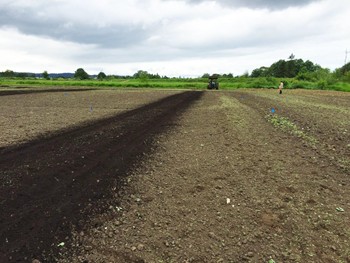
Food safety requires a waiting period between manure application and crop harvest (see the section Using Manure Safely). Using compost instead of manure provides greater flexibility in timing of application because compost has already been treated to reduce or eliminate human pathogens. Soil compaction risk during manure application is usually greater when soil is wet in the spring.
To reduce nutrient loss with fall manure application, apply manure early in the fall and plant a cover crop to help capture nutrients and prevent runoff. Alternatively, apply manure at moderate rates to pastures, hay fields, or other land with vegetated cover.
Using Manure Safely
Fresh manure sometimes contains pathogens that can cause diseases in humans. Salmonella and E. coli 0157:H7 bacteria are among the most serious pathogens found in animal manure.
These pathogens are not taken up into plant tissues but they can adhere to soil on plant roots or on the leaves or fruit of low-growing crops. Cooking destroys pathogens, but raw food carries a risk of pathogen exposure. The risk from pathogens is greatest for root crops (e.g., carrots and radishes) or leaf crops (e.g., lettuce or spinach), which have edible parts close to the soil. The risk is negligible for crops such as sweet corn, which does not have edible parts close to the soil, or for any crop that is cooked thoroughly.
Consider manure to be a potential source of pathogens. Pathogens die off naturally during extended storage or after field application. Die-off of bacterial pathogens occurs over days to months, depending on the pathogen and environmental conditions.
Composting manure at high temperatures will reduce pathogens, but you need careful quality control and daily temperature monitoring to make sure that all of the manure reaches conditions for pathogen kill (Figure 7). If you plan to compost manure, refer to the Additional Resources section for procedures to compost manure under conditions that destroy pathogens.
If you grow certified organic crops, you must follow the manure and compost practices in the National Organic Standards. These practices specify a waiting period of 120 days between the application of fresh manure and the harvest of high-risk crops and 90 days for low-risk crops. In practical terms, this means that many high-risk crops are not compatible with fresh manure being applied during the growing season in which the crops are grown.

The National Organic Standards also specify procedures for composting manure, which include maintaining compost temperatures above 131°F for a minimum of three to 15 days, depending on the type of compost system used. Even if you don’t grow certified organic crops, use the National Organic Standards as a minimum best practice when using animal manures. Refer to the National Organic Standards for more details.
The US Food and Drug Administration has drafted production regulations for protecting food safety, and they are developing research-based standards for manure and compost use. Refer to the Food Safety Modernization Act (FSMA) Final Rule on Produce Safety and Additional Resources for details on food safety standards when manure is used.
Manure Storage
If you raise animals on your farm or import manure for crop production, you may need to store manure on your farm prior to application. Proper manure storage conserves nutrients and protects surface water and groundwater. Storing manure can be as elaborate as keeping it under cover in a building or as simple as covering the manure pile with a tarp. The important point is keeping the pile covered and away from drainage areas and standing water. The storage location should also be convenient to your animals and crop production. To avoid inadvertent pathogen contamination of crops, choose a location with a low risk of runoff of manure onto cropland. If you decide to build a manure storage structure, refer to the Additional Resources section for a list of sources that cover this, or see your local Natural Resources Conservation Service office.
Using Soil Testing to Adjust Application Rates
Taking soil test samples and observing your crops can help you determine if manure application rates are adequate or if they need adjusting. The post-harvest soil nitrate test helps determine if you are applying too much manure. The post-harvest test measures nitrate-N remaining in the soil in the fall. If you apply too much manure, nitrate-N will accumulate in the soil, unused by the crop. When the fall and winter rains come, the nitrate will leach from the soil and become a potential contaminant in groundwater or surface water. Excess nitrogen can also harm some crops, delaying fruiting and increasing the risk of disease damage, winter injury, and wind damage. Although the post-harvest soil nitrate test outlined below was developed specifically for west of the Cascades, it also has use in nitrogen management in irrigated and dryland areas east of the Cascades.
To do a post-harvest soil nitrate test, sample the soil (zero to 12-inch depth) between August 15 and October 1. Timing is critical, particularly west of the Cascades. You want to sample when most crop uptake of nitrogen has occurred, but before the fall rains leach nitrate from the soil. Take a post-harvest nitrate sample as you would any other soil sample, collecting soil cores at multiple spots in the field and combining the cores into a composite sample. For details on soil sampling procedures, refer to Oregon State University Extension Publication EM 8832 Post-harvest Soil Nitrate Testing for Manured Cropping Systems West of the Cascades in Additional Resources. This publication also provides detailed background on the post-harvest test and interpretation.
If your post-harvest nitrate-N results are greater than 15–20 mg/kg, this suggests you are supplying more nitrogen than your crop needs, and you can reduce manure application rates. Post-harvest nitrate-N levels greater than 30 mg/kg are excessive.
When interpreting post-harvest soil nitrate results, consider the performance of your crop, too. If crop growth was poor because of drought, pests, or poor growing conditions, crop nitrogen uptake may have been less than expected, resulting in excess nitrate-N remaining in the soil profile even if manure applications were on target for a normal crop.
You can use routine soil tests to evaluate the soil for sufficiency or excess of other nutrients. A routine soil test includes phosphorus (P), potassium (K), calcium (Ca), magnesium (Mg), boron (B), and pH. West of the Cascades, a routine test should also include a lime requirement test. Soil tests east of the Cascades should include electrical conductivity, a measure of soluble salts.
When soil test phosphorus and potassium are low, and you observe reduced crop growth, you can probably increase manure application rates. When soil test phosphorus and potassium are consistently excessive, you may need to decrease or eliminate manure applications, as described below. For additional information on soil tests for these and other nutrients, refer to Oregon State University Extension Publication EC 1478 Soil Test Interpretation Guide in Additional Resources.
Long-Term Effects of Manure Applications
Repeated applications of manure can increase soil organic matter content and the soil nutrient supply. Increasing organic matter often improves soil physical properties, such as bulk density, infiltration rate, and water-holding capacity. Because the supply of slow-release nutrients increases in soil, the amount of manure needed to meet crop needs will decline over time.
If you apply manure repeatedly to the same fields, it is important to have a regular soil testing program to track nutrient levels, as described in the Laboratory Analysis section of this publication. In drier regions (e.g., east of the Cascades), it is important to track soluble salts and cease applications of manure before salt accumulation reaches harmful levels. When manure applications are based on nitrogen need, manure usually supplies phosphorus and potassium in excess of crop needs. As a result, phosphorus and potassium can accumulate in soils with a history of manure applications, and may eventually reach excessive levels. Excess levels of soil phosphorus can increase the amount of phosphorus in runoff, increasing the risk of surface water degradation. Many crops can handle high levels of potassium, but blueberries and some other specialty crops can suffer from nutrient imbalances in soils with excessive potassium. Livestock can also be harmed by nutrient imbalances if they consume a diet of forages with high potassium levels.
If soil test phosphorus and potassium reach excessive levels, you may need to switch to a commercial fertilizer that supplies only nitrogen. If you are an organic farmer and do not use synthetic fertilizers, consider replacing some or all manure with legume cover crops or products such as feather meal with high nitrogen content and low phosphorus and potassium. Legumes will fix nitrogen from the atmosphere, but they do not supply phosphorus or potassium. Excess phosphorus and potassium levels can be reduced by growing forage crops, such as alfalfa, that will supply their own nitrogen but export considerable amounts of phosphorus and potassium in the dry matter that is removed. Reserve manure for fields that have lower phosphorus and potassium levels.
Worksheet A
Spreader Calibration Using a Full Spreader Load and Scales
Use this method to monitor the manure application rate on the entire field. After the initial weighing to determine the capacity of the application vehicle, the only tool you need is a field-measuring wheel or long tape.
Determine the weight of manure the spreader will hold using a truck scale to weigh the spreader when empty and full. Record the weights on Worksheet A.
Spread a load on the field using constant, even tractor speed and settings to cover the area uniformly. Spread in a rectangular pattern so the area calculation will be simple. Record tractor speed and gear settings used on Worksheet A.
Measure the length and width covered by one full load and compute the application rate in tons per acre using Worksheet A.
Adjust the application rate by changing tractor speed or gearing, or by making an adjustment on the manure spreader. After adjustment, you will need to repeat the calibration procedure until you have arrived at the desired application rate.
Keep the calibration records for future use.
By
Andy Bary, Senior Scientific Assistant, Puyallup Research and Extension Center, Washington State University
Craig Cogger, Extension Soil Scientist Emeritus, Puyallup Research and Extension Center, Washington State University
Dan Sullivan, Professor, Department of Crop and Soil Science, Oregon State University