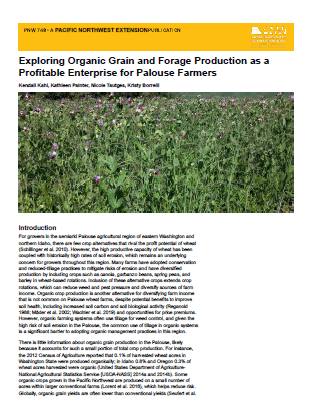
Exploring Organic Grain and Forage Production as a Profitable Enterprise for Palouse Farmers
Demand for organic grain has outpaced actual US grain production in recent years. Yet little is known about organic grain production in the Palouse, likely because it comprises a small portion of total crop production. This study takes a closer look. It examines crop productivity under reduced-tillage conditions, provides estimates of field-scale costs, determines the benefits of crop rotation, and describes the principal factors that determine profitability within cropping systems. The verdict: organic grain and forage production can be a profitable niche enterprise within a traditional Palouse nonorganic wheat farm.
Published: November 2020
Hurry! Only left in stock.
Related publications
-
Backyard Composting (Home Garden Series)
Curious about compost? Composting reduces waste and provides an inexpensive treatment for home gardens and landscapes. Whether you have been composting for years or want to start your first pile, this ...
- Published:
- August 1994
- Revised:
- March 2017
- SKU:
- EB1784E
Authors: -
Aquatic and Riparian Weeds of the West
This is a practical guide to the identification and biology of submerged, floating-leaved, and emergent aquatic and riparian weeds.
Price: $30.80 -
Strawberry Nutrient Management Guide for Oregon and Washington
Strawberry growers in Oregon and Washington raise fruit for both the processed and fresh markets, using both conventional and certified organic systems.
- Published:
- April 2019
- Reviewed:
- January 2023
- SKU:
- EM9234
-
Performance of Hard Red Winter Wheat in Late-Planted No-Till Fallow
This publication describes results of field research on the performance of hard red winter wheat cultivars in a late-planted fallow system in the low-precipitation zone of Oregon and Washington. ...
- Published:
- June 2016
- Revised:
- June 2020
- Reviewed:
- January 2023
- SKU:
- PNW635
Authors: