Emergence of Amitraz-Resistant Varroa: What Beekeepers Should Know and How to Respond
Description
Amitraz resistance in Varroa mites poses a serious threat to US beekeepers. Learn how to test Varroa resistance in colonies and strategies to protect honey bee health.Table of Contents
- Overview
- What Is Pesticide Resistance and How Does It Develop?
- Emergence of Amitraz-Resistant Varroa
-
Current EPA-Registered Products Containing Amitraz (as of March 2026)
- Apivar
- Amiflex
Overview
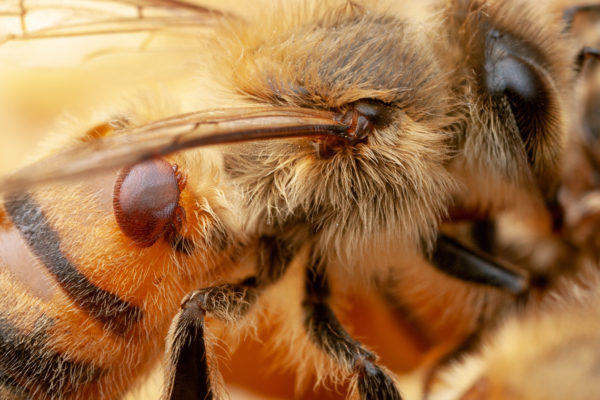
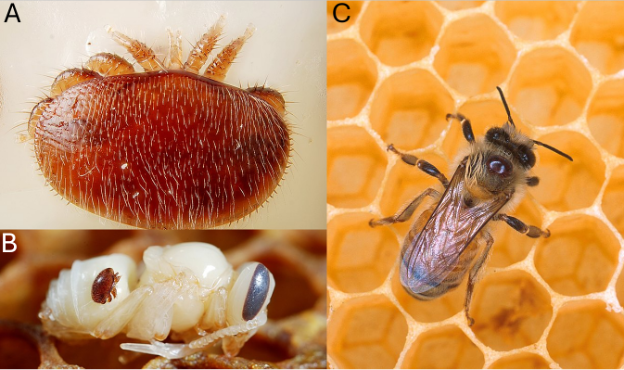
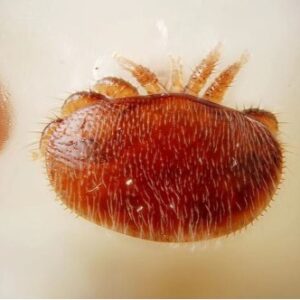
Varroa destructor (Anderson and Trueman), or simply “Varroa,” is the most damaging pest of honey bee colonies worldwide (Steinhauer et al. 2018). These ectoparasitic mites feed on honey bee adults and brood while vectoring deadly viruses (Figure 1) (Lamas and Evans 2024; Ramsey et al. 2019). Varroa coevolved with the eastern honey bee (Apis cerana), but it has since jumped hosts to the western honey bee (Apis mellifera), which generally lacks inherent defenses against Varroa infestations (Denmark et al. 1991). Varroa was first detected in the United States in 1987 and has since expanded its range to all continents except Antarctica (Bourke et al. 2024; Denmark et al. 1991; Mondet et al. 2014). There are several approaches for beekeepers to manage Varroa including chemical, cultural, and mechanical controls.
Chemical treatments include synthetic miticide (amitraz, tau-fluvalinate, coumaphos) and organic compounds (formic acid, oxalic acid, thymol, and hop beta acids). However, Varroa populations across the United States have developed resistance to tau-fluvalinate and coumaphos due to historic overuse of these ingredients and the persistence of those miticides in the wax (Elzen et al. 2000; Kanga et al. 2010; Medici et al. 2015; Pettis 2004). Additionally, there is growing evidence showing that the efficacy of amitraz is similarly dwindling due to the development of resistance (Rinkevich 2020). This phenomenon presents an urgent need for alternative control strategies to mitigate Varroa-associated honey bee colony losses. This Extension publication addresses the recent emergence of amitraz-resistant Varroa populations across the United States, describes how pesticide resistance develops, provides a method for beekeepers to test for amitraz-resistant Varroa themselves, and emphasizes ways to slow pesticide resistance development.
What Is Pesticide Resistance and How Does It Develop?
Pesticide resistance happens when a pest or pathogen develops a heritable ability to survive pesticide exposure that previously controlled it. This phenomenon usually occurs after repeated use of the same or similar active ingredient(s) or mode(s) of action. The earliest documented report of insecticide resistance was made by Axel Leonard Melander, an entomologist at the Washington Agricultural Experiment Station in Clarkston, Washington. In a 1908 experiment, Melander observed that a subset of a San Jose scale insect population miraculously survived lime sulfur spray (Melander 1914). Previously, this same treatment had always induced 100% mortality. He suspected that the scale insects’ ability to survive the chemical treatment was hereditary and thus passed on from generation to generation. His understanding still holds true to our current understanding of how resistant pest populations emerge.
Pesticide resistance occurs at the individual level but can evolve at the population level. This means that individuals who are susceptible to a given control method cannot “gain” resistance in their lifetime. However, since resistance is hereditary, resistant individuals who reproduce can pass on resistant genes to their offspring. With consistent pesticide applications across several generations, susceptible individuals will die off, while resistant individuals will survive and produce offspring that are also likely to be resistant. Eventually, the pest population may have enough resistant individuals to persist, greatly reducing the efficacy of that control strategy. At that point, a different control method must be implemented to successfully keep the pest population under the desired threshold before it causes economic losses or unacceptable levels of damage.
Emergence of Amitraz-Resistant Varroa
Amitraz is a formamidine miticide which works by selectively binding to and activating Varroa’s octopamine receptor, leading to hyperexcitation, paralysis, and death (Evans and Gee 1980; Guo et al. 2021). Amitraz was initially approved for beekeeping use in South Dakota in 2010 with a special Section 18 permit issued by the Environmental Protection Agency (EPA). Though concerns about resistance were documented prior to that point (Elzen et al. 2000), amitraz has since become the industry standard for chemical Varroa control in the United States.
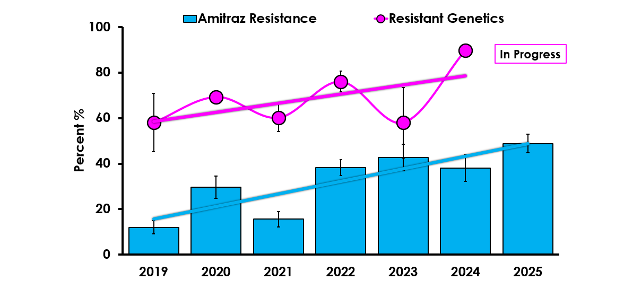
Reports of amitraz-resistant Varroa across several commercial beekeeping operations were first documented in 2020 (Rinkevich 2020). The most likely mechanism for this resistance is a mutation in the mite’s β2-octopamine receptor gene which changes the amino acid sequence of the receptor protein and thus prevents amitraz from binding (Rinkevich et al. 2023). From 2019 to 2025, the average percentage of amitraz-resistant Varroa in honey bee colonies across the United States rose from less than 20% to nearly 50% (Figure 2; Rinkevich in preparation, personal communication). The resulting difficulty in controlling Varroa with conventional methods may have contributed to the record honey bee colony losses in 2024–2025 (Nearman et al. 2025). A recent study on this phenomenon reported that all Varroa mites collected from six US commercial beekeeping operations in January 2025 displayed the Y215H mutation associated with amitraz resistance (Rinkevich et al. 2023; Lamas et al. 2026). Similarly, this same marker of resistance was detected in Varroa across 90% of sampled apiaries in Alberta, Canada, in 2020 and 2022 (Bahreini et al. 2025).
The widespread emergence of amitraz-resistant Varroa across the United States and Canada after only 10 years of EPA-approved use concerns beekeepers and researchers alike (Bahreini et al. 2025). This phenomenon necessitates a shift in how many beekeepers approach Varroa management strategies to account for and adapt to this resistance. Now more than ever, all beekeepers have a responsibility to become familiar with and implement Varroa-specific integrated pest management (IPM). While performing any form of Varroa control is a good way for beekeepers to reduce the risk of colony mortality, the most successful IPM strategies use multiple forms of prevention and control, such as regular monitoring, rotating use of different active ingredients, and utilizing mechanical or cultural controls (Steinhauer et al. 2020; Jack and Ellis 2021).
Current EPA-Registered Products Containing Amitraz (as of March 2026)
Apivar
Apivar (Véto-pharma) is a sustained-release plastic strip with a 56-day treatment period. These amitraz strips target mites attached to an adult bee in the hive, but since the chemical does not penetrate through wax brood cell cappings, the strips do not kill reproductive or juvenile mites. There are now two versions with slightly different formulations: the original Apivar and the faster-acting Apivar 2.0. Apivar 2.0 is intended to replace the original Apivar, offering North American beekeepers a new, next-generation amitraz-based treatment. As of September 2026, EPA registration for Apivar 2.0 has been approved in all US states except California. Registration of the original Apivar will be discontinued after each local deadline. Visit the EPA website for Apivar details and the most recent label information.
Amiflex
Amiflex and Amiflex 2.0 (Véto-pharma) are gel amitraz formulations with a short seven-day treatment period, offering more flexibility for beekeepers to plan their treatments around honey flows. Like Apivar, Amiflex treatments do not penetrate through wax cappings and therefore only work on phoretic mites attached to adult bees. Amiflex was registered through the EPA in 2023 as a Restricted Use Pesticide (RUP), which requires specific certifications for its purchase and use. However, Amiflex 2.0 has the same formulation but does not require an RUP license for purchase. As of March 2026, Amiflex 2.0 is approved for use in most US states, including Washington. Visit the EPA website for Amiflex details and label information.
How Can I Test for Amitraz-Resistant Varroa in My Colonies?
Beekeepers may suspect amitraz resistance in Varroa populations when mites can no longer be effectively controlled with Apivar or Apivar 2.0 and Amiflex or Amiflex 2.0 treatments. Fortunately, there is a simple, cheap, and fast way to test for amitraz resistance.
Beekeepers interested in testing for amitraz-resistant Varroa in their colonies should contact Dr. Frank Rinkevich (frank.rinkevich@usda.gov). A test kit will be provided free of charge along with detailed instructions, which are summarized below. Beekeepers located in Washington are especially encouraged to perform this test and share their results with Dr. Rinkevich, because the current prevalence of amitraz-resistant Varroa in Washington is poorly understood. In 2022–2025, a total of 783 Varroa were collected from 10 beekeepers in Washington State, and 97.8% of those Varroa had a mutation associated with amitraz resistance. Therefore, amitraz resistance in Washington Varroa may be high and widespread, but much more data are required to be conclusive.
Amitraz Resistance Screening Instructions
Supplies needed:
- Nitrile gloves*
- Apivar squares or amitraz treated cardboard strips*
- Quart-sized plastic deli cups with screened and normal lids*
- Binder clips*
- Plastic weighing dishes*
- 4 oz plastic cup*
- Strainer*
- Tubes for Varroa with green and red dots*
- Data sheet*
- Marker/pen
- Petroleum jelly
- Hot glue and hot glue gun
- Dish soap
- 5-gallon bucket
- Beekeeping equipment (hive tool, smoker, etc.)
- Forceps or tweezers
Supplies highlighted with an asterisk (*) are included in the research test kit provided by Dr. Frank Rinkevich. Email Dr. Rinkevich (frank.rinkevich@usda.gov) to request your test kit to be mailed to you free of charge.
Instructions
This test performs best when the hive contains a sufficiently large Varroa population (i.e. greater than three mites per 100 bees). For best results, plan to perform the test in late summer or early fall after honey supers have been removed and before any chemical mite treatment has been applied. Do not use any other amitraz treated materials or products other than what is supplied with the kit. Do not reuse bioassay cups, as the results become unreliable after one use.
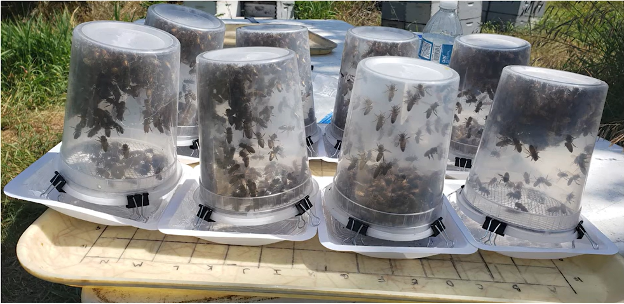
- Attach Apivar squares or amitraz treated cardboard strips perpendicularly to the bottom of the plastic containers with hot glue to make test containers, as shown in Figure 3.
- Number weighing dishes one to 10 on the edge and coat with a thin layer of petroleum jelly.
- Shake two frames of bees from frames containing sealed brood into a bucket. Before you shake, ensure that the queen is not on either of these frames, and if she is, return her to the hive.
- Scoop a bee sample using a 4 oz cup, deposit into a test container, and seal with screened lid. Write the colony number and time on the bottom of the container. Attach four binder clips to the lid of the test container.
- Invert container over weighing dish covered with petroleum jelly. Keep containers in shade at ambient temperatures (68°F–86°F or 20°C–30°C) for three hours.
- Flip container on the bottom. Record number of Varroa on the dish on the data sheet. Collect Varroa from dish into tube with green lid. Write the colony number on the lid.
- Add a small amount of dish soap though the screen. Fill container halfway with water. Swirl to submerge bees. Add more water until the container is three-quarters full. Replace screen lid with regular lid. Shake vigorously for 30 seconds and rest for one minute. Repeat three times.
- Gently pour water from the test container through the fine mesh strainer to collect Varroa. Rinse bees with additional water and collect Varroa in the sieve until no soap remains on the bees and no additional Varroa mites are collected, approximately three rinses. Count number of Varroa mites in strainer and record on the data sheet. Using a brush or forceps, collect Varroa from the strainer and place them in the tube with red dots.
- Empty the bees onto a large tray. Count the total number of bees in the sample and record on the data sheet.
- Calculate amitraz resistance and Varroa infestation levels using the formulae on the data sheet.
- Send a photo of the completed data sheet for each apiary to Frank Rinkevich to contribute to the body of research on amitraz resistance and its prevalence across the United States.
For a demonstration of this procedure, see the video “Testing for Amitraz Resistance in Varroa destructor.”
Responding to Amitraz-Resistant Varroa
After performing the amitraz resistance test described above, refer to the decision matrix below to figure out your next steps (Figure 4). You will need to know the Varroa infestation level (the number of mites per 100 bees) and the amitraz resistance rate (percentage of amitraz-resistant mites).
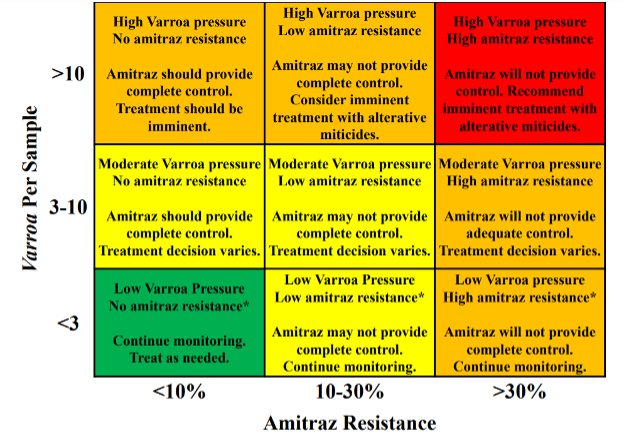
If you have an active Varroa infestation greater than 5 mites per 100 bees and more than 30% of the Varroa are resistant to amitraz, you will need to use a different chemical ingredient to treat your hives. Amitraz will not work.
If colonies have lower Varroa pressure, a lower amitraz resistance rate, or both, using a non-amitraz chemical treatment may be useful, but not completely necessary. With Varroa infestation levels below one mite per 100 honey bees, beekeepers should continue to perform regular mite washes to monitor Varroa populations in their colonies and implement non-chemical forms of Varroa control. If chemical treatment is necessary, consider using an amitraz-based treatment to provide adequate control.
Minimizing Development of Pesticide Resistance
The widespread emergence of amitraz-resistant Varroa across North America after only 10 years of EPA-approved use concerns beekeepers and researchers alike. This phenomenon necessitates a shift in how many beekeepers approach Varroa management to account for and adapt to this resistance. Now more than ever, all beekeepers have a responsibility to become familiar with and implement Varroa-specific integrated pest management (IPM).
Regular monitoring is the first step in any successful integrated pest management (IPM) regime (Jack and Ellis 2021). Beekeepers should perform mite washes at least four times a year when colonies are active and after a chemical treatment to assess its effectiveness and determine if additional intervention is needed. Additionally, beekeepers should consider implementing nonchemical strategies along with chemical controls in their Varroa management regimens. Using naturally Varroa-resistant bee stocks, appropriately spacing hives throughout an apiary to reduce drift, and interrupting the Varroa reproduction cycle with artificial brood breaks are examples of nonchemical measures that can help protect honey bee colonies against Varroa (Seeley and Smith 2015; O’Shea-Wheller et al. 2022; Aurell et al. 2025; Price et al. 2025).
When using chemical Varroa treatments, there are several ways for beekeepers to minimize the development of resistance. Beekeepers should rotate the use of different active ingredients, especially when using amitraz. Periodic comb culling may also help reduce resistance development in Varroa in addition to protecting bee health (Meng et al. 2025). Chronic exposure to chemical residues in contaminated beeswax has been shown to contribute to the development of coumaphos and tau-fluvalinate resistance and has recently been associated with amitraz resistance as well (Medici et al. 2015; Benito-Murcia et al. 2021; Hartel 2024). For information on culling and rotating old comb, see this video demonstration: “Beekeeping: Rotating and Culling Old Comb with Blake Shook.”
For any chemical miticide, beekeepers should always check the product label for instructions, including whether the product should be used with honey supers present. Special considerations may also include application timing, ambient temperature during application, and presence of brood, as these factors affect treatment efficacy and safety for bees (Underwood and Currie 2003; Bacandritsos et al. 2007; O’Shea-Wheller et al. 2025). Beekeepers should only use ingredients specifically registered for Varroa control by the Environmental Protection Agency (EPA) and specific state regulations. The use of unregistered ingredients or off-label use of registered ingredients may be ineffective or even harmful to bees. To view a current list of EPA-registered pesticide products for Varroa control in the United States, visit the EPA-Registered Pesticide Products Approved for Use Against Varroa Mites in Bee Hives website. To view a current list of state-registered pesticide products for Varroa control in Washington State, go to the WSU’s Pesticide Information Center OnLine Database (PICOL) website. For more comprehensive guidance on different management strategies, including cultural, mechanical, and chemical forms of control, refer to the Honey Bee Health Coalition’s Varroa Management Guide and Management Decision Tool (2024).
References
Aurell, D., S. Bruckner, T.D. Steury, and G.R. Williams. 2025. Treating Newly Split Apis mellifera Honey Bee Colonies with Organic Miticides—An Opportunity for Integrated Pest Management of Varroa destructor Mites (Metostigmata: Varroidae). Journal of Economic Entomology 118(4): 1495–1503.
Bacandritsos, N., I. Papanastasiou, C. Saitanis, A. Nanetti, and E. Roinioti. 2007. Efficacy of Repeated Trickle Applications of Oxalic Acid in Syrup for Varroosis Control in Apis mellifera: Influence of Meteorological Conditions and Presence of Brood. Veterinary Parasitoloy 148(2): 174–178.
Bahreini, R., J. González-Cabrera, C.S. Hernández-Rodríguez, et al. 2025. Arising Amitraz and Pyrethroids Resistance Mutations in the Ectoparasitic Varroa destructor Mite in Canada. Scientific Reports 15: 1587.
Benito-Murcia, M., C. Bartolomé, X. Maside, et al. 2021. Residual Tau-Fluvalinate in Honey Bee Colonies is Coupled with Evidence for Selection for Varroa destructor Resistance to Pyrethroids. Insects 12(8): 731.
Bourke, R., M. Page, E.A. Frost, et al. 2024. First Detection and Initial Distribution of ‘Varroa’ destructor in New South Wales, Australia—The First 100 Days Towards Eradication. General and Applied Entomology 52: 31–36.
Denmark, H.A., H.L. Cromroy, and L. Cutts. 1991. Varroa Mite, Varroa jacobsoni Oudemans (Acari: Varroidae). Florida Department of Agriculture and Consumer Services, Division of Plant Industry. Entomology Circular No. 347.
Elzen, P.J., J.R. Baxter, M. Spivak, W.T. Wilson. 2000. Control of Varroa jacobsoni Oud. Resistant to Fluvalinate and Amitraz Using Coumaphos. Apidologie 31(3): 437–441.
Evans, P.D., and J.D. Gee. 1980. Action of Formamidine Pesticides on Octopamine Receptors. Nature 287: 60–62.
Guo, L., X. Fan, X. Qiao, C. Montell, and J. Huang. 2021. An Octopamine Receptor Confers Selective Toxicity of Amitraz on Honeybees and Varroa Mites. eLife 10: e68268.
Hartel, E. 2024. Pesticide Residues in Beeswax Predict the Occurrence of Varroa with Alleles that Confer Amitraz Resistance. Master’s thesis, University of Maryland.
Honey Bee Health Coalition. 2022. Tools for Varroa Management: A Guide to Effective Varroa Sampling & Control, 8th edition. Keystone Policy Center.
Jack, C.J., and J.D. Ellis. 2021. Integrated Pest Management Control of Varroa destructor (Acari: Varroidae), the Most Damaging Pest of (Apis mellifera L. (Hymenoptera: Apidae)) Colonies. Journal of Insect Science 21(5): 6.
Kanga, L.H.B., J. Adamcyzk, K. Marshall, and R. Cox. 2010. Monitoring for Resistance to Organophosphorus and Pyrethroid Insecticides in Varroa Mite Populations. Journal of Economic Entomology 103(5): 1797–1802.
Lamas, Z.S., and J.D. Evans. 2024. Deadly Triangle: Honey Bees, Mites, and Viruses. Frontiers in Bee Science 2.
Lamas, Z.S., F. Rinkevich, A. Garavito, et al. 2026. Viruses and Vectors Tied to Honey Bee Colony Losses. PLoS Pathogens 22(2): e1013939.
Medici, S.K., M.D. Maggi, E.G. Sarlo, S. Ruffinengo, J.M. Marioli, and M.J. Eguaras. 2015. The Presence of Synthetic Acaricides in Beeswax and Its Influence on the Development of Resistance in Varroa destructor. Journal of Apicultural Research 54(3): 267–274.
Melander, A.L. 1914. Can Insects Become Resistant to Sprays? Journal of Economic Entomology 7: 167–173.
Meng, Q., R. Huang, S. Yang, W. Jiang, Y. Tian, and K. Dong. 2025. An Overview of the Adverse Impacts of Old Combs on Honeybee Colonies and Recommended Beekeeping Management Strategies. Insects 16(4): 351.
Mondet, F., J.R. de Miranda, A. Kretzschmar, Y. Le Conte, A.R. Mercer. 2014. On the Front Line: Quantitative Virus Dynamics in Honeybee (Apis mellifera L.) Colonies Along a New Expansion Front of the Parasite Varroa Destructor. PLoS Pathogens 10(8): e1004323.
Nearman, A., C.L. Crawford, M.M. Guarna, et al. 2025. Insights from U.S. Beekeeper Triage Surveys Following Unusually High Honey Bee Colony Losses 2024–2025. Science of the Total Environment 1003: 180650.
O’Shea-Wheller, T.A., A. Hall, K. Stainton, et al. 2025. A Large-Scale Study of Varroa destructor Treatment Adherence in Apiculture. Entomologia Generalis 45(1): 127–136.
O’Shea-Wheller, T.A., F.D. Rinkevich, R.G. Danka, M. Simone-Finstrom, P.G. Tokarz, and K.B. Healy. 2022. A Derived Honey Bee Stock Confers Resistance to Varroa destructor and Associated Viral Transmission. Scientific Reports 12: 4852.
Pettis, J.S. 2004. A Scientific Note on Varroa destructor Resistance to Coumaphos in the United States. Apidologie 35: 91–92.
Price, B.E., R. Reed, T. Reams, and B.K. Hopkins. 2025. Induced Brood Breaks by Refrigerated Bee Storage in Spring: An Effective Strategy for Varroa destructor (Metostigmata: Varroidae) Control in Honey Bee Colonies. Journal of Insect Science 25(5): ieaf087.
Ramsey, S., R. Ochoa, G. Bauchan, and D. vanEngelsdorp. 2019. Varroa destructor Feed Primarily on Honey Bee Fat Body Tissue and Not Hemolymph. Proceeds of the National Academy of Science 116(5): 1792–1801.
Rinkevich, F. D. n.d. Research Entomologist. Honey Bee Breeding, Genetics, and Physiology Research Unit, USDA-ARS.
Rinkevich, F.D. 2020. Detection of Amitraz Resistance and Reduced Treatment Efficacy in the Varroa Mite, Varroa destructor, within Commercial Beekeeping Operations. PLoS ONE 15(1): e0227264.
Rinkevich, F.D., S. Moreno-Martí, C.S. Hernández-Rodríguez, and J. González-Cabrera. 2023. Confirmation of the Y215H Mutation in the β2-Octopamine Receptor in Varroa destructor Is Associated with Contemporary Cases of Amitraz Resistance in the United States. Pest Management Science 79(8): 2840–2845.
Seeley, T.D., and M.L. Smith. 2015. Crowding Honeybee Colonies in Apiaries Can Increase Their Vulnerability to the Deadly Ectoparasite Varroa destructor. Apidologie 46: 716–727.
Steinhauer, N., K. Kulhanek, K. Antúnez, et al. 2018. Drivers of Colony Losses. Current Opinion in Insect Science 26: 142–148.
Steinhauer, N., D. vanEngelsdorp., and C. Saegerman. 2020. Prioritizing Changes in Management Practices Associated with Reduced Winter Honey Bee Colony Losses for US Beekeepers. Science of the Total Environment 753: 141629.
Underwood, R.M., and R.W. Currie. 2003. The Effects of Temperature and Dose of Formic Acid on Treatment Efficacy Against Varroa destructor (Acari: Varroidae), a Parasite of Apis mellifera (Hymenoptera: Apidae). Experimental & Applied Acarology 29: 303–313.
Allyson Martin, Postdoctoral Research Associate, WSU Department of Entomology
Briana Price, Education and Outreach Coordinator, WSU Department of Entomology
Frank Rinkevich, Research Entomologist, USDA-ARS Honey Bee Breeding, Genetics, and Physiology Research Unit
Priyadarshini Chakrabarti, Assistant Professor of Pollinator Health and Apiculture, WSU Department of Entomology
Brandon Hopkins, P. F. Thurber Endowed Distinguished Professor of Pollinator Ecology, WSU Department of Entomology

FS411E

Copyright © Washington State University
WSU Extension publications contain material written and produced for public distribution. Alternative text descriptions for select complex images were generated using ChatGPT (OpenAI), then reviewed and adapted to ensure compliance with Web Content Accessibility Guidelines (WCAG) accessibility standards.
Issued by Washington State University Extension and the US Department of Agriculture in furtherance of the Acts of May 8 and June 30, 1914. Extension programs and policies are consistent with federal and state laws and regulations on nondiscrimination regarding race, sex, religion, age, color, creed, and national or ethnic origin; physical, mental, or sensory disability; marital status or sexual orientation; and status as a Vietnam-era or disabled veteran. Evidence of noncompliance may be reported through your local WSU Extension office. Trade names have been used to simplify information; no endorsement is intended.
.jpg)

