Backyard Composting (Home Garden Series)
Table of Contents
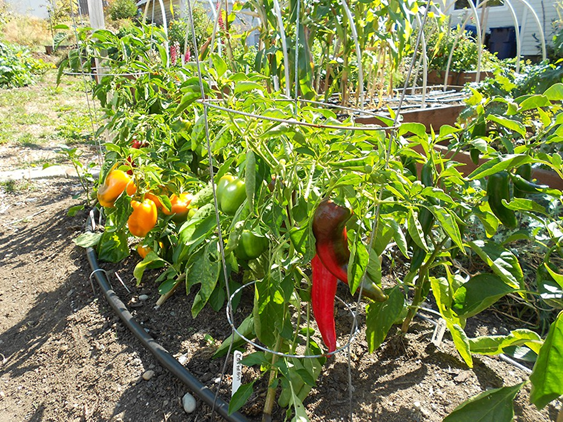
Gardeners have long made and used compost because of the way it improves garden soil. Home composting transforms yard debris and food scraps into a valuable soil amendment and closes the recycling loop in our own backyards (Figure 1). Today, many cities have municipal composting programs. These programs include curbside yard and food debris collection, large-scale composting at commercial facilities, and resale of the finished compost to gardeners and landscapers. Nonetheless, backyard composting remains popular in areas without municipal programs, and for gardeners who want to make and use their own compost.
The Science of Composting
The Cycle of Growth and Decay
Composting carries out part of the earth’s biological cycle of growth and decay. Plants grow by capturing the sun’s energy along with carbon dioxide from the air and nutrients and water from the soil. When plants (and the animals that eat them) die, they become raw materials for the decay process. Bacteria, fungi, insects, worms, mites, and other creatures convert some of the carbon from dead plants into energy for their own metabolism, releasing carbon dioxide into the air. They also cycle some of the carbon and nutrients from the decaying plants into their own bodies as they grow, and eventually back into the soil, where the cycle begins again. The material that remains from the decay process is similar to soil organic matter. It holds water and nutrients in the soil and makes the soil more porous and easier to dig.
Fast or Hot Composting
We can manipulate the decay process to make it proceed faster. We do this by balancing food, water, and air in the compost pile to favor the growth of thermophilic (high-temperature) microorganisms. One byproduct of microbial activity is heat. When conditions are favorable for high-temperature microorganisms, compost piles heat rapidly to 130°F–150°F. This temperature range kills most weed seeds and pathogens (disease organisms) (Zabroski 2015). Once the hot phase is complete, lower temperature bacteria along with fungi, worms, insects, and other organisms complete the decay process.
Slow Composting
If we do not maintain ideal conditions for hot composting, microorganisms will still break down the wastes, similar to what happens in soil. Decay will be slower, cooler, and less effective at killing weed seeds and pathogens.
Managing the Decay Process
You can affect the speed of the composting process and the quality of the compost product by managing the factors described below.
Food (Raw Materials)
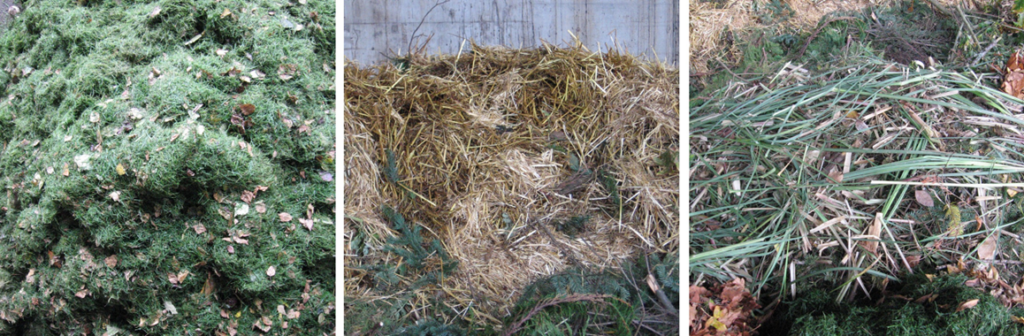
For fast composting, the initial mix must have the proper moisture and air content as well as organic materials that provide a rich energy and nutrient source for bacteria. Table 1 and Figure 2 show some materials commonly used in making compost. They are separated into “energy” materials, “bulking agents,” and “balanced” materials.
Energy Materials
Energy materials provide the nitrogen and high-energy carbon compounds needed for fast microbial growth. If piled without bulking agents, these materials usually are too wet and dense to allow much air into the compost pile. The pile will become anaerobic (lacking oxygen) and produce foul, rotten odors.
Bulking Agents
Bulking agents are dry, porous materials that help aerate the compost pile. They are too low in moisture and nutrients to decay quickly on their own.
Balanced Raw Materials
Some raw materials contain a balance of energy and bulking agent properties. These materials will compost readily without being blended with other ingredients. Examples include deciduous leaves, horse manure mixed with bedding, and spoiled alfalfa hay. These materials are handy for ensuring the success of hot compost piles.
Mixing bulking agents with energy sources provides a balance of moisture, air, and nutrients for rapid composting. A mixture of one part energy material with two parts bulking agent (by volume) usually gives a reasonable mix for rapid composting.
Table 1. Examples of raw materials for making compost
Bulking Agents
(Low moisture, high porosity, low nitrogen)
- Wood chips
- Sawdust
- Wheat Straw
- Corn Stalks
- Christmas trees (chipped)
Energy (Green) Materials
(High moisture, low porosity, high nitrogen)
- Garden Trimmings
- Fruit and Vegetable Waste
- Grass Clippings
- Dairy, chicken, or rabbit manure
Balanced Raw Materials
(Low to medium moisture, medium porosity, low to medium nitrogen)
- Deciduous leaves
- Horse manure and bedding
- Spoiled hay
Particle Size
Grinding, cutting, smashing, or chopping raw materials reduces particle size. Small particles have more surface area for microbial activity and are easier to mix. Woody branches that have not been ground often make it difficult to turn a pile. They also decompose very slowly. We suggest grinding or chipping woody branches to use as bulking agent or mulch, piling them separately, or placing them in a municipal yard debris container.
Mixing
Mixing raw materials stimulates the composting process by balancing moisture, aeration, and nutrients throughout the pile. Mix materials thoroughly when building the pile.
Pile Size
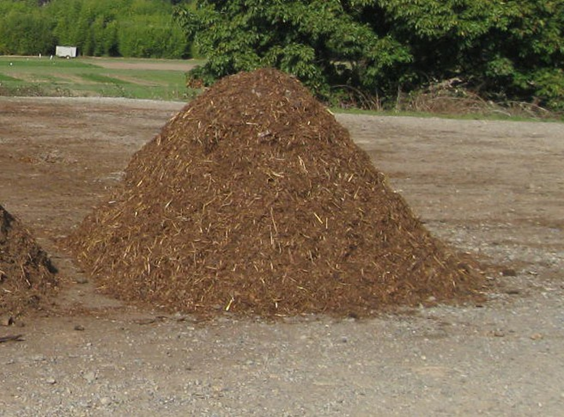
The pile must be big enough to hold heat. A hot pile decays much faster than a cold pile. Small piles are usually colder because they have small cores that hold less heat. Small piles also dry out faster. A pile of about one cubic yard is big enough for year-round composting, even in cold-winter areas.
Moisture
The mixed material should feel moist, but you should not be able to squeeze water out of it with your hands. Piles that are too dry limit microbial growth. Piles that are too wet reduce the movement of oxygen, which also limits microbial growth. When conditions are dry, you may need to add water to maintain pile moisture. In rainy winter locations, a pile may not heat up unless you cover it to keep out rainwater. Check moisture when you turn the pile.
Aeration
The microorganisms responsible for fast decomposition need oxygen. In the pile, oxygen is consumed by microbes. If oxygen is not replenished, the pile can become anaerobic and produce foul odors. The pile needs to be porous to pull outside air into it. Use enough bulking agents to create a porous pile. As the pile decomposes, it settles, reducing aeration. Turning the pile or adding bulking agents helps restore porosity.
Microorganisms
Raw materials used to form a compost pile usually contain all the microorganisms needed to make compost. You do not need to add soil or compost starters with “special” microorganisms.
Nutrients
Just like people, microorganisms need nutrients (such as nitrogen, phosphorus, sulfur) to grow and reproduce. These nutrients occur in the raw materials used in the compost mix. Additional fertilizer from any source (organic or inorganic) usually is not needed. Nitrogen fertilizer may be beneficial for mixes consisting mainly of bulking agents. The best way to supply nitrogen is to add energy materials or organic nitrogen fertilizer and mix them well throughout the pile.
Piles vs. Bins
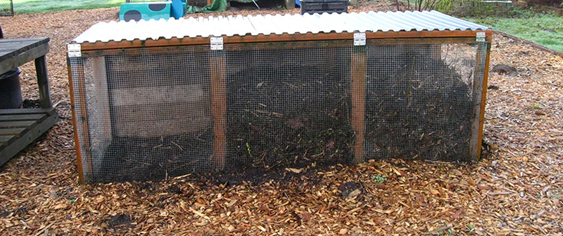
You do not need a bin or other container to make compost (Figure 3). Piles work well. Some people prefer containers because they look neater, or because it is easier to shield them from pests. Containers can be simple or fancy. Make them from materials such as old pallets, lumber, mesh fencing, or cinder blocks. You can also purchase pre-made bins. For hot compost, each bin should be at least 3 feet by 3 feet by 3 feet in size. Avid composters often have three bins: two for turning, and one for curing compost.
How to Make Compost
Slow Composting
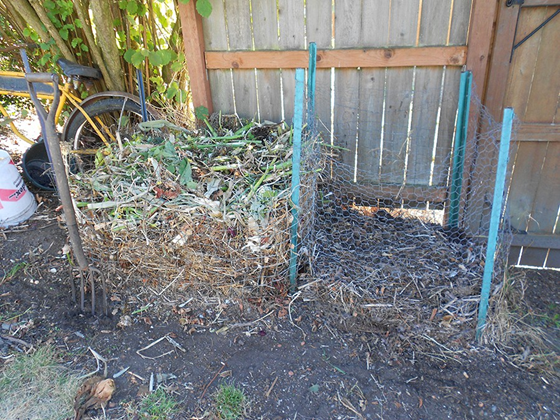
Slow composting is an easy way to turn yard wastes into a useful soil amendment. It is often the best method for people who do not have the time to tend a hot compost pile. A two-pile, two-year system gives ample time for most raw materials to decompose (Figure 4).
Start by mixing non-woody yard wastes into a pile and letting them sit for a year or more. Microorganisms, insects, earthworms, and other decomposers will slowly break down the wastes. A mixture of energy materials and bulking agents provide the best food source and environment for decomposition (Table 1). Cutting long stems and smashing coarse materials into smaller pieces also improves decomposition. The best time to start a slow pile is when you are collecting a lot of yard waste, such as during spring or fall garden clean-up.
During the first year, you can add fresh yard waste or fruit and vegetable scraps to the pile. Open the pile, place fresh wastes in the center, mix, and cover them. This helps loosen the pile to improve aeration, and also buries the fresh wastes so they do not attract pests. After a year, turn the pile, and let it sit for another year, without adding any fresh wastes. Often you will find poorly decomposed stems and rinds in the year-old pile. You can recycle these materials as bulking agents when you build a new pile. Even after two years, some stems will not be fully decomposed. Simply mix them into the garden soil along with the rest of the compost, where they will continue to decay.
Fruit and vegetable wastes are particularly appealing to pests, such as flies, rats, and raccoons. To avoid pests, fully bury these wastes within the pile. If you bury the vegetable wastes in the pile and pests are still a problem, you may need to use a pest-resistant bin (Figure 5) or keep vegetable wastes out of the pile. Other options for vegetable wastes are municipal yard waste containers (in communities where yard and food waste are collected), worm bins, or direct burial in the garden. For more information on worm bins refer to Composting with Worms (EM 9034; Angima et al. 2011).
Slow composting does not produce enough heat to kill many weed seeds, rhizomes, or pathogens. It is best to pull and compost weeds before they go to seed. If you have a municipal yard waste container, you can use it for weeds with seeds, rhizomes, and diseased plants. Compost piles at the commercial facilities that receive municipal yard waste are managed to generate the heat needed to kill weed seeds and pathogens.
Fast Composting
If you create and maintain a balance of air, moisture, and energy for the compost microorganisms, they will produce a hot compost that will break down quickly and kill off many weed seeds and disease organisms. Making hot compost takes extra effort, but it produces a high-quality product within a few months. One method for making hot compost is described below:
Building the Pile
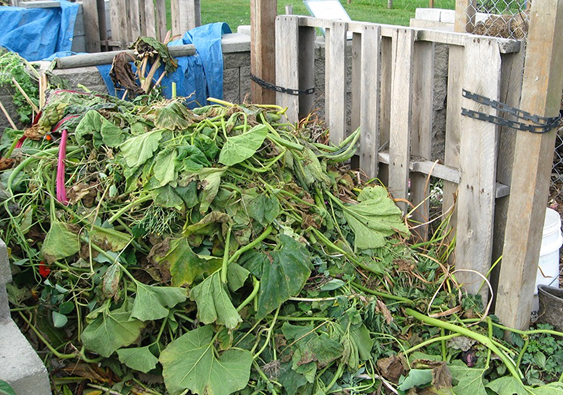
- Collect enough material to make a pile at least 1 cubic yard in volume (an open pile 5 feet wide at the base by 3 feet high holds about a cubic yard; Figure 6). You need roughly two parts bulking agent to one part energy material (Table 1). Chop, shred, mow, or smash coarse materials so they will break down faster.
- Start the pile by adding energy material and bulking agent, and mixing with a pitchfork.
- Squeeze a handful of the mixed material to check its moisture level. If you can barely squeeze out a drop of water, the moisture level is ideal. If the pile is too dry, add water and check the moisture again. If it is too wet, mix in some drier material.
- Continue adding energy material and bulking agent, mixing, and checking moisture until the pile is built.
Turning the Pile
Use a pitchfork to turn the pile weekly for the first 4 to 6 weeks, and add water when needed. Turning improves the porosity of the pile and speeds biological decay. Turning also mixes material from the outside of the pile into the hot center. Cover the pile during rainy periods so it will not get too wet.
Curing Phase
After initial mixing, a carefully tended pile usually stays hot (120°F–150°F) for several weeks. The pile will shrink to about half its original volume during the hot phase. The pile then needs to sit for another 2–3 months to cure. Temperatures during curing are 80°F–110°F. The compost is ready to use when at least 3 months have passed since initial mixing, the pile no longer heats when turned, and the material looks dark and crumbly.
Curing affects the availability of nitrogen and the microbial activity of the compost. Uncured compost may harm some plants. This is most likely when compost is used in potting soil or to start seeds. Complete curing is less critical when small amounts of compost are worked into garden soil.
Compost Use, Health, and Safety Questions
Composting in Community Gardens
Community gardens provide opportunities for composting on a larger scale. Larger volumes of garden waste mean that it is easier to collect enough waste at one time to practice hot composting. But larger volumes of garden waste can also increase odor and pest problems if composting is not well managed.
To make compost successfully, a community garden needs a person or a team to take responsibility for composting. Responsibilities include managing the garden waste, building and managing compost piles, and educating fellow gardeners about garden waste and composting in the community garden. One option for community garden composting is multiple bins, with the number and size of bins based on the amount of garden waste produced. Another option is a long pile with fresh materials added to one end and finished compost removed from the other end.
Using Compost in Gardens and Landscapes
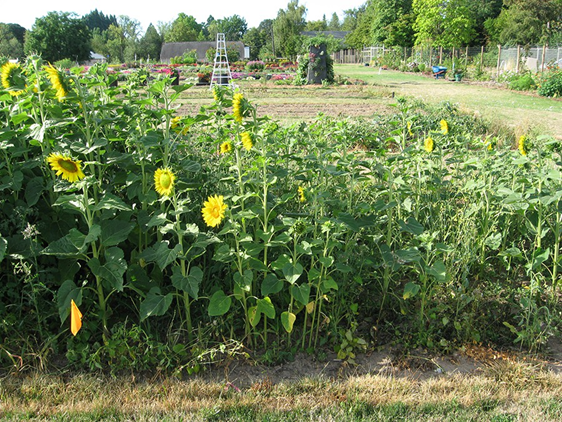
Composts are good soil amendments, providing organic matter and some nutrients (Figure 7). They make the soil easier to work and create a better medium for plant growth. You can mix 1 to 3 inches of compost into soil before establishing a new garden or landscape bed. Add smaller amounts (1/2 to 1 inch per year) to established gardens. If you are considering adding compost to a site subject to runoff, test soils first to make sure nutrient levels are not excessive.
Composts applied to the soil surface as garden mulch help conserve water and protect the soil from erosion. The best times to apply compost mulches to annual gardens are in early summer, after plants are established and the soil has warmed, or after harvest in the fall to reduce runoff and erosion. Composts that are rich in nutrients will promote weed growth and are not effective as long-term mulches. Till or dig the compost mulch into the soil when you prepare the garden for the next planting to get further benefits as a soil amendment. For more information on compost use in home gardens, refer to Organic Amendments in Soils and Gardens (FS123E; Collins et al. 2013) and A Home Gardeners Guide to Soils and Fertilizers (EM063E; Cogger 2014).
Composting and the Environment
Composting reduces the flow of wastes to landfills or burn piles and produces valuable organic matter for the soil at the same time. Composting does all this using a process fueled by the solar energy captured in plant tissue. These benefits are the same whether we compost in carefully tended hot piles, or in neglected slow piles. Composting is a simple, yet important way to improve our communities and the environment.
Additional Resources
Using Compost
Cogger, C.G. 2014. A Home Gardener’s Guide to Soils and Fertilizers. Washington State University Extension Publication EM063E
Collins, D., C. Miles, C. Cogger, and R. Koenig. 2013. Soil Fertility in Organic Systems: A Guide for Gardeners and Small Acreage Farmers. Washington State University Extension Publication PNW646
Cogger, C., and G. Stahnke. 2013. Organic Soil Amendments in Yards and Gardens: How Much is Enough? Washington State University Extension Publication FS123E.
Food Safety
US Food and Drug Administration. 2015. FSMA Final Rule on Produce Safety.
Harrison, E.Z., D. Olmstead, J. Bonhotal, and N.M. Regenstein. 2004. Health and Safety Guidance for Small Scale Composting. Cornell University Waste Management Institute.
Soil Testing
Fery, M., and E. Murphy. 2013. A Guide to Collecting Soil Samples for Farms and Gardens. Oregon State University Extension Publication EC 628.
Animal Manure
Bary, A., C. Cogger, and D. Sullivan. 2016. Fertilizing with Manure and Other Organic Amendments. Washington State University Extension Publication PNW533.
Herbicides and Compost
Clopyralid in Compost. Washington State University Puyallup Organic Farming Systems and Nutrient Management website.
Composting and Weed Seeds
Zabroski, E. 2015. Composting to Reduce Weed Seeds and Plant Pathogens. eXtension.
Worm Composting
Angima, S., M. Noack, and S. Noack. 2011. Composting with Worms. Oregon State University Extension Publication EM9034.
By
Craig Cogger, Extension Soil Scientist Emeritus, WSU Puyallup Research and Extension Center.
Dan M. Sullivan, Professor, Department of Soil Science, Oregon State University.
Andy Bary, Senior Scientific Assistant, WSU Puyallup Research and Extension Center

EB1784E

Copyright © Washington State University
WSU Extension publications contain material written and produced for public distribution. Alternative text descriptions for select complex images were generated using ChatGPT (OpenAI), then reviewed and adapted to ensure compliance with Web Content Accessibility Guidelines (WCAG) accessibility standards.
Issued by Washington State University Extension and the US Department of Agriculture in furtherance of the Acts of May 8 and June 30, 1914. Extension programs and policies are consistent with federal and state laws and regulations on nondiscrimination regarding race, sex, religion, age, color, creed, and national or ethnic origin; physical, mental, or sensory disability; marital status or sexual orientation; and status as a Vietnam-era or disabled veteran. Evidence of noncompliance may be reported through your local WSU Extension office. Trade names have been used to simplify information; no endorsement is intended.