A Guide to the Small Hive Beetle: An Emerging Pest in Washington State
Description
Historically considered a minor honey bee pest in Washington, current and future climate models indicate regions here of increasingly suitable habitat for small hive beetle. This pub provides information for Washington beekeepers to detect, accurately identify, monitor, treat, and report sightings.
Table of Contents
- Introduction
- Potential Establishment in Washington State
-
Damage to Stored Honey and Honey Bee Colonies
- Honey
- Colonies
Introduction
The small hive beetle (SHB), Aethina tumida, is native to sub-Saharan Africa. SHB are members of the family Nitidulidae, nicknamed “sap beetles.” This family of beetles is known to feed on decaying matter, pollen, fermenting plant juices, and decaying fruits. Small hive beetle is one in a handful of Nitidulids that live exclusively in honey bee hives but the only one to cause extensive damage (Ellis et al. 2008). Apart from the Cape honey bee subspecies, Apis mellifera capensis, that is well adapted to small hive beetle infestation (Ellis et al. 2003), SHB has become a major pest to honey bee colonies and stored honey globally. These beetles were first detected in South Carolina in the 1990s (Schäfer et al. 2019) and quickly expanded their range within the US, being most prevalent in the southeastern states. The widespread range expansion of small hive beetles is likely facilitated by international trade of honey bee colonies and bee products.
Recently, reports from northwestern Washington indicate presence of small, sustained populations of SHB. This Extension publication will give Washington State beekeepers information to detect, accurately identify, monitor, treat, and report SHB infestation(s) in their region.
Potential Establishment in Washington State
Small hive beetles prefer climates with high humidity and temperatures for reproduction. Historically, SHB has been considered a transient pest, introduced from packages or bee products with little to no potential to sustain, in Washington State. It has long been assumed that climate and soil conditions would inhibit establishment of this species in Washington State. However, recent research has revealed that global warming may contribute to the expanse of suitable habitat for this invasive species. Under current and future climate scenarios, models of SHB survival and pupal development time, in response to soil conditions were created, then suitable regions were classified (Cornelissen et al. 2019); this work showed potential SHB invasion into more temperate regions.

Correlative ecological niche models were employed to make a heat map of SHB habitat suitability for Washington State, with red and orange being most suitable for reproductive populations and light blue and purple being least suitable (Figure 1). Highly suitable habitats were identified in low elevation areas of the Puget Sound and Cascade Mountain Range in western Washington. Northern areas near the Pacific Coast Range are not currently suitable areas for SHB. Northeastern Washington has relatively suitable climate, while most areas in eastern and central Washington that are characterized by arid high desert, rolling hills, and sagebrush, do not have suitable climate for SHB. The WSU Zhu Lab developed a habitat suitability map that allows users to zoom in on their region(s) to assess risk of sustained SHB populations (Figure 1).
State University and Washington State Department of Agriculture that confirm a handful of sustained SHB populations in different parts of Whatcom County and Skagit County. If honey bee colonies live in areas with greater SHB habitat suitability (in areas in red, orange, or yellow in Figure 1), beekeepers should regularly monitor for SHB, use preventative or control measures discussed below, and consider chemically treating if populations grow to an extremely damaging level.
Damage to Stored Honey and Honey Bee Colonies
Honey
SHB cause the most damage during their larval stage. During this life stage, they feed on everything in the hive except wax including pollen, bee bread, honey bee brood, and honey stores. The yeast in their guts, Kodamaea ohmeri, is spread throughout the hive as larvae excrete waste. The yeast in the SHB larval excrement will discolor, froth, and ferment honey stores. Heavily infested hives will have slimy, fermented honey dripping out of comb cells. The spoiled honey might have a rotten orange odor that is attractive to other SHB. Additionally, these beetles are a threat to stored equipment, particularly honey houses. It is best to extract honey immediately if your bee yards are in an area that is suitable for small hive beetles. Honey supers that have SHB infestation should not be harvested and should be discarded.
Colonies
Weaker colonies or small nucleus hives used for queen production or splits are especially vulnerable to SHB. SHB will feed on supplemental protein that beekeepers add to their hives, such as pollen patties. This can be a problem when colonies are weaker and do not consume the supplement rapidly. Queen honey bees may be reluctant to lay eggs and may stop producing offspring when a colony becomes infested. Large populations of SHB can cause extra heat production within a hive, causing a honey bee colony to abandon it. Heavy infestations can lead to a colony’s collapse. To date, there have been no reports of these heavy infestations in Washington State.
Life Cycle of Small Hive Beetle
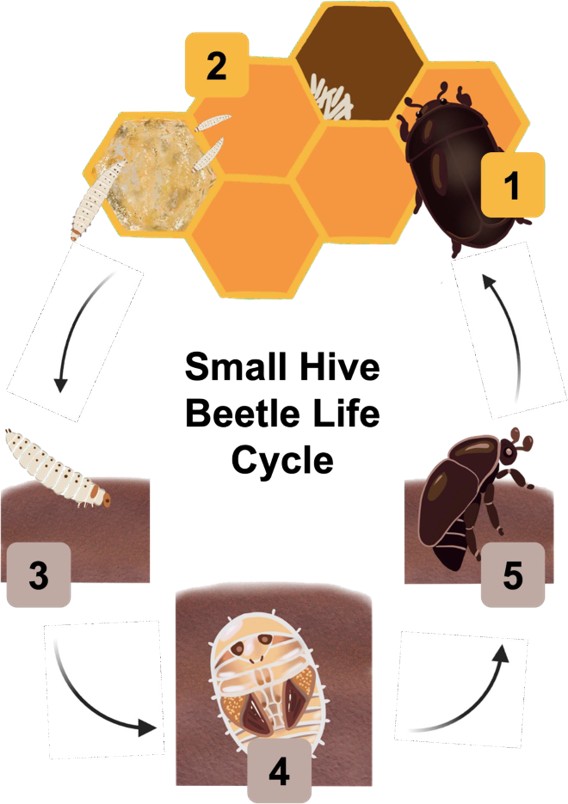
Adults can fly and disperse over nine miles, finding new hives using chemoreception or sense of smell. Adults can live up to six months. Females can lay between 1,000 and 2,000 eggs in their lifetime (Hood 2004), and SHB can have up to six overlapping generations per year. SHB adults do not reproduce in winter but can overwinter in honey bee clusters. SHB complete their life cycle through egg, larval, pupal, and adult stages (Figure 2). SHB can develop from egg to adult in 20–54 days, depending on environmental conditions (Noor-ul-Ane and Jung 2020). Roughly 75% of that time is spent underground as pupae.
While guard honey bees can physically remove some adult beetles, many beetles can stay hidden in crevices and exploit food provisions from the bees. By rubbing on the bees’ mandibles with their antennae, the beetles can elicit regurgitation by the bees and then consume the regurgitant (Ellis 2005). Adult females will lay irregular clusters of eggs directly onto frames or crevices inside the hives and within stored hive boxes. Newly hatched larvae begin feeding on pollen, brood, and honey immediately, and as they feed, the yeast in their guts cause fermentation of honey stores. Once SHB are physiologically ready to transition into their pupal stage, they are considered “wandering larvae” and travel up to 35 inches from the hive to burrow approximately four inches underground where they pupate; at these stages they are the most vulnerable to environmental conditions. Pupation lasts from three to six weeks depending on environmental conditions, and adults emerge to repeat the life cycle again.
Prevention and Control
Prevention
The best defense against SHB is maintaining strong colonies and clean apiaries.
- Remove dead-outs or unprotected boxes of extra combs of honey and pollen in your apiary or honey house.
- Combine or re-queen weaker colonies.
- Restrict supplemental pollen patty feeding to early spring only or whenever necessary. When feeding protein supplements, only provide amounts that bees can consume within one week.
- Avoid adding multiple honey supers, if possible.
- Avoid tossing burr comb around hives.
- Place hives in partial or full sun since adult beetles prefer shady locations.
- Inspect equipment before moving it to other bee yards.
Control
Currently, there is no established economic threshold for small hive beetle control. Management of small hive beetle often involves a multifaceted approach that can include more than one control option.
Non-chemical Control Options
- Commercial traps. There are a variety of commercially available traps for SHB that fit between hive frames, such as “Beetle Jails” or “Beetle Blasters.” Most traps bait SHB using apple cider vinegar, sugar, or banana peels, among other options, then drown the beetles in vegetable oil, mineral oil, or soapy water.
- Entrapment with household materials. Some beekeepers have recommended placing odorless Swiffer Dry Cloths on top of the frames in the corners of the hive; adult SHB become entangled due to their barbed feet. Other beekeepers have had success placing dry microfiber towels or heavy duty paper towels in their hives, and as the bees chew and fray the material, the beetles can get tangled and trapped. Though, with use of microfiber materials like these, concern about microplastic contamination within honey bee bodies and honey stores has been recently revealed and suggest that reusable traps may be a more environmentally friendly approach to SHB control (Buteler et al. 2023).
- Cultural control. As mentioned previously, maintenance of clean apiaries and healthy colonies will reduce attraction of SHB. Landscaping fabric underneath hive stands may prevent wandering SHB larvae from burrowing and pupating in the soil. Keep in mind that the wandering larvae are known to travel up to 35 inches or more from the hive.
- Biological control. Soil-dwelling entomopathogenic nematodes (Heterorhabditis indica or Steinernema sp.) have been reported as highly virulent toward pupating SHB (Ellis et al. 2010). These nematodes are available commercially and are known to quickly seek out SHB pupae and kill them within 24 to 48 hours. The general recommendation is 5 million nematodes per 10 beehives.
Chemical Control Options
Diatomaceous earth has insecticidal properties (McLaughlin 1994) and can be used in the traps mentioned previously. As mechanical controls, these powders could be applied to the soil surrounding the hive or placed in trays on a solid bottom board underneath a screened bottom; the screen should prevent exposure to the honey bee colony. Precaution must be taken when using these materials as they can harm honey bees. These materials render many insects incapable of movement or destroy the wax layer on their cuticles, since the powders are dehydrating and hydrophilic (Buchholz et al. 2009).
The two chemicals currently approved for SHB control in Washington State are Checkmite+ Bee Hive Pest Control Strip (active ingredient: coumaphos) and Y-Tex Gardstar 40% EC Livestock and Premise Insecticide (active ingredient: permethrin) (Washington State Department of Agriculture Pesticide Management Division, n.d.). Both options have the potential to poison adult honey bees and brood or leave residues in beeswax and should be used as a last resort if SHB have overtaken your hive(s). Always use personal protective equipment when handling pesticides, and thoroughly learn about these chemicals before using.
Coumaphos is an organophosphorus compound. There is evidence that small hive beetles have developed resistance to coumaphos (Kanga et al. 2021). If this management tool is utilized, it is recommended that the strips are stapled to a piece of corrugated cardboard (with tape on one side to deter bees from chewing) or corrugated plastic, and placed strip-down on the bottom board. Treatment strips can stay in place for 42–45 days maximum. Do not treat colonies more than four times annually for SHB control. To reduce chemical buildup, replace comb every three years.
Permethrin is highly toxic to bees. It should be applied in front of hives or before hives are placed in an apiary. Permethrin remains active in soil for 30–90 days, depending on soil type, pH, and moisture content. It must not be applied directly to honey bee colonies, only apply to the surrounding ground surface. This treatment should never be used as a preventative measure.
Stored Honey Hygiene
- If any SHB are present in nearby areas, it is especially important to protect any honey storage areas or honey extraction facilities.
- Freeze all frames infested with beetle larvae or eggs for at least 48 hours. Wrap honey supers in trash bags and freeze for at least 48 hours. If there is no access to a freezer, harvest immediately to limit chances of honey being spoiled by any larval feeding.
- If larvae are on wax cappings, be sure to wash, chill, or melt within 24 hours of extracting honey.
- Keep extraction equipment sanitized and honey house humidity <50%, if possible.
- Dispose of all waste in a properly sealed container to limit spread.
Identifying Small Hive Beetle
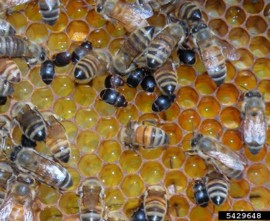
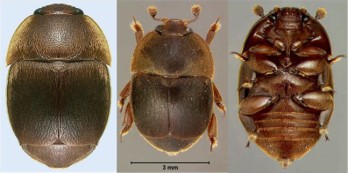
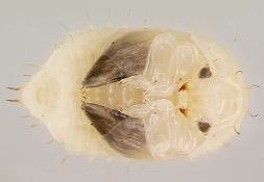
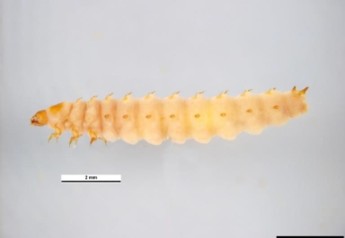
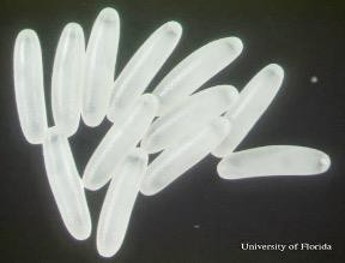
See Figures 3–7 for morphological characteristics of the small hive beetle at each of its life stages.
Adults
Pupae
Larvae
Eggs
Differentiation Between Small Hive Beetles and Wax Moths
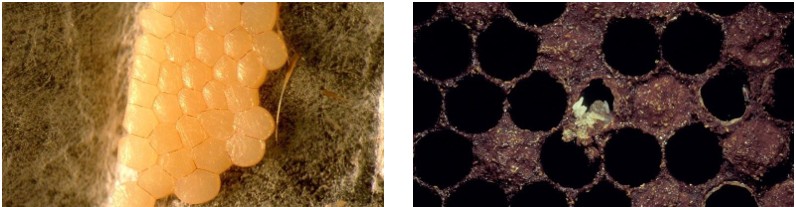
Immature stages of wax moths, greater wax moth, Galleria mellonella, and lesser wax moth, Achroia grisella, can be easily mistaken for SHB larvae.
Two major diagnostic differences between these species are:
- Morphology: eggs are different shapes and sizes and are laid in different areas (Figure 8). Although wax moth and small hive beetle larvae may appear similar, small hive beetle larvae are smaller and have dorsal spines (Figure 9).
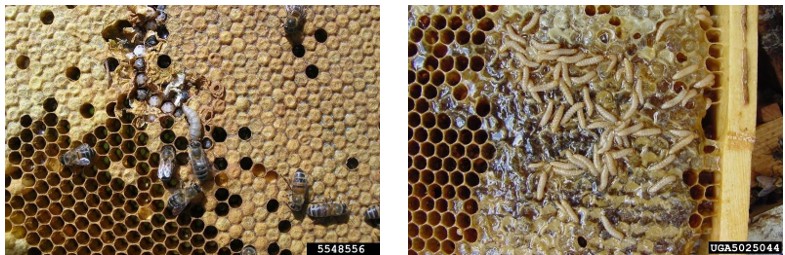
- Damage: small hive beetles create slimy, frothy honey stores, and wax moths burrow through combs and spin webbing (Figure 10).

Reporting Small Hive Beetle Infestation
If you suspect the presence of small hive beetles in your apiary, please take photos and collect specimen sample(s) in rubbing alcohol or white vinegar and contact the Washington State Department of Agriculture (WSDA) at pollinators@agr.wa.gov or pestproblem@agr.wa.gov. If you have questions or concerns about small hive beetle, feel free to reach out to the WSU Honey Bees + Pollinators Program.
References
- Buchholz, S., K. Merkel, S. Spiewok, J.S. Pettis, M. Duncan, R. Spooner-Hart, C. Ulrichs, W. Ritter, and P. Neumann. 2009. Alternative Control of Aethina tumida Murray (Coleoptera: Nitidulidae) with Lime and Diatomaceous Earth. Apidologie 40: 535–548.
- Buteler, M., E. Villalobos, A.A. Marina, L. Silva, and J.P. Tomba. 2023. Source of Microplastic Contamination in Honey and Honeybee Colonies. Environmental Pollution 334: 122151.
- Cornelissen, B., P. Neumann, and O. Schweiger. 2019. Global Warming Promotes Biological Invasion of a Honey Bee Pest. Global Change Biology 25: 3642–3655.
- Ellis, J.D. 2005. Reviewing the Confinement of Small Hive Beetles (Aethina tumida) by Western Honey Bees (Apis mellifera). Bee World 86: 56–62.
- Ellis, J.D., K.S. Delaplane, A. Cline, and J.V. McHugh. 2008. The Association of Multiple Sap Beetle Species (Coleoptera: Nitidulidae) with Western Honey Bee (Apis mellifera) Colonies in North America. Journal of Apicultural Research 47(3): 188–189.
- Ellis, J.D., R. Hepburn, K.S. Delaplane, P. Neumann, and P.J. Elzen. 2003. The Effects of Adult Small Hive Beetles Aethina tumida (Coleoptera: Nitidulidae) on Nests and Flight Activity of Cape and European Honey Bees (Apis mellifera). Apidologie 34: 399–408.
- Ellis, J.D., S. Spiewok, K.S. Delaplane, S. Buchholz, P. Neumann, and W.L. Tedders. 2010. Susceptibility of Aethina tumida (Coleoptera: Nitidulidae) Larvae and Pupae to Entomopathogenic Nematodes. Journal of Economic Entomology 103: 1–9.
- Hood, W.M. 2004. The Small Hive Beetle, Aethina tumida: A Review. Bee World 85: 51–59.
- Kanga, L.H.B., W. Marechal, J.C. Legaspi, and M. Haseeb. 2021. First Report of Insecticide Resistance to Organophosphates and Pyrethroids in the Small Hive Beetle (Coleoptera: Nitidulidae) and Development of a Resistance Monitoring Technique. Journal of Economic Entomology 114(2): 922–927.
- Noor-ul-Ane, M., and C. Jung. 2020. Temperature-Dependent Development and Survival of Small Hive Beetle, Aethina tumida (Coleoptera: Nitidulidae). Journal of Apicultural Research 59(5): 807–816.
- McLaughlin, A. 1994. Laboratory Trials on Desiccant Dust Insecticides. In: Proc. 6th Int. Working Conf. on Stored Product Protection, E. Highley, E.J. Wright, H.J. Banks, B.R. Champ, eds.,17–23.
- Schäfer, M.O., I. Cardaio, G. Cilia, B. Cornelissen, K. Crailsheim, G. Formato, A.K. Lawrence, et al. 2019. How to Slow the Global Spread of Small Hive Beetles, Aethina tumida. Biological Invasions 21: 1451–1459.
- Washington State Department of Agriculture Pesticide Management Division. n.d. Pesticides Approved to Control Tracheal Mites or Varroa Mites in Honey Bee Colonies (PDF file). AGR PUB 707-231 (R/6/15).

By Briana Price, Extension Coordinator, Entomology, Washington State University; Riley Reed, PhD Candidate, Entomology, Washington State University; Brandon Hopkins, Assistant Research Professor, Hopkins Lab, Entomology, Washington State University; Gengping Zhu, Assistant Research Professor, Zhu Lab, Entomology, Washington State University

Copyright © Washington State University.
WSU Extension publications contain material written and produced for public distribution. Alternate formats of our educational materials are available upon request for persons with disabilities. Please contact Washington State University Extension for more information.
Issued by Washington State University Extension and the US Department of Agriculture in furtherance of the Acts of May 8 and June 30, 1914. Extension programs and policies are consistent with federal and state laws and regulations on nondiscrimination regarding race, sex, religion, age, color, creed, and national or ethnic origin; physical, mental, or sensory disability; marital status or sexual orientation; and status as a Vietnam-era or disabled veteran. Evidence of noncompliance may be reported through your local WSU Extension office. Trade names have been used to simplify information; no endorsement is intended. Published September 2024.