Description
Introduction
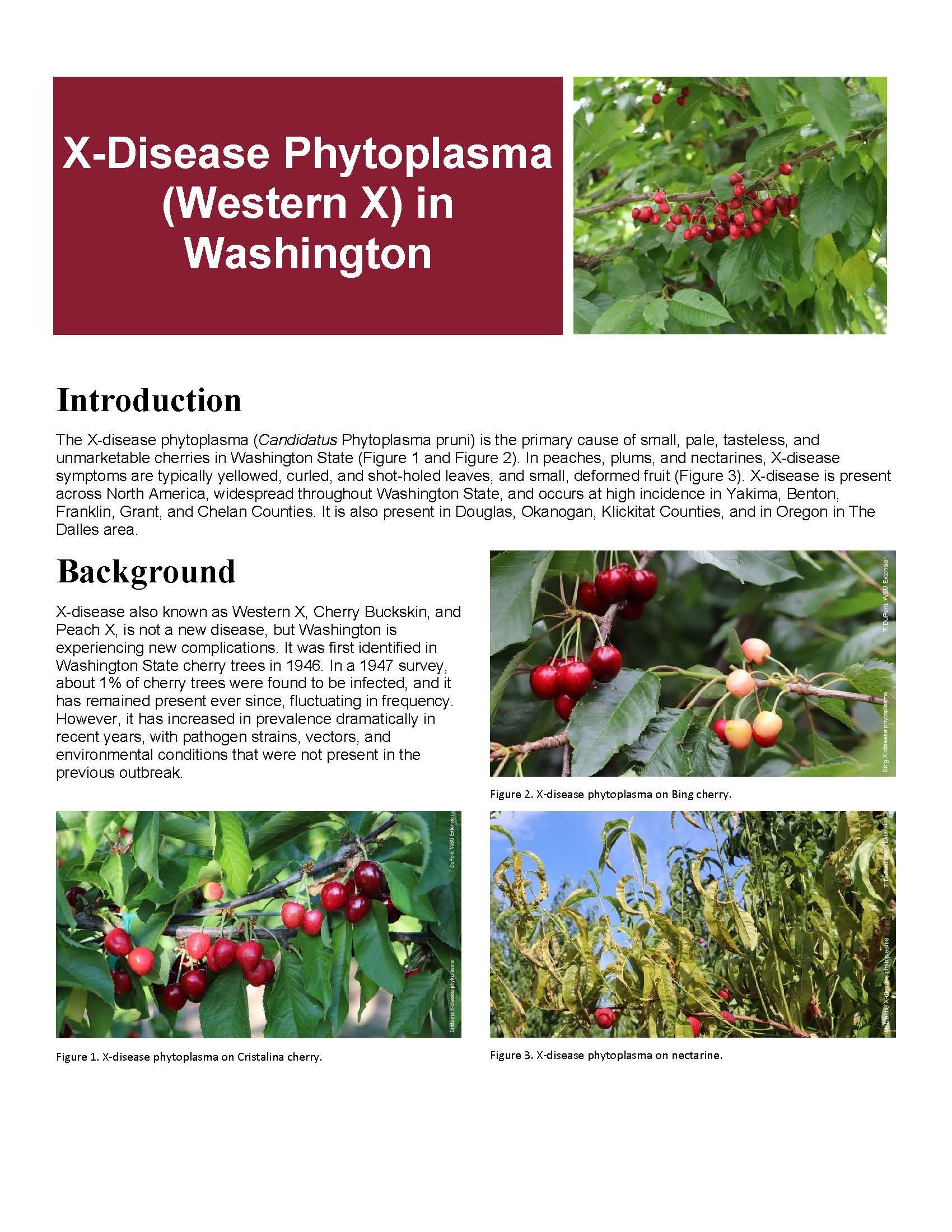
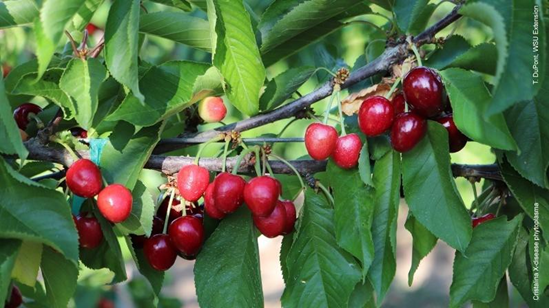
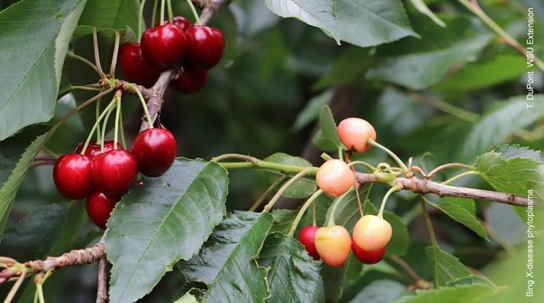
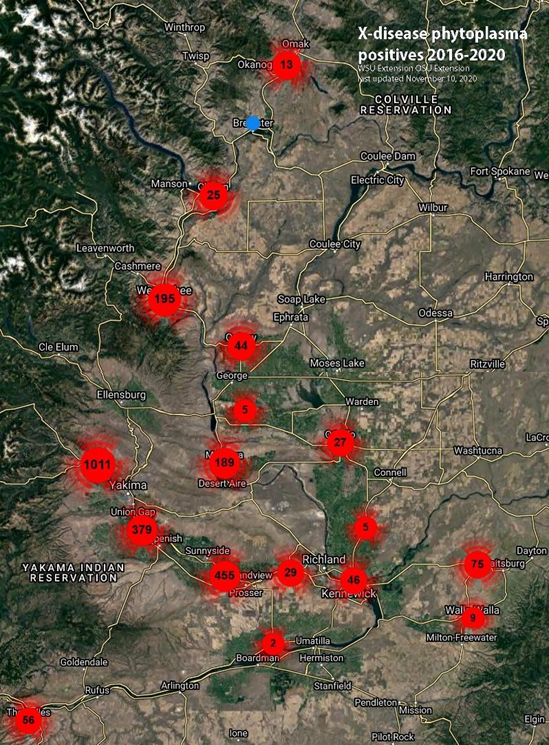
The X-disease phytoplasma (Candidatus Phytoplasma pruni) is the primary cause of small, pale, tasteless, and unmarketable cherries in Washington State (Figure 1 and Figure 2). In peaches, plums, and nectarines, X-disease symptoms are typically yellowed, curled, and shot-holed leaves, and small, deformed fruit (Figure 3). X-disease is present across North America, widespread throughout Washington State, and occurs at high incidence in Yakima, Benton, Franklin, Grant, and Chelan Counties. It is also present in Douglas, Okanogan, Klickitat Counties, and in Oregon in The Dalles area.
Background
X-disease also known as Western X, Cherry Buckskin, and Peach X, is not a new disease, but Washington is experiencing new complications. It was first identified in Washington State cherry trees in 1946. In a 1947 survey, about 1% of cherry trees were found to be infected, and it has remained present ever since, fluctuating in frequency. However, it has increased in prevalence dramatically in recent years, with pathogen strains, vectors, and environmental conditions that were not present in the previous outbreak.
Symptoms
Infection reduces fruit size and quality in sweet cherries. In contrast to little cherry virus 2 where fruit are often bitter, fruit from X-disease infected trees are often tasteless. Fruit from X-disease infected trees have reduced fructose, glucose, and sorbitol content and in some cases total phenolic content increases (Wright et al. 2021; Harper et al. 2020). The primary strains present in the Pacific Northwest do not generally express foliar symptoms on cherry, whereas strains in other parts of the country can produce enlarged styles and witches’ broom.
Symptoms in Cherry
- Small and misshapen fruit.
- Poor color development.
- Fruit bitter or lacking in flavor.
- Symptoms can be confused with unripe fruit until close to harvest.
- Symptoms are restricted to one or a few branches unless trees have been infected for multiple years.
Symptoms in Peaches, Plums, and Nectarines
- Yellowed, curled leaves.
- Leaf shot hole.
- Small, deformed fruit.
- Leaf yellowing symptoms on infected peaches and nectarines begin to appear about two months prior to harvest and get progressively worse, with shot holes appearing as the season progresses.
Symptom Progression
- Years 1 and 2: Small fruit may be restricted to one branch or cluster. Fruit color may develop normally, or individual pale to white fruit may be observed. Early infections may display no notable symptoms.
- Years 3–4: Systemically infected tree. Small fruit observed on multiple or all limbs, and poor color development is pronounced.
- 5+ years: Cultivar dependent, but characterized by reduced fruit yield and dieback of limbs.
Causal Organism
X-disease phytoplasma is not a virus but instead is a type of wall-less bacterium known as a phytoplasma. The X- disease phytoplasma lives and replicates in the vascular phloem of infected trees, interfering with tree growth and development. Five major strains of Ca. P. pruni have been found to cause X-disease in commercially grown Prunus species (Molnar et al. 2024). These strains differ in geographic distribution, severity, symptoms, and vector transmissibility. Unfortunately, the dominant strains in the Pacific Northwest cause fruit symptoms, but not leaf symptoms or stunting, making them more difficult to scout for.
Occurrence
X-disease is present across North America and throughout Washington State, with high incidence in Grant, Yakima, Benton, Franklin, and Chelan Counties, and is also present in the Oregon counties of Okanogan, Douglas, and Klickitat as well as in The Dalles area (Figure 4) (Molnar et al. 2022).
Impacts
More than 238,856 sweet cherry trees (covering 974 acres) and 33,082 peach, nectarine, plum and apricot trees (covering 81 acres) were removed due to X-disease and little cherry disease (caused by LCV2 and LCV1) between 2015 and 2020 according to a recent survey conducted by Washington State University Extension and Oregon State University Extension. The survey included 81 respondents who collectively manage 15,420 acres, 26% of the total cherry acreage in Washington and Oregon (Molnar et al. 2022). Tree removals reduced industry revenue by an estimated $30 million in 2020 and $65 million between 2015 and 2020. Over the seven-year re- establishment period, estimated lost revenue and establishment costs to growers were approximately $115 million.
Host Range
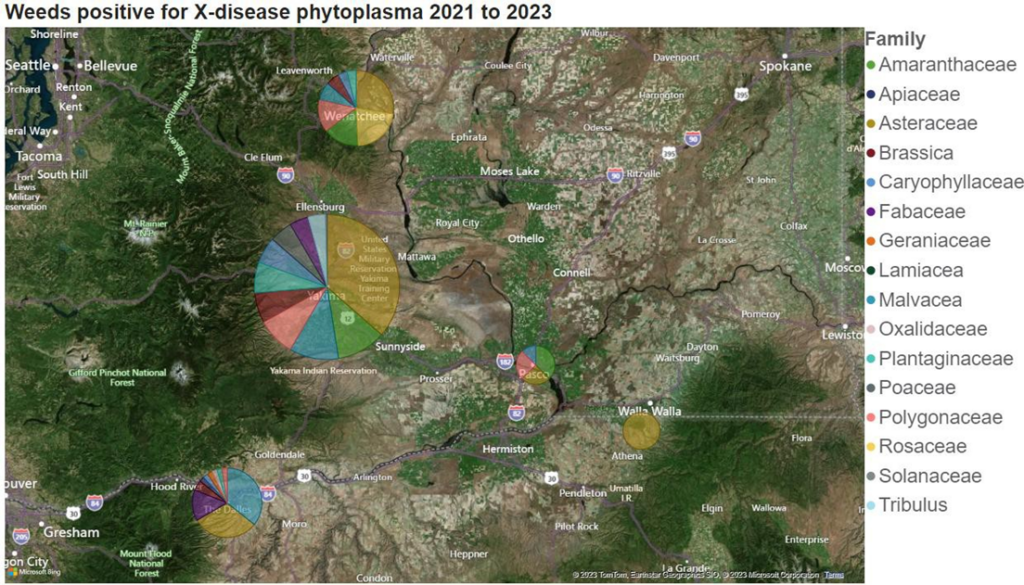
X-disease phytoplasma infects most Prunus species (e.g., cherries, peaches, nectarines, almonds, plums, and chokecherry). X-disease phytoplasma also infects a wide range of broadleaf plants. Previous studies found milkweed, alfalfa, clover, mustards, and plantains to be hosts (Jensen 1971; Chiykowski and Sinha 1982), but this was mostly through experimental inoculation. To identify the natural host range, a survey was conducted from 2021 to 2023 in which a total of 52 plant species, from 77 species tested, were positive for X-disease phytoplasma (Figure 5) (Shires et al. 2024). Plants from six families had significant numbers of positives, including members of the Asteraceae (dandelion), Malvaceae (mallow), Amaranthaceae (goosefoot/lambsquarter and pigweed), Polygonaceae (knotweed), Brassicaceae (flixweed, tumble mustard, hoary bittercress, and shepherd’s purse), and Plantaginaceae (plantain). All these species are common components of the orchard floor or are present around orchard borders. Twelve other plant families were less prevalent in orchards and had a small number of positives for X-disease phytoplasma, including Apiaceae (e.g., queen anne’s lace and wild carrot), Caryophyllaceae (chickweed), Fabaceae (clover), Geraniaceae (redstem filaree), Lamiaceae (henbit, purple dead nettle), Oxalidaceae (oxalis, ground sorrel), Poaceae (downy brome), Rosaceae (wild rose), Solanaceae (nightshades), and Tribulus (puncture vine).