Cornmeal and corn gluten meal applications in gardens and landscapes (Home Garden Series)
Description
Do cornmeal and corn gluten meal (CGM) have a legal and practical use in home gardens and landscapes? A review of research and current recommendations here.
Table of Contents
- What is the difference between cornmeal and corn gluten meal?
-
How are these corn-based products applied in gardens and landscapes?
- Cornmeal application
- Corn gluten meal application

Cornmeal and corn gluten meal, both products from corn milling, are readily available to home gardeners. This fact sheet reviews the horticultural science behind each of these products and explains whether they have a legal and practical use in home gardens and landscapes. Alternative strategies are suggested for situations where neither product should be applied.
What is the difference between cornmeal and corn gluten meal?
Both cornmeal and corn gluten meal are extracted from the endosperm of corn (Zea mays). During processing, the endosperm (which is the food source for the embryo) is separated into carbohydrate and protein fractions. Cornmeal (Figure 1a) is made from the carbohydrate portion, while corn gluten meal (CGM, Figure 1b) is made from the protein fraction. Technically, these proteins do not contain gluten (which is a protein in cereal crops, such as wheat) but “corn gluten meal” is the accepted term for this product.
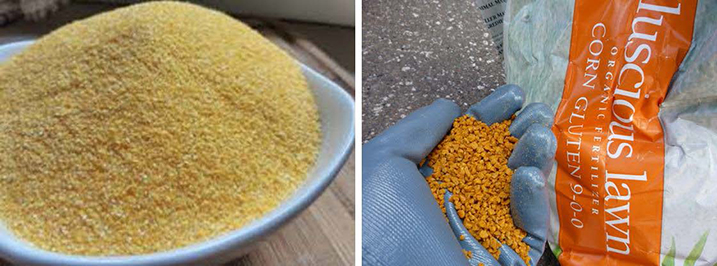
The chemical differences between these two corn products are important, as they determine what effect, if any, each might have when applied to garden and landscape soils. As a source of carbohydrates, cornmeal provides energy to soil organisms such as microbes and earthworms. Corn gluten meal has a significant protein component, meaning that it serves as a source of nitrogen. NPK ratios of CGM can vary, but are typically 10-0-0. The legal difference between the two corn products is that cornmeal is not a component of any registered fungicide, but CGM is a component of several herbicides registered in Washington State.
How are these corn-based products applied in gardens and landscapes?
Cornmeal application
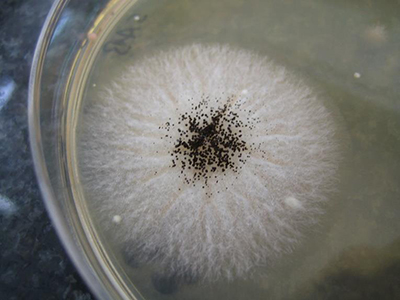
While popular gardening websites and personalities promote cornmeal as a powerful (unregistered) fungicide, there is no legal basis nor published research supporting its use for this or any other horticultural purpose. Do not use cornmeal as a fungicide. Rather than acting as a fungicide, the opposite happens: cornmeal encourages growth of many fungal species, and it is routinely used to culture common plant pathogens such as Rhizoctonia (Trivedi et al. 2005), Sclerotium (Azhar et al. 2003), and Sclerotinia spp. (Garcia et al. 2012; Figure 2).
A review of the relevant literature suggests that cornmeal proponents may have misunderstood the research. In 1947, Sanford reported that an application of cornmeal reduced the incidence of Rhizoctonia solani. However, the author was clear in explaining that the suppression was not due to the cornmeal. Rather, “the reduction of the disease and the apparent decline of the pathogen in the soil are attributed to antibiotic effects from the associated soil fungi and bacteria.” In other words, the cornmeal was a food source that enhanced populations of microbes which were antagonistic to Rhizoctonia solani.

Further work identified Trichoderma spp. as one of these antagonistic fungal groups (Gul and Fazli 2005) that grow vigorously on cornmeal agar. Use of Trichoderma species for suppressing common plant root pathogens has been so successful that several species are now EPA registered as fungicides and are commercially available as preventative biocontrol agents. So it is these fungal antagonists—not cornmeal—that suppress pathogenic fungi.
Corn gluten meal application
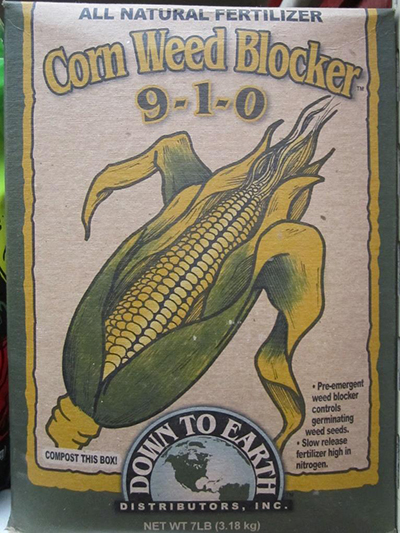
Unlike cornmeal, corn gluten meal has a legal and horticulturally legitimate use as a pre-emergent organic herbicide (Figure 3). This application was developed by researchers at Iowa State University who found that CGM could inhibit seedling growth by desiccating the emerging root. Germination may also be inhibited by protein-related compounds in CGM (Liu and Christians 1994).
While early research on CGM proved successful in greenhouse studies, its application and success under real world conditions has been inconsistent. There are several reasons for these inconsistencies.
- Water availability:
- Water must be available for seed germination, but then restricted for CGM to be effective.
- Controlling water availability is easy in a greenhouse but difficult in open landscapes and gardens.
- Too much water will eliminate CGM’s activity and seedling growth will continue.
- Seasonal considerations:
- Spring weed control by CGM is most effective in regions with infrequent spring rainfall and least effective where spring rainfall is abundant.
- CGM is a broad-spectrum herbicide, killing desirable as well as weed species.
- Not all weed species are affected by CGM (Figure 4).
- Other confounding factors:
- CGM has no herbicidal effect on established plants.
- CGM is a high-nitrogen compound (Figure 5) and will enhance, rather than inhibit, the growth of established plants.
- Weed seeds can germinate throughout a growing season, requiring a constant re-application of CGM, which has no residual activity.
- CGM is an expensive product.
Relevant research for home gardeners
There is no research on cornmeal that has demonstrated application value for home gardens and landscapes. Legally, it cannot be used as a fungicide. On the other hand, a variety of researchers have tested corn gluten meal as an herbicide and a fertilizer under conditions that are relevant to gardening situations.
Container plants:
- CGM used in containers of potting media was more effective in weed control than when applied to containers of sandy soil (Abouziena et al. 2009).
- Container plants treated either with CGM or left untreated had similar levels of weeds. This is not surprising as container plants must be watered on a regular basis. Furthermore, weeds in CGM-treated containers weighed more than those in untreated containers, possibly due to the high nitrogen content of CGM (Wilen et al. 1999). Avoid CGM use in containerized plantings.
Lawns and roadsides:
- CGM had little to no effectiveness on most weed species in turfgrass (Wolfe et al. 2016).
- CGM is an effective fertilizer: of all organic fertilizers tested, it had the greatest impact on turfgrass color and growth (Cheng et al. 2010). Avoid CGM use on lawns and roadsides.
- Over time, CGM was less effective than any mulch materials tested for roadside weed control (Barker and Prostak 2009).
Gardens:
- CGM was less effective than other weed control methods in newly transplanted blackberries (Takeda et al. 2005).
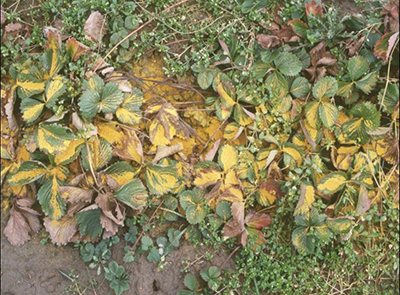
- CGM did not reduce total weeding time in strawberry fields and could increase it. The high nitrogen content made for more robust weeds (Figure 6) that took longer to remove (Miller et al. 2013).
- CGM provided good weed control when used as “grit” in a process similar to sandblasting. When blown at high pressure on weed seedlings, CGM abraded foliage and killed the seedlings of susceptible species (Forcella et al. 2010).
Action items for gardeners
- Use integrated pest management principles to manage pests (Integrated Pest Management, n.d.).
- Avoid application of any unregistered pesticide.
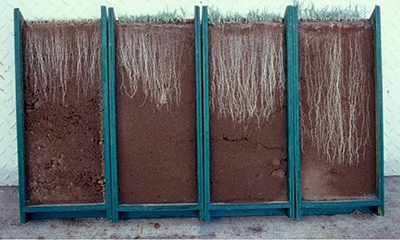
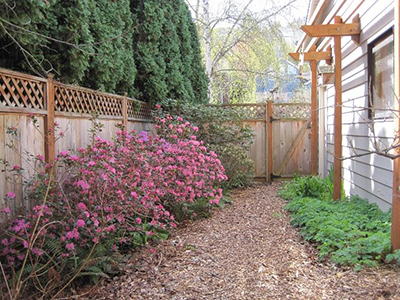
- Use woody mulches, such as arborist chips, to suppress weeds. Not only are mulches more effective than corn gluten meal (Wilen et al. 1999), they also help maintain soil moisture, provide slow-release nutrients, and support a variety of beneficial microbes (Chalker-Scott 2015; Figure 7).
- Use sub-irrigation methods (such as buried soaker hoses) to deter weeds where woody mulches are not practical (Wilen et al. 1999).
- Maintain optimal soil health by mulching properly, eliminating unnecessary additions of fertilizers and pesticides, and reducing soil tillage and compaction. The microbes that flourish in these soils can help control pathogenic species.
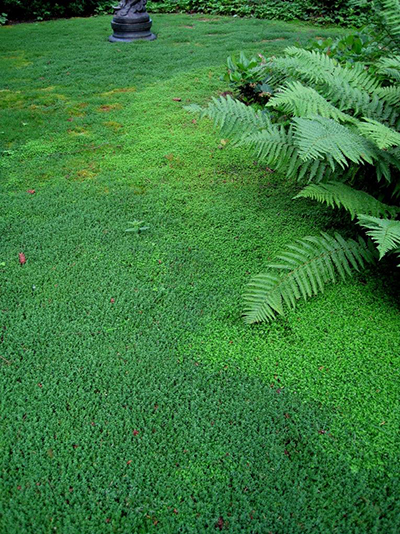
- Plant mixtures of lawn grasses and other ground covers rather than growing monocultures (Figure 8).
- Rotate plant placement in your vegetable garden every year to reduce local buildup of plant root pathogens.
Literature cited
Abouziena, H.F.H., A.A.M. Omar, S.D. Sharma, and M. Singh. 2009. Efficacy comparison of some new natural-product herbicides for weed control at two growth stages. Weed Technology 23:431–437.
Azhar, H., S.M. Iqbal, N. Ayub, and A.M. Haqqani. 2003. Physiological study of Sclerotium rolfsii Sacc. Pakistan Journal of Plant Pathology 2(2):102–106.
Barker, A.V., and R.G. Prostak. 2009. Alternative management of roadside vegetation. HortTechnology 19(2):346–352.
Chalker-Scott, L. 2015. Using arborist wood chips as a landscape mulch. (link to PDF document) WSU Extension Fact Sheet FS160E. Washington State University.
Cheng, Z., S.O. Salminen, and P.S. Grewal. 2010. Effect of organic fertilisers on the greening quality, shoot and root growth, and shoot nutrient and alkaloid contents of turf-type endophytic tall fescue, Festuca arundinacea. Annals of Applied Biology 156:25–37.
Forcella, F., T. James, and A. Rahman. 2010. Post- emergence weed control through abrasion with an approved organic fertilizer. Renewable Agriculture and Food Systems 26(1):31–37.
Garcia, R.A., F.C. Juliatti, and T.A. Cassemiro. 2012. Production of sclerotia on Sclerotinia sclerotiorum (Lib.) de Bary in culture media. Bioscience Journal 28(1):1–7.
Gul, Z., and R. Fazli. 2005. Effect of media type and concentration on the in vitro interactions of Trichoderma harzianum and Fusarium oxysporum f.sp. lycopersici. Sarhad Journal of Agriculture 21(1):103–107.
Integrated Pest Management (opens in new window). n.d. WSU Extension.
Liu, D.L.-Y., and N.E. Christians. 1994. Isolation and identification of root-inhibiting compounds from corn gluten hydrolysate. Journal of Plant Growth Regulation 13:227–230.
Miller, T.W., C.R. Libbey, and B.G. Maupin. 2013. Evaluation of organic amendments and flaming for weed control in matted-row strawberry. HortScience 48(3):304–310.
Sanford, G.B. 1947. Effect of various soil supplements on the virulence and persistence of Rhizoctonia solani. Scientific Agriculture 27:533– 544.
Takeda, F., D.M. Glenn, and T. Tworkoski. 2005. Weed control with hydrophobic and hydrous kaolin clay particle mulches. HortScience 40(3):714–719.
Trivedi M., O.P. Dhawan, R.K. Tiwari, and A. Sattar. 2005. Genetic studies on collar rot resistance in opium poppy (Papaver somniferum L.). Journal of Applied Genetics 46(3):279–284.
Wilen, C.A., U.K. Schuch, and C.L. Elmore. 1999. Mulches and subirrigation control weeds in container production. Journal of Environmental Horticulture 17(4):174–180.
Wolfe, J.C., J.C. Neal, and C.D. Harlow. 2016. Selective broadleaf weed control in turfgrass with the bioherbicides Phoma macrostoma and Thaxtomin A. Weed Technology 30:688–700.
Linda Chalker-Scott, Associate Professor and Extension Horticulturist, WSU Puyallup Research and Extension Center, Washington State University

FS326E

Copyright © Washington State University
WSU Extension publications contain material written and produced for public distribution. Alternative text descriptions for select complex images were generated using ChatGPT (OpenAI), then reviewed and adapted to ensure compliance with Web Content Accessibility Guidelines (WCAG) accessibility standards.
Issued by Washington State University Extension and the US Department of Agriculture in furtherance of the Acts of May 8 and June 30, 1914. Extension programs and policies are consistent with federal and state laws and regulations on nondiscrimination regarding race, sex, religion, age, color, creed, and national or ethnic origin; physical, mental, or sensory disability; marital status or sexual orientation; and status as a Vietnam-era or disabled veteran. Evidence of noncompliance may be reported through your local WSU Extension office. Trade names have been used to simplify information; no endorsement is intended.