Using Coffee Grounds in Gardens and Landscapes (Home Garden Series)
Chemical Composition of Coffee Grounds
Not everything contained in a coffee bean makes it into a cup of coffee. Nitrogen-rich proteins needed for seed germination and growth comprise over ten percent by weight of the content in coffee grounds (Table 1) (Tokimoto et al. 2005). Since coffee is extracted in water, most of the hydrophobic compounds, including oils, lipids, triglycerides, and fatty acids, remain in the grounds, as do insoluble carbohydrates like cellulose. Structural lignin, protective phenolics, and the wonderful aroma-producing essential oils also remain in the grounds following the brewing process. Even small amounts of caffeine may remain in the grounds (Bravo et al. 2012).
While many minerals are solubilized and leached during the brewing process, a percentage remain in the used grounds (Table 1). The values are highly variable, but potassium is commonly the largest mineral constituent followed by a combination of phosphorus, magnesium, and calcium.
Decomposition of Coffee Grounds
Left outdoors over the course of several months, bacteria and fungi break down the various chemical components of coffee grounds. Nitrogen-rich compounds including proteins and caffeine break down quickly, releasing plant-available nitrogen into the soil.
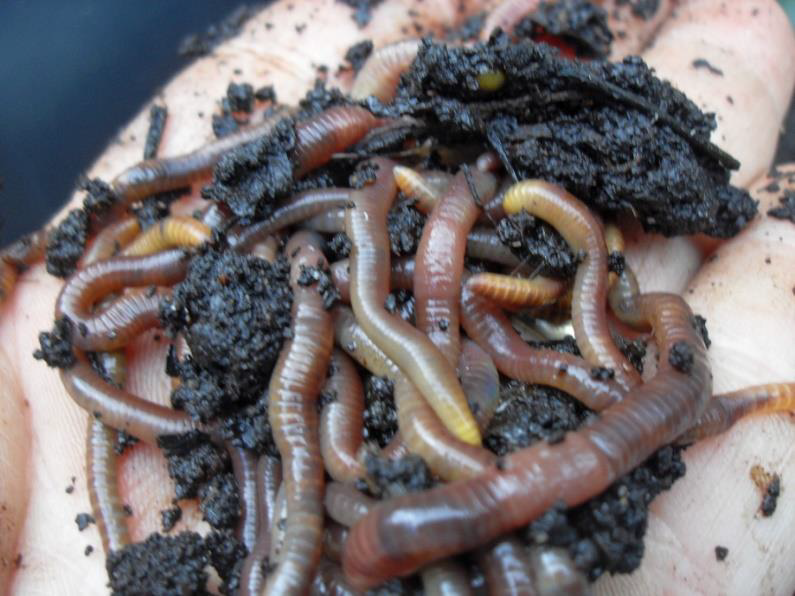
Some larger bioconsumers, including earthworms (Figure 2), use coffee grounds as a food source (Bollen and Lu 1961). The fact that earthworms pull coffee grounds deeper into the soil may account for noted improvements in soil structure such as increased aggregation following the application of coffee grounds (Wakasawa et al. 1998).
| Beverage | Protein | K | P | Mg | Ca | Al | Fe | Mn | Cu | Na |
|---|---|---|---|---|---|---|---|---|---|---|
| Coffee | 13.6 | 22 | 9 | 8 | 5 | 2 | 1 | <1 | <1 | - |
| Espresso | 12.8–16.9 | 38–64 | 8 – 9 | 12–20 | 2 | - | <1 | <1 | <1 | <1–4 |
Notes: K = potassium; P = phosphorus; Mg = magnesium; Ca = calcium; Al = aluminum; Fe = iron; Mn = manganese; Cu = copper; Na = sodium.
Carbon-to-nitrogen ratios change during coffee ground degradation, generally starting out high (e.g., 25–26:1) and decreasing over time to about 10:1 (Morikawa and Saigusa 2011, 2008; Ouatmane et al. 2000). The latter is an ideal ratio for plant and soil nutrition.
How Coffee Grounds Affect Soils
Coffee grounds used as mulches or amendments have mostly positive effects on soils (Yamane et al. 2014). Coffee grounds will moderate soil temperature and help retain soil water (Ballesteros et al. 2014) like any other good mulch material. Coffee grounds bind pesticide residues (Bouchenafa-Saïb et al. 2014; Fenoll et al. 2014) and toxic heavy metals such as cadmium (Azouaou et al. 2010; Kim et al. 2014), preventing their movement into the surrounding environment. They can also increase the availability of essential plant nutrients, such as nitrogen, phosphorus, iron, and zinc (Kitou and Okuno 1999; Liu and Price 2011; Morikawa and Saigusa 2011, 2008), especially in more alkaline soils.
FAQs about Coffee Grounds
Many gardeners assume that coffee grounds are acidic, but this does not hold true experimentally. Studies on coffee ground composting have reported pH levels ranging from mildly acidic (Cruz et al. 2012; Morikawa and Saigusa 2008) to somewhat alkaline (Ros et al. 2005). The pH of decomposing coffee grounds is not stable and one shouldn’t assume that it will always, or ever, be acidic. Also keep in mind that pH changes will only be in the immediate vicinity of the coffee grounds, not throughout the entire soil profile.
Yes. When they are composted, either alone or as part of a compost pile, coffee grounds provide a rich supply of nutrients once applied to the soil (Yamane et al. 2014). Fresh grounds are demonstrably phytotoxic to a variety of plants (Cervera-Mata et al. 2020; Ciesielczuk et al. 2018; Hardgrove and Livesley 2016; Wakasawa et al. 1998), so their use as an amendment or mulch is not recommended.
Likewise, don’t use coffee grounds in areas where you are growing plants from seed. Reduced seed germination and plant growth of many crop and ornamental species has been observed in experiments using coffee grounds (Ciesielczuk et al. 2018; Nagaoka et al. 1996; Wakasawa et al. 1998).
There is no published evidence that coffee grounds will repel or kill any garden pests. Nor is there any science-based information on their ability to attract either pests or beneficial animals like earthworms.
Research suggests that the bacterial (Nagai et al. 2002; Ros et al. 2005) and fungal species normally found on decomposing coffee grounds, such as nonpathogenic Pseudomonas, Fusarium, and Trichoderma spp., and pin molds (Mucorales), prevent pathogenic fungi from establishing (Hamanaka et al. 2005; Ros et al. 2005) on crops such as beans (Adams et al. 1968a, 1968b), melons (Ros et al. 2005), spinach (Escuadra et al. 2008), and tomatoes (Nagai et al. 2002).
Action Items for Gardeners Using Coffee Grounds in Compost
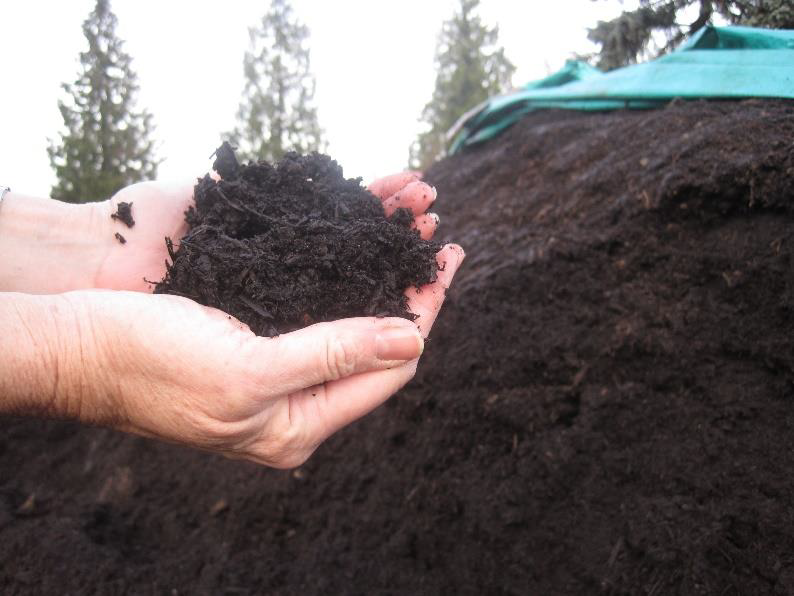
- Use no more than 20 percent by volume of coffee grounds in a compost pile (Figure 3). A diverse feedstock will ensure a healthy diversity of microorganisms. Excessive coffee grounds in composts can be phytotoxic (Kopeć et al. 2018).
- Don’t assume coffee grounds will make an acidic compost; pH levels will change over time.
- Be sure to allow coffee grounds to cool before adding them to your compost; heat can kill your beneficial microbes.
- Avoid adding coffee grounds to vermicomposting bins; they can injure or kill earthworms in these confined areas (Liu and Price 2011).
- Understand that disease suppression from nonpathogenic organisms found in decomposing coffee grounds has only been demonstrated under controlled conditions on a handful of crops; their efficacy in gardens and landscapes is unknown.
- Refer to Backyard Composting (Cogger et al. 2017) for additional information on composting at home.
Action Items for Gardening Using Coffee Grounds as a Landscape Mulch
- Be sure to have a soil test to determine if your soil requires any additional nutrients or organic material. If you have optimal or excessive nutrients, do not add coffee grounds in any form.
- Organic material, including coffee grounds, should not be worked into the soil, but laid on top as a thin mulch layer for natural incorporation.
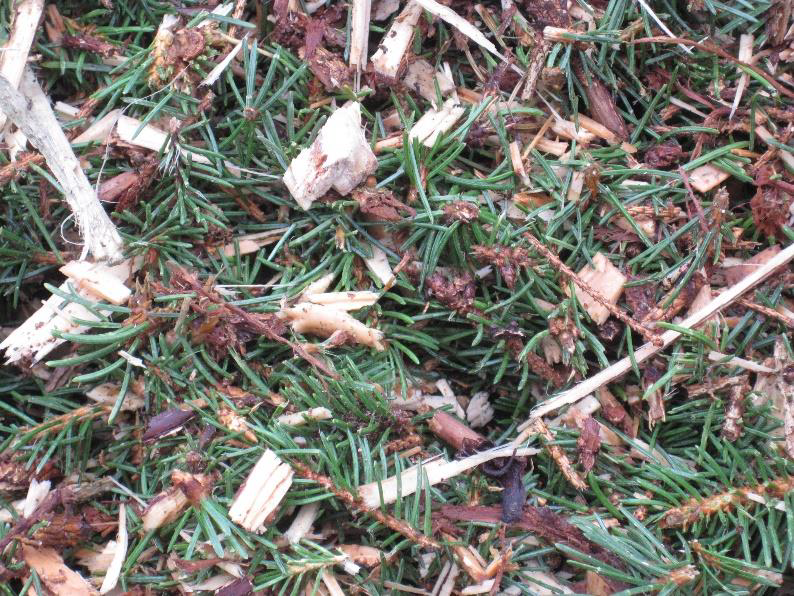
- If your soil test indicates that nutrients are low, apply a thin layer (no more than half an inch) of composted coffee grounds. Cover with a thicker layer (four inches) of coarse organic mulch like wood chips (Chalker-Scott 2015). This will protect the coffee grounds, and underlying soil, from compaction (Figure 4).
- Don’t apply thick layers of coffee grounds as a stand-alone mulch. Because they are finely textured and easily compacted, coffee grounds can interfere with moisture and air movement in soils (Chalker-Scott 2007).
Acknowledgements
Adapted from Coffee Grounds—Will They Perk Up Plants? (Chalker-Scott 2009).
References
- Adams, P.B., J.A. Lewis, and G.C. Papavizas. 1968a. Survival of Root-Infecting Fungi in Soil. IX. Mechanism of Control of Fusarium Root Rot of Bean with Spent Coffee Grounds. Phytopathology 58 (12): 1603–1608.
- Adams, P.B., G.C. Papavizas, and J.A. Lewis. 1968b. Mechanism of Control of Fusarium Root Rot of Beans with Spent Coffee Grounds. Phytopathology 58: 883.
- Azouaou, N., Z. Sadaoui, A. Djaafri, and H. Mokaddem. 2010. Adsorption of Cadmium from Aqueous Solution onto Untreated Coffee Grounds: Equilibrium, Kinetics and Thermodynamics. Journal of Hazardous Materials 184 (1/3): 126–134.
- Ballesteros, L.F., J.A. Teixeira, and S. Mussatto. 2014. Chemical, Functional, and Structural Properties of Spent Coffee Grounds and Coffee Silverskin. Food and Bioprocess Technology 7 (12): 3493–3503.
- Bollen, W.B., and K.C. Lu. 1961. Microbial Decomposition and Nitrogen Availability of Reacted Sawdust, Bagasse, and Coffee Grounds. Journal of Agriculture and Food Chemistry 9: 9–15.
- Bouchenafa-Saib, N., A. Mekazria, B. Bouzid, O. Mohammed, A. Khelifa, K. Benrachedi, and N. Belhaneche. 2014. Removal of Malathion from Polluted Water by Adsorption onto Chemically Activated Carbons Produced from Coffee Grounds. Desalination and Water Treatment 52 (25/27): 4920–4927.
- Bravo, J., I. Juárez, C. Monente, B. Caemmerer, L.W. Kroh, M. Paz de Peña, and C. Cid. 2012. Evaluation of Spent Coffee Obtained from the Most Common Coffeemakers as a Source of Hydrocyclable Bioactive Compounds. Journal of Agricultural and Food Chemistry 60: 12565–12573.
- Cervera-Mata, A., G. Delgado, J. Montilla-Gómez, M. Navarro-Alarcón, S. Pastoriza, and J.A. Rufián-Henares. 2020. Phytotoxicity and Chelating Capacity of Spent Coffee Grounds: Two Contrasting Faces in Its Use as Soil Organic Amendment. Science of the Total Environment 717. DOI: 10.1016/j.scitotenv.2020.137247.
- Chalker-Scott, L. 2009. Coffee Grounds—Will They Perk Up Plants? MasterGardener Magazine 3 (1): 40–41.
- Chalker-Scott, L. 2015. Using Arborist Wood Chips as Landscape Mulch. Washington State University Extension Publication FS160E. Washington State University.
- Ciesielczuk, T., A. Szewczyk, C. Rosik-Dulewska, D. Miłek, I. Sławinska, and J. Poluszyńska. 2018. Acute Toxicity of Experimental Fertilizers Made of Spent Coffee Grounds. Waste and Biomass Valorization 9 (11): 2157–2164. DOI: 10.1007/s12649-017-9980-3.
- Cogger, C., D. Sullivan, and A. Bary. 2017. Backyard Composting. Washington State University Extension Publication EB1784E. Washington State University.
- Cruz, R., M.M. Cardoso, L. Fernandes, M. Oliveira, E. Mendes, P. Baptista, S. Morais, and S. Casal. 2012. Espresso Coffee Residues: A Valuable Source of Unextracted Compounds. Journal of Agricultural and Food Chemistry 60: 7777–7784. DOI: 10.1021/jf3018854.
- Escudero, G.M.E., T. Usami, and Y. Amemiya. 2008. Effect of Compost Amendment on Soil Microbial Community and Pathogen Causing Fusarium Wilt Disease in Spinach. HortResearch 62: 21–29.
- Fenoll, J., N. Vela, G. Navarro, G. Pérez-Lucas, and S. Navarro. 2014. Assessment of Agro-industrial and Composted Organic Wastes for Reducing the Potential Leaching of Triazine Herbicide Residues through the Soil. Science of the Total Environment 493: 124–132.
- Hamanaka, Y., K. Toyota, and K. Hayashi-Ikeda. 2005. Screening of Fungal Strains Responsible for Strong Fungistasis against Fusarium oxysporum f. sp. radicis-lycopersici in a Coffee Compost-Amended Soil. Japanese Journal of Soil Science and Plant Nutrition 76 (6): 817–824.
- Hardgrove, S.J., and S.J. Livesley. 2016. Applying Spent Coffee Grounds Directly to Urban Agriculture Soils Greatly Reduces Plant Growth. Urban Forestry & Urban Greening 18: 1–8. DOI: 10.1016/j.ufug.2016.02.015.
- Kim, M.S., H.G. Min, K.M. Koo, J.S. Park, S.H. Lee, G.I. Bak, and J.G. Kim. 2014. The Effectiveness of Spent Coffee Grounds and Its Biochar on the Amelioration of Heavy Metals-Contaminated Water and Soil Using Chemical and Biological Assessments. Journal of Environmental Management 146: 124–130.
- Kitou, M., and S. Okuno. 1999. Effect of Mulching with Coffee Residue on Growth of Soybeans and Growth of Following Crops Fertilized with Coffee Residue: Study on Agricultural Utilization of Coffee Residue (part 2). Japanese Journal of Soil Science and Plant Nutrition 70 (5): 495–503.
- Kopeć, M., A. Baran, K. Gondek, M.J. Chmiel, and M. Mierzwa-Hersztek. 2018. Effect of the Addition of Biochar and Coffee Grounds on the Biological Properties and Toxicity of Compost. Waste and Biomass Valorization 9 (8): 1389–1398. DOI: 10.1007/s12649-017-9916-y.
- Liu, K., and G.W. Price. 2011. Evaluation of Three Composting Systems for the Management of Spent Coffee Grounds. Bioresource Technology 102 (17): 7966–7974.
- Morikawa, C.K., and M. Saigusa. 2008. Recycling Coffee and Tea Wastes to Increase Plant Available Fe in Alkaline Soils. Plant and Soil 304 (1/2): 249–255.
- Morikawa, C.K., and M. Saigusa. 2011. Recycling Coffee Grounds and Tea Leaf Wastes to Improve the Yield and Mineral Content of Grains of Paddy Rice. Journal of the Science of Food and Agriculture 91 (11): 2108–2111.
- Mussatto, S.I., L.M. Carneiro, J.P.A. Silva, I.C. Roberto, and J.A. Teixeira. 2011. A Study on the Chemical Constituents and Sugars Extraction from Spent Coffee Grounds. Carbohydrate Polymers 83: 368–374.
- Nagai, H., M. Matsusaki, and M. Ogiso. 2002. Disease Suppressing of Fusarium Crown and Root Rots of Tomato by Antagonistic Actinobacteria AP-1. Research Bulletin of the Aichi-ken Agricultural Research Center 34: 105–110.
- Nagaoka, T., K. Umezu, K. Kouno, S. Yoshida, Y. Ishiguro, and T. Ando. 1996. Selective Inhibitors of Germination of Legume Seeds in Activated Sludge Compost. Plant Growth Regulation 20 (3): 295–302.
- Ouattmane, A., M.R. Provenzano, M. Hafidi, and N. Senesi. 2000. Compost Maturity Assessment using Calorimetry, Spectroscopy and Chemical Analysis. Compost Science and Utilization 8 (2): 134–143.
- Ros, M., M.T. Hernandez, C. Garcia, A. Bernal, and J.A. Pascual. 2005. Biopesticide Effect of Green Compost Against Fusarium Wilt on Melon Plants. Journal of Applied Microbiology 98 (4): 845–854.
- Tokimoto, T., N. Kawasaki, T. Nakamura, J. Akutagawa, and S. Tanada. 2005. Removal of Lead Ions in Drinking Water by Coffee Grounds as Vegetable Biomass. Journal of Colloid and Interface Science 281 (1): 56–61.
- Wakasawa, H., K. Takahashi, and K. Mochizuki. 1998. Application and Composting Conditions of Coffee Grounds. I. Application of Coffee Grounds in Soil. Japanese Journal of Soil Science and Plant Nutrition 69 (1): 1–6.
- World Population Review. 2021. Coffee Consumption by Country 2021.
- Yamane, K., M. Kono, T. Fukunaga, K. Iwai, R. Sekine, Y. Watanabe, and M. Iijima. 2014. Field Evaluation of Coffee Grounds Application for Crop Growth Enhancement, Weed Control, and Soil Improvement. Plant Production Science 17 (1): 93–102.
By
Linda Chalker-Scott, Professor and Extension Specialist, Washington State University

FS207E

Copyright © Washington State University
WSU Extension publications contain material written and produced for public distribution. Alternative text descriptions for select complex images were generated using ChatGPT (OpenAI, GPT-5.2), then reviewed and adapted to ensure compliance with Web Content Accessibility Guidelines (WCAG) 2.1, Level AA accessibility standards.
Issued by Washington State University Extension and the US Department of Agriculture in furtherance of the Acts of May 8 and June 30, 1914. Extension programs and policies are consistent with federal and state laws and regulations on nondiscrimination regarding race, sex, religion, age, color, creed, and national or ethnic origin; physical, mental, or sensory disability; marital status or sexual orientation; and status as a Vietnam-era or disabled veteran. Evidence of noncompliance may be reported through your local WSU Extension office. Trade names have been used to simplify information; no endorsement is intended.