Structural and Turf Demossing Study Manual
Description
A study guide for certification in structural and turf demossing. Covers basic principles of control for mosses, lichens, and algae. Used in pesticide training for Washington State Department of Agric ...
Introduction
This publication covers the basic principles of control for mosses, lichens, and algae. This is a very specialized area of pest control that is usually conducted under conditions likely to generate public concern. It is, therefore, essential that you exercise extreme care when using pesticides for this type of control.
The following are examples of the kinds of questions you will encounter on the Washington State Department of Agriculture Structural and Turf Demossing licensing exam:
- The most common cause for growth of moss in lawns in is
- Grass diseases
- Lack of soil diversity
- Mild, wet winters
- Alkaline soils
- Which of the following combinations would be most likely to cause drift problems when using a hydraulic spray applicator?
- Small orifice, low pressure
- Small orifice, high pressure
- Large orifice, low pressure
- Large orifice, high pressure
- The best time to spray pesticides for moss, algae, or lichen control on deciduous trees and shrubs is during
- Late evening
- Summer
- Early morning
- Winter
- During the asexual generation, moss will reproduce by
- Flowers
- Spores
- Rhizomes
- Pollen
- True or False? Some compounds normally used as weed killers are also effective for moss control.
- True or False? A heavy growth of moss, algae, or lichen on trees or shrubs can reduce sunlight reaching the leaves.
Contrary to the title of this study package and the licensing exam for which you are preparing, your work may well involve the control of lichens and algae as well as mosses. These three groups of plants are considered primitive; however, they are highly successful in cool, damp climates. Washington, west of the Cascade Mountains, provides just such a climate, so it is not surprising that those plants are considered pests in this environment.
Since these three plant groups are somewhat different in their biology we shall treat each separately.
Algae
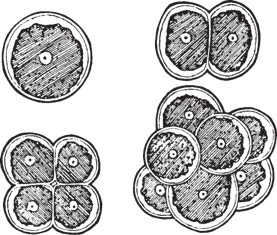
Of the many different kinds of algae species, most live in bodies of water. Our concern, however, is with the relatively few species that are capable of thriving on land, specifically the green algae. These algae consist of single cells containing chlorophyll and are capable of making their own food from carbon dioxide and water in the presence of sunlight (photosynthesis). They thrive and reproduce rapidly under moist, temperate conditions. Being single cells, they are too small to be seen with the naked eye. The pale green film characteristic of homeowner algae problems is produced by thousands or millions of algae cells. Algae are capable of very rapid reproduction and do so by simple fission in which each cell simply divides, producing two cells. When algae are subjected to dry or hot conditions, they are capable of lying dormant for extended periods.
Lichens
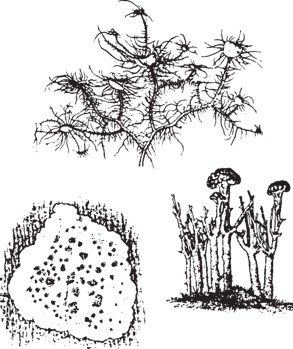
These organisms are somewhat unique in that they actually consist of two different kinds of organisms (algae and fungi) living in a close and mutually advantageous association. The algae produce food necessary for both kinds of organisms and the fungi provide water and shelter for these composite organisms. Lichens grow on a wide variety of surfaces such as on soil, rocks, trees, shrubs, etc. They occur in many forms but the most common are crusty gray, green, yellow, or whitish growths, which may appear to be leaflike structures clinging closely to a surface or coarse hairlike structures hanging from tree branches.
Like algae and moss, lichens thrive and reproduce under cool, moist conditions.
They are capable of lying dormant for extended periods, resuming their growth when conditions are more favorable.
Neither algae nor lichen produce flowers or seeds. Neither has true roots, stems, or leaves, nor do they have any tissue specifically designed to conduct water or food as do the seed-producing plants.
Control Measures for Algae and Lichens
Since these plants make their own food, they do not directly injure the plants on which they grow. Many people find these plants esthetically pleasing because of the patterns and colors they impart to their yards, especially during the winter season. Actually, lichens are very sensitive to air pollution so their presence in a neighborhood is a good indicator of the air quality in that area. Many people believe lichen growth should be encouraged rather than controlled.
Control of these plants is rarely necessary and should be undertaken only when their growth is so great that they reduce the amount of sunlight reaching the leaves of the plants upon which they grow.
Some pesticides are registered for the control of lichens and algae on turfgrass, plants, or structures (sidewalks, stairways). Some fungicides (potassium laurate, copper hydroxide or metallic) are labeled for control of algae or lichen growth on plants, but the plant you want to treat must be listed on the label (the above-mentioned products were registered for use at the time of revised publishing (2014), but their status may subsequently change).
Algae and lichens are best controlled when they are actively growing, generally in winter. Rain occurring just after an application may wash off the pesticide. Furthermore, runoff can lead to damage of plants and metal objects. Once killed, algae and lichens may remain until weathering eventually causes them to be sloughed off.
Mosses and Liverworts
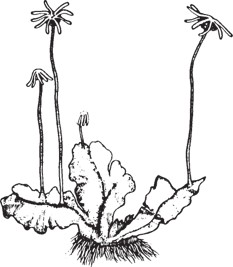
Mosses and liverworts are among the simplest of land plants. These plants do not have flowers, nor do they produce seeds. Because liverworts and mosses are believed to be closely related, they are classified in the division Bryophyta. Liverworts are small plants, 1/16 inch to a foot in length, though they rarely grow over 6 inches. Like the algae and lichens, both mosses and liverworts are characterized by a lack of tissue that conducts water and food. The absence of this tissue contributes to the relatively small size of these plants.
Liverworts got their name because some of the larger species were thought to resemble the lobes of the human liver. Though often confused with the mosses, liverworts show distinct differences from them. The liverwort plant body is not differentiated into stem and leaves but consists of a flattened frond called a thallus; or if there are leaves, as in the so-called “scale mosses,” the leaves are divided into segments that have no midrib or nerve. The mosses, on the other hand, have true stems and leaves; the leaves, never lobed or divided, have a midrib.
No species of mosses or liverworts have real roots, but their rhizoids (rootlike filaments) act like roots, anchoring the plants and taking materials out of the ground to make food. All mosses and liverworts are photosynthetic; in other words they manufacture their own food from carbon dioxide and water by means of chlorophyll, with the aid of sunlight. They are green, at least in part, because of the chlorophyll in these plants.
Generally, this group of plants is considered to have little practical or economic value, but perhaps one of the most important functions of moss and liverworts is in the formation and conservation of soil. They grow in thin layers of soil on and about rocks, sometimes directly on the rocks. Parts of the plants force their way into the minute pores of rocks, making it easier for water and frost to act on them. Small bits of these rocks, dead organic matter, and the moss plants are steadily forming new soil.
(The above-mentioned products were registered for use at the
time of printing, but their status may subsequently change.)
Life Cycle of Mosses
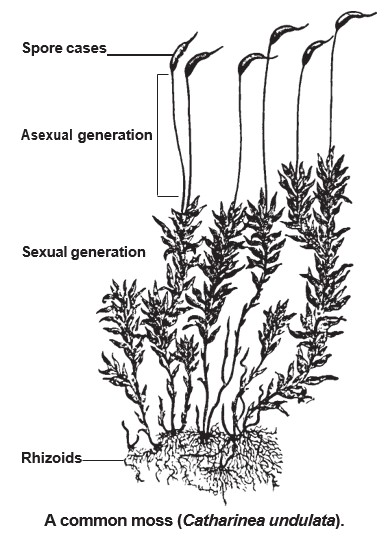
Both liverworts and mosses have an alternation of generations, a sexual generation alternating with an asexual one. During the asexual generation, moss will produce airborne spores—one-celled particles of living matter with a firm protective wall. Most spores are widely distributed in the atmosphere. Spores that come to rest upon favorable, moist surfaces absorb water and renew their growth in a process called germination. The spore puts forth a slender, branching, many-celled green thread called a protonema. Protonema may cover several inches or feet and may resemble green algae. Developing bud(s) on the protonema grow into leafy shoots. They are anchored and nourished by numerous rhizoids that grow into the substrate.
During the sexual phase, the tips of some branches of moss plants become fertile, producing sex organs. Egg and sperm cells are produced which fuse into a single cell called a zygote. From this zygote, an embryo develops and produces the asexual generation of this plant.
In dry places some mosses do not form spores. Instead, the wind carries broken-off bits of leaves or branches, and when these fall in a suitable place, new plants begin if they have enough moisture to get a new start. This form of propagation is called vegetative reproduction.
Some mosses are short-lived. However, the majority live from year to year, growing at the tips of stems and branches, persisting for a number of growing seasons; such species are said to be perennial.
Where They Grow
Liverworts generally require more moist conditions than mosses. They are typically found growing on damp soils, rocks, tree bark, or floating on water. Mosses are found everywhere in the world except deserts.
Each moss species grows in its own special environment. Most mosses live on land, the majority of them on trees, but mosses may be found growing on rotting logs, wet or bare rocks, on buildings, in lawns, and even in the tiny cracks in streets. A few are found under water in streams and ponds. Certain mosses grow at low altitudes; others thrive on the rocky slopes of Mt. Everest. There are about 20,000 different kinds of mosses.
Moss grows vigorously during the rainy seasons—fall, winter, and spring. The evergreen forests of the west coast are distinguished in having the largest and most diverse number of moss species on the North American continent.
Structural Demossing
In the cool, moist climate of the Pacific North-west, moss may become a problem on and around houses and other structures. Moss often causes problems on roofs, patios, sidewalks, and steps that are infrequently used and which remain wet for extended periods of time.
If not controlled, moss will shorten the lifespan of a roof. Control measures include removing overhanging branches that shade the roof, removing as much of the moss as possible, and using liquid spray or granular application of a pesticide. In many cases, where the pitch of the roof is not too steep, a sprinkling can rather than a tank sprayer can be used for applying the solution. This application method minimizes drift problems, but the applicator must not put too much solution on so that it runs from eaves or splashes on planted areas below roofs. Where this possibility exists, cover plants with plastic sheets to protect them. The application of these chemicals is most effective when moss is actively growing, and when it isn’t expected to rain for several days.
Zinc galvanized or copper flashings and ridges will be effective for moss control when placed approximately 10 to 15 feet down from the ridge on most roofs. Bare copper wires, stretched about every 10 feet horizontally along the butt ends of shingles, will provide some moss control through normal corrosion.
Some pesticides are registered for moss control on structures (roofs, walks, decks, patios) and can be effective in killing moss and inhibiting its regrowth for a period of time. The length of time this residual action is effective will depend on the type of roof, amount of penetration, the amount of rainfall, and the type of chemical used.
The most effective chemicals for moss control on structures are copper compounds such as copper naphthenate (copper metallic) and some registered herbicides. These can be applied anytime when the moss is actively growing. Applications are made by sprinkling can, hose-end, or tank sprayer. Usually, the moss must be thoroughly soaked, but avoid runoff.
Runoff from applications can cause damage to plants, animals, and physical items. Two disadvantages of copper compounds are that they may have an odor and also can cause damage to desirable plants.
Some herbicides are also effective for moss control. Follow the manufacturer’s directions and precautions for use.
Turf Demossing
Maintaining a vigorous lawn is the most effective control against the establishment of a moss infestation. The presence of moss in turf is generally reflective of one or a combination of the following conditions: low soil fertility, too much shade, improper watering practices, grass diseases, and poorly drained or compacted soils. To permanently rid or control moss in a turf situation, eliminate the conditions favoring the moss growth.
Lack of fertility is the most common cause for the growth of moss. Regular fertilizing will help to develop a healthy, vigorous turf. Some commercial turf fertilizers have a moss control agent in them.
Moss is a shallow “rooted” plant. Any practices that restrict deep grass root penetration will favor moss development. Infrequent, heavy irrigations will encourage deeper grass root development and will dry the surface moss roots. If soil water movement is hampered by accumulations of thatch or mats of old clippings on the surface, renovation of the surface with power rakes or vertical mowers will promote a stronger grass growth. The moss may be raked out during this process. Reseed if the grass is gone and follow a regular fertilizer and watering program.
Various materials are available to kill moss in turf, and by following label directions, you may obtain good moss kill. Read labels carefully for concerns related to corrosion and toxicity to other organisms (the above-mentioned products were registered for use at the time of revised publishing (2014), but their status may subsequently change).
Unless the basic fault that allowed moss to enter in the first place is corrected, the control will be incomplete or only temporary.
(The above-mentioned products were registered for use at the
time of printing, but their status may subsequently change.)
Application Safety and Principles
Use extreme care when applying these chemicals, especially when treating roofs on family homes. The residential neighborhood environment contains all that is most valuable to humans: children, dogs, cats, ornamental plants, cars, etc. Most moss problems occur under or very near the roof eaves. To prevent most of the problems encountered in this situation, it is important that you:
- Read and abide by all pesticide label directions.
- Heed all precautionary statements.
- Do not use application equipment or techniques that produce fine droplets that drift off target (review drift in EM012, Washington Pesticide Laws and Safety).
- Protect against damage from off target drift or runoff, cover all ornamental plants, bird baths, small fish ponds, etc., and relocate vehicles and other movable equipment situated near the area to be treated.
- Impress the homeowner with the importance of keeping children and pets away from the area of application.
- Remember that some of these chemicals are corrosive to metal, so flush gutters and downspouts with water after treatment. (If downspouts are vented over the lawn or into shrubs, be sure to collect flush water in buckets and later use as a diluent or dispose of properly.)
- Never leave pesticide containers or equipment unattended.
- Be able to tell customers or concerned neighbors what chemicals you are using and the toxicity or hazards associated with the chemicals.
Other procedures important to the safety of the applicator and the general public include the following:
- Wear proper protective gear when mixing and applying these chemicals. Rubber gloves, rubber boots, coveralls, and a brimmed hat are suggested minimums. Heed the label precautions and dress accordingly.
- Spills on clothing, particularly with the concentrated chemical, should be quickly followed by removal of the clothing and thorough washing of the body parts exposed to the chemical.
- Store these chemicals in their original containers in a lockable storage structure.
- Disposal of empty chemical containers can best be accomplished by rinsing them three times, pouring the rinsate into the sprayer, and delivering the empty containers to a sanitary landfill.
For additional information on personal or environmental safety and pesticide laws, review EM012, Washington Pesticide Laws and Safety.

Revised by C.A. Black, M.S., Washington State University Extension pesticide education specialist, and G.L. Thomasson, retired WSU pesticide educator.
College of Agricultural, Human, and Natural Resource Sciences
Use pesticides with care. Apply them only to plants, animals, or sites listed on the label. When mixing and applying pesticides, follow all label precautions to protect yourself and others around you. It is a violation of the law to disregard label directions. If pesticides are spilled on skin or clothing, remove clothing and wash skin thoroughly. Store pesticides in their original containers and keep them out of the reach of children, pets, and livestock.
WSU Extension bulletins contain material written and produced for public distribution. Alternate formats of our educational materials are available upon request for persons with disabilities. Please contact Washington State University Extension Publishing and Printing for more information.
You may order copies of this and other publications from WSU Extension Publications or call 1-800-723-1763. Issued by Washington State University Extension and the U.S. Department of Agriculture in furtherance of the Acts of May 8 and June 30, 1914. Extension programs and policies are consistent with federal and state laws and regulations on nondiscrimination regarding race, sex, religion, age, color, creed, and national or ethnic origin; physical, mental, or sensory disability; marital status or sexual orientation; and status as a Vietnam-era or disabled veteran. Evidence of noncompliance may be reported through your local WSU Extension office. Trade names have been used to simplify information; no endorsement is intended. Replaces EM4749. Published July 2003. Revised February 2014.