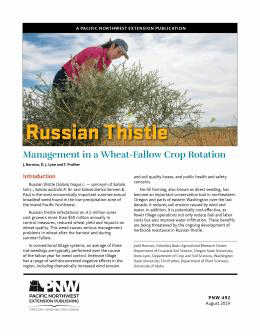
Russian Thistle: Management in a Wheat-Fallow Crop Rotation
Reviews Russian thistle biology as it relates to management, including seed dormancy and longevity in soil, seed distribution, seed germination and emergence, plant growth after establishment, crop competition, and resistance to herbicides. Outlines key considerations for managing for 3 crop years and 1 fallow year. Describes results from a residue management experiment designed to determine how to reduce tillage while maintaining winter wheat production.
Page Count: 10
Published: November 1995
Revised: August 2019
Reviewed: January 2023
Hurry! Only left in stock.
somdn_product_pageRelated publications
-
Overwintered Honey Bee Nucleus Colonies: Big Solutions in Small Packages
This publication describes how commercial and backyard beekeepers can minimize colony losses and related problems by establishing nucleus colonies. Reviewed by WSU specialist W.S. Sheppard. ...
- Published:
- October 2015
- Reviewed:
- January 2024
- SKU:
- PNW682
somdn_product_page -
Identification and Habits of Key Ant Pests in the Pacific Northwest
This publication describes the 12 most common ants characterized as structural pests in Washington, Idaho, and Oregon. Drawings and descriptions follow an introduction to ants and their general biology.
Authors:somdn_product_page -
Controlling Root and Crown Diseases of Small Grain Cereals
This publication describes fundamental practices to manage and minimize losses from root and crown diseases of wheat and barley grown in the Pacific Northwest. Includes tables that list the hosts, ran ...
- Published:
- November 2012
- SKU:
- PNW639
somdn_product_page -
Biology and Management of the Potato Tuberworm in the Pacific Northwest
The potato tuberworm is an important pest worldwide, and has become a major concern for potato production in the Pacific Northwest in the last 5 years. Protecting potatoes with an integrated approa ...
- Published:
- April 2007
- Reviewed:
- January 2021
- SKU:
- PNW594
Authors:somdn_product_page