Description
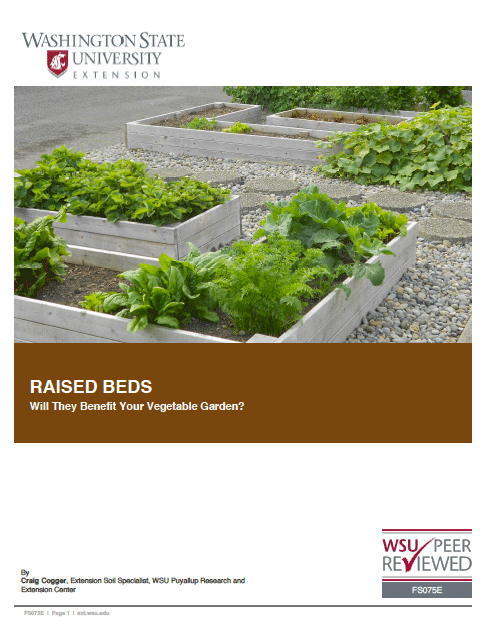
Raised Beds
Otherwise, evaluate your soil—for depth, texture, and compaction—to decide whether native soil or a raised bed would serve you best.
We often assume that soils in urban yards have been disturbed to the point that they are not productive, but that is not always the case. To check out the soil in your future garden spot, all you need is a spade or shovel, some elbow grease, and some simple observations. Choose a spot that receives at least a half day of sun (6 hours or more) during the growing season, and begin digging a small hole. It is best to do this when the soil is moist (but not wet) and easier to dig. If the digging is difficult, decide if it is because of soil compaction or rocks. Many Northwest soils are rocky, but with patience you can loosen the rocks and continue digging. Dig as deep as you can – and if you can make it to 12 inches or more, you have enough native soil for a vegetable garden. If you hit a layer of soil you cannot dig through, you may have reached “hardpan,” (a compact or cemented layer that is a barrier to roots), or a layer that is full of rocks, which means you are at the bottom of the usable soil. For more information on soil suitability for gardens, refer to A Home Gardener’s Guide to Soils and Fertilizers (Cogger 2014).
Take a handful of moist soil and estimate its texture. Texture tells us a lot about the ability of a soil to hold and drain water and hold nutrients. Soils that feel gritty contain mostly sand and are good at draining water but not holding it. Soils that feel smooth like flour contain mostly silt and hold water more tightly. Soils that are sticky and easy to sculpt contain a lot of clay. Clay soils are slow to dry in the spring and can be difficult to work when wet or dry. Soils that are a mixture of sand, silt, and clay are called loams, and they are generally good at draining and holding water. Loamy soils have a little grit but hold together well in your hand. To learn how to estimate the texture of your soil, watch the short video Determining Soil Texture by Hand (Cogger 2010), and then try it yourself.
Choosing Soil for Raised Beds
Gardeners usually use commercial “topsoil” for filling raised beds. However, it is seldom truly topsoil and is more appropriately called landscaping fill. Landscaping fill is usually a mixture of sand and organic material, such as compost. The sand has large pores (macropores) that allow water to infiltrate and drain, while the organic matter increases the capacity of the fill to hold water and nutrients. The result is a mix that drains water well but dries out more quickly than most native soils. Some specialized mixes are similar to potting soil, containing peat and vermiculite as well as compost. Specialized mixes are expensive and seldom offer benefits over simple sand-compost mixes.
Why not obtain real topsoil for filling raised beds? Natural processes in native soil create a structure of aggregates with macropores between them (Figure 5). Macropores are the pathway for water infiltration and drainage. Small capillary pores within the aggregates hold water, storing it for plant uptake.
Excavating, transporting, stockpiling, and spreading topsoil destroys that structure, resulting in a material with few macropores and poorer drainage capacity than native soil left in place. Sandy landscaping fill is a compromise that allows water to infiltrate and drain from the outset, but it will never have the capacity to hold much water.
FIGURE 5
So, if you purchase landscaping fill for raised beds, expect a sandy material mixed with organic matter. Not all landscaping fills are high quality—some may contain rocks, trash, or large sticks. It is wise to inspect the fill before you purchase it.
Adding Soil to Raised Beds
If you are building low, uncontained beds, you can use native soil from the pathways between the beds. Simply digging the soil from the pathways and placing it in the beds does little damage to its structure. Mixing compost with the native soil in the beds will help create structure and improve water movement. If the site was previously a garden or well-maintained lawn, the soil may have plenty of organic matter, and additional compost is not needed. Unframed beds will need to be reshaped each year to counter the effects of settling and erosion. Because unframed beds are subject to runoff and erosion, it is important to test soils to make sure nutrient levels are not excessive, and take measures to reduce runoff from the site.
If you are filling framed beds, you will likely need to purchase landscaping fill. Because the fill is usually a different texture from your underlying soil, it is good to mix the fill with your soil as you build the bed, so that you have a textural gradient rather than a sharp textural boundary. Sharp textural boundaries slow the downward flow of water. Add 3 or 4 inches of fill to the bed and dig it into the underlying soil, then add another layer of fill and dig it in again, repeating until the bed is full. Do not worry if a few rocks from the underlying soil get mixed into the bed. If you are building beds because there is no suitable soil, then layer the fill directly onto the existing surface. In this case, you will want beds at least 15 to 18 inches deep, because the entire root zone of the plants will be in the fill material.
Irrigating and Maintaining Raised Beds
If your soils have medium to heavy texture or are poorly drained, raised beds will allow you to get around these problems and start your gardening season earlier in the spring. But, you will also find that the soils dry out much faster in the summer (particularly if you use landscaping fill), and you will need to be diligent about irrigation. Because landscaping fill does not hold much water, you will need to irrigate frequently, but at lighter rates. During hot, dry weather you may need to irrigate as often as every day.
It is difficult to keep up with watering if you have more than one or two raised beds, unless you use drip irrigation or automated sprinklers. Drip irrigation makes it easy to water multiple raised beds, and wastes much less water than hand or automated sprinklers (Figure 8). For information on planning and installing garden drip irrigation, refer to Drip Irrigation for the Yard and Garden (Peters 2011).
The settling of fill material and decay of organic matter will reduce the depth of soil in raised beds, so you will need to replenish the beds every year or two with more fill, compost, or both to maintain their original depth. Otherwise, framed raised beds require little maintenance if you use long-lasting framing materials. Uncontained raised beds require reshaping each year and adding more soil or compost as needed to maintain the height and shape of the bed.
Growing Vegetables in Raised Beds
Raised beds may expand the choice of vegetables that you grow because of improved soil drainage, which can extend the growing season. For information on garden vegetable production, including raised bed gardening, refer to Home Vegetable Gardening in Washington (Miles et al. 2013).
FIGURE 8
Further Reading
Cogger, C. 2010. Determining Soil Texture by Hand. Washington State University.
Cogger, C. 2014. A Home Gardener’s Guide to Soils and Fertilizers. Washington State University Extension Publication EM063E. Washington State University.
Cogger, C., and G. Stahnke. 2013. Organic Amendments in Yards and Gardens: How Much Is Enough? Washington State University Extension Publication FS123E. Washington State University.
Fery, M., and E. Murphy. 2013. A Guide to Collecting Soil Samples for Farms and Gardens. Oregon State University Extension Publication EC628.
Miles, C., G. Sterrett, L. Hesnault, C. Benedict, and C. Daniels. 2013. Home Vegetable Gardening in Washington. Washington State University Extension Publication EM057E. Washington State University.
Nair, A. 2016. Raised Beds for Vegetable Production. Iowa State University Extension and Outreach.
Peters, R.T. 2011. Drip Irrigation for the Yard and Garden. Washington State University Extension Publication FS030E. Washington State University
By
Craig Cogger, Extension Specialist, Washington State University Puyallup Research and Extension Center

FS075E