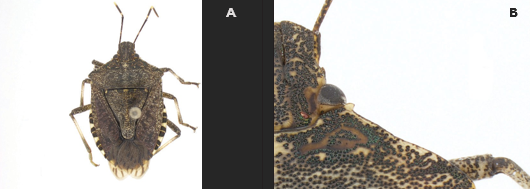
Figure 3. BMSB adult. A) Note the light and dark bands on antennae, legs, and abdomen. B) The edges of the shoulders are smooth. (D. Kitchen, WSDA)
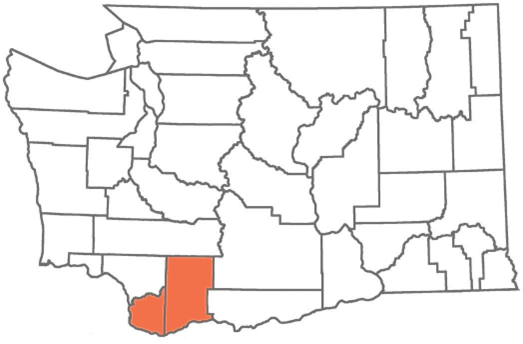
The brown marmorated stink bug (BMSB) causes damage to agricultural crops and annoyance to homeowners. Reported findings in the United States indicate the pest has moved from the East Coast to southwest Washington State in just over a decade. To minimize the risk of further migration, Washington State University Extension and Washington State Department of Agriculture agents need citizens to report sightings in undocumented areas of the state.
Classified as Halyomorpha halys (Stål), the BMSB is a native Asian insect that was first reported in the United States in the late 1990s. Since its initial detection in Allentown, Pennsylvania, the BMSB has been found in 35 other states. Documented sightings in Washington State began in the fall of 2010, and so far are restricted to Clark and Skamania Counties (Fig. 1).
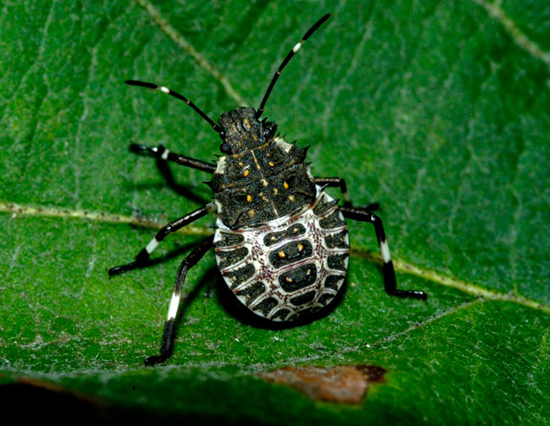
MSB nymphs (Fig. 2) are brightly colored red and black or white and black when they first hatch from eggs. Nymphs begin to resemble the adult stage in coloration but lack developed wings. Adults are a half-inch long with a shield-shaped body characteristic of all stink bugs (Fig. 3A). The body color is a mottled brown and grey and the margins of the shoulders (pronotum) are smooth (Fig. 3B). The anten-nae and legs have dark and light bands. The abdomen also has alternating dark and light bands which extend beyond the wings and are easily visible when viewing an adult bug. The underside is white, sometimes with dark markings.
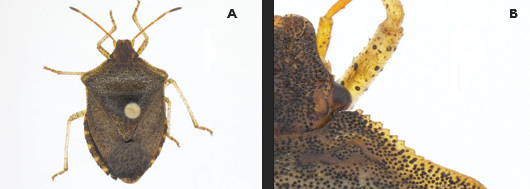
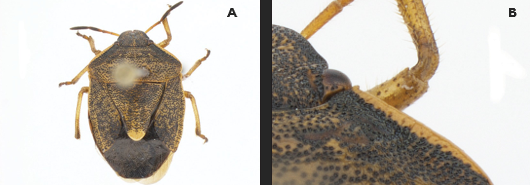
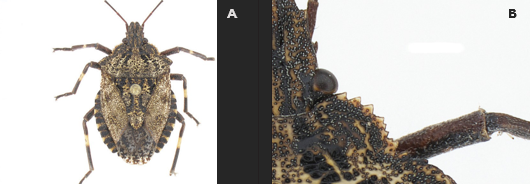
Other stink bugs and related Hemipterans (true bugs) already occurring in Washington may be confused with BMSBs. Similar-appearing stink bugs include Euschistus sp. (Fig. 4), Holcostethus sp. (Fig. 5), and Brochymena sp. (Fig. 6). BMSBs can be distinguished from other stink bugs by their mottled coloration in combination with light and dark banding on the antennae, legs, and abdomen (Fig. 3A).
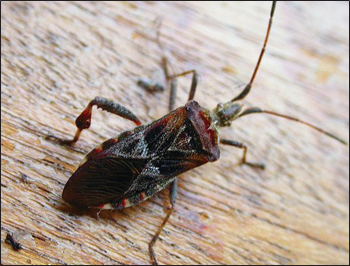
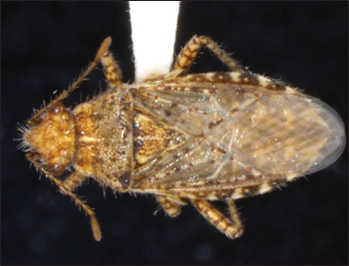
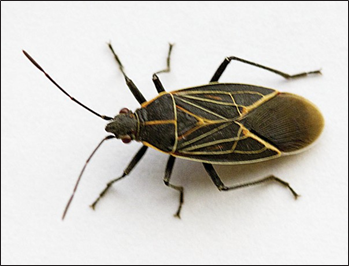
Euschistus and Brochymena look strikingly like BMSBs except for the toothed edges on the shoulders (Figs. 4B and 6B, respectively). While Holcostethus can have smooth-edged shoulders (Fig. 5B), they do not have banded legs or antennae (Fig. 5A). Other hibernating bugs commonly found in the home are western conifer seed bugs (Leptoglos-sus occidentalis, Fig. 7), grass bugs (Peritrechus sp., Fig. 8), boxelder bugs (Boisea, Fig. 9), milkweed bugs (Lygaeus, Fig. 10), and the seed bugs Rhyparochromis vulgaris (Fig. 11) and Raglius alboacuminatus (Fig. 12).
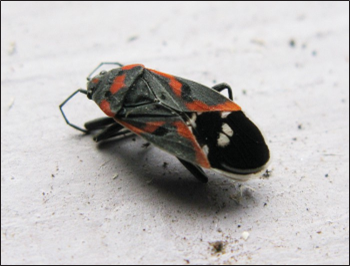
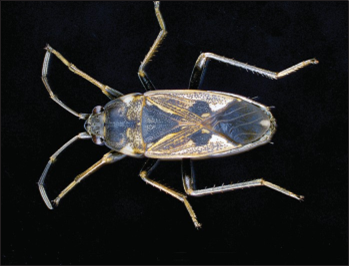
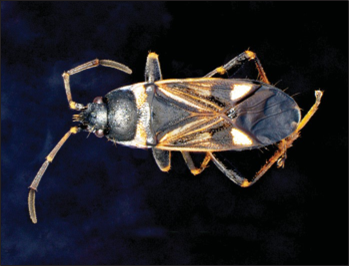
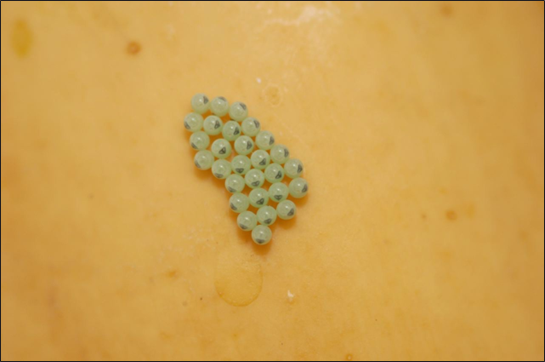
Overwintering female BMSB adults emerge from protected areas such as buildings in early spring to lay eggs in clusters of 20 to 30 on the undersides of leaves (Fig. 13). Eggs begin hatching by early June. Nymphs go through five growth stages. Early instar nymphs tend to feed in aggregations but begin to disperse as they get older. Nymphs are highly mobile and are often seen walking from tree to tree. The next generation’s adults appear by August.
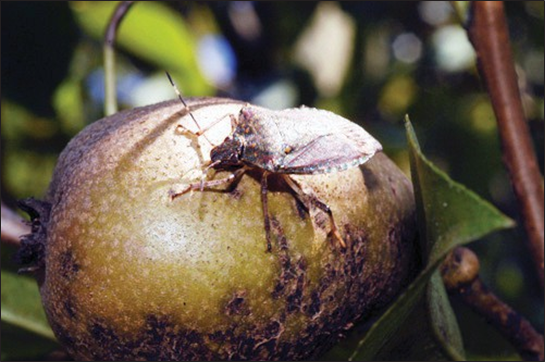
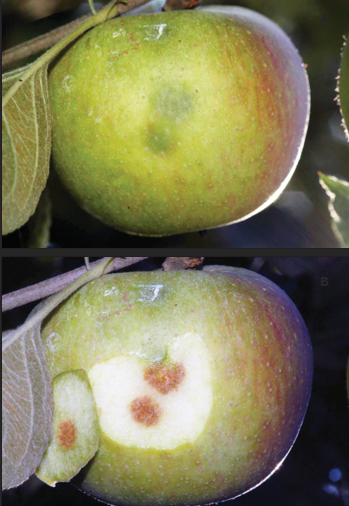
The BMSB has proven to be a significant pest in the eastern United States, causing severe losses in apple yields. It feeds throughout its nymph and adult stages on a wide range of plants, including high-value agricultural crops such as tree fruit (Fig. 14), grapes, berries, vegetables, corn, soybeans, and ornamentals. BMSB feeding damage results in deformation and rotten blemishes on fruit and other plant parts (Fig. 15).
As the name implies, BMSBs emit unpleasant odors. Beginning in September, BMSB adults aggregate in large masses often on the sides of homes and other buildings. They enter structures to avoid cold weather. While stink bugs are not known to harm people or cause damage to buildings, they can be quite distressing when large numbers of individuals enter households. Adult bugs may become active during warm periods of the winter, further causing annoyance as they fly and crawl around inside houses and emit unpleasant odors. The overwintering behavior adds to the BMSB’s pest status as a nuisance to homeowners.
The BMSB has shown high adaptability to different cli-mates in the United States and appears to resist commonly used pesticides. Farmers are resorting to using broad-spectrum insecticides until better management techniques are developed. Entomologists are researching long-term management tools such as biological control. Small wasps have been found to effectively parasitize and kill BMSB eggs in the pest’s China homeland. However, further study is needed before these wasps are proven safe to release.
In areas of the country where BMSB populations are high, homeowners have dealt with problems by sealing up their houses as tight as possible. Sealing cracks, mending screens, and screening vents mechanically exclude BMSB adults from entering houses. When aggregations begin to form, regular vacuuming BMSB adults has helped reduce the number entering houses.
It is likely that the BMSB will continue to spread, as this pest often hitchhikes on cars and cargo. Without any reliable survey methods identified as of yet, limiting the spread will rely on public detections of BMSBs in new locations. If you suspect you have BMSBs in a new region of Washington State, please collect a sample in a crush-proof container, note the date and specific location, and place it in a freezer until you can take it to your local WSU Extension office or local Master Gardener clinic. Your observations will be recorded and help minimize the distribution of BMSBs statewide.
By
Todd Murray, Extension Educator, WSU Skamania County Extension
Chris Looney, Pest Biologist, Washington State Department of Agriculture
Eric LaGasa, Chief Entomologist, Washington State Department of Agriculture
Peter Shearer, Professor of Entomology, Mid-Columbia Agricultural Research and Extension Center, Oregon State University.

FS079E

Copyright © Washington State University
WSU Extension publications contain material written and produced for public distribution. Alternative text descriptions for select complex images were generated using ChatGPT (OpenAI), then reviewed and adapted to ensure compliance with Web Content Accessibility Guidelines (WCAG) accessibility standards.
Issued by Washington State University Extension and the US Department of Agriculture in furtherance of the Acts of May 8 and June 30, 1914. Extension programs and policies are consistent with federal and state laws and regulations on nondiscrimination regarding race, sex, religion, age, color, creed, and national or ethnic origin; physical, mental, or sensory disability; marital status or sexual orientation; and status as a Vietnam-era or disabled veteran. Evidence of noncompliance may be reported through your local WSU Extension office. Trade names have been used to simplify information; no endorsement is intended.