Description
Table of Contents
Introduction
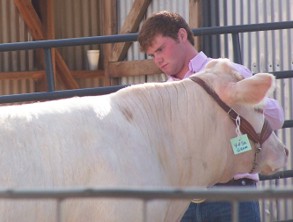
Market steers are a popular 4-H project with many youth. While youth learn to select, feed, manage, and show their market animal, they also develop many important life skills. They learn how to solve problems, make good decisions, keep accurate records, and manage money. One of the outcomes of this process is that youth produce a market steer that hopefully meets or exceeds the quality standards set forth by the American beef industry. While youth beef projects make up less than 1% of the total beef produced in the United States, they still contribute a significant amount of product to the nation’s food supply.
Beef Industry Standards
Many cattle are sold to the meat packer based upon the yield and quality of the beef carcass. Premiums or deductions are applied to individual carcasses based on how they compare to industry standards. For example, yield grade 1 and 2 carcasses may receive a premium, while yield grade 4 and 5 carcasses will receive deep discounts. For quality grade, the Choice grade is still the industry standard for most sectors of the cattle industry. Prime beef carcasses and carcasses graded in the upper two-thirds of Choice have added value because their retail cuts meet the specifications of the white tablecloth restaurant industry. They also meet the specifications for branded beef programs such as Certified Angus Beef as well as some export markets. Select grade carcasses are usually discounted, and Standard grade carcasses receive deep discounts based on the lower value of their end product.
Quality Grades of Beef Cattle
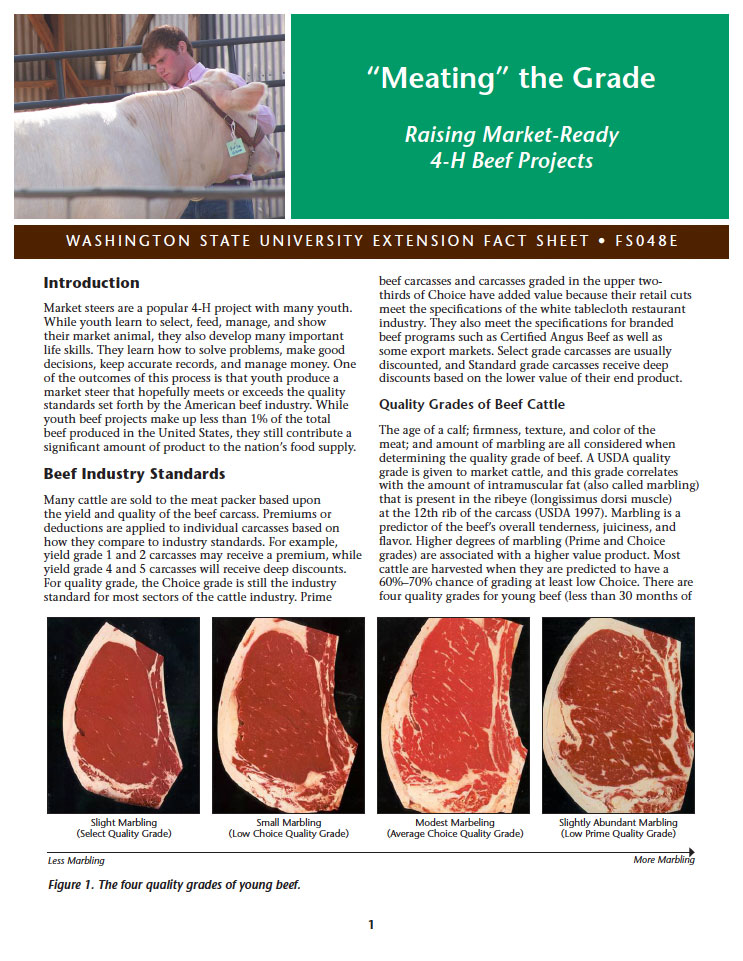
The age of a calf; firmness, texture, and color of the meat; and amount of marbling are all considered when determining the quality grade of beef. A USDA quality grade is given to market cattle, and this grade correlates
with the amount of intramuscular fat (also called marbling) that is present in the ribeye (longissimus dorsi muscle)
at the 12th rib of the carcass (USDA 1997). Marbling is a predictor of the beef’s overall tenderness, juiciness, and flavor. Higher degrees of marbling (Prime and Choice grades) are associated with a higher value product. Most cattle are harvested when they are predicted to have a 60%–70% chance of grading at least low Choice. There are four quality grades for young beef (less than 30 months of