Fresh Cheese Made Safely
Description
Queso fresco, a fresh, crumbly, white cheese, can be made at home! Step-by-step process for making this cheese safely included.

Introduction
Queso fresco is a fresh, crumbly white cheese that has been made for generations by Latin-American families. Traditionally, queso fresco is prepared with fresh dairy milk that has not been pasteurized (heat treated). Unfortunately, this method of making queso fresco can cause serious illness. The instructions in this publication use pasteurized milk to ensure a queso fresco that will not make you sick. To prepare a safe cheese, you can either begin with pasteurized milk or pasteurize your milk before making it into cheese. Procedures on how to sanitize cheese-making equipment are included for the same purpose.
Sanitation
To help prevent illness . . . Keep everything clean and free of germs during the cheese-making process.
- Boil clean cheese-making equipment before use and between uses. Or, soak clean cheese-making equipment in a bleach-water solution for 2 minutes. Remove from solution, drain, and air dry.
- For the best quality cheese, use new cheesecloth each time you make cheese. (Reuse cheesecloth only if it has been washed and then boiled. Or you may soak it for 2 minutes in bleach-water.)
Bleach-water
- Add 1 tablespoon of unscented household bleach to 1 gallon of lukewarm water.
- Make a new bleach-water solution each time you make cheese.
- This recipe for bleach-water can be doubled if necessary.
Heat Treatment of Fresh, Unpasteurized Milk
Remember, even the freshest milk from the cleanest dairy can contain harmful bacteria. To protect others and yourself from harmful bacteria, pasteurize raw milk before making queso fresco as described here.
To kill harmful bacteria in milk:
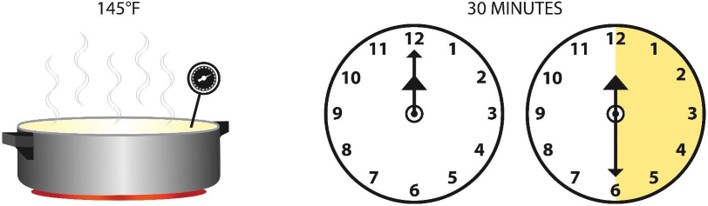
Heat raw milk in uncovered pan to 145°F for 30 minutes.
- Place a cooking thermometer into the milk to measure its temperature.
- Bring temperature to 145°F. Keep the milk at or just above this temperature for 30 minutes, stirring frequently. Hold the temperature steady.
- Remove from heat.
- Cool to below 90°F before making into cheese.
Caution: Temperatures under 145°F will not kill harmful bacteria. If the temperature drops below 145°F at any time during heating, raise the temperature and restart the timer for 30 minutes (Figure 1).
Queso Fresco Recipe
Ingredients
- 1 rennet tablet
- 1/2 cup cold water
- 1 qt pasteurized cultured buttermilk
- 2 qt pasteurized whole milk (can be from a goat, sheep, or cow)
- 7 tsp white vinegar (2 tbsp + 1 tsp)
- 3/4 tsp salt
Optional:
- 1 tsp dried herb
- 1 tbsp fresh herbs
- 1–2 tbsp fresh peppers
- Cooking spray
Preparation
- Mix 1 quart cultured buttermilk with 2 quarts pasteurized milk.
- Add 7 teaspoons white vinegar to the milk mixture.
- Mix well.
- Heat milk to 90°F stirring frequently. Remove pan from heat. Do not overheat.
- Crush rennet tablet in foil pouch. Place crushed rennet into 1/2 cup cold water. Stir until dissolved.
- Add dissolved rennet to heated milk mixture and stir for about 2 minutes.
- Let mixture stand 30–40 minutes until curd is formed and firm. Do not stir.
- Cut curd into 1-inch cubes and let stand for about 5 minutes.
- Heat curds and whey to 115°F (without stirring). Remove pan from the heat, then let stand for 5 minutes.
- Line colander with cheesecloth. Spray cheesecloth lightly with cooking oil spray to prevent sticking.
- Pour mixture (curds and whey) slowly through cheesecloth and allow to drain for 5 minutes.
- Form curds into a ball and gently twist the cheesecloth to squeeze out the whey (liquid).
- Break up curds in a bowl. Add 3/4 teaspoon salt.
- Mix in salt, adding herbs or peppers if desired. Let stand for 5 minutes, then squeeze again as before.
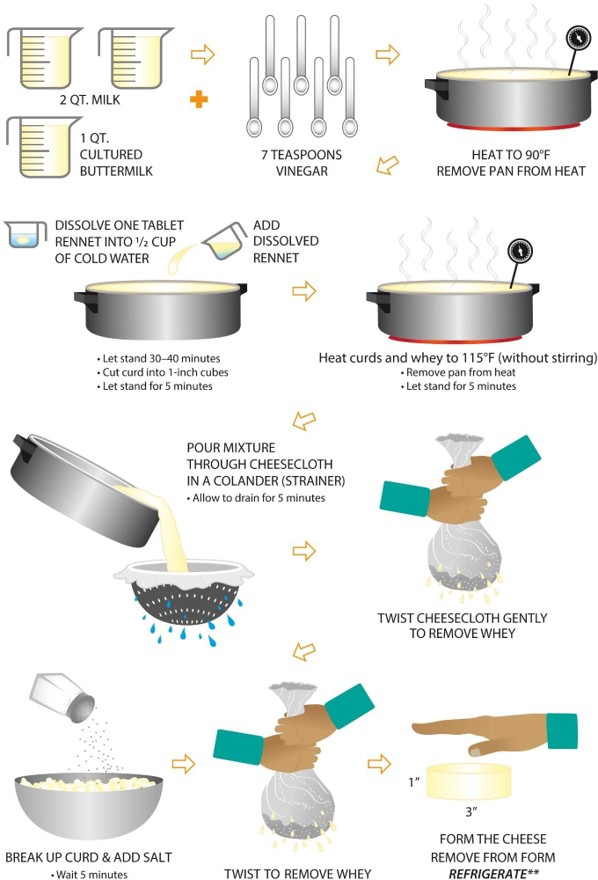
- Form the cheese. Refrigerate. See Figure 2 for illustrated, step-by-step directions.
Helpful Hints
A thermometer is critical to the safety and quality of the queso fresco. Use a thermometer in good working order to monitor heat throughout the process. Avoid heating rennet to more than 90°F or the curd will not form.
Cheese made from this recipe can be safely stored in a refrigerator at 40°F or below for up to one week, or in a freezer for up to one month.
This recipe can be doubled or tripled to make more cheese.
Use whole milk or 2% milk, no less than that. Whole milk has more milk solids, resulting in a larger yield.
Goat’s and sheep’s milk can be used. Both have more solids than cow’s milk, but the flavor will be different.
Mix rennet in water just before use. Extended time in water will reduce effectiveness. Crush tablet in foil packet before opening to help tablet dissolve more quickly.
Amounts of herbs and spices are approximate; you can vary to taste.
Sale of Queso Fresco
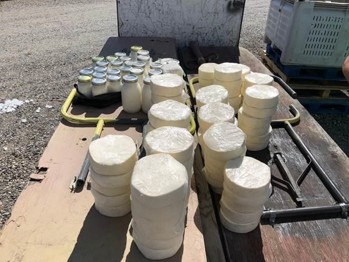
These directions are intended for preparing and consuming fresh cheese in your home. Preparation of cheese for distribution to the public (such as bazaars, farmers markets, grocers, and online sales) requires licensing and special facilities (see Figure 3). Please contact your local health department or state department of agriculture for more information.
Credits: Ryan Bell, Mike Costello, Frances Herrera, Val Hillers, Lloyd Luedecke, Mike Schmitt, Theo Thomas, and Anna Zaragoza created the original 2000 version.
Acknowledgements
Special thanks to Julia Herrera for allowing the use and modification of her queso fresco recipe.
This publication was originally developed for the Abuela Project, as described in the American Journal of Public Health (Sept. 1999, pp. 1421–1424). Grandmothers taught this recipe for safely making fresh cheese to people in eastern Washington. The recipe and directions in this publication were developed by a team of dairy scientists from Washington State University. Consideration for regional taste and texture preferences were addressed during recipe development. The result was a rapid decrease in Salmonella illnesses in Yakima County and surrounding areas of Washington State.

By Lizann Powers-Hammond, Food Safety Regional Specialist, WSU Extension Benton & Franklin Counties, Washington State University
Published and distributed in furtherance of the Acts of Congress of May 8 and June 30, 1914, by Washington State University Extension, Oregon State University Extension Service, University of Idaho Extension, and the U.S. Department of Agriculture cooperating. WSU Extension programs, activities, materials, and policies comply with federal and state laws and regulations on nondiscrimination regarding race, sex, religion, age, color, creed, and national or ethnic origin; physical, mental, or sensory disability; marital status or sexual orientation; and status as a Vietnam-era or disabled veteran. Washington State University Extension, Oregon State University Extension Service, and University of Idaho Extension are Equal Opportunity Employers. Evidence of noncompliance may be reported through your local Extension office. Trade names have been used to simplify information; no endorsement is intended.
Pacific Northwest Extension publications contain material written and produced for public distribution. You may reprint written material, provided you do not use it to endorse a commercial product. Please reference by title and credit Pacific Northwest Extension publications.
Please select a valid parent category.
Copyright © Washington State University
Pacific Northwest Extension publications are produced cooperatively by the three Pacific Northwest land-grant universities: Washington State University, Oregon State University, and the University of Idaho. Similar crops, climate, and topography create a natural geographic unit that crosses state lines. Since 1949, the PNW program has published more than 650 titles, preventing duplication of effort, broadening the availability of faculty specialists, and substantially reducing costs for the participating states. Revised November 2019.