DNR General Contact
MS 47000
1111 WASHINGTON ST SE
OLYMPIA, WA 98504
360-902-1000
Visit the DNR website for more.
Whatever your goals are for your forested property or woodlands, there is probably a resource in this pub to help you out!
Forestry education and assistance for forest and woodland property owners in Washington is available from a variety of sources, including public agencies, private consultants, and fellow landowners. Available resources include publications, videos, workshops, online classes, technical advice, and financial assistance. Whatever your situation, there is likely a resource, organization, or individual that can help you meet your goals for your property.
The land-grant system was first established by Congress through the Morrill Act, which Abraham Lincoln signed into law in 1862 to provide better higher education opportunities for working classes. The goal of the land-grant system was to make public universities more accessible to the public and to begin offering higher education on more applied subjects such as agricultural, engineering, and military science in addition to classical studies. The federal government granted federal land to each state that the states could then sell and use the funds to establish the land-grant universities. The land-grant system was expanded in 1890 to include historically black colleges and universities, and it was expanded in 1994 to include tribal colleges and universities. Washington has two land-grant institutions. Washington State University (WSU) in Pullman is the 1862 land-grant institution, and Northwest Indian College in Bellingham is the 1994 tribal land-grant institution.
Building on this mission of providing greater public accessibility to university resources, the Smith-Lever Act of 1914 established the nationwide Cooperative Extension Service as part of the land-grant system. WSU Extension is a three-way partnership between the USDA National Institute of Food and Agriculture (NIFA), Washington State University, and local county governments. WSU Extension has offices in every county in Washington as well as four Research and Extension Centers.
Each local office offers a different mix of local programs that may include agriculture, gardening, community and economic development, health and wellness, nutrition education, youth and families, forestry, and natural resource stewardship. Agriculture, Master Gardeners, Livestock Advisors, Beach Watchers, 4-H, and Forestry are examples of specific programs offered by WSU Extension around the state. The specific Extension programs offered in a county are determined by the county legislative authority (i.e., county council or county commissioners). Some counties in Washington elect to have an Extension Forestry program and some do not.
The WSU Extension Forestry program provides educational workshops, demonstrations, tours, online courses, educational videos, publications, newsletters, and individual consultation on a variety of forestry subjects, including silviculture, wildlife, invasive weeds, forest health, wildfire, climate change, tool and chainsaw safety, and small-scale forestry operations. Extension Forestry personnel are WSU faculty members and administrative professionals who are stationed at local county Extension offices and serve a region of the state. Visit the WSU Extension Forestry website to learn about the Extension Forestry staff who serve your county.
An additional role of the Extension Forestry program is to facilitate connections between property owners and other resources. This includes connecting people with technical and financial support offered by our partner agencies such as the Washington Department of Natural Resources (DNR), local conservation districts, and USDA Natural Resources Conservation Service (NRCS). The program also connects people with private sector professionals. The WSU Extension Forestry website maintains up-to-date directories of consulting foresters, silvicultural contractors, and small-scale sawmill operators.
For additional information about WSU Extension resources in your county, please contact your local county Extension office. The WSU Extension website has information on all WSU County Extension offices and a vast library of Extension publications, which cover topics including forestry, home gardening, agriculture, and more. In addition to all of the resources available on the WSU Extension website, you can also plug into the national Extension network through the Extension Foundation, which has a vast array of resources for foresters, farmers, communities, and homeowners.
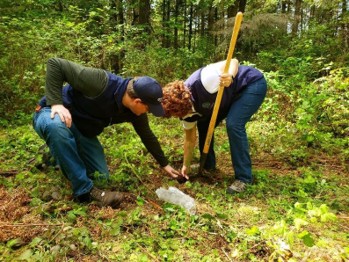
Coached Planning is the flagship of the WSU Extension Forestry Program. Coached Planning courses are offered both in person at various locations around the state and online. These courses typically include one evening class per week for seven to nine weeks, plus a Saturday field trip (Figure 1). The classes are designed to help property owners develop customized management solutions to meet their individual ownership objectives. Participants will identify their property ownership goals and develop a comprehensive forest management plan.
A written management plan may qualify landowners for:
See WSU Extension publication Your Forest Stewardship Plan (FS060E) for additional information on the benefits of management plans.
See the Washington State Integrated Forest Management Plan Guidelines and Template (pdf) for management plan requirements.
The Coached Planning courses are designed for those with a few wooded acres as well as those with larger forested tracts, whether managing for timber production or simply for enjoyment of wildlife and aesthetics. Resource managers from nonprofits, land trusts, or local parks departments are also encouraged to attend.
Forest Stewardship Coached Planning is a collaborative educational partnership offered by WSU Extension in cooperation with the Washington Department of Natural Resources (DNR) and the U.S. Forest Service, along with other federal, state, and local natural resources agencies. For more information and a list of upcoming classes, please visit WSU Extension Forestry or contact your local Extension Forestry staff.
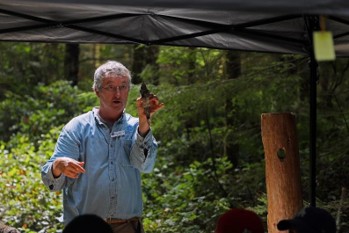
Each summer, WSU Extension, the DNR, and other agency partners host educational field days for owners of forested or wooded properties. These field days offer a hands-on, “out in the woods” educational experience for the whole family. Participants can attend outdoor seminars, forest walks, and demonstrations offered throughout the day on a variety of forestry topics, such as forest health, thinning, pruning, riparian management, wildlife habitat, special forest products, wildfire protection, growing edible mushrooms, chainsaw safety, and more (Figure 3). Sessions are offered every hour at different stations throughout the field day site, and participants get to choose which session they want to attend for each time slot. With advance notice, mobility assistance can usually be available.
Like the Coached Planning courses, the field days provide educational opportunities for participants of all skill levels regardless of property size or ownership objectives. They offer an excellent introduction to forest stewardship, provide advanced learning opportunities for experienced landowners, or simply allow landowners a chance to “sharpen the saw” to refresh existing skills or be updated on the latest forestry research and developments. The field days also offer valuable opportunities for networking with forestry professionals and fellow property owners.
Typically, at least three Saturday field days are held each year in different locations around the state, with at least one in western Washington and one in eastern Washington. An online version featuring field videos with live interaction with instructors is sometimes offered as well. For information on upcoming field days, contact your local Extension office.
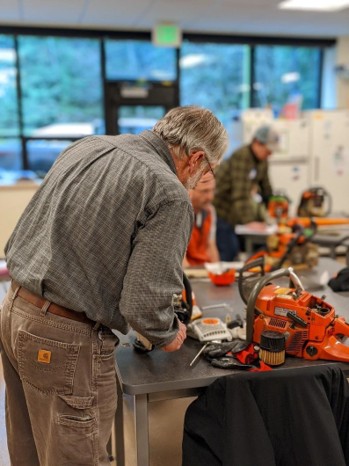
Winter School is the classroom counterpart to the summer Forest Owners’ Field Days, offering a chance to brush up on forestry knowledge during the off season. Similar to the field days, sessions are offered every hour in different classrooms at the Winter School venue, with participants choosing which session they want to attend for each time slot. A variety of topics are offered, including forest health, invasive weed management, wildlife, climate change, growing edible mushrooms, chainsaw maintenance, and more (Figure 4 and Figure 5). Panel discussions and landowner roundtables are often included as well. Winter School is another opportunity for valuable networking with forestry professionals and fellow property owners.
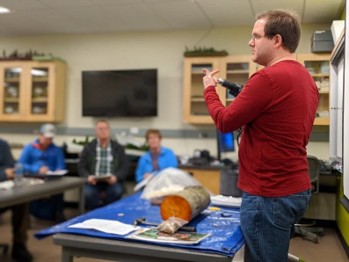
Winter School is usually offered at least twice per year between January and March, with at least one offered in western Washington and one in eastern Washington. A live webinar-based online version is sometimes offered as well. For information on upcoming Winter School programs, contact your local Extension office.
Forest Stewardship University is a suite of online classes available from WSU Extension on a variety of topics, including tree and plant identification, silviculture, forest health, managing noxious weeds, and understanding forest taxes and regulations. These online classes are available on demand at WSU Extension Forestry.
Woman Owning Woodlands Network (WOWnet) is a network of women who learn, educate, and work together to build female literacy and involvement in forestry, land conservation, and natural resources. WOWnet is a nationwide program that is dynamic, fun, and informative, and WOWnet strives to bring topical, accessible, and current forestry information to women woodland owners and forest practitioners. WOWnet supports women in forest leadership, woodlands management, and forest stewardship. Through educational resources and personal stories, WOWnet strives to instill a sense of confidence and empowerment in women’s abilities to meet the challenges of forest ownership. See their website for more information on the National Women Owning Woodlands Network.
WSU Extension facilitates the Western Washington Chapter of WOWnet. The chapter operates primarily through a group email discussion list where list members can ask questions, share stories, and arrange get-togethers. The chapter also has a Facebook page and a Facebook group.
WSU Extension Forestry offers a regularly updated collection of research-based, peer-reviewed publications written specifically for property owners. These informational fact sheets and how-to manuals cover a variety of topics such as forest health, forest management, native trees, wildfire, wildlife, and more. Most of these publications are available as free PDF downloads. Select publications are available in print for a nominal fee.
Visit WSU Extension Forestry to browse WSU natural resources publications. You can also contact WSU Extension Publications at 509-335-2857, 800-723-1763, or through email.
Woodland Fish and Wildlife Publications
WSU Extension is part of the Woodland Fish and Wildlife (WFW) Project, a cooperative effort between local, state, and federal agencies, universities, and woodland owner associations in the Pacific Northwest to provide information on improving wildlife habitat. The WFW publications are a series of short, practical, how-to publications written specifically for small woodland owners. The WFW series includes general wildlife habitat publications as well as publications on specific species of interest, including deer, bats, beavers, raptors, reptiles, and more. All WFW publications are available as free PDF downloads at their website.
For a variety of how-to demonstrations, webinar recordings, and other educational videos, visit the WSU Extension Forestry YouTube channel.
Visit WSU Extension Forestry to find the current list of WSU Extension Forestry faculty and staff that serve your area and their contact information. If you do not see your county listed in the faculty and staff list, this means no local program is presently established in your county. In this case, contact the county director at your county’s WSU Extension office to learn about engaging Extension Forestry.
Stay on top of the latest news, information, upcoming events, and other available resources for forest landowners by subscribing to one or more of these free email newsletters:
This statewide educational newsletter provides news, feature articles, technical advice, and event announcements for forest landowners throughout Washington. The newsletter is published quarterly by WSU Extension Forestry and the Washington DNR Small Forest Landowner Office (SFLO). To view current and past issues, visit the Forest Stewardship Notes website. On that page, click on “Get email alerts about new posts” to subscribe to the newsletter.
This daily electronic mailing list provides news about forest landowner programs and events occurring around Washington State. This email announcement list is managed by WSU Extension Forestry and conveys information by all landowner assistance agencies and organizations. To subscribe, email Andy Perleberg.
Winner of a national gold award for Extension newsletters, this newsletter features news, information, events, and resources of interest to forest and woodland owners. This newsletter is primarily focused on the Puget Sound area. To subscribe or view past issues, visit the Puget Sound Extension Forestry E-Newsletter website.
This electronic mailing list provides periodic information and events of specific interest to forest landowners in the southwest Washington area.
The DNR offers free advisory site visits to property owners with five or more acres of forest as part of their Forest Stewardship Program, which is administered by DNR’s Forest Health and Resiliency Division. For these site visits, a DNR stewardship forester can walk the property with the owner to assess the forest conditions, provide general management advice, and assist landowners in writing their own forest management plan at no cost. A stewardship wildlife biologist is also available to provide site visits for property owners who have a special interest in wildlife habitat. Property owners with fewer than five acres of forest can receive advice from the stewardship assistance forester or stewardship biologist via phone or email. To find the stewardship assistance forester or stewardship wildlife biologist serving your area, visit the DNR’s Forest Health Assistance for Small Forest Landowners website.
The SFLO offers financial and regulatory assistance programs to property owners. A Regulation Assistance Forester is available to answer questions about forest practices regulations for timber harvesting, road construction, and other regulated forest practices. The Regulatory Assistance Forester can help property owners understand when a Forest Practices Application is required and how to apply for one.
For more information, contact the Regulation Assistance Forester or call 360-902-1029.
This program provides funding for property owners to replace culverts or other stream crossings on forest roads that restrict fish from reaching upstream habitat. The program covers most or all of the cost of the stream crossing replacement. Limited funding is available, and projects are prioritized based on the amount of upstream habitat that would be opened up. Even if a property owner’s project is not immediately funded, just having applied for the program and been put on the waiting list exempts the property owner from forest practices rules requiring correction of fish barriers.
For more information, contact the FFFPP Manager or call at 360-902-1404.
This program provides partial compensation to qualifying landowners for the lost financial value of qualifying timber that forest practices regulations require be left in riparian buffers or other critical areas. Enrolling in this program grants the state a 50-year easement on this timber. Funding is limited and is awarded on a first come, first served basis.
For more information, contact the FREP Manager or call at 360-902-1427.
The Rivers and Habitat Open Space Program buys permanent conservation easements from eligible property owners who have critical habitat for state-listed threatened or endangered species or river habitat in an unconfined channel migration zone. Funding is limited and allocated based on the characteristics of the habitat.
For more information, contact the Rivers and Habitat Open Space Program Specialist or call at 360-902-1427.
The SFLO provides an email newsletter, Small Forest Landowner News.
DNR General Contact
MS 47000
1111 WASHINGTON ST SE
OLYMPIA, WA 98504
360-902-1000
Visit the DNR website for more.
Northeast Region
225 S SILKE RD
COLVILLE, WA 99114-0190
509-684-7474
Email Northeast Region.
Ferry, NE Lincoln, Okanogan, Pend Oreille, Spokane, and Stevens counties.
Northwest Region
919 N TOWNSHIP ST
SEDRO WOOLLEY, WA 98284-9384
360-856-3500
Email Northwest Region.
Island, NE King, San Juan, Skagit, Snohomish, and Whatcom counties.
Olympic Region
411 TILLICUM LANE
FORKS, WA 98331-9271
360-374-2800
Email Olympic Region.
Clallam, Jefferson, NW Grays Harbor, and NW Mason counties.
Pacific Cascade Region
601 BOND RD
PO BOX 280
CASTLE ROCK, WA 98611-0280
360-577-2025
Email Pacific Cascade Region.
Clark, Cowlitz, SE Grays Harbor, Lewis, Pacific, Skamania, Thurston, and Wahkiakum counties.
South Puget Sound Region
950 FARMAN AVE N
ENUMCLAW, WA 98022-9282
360-825-1631
Email South Puget Sound Region.
King, Kitsap, Mason, and Pierce counties.
Southeast Region
713 E BOWERS RD
ELLENSBURG, WA 98926-9301
509-925-8510
Email Southeast Region.
Adams, Asotin, Benton, Chelan, Columbia, Douglas, Franklin, Garfield, Grant, Kittitas, Klickitat, SE Lincoln, SE Skamania, Walla Walla, Whitman, and Yakima counties.
The DNR has forest entomologists (insect specialists) and pathologists (disease specialists) who monitor forest health problems around the state. These experts are frequent speakers at educational programs for forest landowners. For assistance with a forest health problem, first contact your local DNR Stewardship Forester or WSU Extension Forestry staff for diagnoses and recommendations or for a referral to forest health specialist if necessary.
DNR publishes annual Forest Health Highlights reports on current forest health issues around the state.
This program provides cost-share and technical assistance to qualifying eastern Washington forest owners to implement treatments to reduce wildfire risk or improve forest health.
For forest landowners with property in Ferry, Lincoln, Okanogan, Pend Oreille, Spokane, or Stevens counties, contact the DNR Northeast Region Office in Colville at 509-684-7474. For forest landowners with property in all other eastern Washington counties, contact the DNR Southeast Region Office in Ellensburg at 509-925-8510.
The DNR is responsible for wildfire protection on 12 million acres of private and state forestland. For tips and best practices information on protecting your home and forestland from wildfire, contact your local DNR Stewardship Forester, DNR Landowner Assistance Forester (eastern WA), or WSU Extension Forestry staff. Your local conservation district may also offer information and assistance on wildfire prevention.
To obtain a burn permit or to ask questions about forestry-related burning, contact the DNR regional office that serves your area. To report a wildfire, call the DNR Wildfire Hotline at 800-565-6010.
The DNR Urban and Community Forestry Program provides information and technical and financial assistance to municipalities and other organizations regarding trees in urban environments, such as street trees and trees in municipal parks. The program offers a free email newsletter. For more information, contact Ben Thompson, Urban and Community Forestry Program Manager, at 360-485-8651.
The DNR Webster Forest Nursery, located south of Olympia, offers tree seedlings for sale to landowners. This nursery grows seedlings for a variety of zones and elevations throughout the state of Washington. Seedling orders are typically accepted at the beginning of September for planting the following spring. The nursery sells out quickly each year, so people interested in purchasing seedlings should place their orders immediately when the nursery begins accepting orders in September. For more information, contact the nursery at 360-902-1234.
The Natural Resources Conservation Service (NRCS) is a federal agency within the United States Department of Agriculture (USDA). Formerly known as the Soil Conservation Service, NRCS works to conserve natural resources on private lands by providing technical and financial assistance to farmers, forest owners, and others. Visit their website to learn more about NRCS programs in Washington.
NRCS administers a variety of funding programs. These programs provide a type of financial assistance in which the government enters into an agreement with a private landowner to pay a portion of the cost to complete a conservation project on private land. This allows landowners to implement projects that would otherwise be cost prohibitive. A variety of conservation activities could potentially be eligible for financial assistance, such as post-wildfire restoration, pre-wildfire fuels reduction treatments, and forest health improvements. Restoration or maintenance of fish and wildlife habitats or other ecological functions through the use of basic forest practices like pre-commercial thinning, pruning, tree planting, treating forest slash, and creating or protecting habitat structures may also be eligible.
Financial assistance programs are typically established by Congress as part of federal “Farm Bill” legislation. Historically these programs have been geared to agricultural producers, but there have been increasing opportunities for forest owners. The Environmental Quality Incentives Program (EQIP) is a current example of a cost-share program that offers many opportunities for forest owners.
To find out about financial assistance opportunities, eligibility requirements, and application procedures and deadlines, contact your nearest NRCS office. Conservation districts can also provide information on funding programs since they work closely with the NRCS and are often located in the same building.
NRCS is the premier source for soil information, such as soil type, physical and chemical properties, drainage characteristics, land-use suitability, forest productivity, and much more. Historically this information was published by county in soil survey books. These books are no longer updated, since the information is now made available for free online through the NRCS Web Soil Survey.
For assistance in using the Web Soil Survey to get soil information, contact your local NRCS office, DNR Stewardship Forester, or WSU Extension Forestry staff. WSU Extension publication Forest Soil Data for Your Forest Stewardship Plan (EM064) provides a step-by-step guide for using the Web Soil Survey to get the most commonly needed forest-specific soil data.
As part of NRCS’s snow telemetry (SNOTEL) data collection, NRCS provides water supply forecasts and climate monitoring through interactive maps and charting tools.
Conservation districts are local, special purpose districts (other examples of special purpose districts include hospital, fire, and school districts). Conservation districts provide technical and financial assistance to encourage conservation on private land. Conservation districts sometimes have local funding opportunities in addition to the broader federal programs available through NRCS.
There are 45 conservation districts in Washington. Most, but not all, conservation districts follow county boundaries. To find your local conservation district, see the directory at the end of this publication. You can also visit their website to learn more about conservation districts in Washington.
Some conservation districts in Washington have staff foresters who are available to provide no-cost technical assistance to property owners, including those with fewer than five acres. These services include site visits and assistance in developing forest management plans.
Conservation districts typically hold native tree and plant sales each year in late winter or early spring. These sales are excellent sources for tree seedlings and native plants that are appropriate for use in reforestation or restoration projects in local areas. Contact your local conservation district for information on upcoming sales and any preorder requirements. Your local conservation district can also help you select appropriate plant and tree species and stock types for your specific site and project needs.
The Washington Association of Conservation Districts (WACD) has a Plant Materials Center in Bow, Washington (Skagit County), that is another good source for native tree and plant seedlings. For more information, email the WACD Plant Materials Center or call at 360-757-1094.
Washington, like many states, allows for what is called current-use taxation (CUT), which means that land can be taxed at its value for forestry use rather than its market value, which may reflect its value for development. Forestland values are set by the Washington Department of Revenue (DOR) and adjusted each year using a formula established by state law. These values are variable and are based on the productivity and accessibility of the land. Under CUT, the assessed value of forestland is typically in the range of $1–$200 per acre depending on the quality and accessibility of the property. Switching from standard taxation to CUT can significantly reduce your property taxes on the forested portion of a property.
In Washington, there are two types of forestland classifications for CUT. The Designated Forest Land (DFL) classification is for timber tracts that are five or more forested acres. Open Space Timber (OST) is a similar classification that also requires at least five forested acres. If a residence is on the property, a minimum of one acre is subtracted from eligibility. In other words, a five-acre parcel with a residence would not qualify because it would only have four eligible acres when the acre is subtracted for the residence.
The two classifications function similarly and offer the same tax reduction, but there are slight differences in the rules, the penalties for withdrawal, and how they are administered by the county. Before 2014, DFL required a minimum of 20 forested acres, making the minimum acreage requirements (20 vs. 5) a primary difference between the programs. A legislative change in 2014 reduced the DFL minimum to five acres, eliminating this difference. As part of this legislative change, counties are given the option of eliminating their OST program and switching all enrolled properties over to DFL. Some counties have made this change while others have not.
For both DFL and OST, state law requires that the primary use of the land be the growth of timber for commercial harvest. Property owners who do not wish to do logging on their property should not enroll in either of these programs. There are financial penalties for later removing land from these classifications (e.g., if the property owner decides to develop the property or decides not to use it for logging). An approved forest management plan is usually an enrollment requirement. A property enrolled in a CUT program can be sold and remain in the program if the buyer signs a continuance which states that they will continue to manage the property per the requirements of the program. If the buyer does not wish to sign a continuance, then the property must be removed from the program before the sale can be recorded, and the seller must pay the removal penalties. Property owners should consider the CUT options carefully and seek professional advice to determine if CUT is right for them.
State law allows counties the option of having a Public Benefit Rating System (PBRS) program, which is part of general open space. Unlike DFL and OST that require timber harvest, PBRS is conservation-based. Property owners are awarded points for voluntary conservation measures above the minimum required by law, and these points add up to tax savings. Similar to DFL and OST, a forest management plan is usually required to enroll, and there are financial penalties for removal. Some counties in Washington have chosen to offer PBRS, while others have not. Also, what qualifies for points differs by county. Some counties offer a wide range of things that are eligible for points while others have very restrictive criteria, such as allowing public access or providing habitat for a threatened or endangered species.
Designated forestland and open space timber are state programs based in state law. The application process and administration of the programs is done at the county level, though. The County Assessor’s office handles DFL while the county legislative authority (i.e., county council or commissioners) handles OST and PBRS (if applicable), usually via the county’s planning department. To find out what is available in your county, contact your County Assessor’s office or county planning department.
If you sell timber from your property, you may be liable for the Washington Forest Excise Tax (FET) or the Business and Occupation (B&O) tax, depending on how your sales transaction is handled. The DOR has professional foresters on staff to assist property owners with these state forest-tax issues. For more information, call the DOR Forest Tax Program at 360-534-1324, or email Chris Westwood, Department of Revenue Forester.
Federal income tax may be owed on harvested timber revenues. How federal income taxes apply to timber income is complex, subject to tax law changes, and specific to each individual’s situation. Consequently, you may wish to seek advice from your tax professional or the Internal Revenue Service (IRS). Another available educational resource is the National Timber Tax website, a comprehensive clearinghouse for federal and state tax information specifically for forest landowners.
In many cases, you will need to hire a private consultant for assistance, especially when it comes to functions like timber harvesting on your property.
A professional arborist can assist you with individual trees, such as trees in your yard, trees in an urban setting, and ornamental trees. Services provided by arborists include hazard tree assessment, individual tree health assessment, tree trimming, and tree removal. There are two different types of arborists. Commercial arborists perform the work such as tree trimming and removal. Consulting arborists provide independent advice and assessment. If you know the service you need, you can go directly to a commercial arborist. If you are not sure what services you need or what condition your trees are in, you may wish to start with a consulting arborist to avoid a conflict of interest (e.g., an arborist that would stand to gain financially by telling you to remove a tree).
Certified arborists are different than “tree services.” Arborists who have been certified by the International Society of Arboriculture (ISA) have met professional standards of knowledge and continuing education. The Pacific Northwest Chapter of the ISA maintains a directory of certified arborists.
Hiring a professional consulting forester is strongly recommended when selling timber. A consulting forester serves as your advocate by negotiating the best price for your timber, facilitating the permit and preparation process, verifying property boundaries, protecting your liability, working with the logger, log trucker, and other contractors, and ensuring that the entire sales process goes smoothly and meets your objectives. Other services provided by consulting foresters include management plan preparation, forest inventory (timber cruising), and timber or forestland appraisal. Some consulting foresters have been certified through the Society of American Foresters. Certified Foresters have met professional standards of knowledge and continuing education.
Silvicultural contractors provide forestry services such as reforestation, vegetation control (herbicide application, hand release, etc.), pre-commercial thinning, and pruning. Some forestry firms offer both consulting forester and silvicultural contractor services.
WSU Extension Forestry maintains an online directory of consulting foresters and silvicultural contractors in Washington that provide services to small forest landowners. The directory can be searched by county and service needed.
Working with a skilled and knowledgeable logger is invaluable when cutting trees on your property, whether for wood production, habitat enhancement, or forest health improvement. You may wish to seek assistance from a consulting forester in hiring an experienced and reputable logging company that will best meet your needs.
Small-scale sawmills, which are usually portable, offer custom milling of small quantities of timber. For harvesting timber quantities that are smaller than what is economically feasible to send to a traditional mill, harvesting specialty species like walnut, or directly utilizing timber from your own property, a small-scale sawmill may be a good solution. WSU Extension Forestry maintains an online directory of small-scale sawmills in Washington that offer services to small forest landowners. The directory can be searched by county and service needed.
Forest property owners may need specialized equipment, supplies, and tools that are not available from a typical home improvement store. You may find forestry supplies at your local saw shop. There are also several online forestry supply companies that offer a large selection of specialized forestry products. This non-exhaustive list of private companies is for educational purposes with no implied endorsement by WSU. These companies include:
Invasive weeds can be a frustrating problem for property owners. Washington State has noxious weed laws that require property owners to control certain weeds. Most counties in Washington have a noxious weed control board and noxious weed control staff who can provide resources for identifying and controlling invasive forest weeds, including weed lists, publications, and disposal information. There is also a state noxious weed control board. Financial assistance programs through NRCS or local conservation districts may be available for financial assistance with weed control projects. A silvicultural contractor may be needed for large projects.
For more information, visit the Washington State Noxious Weed Control Board website or do an internet search for “[county name] county noxious weed control board” to find your local noxious weed control program.
Your fellow landowners can be an excellent source of knowledge and practical experience. Landowner associations provide an opportunity to connect with other landowners, share ideas, and explore similar interests. Below are several examples. This non-exhaustive list of private organizations is for educational purposes with no implied endorsement by WSU. Information on each organization was gathered from their websites.
Forest Stewards Guild
An advocacy organization for “ecologically, economically, and socially responsible forestry” that offers education and other programs.
Contact info: membership@forestguild.org
Mt. Adams Resource Stewards
A nonprofit community forest program that owns and operates the Mt. Adams Community Forest and promotes natural resource stewardship, stewardship-based economic and community development, and climate adaptation in the Mt. Adams area.
Contact info:
PO BOX 152
GLENWOOD, WA 98619
509-364-4110
National Woodland Owner Association (NWOA)
Provides education and advocacy for small forest landowners at the national level. Membership includes a subscription to National Woodlands magazine. NWOA also offers liability insurance policies specifically for small forest landowners.
Contact info:
374 MAPLE AVE E STE 310
VIENNA, VA 22180-4751
703-255-2700
Vashon Forest Stewards
A nonprofit community forestry organization on Vashon Island that provides consulting, education, and other services and promotes island-grown wood products.
Contact info:
PO BOX 602
VASHON, WA 98070
206-463-9405
Washington Farm Forestry Association (WFFA)
WFFA provides networking with other landowners, education, and advocacy for small forest landowners at the state level. Membership includes a subscription to Northwest Woodlands magazine.
Contact info:
PO BOX 1010
CHEHALIS, WA 98532-0130
360-888-7074
Northwest Natural Resources Group (NNRG)
NNRG offers education programs and consulting and certification services for small forest landowners. Membership includes discounts on events and services.
Contact info:
2701 1ST AVE STE 240
SEATTLE, WA 98121-1133
206-971-3709
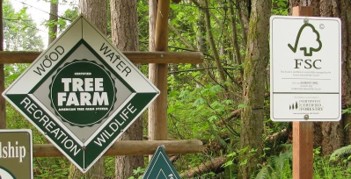
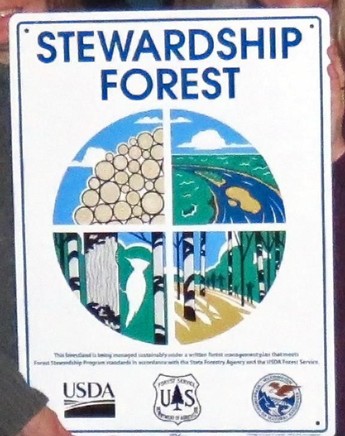
Certification programs are voluntary programs that provide third-party recognition of sustainable forest management. Certification programs have specific forest management standards that must be met. Wood harvested from certified properties may fetch a higher price at the mill. Eligibility requirements include a minimum number of forested acres, a written forest management plan, documentation that forest management meets the required standards, and regular on-site inspections by a representative of the certification program. Certified properties get to display certification signs (Figure 6).
ATFS certification is geared toward small forest landowners and is available at no cost. ATFS-certified properties are eligible for the Outstanding Tree Farmer of the Year award. In Washington, ATFS certification is administered by the Washington Tree Farm Program. For more information, contact the Washington Tree Farm Program at 360-602-1603 or info@watreefarm.org.
Property owners must pay fees to be FSC certified. In Washington, FSC certification is administered by the Northwest Natural Resources Group (NNRG) through a group certificate, because it is more cost-effective to certify multiple properties as a group and spread the certification fees among group members. For more information, contact NNRG at 206-971-3709.
Land trusts are nonprofit organizations that hold conservation easements. Conservation easements permanently protect a property from development. Property owners who want to see their property maintained as forest in perpetuity can set up a conservation easement by donating the development rights to their local land trust. The easement becomes part of the property’s title such that no future owner can develop the property. In some cases, a cash gift is required along with the donation of the development rights so that an endowment can be established to cover the land trust’s costs of maintaining and enforcing the easement in perpetuity. For more information, contact your local land trust. A directory of the land trusts in Washington is available from the Washington Association of Land Trusts.
205 W MAIN
RITZVILLE, WA 99169-1894
509-659-3209
118 E MAIN AVE
RITZVILLE, WA 99169-1406
509-659-1553
506 WEBER AVE STE B
RITZVILLE, WA 99169-2118
509-659-1761
135 2ND ST RM B107 (physical)
PO BOX 9 (mailing)
ASOTIN, WA 99402-0009
509-243-2009
720 6TH ST STE B
CLARKSTON, WA 99403-2012
509-552-8117
720 6TH ST STE B
CLARKSTON, WA 99403-2012
509-552-8116
7102 W OKANOGAN PL STE 102
KENNEWICK, WA 99336-1387
509-735-3551
620 MARKET ST
PROSSER, WA 99350-1320
509-786-5609
10121 W CLEARWATER AVE STE 101
KENNEWICK, WA 99336-3500
509-736-6000
415 WINE COUNTRY RD
PROSSER, WA 99350-9555
509-786-1923
400 WASHINGTON ST
WENATCHEE, WA 98801-2670
509-667-6540
14 N MISSION ST
WENATCHEE, WA 98801-2250
509-436-1601
215 MELODY LN
WENATCHEE, WA 98801-2990
509-664-1141
223 E 4TH ST STE 15
PORT ANGELES, WA 98362-3015
360-417-2279
228 W 1ST ST STE H
PORT ANGELES, WA 98362-2640
360-775-3747
1601 E FRONT ST STE A
PORT ANGELES, WA 98362-4646
360-452-8994
1919 NE 78TH ST
VANCOUVER, WA 98665-9752
564-397-5733
813 W MAIN ST STE 106
BATTLE GROUND, WA 98604
360-859-4780
500 W 12TH ST STE 135
VANCOUVER, WA 98660-2888
360-883-1987
137 E MAIN ST
DAYTON, WA 99328-1350
509-382-4741
202 S 2ND ST
DAYTON, WA 99328-1327
509-382-4273
531 CAMERON ST
DAYTON, WA 99328-1327
509-382-2421
304 COWLITZ WAY
KELSO, WA 98626
360-577-3014
2125 8TH AVE
LONGVIEW, WA 98632-4053
360-425-1880
2125 8TH AVE
LONGVIEW, WA 98632-4053
360-425-1880
203 S RAINIER ST (physical)
PO BOX 550 (mailing)
WATERVILLE, WA 98858-0550
509-745-8531
203 S RAINIER ST (physical)
PO BOX 398 (mailing)
WATERVILLE, WA 98858-0398
509-888-6372
206 N CHELAN AVE (physical)
PO BOX 246 (mailing)
WATERVILLE, WA 98858-0246
509-745-9160 or 509-745-8121
103 N BAKER ST (physical)
PO BOX 428 (mailing)
WATERVILLE, WA 98858-0428
509-745-8561
350 E DELAWARE AVE STOP 9
REPUBLIC, WA 99166-9747
509-775-5225 Ext. 1116
84 E DELAWARE AVE (physical)
PO BOX 1045 (mailing)
REPUBLIC, WA 99166-1045
509-775-3473 Ext. 190
84 E DELAWARE AVE (physical)
PO BOX 315 (mailing)
REPUBLIC, WA 99166-0315
509-775-3473
404 W CLARK ST
PASCO, WA 99301-5629
509-545-3511
1724 E SUPERIOR ST
PASCO, WA 99301-5392
509-416-0440
1533 E SPOKANE ST STE B
PASCO, WA 99301-4216
509-545-8546
757 MAIN ST (physical)
PO BOX 190 (mailing)
POMEROY, WA 99347-0190
509-843-3701
910 MAIN ST (physical)
PO BOX 468 (mailing)
POMEROY, WA 99347-0468
509-843-5008
804 W MAIN ST (physical)
PO BOX 468 (mailing)
POMEROY, WA 99347-0468
509-843-1997
1525 E WHEELER RD
MOSES LAKE, WA 98837-9753
509-754-2011 Ext. 4313
1107 S JUNIPER DR
MOSES LAKE, WA 98837-2313
509-765-9618
2145 BASIN ST SW STE B
EPHRATA, WA 98823-9451
509-754-2463
32 ELMA MCCLEARY RD (physical)
PO BOX 3018 (mailing)
ELMA, WA 98541-3018
330 PIONEER AVE W STE D
MONTESANO, WA 98563-4412
360-249-8532
330 PIONEER AVE W
MONTESANO, WA 98563-4412
360-249-5900
406 N MAIN ST
COUPEVILLE, WA 98239-3416
360-639-6060
1 NE 4TH ST (physical)
PO BOX 490 (mailing)
COUPEVILLE, WA 98239-0490
360-678-4708 or 888-678-4922
Note: Whidbey Island is served by the USDA-NRCS Mount Vernon Service Center (see Skagit County below), and Camano Island is served by the Snohomish Conservation District and the USDA-NRCS Lake Stevens Service Center (see Snohomish County below).
KIVLEY CENTER 121 OAK BAY RD
PORT HADLOCK, WA 98339-8718
360-379-5610
205 W PATISON ST
PORT HADLOCK, WA 98339
360-385-4105
Note: Jefferson County is served by the USDA-NRCS Port Angeles Service Center (see Clallam County above).
560 NACHES AVE SW STE 130
RENTON, WA 98057-2219
425-738-0111
800 SW 39TH ST STE 150
RENTON, WA 98057-4928
425-282-1900
941 POWELL AVE SW STE 102
RENTON, WA 98057-2992
425-277-5580
345 6TH ST STE 550
BREMERTON, WA 98337-1874
360-228-7300
10332 CENTRAL VALLEY RD NE
POULSBO, WA 98370-8143
360-204-5529
500 PACIFIC AVE STE 301
BREMERTON, WA 98337-1904
360-479-5472
901 E 7TH AVE STE 2
ELLENSBURG, WA 98926-3350
509-962-7507
2211 W DOLARWAY RD STE 4
ELLENSBURG, WA 98926-8227
509-925-3352
2211 W DOLARWAY RD STE 6
ELLENSBURG, WA 98926-8227
509-925-8585
228 W MAIN STOP 12
GOLDENDALE, WA 98620-9055
509-773-5817
1107 S COLUMBUS AVE
GOLDENDALE, WA 98620-9296
509-773-5823 Ext. 5
Note: West Klickitat is served by the Underwood Conservation District (see Skamania County below).
1107 S COLUMBUS AVE
GOLDENDALE, WA 98620-9268
509-773-5822
351 NW NORTH ST MS: AES01
CHEHALIS, WA 98532-1900
360-740-1212
2057 SW SALSBURY AVE
CHEHALIS, WA 98532
360-996-4560
1554 BISHOP RD
CHEHALIS, WA 98532-8710
360-748-0083
303 6TH ST (physical)
PO BOX 399 (mailing)
DAVENPORT, WA 99122-0399
509-725-4171
1310 MORGAN ST (physical)
PO BOX 46 (mailing)
DAVENPORT, WA 99122-0046
509-725-4181 Ext. 3
1310 MORGAN ST
PO BOX 46
DAVENPORT, WA 99122-0046
509-725-4501
303 N 4TH ST
SHELTON, WA 98584-3417
360-427-9670 Ext. 680
450 W BUSINESS PARK RD
SHELTON, WA 98584-1284
360-427-9436
Note: Mason County is served by the USDA-NRCS Olympia Service Center and the USDA-NRCS Bremerton Field Office (see Thurston County below and Kitsap County above).
1234 2ND AVE S
OKANOGAN, WA 98840-9723
509-422-7245
1251 2ND AVE S STE 102
OKANOGAN, WA 98840-9767
509-422-0855
1251 2ND AVE S STE 101
OKANOGAN, WA 98840-9767
509-442-2750
1216 W ROBERT BUSH DR (physical)
PO BOX 88 (mailing)
SOUTH BEND, WA 98586-0088
360-875-9331
904 W ROBERT BUSH DR (physical)
PO BOX 336 (mailing)
SOUTH BEND, WA 98586-0336
360-875-6735
Note: Pacific County is served by the USDA-NRCS Olympia Service Center and the USDA-NRCS Chehalis Field Office (see Thurston County below and Lewis County above).
227 GARDEN AVE (physical)
PO BOX 5045 (mailing)
NEWPORT, WA 99156-5045
509-447-2401
121 N WASHINGTON AVE RM 110
PO BOX 465
NEWPORT, WA 99156-0465
509-447-5370
100 N WASHINGTON AVE RM 110
PO BOX 280
NEWPORT, WA 99156-9070
509-447-4217
3602 PACIFIC AVE STE 200
TACOMA, WA 98418-7920
253-798-7180
308 W STEWART AVE (physical)
PO BOX 1057 (mailing)
PUYALLUP, WA 98371-0256
253-845-9770
1011 E MAIN STE 106
PUYALLUP, WA 98372-6768
253-845-9272
221 WEBER WAY STE LL
FRIDAY HARBOR, WA 98250-9375
360-378-4414
530 GUARD ST (physical)
PO BOX 1728 (mailing)
FRIDAY HARBOR, WA 98250-1728
360-378-6621 Ext. 0
Note: San Juan County is served by the USDA-NRCS Mount Vernon Service Center (see Skagit County below).
11768 WESTAR LN STE A
BURLINGTON, WA 98233-3672
360-428-4270
2021 E COLLEGE WAY STE 203
MOUNT VERNON, WA 98273-2373
360-428-4313
2021 E COLLEGE WAY STE 214
MOUNT VERNON, WA 98273-2373
360-428-7684
710 SW ROCK CREEK DR (physical)
PO BOX 369 (mailing)
STEVENSON, WA 98648-0369
509-427-3932
170 NW LINCOLN ST (physical)
PO BOX 96 (mailing)
WHITE SALMON, WA 98672-0096
509-493-1936
Note: Skamania County is served by the USDA-NRCS Yakima Service Center and the USDA-NRCS Vancouver Service Center (see Yakima County below and Clark County above).
6705 PUGET PARK DR
SNOHOMISH, WA 98296-4214
425-338-2400
528 91ST AVE NE STE A
LAKE STEVENS, WA 98258-2538
425-335-5634
Visit the Snohomish Conservation District support website for additional information.
528 91ST AVE NE STE B
LAKE STEVENS, WA 98258-2538
425-595-3284
222 N HAVANA ST
SPOKANE, WA 99202-4799
509-477-2048
210 N HAVANA ST
SPOKANE, WA 99202-4724
509-535-7274
8815 E MISSION AVE STE B
SPOKANE VALLEY, WA 99212-2532
509-924-7350
986 S MAIN ST STE D
COLVILLE, WA 99114-2513
509-684-2588
232 WILLIAMS LAKE RD
COLVILLE, WA 99114-9638
509-684-7579
765 S MAIN ST
COLVILLE, WA 99114-9638
509-685-0858
3054 CARPENTER RD SE BENOSCHEK BUILDING
OLYMPIA, WA 98503-3961
360-867-2151
2918 FERGUSON ST SW STE A
TUMWATER, WA 98512-6187
360-754-3588
1835 BLACK LAKE BLVD SW STE E
OLYMPIA, WA 98512-5607
360-704-7740
25 RIVER STREET STE E (physical)
PO BOX 278 (mailing)
CATHLAMET, WA 98612-0278
360-795-3278
957 STEAMBOAT SLOUGH RD
SKAMOKAWA, WA 98612 (physical)
PO BOX 67 (mailing)
CATHLAMET, WA 98612-0067
360-795-8240
Note: Wahkiakum County is served by the USDA-NRCS Longview Service Center (see Cowlitz County above).
328 W POPLAR ST
WALLA WALLA, WA 99362-2830
509-524-2685
325 N 13TH AVE
WALLA WALLA, WA 99362-1700
509-956-3777
325 N 13TH AVE
WALLA WALLA, WA 99362-1700
509-522-6347
1000 N FOREST ST STE 201
BELLINGHAM, WA 98225-5594
360-778-5800
6975 HANNEGAN RD
LYNDEN, WA 98264-9019
360-354-2035 Ext. 3
914 CITADEL DR STE C
EVERSON, WA 98247-9668
360-354-5658
310 N MAIN ST RM 209
COLFAX, WA 99111-1894
509-397-6290
1615 NE EASTGATE BLVD STE H
PULLMAN, WA 99163-5348
509-332-4101
3 N PARK ST (physical)
PO BOX 438 (mailing)
SAINT JOHN, WA 99171-0438
509-648-3680 Ext. 100
401 S STATE RTE 27
OAKSDALE, WA 99158-5001
509-285-5122
601 N MAIN ST STE A
COLFAX, WA 99111-2118
509-397-4636 Ext. 120
805 S VISTA POINT DR
COLFAX, WA 99111-9565
509-397-4301
2403 S 18TH ST STE 100
UNION GAP, WA 98903-1637
509-574-1600
1606 PERRY ST STE C
YAKIMA, WA 98902-5769
509-454-5736
200 CHEYNE RD (physical)
PO BOX 1766 (mailing)
ZILLAH, WA 98953-1766
509-829-9025
1606 PERRY ST
YAKIMA, WA 98902-5795
509-367-8585
200 CHEYNE RD
ZILLAH, WA 98953-9764
509-829-3003 Ext. 3
By,
Kevin W. Zobrist, Professor, Washington State University Extension Forestry
FS043E
Copyright © Washington State University
WSU Extension publications contain material written and produced for public distribution. Alternative text descriptions for select complex images were generated using ChatGPT (OpenAI), then reviewed and adapted to ensure compliance with Web Content Accessibility Guidelines (WCAG) accessibility standards.
Issued by Washington State University Extension and the US Department of Agriculture in furtherance of the Acts of May 8 and June 30, 1914. Extension programs and policies are consistent with federal and state laws and regulations on nondiscrimination regarding race, sex, religion, age, color, creed, and national or ethnic origin; physical, mental, or sensory disability; marital status or sexual orientation; and status as a Vietnam-era or disabled veteran. Evidence of noncompliance may be reported through your local WSU Extension office. Trade names have been used to simplify information; no endorsement is intended.