Description
Table of Contents
-
The Purpose and Audience
- How the Manual is Organized
- Credits and Origins
- Acknowledgments
- Washington State University Extension
- 4-H / Youth Development

The Purpose and Audience
This manual is designed to provide initial and ongoing guidance for Adventure facilitators in youth development programs. It offers facilitators a broad overview of the common theoretical and practical methodology that affect Adventure education across programmatic offerings, while allowing for program specialization. Adventure programs should have local operating procedures that will support this text and define the details of the program’s sites, activities, and traditions. This manual is not intended to stand alone from specific organizational documents and site-specific Local Operating Procedures.
Most of the information contained in this manual is considered to be foundational knowledge required to facilitate adventure-based learning communities. Since it is primarily for adventure education facilitators, questions and suggestions are occasionally posed in an informal, narrative structure—much like a facilitator would use in practice. Theories discussed in this document were developed by scholars and organizations from around the nation, and their contributions are cited throughout. Several generations of Washington State University experiential educators have made contributions to this work. In this spirit, you are invited to join the adventure community.
How the Manual is Organized
Section I introduces the larger theoretical components and foundations of adventure learning. These are the philosophies used to help participants understand and work with each other.
Section II looks at a few of the current methodologies of learners and facilitators, highlighting several current learning theories, and how they are encountered within adventure education. This section considers individual differences and group dynamics, and the role of the facilitator, as it pertains to individuals and groups. Ethics related to facilitation are also presented.
Section III provides the tools and framework for safe and effective adventure education facilitation. Techniques that help build unique personal and group learning experiences are examined.
Credits and Origins
This manual is the culmination of 25 years of Challenge/Adventure programming (starting in 1987) delivered through Washington State University and the 4-H Youth Development Program. The methods for experiential education and adventure programming contained in this guide date back to John Dewey from the turn of the century, and carry forward to innovative methods offered from current adventure facilitators.
Design Team:
Bryan Brandt, Hannah Butler, Sarah Butzine, Aaron Hansen, Vicky McCarley, Jeff McKenna, Kevin Powers, Sam Tower, Scott VanderWey, Michael Wallace, Tim Wood, and Kevin Wright.
Editors:
Scott VanderWey, Michael Wallace, and Aaron Hansen
Acknowledgments
The 4-H Adventure Program is indebted to the work of its pioneers and scholars, many of whom are recognized throughout this manual. As a community of practitioners, we commit to the intention of openly sharing, adapting, and growing our methods and activities for the benefit of those we serve. We recognize that very little of this material would be available without this commitment. We wish to specifically thank the members of the Association for Experiential Education, 1993 Washington State University 4-H Natural Resource Curriculum Committee, and the founding members of Project Adventure, Inc.
Washington State University Extension
As the educational outreach unit of Washington State University, Extension’s purpose is to take the research done at the university back out to the public where it can best be put to use. Extension strives to help people develop leadership skills and use research-based knowledge to improve their community viability, economic status and quality of life. Extension believes in the people of Washington and the importance of investing in their capacity to face the challenges and opportunities of today’s changing world.
By providing information, education, technical assistance for local development, we work with the people of Washington to address agricultural, natural resource, youth, family, community, and environmental issues.
Washington State University programs are available to all without discrimination.
4-H / Youth Development
A time-honored tradition of the Land Grant University Extension system nationwide has been the 4-H Youth Development Program. 4-H serves youth through volunteer adult engagement and a highly innovative and community-based staffing system. Washington State University Extension oversees the 4-H Youth Development Program of Washington. Our goal is to develop caring, capable, and contributing citizens.
Introduction
The Mission of the 4-H Youth Development Program
4-H is the youth development component of the federal land grant university system. In Washington State, 4-H is linked to Washington State University (WSU). The mission of WSU 4-H is to create supportive environments for all youth and families to reach their fullest potential. The targeted outcomes of 4-H involvement are:
- Developing Life-Skills. Responsibility, self-efficacy, decision making, communication, and teamwork are just a few of the life-skills that youth can develop through interaction within their 4-H communities. Sustained and meaningful relationships reinforce the quality of learning in 4-H programs.
- Creating Caring, Capable, and Contributing Citizens.
4-H clubs are encouraged to commit a part of their time to community service and development projects. Research has demonstrated that 4-H youth who spend several years in a 4-H program are 3.5 times more likely to continue with civic engagement than peers who never participate in 4-H (Lerner and Lerner 2006). This outcome is also directly linked to the Washington State University Extension mission of striving “to help people develop leadership skills and use research-based knowledge to improve their economic status and quality of life.”
4-H Adventure Programs offer youth and adults the opportunity to learn experientially, providing the skills to build strong learning communities capable of creating positive social change.
What is Experiential Learning?
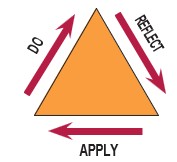
Experiential learning is loosely defined as “learning by doing” (Figure 1), which consists of doing an activity and then reflecting upon the experience to gain learning insights. The insights we gain through experience can then be applied to other experiences. In order to really learn from an experience, the doing, reflecting, and applying, are all necessary steps for learning. Adventure education is one approach to experiential learning.
“Experiential learning takes place when a person is involved in an activity, then looks back and evaluates it, determines what was useful or important to remember and uses this information to perform another activity” (Dewey 1938).
What is Adventure Education?
“When a student participates voluntarily, is intrinsically motivated, and experiences a sense of uncertainty about the outcome, he or she is, by definition, having an adventure.” (Priest and Gass 1997).
Although the term “adventure” is likely to conjure up images of Indiana Jones or something from the pages of National Geographic, participants in adventure programs don’t have to chase after lost treasures, or venture halfway around the globe in order to have an adventure. Lori Frank, in her book, Adventure in the Classroom (Frank 1988), puts forward these fundamental beliefs of what the adventure-based learning model is:
- Fun and Engaging. In order for learning to take place, it must be meaningful, stimulating, and personally rewarding.
- Relationship Centered. Every situation offers participants a chance to build strong relationships. In order to take healthy risks, participants must feel physically and emotionally safe and supported.
- Intentional. Growth is change. In order for growth to take place, participants must be willing to stretch their comfort zones by taking healthy physical, intellectual, and emotional risks.
Traditionally, adventure programs created unique learning environments by taking participants outdoors, away from their normal settings, and allowing them to connect with nature in the woods, on a rock cliff, on a river, or in the snow. Early research indicated that a change of environment was a necessary piece of the adventure experience. However, by creating an element of the unknown, the opportunity for adventure can happen just about anywhere, such as a classroom, hallway, gym, retreat center, board room, even a parking lot. Any of these places can become the location of an adventure, if an element of carefully managed risk, surprise, and uncertainty exists.
The Spectrum of Adventure-Based Programs
There are many different purposes for adventure programs (Figure 2). Although on the surface there are similarities between activities, there is a wide spectrum of purposes and philosophies in the experiential field. Adventure programs can range from recreational-type activities to therapy-driven activities. The 4-H Adventure Education Programs fall in the middle of the spectrum. These programs focus on education and life-skill development, and are designed to be more than entertainment or recreation. They help participants learn new concepts, and develop or enhance, personal and interpersonal skills and behaviors through meaningful and fun experiences.

Adventure-based activities are an instrument of change:
- Recreation (Change Feelings): Providing an enjoyable and cathartic experience.
- Education (Change Thinking): Teaching concepts, generating enrichment or creating awareness.
- Development (Change Behaviors): Enhancing positive actions and increasing functional behaviors.
- Therapy (Change Misbehaviors): Diminishing negative actions and decreasing dysfunctional behaviors.
WSU 4-H Adventure Education Programs
This manual is a foundation of theories and methods which support educational adventure activities and building learning communities. WSU 4-H Adventure Education provides a wide range of delivery modes for facilitators to present their expertise. High, low, and portable low challenge courses, boating, backpacking, and a variety of winter sports, all can be opportunities to frame adventure learning.
School systems and teachers can use adventure techniques through the 4-H programs, “Building Successful Learning Communities,” and “Rites of Passage.” However, these programs require specialized training and use the foundational theories and techniques presented in this publication.
Section I: Theoretical Components
Adventure is Human Potential
Regardless of what kind of adventure you are facilitating, be it an inquiry in a museum or repelling down a one-hundred-foot cliff-face, if your goal is to build life-skills in an intentional and supportive community, there are methods you can use that will help you create a successful experience.
Each piece of this theory is an integral part of creating an intentional learning community, which is the bedrock of adventure learning. Participants aren’t just going to the museum, and they aren’t just jumping off a cliff. Facilitators are being intentional about observing how participants engage in the midst of challenging experiences. The WSU 4-H Adventure Education Program identifies and achieves individual and group outcomes by offering participants visceral, focused experiences, which develop self-efficacy and cooperation skills through meaningful reflection.
Experiential Education Theory
An experience can engage all the senses of the participant, and if effective, it can impact emotional, social, mental, and possibly, spiritual growth. The group is an “entity,” and if a facilitator brings the group dynamic to attention, the experiences can also help shape an evolving community. Experience-based, action-oriented learning is often reported to have long-range and memorable impacts on the experiential learner.
Based on David Kolb’s Experiential Education Model (Kolb and Fry 1975), the adventure approach to activities use a “Do, Reflect, Apply” process (Figure 1). Through this process, facilitators guide an experience, then ask participants to step back from that experience and reflect on what they did and what they can learn from that experience. Facilitators can also provide follow up questions and new opportunities for the group to apply what they have learned. A common aim of facilitation is to help participants transfer their learning by helping them draw parallels between their adventure experiences, and the challenges they face in their everyday lives.
- Do the Activity. Participants explore and learn when they are involved in a hands-on activity. Activities generally encourage use of all the senses as well as group interaction.
- Reflect on the Activity. Participants reflect on the activity when they think about their experience. To do this, the leader asks participants questions such as, “What did you just do? How did your plan develop? Were everyone’s ideas heard? Did everyone know the plan before you started? Why is it important that everyone know? What was your role in the planning process?”
- Apply the Activity. The real indicator of successful learning occurs when participants take what they have learned in an experience, and transfer it to another activity, or into their lives beyond the experience. By asking questions, the facilitator guides the group to these discoveries. Questions may include, “What did you learn about group planning? Think of an activity you are going to plan with a group of people at school, in your community, with your family, or in a group you belong to. Now, how can you apply what you have learned to the planning of that activity?”
Principles of Experiential Education
The following principles of experiential education are adapted from the Association for Experiential Education (2007) and used with permission:

- Experiential learning occurs when carefully chosen experiences are supported by reflection, critical analysis, and synthesis.
- Experiences are structured to require the learner to take initiative, make decisions, and be accountable for the results.
- Throughout the experiential learning process, the learner is actively engaged in posing questions, investigating, experimenting, being curious solving problems, assuming responsibility, being creative, and constructing meaning.
- Learners are engaged intellectually, emotionally, socially, soulfully, and physically. This involvement produces a perception that the learning task is authentic.
- The results of the learning are personal and form the basis for future experience and learning.
- Relationships are developed and nurtured: learner to self, learner to others, and learner to the world at large.
- Because the outcomes of experience cannot be totally predicted, the educator and learner may experience success, failure, adventure, risk-taking, and uncertainty.
- Opportunities are nurtured for learners and educators to explore and examine their own values.
- The educator’s primary roles include setting suitable experiences, posing problems, setting boundaries, supporting learners, insuring physical and emotional safety, and facilitating the learning process.
- The educator recognizes and encourages spontaneous opportunities for learning.
- Educators strive to be aware of their biases, judgments, and pre-conceptions and how they influence the learner.
- The design of the learning experience includes the possibility to learn from natural consequences, mistakes, and successes.
Growth Zones and Risk Taking
It was the psychologist Piaget (known as the “father of constructivism”) that first introduced the theory that learning takes place when an individual is in a state of disequilibrium, and must either assimilate new knowledge into already existing mental schema, or accommodate new knowledge by reforming existing mental schema (Piaget 1985). Adventure education aims to develop personal growth by intentionally assisting participants in challenging boundaries or comfort zones. (Luckner and Nadler 1992). The effectiveness of the model depends on creating a physically and emotionally safe space where learning can occur in the context of enjoyment, rather than coercive socialization or discipline.
The Comfort and Growth Zone concept is based on the idea that all individuals have unique strengths and weaknesses. Each individual has things that are easy for them—things within their comfort zone. And, each has things that are not easy or comfortable—things that stretch and challenge them create a growth zone. It is in this growth zone that challenges and learning occurs.
If we wish to grow mentally, socially, and emotionally as human beings, we cannot remain in our comfort zones. We must confront the things that are difficult and uncomfortable, learn to step outside our comfort zone, and risk the uneasiness of our growth zone. This is often referred to as pushing our growing edges. Fortunately, as we push our growing edges with increased frequency, we become accustomed to the disequilibrium, and suddenly we find our comfort zone has expanded. Consequently we feel more confident in further challenging ourselves.
There is a point of caution. It is possible to take participants so far out of their comfort zones, that their natural physical, mental, and emotional defenses kick in (panic zone). In a state of panic or fear, participants are no longer open to, or capable of growth. It is not uncommon at this point for participants to shut down or retreat to the comfort zone, and resist further growth. In this case, it is difficult for positive learning to take place. In fact, it’s likely that the experience will be viewed by the participant as a negative-learning experience. Negative experiences generally result in fear and other emotional baggage, which needs to be recognized and addressed before new positive learning can be experienced. Using the growth circles model (Frank 1988) with participants can help them become conscious of a process that is usually operating outside of their conscious awareness (Figure 3).
Challenge by Choice

Participants may not be willing to step into their growth zones in an environment they suspect, or know, is physically hostile or emotionally threatening. Participants will want to feel safe and supported before they choose to step into their growth zone. Facilitators are an important factor in establishing that environment of trust. The team, group, or intentional learning community also plays a critical role in supporting each other’s sense of well-being. An excellent practice for group support is commonly referred to as “Challenge by Choice” (Challenge by Choice used with permission from Project Adventure, 1991).
A concept forged by Project Adventure (1991), Challenge by Choice asks participants to challenge themselves and participate fully in each experience. The participating group must recognize that any activity or goal may pose a different level and type of challenge for each group member, and that authentic personal change comes from within. Whereas one participant might be taking a significant personal risk, facing fears, and stepping into their growth zone when they climb to the top of a six foot ladder, another participant might need to be challenged by being blindfolded for the same activity. Challenge by Choice is different for each participant. In a learning community it’s not about who goes further or does the most, it’s about how much each person chooses to push himself or herself, and the mutual respect and support they receive from their group.
When participants agree to practice Challenge by Choice, they agree to respect and support each other’s thoughtful choices. This means that the group will offer support and encouragement, but will not push someone into their panic zone through peer pressure. Although this may result in participants playing different roles during an activity, all participants are still expected to contribute to the group’s process in some way. Each individual is responsible for setting their own goals and limits based on their own understanding of their comfort zone and growth circle. No one can tell someone else what they need to accomplish to have a growing experience. Challenge by Choice is the open door that invites participants to step out of their comfort zone and push their growing edges. It helps create a caring atmosphere in which participants can challenge themselves.
The Full Value Contract
Building a community where each individual is valued and supported is the facilitator’s goal. An essential tool in reaching this goal is the Full Value Contract (Full Value Contract used with permission from Project Adventure, 1991), a declaration of working rules or principles whereby each group member is fully valued. All contracts have two non-negotiable points in them:
- We agree to be emotionally and physically safe.
- We agree to practice Challenge by Choice.
There are various ways facilitators can develop a Full Value Contract with a group, depending on their purpose and amount of time available. In extremely short programs (2 to 3 hours), they can quickly frontload a contract for the group to adopt. But whenever possible, it is strongly recommend that facilitators take the time to initiate a discovery process, whereby the group creates its own contract.
To facilitate this process there are numerous Full Value Contract activities to choose from. Ultimately, the group must come to an agreement on what behavior participants expect from each other in order to work together effectively and safely. When a group creates their own contract, its members take ownership in it and its value increases greatly.
The group’s commitment to a contract also provides the facilitator with a tool for guiding behavior and for developing debriefing questions. A facilitator, early in the process, and particularly with younger audiences, may want to point out when people are living by or devaluing the contract, and making it clear that the group should to hold to its agreement. Facilitation can also include debrief questions such as, “How does what just happened fit our Full Value Contract?” It is critical that the group develops a contract that fits individual and collective needs, as well as the goals of the group. Remember that a full value contract is a “living document,” and it can be revisited and changed as the group evolves. A Full Value Contract can be the glue that holds the group together.
Full Value Contract Samples
Group Commitments
- Work Together as a Group. We will work towards our group and individual goals as a team.
- Be Safe—Physically and Emotionally. Be careful of yourself and others, no put-downs. You will be supportive and caring to others.
- Give and Receive Honest Feedback. Tell others what you are thinking and feeling in an emotionally-safe way. Be willing to listen to what others say to you.
- Have Fun! We all need to play and have fun in a safe manner.
- Recognize Growth. By listening, trying new things, and working towards goals, you will experience personal and group growth.
The Five Finger Contract (Figure 4)
- First Finger. Safety First (first finger up). Part of safety is listening (first finger by ear) to the leader, each other, and yourself.
- Middle Finger. No put-downs or discounting of others (shield middle finger from others with opposite hand), or yourself (shield middle finger from self with opposite hand).
- Ring Finger. Represents a commitment to support each other. One important way to support one another is to be willing to give and receive feedback, and be willing to change.
- Little Finger. Represents taking appropriate risks. The little finger is the weakest and could easily be harmed if it was working without the support of the rest.
- Shake Hands (as if shaking off water). This represents a willingness to let go. We can’t always solve every problem or resolve every conflict. We can accept that some things won’t reach a conclusion while we are together, and we can decide to move on.
- The Whole Hand. We are a group (the whole hand), with individual goals (thumb), and group goals (fingers). Both need to be respected to have the best function of the group.
- High Five or Jazz Hands (or whatever is trendy). When we keep our commitments to the Full Value Contract, we have plenty of fun!

Intentional Sequencing of the Adventure Experience
In order for the Do, Reflect, Apply Experiential Education model to be most effective, participants should have an opportunity to apply their learning from one activity to another, resulting in a series of activities being linked together. For best results, some time and thought should be invested in the best sequence for reaching group goals.
Experience has shown that the most effective sequences create a natural wave of high and low energy, and present increasing levels of risk over time. Early in a group’s development low-risk activities break down barriers and begin to build relationships. As time passes, the physical, mental, or emotional challenge of the activities should increase in order to continue to create an engaging environment. These activities may build to one or more peak experiences. Finally, the program should be brought to a natural conclusion with a closure activity.
Whether it is a few hours, a day, a week, or an entire year, a typical program begins with an introduction, followed by a few warm-up activities—quick, silly games that serve as deinhbitizers or icebreakers. From there, the program progresses to cooperative activities, then to trust activities, followed by problem solving initiatives, and finally finishing with some type of celebration or closure activity.
Every program is different, and rightly so, as inventiveness and spontaneity are important aspects. With this in mind, activities should be sequenced in a way that will move the group towards achieving their goals.
Here is a sample sequence of activities:
- Introduction
- Name Game
- Safety Overview
- Health Check
- Warm-up and Stretch
- Full Value Contract
- Quick Silly Game
- Adventure Experience(s)
- Intentional Support and Trust Sequence
- More Adventure Experience(s)
- Final Debrief
- Celebration or Closure
Developing sequences is explored in greater detail in Section III.
Ladder of Group Development
Just as there is a natural progression in a sequence of activities, groups can progress naturally towards greater levels of efficiency and effectiveness. This is represented by the Ladder of Group Development (Figure 5). Once groups cooperate with one another, they can practice support behaviors that help build trust among participants. When a group’s participants support each other, they can effectively solve initiatives and problems.
If a group lacks a basic foundation, they will often be unsuccessful in progressing to a higher level of accomplishment. It’s unlikely you would trust someone who refuses to cooperate with you, just as it is unlikely that you would let a conflict be resolved by someone you don’t trust. The solution is taking the time to build and sustain real relationships within the group.
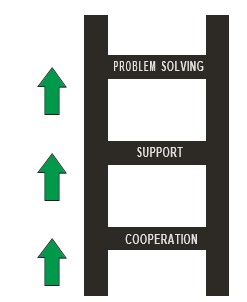
Figure 5. The ladder of group development.
- Adhere to Collective Decision Making
- Take Turns: Communal Leadership is Shared
- Fearlessly Confront Conflict as Opportunity
- Take Responsibility for Each Other’s Emotional and Physical Safety
- Allow and Make Mistakes
- Communicate Your Boundaries
- Respect the Feelings of Others
- Take Risks
- No Put Downs
- Include Everyone, Work with Everyone
- Listen and Repeat What You Hear
- Show Respect for Each Other
Section II: The Adventurous Community
The 4-H Youth Development Program and the 4-H Adventure Education Program have a mission to strengthen life-skills in young people. Using the Adventure Education model, be it on a ropes course, a backpacking trip, a club meeting, or in a classroom, the objective is to build successful communities of individuals who are learning from themselves and each other.
In this section, a number of current theories and constructs that define youth development and group work are presented, as well as a brief exploration of the facilitator’s relationship to this process.
The Individual

A group is comprised of individual members, each with his and her own unique needs and aspirations. Part of a facilitator’s task is to recognize and build upon the individual differences of the group members. The goal is to provide an enriching experience for each individual, as well as the group as a whole. Basic theories of individual human development are listed below, and provide a foundation for understanding individuals and their behaviors.
Basic Human Needs
In 1943 Abraham Maslow developed a theory of motivation based on a hierarchy of human needs (Maslow 1943). His model focuses on the following basic human needs:
- Physical Safety. All humans have basic physiological needs which they must meet: food, air, shelter. People need to know that they are physically safe. If they don’t feel safe, this need preempts meeting any other needs. For young people, who often do not directly control this element of their lives, physical threats in unsupportive environments can be traumatizing.
- Belonging and Affection (Social Needs and Emotional Safety). People need affiliation. For youth, feelings of personal worth are often tethered to what others think of them. Affection or love is essential to personality development. Young people want to know that they are accepted unconditionally. Supportive groups can aid in meeting such needs. The desire to belong is natural.
- Independence and Power. Needing to act independently and to exert power over others are two sides of the same coin. Ultimately, the goal is to achieve a sense of competence and autonomy. Groups that share and encourage leadership can help keep the focus on communication and supportive relationships.
- Achievement and Self Esteem. People need to be recognized for their accomplishments. Youth want to know that their efforts are worthwhile and appreciated. People can also get a sense of achievement through what they do for others, as well as for themselves. Bear in mind that individual definitions of achievement will vary.
- New Experiences (Self Actualization). The true self emerges when we encounter new situations or new problems to solve, and we produce unique responses.
The resulting construct is provided to help facilitators understand the reasons why 4-H programs are structured the way they are. Facilitators are encouraged to find ways their programs can incorporate the Essential Elements. With the Essential Elements present, the evidence is clear: youth become caring, capable, and contributing adults.
Belonging
- A positive relationship with a caring adult. A caring adult acts as an advisor, guide, and mentor. The adult helps set boundaries and expectations for young people. The adult could be called a supporter, friend, and advocate.
- An inclusive environment (affirming, belonging). An inclusive environment is one that creates a sense of belonging, encourages and supports its members with positive and specific feedback. Healthy groups celebrate the success of all members and takes pride in the collective efforts of all.
- A safe environment—physically and emotionally. Youth should not fear physical or emotional harm while participating in a 4-H experience; whether from the learning environment, adults, other participants, or spectators.
Mastery
- Engagement in learning. An engaged youth is one who is mind-ful of the subject area, and builds relationships and connections in order to develop understanding. Through self-reflection, youth have the ability to self-correct and learn from experience. The engaged learner has a higher degree of self-motivation and an inexhaustible capacity to create.
- Opportunity for mastery. Mastery is the building of knowledge, skills, and attitudes; and the demonstration and competent use of this learning in the manner of a proficient practitioner. The level of mastery is dependent on the developmental ability of the individual child or youth. The development of mastery is a process over time.
Independence
- Opportunity to see oneself as an active participant in the future. To see one’s self in the future, is the ability to harness the hope and optimism to shape life choices that will facilitate the transition into adulthood.
- Opportunity for self-determination. Believing that one has impact over life’s events rather than passively submitting to the will and whims of others is self-determination. Youth must exercise a sense of influence over their lives, exercising their potential to become self-directing, autonomous adults.
Generosity
- Opportunity to value and practice service for others. Finding one’s self begins with losing yourself in the service of others. Service is a way for members to gain exposure to the larger community, and indeed, the world itself.
Ages and Stages of Development
Throughout our lives, our needs change. Youth have different needs at different ages, and will go about meeting those needs in different ways. 4-H capitalizes on the potential of youth to be of service to their peers and act as partners with adults. Listed below are general developmental characteristics for each age, and strategies to help facilitate experiential learning.
Table 1. Developmental Characteristics and Facilitator Strategies for Youth in Grades 4 to 5 (9 to 10 years old)
| Characteristics | Facilitator Tips |
|---|---|
| Learn best when physically active. | Allow youth to participate in activities where they can use physical energy. |
| Have a special attachment to older youth. | Allow youth to choose an older youth to be a helper and role model. |
| Are easily motivated and eager to try something new. | Offer a wide variety of learning experiences. Use encouragement to keep them motivated. |
| Often have rapidly changing interests. | Use varied, short-term activities to keep them interested. |
| Seek acceptance by peer group. | Use the peer group to recognize good work. Applaud sincere attempts as well as successes. |
| Enjoy both cooperation and competition. | Plan activities that allow youth to work together, along with activities that have them compete with each other. |
| Show independence by seeking individual attention and sometimes disrupt the group. | Involve youth in selecting activities they would like. Give individual attention. |
| Have a natural curiosity. Constantly ask “why?” | Provide activities that allow youth to discover their own answers. Encourage them to share their personal discoveries. |
| Tend to want to judge in absolutes. | Provide opportunities to see the “middle ground.” |
| Need feelings of competence to enhance self-concept. | Provide activities which will let youth feel good about themselves and succeed. Recognition ceremonies before family and peers means a great deal to this age group. |
| Are able to consider other people’s perspectives. | Role playing, case studies, and stories illustrating other people’s viewpoints contribute to the development of empathy. |
Source: Adapted from N4HCCS curricular materials, 2003.
Table 2. Developmental Characteristics and Facilitator Strategies for Youth in Grades 6 to 8 (11 to 13 years old)
| Characteristics | Facilitator Tips |
|---|---|
| Are concerned about physical development. | Encourage learning experiences which promote healthy body image. |
| Are ready for in-depth, long-term learning experiences. | Activity should have increased expectations, provide more challenges, and permit deeper exploration of leadership roles. Provide hands-on and skill-centered experiences in specific subject matter. |
| Can take responsibility in planning and evaluating their own work. | Give youth responsibility for group activities, including planning, implementing, and evaluating. |
| Tend to avoid difficult tasks due to concerns about failing. | Encourage youth to participate in challenging tasks. Help them to succeed and acknowledge dedicated effort, as well as success. |
| Desire a sense of independence and want to make decisions, but still depend on adult guidance. | Establish guidelines that give parameters for youth to follow. Encourage them to work with adults and older teens to complete learning experiences and apprenticeships. |
| Seek heroes and idols. | Create opportunities for youth to practice leadership roles with coaching. |
| Tend to be self-conscious. | Activities should promote individual skill development, which promotes self-esteem. Avoid asking youth to share their work individually until they feel more comfortable in the group. |
| Are interested in learning more about their community. | Encourage activities which provide opportunities to explore the community. |
| Gain skills in social relations with peers and adults. | Provide activities which foster social interaction with peers and adults. |
| Feel peer-pressure; first from the same sex, then from the opposite sex. | Have group give encouragement to individuals. |
| Commonly feel infatuated. | Interest in others is often shown in contrary behavior, such as pushing and hair pulling. Allow for appropriate social interaction involving boys and girls. Let youth choose partners. |
| Enjoy doing things valued by peer group that lead to personal satisfaction and self-improvement. | Provide activities and experiences valued by the group. |
| Feel strong emotional attachment to older youth and adults. | Encourage youth to develop appropriate relationships with older youth and adults. |
| They are beyond the age of fantasy, but are still struggling with values. | Assist youth in making realistic choices. Review their plans, discuss alternatives, and help them weigh options before making decisions. |
| Can look at cause and effect situations. | Provide opportunities for exploring consequences of making different choices. |
| Are interested in activities of a physical nature. | Encourage fun, active learning experiences. |
Source: Adapted from N4HCCS curricular materials, 2003.
Table 3. Developmental Characteristics and Facilitator Strategies for Youth in Grades 9 to 12 (14 to 18 years old)
| Characteristics | Facilitator Tips |
|---|---|
| Express emerging personal philosophies. | Use activities where youth search for experiences which will allow them to identify their own philosophies. Provide outlets for self-expression. |
| Patterns of interest have become more definite. | Encourage more in-depth pursuit of leadership roles and life skills. |
| Enjoy discussing the world situation, as well as personal activities. | Encourage discussion of events and feelings. |
| Reach a higher level of abstract thinking and problem solving. Can analyze events that have multiple causes and effects. | Put youth into real life problem-solving situations. |
| Show strong desire for status in peer group. | Develop a climate in which youth are encouraged and supported by peers. Provide opportunities for youth to exercise their leadership skills. |
| Need and want a strong voice in planning their own program without adult supervision, but need help in anticipating consequences. | Encourage youth to plan programs with facilitation by adult leaders. Advise adults to provide guidance and support rather than direction. |
| May have feelings of inferiority and inadequacy. This can be widespread, although youth may be unaware that others feel similarly. | Encourage and help youth see their positive worth and talk about their feelings. Develop activities where youth hear how others cope with, and resolve, these feelings. |
Source: Adapted from N4HCCS curricular materials, 2003.
Challenging the Whole Child
Adventure-based education challenges traditional education models, asserting that effective learning—necessary learning—isn’t purely cerebral (from the neck up), nor is it the job of the educated to pour knowledge into the “empty vessel” of the student.
Adventure education is constructivist in nature, asserting that meaning is derived from individual experience, and that everyone interprets experience differently. Several more recent constructs of youth development and learning echo these long-held sentiments of adventure-based theory. Summarized below are three such models: Multiple Intelligences (Gardener 1983), the 4-H Targeting Life Skills model (Hendricks 1996), and a 4-H Diagram of Social Emotional Skills. A closer inspection reveals how meaningful adventure-based experiences help youth develop many of the traits deemed as worthwhile, healthy, and necessary.
Multiple Intelligence Theory
Intelligence is the ability to find and solve problems and create products of value in one’s own culture.” — Dr. Howard Gardener
Multiple intelligence refers to the notion that people can be smart in a multitude of ways—at least 8 or 9 ways, according to criteria developed by Howard Gardner (Gardener 1983). In the past, intelligence has been viewed as a single factor, generally related to verbal and logical reasoning abilities. In contrast, Gardner suggests that verbal-linguistic skill and logical mathematical reasoning are only two of several intelligences. If intelligence refers to the ability to solve problems or fashion valued products, then multiple intelligences represent different methods and symbolic systems for problem-solving or creating products.
Learning Modalities
- Verbal and Linguistic: facility with words, languages.
- Logical and Mathematical: pattern recognition, abstract reasoning, calculation.
- Visual and Spatial: schematic visualization, graphic representation, mechanically adept.
- Bodily and Kinesthetic: learn through touch, movement, mimetic ability.
- Musical and Rhythmic: sensitivity, recognition, and reproduction of melody and rhythm.
- Naturalistic: recognizes relationships with nature, classification, identification.
- Interpersonal: effective communicator, empathetic, motivator.
- Intrapersonal: transpersonal sense of self, intuitive, concentration, spiritual.
Multiple intelligence theory is not an educational prescription or methodology, nor is it an end in itself. At the heart of Gardner’s philosophy is the understanding that each person is a unique individual with unique learning abilities and needs. Gardner encourages that learners receive instruction in a variety of learning domains: music, art, creative movement, drama, environmental awareness, interpersonal skills, thinking skills, and self-reflection. While we identify and provide opportunities for learners to more fully develop their talents in their strength areas, they can also be encouraged to explore other expressive styles, not just the ones that come easily.
Creating an inclusive adventure community could involve group chanting or singing, climbing, hiking, practicing balance, communicating feelings, or exploring group dynamics meta-cognitively. Ideas for processing in accord with different learning styles will be explored in Section III.
4-H Targeting Life Skills
While many programs of public education have become focused on benchmarks and standards for the measurement of academic knowledge, 4-H has maintained an interest in supporting the development of the whole child: head, heart, hands, and healthy lifestyles. Youth development is a process of mental, physical, social, and emotional growth, during which young people prepare to live productive and satisfying lives.
Facilitating learning communities and using adventure-based activities provides youth with numerous opportunities to develop important personal and social skills they aren’t likely to learn through traditional educational methods.
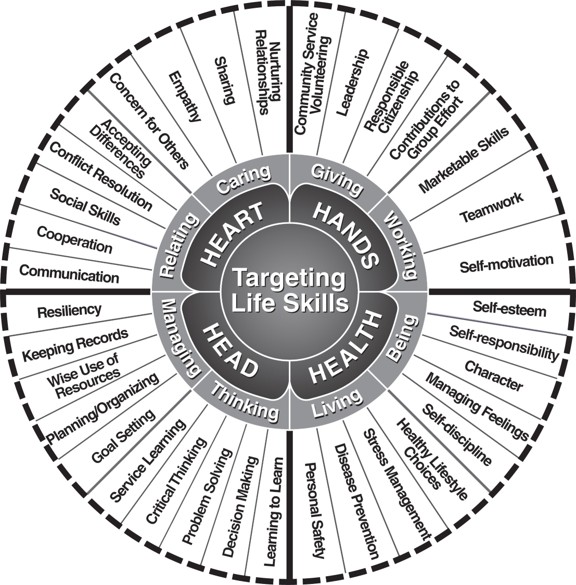
The 4-H Targeting Life Skills Model (Hendricks 1996) lists several life-skills youth develop when participating in experiential learning, and a number of these can easily be extracted as tangible outcomes of adventure based learning.
This model is designed to help facilitators select a few key life-skills to focus on in program development. While activities may touch on many life-skills, research suggests that choosing two or three, supports greater gains in life-skill development. Experience has demonstrated that adventure education lends itself particularly well to the development of life-skills, such as goal setting, self-responsibility, self-efficacy, problem solving, healthy lifestyle choices, communication, cooperation, teamwork, empathy and nurturing relationships. However, a skilled facilitator could address any life-skill though experiential learning.
For adventure facilitators, the life-skills wheel (Figure 6) is a great tool to use with the group or stakeholders to identify the skills the group wants to improve upon. A facilitator can then focus their debrief questions and observations on life-skill building that the group supports. The Targeting Life Skills Model is also supported through an online evaluation template.
Social Emotional Learning
The design of social emotional learning (SEL) is based on the predicted outcomes of participating in the processes by which we acquire life-skills, including the skills to deal with ourselves, others, relationships, and work in an effective manner (Figure 7). Daniel Goleman’s book, Emotional Intelligence: Why It Can Matter More Than IQ (Goleman 1995), and the Collaborative for Academic, Social, and Emotional Learning (CASEL 2013), both stress the importance of early developmental experiences on the acquisition of social emotional intelligence.
Carefully delivered adventure activities can provide an opportunity for the development of social emotional intelligence that is not coercive, prescriptive, or manipulative. A facilitator can help participants recognize and speak up for their needs. The most meaningful insights for individuals as they participate in adventure education experiences, are often those insights that encourage social and emotional growth. Experiential learning, such as that provided through 4-H, is at the nexus of personal growth.

The Group
The changes that take place in individuals through adventure education are often enhanced by the presence of a supportive group that shares a common agreement on communication and goals. While the Full Value Contract helps a group communicate its needs for a physically and emotionally safe space to work within, helping a group become focused on their goals, empowers them to succeed.
Creating Intentional Communities
Effective facilitators grow to recognize that the greatest power of change comes from within the group. Groups evolve like individuals, with goals, aspirations and challenges to overcome. Here are the principles that support adventure-based education:
- Shared Membership. In a community, it’s important that everyone feels welcome and included. If individuals don’t feel accepted and valued for who they are, they are unlikely to take healthy risks and try new things. Furthermore, they are unlikely to fully contribute to the best of their ability.
- Shared Purpose. Creating a meaningful reason for being together and engaging in activities is vital to the success of the community. This can be created as a motto, a mission statement, or something more symbolic, like a metaphor introduced by the facilitator. Each member of the community should be able to recognize the relevance of their engagement.
- Shared Norms. Creating behavior-expectations establishes the culture of the community. Taking time to develop shared norms is the first step to creating a safe environment where participants are willing to take healthy risks that lead to growth. Regularly referring to these norms, and reflecting on how well the community is living up to them, is critical for ongoing success.
- Shared Skills. A community needs to recognize its social, emotional, and intellectual assets that will allow it to be successful. The intentional recognition and development of these life-skills is foundational for a community to successfully reach their goals.
- Shared Outcomes. Creating meaningful and shared goals and objectives is essential for a group to focus as a learning community. As a community, a common understanding of their goals and targeted outcomes will increase their level of success.
Stages of Group Development
Adapted from “Developmental Sequence in Small Groups”. (Tuckman 1965).
Groups, like people, go through developmental stages as they form and evolve. It’s very helpful for a small-group facilitator to understand this concept; to be able to recognize what stage the group is in, and to know when the group moves to a new stage. This knowledge affects how the facilitator sequences, briefs, leads, and debriefs the activities.
The nomenclature and general characteristics of the first four stages of group development—forming, norming, storming and performing—were put together by Tuckman (Tuckman 1965). The fifth stage “transforming,” was added later. This model can help groups understand what they have been through, or what they are going through. It is important to keep in mind is that this process is not strictly linear. A group can move back and forth between stages at any time (Schoel, Prouty and Radcliffe 1988).
Each stage in the model can be viewed in the form of a question, as shown below.
Forming: “Who am I in this group?”
This is the initial stage that a group goes through when participants first come together or when there is major group restructuring, such as a significant change in membership. According to Schoel, confession, anxiety, and a willingness to please, are some of the traits exhibited by members in this stage. There is usually a scramble for leadership, with members acting as individuals that do not effectively contribute to the group. Johnson and Johnson added the determination of rules and procedures to the forming stage (Johnson and Johnson 1994). In adventure education, this is the development and implementation of a Full Value Contract.
The task of a facilitator is to help the group pass through this development stage on its journey toward its goals. To help alleviate anxiety, and begin to find commonality, it is useful to focus on icebreakers, name games, and simple group challenges. Building on Schoel’s idea that in the forming stage members are willing to please, facilitators can help the group start to recognize its collective strength by giving it a simple problem to solve.
Important components of the problem-solving quest should assure that:
- all members of the group participate in the problem-solving
- the group sets a common goal, and
- there is a high chance of success in solving the problem.
Schoel points out that this initial success is a good reference point for the group when things aren’t going as well. When someone questions the facilitator’s authority, or some kind of conflict arises in the group, the group has moved to the next stage.
Storming: “Who am I with others in this group?”
This stage may be uncomfortable for both the facilitator and the participants, but it is essential stage for a group to go through. It is through the storming process that the participants can answer the questions, “Is this group safe?” and, “Can the facilitator (or self-elected leaders) handle us?” Schoel defines this stage as a time when alliances are formed, negative behavior happens, and leaders are tested.
Johnson and Johnson see the group members differentiating themselves through conflict. Some of this conflict comes from members not taking responsibility for their own actions and needs. They also use the term rebellion in defining the storming stage: rebellion against the leader, the procedures, the rules, or even the outcome. A much less emotionally-charged, but quite useable definition, is when conversation moves beyond neutral subjects like names and shoe size. The underlying motive, from a participant’s perspective, is to test, “How safe am I in this group? Can I express my opinions, ask to have my needs met, or disagree with another member, without being ostracized or ridiculed?”
Johnson and Johnson came up with a good metaphor for facilitating this stage: “a group at this stage is like teaching a child to ride a bicycle; one runs alongside to prevent the child from falling, but must let loose so the child can learn to balance on his or her own.”
Facilitators need to be there to help the group understand their Full Value Contract, and to keep the process emotionally and physically safe; while at the same time, letting go of control so the group will take ownership in its own process and success. The group needs to move toward setting and monitoring its own boundaries, as opposed to having them imposed from the outside.
As the group passes through this stage, it needs activities to be well defined, so the participants have something with which to gauge their progress and interactions, as well as something to rebel against. When the group reaches its transition point to the next stage, differences among members will be accepted, and the group as a whole, will be internally focused. It is worth noting that participants arriving in a group following a storming stage have additional challenges to face towards inclusion.
Norming: “What are we going to do?”
By this stage, the relationships in the group have been defined. In the norming stage, Schoel sees the group operating as a unit, using its own strengths, and moving away from dependence on the facilitator. They take pride in their accomplishments, and are able to confront each other in terms of their goals and behaviors. The markers that Johnson uses to denote this stage are cohesiveness and commitment. The group discovers new ways to work together and sets norms for appropriate behavior. It takes ownership in itself, in other words “it’s our group” instead of “it’s the facilitator’s group.” The members have become committed to each other. The group begins to be responsible for itself and presents a united front to the outside world; values, questions, and motivation can be discussed openly.
It is at this stage of development that group members solidify their bonding process. They start taking responsibility for each other. It is now safe to share ideas, thoughts, and feelings with the group—which leads to greater trust. In other words, the group has become interdependent. What this means for facilitators, is that they can give the group more open-ended problems to solve. The ownership of rules, process, and outcome now belongs more to the group than to the facilitator.
Performing: “How are we going to do it?”
When a group reaches the performing stage, they are ready to look outside of themselves. Groups in this stage may be open to outsiders, seeking contact with the wider community and trying to extend their influence. They get work done. Developing proficiency in achieving goals and flexibility in patterns of working together, are some of the things that Johnson and Johnson see taking place at this stage. This flexibility can be observed in several ways. The group spends time on both task and group maintenance as needed. The group is truly collaborative, recognizing, using, and valuing each member’s skills and abilities. Controversy is encouraged and conflicts are openly confronted and resolved.
One of the key ingredients needed for a group to reach this stage is time. A one-day or short-time experience usually will not get a group to this stage. How much time it will take depends on a number of variables, including the make-up of the group, the goals they are trying to achieve, the planned duration of the group, the sequence of activities, and the skill of the facilitator.
Transforming
This stage usually occurs when a group comes to an end, or goes through a major restructure and a shift in goals. Johnson and John-son point out that the longer a group has been together, and the more bonded they are, the harder this process is. It is important to let a group process their feelings of loss and what the group has meant to them. Closing ceremonies and ritual can be helpful at this stage. As a group facilitator, do not discount your own feeling of loss. It is very appropriate for you to be an active part of a closing process.
There are many activities which can help this process. For some groups that have the time, it is useful to let them plan the closure of the group. Be aware that the closer the group gets to the end, the more you will see behavior changes. The members may start acting out, and the group may have a hard time staying on task. It is sometimes useful to point these changes out and get the group to deal with them.
Group Behaviors
(Adapted with permission from Functional Roles of Group Members, Benne and Sheats 1948).
Behavior in a group can be viewed in terms of what its purpose or function seems to be. When a group member says something, is that person trying to get the group’s tasks accomplished (task-oriented behaviors), to improve or fix relationships among members (maintenance-oriented behaviors), or to meet some personal need or goal without regard to the group’s problems (self-oriented behaviors)? As a group grows and its members’ needs become integrated with group goals, there will be less self-oriented behavior and more task or maintenance behavior.
Consider how the behaviors listed below align with our basic needs.
Task-Oriented Behaviors
Task oriented behaviors ensure that the group’s task will be accomplished.
- Initiating. For any group to function, some person(s) must be willing to take some initiative and propose ideas or procedures. These can be seemingly trivial statements like, “let’s build an agenda,” or “it’s time we moved on to the next item;” but without them, little task-related activity would occur. People would either sit in silence or develop side conversations.
- Seeking or Giving Information or Opinions. The clear and efficient flow of information, facts, and opinions is essential to task accomplishment. Giving-type statements, such as, “I have some information that may be relevant,” or “My own opinion in this matter is…,” ensure that decisions are based on full information. Information-seeking statements not only help the seeker, but the entire group. This person asks for, as well as offers ideas.
- Clarifying and Elaborating. Many useful inputs into group work get lost if this task-related behavior is missing. Clarifiers communicate a listening and collaborative stance. The clarifier illuminates or builds upon ideas or suggestions of others.
- Summarizing. At various points during a group’s work, it is very helpful for someone to summarize and pull together the discussion. This gives the entire group an opportunity to pause, step back, and see how far they have come, where they are, and how much further they must go to complete their work.
- Consensus Testing. Many times a group’s work must result in a consensus decision. At various points in the meeting, the statement, “Have we made a decision on that point?” can be very helpful. Even if the group is not ready to commit to a decision, it serves to remind everyone that a decision needs to be made, and as such, it adds positive work tension into the group. This behavior explores whether the group may be nearing a decision.
- Manipulating: Introducing or supporting ideas that meet one’s personal needs and interests regardless of whether they are in the best interest of the group.
- Clowning: Clowning, joking, or mimicking, which disrupts the work of the group.
- Seeking Attention: Attempting to call attention to one’s self by loud or excessive talking, extreme ideas, or unusual behavior.
- Withdrawing: Acting indifferent or passive, resorting to excessive formality, day-dreaming, doodling, whispering to others, or wandering from subject.
- Competing: Conscious or unconscious striving to rival others. An effort to appear more competent, useful, and able than others in the group in order to gain favor from important people.
Rules and Rights of Group Work
These rules and rights of groups, like the Full Value Contract or shared principles of learning communities, can help mitigate self-oriented behaviors.
Ground Rules for Effective Group Work
- All members will actively listen and participate.
- Test assumptions without being competitive.
- Share relevant information, be specific and use examples.
- Focus on interests, NOT positions. Suspend ego.
- Agree on what important words mean.
- Make statements and invite questions and comments.
- Explain reasoning behind statements.
- Openly disagree. Discuss the un-discussable issues.
- Do not take cheap shots or otherwise distract the group.
- Do self-critiques.
- Do your homework. Prepare in advance for meetings.
Group Members Individual Rights
- Members have the right to be silent.
- Members have the right to be heard without interruption.
- Members have the right to ask questions.
- Members have the right to their own opinions.
- Members have the responsibility to respect others.
- Members have the right to confidentiality.
The Facilitator
Being an effective facilitator can be demanding, and requires highly developed skills. Facilitators must be willing to share their skills and knowledge on a personal and professional basis with a variety of people. Because concern for physical and emotional safety is a critical foundational piece of the program, they must develop the highest level of expertise in interpersonal and technical skills, as well as demonstrate a working understanding of experiential learning.
The Role of an Experiential Facilitator
Experiential facilitators are individuals who work with groups of people, presenting games and activities in a way that is designed to build community and develop life-skills. Fun is a considerable element of this process, however, the philosophy within the 4-H Adventure Program is that this is more than just a recreational adventure—it is an educational process.
A facilitator doesn’t direct a learning process; a facilitator guides a learning process. A facilitator doesn’t provide all the answers to the group; he or she creates a process that allows participants to learn from each other and the experience. Facilitators don’t shape the learning outcomes; they allow the group to shape its outcomes. Facilitators avoid pushing their ideas on a group; they support group members in communicating ideas.
Facilitators implement an adventure-based learning model, take participants out of their standard frame of reference, and allow them to see things from a different point of view. However, the experience doesn’t end with the completion of the activity. Facilitators help participants relate what they have learned back into their regular life.
Facilitators build a framework for support by:
- Allowing participants to share pieces of themselves without fearing that they’ll be laughed at or ignored;
- helping participants to recognize that there are people who support them;
- and allowing participants to take appropriate risks within a supportive environment.
Facilitators set a fun and energetic tone. If the facilitator demonstrates by example that it’s okay to look silly, participants will feel more willing to take emotional or physical risks.
Identifying Stakeholder Objectives
Just as facilitators will help participants identify their individual and group goals, it is important to have a solid understanding of the participating stakeholder’s objectives for using adventure-based education programs (stakeholders are the people who contract with a facilitator for program services). Use the Spectrum of Adventure Based Activities model (Figure 1) to help those seeking facilitation to understand their objectives.
- Are the stakeholders just looking for recreation?
- Are they trying to build a more cohesive team?
- Are they trying to identify their organizational objectives?
Knowing what your audience needs will help you to design a meaningful sequence. Likewise, knowing when you are being asked to facilitate out of your field of experience is also important. If, for example, someone needs facilitation for therapeutic intervention, and you are not a qualified therapist, you should decline and refer them to someone who is qualified to provide the service they seek.
Some broad examples of stakeholder goals might include helping their group members communicate more clearly with one another; helping their group work together better; or helping their workers take more ownership in their work.
Adaptive Leadership: A Time and a Place for Everything
The facilitator’s approach to experiential teaching and learning is important. Generally, when a facilitator first engages with a new group, he or she may be more directive, helping people make connections, setting boundaries, and the like. As the participants become more comfortable with each other, and begin to demonstrate signs of norming (operating as a unit, using their own strengths, and moving away from dependence on the facilitator), the facilitator can reduce the amount of direct leadership provided. This allows for the group’s natural leadership processes and structure to develop. Leaders emerging from the group will also demonstrate some degree of directive or supportive leadership. Reflecting on how we lead can be an enriching component of adventure education.
Adaptive leadership is based on the premise that there is “no one right way to lead.” Each style of leadership has its strengths and limitations. Leadership can be as unique as individuals. Good leaders are able to maximize their effectiveness, positively impact performance and group satisfaction, and task completion by adapting their leadership style to the situation. They recognize the need to intentionally alter their style to fit the situation, the needs of the people involved, and the established goals; rather than demanding the situation and people fit their style. This allows a facilitator to approach each situation as a unique, new set of problems, goals, and recourses.
- Directive or Impersonal Leadership helps a group that needs structure and boundaries established.
- Interactive or Interpersonal Leadership engages the group through coaching, participation, and guided reflection.
- Non-active or Intrapersonal Leadership gives space to participants to reflect upon their own experiences and act accordingly.
It is important to recognize the needs of the group and match one’s leadership style to those needs. A leadership style mismatched to a group’s needs could have a considerably negative impact on the growth and development of the group.
A Code of Ethics
Adventure facilitators are acting in a highly professional capacity. One of the criteria required to be a professional facilitator is a code of ethical behavior. Listed below are some of the commonly held tenants of this profession.
Uncertain Outcome
Since adventures are defined as experiences with uncertain outcomes, facilitators employing adventure-learning methods frequently avoid rescuing participants—that is, giving away the answers to difficult tasks, solving problems they encounter along the way, or making decisions for them. As an experienced facilitator, it is easy to know it all and be swayed into helping a group, but that takes the success of learning away from the community the facilitator is there to serve. By giving away the ending, the spirit of true adventure is destroyed and the learning potential is severely compromised. The only exception is when real dangers are present. If the group appears to be heading for trouble, accident, or injury, then the facilitator’s intervention and assistance are expected.
Challenge by Choice vs. Coercion
Perceived freedom of choice is a necessary antecedent to adventure. Take away the participant’s power to decide for themselves by forcing their involvement, and they are likely to attribute success or failure to the person who made them do it, and not to themselves. Not only is this somewhat morally inappropriate, it may border on negligence; if injury should occur, the participants can claim they were forced to comply against their will. Facilitators using adventure-learning methods avoid coercing participants, and prefer to operate under Project Adventure’s axiom of Challenge by Choice (Project Adventure 1991) as a means to diffuse any mandated or obligated participation by a higher authority.
For facilitators, this may mean encouraging participants to attempt tasks even when they say, “I can’t do it.” However, the instant the participant asserts, “I won’t do it!” the facilitator must back off and honor the decision.
While the method is not foolproof, it does provide reasonable guidance. For some participants, being able to say “no” is far more important than completing the task (and ignoring their affirmation can prevent a major breakthrough). Ultimately, choice creates ownership for the participant.
Perceived Risk vs. Actual Risk
Participants in effective adventure activities will take physical, emotional, and social risks. Some fear increases personal motivation and challenge. It is desirable that participants perceive a risk to their safety, even though the risk is actually minimal. The conditions of a physical environment evoking feelings of intimidation are much better than having it come from another human being. This is one reason why adventure challenges have traditionally been set outside of the participant’s usual environment. On outdoor adventures, facilitators must carefully teach and monitor technical skills, use of equipment, and safety concepts. After participants are informed of the prescribed safety precautions for each activity, they assume responsibility for their participation by making a verbal commitment to participate at their chosen level.
Adventure experiences provide natural or inherent risks, and these facilitator-mediated risks provide participants with opportunities to grow through their inhibitions. Facilitators should not present risks that present a real danger to participants.
Empowerment
Another prerequisite to adventure is the use of personal competence and the opportunity to exercise control over one’s environment and actions; thus attempting to influence the way an adventure turns out. Consider rafting in a motorized craft—it is certainly exciting—but it’s more chance than challenge, because success and failure is in the hands of the engine operator, and all the participants do is hang on. Put paddles in their hands, and they are likely to be empowered by the challenge, and will likely learn from their own successes and failures.
The “amusement park” approach to adventure programming, in which participants are removed from attending to safety and group responsibility, is a good example of disempowerment. Such exclusion can lead a participant to further dependence on program or facilitator expertise. It can also interfere with the development of a strong team, caring for group members, and may even be injurious, as safety is an attitude to be shared by all.
Natural Consequences
People learn from their mistakes, and this is one of the fundamental premises of adventure programming. For this reason, facilitators can never afford to be put in a position where they give reward or punishment for a participant’s success or failure. The consequences of participants’ decisions must be real and natural (such as enjoying a beautiful view and sense of accomplishment from reaching the summit, or the embarrassment of getting lost and walking an extra two miles into nightfall).
Flexibility
Flexibility is one of the reasons why experiential education is so powerful. Adventure programming allows each participant to grow regardless of where they are starting. Non-experiential education techniques often teach to a fictitious person called “Norma Normal” or “Norm” (the middle or average person in the group). By doing so, these practices neglect the people who need more challenge (and thus, are bored), and those who need less challenge (and are anxious). Rarely does “Norm” ever exist. Good facilitators recognize that an adventure is a state-of-mind, which fluctuates according to each participant’s perceptions of situational risks and personal competence. Flexible facilitators are pre-pared to offer a range of challenges to participants in the same activity (such as a different craft for paddling, or various climbing routes for the same cliff).
Furthermore, if a facilitator is working on improving communication, and finds a lack of trust a barrier, the facilitator must be flexible enough to change the program activities to evolve with the needs of the participants.
Sound Judgment
Sound judgment is a critical component of the safety and effectiveness of adventure programming. A facilitator needs to monitor their personal situations that can impact their judgment, such as personal issues or health concerns. Facilitators need to be open to improvement of judgment skills through peer feedback and skills evaluation. More information on judgment and behavior expectations can be found in the 4-H Code of Conduct.
Confidentiality
For groups to be more open, a level of confidentiality needs to exist between participants and facilitators. Participants should agree to honor the confidentiality of the experience, and what arises during and after the adventure process. When facilitators have discussions regarding participants’ challenges, those discussions should be limited to improving participant experiences and be held in professional confidence. Certain job requirements, child protection, and safety may be reasons to break confidentiality. Contact your local 4-H staff for support if needed.
Experiential Processing
Adventure experiences should be debriefed after they have taken place to avoid losing experiential learning potential. Adventure without reflection is bound to be good recreational fun, but not our organizational goal. Similarly, giving participants an opportunity to apply what they are learning from an experience, or debrief, helps ensure that the learning has the opportunity to transfer to other experiences.
Environmental Protection
Adventure programs were borne out of wilderness experiences and have strong ties to the environment. We recognize synergy and interdependence of living systems as foundational principles of the work we do, and respect and preserve the natural environments in which we work.
Section III: The Art of Facilitation
Introduction to Facilitation
In Section III, the details of the processes through which facilitators provide meaningful experiences to adventure participants. Remember, facilitation is a skill that improves with experience, and the best facilitators never lose sight of fun.
The Process
Adventure Wave Theory
Adventure Programming operates on the adventure wave theory (Figure 8), which allows for peaks, valleys, turbulence, excitement, periods of calm, and periods of activity. When one wave is finished, another one follows. It is an ongoing and continuous process. Not all waves are the same size, but all should be driven by the energy of established goals. The facilitator makes ongoing assessments of participants during activities and debriefs. This reflection is a vital part of experiential education, and possibly the hardest skill for a facilitator to develop. Note in Figure 8 below, Safety, Individual and Group Goals, Challenge by Choice, and the like, are the bedrock to the wave theory.
Assessing the Group
The art of facilitation involves the constant assessment of the group and the adaptation of the sequence, based on the new information that ongoing assessment provides. The assessment begins the moment the facilitator starts discussing the group objectives with the organizing stakeholder (see Section II, Identifying Stakeholder Objectives). Once work has started with a group, an “on-the-fly” assessment can lead to changes in a debriefing plan, or the cessation of an activity for a safety or learning intervention. Using established assessment tools helps the facilitator gather information on the group and allows for structured discussion with other facilitators. One such tool is GRABBSS (Goals, Readiness, Affect, Behavior, Body, Stage, Setting), and covers most aspects of a group assessment (see below).

The Five Second Scan: Building Facilitator Observation Skills
A facilitator’s primary task is to monitor and observe the group for various physical or behavioral changes. This information is used for safety and better facilitation. With so many elements of an experience to assess, facilitators must condition themselves to repeatedly stand back from the activity to make a quick assessment of the group. The idea emerged that this takes about 5 seconds, hence a 5-Second Scan. Facilitator proximity is being aware of ones own presence, location, and impact on and within the group. Each adventure program shares common items to scan for, in addition to specific items, such as goals.
GRABBSS Modality Check List
This useful tool, adapted by Schoel, Prouty and Radcliffe (1988) from the Modality Therapy of Arnold Lazarus, (Lazarus 1981), can help keep the facilitator focused on the various aspects of their group throughout the adventure experience.
Goals
Readiness
Affect
Behavior
Body
Stage
Setting
Goals
- How does the activity relate to the group and individual goals that have been set?
Readiness
- Is the group ready to do the activity? Will they endanger themselves or others? Do they have the ability to attempt or complete? What will you have to do to change the event to compensate for lack of readiness? Readiness determines levels of instruction and safety considerations.
Affect
- What is the feeling of the group? What kinds of sensations are they having? What is the level of empathy or caring in the group?
Behavior
- How is the group acting? Are they resistive? Disruptive? Agreeable? Are they more self-involved, or group-involved? Are there any interactions that are affecting the group, both positive and negative? How cooperative are they?
Body
- What kind of physical shape are they in? How tired are they? How comfortable are they with physical engagement? How do they see their own bodies? Do your participants have a history of substance abuse? Are they on medication? Are there invisible disabilities?
Stage
- At which group development stage (forming, storming, norming, performing) is the group? Groups will go through levels of functioning. Having a schema to describe these levels provides another means of assessment.
Setting
- Where is the activity taking place? What is the relationship of the participants to that setting? This could take questions of culture, physical and environmental concerns, comfort, and familiarity into consideration.
Sequencing the Adventure Experience
A rigid sequence will not serve the needs of a group experiencing an adventure-based program. There are a variety of reasons why this is true, but the most important one is that groups will never experience the exact same process. Because of this, facilitators must be willing to adjust their sequence and pace in order to fully meet the needs of the group. Each wave in a sequence should build on the one before it, and all should be designed to move the group towards its goals.
The following pieces, when built into a sequence, make for a cohesive educational adventure, which should yield plentiful learning opportunities. These include lead-up activities and goal identification (to help group formation); followed by the experiential components of the brief, the activity, and its’ debrief. Understanding the components of the adventure experience will make adjustments and accommodations easier to facilitate.
Lead-Up Activities
These activities, which include goal setting, games, deinhibitizers, establishing a Full Value Contract, support and trust building, and initiatives, are essential as they allow time for the facilitator to assess the group’s abilities and potential, while giving the group an opportunity to get acquainted or become comfortable with one another on new terms. Everyone engaged should recognize that the group and its goals are the focus, not whether they get through all of the activities or not. The tone set by the facilitator during this time will affect the group’s experience in great measure.
In the introduction, individuals should be told what to expect from the adventure program. Their pre-conceived expectations often create a barrier to learning from the unexpected. Be clear with the group about your role as a facilitator: to ensure safety, instruct, facilitate, observe, raise issues, and clarify. Simultaneously, a facilitator should be clear about what they are not there to do: to force people to change, to judge, or to lay opposing values on them.
Checking In
At the beginning of the day, the facilitator may “check in” by asking if there are any physical or emotional issues the participants want to share with the group. This pre-brief can be delivered in as many creative ways as debriefs.
Deinhibitizers
Any time a new group of people assembles it is a little awkward. Quick Silly Games (QSG) are simple games and ice-breakers that help people feel more at ease and set a tone of fun for the experience. Name games are also very useful when a group is unfamiliar with one another. QSG can be used anytime a group needs to decompress or pick up energy. They don’t require debriefing.
Full Value Contract
As previously mentioned in this manual, the facilitator should establish a Full Value Contract with a group early on, and affirm Challenge by Choice. When the group is in the forming and norming stages, revisit these agreements as necessary, to pose questions when agreements are not met and to applaud the group when they are.
Goal Setting
During adventure activities there are rules, goals, or directives to initiatives that frequently occur, or the facilitator may ask a team to plan their goals before beginning an activity. Consciously keeping a group attuned to their goals, is an important and productive part of the adventure process. On occasion, a facilitator may stop an activity halfway through, and ask the participants to evaluate the feasibility of their strategies. Making goals as a group is an important activity in assertiveness, communication, critical thinking, and commitment.
Guidelines for Goal Setting
(Adapted from Sharp and Cox 1970)
To set effective goals, it is important that one observe the following guidelines. A goal must be:
- Conceivable. You must be able to conceptualize the goal so that it is understandable, and then be able to identify that goal to a group.
- Believable. In addition to being consistent with our personal value system, you must believe you can reach the goal. Few people can believe a goal that they’ve never seen achieved by someone else. This may have implications for goal-setting with socio-economically deprived groups and individuals.
- Achievable. The goals set must be attainable with your given strengths and abilities. Younger audiences need more assistance in identifying practical goals.
- Controllable. Goals should be within the boundaries of a group or individual’s influence.
- Measurable. Your goal must be stated so that it is measurable in time and quantity. For example, “By 3 p.m. Friday, we will have each led the group through at two activities.”
- Desirable. Your goal should be something that you, and each member of the group, really want to do. Whatever your ambition, it should be one that you want to fulfill, rather than something you feel you should do.
- Stated with No Alternative. Set one goal at a time. Goals can change as you progress, but a group should not be divided in focus.
- Growth-Facilitating. Goals should be positive, so that you can build on them in a healthy way. Help participants restate their negative goals in positive terms.
The Brief
The first problem for all of us, men and women, is not to learn, but to unlearn.”
— Gloria Steinem
How many times have you heard a student say, “What’s the point?” or “Why are we doing this?” Groups need to have a context for why they are engaging in an activity. Creating context is a very important step in the adventure wave called briefing.
Briefing is the facilitator’s opportunity to paint a common picture for the group, and give them the information they will need to plan, set objectives, and make a successful attempt of the task.
Briefing creates a sense of excitement, fun, and adventure. It also focuses the group on the upcoming task, which could be an adventure activity, a 4-H fundraiser, a community service learning project, or the fair. Briefing can also be used to bridge your group to their previous experiences and knowledge.
In this stage the facilitator explains the objectives and safety concerns of an activity in a clear and understandable manner. Caution is given to facilitators to avoid explaining the activity more than necessary. The activity and the process should belong to the group.
The use of creative and fun story lines can help create a sense of adven-ture. An appropriate metaphor can also help to make the activity more meaningful.
In sequential activities, the facilitator can remind the group of their previous experiences, and ask how they can build on what they have already learned about their process. When appropriate, the briefing is also a good time to set group goals.
Good briefing includes the following parts:
- A story line, metaphor or frame for the activity.
- Goals and objectives of the activity.
- Directives of the activity (the rules).
- Safety considerations.
Framing
Framing is the way the facilitator set up the stage of an activity. The use of a thoughtful frame or well-placed metaphor can greatly increase the relevance of a task or activity to the group. For instance, a rock face about to be climbed by a participant might represent obstacles in the individual’s life; while the rope represents their support from family, friends, and school. Another example is presenting a 4-H member faced with a stubborn fitting and showing animal with the metaphor of family members or friends who refuse to cooperate. A good frame provides a story or metaphor, which will become important in transferring skills learned in an activity, back to what the group or individual does on a regular basis (such as communication, accountability, cooperation).
Directives
A second piece of briefing is informing the group of the directives for the activity. These are sometimes referred to as rules, but a more accurate explanation would be setting up the boundaries and describing the “nuts and bolts” of the activity. Directives let the group know what they are to do and how they are to do it. For instance, if a group is told they need to plan an activity that will help improve the appearance of the community within the next month, directives might include budget, action assignments, and safety considerations. A ropes course activity is another example. Here, the facilitator informs the group of the task they are being asked to complete. For instance, “You need to get the whole group from one side of the cable to the other side of the cable without stepping off, and everyone must stay connected as a group.”
The conditions a group must follow in accomplishing the task are part of the directives. These conditions can be very specific. Narrowing the scope of the task down, is often done for safety reasons. On the other hand, with high functioning groups, the facilitator may purposely leave the directives vague and sketchy, allowing the group to define their own conditions for success.
Briefing for Safety
With all of the emphasis put on framing, directives, and group process, it is easy to lose sight of safety. Beginning leaders are encouraged to emphasize and pay attention to their delivery of safety instructions, and leave the metaphors to an experienced co-facilitator. An experienced facilitator should be able to cover both the group process and safety concerns of an activity comfortably. When in doubt, a prudent facilitator should consider choosing an activity that they are more experienced in leading.
Discussing safety concerns with a group during the briefing of an activity is an excellent way to focus their attention on the actual risk involved in an activity. For instance, if a facilitator was working with youth around large animals it would be advisable to cover the appropriate level of caution necessary to avoid being kicked, stepped on, or bitten. Discussing safe spotting techniques for low challenge courses, communicates shared trust and shared risk taking. Making participants aware of the safety concerns also allows them to make an informed decision on whether or not they wish to participate. This is part of the Challenge by Choice concept.
It is important for a facilitator to present the actual risk in such a way that it balances with the perceived risk, and does not intimidate the group. A useful strategy for this is to ask the participants what they see as safety concerns for the activity. This empowers the group, gives them practice in taking responsibility, and allows the leader to assess the group’s level of awareness regarding safety issues.
Groups that are less skilled at taking care of themselves and others, or have exhibited unsafe behaviors in the past, may need to hear and repeat back safety concerns before the framing or objectives. This ensures that they are listening to the safety instructions rather than visualizing themselves doing the activity or thinking of a plan. A leader can also repeat safety concerns several times during a briefing, or even during an activity, if it becomes necessary.
Ultimately, it is the facilitator’s job to make sure that the group understands all of the potential risks before engaging in an activity.
Additional Briefing Techniques
Altering Directives
Directives can be altered to meet the group’s skill level. For instance, setting directives lower can help a group achieve a feeling of success (as long as the activity doesn’t become unsafe); or directives can be more stringent, forcing a group to struggle before finding a way to complete the task. Setting directives so that a task appears achievable when it actually is not, will allow participants to cope with falling short of expectations and require them to redefine success (Did the group work together? Did everyone have fun?).
Directives may include limitations such as the number of required spotters, time allotted to plan or complete the task, physical boundaries, numbers of participants who may participate at once, and other “Dis-Abilities” (challenges or tasks that take away one or more of their senses or abilities).
Many of these alterations to directives can be done on-the-fly as a facilitator re-assesses skill levels in the group.
When planning an activity, a facilitator should never forget to factor in fun. Activities should be safe, but also engaging and inclusive, promoting a sense of adventure and personal challenge.
For facilitators, the attainment of an activity objective is actually of secondary importance. The process, the interactions, and learning that the group accomplishes during the activity are the facilitator’s focus. Successful facilitators are focused on the group members in the present moment. The metaphors and framing can help the participants make the connection between what was learned from interactions during the activity, and how to apply it to interactions with others outside the group. This connection, called transference, will be covered in the section on Debriefing.
Using Dis-Abilities
Dis-Abilities are challenges or tasks given to participants that take away one or more of their senses or abilities. Dis-Abilities usually create unfamiliar and unexpected responses, and as a result, raise the level of disequilibrium in participants and the group. This disorientation can facilitate in the restructuring of an individual’s beliefs.
Facilitators can use Dis-Abilities at any time or with any event, and the educational and therapeutic uses are unlimited. Deciding the who, what, where and when of Dis-Abilities, creates endless possibilities. It’s important to know the individuals well, so the Dis-Ability creates a constructive level of anxiety and not a destructive one. Stretching limits is vital, as is trying to ensure success for the individual and group. If the level of anxiety becomes too high, the facilitator should consider removing the Dis-Ability. Dis-Abilities can be used to make events more challenging for groups and individuals.
Another reason to use Dis-Abilities is to help individuals expand their potential. They are unable to rely solely on their strengths, like being verbal, being a leader, or using their physical power. The disequilibrium caused by Dis-Abilities compels participants to develop other abilities. When using Dis-Abilities, processing (de-briefing) the experience is extremely important in order to raise individual levels of awareness, and to increase the chances that participants will transfer the learning to other life challenges.
The “locus of control” is the extent to which participants believe they can control events that affect them. There are both external and internal locus of control. An example of external locus of control would be for a participant to use a blindfold; an example of internal locus of control would be having the participant close their eyes.
Below are common Dis-Abilities that can be used, and issues or themes to be gleaned when processing:
- Non-sighted. Participants are given a blindfold to put over their eyes. Issues include powerlessness, being out of control, trust in others or a higher power, sense of the unknown or unexpected, and use of new senses or ways of knowing. This Dis-Ability is particularly well suited for individuals in recovery from chemical dependency. A questions to ask might be, “What are you blind to in your future or recovery?”
- Nonverbal. Participants are unable to speak to others. This is good to use with a leader or take-charge type person. Issues include powerless, communicating in new ways, reliance on others, awareness of new senses, and being in new roles. A question to ask may be, “What things in your life are you speechless about?”
- Paralyzed. Participants are unable to use one or both of their arms or legs. This is good to use with someone who relies on their physical strength. Issues include disabilities, powerlessness, reliance on body versus mind, feeling like a victim, dependency, teamwork, sense of the unexpected, and vulnerabilities. A question to ask may be, “What paralyzes you in work, relationships, or life?”
- Joined. Participants are connected side-by-side, like conjoined twins, and must move together without any individual getting between them. This is a good Dis-Ability to use in couple or family work. Issues include compatibility, dependency on others, cooperation, enmeshment, consequences of how one affects the other, and commitment. This Dis-Ability can be used to get a passive and unengaged person involved when joined to an active leader-type. A question to ask may be, “What issues are you and your partner focused on?” In 4-H, doing public presentations in pairs is a good example of joined-participant work.
- Single Voice. Partners can only talk through another person. Somebody else is their voice, and they can only share ideas with this person who will then vocalize the idea to the whole group. Like the Joined Dis-Ability, Single Voice is a good way to get quiet participants involved, by sharing ideas to a leader with their voice. Couples and families are well suited for this Dis-Ability. In 4-H, senior members can shadow intermediate members who are practicing teaching younger members project skills. Issues include communication, listening, cooperation, not being heard, and being a leader. Participants will experience how it feels to only share another’s ideas and not their own. A question to ask may be, “What do you really want to say to others in your life?”
- Questions. Participants are asked only to ask questions, rather than make statements. This is good when some individuals are dominating the process, but you don’t want to take their voice away. It allows dominate participants to stay involved in a challenging manner. Issues include communication, dominance, the importance of clear communication, and cooperation. Questions to ask might be, “What was this like for you?” and “Who in your life do you need to ask more questions of, rather than making statements?
- Negation Statements. Negation statements are statements like, “This won’t work,” or “That’s a dumb idea.” Self-negation, which can be working very quietly in the background, include, “I can’t do this,” or “I’ll never get over the wall.” One or two participants are asked to make either of these statements to observe the effect on the group process. It’s good to let the activity go for only five to ten minutes, and then stop and ask the group what they noticed. Issues include negative forces within the group, and participants avoiding offering their ideas because of the fear of rejection. Questions to ask include, “What happened to the team spirit when these statements were introduced? “Who makes negation statements in your life?”
- Confusion Technique. Participants are asked to say the opposite of what someone else says. Usually one or two people are asked to assume this Dis-Ability. One member says “stop and turn right.” The Dis-Abling member says “let’s go and turn left.” Issues include opposition in the group, people talking at the same time, poor communication, and an inability to resolve conflict. Questions to ask may be, “How did the group experience this confusion?” “Where in your life do you get mixed messages and become confused?”
- Prescribing the Symptom: One or two participants are asked to perform the role he or she normally plays (see Group Behavior in Section II), but perhaps may not be aware of, especially when it’s an unproductive role. Prescribing the symptom makes the participant conscious of what they are doing, and what effect it may have on the other group members. Issues include unproductive group role and raising awareness of the group process.
- Questions may include, “What effect does this role have on the group process?” “What happens when you take this role?” “What do you think a person with this role achieves from it?”
In most cases, creating Dis-Abilities is considered an advanced skill of facilitation and more appropriate for experienced groups. When working with groups, new facilitators may discover that these Dis-Abilities are real and they don’t need to be contrived in order to be addressed!
The Activity: Objectives and Aims
It is important to allow a group to experience and work through a challenge on their own. During this time the facilitator should stand back, keeping a healthy facilitator proximity, and trust the process, but be fully aware and observant of potential safety issues, and the interpersonal dynamics which are taking place. Different stages of group development require different levels of facilitator engagement (see Section II, Stages of Group Development).
Notice that many of the traditional objectives of the adventure experience listed below, are also identified 4-H life-skills (see Section II, 4-H Targeting Life Skills). The features of each objective provide indicators that facilitators can use to assess group performance, and later debrief as life-skills.

Icebreakers and DeInhibitizers
Objective. To provide opportunities for group members to become acquainted and feel comfortable with each other through activities, initiatives, and games that are primarily fun, non-threatening, and group based.
Features:
- Fun is a major component.
- Group members interact in a non-threatening manner.
- Success-oriented; tasks can be easily accomplished with minimal amount of frustration.
- Requires minimal verbal interaction and decision-making skills.
Support, Trust, and Empathy
Objective. To provide an opportunity for group members to trust their physical and emotional safety with others by attempting a graduated series of activities, which involve taking some physical and emotional risks.
Features:
- Involves group interaction both physically and verbally.
- Generally involves fun, but may create some fear.
- Involves the support and cooperation of group members to care for the safety of others.
- Risk taking occurs at many levels in most trust activities.
- The development of trust occurs within the group gradually.
- Trust activities are chosen with the intent of building trust; basic trust activities are initially chosen and can be performed repeatedly to reinforce, and insure, the safety of group members.
Communication
Objective. To provide an opportunity for group members to enhance their ability and skill to communicate thoughts, feelings, and behaviors more appropriately through activities, which emphasize listening, verbal, and physical skills in the group decision-making process.
Features:
- Physical activity, verbal interaction, and discussion are major components in the sharing of ideas.
- The solving of the problem is the established goal.
- Some frustration is generally evident in the solving of the problem.Leadership abilities and skills usually evolve from participants within the group.
- Most activities require at least five members.
Decision Making and Problem Solving
Objective. To provide an opportunity for group members to effectively communicate, cooperate, and compromise with each other through trial-and-error participation in a graduated series of problem-solving activities, which range from simple to complex.
Features:
- Physical activity and verbal communication are involved in order to solve stated problems.
- Arousing a higher level of frustration teaches patience is a virtue.
- Activities demand that group members demonstrate an ability to listen, cooperate, and compromise.
- Leadership roles evolve in the attempt to solve the stated problem or reach the stated goal.
- Trial-and-error approach to learning is most often employed by the group in the problem-solving and decision-making process.
Social Responsibility
Objective. To provide a setting wherein group participants can build upon previous gains in acquaintance, trust, communications, and decision making, and to develop skill in assessing and working effectively with the strengths and weaknesses of individuals in a group.
Features:
- Success in these activities is somewhat dependent upon individuals being able to learn how to support and encourage each other’s efforts.
- Activities tend to help participants learn the value of thinking and planning ahead, rather than reacting in an impulsive and random manner.
- Activities tend to emphasize that participants in the group communicate and cooperate verbally and physically.
- Activities help participants develop skills in assessing problems and formulating solutions.
- Activities help the group relate to the world outside their own in an empathetic and concerned manner.
- Activities tend to help individuals and the group identify and develop leadership in the group.
Personal Responsibility
Objective. To provide activities of a more individualistic nature, which help develop persistence and resistance to frustration in attempting to reach a desired goal.
Features:
- Classic low-challenge course events are the most difficult and trying and the most exciting.
- Activities help group members acknowledge individual and common reactions to fear, stress, and physical limitation.
- Participation in these activities encourages group support for individual efforts.
- Participation helps group members extend the limits of their self-perceived competence, and builds self-confidence by successful completion of a difficult task.
- Activities help group members act on what they have learned about working together, supporting one another, and taking responsibility for one another’s safety.
The Debrief
From the educational perspective, the ultimate goal for the facilitator is to effectively assist participants in learning as much as possible from their experiences. When facilitators intentionally ask participants to reflect on their experiences and identify what they have learned, they create opportunities for learning to take place, while reinforcing self-efficacy, and the likelihood that skills will be transferable to other situations. When they then provide opportunities for participants to transfer what they have learned to a new situation, facilitators are assisting participants in developing new, potentially superior, behavior patterns (Bandura 1997).
In order to facilitate this intentional reflection step, facilitators must observe and assess individual and group behaviors, and develop appropriate questions to help participants recognize what happened during an activity.
Although there are many different debriefing methods, a quality debrief is usually based in the facilitator’s ability to ask meaningful questions. When a facilitator uses nonjudgmental, open-ended questions in debriefing, they enhance a participant’s openness to self-evaluation and ability to learn.
Facilitators should stay open to new possibilities and insights. Preconceived right answers and personal agendas can block creativity, and the group’s natural process. Participants are going to learn from the activity what they need to learn at that time, not what the facilitator wants them to learn. The more a facilitator talks, the more likely group members will remain silent. Create an environment that is safe and on task, and participants will fill it with their own thoughts, feelings, and laughter.
What? So What? Now What?
Successful debriefing is dependent upon getting the group to move from the experience to the reflective learning as seamlessly as possible.
An easy way reach this goal is by focusing the debrief questions on a specific learning objective. This also helps a facilitator focus. When other items come up outside of the target questions, those items can be tabled, and brought up when the group is done with the strand. This works well with the 4-H Targeting Life Skills Model, and with the key issues the stakeholder has determined the group needs work on. For example, if communication is important to the group, then the target communication activities, and most of the debriefing, should focus on communication.
Examples of Debriefing Strands
Support Others Strand
- What: What did you do to support others?
- So What: What did we learn about supporting others?
- Now What: Now what can we do today to support each other more?
Supporting Ourselves Strand
- What: What did you do to ask for support?
- So What: What did we learn about asking for support?
- Now What: Now what can we do today to receive more support from each other?
Listening Strand
- What: What happened when listening to everyone’s ideas?
- So What: So what did you learn about listening to ideas?
- Now What: Now what can you do today to be a better listener?
Communication Strand
- What: What happened with your communication?
- So What: So what did you learn about good communication?
- Now What: Now what can you do to be a better communicator today?
Safety Strand
- What: What do you have to do to be fast and safe?
- So What: So what did you learn about fun and safety?
- Now What: Now, where do we need to be fast and safe?
Teamwork Strand
- What: What did you do to protect the team?
- So What: So what did you learn about protecting others?
- Now What: Now what can you do to protect the team today?
Processing Questions to Meet Specific Objectives
by Clifford E. Knapp (Used with permission from the Adventure Based Counseling Workshop Manual, Project Adventure, 1991)
Debriefing or processing is a method for facilitating specific personal changes by helping people reflect on experiences. Experiential educators can improve their ability to debrief an experience by being clear about their objectives and then planning strategies to meet them.
There are many personal and group objectives that can be achieved through adventure programming. Among the more important objectives are: communicating effectively, expressing appropriate feelings, listening, appreciating self and others, decision making cooperating, and trusting the group. If the leader has one or more of these objectives in mind, debriefing questions can be more focused toward achieving these objectives.
The following questions, organized by specific program objectives, are designed to assist leaders in more effectively processing experiential activities for personal and group growth.
Listening
- Who made suggestions for completing the activity?
- Were all of these suggestions heard? Explain.
- Which suggestions were acted upon?
- Why were the other suggestions ignored?
- How did it feel to be heard when you made a suggestion?
- What interfered with your ability to listen to others?
- How can this interference be overcome?
- Did you prevent yourself from listening well? How?
- Did you listen in the same way today as you generally do? If not, what was different about today?
- How did the speaker respond when I listened well? When I listened poorly?
- When did I listen poorly? What did I do?
Communicating Effectively
- Can anyone give an example of when you thought you communicated effectively with someone else in the group (consider verbal and non-verbal communication)?
- How did you know that what you communicated was understood (consider different types of feedback)?
- Who didn’t understand someone’s attempt to communicate?
- What went wrong in the communication attempt?
- What could the communicator do differently next time to give a clearer message?
- What could the message receiver do differently next time to understand the message?
- How many different ways were used to communicate messages?
- Which ways were most effective? Why?
- Did you learn something about communication that will be helpful later?
Leading Others
- Who assumed leadership roles during the activity?
- What were the behaviors which you described as showing leadership?
- Can everyone agree that these behaviors are traits of leaders?
- How did the group respond to these leadership behaviors?
- Who followed the leader, even if you weren’t sure that the idea would work? Why?
- Did the leadership role shift to other people during the activity? Who thought they were taking the leadership roles? How did you do it?
- Was it difficult to assume a leadership role with this group?
- Why didn’t some of you take a leadership role?
- Is it easier to take a leadership role in other situations or with different group members? Explain.
- Did anyone try to lead the group, but felt they were unsuccessful? What were some possible reasons for this? How did it feel to be disregarded?
Following Others
- Who assumed a follower role at times throughout the activity? How did it feel?
- How did it feel to follow different leaders?
- Do you consider yourself a good follower? Was this an important role in the group today? Explain.
- How does refusal to follow affect the leadership role?
- What are the traits of a good follower?
- How can you improve your ability to follow in the future?
Cooperation
- Can you think of specific examples of when the group cooperated in completing the activity? Explain.
- How did it feel to cooperate?
- Do you cooperate in most things you do?
- How did you learn to cooperate?
- What were the rewards of cooperating?
- Are there any problems associated with cooperation?
- How did cooperative behavior lead to successfully completing the activity?
- How can you cooperate in other areas of your life?
- Did you think anyone was blocking the group from cooperating? Explain.
Making Group Decisions
- How were group decisions made in completing the activity?
- Were you satisfied with the ways decisions were made? Explain.
- Did the group arrive at any decisions through group consensus (some didn’t get their first choice, but they could accept the decision)?
- Were some decisions made by one or several individuals?
- Did everyone in the group express an opinion when a choice was available? If not, why not?
- What is the best way for this group to make decisions? Explain.
- Do you respond in similar ways in other groups?
- What did you like about how the group made decisions? What didn’t you like?
Respecting Human Differences
- How are you different from some of the others in the group?
- How do these differences strengthen the group as a whole?
- When do differences in people in a group prevent reaching certain objectives?
- What would this group be like if there were very few differences in people?
- How would you feel if this were so?
Respecting Human Commonalities
- How are you like some of the others in the group?
- Were these commonalities a help to the group in completing their task? Explain.
- Were these commonalities a hindrance to the group in completing their task? Explain.
- Do you think you have other things in common with some of the group members that you haven’t discovered yet?
- How did this setting help you discover how you are similar to others?
Deferring Judgment of Others
- Is it difficult for you to avoid judging others? Explain.
- Can you think of examples of when you judged others in the group today? When you didn’t judge others?
- What were some advantages to you by not judging others?
- What were some advantages to others by you not judging them?
- How does judging and not judging others affect the completion of the activity?
- Were some behaviors of others easy not to judge and other behaviors difficult?
- Would deferring judgment be of some value in other situations? Explain.
Trusting the Group
- Can you give examples of times when you trusted someone in the group?
- Is it easier to trust some people and not others? Explain.
- Can you think of examples when trusting someone could not have been a good idea?
- How do you increase your level of trust for someone?
- On a scale of 1 to10 rate how much trust you have in the group as a whole. Can you explain your rating?
- What did you do today that deserves the trust of others?
- How does the amount of fear you feel affect your trust of others?
Expressing Appropriate Feelings
- Can you name a feeling you had at any point in completing the activity (mad, glad, sad, or scared)? Where in your body did you feel it most?
- What personal beliefs were responsible for generating that feeling? What was the main thought behind the feeling?
- Is that feeling a common one in your life?
- Did you express that feeling to others? If not, what did you do with the feeling?
- Do you usually express feelings or suppress them?
- Would you like to feel differently in a similar situation? If so, how would you like to feel?
- What beliefs would you need to have in order to feel differently in a similar situation? Could you believe them?
- How do you feel about the conflict that may result from expressing certain feelings?
- How do you imagine others felt toward you at various times during the activity? Were these feelings expressed?
- What types of feelings are easiest to express? Most difficult?
- Do you find it difficult to be aware of some feelings at times? If so, which ones?
- Are some feelings not appropriate to express to the group at times? If so, which ones?
- What feelings were expressed non-verbally in the group?
- Does expressing appropriate feelings help or hinder completing the initiative?
Closure Questions
- What did you learn about yourself?
- What did you learn about others?
- How do you feel about yourself and others?
- What new questions do you have about yourself and others?
- What did you do today of which you are particularly proud?
- What skill are you working to improve?
- How was your behavior today typical or different of the way you usually act in a group?
- How can you use what you learned in other life situations?
- What beliefs about yourself and others were reinforced today?
- Would you do anything differently if you were starting the activity again with this group?
- What would you like to say to the group members?
Debriefing Tips
Facilitator know thyself You can only take others as far as you have gone. The more in-touch you are with your own feelings, patterns of communication, and methods of resolving conflict, the easier it will be to facilitate learning in a group setting. You can’t expect to relate to the life experiences and problems of all individuals with whom you work. Be honest. Don’t pretend to have answers you don’t have. Ask good questions. Often group members can use each other as resources, and usually people can find their own answers, especially when encouraged to listen to their own inner wisdom. We can point out behavior and offer options as to ways to handle a situation, but individuals need to make their own decisions. The things that you choose not to say are many times the most accurate and facilitative. Learn to trust yourself and your intuition.
Set a positive tone for debriefing. Revisit the Full Value Contract before beginning.
Suspend judgment. Refrain from assuming someone’s motives. Being non-judgmental and sensitive to someone else’s point of view entails believing that all people are of equal worth, and all values and lifestyles are equally valid.
Focus on debrief behavior. “What was she doing that made you think or feel that way?” While listening, look around to see how others are behaving and reacting. Look for signs of confusion, boredom, anger, and the like. Look for people talking, writing or not writing.
Ask open-ended questions. “How was that for you? What was that like for you? How was that experience?” Avoid yes or no questions.
Explore in more depth. “Can you say more about that? What would be an example? Which was the result of what? Which lead to what?”
Reflect feelings back to people. Use their own words. “You say you were frustrated.”
Focus on feelings. “How did you feel? What is everyone feeling right now? Can you each provide one word to describe your feelings?” Ask everyone to use “I” statements, and not to speak for entire group. If members begin to cry, the facilitator can still ask them questions, or ask them if they want to stop and pull themselves together. If an individual is opening up and really helping the group, don’t let the opportunity dry up. Open up the experience to all, widen the focus, and tie each person’s issues into other’s in the group. For example, a facilitator might say “Greg, we all know how Judy deals with her anger, how do you deal with yours?” Help individuals turn negative feelings into positive learning experiences. Remember disequilibrium is the catalyst for growth.
Draw out learning. “What can we learn from that?” Look for common themes or issues in the group to link them to each other. A facilitator’s job is similar to a weaver or tailor, by connecting issues and people with each other, and then continually drawing them in closer.
Ask the group to self-assess. “What is happening here right now?” Most people may not be ready to deal with an issue the first time it is brought up. If it’s important, it’ll come up again.
Focus on one issue at a time. “We want to move on to that. Let’s see what else there is on this topic.” Try not to over focus or get into unsolvable problems.
Test out perceptions. “What do other people feel?”
Respect limits. “I’m confused. How do other people feel?” When honesty and respect are demonstrated and trust ensues, confrontations and open questioning are usually met with appreciation. Realize that for many people, it takes a lot of courage to let down defenses and engage in open, honest communication. Facilitation means respecting people for who they are. Some will disclose and share deeply; with others, what appears to be superficial and non-risky to us may be a large emotional risk to them.
Processing burn-out. Don’t process too much. Talking is an activity. Like any activity, if a facilitator does it for too long, participants will not want to do it with them in the future. Stop the talking, before participants get bored. A good discussion is ended with participants wanting more. Sharing is what binds the group together. Reflection is the foundation for learning from our experiences. A vibrant and healthy learning community must look forward to, and thrive on, mutual sharing and reflection, not dread it.
Interpreting. “Does the large amount of joking going on suggest avoidance of an important issue?” This question is posed as a question and not an assumption.
Ask the group to summarize or review. “How far have we gotten? What have we covered? What have we learned? Have we missed anything?”
Ending. “Any last thoughts on this before we move on?”
Processing for Different Learning Styles
There is a cautionary saying in the teaching profession that states, “If all you have is a hammer, everything looks like a nail.” Think about what a house would look like if the only tool that a carpenter had to build with was a hammer. While the hammer is an important tool, it’s not the only tool needed to build a house. The time-honored approach to adventure debriefing has been interpersonal communication, reflective questioning, and talking it out. However, young people have a limited tolerance for emotional processing, and can quickly develop Processing Burn-Out (PBO). When facilitating young people, use all the tricks in the facilitator-bag to keep processing fresh and engage authentic responses. Find ways to make sure people with different learning styles are given opportunities to play to their strengths and develop new ones. Focus on participant abilities rather than disabilities.
Here are just a few ideas of how different types of processing or debriefing experiences can accommodate different types of intelligence. When introducing innovative debriefing, be sure to have a fellow facilitator present to help debrief the effectiveness of the innovation.
Interpersonal
Large Group Discussion. This is the approach that most people think of when the word processing comes to mind. There are several different ways for a facilitator to structure the discussion as shown below.
- Open Forum: With this approach, the facilitator pulls the group together and provides an opening statement in anticipation that the group will volunteer their perceptions and insights. An example of an opening statement is “I’m interested in hearing peoples’ reactions to today’s peak ascent.”
- Popcorn: The facilitator invites everyone to share when they feel ready to share. This allows each person to choose when to engage in the conversation. Participants may choose to contribute or not. The facilitator can encourage more conversation by saying, “Would anyone else like to share before we move on to the next activity?”
- Questioning: This entails the development of a set of questions that the facilitator would like participants to respond to after they have completed the activity. The sequence of questions that the facilitator will use will vary according to their personal style. However, beginning with the What, So What, Now What model is always an effective start.
- Talking Object: This method allows a person with the chosen object to speak. Other participants raise their hand when they would like the object passed to them so that they may have a turn. This helps group members become more conscious of when they interrupt others.
- Rounds: A round is an activity in which every member of the group is asked to respond to a stimulus that has been presented to the group. According to Jacobs, Harvil and Masson (Jacob, Harvil and Masson 1988), there are three types of rounds.
- The designated word or number round, “On a scale of 1 to 10,” or “Do you feel good, bad or indifferent?”
- The word or phrase round (brief, open ended contributions).
- The comment round (open ended, in depth responses).
- Advantages of using rounds are that they are often quick, and can be used at the beginning of group discussion to get members focused, as well as the end. Begin with the person who demonstrates comfort sharing his or her ideas. This will get the conversation flowing with energy and enthusiasm. Think about where to end the round, especially if there is an individual that is reluctant to talk, or who may be in need of some additional time and attention. By ending with that person, focus can be on that member’s comments without spotlighting him or her.
Dyads or Small Group Discussion. Dyads occur when group members pair up to share their perceptions with each other. The value in using dyads is that they allow for more personal interaction. Dyads provide more time for each member to talk, and also provide the setting for individuals to discuss things that they may not be comfortable sharing in a large group. Dyads are particularly effective at the beginning of the adventure experience to help people become better acquainted and more comfortable with each other.
When using dyads, facilitators need to give clear directions to participants regarding the topic that is to be discuss. It is also important to let groups know when they have reached the halfway point, so that one individual does not monopolize the conversation.
- Pair-share: This method allows people to turn to the person next to them to converse about their experience, and then share highlights with the wider group.
Intrapersonal
Personal Reflection Experience. This beneficial form of debriefing creates space for participants to have time to silently reflect through writing, art, poetry, and similar activities. Depending on the time constraints of the program, this may be as short as a minute of silence before asking participants to share their ideas with the group, to building in time for a 15-minute activity where participants are given supplies and invited to draw a picture, write a poem, or create a symbol that reflects their experience.
Longer programs may include a more intensive personal reflection period. For example, 4-H in Washington State offers a Rite of Passage reflection that can extend up to three days in the natural world.
Linguistic
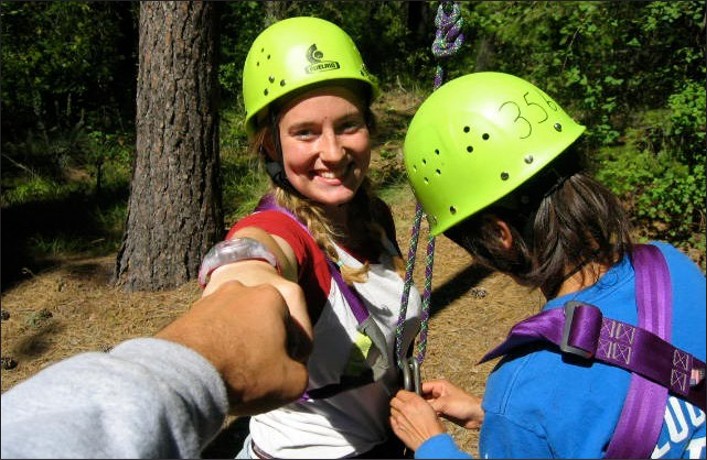
Reflective Journaling. Reflective Journaling is a strong tool that can be used for processing the experience. Journal writing promotes exploration of personal emotional knowledge. Without threat of criticism by an external audience, individuals are free to concentrate on, and explore, their uninterrupted thoughts and feelings. Journal writing provides situations for explicit self-awareness, often leading to a renewed awareness of personal knowledge and integrity. Journal writing also provides an opportunity for the clarification of feelings and emotions.
Choosing to use reflective journaling as a way to process requires providing time for participants to do so. If time is not set aside for writing, don’t expect participants to find time. Journaling should begin very early in the experience. It becomes difficult to get participants involved at a later time, establish a pattern, and stick to it. When structuring journal writing time, choose between using free writing or assigning processing questions, like the ones listed above.
Musical and Body-Kinesthetic
Group and Individual Creation. Some people connect and communicate their intuitive responses more clearly through motion and sound. Just like guiding any other verbal process, the facilitator can guide the creative process with specific activities or key words, before releasing individuals or groups to generate a response. When these people bring their creations back to be shared with the group, it is often leads to deeper realization of a group’s connectedness.
Symphony. A group (or individual) can repeat noises or phrases they heard during an activity in a rhythmic and musical collage, bringing a deeper awareness to our sonorous presence during activities.
Continuum. This method creates a kinesthetic experience when participants stand on a line and share how they feel about an experience. For example, a facilitator may point to opposite sides of a line on the floor and state, “Stand on this side of the continuum if you feel every idea shared by group members was heard and thoughtfully discussed by the group. Stand on this side of the continuum if you felt there was not space created for ideas to be heard or thoughtfully discussed by the group.” Then the facilitator can ask for participants to share from where they are standing.
Body Sculpting and Tableau. A facilitator can ask a group to create their impression of a given key word as it relates to a recently completed activity. One person in the group can be designated as a sculptor, and the other people are the clay he or she shapes into a tableau. Another option is for the facilitator to say a word and give the group five seconds to randomly structure themselves.
Groups that have created a respectful and safe community can also drum, dance, improvise, and relate stories together. These are some of our oldest forms of memory building and group bonding.
Spatial and Visual
Draw It. The simple act of giving people some colored pens and asking them to draw their experience can be powerful. When the group shares their experiences, those people who thrive in visual intelligence will have much more to say, having visualized their response first. This method is often used in constructing Full Value Contracts, but also works well in debriefing.
Photos and Images. Photography and imagery can be used connect participants with a visual stimulus as a method of reflection, or as part of a specific activity. There are many opportunities to include this method of reflection. Participants can select a picture from a gallery of images that reflects how they are feeling; then share with the group what the feeling was and why. Photographs can be used to have the group reflect on where they are on a scale—this could be a debriefing activity or an icebreaker activity. This method can also be used for participants to place themselves, or relate with, a particular photo or image. Allow participants to select a photograph that is representative of an ideal, a value, or a goal that they have.
Video Recording. In this era of technological advancement there are plenty of opportunities to use video recordings for the discussion of thoughts, feelings, and behavior. This is especially true with shorter adventure courses. Video records while the group is planning to solve an initiative activity, while they are implementing the plan, and when they complete the activity. Begin the discussion of how they approached the problem, and what each person’s role was in the process was. At the end of the discussion, play back the videotape and compare their perceptions with the information on the screen. Please consider any cultural barriers when choosing to use video recordings. Recordings should be considered a part of the group, and not shared with others without full disclosure to, and acceptance from, the parties involved.
Logical and Mathematical
Alternate Strategies. Logical Mathematical people with leadership ability will frequently want to retry an activity with a carefully explained alternative approach. When a facilitator has a number of logical-mathematical learners in a group, creating Dis-Abilities or setting time limits to reach specified goals will create more enthusiasm. The challenge is usually getting around to trying each person’s ideas.
Create a Game. Logical people may also enjoy the invitation to take the props of a recently completed activity and invent a new game. They will enjoy the challenge of thinking out all the possible foils to the main scheme.
Leader Interventions
(Adapted from Processing the Adventure Experience Nadler and Lackner 1992)
The primary responsibilities of a leader of adventure-based learning experiences include overseeing safety parameters, providing skills instruction, and facilitating personal development. To adequately meet these responsibilities facilitators may use a variety of interventions. There are nine types of leader interventions, which have been adapted from Dyer (Dyer 1972), and can be used to structure and process the experience. A facilitator’s educational background and training, as well as the situations that arise with groups, will determine which interventions can be carried out with the most comfort.
Content Focus. This entails some specific introduction of information into the group focus. The information may include safety issues, providing clear guidelines and parameters, addressing participant concerns and expectations, sharing an experience, giving an opinion, or clarifying some instructions. Content interventions are most helpful when they provide information the group members feel they require to proceed with the activity or exercise. For example: (a) “Today’s hike is going to be challenging. I would like you to monitor the statements that you make to yourself when you are feeling stretched,” or (b) “On this activity you have a twenty minute time limit. Then we will take some time to discuss how decisions were made.”
Process Focus. This intervention focuses on what is happening within the group. It looks at the interactions among members while they are doing certain tasks. Facilitators should focus on the “here and now” process in the group. Examples may be (a) “How are you working together as a group?”, (b) “I wonder why some people aren’t sharing their feelings or ideas,” (c) “It seems like the same people do all the work,” (d) “What is preventing people from speaking their mind?”, (e) “It seems like the group is more concerned with getting the task done rather than with how it’s done,” or (f) “Right now I sense a lot of ten-sion in the group.”
Eliciting Feelings. This intervention helps members develop a sense of being a group. It may not only let members know that they are not alone, but also may help them see how others feel about their behavior. Reluctance to share feelings may be based on lack of trust, self-confidence, or inability to identify feelings. An example of this intervention may be, “How did you feel, Mary, when the group rejected you suggestions?”
Sequencing Activities. Make decisions about course components and the order in which they occur. This is an important aspect of establishing a positive learning environment. Some of the important questions to ask yourself include: How does the activity relate to the group and individual goals that have been set? Is the group mentally and physically prepared to do the activity? Do they have the ability to attempt the activity or to complete it? What is the general mood of the group? What types of positive and negative interactions are affecting the group? How cooperative are the group members? What is the physical shape and abilities of the participants? How tired are they? What is the group’s developmental stage and level of functioning?
Direct Feedback. In a group, members are usually anxious to know how you view them. These concerns may be a legitimate request for feedback, or may indicate that the participants have not worked through viewing you as an authority figure. Feedback is very important in the group process. It’s important that members not only get it from you, but also from their peers. You can facilitate this by asking, “Ernie, how do you interpret or view Bill’s behavior now?” Once a few viewpoints are expressed, then you can respond. If the group is protective of its members, you may want to go first, and then ask others for their feedback. Once the group coalesces, the group members will begin to give each other direct feedback without you having to do so.
Cognitive Orientation. At times, you may want to offer participants relevant theory or information in order to provide them with a conceptual framework for understanding group process. Suggestions for topics include problem-solving techniques, group stages, how to express feelings, assertive behavior, defining forgiveness, and leadership styles. The extent to which you use the cognitive orientation intervention will depend on your need to be seen as an expert, as well as an assessment of how best to help group members learn.
Performing Group Functions. You may intervene by using task maintenance functions. The purpose of these interventions is to help the group maintain itself as an effective system that continues to promote learning. One way to do this is to have the group reflect upon and analyze, “what do you need to do to be more efficient?” Generally, you will reduce such interventions as participants develop a greater ability to perform these functions.
Diagnostic Intervention. When a group is having difficulty getting started or working together, you may diagnose what you see happening in the group. An example of a diagnostic intervention would be: “There may be a number of possible reasons to explain why the group is disintegrating. The goals may be too vague. Another is that individuals may be afraid of revealing themselves because they may be criticized. Are there any other possible reasons that you think may exist?” The diagnostic intervention encourages participants to use a diagnostic approach in order to better understand the group process.
Protective Intervention. In some groups, members may want to share deep emotional issues (such as incest, physical abuse, or rape) that extend beyond the boundaries of the group. These personal emotional issues may significantly diverge from the goals of the group. In addition, you may not have the appropriate training to deal with such issues. Therefore, you will want to intervene and possibly choose to speak with the member individually and encourage him or her to contact a professional counselor or psychologist. You also want to intervene when one or two members are being cruelly criticized. In general, you are responsible for protecting the emotional safety of each of the group members.
Adventure Program Safety & Prevention
Physical and emotional safety is an integral part of an adventure-based experiential education program. Unless a participant feels emotionally and physically safe and supported, they will not be willing to step outside of their comfort zone and into their growth zone. Without risk there can be no growth. Adventure learning aims to control the environment of risk for the learner. There are several concepts related to the facilitation of WSU 4-H Adventure Programs that facilitators should be familiar with.
Perceived vs. Actual Risk. As stated in the Facilitator’s Code of Ethics (Section II), adventure experiences provide natural or inherent risks which are facilitator mediated to provide participants with opportunities to grow through their inhibitions.
Facilitators should not present risks that present a real danger to participants.
Environmental Factor + Human Factor = Accident Potential (E+H=A)
Watch hunger and fatigue levels and work within the energy level of you and the group.
Accidents are caused by:
- Not being preventative.
- Not following simple steps or directions.
- People pleasing and doing the activity for others.
- Pride, or fear of looking bad in front of others.
Making Course Corrections
Inflexibility. Though you may be proud of your sequence, you should be ready to adapt, based on the assessments you make of your group in action. Accidents happen when facilitators don’t acknowledge the needs and limitations of participants.
Ongoing Assessment. The key to accident prevention is to evaluate the degree of risk in all adventure activities, and the level of competence of everyone involved. Evaluate the level of participants’ understanding, the limits of equipment, the environmental conditions, and specific program guidelines. Participation by members is always at your discretion.
Supporting the Group. When participants can trust their group they are more apt to step out of their comfort zones, take risks, push themselves, and “go for it.” Accidents, near misses, and de-valuing the Full Value Contract can destroy the feeling of support the group is creating. These intrusions should be dealt with and then debriefed. Once lost, trust is not easily regained. Specific physical support sequences are trained for individual adventure activities.
Risk Management in the 4-H Adventure Program
The reduction of exposure to risk is called risk management. Risk management is dynamic and ongoing. It is both a point of departure for the adventure planning process, and a revisited line of reasoning as adventures and activities unfold. For a given program, risk management of 4-H, land management, and local operating procedures will need to overlap to minimize personal injury and property loss. Additionally, as situations emerge, facilitators will take this, and changing conditions, into account to provide the highest level of safety possible.
In the 4-H Youth Development Program the most basic responsibility is to provide a safe, wholesome, and healthy environment for young people, and for the adults who work with them. This responsibility of positive youth development is important and requires attention. Overall, 4-H has a very good history of providing safe environments for children, and protecting them from potential risks. To maintain this record of safety, programs and activities need to be systematically reviewed to ensure that considerations are provided for dealing with health, safety, legal, and liability issues. Staff and volunteers who act on behalf of Washington State University Extension 4-H Youth Development are expected to be proactive partners in the development of risk management plans for all 4-H events and activities. The phrase, “good faith effort” means that all reasonable efforts have been made to pro-vide a high quality, safe environment for young people and the adults who work with them.
There are different levels of risk for the assorted 4-H programs and activities. Do not assume that young people, their parents or adult volunteers are always aware of, and understand, the possible risks and unsafe conditions associated with an activity. Consequently, it is extremely important to inform youth and their parents beforehand, so that they can understand the level of risk associated with the events and activities in which they wish to participate.
One of a facilitator’s primary tasks is assessing risk before and during adventure activities. The following table places some perspective on whether or not activities should be initiated. Following a GRABBSS assessment of a group (see Section II), if the facilitator discerns Moderate or Substantial risk, the activity should not be undertaken. If controls cannot be put in place to reduce the risk to at least a tolerable level, the activity should not be undertaken.
Table 4. Probability/Severity Matrix.| - | Slightly Harmful | Harmful | Extremely Harmful |
|---|---|---|---|
| Highly Unlikely Occurrence | Minimal Risk | Tolerable Risk | Moderate Risk |
| Likely Occurrence | Moderate Risk | Substantial Risk | Intolerable Risk |
| Unlikely Occurrence | Tolerable Risk | Moderate Risk | Substantial Risk |
Assumption of risk, is a term that is considered when determining liabilities that may arise in certain situations. Assumption of risk means that whenever someone chooses to do something, he or she (or their parent/guardian) assumes a level of risk. Responsibilities for actions are passed along, and shift from extension educators and volunteers to parents and children. Rules need to be enforced and dangerous or unsafe activities must be stopped. It is often difficult to discipline other people’s children, or to even cancel an activity or event, but remember that providing a safe, wholesome environment must be the primary consideration. Contributory Negligence, describes any participant negligence that contributes to an injury; that is, if the participant had not been negligent, he or she would not have been injured.
Consent
When taking a group outside their regular meeting places, the facilitator is responsible for obtaining written consent for each participant, signed by his or her parent or legal guardian. No one can participate without a signed consent form. The facilitator is also responsible to find out about any prescription medication, existing injuries, and all special medical or physical problems that could affect any individual’s performance before an activity. The release and consent form, and health form must accompany all participants to the 4-H activity. Use the forms provided by the local county program office or those found on the State 4-H website.
Liability Coverage
All 4-H volunteers must individually enroll through their local Extension Office and the Washington State 4-H Office, in order for WSU to assume responsibility for liability protections of adult volunteers. Adult volunteer leaders are protected under the State of Washington Tort Claims Law, RCW 4.92.060. An authorized volunteer 4-H leader can request the University defend him or her if an action or proceedings for damages are brought, which arise from their acts or omission while performing, or in good faith purporting to perform, their official volunteer duties. Adult volunteers are expected to act in good faith and without negligence in the performance of their duties in order to minimize any chance of creating a University liability.
The coverage described above does not apply to leaders who are group enrolled. That means that adult volunteers who are assisting with activities or events, but are not individually enrolled, are not covered by WSU liability. Since 4-H members and youth participants are not responsible for the delivery of the 4-H Program, they are not liable for the actions of their 4-H leaders or other adult volunteers. Therefore, 4-H members and youth participants are not protected at any time by the University’s liability coverage.
Records Retention
The records retention schedule will follow WSU and 4-H guidelines on documents collected in the course of program administration. This includes medical consent forms (retain for 6 years), consent and release forms (6 years), medical records (6 years), and incident report forms indefinitely. If an incident occurs and a report form has been completed, all documentation regarding said incident is to be kept indefinitely at the sponsoring county’s 4-H office, and is to be forwarded to the State 4-H Office within thirty days. Additionally, consent and release forms for ALL participants of the same group should be forwarded to the State 4-H Office, along with incident forms and related documentation. Additional records could include copies of certifications, training syllabi, and instructor portfolios.
Enrollment
All adult and youth participants must be enrolled in 4-H. This includes, but is not limited to, paid staff and camp administration. Enrollment includes current background checks for all persons age 18 and over.
Program and Site Inspections
Regularly scheduled inspections of your adventure locations and pro-gramming can help identify potential risks and improve overall per-formance. The WSU Adventure Education Program provides training, evaluation and inspection of programs and equipment.
Program Evaluation
This handbook has provided the over-arching methodology for experiential adventure-based activities, particularly as they pertain to youth programs. Individual evaluations will usually be included within each specific project area (rock climbing, boating, portable challenge, etc.).
WSU Extension staff, volunteers, facilitators, and stakeholders have the opportunity to impact the learning and quality of life of program participants. Did participants change their attitudes and beliefs, and then did they change their behavior? For many programs, measuring these changes can be costly. However, identifying program outcomes is beneficial. Benefits include:
- Participants can reflect upon and communicate changes experienced through experiential learning.
- A facilitator can improve their future facilitations by knowing if the sequence produced a significant shift in belief or behavior, or none at all.
- Stakeholders can be shown results, which helps ensure future investments in the program.
Since adventure programs are unique, anything we learn will be valuable to ourselves, our participants, our staff, our community, and the larger fields of adventure programming and public education. The collection of information about aspects of our program is necessary in or-der for all parties to make short and long-term decisions. Here are some questions that commonly need to be answered.
- What are the successes or failures of the program?
- How can the program be improved?
- Does program practice have implications for industry research?
Long-term tracking of individual behavior and performance may in-clude the following variables:
- Character Development. Locus of control, leadership skills, self-concept, and interpersonal competence (teamwork & social skills).
- Participant Academic Achievement and Success. Cognitive development, test scores, grades, credit completion, graduation, attendance and criminal recidivism.
Evaluations can come from multiple sources including:
- Participant Surveys and Interviews. Pre-, concurrent, and post-.
- Advocate Surveys and Interviews. Parent, sponsor, teacher, staff.
- Isolated Performance and Behavior Testing
The minimum evaluation and assessment plan for adventure programs is one that can answer the question: Did participants have a change in their attitudes and beliefs?
A time-series longitudinal evaluation of the duration of a program’s effects reinforces its efficacy. For assistance in constructing viable evaluations for your programs, contact your WSU Adventure Education staff.
References
- Association of Experiential Education. 2007. What is experiential education? 2011. Creative Flavor, Inc.
- Bandura, A. 1997. Self-Efficacy: The Exercise of Control. New York: W.H. Freeman.
- Benne K.D., and P. Sheats. 1948. Functional Roles of Group Members. Journal of Social Issues. no.4 Spring: 41-49.
- Dewey, J. 1938. Experience and Education. New York: Collier Books. (Collier edition first published 1963).
- Dyer, W.G. 1972. An Inventory of Trainer Interventions. In Diedrick R. C. and H.A. Dye (Eds.). Group procedures: Purpose, Processes, and Outcomes. 115-119. Boston: Houghton Mifflin.
- Eccles, J. and A. J. Gootman. 2002. Community Programs to Promote Youth Development. National Research Council & Institute of Medicine. Washington, DC: National Academy Press.
- Frank, L. 1988. Adventure in the Classroom: A Stress/Challenge Curriculum. Madison, WI: Madison Metropolitan School District.
- Gardener, H. 1983. Frames of Mind: The Theory of Multiple Intelligences. Harvard University Press.
- Goleman, D. 1995. Emotional Intelligence: Why It Can Matter More than IQ. New York, NY: Bantam Books.
- Hedricks, P.A. 1996. Life Skills Wheel. University of Iowa Extension.
- Jacobs, E.E., R.L. Harvil, and R.L. Masson. 1988. Group Counseling: Strategies and Skills. Belmont CA: Brookes/Cole Publishing Co.
- Johnson D. and F. Johnson. 1994. Joining Together: Group Theory and Group Skills. Columbus, Ohio: Allyn and Bacon Publishers.
- Knapp, C.E. 1984. Designing Processing Questions to Meet Specific Objectives. The Journal of Experiential Education. Vol. 7 no. 2 Summer: 47-49.
- Kolb D. and R. Fry. 1975. Towards an Applied Theory of Experiential Learning. Theories of Group Processes. 33- 57. Wiley, London: C. Cooper.
- Kress, C. 2005. NAA keynote address: Transforming the Lives of Youth: The Essential Elements of Youth Development. National 4-H Headquarters. USDA.
- Lazarus, A. 1981. The Practice of Multi-modal Therapy. 4, 33-43, 155-156. New York: Mcgraw-Hill.
- Lerner, R. and J. Lerner. 2006. Positive Youth Development, Participation in Community Youth Development Programs.
- Lerner, R. and J. Lerner. 2006. Community Contributions of Fifth Grade Adolescents: Findings from the First Wave of the 4-H Study of Positive Youth Development.
- Luckner and Nadler. 1992. Processing the Adventure Experience: Theory and Practice. Dubuque, Iowa: Kendall/Hunt Publishing.
- Maslow, A. 1954. Motivation and Personality. 3rd ed. Harper and Row Publishers.
- National 4-H Cooperative Curriculum System Inc. 2003. Ages and Stages of Youth Development: Step Up to Leadership Mentor Guide for Grades 6-12. 4-H CCS-BU-07904.
- National 4-H Assessment Impact Project. 2001. National 4-H Headquarters.
- Piaget, J. 1985. The Equilibration of Cognitive Structures: The Central Problem of Intellectual Development. Chicago: University of Chicago Press. L’equilibration des Structures Cognitives. 1975. Previously translated as: The Development of Thought: Equilibration of Cognitive Structures. 1977.
- Priest, S. and M. Gass. 1997. Effective Leadership in Adventure Programming. Durham, NH: University of New Hampshire Press.
- Project Adventure, Inc. 1991. Adventure Based Counseling Workshop Manual. Dubuque, Iowa: Kendall/Hunt Publishing.
- Rugby Football Union. 2009. Probability/Severity Matrix.
- Schoel, J., D. Prouty, and P. Radcliffe. 1988. Islands of Healing, A Guide to Adventure Based Counseling. Project Adventure Inc. Hamilton, MA.
- Sharp B. and C. Cox. 1970. Choose Success: How to Set and Achieve All Your Goals. New York: Hawthorne Books.
- Tuckman B.W. 1965. Developmental Sequence in Small Groups. Psychological Bulletin. No. 63: 384-399.
- The Principles of Experiential Education practice. (n.d.). Association for Experiential Education.
Further Reading
- Fluegelman, A. 1981. More New Games and Playful Ideas from the New Games Foundation. Garden City, NY: Dolphin Books/Doubleday & Co.
- Fluegelman, A. 1976. The New Games Book, Play Hard, Play Fair, Nobody Hurt. Garden City, NY: Dolphin Books, Doubleday & Co.
- Houston, J. 1982. The Possible Human. Boston, MA: Houghton-Mifflin.
- Johnson, D.W. and F.P. Johnson. 1987. Joining Together. Englewood Cliffs, NJ: Prentice-Hall.
- Luckner, J.L. and R.S. Nadler. 1997. Processing the Experience. Dubuque, Iowa: Kendall/ Hunt.
- Masters, R. and J. Houston. Listening to the Body. New York: Dell Pubulications.
- Rohnke, K. 1977. Cowstails & Cobras: A Guide to Ropes Courses, Initiative Games and Other Adventure Activities. Hamilton, MA: Project Adventure, Inc.
- Rohnke, K. High Profile. Hamilton, MA: Project Adventure, Inc.
- Rohnke, K. 1995. Quicksilver. Dubuque, Iowa: Kendall/Hunt.
- Rohnke, K. 1984. Silver Bullets: A Guide to Initiative Problems, Adventure Games and Trust Activities. Hamilton, MA: Project Adventure, Inc.
- Schoel, J, D. Prouty and P. Radcliffe. 1988. Islands of Healing: A Guide to Adventure-Based Counseling. Hamilton, MA: Project Adventure, Inc.
By Scott VanderWey, 4-H Director of Adventure Education, Extension Specialist, WSU Puyallup Research and Extension Center; Brian Brandt, 4-H Faculty, WSU Pierce County Extension, Tacoma, WA; Mike Wallace, 4-H Faculty, Extension Educator, WSU Whatcom County Extension, Bellingham, WA; Tim Wood, 4-H Trainer and Experiential Education Consultant, Seattle, WA; Sarah Sullivan, School Wellness Program Supervisor, Office of Superintendent of Public Instruction (OSPI). Seattle, WA; Sam Tower, State Challenge Manager (Retired), Play for Peace International, Tacoma, WA; Vicky McCarley, 4-H Challenge Course Manager, Camp Panhandle, Olympia, WA.
Copyright 2014 Washington State University
WSU Extension bulletins contain material written and produced for public distribution. Alternate formats of our educational materials are available upon request for persons with disabilities. Please contact Washington State University Extension for more information.
You may download copies of this and other publications from WSU Extension.
Issued by Washington State University Extension and the U.S. Department of Agriculture in furtherance of the Acts of May 8 and June 30, 1914. Extension programs and policies are consistent with federal and state laws and regulations on nondiscrimination regarding race, sex, religion, age, color, creed, and national or ethnic origin; physical, mental, or sensory disability; marital status or sexual orientation; and status as a Vietnam-era or disabled veteran. Evidence of noncompliance may be reported through your local WSU Extension office. Trade names have been used to simplify information; no endorsement is intended. Published September 2014