Archived - Do Black Walnut Trees Have Allelopathic Effects on Other Plants? (Home Garden Series)
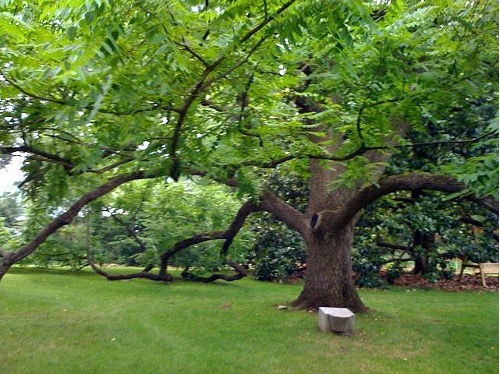
Gardeners have heard that black walnut trees (Juglans nigra; Figure 1) contain a toxic chemical called juglone that will kill any other plants growing nearby. This phenomenon is called allelopathy, and, in recent years, many other possible allelopathic chemicals have been identified. This publication will review the current research into black walnut allelopathy and discuss the practical significance of gardening in the presence of black walnut trees.
What is allelopathy?
Allelopathy literally means “death to others.” In its simplest sense, allelopathy is the ability of one plant species to affect the growth of another through their chemical exudates. While early researchers narrowly defined the relationship to include only the influence of living plants on other living plants (Rice 1974), more recently the definition has been expanded to include interactions within the soil environment. Such “soil-mediated chemical interference” (Inderjit and Foy 2001) is arguably a more relevant definition, as roots of adjacent plants share the same soil environment. Competition for water and nutrients, soil microbial activity, and other environmental conditions should be considered separately from any possible “chemical warfare” among plants. Therefore, allelopathy is currently understood to involve living or dead plant parts that release chemicals into the soil which have an effect on other plants—positive or negative. And no allelopathic chemical is better known—and feared—by gardeners than juglone.
Walnut allelopathy and juglone
Writers from ancient Rome to current day have warned that walnut trees are detrimental to the health of nearby plants (Willis 2000). Initially, injury was attributed to the dense shade and extensive root systems of walnut trees. In the last 100 years, viewpoints have shifted to claims of chemical poisoning of the soil, despite the lack of any direct, supporting evidence.
In the 1920s, damage to tomatoes and other crops near walnut trees caused people to believe that toxic chemicals were involved. However, many farmers had fields near walnut orchards and saw no negative effects on their crops. Still, the public perception that walnut trees would kill other plants persisted and grew, especially when a researcher in Virginia noticed his garden tomatoes were struggling (Willis 2000). Aware of the lore surrounding walnut trees, he correlated the nearby location of such a tree with the damage he observed. Subsequently, he and other researchers suggested that juglone, an orange compound isolated from leaf litter and walnut hulls, was responsible for the damage.
In 1948, the USDA issued a press release assuring the public that walnut trees were harmless, but these assurances failed to convince a skeptical public. In 1951, experimental field testing began: importantly, little to no negative effects were seen (Willis 2000). Experimentation moved to the lab, where juglone applied to germinating seeds and seedlings was found to cause stunting, wilting, and necrosis. The mode of action of juglone remains unclear (Strugstad and Despotovski 2013), though it is thought to disrupt photosynthetic and respiratory pathways and interfere with water uptake (Achatz and Rillig 2014).
Experiments but no explanations
Inconsistent results have been the bane of juglone allelopathy research. For every report of toxicity in a tested species, another report will find no effect. Researchers have pointed out a number of problems with initial assumptions and laboratory trials, which are summarized below:
- Juglone, a highly toxic chemical, is not found in intact tissues of black walnut trees (Strugstad and Despotovski 2013). Instead, living tissues contain a nontoxic precursor called hydrojuglone, which is transformed in the soil to make juglone (Achatz and Rillig 2014).
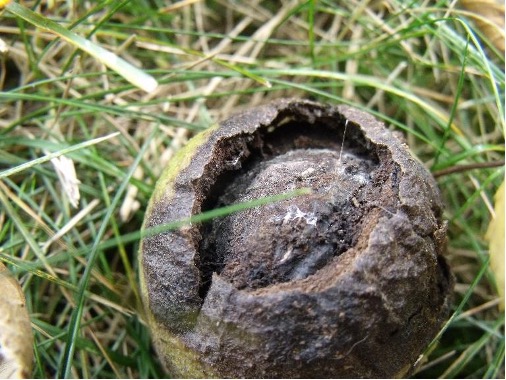
- Most hydrojuglone is contained in the roots and shells of walnuts (Figure 2). There is little in the leaves and virtually none in the wood (Lee and Campbell 1969).
- Many researchers use artificial experimental methods to test for allelopathy. For instance, soilless media and laboratory extractions of juglone from walnut tissues do not occur in nature (Inderjit and Foy 2001).
- Allelopathic responses are enhanced when potting media are used instead of soil. This is attributed to the increasedpermeability of the media compared to soil (Parepa and Bossdorf 2016).
The lack of field test evidence to support laboratory results has spurred critics to insist that experimental testing include a functional soil system to more closely mimic what happens in nature. They note several conditions and activities that may account for the lack of positive field test results:
- Juglone undergoes chemical, physical, and biological degradation in the soil (Inderjit 2001).
- Organic matter and clay particles in soils can bind juglone, reducing its movement within the soil (Inderjit 2001).
- Juglone does not persist in soils with high microbial activity (Jilani et al. 2008; von Kiparski et al. 2007).
An ecosystem approach to studying juglone effects
Researchers interested in juglone and more widely in allelopathy itself have suggested several suggestions to modify conflicting, traditional approaches.
- First, researchers must accept that lab-based bioassays that isolate juglone from the natural environment cannot determine whether allelopathy occurs in nature (Inderjit and Nilsen 2003).
- Second, juglone must “accumulate to phytotoxic levels and reach a target plant to be of ecological relevance” (Choesin and Boerner 1991). This may pose an insurmountable problem for juglone work: Sun et al. (2013) found that while walnut trees release large quantities of juglone into the rhizosphere, very little reaches the bulk soil and thereby other plant roots.
- Finally, researchers “must show that chemicals contributed by specific plants are primarily responsible for growthinhibition in field situations” (Inderjit and Foy 2001). This means demonstrating conclusively that growth inhibition is not due to competition for soil resources, excessive shade, or any other environmental factor.
Evaluating evidence for juglone allelopathy
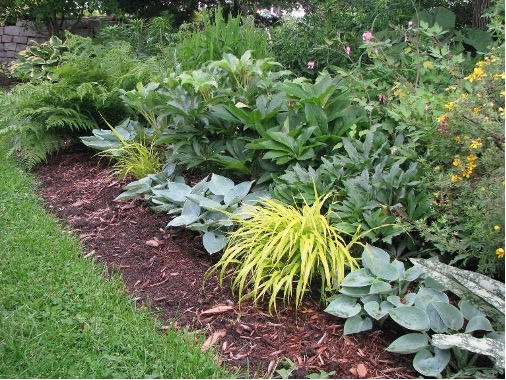
Despite the lack of confirming evidence, websites (Leuty 2010), Extension publications, and research articles (Achatz and Rillig 2014; Strugstad and Despotovski 2013) continue to claim black walnut has allelopathic effects on garden and landscape plants. As evidence, all of these publications cite one or two Extension publications (Crist and Sherf 1973; Funt and Martin 1993) that contain lists of “sensitive” and “tolerant” garden and landscape plants (Figure 3). These two publications are not experimental but simply observational—meaning that they correlate the presence of walnut trees with damage to other species but do not confirm a causative relationship. Furthermore, there is substantial visual evidence in gardens and landscapes that other plants successfully coexist with established black walnut trees (Figure 4).
Table 2: Influence of juglone on some plants (Funt & Martin 1993; Leuty 2010)
Negatively affected
- Asparagus officinalis (asparagus)
- Betula papyrifera (white birch trees)
- Brassica oleracea (cabbage)
- Lycopersicon esculentum (tomato)
- Magnolia x soulangiana (saucer magnolia)
- Medicago sativa (alfalfa)
- Solanum melongena (eggplant)
- Solanum tuberosum (potato)
- Pinus strobus (white pine)
- Vaccinium (blueberries)
- Tilia americana (linden trees)
Unaffected or hardly affected
- Allium cepa (onion)
- Beta vulgaris (beets)
- Pastinaca sativa (parsnip)
- Phaseolus zinnia (lima and snap beans)
- Prunus spp. (cherries, nectarine, peach, and plum)
- Rubus occidentalis (black raspberry)
- Most squashes
- Zea mays (sweet corn)
- Most of the hardy, fall-planted bulbs, including alliums, crocus, daffodils, hyacinth, tulips, and a series of ornamental plants
Figure 3. Table 2 adapted from Strugstad and Despotovski, 2013.
It’s important to note that you’re not likely to find either of these two Extension publications online or in print. As the Extension Communication Manager for Ohio State University explains “…fact sheets that are more than five to seven years old are not available on Ohioline until the content of each is reviewed by the author(s) and validated or revised…The fact sheet you are looking for was published in 1993 [Funt and Martin], so it is now 25 years out-of-date.
I don’t have a copy of the fact sheet, b/c it was removed from circulation” (Cheryl Buck, email communication).
Even more concerning is that the Crist and Sherf (1973) publication does not actually exist. One of the librarians at Cornell University reports, “Here’s our final conclusion about the Cornell Horticulture Extension Bulletin Walnut Wilt by Crist and Sherf. We think that the first time it was cited, it was cited incorrectly…It seems likely that all the other authors who have cited it since probably never saw thebulletin and just copied the citation. We’ve checked the indexes of all the likely bulletins and looked at departmental annual reports (which list research published by members of the department) and we can’t find any trace of an article/bulletin called Walnut Wilt” (Betsy Elswit, email communication).
Thus, the entire body of primary evidence for black walnut allelopathy in the landscape is attributed to two dated Extension publications, one that has been withdrawn from circulation and one that doesn’t exist. These are not reliable sources of information and should not be cited as evidence for juglone toxicity, especially in peer-reviewed journal articles.
Action items for gardeners
- Provide adequate irrigation for landscape plants during drier, warmer weather. All plant roots compete for water, nutrients, and oxygen. The denser your plantings, the more intense competition will be.
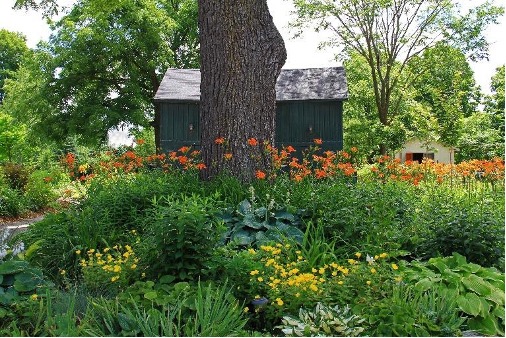
- Plant sun-loving plants in full sun—not under tree canopies. Shade tolerant species are the best choice under walnut trees (Figure 5).
- Mulch well with arborist wood chips to retain soil moisture and to nourish beneficial soil life including mycorrhizae.
- Enjoy your walnut trees! Not only are they robust landscape plants they provide food and habitat for wildlife. In areas with thousand-cankers disease, however, they should not be planted.
- Use walnut wood chips for mulch if you have them. They will not harm plants and work just as well as those from any other woody species.
Literature cited
Achatz, M., and M.C. Rillig 2014. Arbuscular mycorrhizal fungal hyphae enhance transport of the allelochemical juglonein the field. Soil Biology and Biochemistry 78:76–82.
Buck, C. 2018. Email communication. Ohio State University.
Choesin, D.N., and R.E.J. Boerner. 1991. Allyisothiocyante release and the allelopathic potential of Brassica napus (Brassicaceae). American Journal of Botany 78:1083–1090.
Crist, C.R., and A.F. Sherf. 1973. Walnut wilt. Cornell University Horticulture Extension, Bulletin.
Elswit, B. 2018. Email communication. Cornell University.
Funt, R.C., and J. Martin. 1993. Black walnut toxicity to plants, humans and horses. Ohio State University Extension Fact Sheet HYG 1148-93.
Inderjit, and E.T. Nilsen. 2003. Bioassays and field studies for allelopathy in terrestrial plants: progress and problems. Critical Reviews in Plant Sciences 22(3-4):221–238. http://dx.doi.org/10.1080/713610857.
Inderjit, M.K. 2001. Soil: environmental effects of allelochemical activity. Agronomy Journal 93:79–84.
Inderjit, M.K., and C.L. Foy. 2001. On the significance of field studies in allelopathy. Weed Technology 15(4):792–797. http://www.jstor.org/stable/3988562.
Jilani, G., S. Mahmood, A.N. Chaudhry, I. Hassan, and M. Akram. 2008. Allelochemicals: sources, toxicity, and microbial transformation in soil–a review. Annals of Microbiology 58(3):351–357.
Lee, K.C., and R.W. Campbell. 1969. Nature and occurrence of juglone in Juglans nigra L. Journal of Horticultural Sciences 4:31–35.
Leuty, T. 2010. Walnut toxicity. Ontario Ministry of Agriculture, Food and Rural Affairs, Toronto, Ont. http://www.omafra.gov.on.ca/english/crops/facts/inf o_walnut_toxicity.htm.
Parepa, M., and O. Bossdorf. 2016. Testing for allelopathy in invasive plants: it all depends on the substrate! Biological Invasions 18:2975–2982.
Rice, E.L. 1974. Allelopathy. Academic Press, New York.
Strugstad, M.P., and S. Despotovski. 2013. A summary of extraction, synthesis, properties, and potential uses of juglone: aliterature review. Journal of Ecosystem Management 13(3):1–16.
Sun, Y.Z., L.X. Yang, Z.Q. Wang, and J. Fan. 2013. Temporal variations in soil juglone and soil microbial community structure under Manchurian walnut (Juglans mandshurica Maxim.) plantations. Allelopathy Journal 31(1):169–179.
von Kiparski, G.R, L.S. Lee, and A.R. Gillespie. 2007. Occurrence and fate of the phytotoxic juglone in alley soils under black walnut trees. Journal of Environmental Quality 36:709–717.
Willis, R.J. 2000. Juglans spp., juglone and allelopathy. Allelopathy Journal 7(1):1–55.
By
Linda Chalker-Scott, Associate Professor and Extension Horticulturist, WSUPuyallup Research and Extension Center, Washington State University
Cover photo by D. Schreiber

FS325E

Copyright © Washington State University
WSU Extension publications contain material written and produced for public distribution. Alternative text descriptions for select complex images were generated using ChatGPT (OpenAI), then reviewed and adapted to ensure compliance with Web Content Accessibility Guidelines (WCAG) accessibility standards.
Issued by Washington State University Extension and the US Department of Agriculture in furtherance of the Acts of May 8 and June 30, 1914. Extension programs and policies are consistent with federal and state laws and regulations on nondiscrimination regarding race, sex, religion, age, color, creed, and national or ethnic origin; physical, mental, or sensory disability; marital status or sexual orientation; and status as a Vietnam-era or disabled veteran. Evidence of noncompliance may be reported through your local WSU Extension office. Trade names have been used to simplify information; no endorsement is intended.