Cover Crop Mixtures vs. Monocultures: What the Research Shows
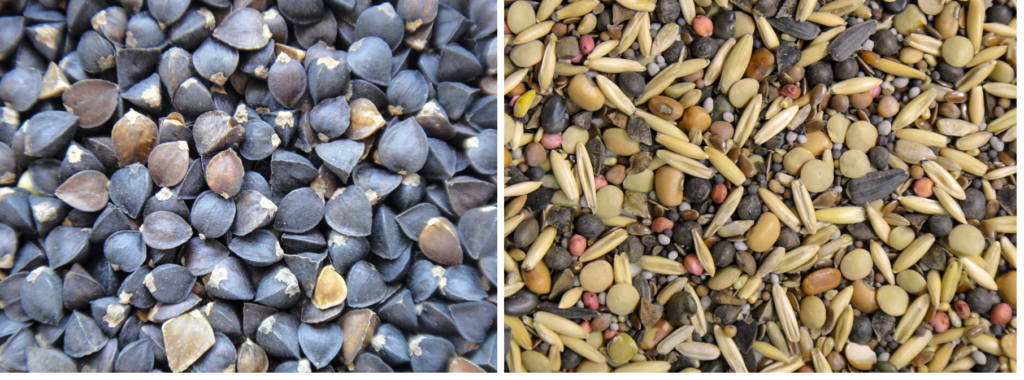
Cover Crop Biomass Drives Benefits
Unlike grain crops where the marketable yield is grain, the measure of success for cover crops is biomass, usually evaluated as just aboveground biomass. Biomass production is important for cover crops because it adds organic matter to the soil, protects the soil surface, and suppresses weeds. Biomass is also a major factor in providing other ecosystem services (Finney et al. 2017). While biomass production is also important in unmanaged natural systems, there are important differences between ecological and cover crop research in how biomass measurements are evaluated.
The Ecological Theory and Agricultural Application
Ecological theory suggests that increased species will increase productivity due to beneficial interactions between the species rather than competition. This is known as the biodiversity-productivity relationship. These beneficial interactions are called complementary or synergistic effects between species in the mixture. While this theory has been tested in hundreds of experiments worldwide, and meta-analyses have summarized these findings, its application to agriculture is different from unmanaged ecosystems (Schulze et al. 2018; Chacón-Labella et al. 2019).
When applied to unmanaged ecosystems, ecological research focuses on the average biomass production at different diversity levels and compares this to the average biomass levels of the monocultures of the mixture’s species. The mixtures are random to simulate nature, and the question ecologists are trying to answer is, “Does species diversity, on average, increase productivity?” The results generally show that the average biomass increases with increased plant species diversity. This is called overyielding. However, in crop production, the important factors are different and so require a different evaluation.
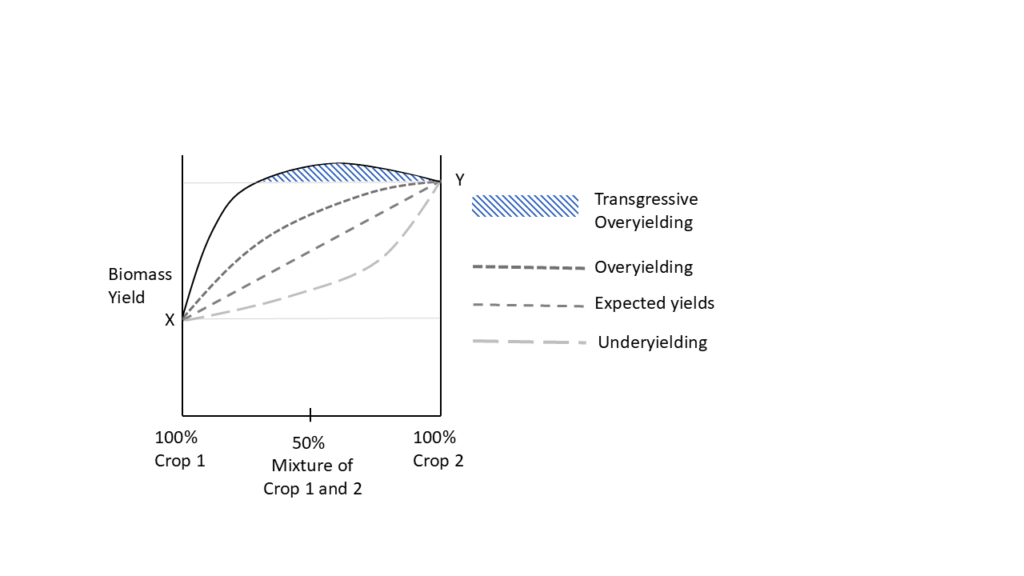
Unlike in unmanaged systems, choosing species to plant on a farm is specific and non-random, based on experience and past research. Unlike ecologists, farmers most often want to know, “Which produces the most biomass, a monoculture or a mixture?” And many wish to know which specific monoculture or mixture is the best, rather than the average of the monocultures or a bunch of random mixtures. Given the options, the question is often “Which will be the best species or the best mixture for a particular cover crop growing window?” In this situation, the relevant comparison is between the best monocultures and the best mixtures. This is called transgressive overyielding (Figure 2) (Schmid al. 2008; Garnier et al. 1997; Trenbath 1974).
Glossary
complementarity: An interaction between different species that results in enhanced ecosystem function.
overyielding: Occurs when a mixture yields more than the average of its constituent monoculture yields. There are various ways to measure overyielding; which one is used can influence the conclusions of these studies (Garnier et al. 1997).
synergy: An interaction between different species that results in a combined effect larger than their separate effects.
transgressive overyielding: Occurs when a mixture’s yield surpasses (transgresses) the yield of the most productive monoculture of the mixture species involved. For agriculture, transgressive overyielding is considered by some to be the relevant indicator of a mixture’s value, as a wise farmer would choose the best-performing monoculture unless a mixture surpassed it (Florence and McGuire 2020; Trenbath 1974).
Research Findings on Biomass Productivity
Recent meta-analyses and studies consistently show that cover crop mixtures generally show overyielding, but not transgressive overyielding.
- An analysis of multiple studies of simple two-species mixtures found that most exhibited overyielding but very few showed transgressive overyielding (Trenbath 1974).
- A more recent meta-analysis of ecological research results found little support for transgressive overyielding in diverse mixtures (Cardinale et al. 2011).
- A systematic review of cover crop research found that the best mixtures outperformed the best monocultures in only 2% of cases, while monocultures performed better in 10% of cases, and in the remaining 88% of cases, performance was comparable. These comparisons were for biomass, weed suppression, nitrogen retention, water conservation, soil biology promotion, following-season crop yield, and biomass stability over time. For biomass specifically, when a statistical difference was found, monocultures produced more biomass in 17 of 19 comparisons (Florence and McGuire 2020).
A suggested reason for this lack of transgressive overyielding is this rule of logic: if one species is less productive than another, replacing a more productive individual with a less productive one will probably reduce overall yield unless there is a significant complementary effect or synergy (Crawley 1983). Replacing a better producing species with a lesser one just dilutes the productivity of the former.
Another explanation for these results involves the shared need by plants for the same resources. Much of the ecological expectation of the benefits of mixtures is based on different species being able to access different resources. This limits their competition with each other when living in the same space and could also allow more complete use of the available resources (niche complementarity and niche partitioning). However, unlike with animals, plants all use the same basic resources, like sunshine, CO2, water, and nutrients, and unlike mobile organisms, plants have limited opportunity for niche differentiation (Barry et al. 2020). Therefore, competition is the norm.
Seeding rates in mixtures is one factor that can change results. For a discussion of the influence of seeding rates, see the open access publication from Florence and McGuire (2020).
There is a major and long-known exception to these results: mixing legume crops with non-legume crops (especially grasses) in soils with low nitrogen levels. These mixtures often show transgressive overyielding (Trenbath 1974), which is thought to be mainly the result of the increased nitrogen fixed by legumes, although there are other beneficial effects of legumes. This effect, however, tends to disappear in soils containing sufficient nitrogen for generating high crop yields.
Research Findings on Ecosystem Services
Beyond biomass production, research has also investigated whether cover crop mixtures provide enhanced ecosystem services compared to monocultures. Following is a summary of the results based on the standard of transgressive overyielding from Florence and McGuire (2020).
- Weed suppression: Studies have found no evidence that mixtures enhance weed suppression over monocultures. Weed suppression is strongly linked to the competitiveness and biomass production of the cover crop. Aggressive species in a mix may suppress weeds, but they can also suppress less aggressive planted species, creating a trade-off (Bybee-Finley et al. 2017; Smith et al. 2014).
- Nutrient recycling or retention: Studies found no significant differences in nitrogen, potassium, or phosphorus uptake or nitrate leaching between monocultures and mixtures (Finney et al. [2016] discuss N retention).
- Pest control, including beneficial insects: Research suggests that the presence and density of flowers in the cover crop (mono- or polyculture) are more important than species diversity for attracting beneficial insects (Finney et al. 2017).
- Water use: Contrary to some claims, studies have found no significant differences in soil water content or growing season crop water use between monoculture and mixture cover crops. In fact, cover crops generally use more water than fallow, indicating a cost for farmers in dryland regions (Nielsen et al. 2015). Claims that cover crop mixtures use water more efficiently than monocultures have been tested and are not supported; results found no difference in water use (Kuykendall 2015; Nielsen et al. 2015; Florence and McGuire 2020).
- Soil biology benefits: In 33 of 35 comparisons between the best mixtures and best monocultures, the soil biology results were similar. Monocultures beat mixtures in the other two comparisons.
- Yield of the following crop: The systematic review found negligible benefit to mixing cover crops on the following crop’s yield, with most comparisons showing no significant difference between the best mixture and best monoculture.
- Biomass stability: Ecological theory suggests mixtures will have more stable productivity over time, but research has shown no consistent differences in stability between the two strategies, and some studies found higher stability in monocultures.
Overall, the research indicates that for many ecosystem services, there are trade-offs from cover crop mixtures rather than synergistic “win-win” outcomes. Mixtures can sometimes provide a greater number of benefits than monocultures (i.e., multifunctionality), but the level of those benefits is lower than the best monoculture providing the same benefit. The more species in the mix, the more diluted each species’ unique services become (Finney and Kaye 2016). For example, cereal rye is a great weed suppressor, but it does not fix nitrogen. If we mix hairy vetch, which fixes nitrogen from the air (an ecosystem service), with rye, we get both services, but the added vetch dilutes the weed suppression of the rye. There is a trade-off in using mixtures to obtain multiple services.
Why Ecological Biodiversity Research Results Seldom Apply to Agriculture
The excitement around cover crop mixtures is driven by the results of ecological research. However, there are fundamental differences between ecological biodiversity research and agricultural goals and practices that explain why many ecological findings do not directly translate to agriculture:
- Performance standard: As mentioned before, ecological studies often look for a general pattern: “Does higher diversity perform better “on average”? Agriculture, however, is focused on maximizing specific outcomes, like biomass production, and therefore requires mixtures to outperform the best monoculture, the standard known as transgressive overyielding.
- Plants used: Ecological studies typically use native perennial plants to mimic natural systems, while agricultural research uses domesticated annual crops. Domesticated crops have been bred for high edible biomass and have different characteristics (e.g., lower anti-herbivore defenses) than wild, native plants.
- Time frame of benefits: In ecological research, the benefits of diversity in perennial mixtures often take three to five years to appear (Cardinale et al. 2007; Reich et al. 2012), partly because monoculture yields may decline over time due to the buildup of soilborne diseases, which mixtures can avoid by dispersing host plants (van Ruijven et al. 2020). In contrast, the annual species used for cover crops are in the soil for only a short period, which may not be enough time for these long-term disease effects to manifest and give mixtures an advantage.
Although their short growing period limits such problems, cover crop monocultures can have issues with pathogens, nematodes, or insect pests, especially if the species grown is closely related to the previous cash crop. - Focus on mechanisms: Ecological biodiversity research, driven by conservation efforts, often focuses on showing a link between diversity and function, often attributing benefits to a complementary effect without fully understanding the underlying mechanisms (Barry et al. 2020; Cardinale et al. 2011; Turnbull 2014). In agriculture, however, knowing the specific physical and chemical interactions or mechanisms between species is crucial for reliable management decisions. Diversity itself is not a cause of the measured benefits or services (Schoolmaster, Jr. et al. 2022), but rather a feature or correlation. The legume plus non-legume exception mentioned above is an example of this; it is the inclusion of legumes—not the diversity of plant species—that provides the benefits (Figure 3). This focus on biodiversity as an actual mechanism is common in the pop-ecology often used to guide agricultural practices.
Bet-Hedging with Cover Crop Mixtures
One reason for using cover crop mixtures is bet-hedging, which involves planting multiple species to spread risk. The expectation is that at least one will thrive under unpredictable environmental conditions (particularly variable precipitation or temperature). However, bet-hedging is a risk reduction strategy, not a synergistic interaction between species. It inherently involves trade-offs; some species in the mix may not grow well or be outcompeted, leading to a financial loss from the seed cost for those species. This strategy is most likely to succeed in locations with highly variable critical weather (rainfall, temperature, or both), or in longer growing windows that span two seasons where conditions vary more. Bet-hedging mixtures have lower odds of success in irrigated systems, late fall planting windows where cool-season grasses dominate, and regions with small year-to-year weather variability.
Conclusion and Recommendations
The accumulated weight of evidence over the past 40 years indicates that if there are benefits of cover crop mixtures over monocultures, they are rare or difficult to achieve. The extra expense for seed and planting difficulties for mixtures often outweighs their infrequent benefits. In addition, because the species used as cover crops are usually crops, it is much easier to figure out the one best species for a given growing window than to figure out which mixture of the many possible combinations would provide equal benefits.
For cover crops, the research points to these recommendations:
- While any cover crop can be beneficial, science suggests that for most agricultural applications, the best monocultures often perform comparably to the best mixtures and are much easier to plant and manage.
- Use crop rotations of monocultures: diversity over time rather than in space. Diverse rotations of monocultures are easier than mixtures to manage, in terms of planting, nutrient management, weed management, and harvest, and provide multiple benefits (e.g., disrupting pests, recycling nutrients, adding nitrogen if legumes are used, shifting soil biology, and benefiting yields).
- Choose one primary goal for your cover crop and plant a monoculture of the species that will best achieve that goal. Do not dilute the strength of a species by putting it in a mixture with less effective species, especially if weed control is a primary goal.
- Consider planting multiple varieties of one species as an alternative to species mixes, as this may offer diversity benefits without the associated problems.
- Finally, if the goal is increase both nitrogen and biomass, plant a mixture of legumes with non-legumes. To increase your return on the more expensive legume seed, make sure it has a growing window that includes warmer conditions.
Acknowledgements
Much of this material was previously published online through the Washington State University Center for Sustaining Agriculture and Natural Resources.
Resources
Clark, A. 2007. Managing Cover Crops Profitably, 3rd ed. Sustainable Agriculture Network.
Midwest Cover Crops Council tools
Western Cover Crops Council tools
References
Abdalla, M., A. Hastings, K. Cheng, et al. 2019. A Critical Review of the Impacts of Cover Crops on Nitrogen Leaching, Net Greenhouse Gas Balance and Crop Productivity. Global Change Biology 25 (8): 2530–43.
Barry, K.E. J. van Ruijven, L. Mommer, et al. 2020. Limited Evidence for Spatial Resource Partitioning Across Temperate Grassland Biodiversity Experiments. Ecology 101 (1).
Bybee-Finley, K., S.B. Mirsky, and M.R. Ryan. 2017. Crop Biomass Not Species Richness Drives Weed Suppression in Warm-Season Annual Grass–Legume Intercrops in the Northeast. Weed Science 65 (5): 669–680.
Cardinale, B.J., K.L. Matulich, D.U. Hooper, et al. 2011. The Functional Role of Producer Diversity in Ecosystems. American Journal of Botany 98 (3): 572–92.
Cardinale, B.J. J.P. Wright, M.W. Cadotte, et al. 2007. Impacts of Plant Diversity on Biomass Production Increase Through Time Because of Species Complementarity. Proceedings of the National Academy of Sciences 104 (46): 18123–28.
Chacón-Labella, J., P.G. Palacios, S. Matesanz, C. Schöb, and R. Milla. 2019. Plant Domestication Disrupts Biodiversity Effects Across Major Crop Types. Ecology Letters 22 (9).
Crawley, M.J. 1983. Herbivory. The Dynamics of Animal-Plant Interactions.
Fageria, N.K., V.C. Baligar, and B.A. Bailey. 2005. Role of Cover Crops in Improving Soil and Row Crop Productivity. Communications in Soil Science and Plant Analysis 36 (19–20): 2733–57.
Finney, D.M., and J.P. Kaye. 2016. Functional Diversity in Cover Crop Polycultures Increases Multifunctionality of an Agricultural System. Journal of Applied Ecology 54 (2).
Finney, D.M., E.G. Murrell, C.M. White, et al. 2017. Ecosystem Services and Disservices Are Bundled in Simple and Diverse Cover Cropping Systems. Agricultural & Environmental Letters 2 (1).
Finney, D.M., C.M. White, and J.P. Kaye. 2016. Biomass Production and Carbon/Nitrogen Ratio Influence Ecosystem Services from Cover Crop Mixtures. Agronomy Journal 108 (1): 39.
Florence, A.M., and A.M. McGuire. 2020. Do Diverse Cover Crop Mixtures Perform Better Than Monocultures? A Systematic Review. Agronomy Journal 112 (5).
Garnier, E., M.-L. Navas, M.P. Austin, J.M. Lilley, and R.M. Gifford. 1997. A Problem for Biodiversity-Productivity Studies: How to Compare the Productivity of Multispecific Plant Mixtures to That of Monocultures? Acta Oecologica 18 (6): 657–70.
Kuykendall, M.B. 2015. Biomass Production and Changes in Soil Water with Cover Crop Species and Mixtures Following No-till Winter Wheat. Thesis, Kansas State University.
Myers, R., and C. Watts. 2015. Progress and Perspectives with Cover Crops: Interpreting Three Years of Farmer Surveys on Cover Crops. Journal of Soil and Water Conservation 70 (6): 125A–129A.
Nielsen, D.C., J. Lyon, G.W. Hergert, R.K. Higgins, F.J. Calderón, and M.F. Vigil. 2015. Cover Crop Mixtures Do Not Use Water Differently Than Single-Species Plantings. Agronomy Journal 107 (3): 1025–38.
Reich, P.B., D. Tilman, F. Isbell, et al. 2012. Impacts of Biodiversity Loss Escalate Through Time as Redundancy Fades. Science 336 (6081): 589–92.
Schmid, B., A. Hector, P. Saha, and M. Loreau. 2008. Biodiversity Effects and Transgressive Overyielding. Journal of Plant Ecology 1 (2): 95–102.
Scholberg, J.M., S.S. Dogliotti, C. Leoni, C.M. Cherr, L. Zotarelli, and W.A.H. Rossing. 2010. Cover Crops for Sustainable Agrosystems in the Americas. In Genetic Engineering, Biofertilisation, Soil Quality and Organic Farming, edited by Eric Lichtfouse, 4: 23–58. Sustainable Agriculture Reviews.
Schoolmaster, D.R., Jr., C.R. Zirbel, and J.P. Cronin. 2022. A Graphical Causal Model for Resolving Species Identity Effects and Biodiversity–Ecosystem Function Correlations: Reply. Ecology 103 (2): e03593.
Schulze, E.D., O. Bouriaud, U. Weber, et al. 2018. Management Breaks the Natural Productivity-Biodiversity Relationship in Forests and Grassland: An Opinion. Forest Ecosystems 5 (1): 3.
Smith, R.G., L.W. Atwood, and N.D. Warren. 2014. Increased Productivity of a Cover Crop Mixture Is Not Associated with Enhanced Agroecosystem Services. PLoS ONE 9 (5): e97351.
Thapa, R., S.B. Mirsky, and K.L. Tully. 2018. Cover Crops Reduce Nitrate Leaching in Agroecosystems: A Global Meta-Analysis. Journal of Environmental Quality 47 (6): 1400–1411.
Tonitto, C.M., B. David, and L.E. Drinkwater. 2006. Replacing Bare Fallows with Cover Crops in Fertilizer-Intensive Cropping Systems: A Meta-Analysis of Crop Yield and N Dynamics. Agriculture, Ecosystems & Environment 112 (1): 58–72.
Trenbath, B.R. 1974. Biomass Productivity of Mixtures. In Advances in Agronomy, edited by N.C. Brady, 26:177–210. Academic Press.
Turnbull, L.A. 2014. Ecology’s Dark Matter: The Elusive and Enigmatic Niche. Basic and Applied Ecology 15 (2): 93–100.
van Ruijven, J., E. Ampt, D. Francioli, and L. Mommer. 2020. Do Soil-Borne Fungal Pathogens Mediate Plant Diversity–Productivity Relationships? Evidence and Future Opportunities. Journal of Ecology 108 (5).
Andrew McGuire, Agronomist, Agriculture and Natural Resources Unit, Washington State University Extension

TB111E

Copyright © Washington State University
WSU Extension publications contain material written and produced for public distribution. Alternative text descriptions for select complex images were generated using ChatGPT (OpenAI, GPT-5.2), then reviewed and adapted to ensure compliance with Web Content Accessibility Guidelines (WCAG) 2.1, Level AA accessibility standards.
Issued by Washington State University Extension and the US Department of Agriculture in furtherance of the Acts of May 8 and June 30, 1914. Extension programs and policies are consistent with federal and state laws and regulations on nondiscrimination regarding race, sex, religion, age, color, creed, and national or ethnic origin; physical, mental, or sensory disability; marital status or sexual orientation; and status as a Vietnam-era or disabled veteran. Evidence of noncompliance may be reported through your local WSU Extension office. Trade names have been used to simplify information; no endorsement is intended.