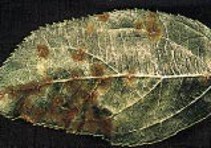
Figure 1.
Apple Scab. Warty, necrotic lesions on leaves, infected by Venturia inaequalis. (Photo courtesy of Dr. M.A. Ellis, Department of Plant Pathology, The Ohio State University, Ohio Agricultural Research and Development Center, Wooster, OH)
Apple scab is a fungal disease that is most common in areas of high rainfall and relative humidity. Spots and lesions develop on leaves and fruit. Illustrations identify symptoms and describe the fung ...
The apple scab fungus infects leaves and fruits. Initially, velvety olive-green spots appear on the leaves (Figure 1). Eventually the lesions enlarge, turn brown or black and assume a scabby appearance. Infection on or near the petiole may result in leaf drop.
The scab fungus can also infect fruit during any stage of fruit development, but fruit becomes less susceptible with maturity. Infections occurring very early in development may result in a blossom blight and possibly fruit drop.
Symptoms on mature fruit infected early in development include olive-green or brownish warty lesions (Figure 2). Sometimes the scab lesions may develop deep cracks in the fruit. Small black spots resulting from infections occurring late in fruit development are termed “pinpoint” scab (Figure 3). Although infection occurs only in the orchard, pinpoint scab symptoms do not develop until the apples are in storage.
Figure 1.
Apple Scab. Warty, necrotic lesions on leaves, infected by Venturia inaequalis. (Photo courtesy of Dr. M.A. Ellis, Department of Plant Pathology, The Ohio State University, Ohio Agricultural Research and Development Center, Wooster, OH)
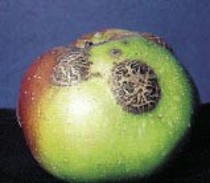
Figure 2.
Apple Scab. Circular, necrotic lesions on fruit infected early in development. (Photo courtesy of M.A. Ellis)
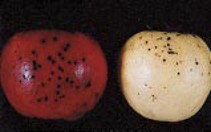
Figure 3.
Apple Scab (Pinpoint Scab). Small black spots resulting from infections occurring late in fruit development.
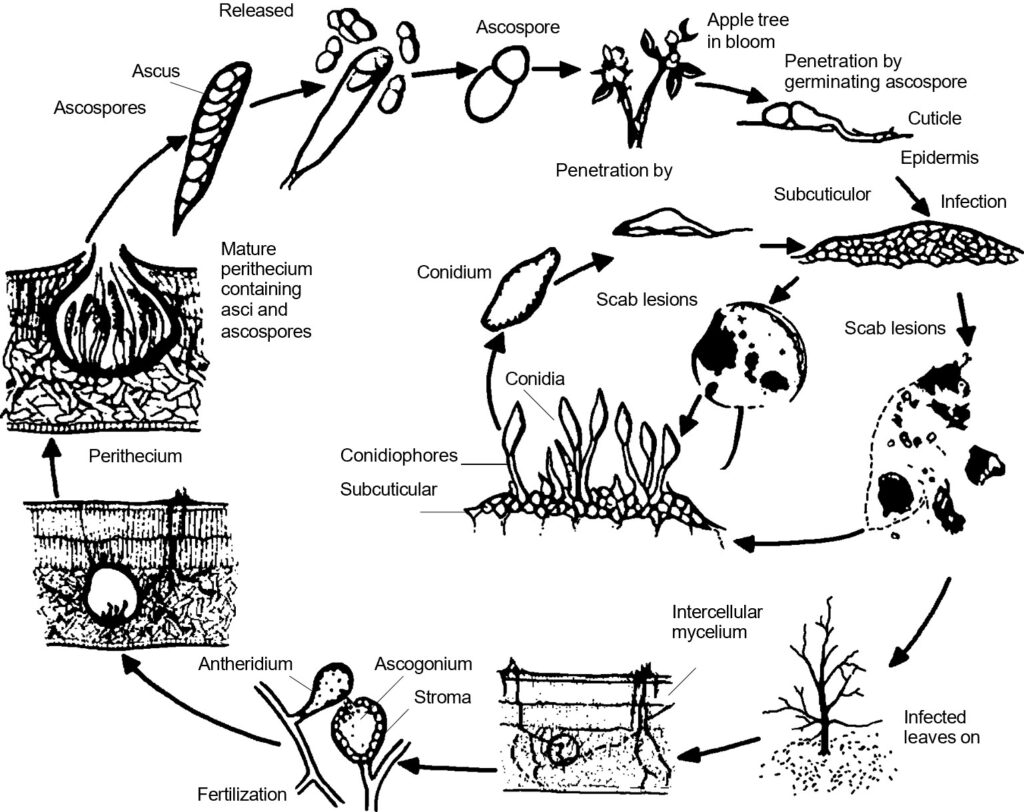
The fungus causing apple scab, Venturia inaequalis, overwinters in colonized dead leaves (Figure 4). The fungus survives the winter in these leaves in the form of a structure called a pseudothecium or perithecium.
Spores (known as ascospores) are produced within the pseudothecia and are discharged during rainy or wet periods in the spring. Ascospores landing on wet leaves or fruit germi-nate in the water film if temperatures are suitable.
Once the initial ascospore-caused infections (called primary scab) are established, the fungus continues to grow in the infected tissue and eventually produces a second type of infectious spore (known as a conidium) in the scab lesions. Infections resulting from conidia are termed secondary infections. After leaf fall, pseudothecia form ensuring a means for the fungus to survive the upcoming winter.
All spores of the apple scab fungus require a film of free water for a given period of time to ensure germination and subsequent infection. The wetness periods required are temperature dependent and are presented in Table 1.
| Average temperature (ºF) | Light infection | Moderate infection | Heavy infection | Days for lesions to appear |
|---|---|---|---|---|
| 33–36 | 48 | 72 | 96 | ? |
| 37 | 48 | 72 | 96 | ? |
| 38 | 41 | 55 | 68 | ? |
| 39 | 33 | 45 | 60 | ? |
| 40 | 29 | 41 | 56 | ? |
| 41 | 26 | 37 | 53 | ? |
| 42 | 23 | 33 | 50 | 17 |
| 43 | 21 | 30 | 47 | 17 |
| 44 | 19 | 28 | 43 | 17 |
| 45 | 17 | 26 | 40 | 17 |
| 46 | 16 | 24 | 37 | 17 |
| 47 | 15 | 23 | 35 | 17 |
| 48 | 15 | 20 | 30 | 17 |
| 49 | 14.5 | 20 | 30 | 17 |
| 50 | 14 | 19 | 29 | 16 |
| 51 | 13 | 18 | 27 | 16 |
| 52 | 12 | 18 | 26 | 15 |
| 53 | 12 | 17 | 25 | 15 |
| 54 | 11.5 | 16 | 24 | 14 |
| 55 | 11 | 16 | 24 | 14 |
| 56 | 11 | 15 | 22 | 13 |
| 57 | 10 | 14 | 22 | 13 |
| 58 | 10 | 14 | 21 | 12 |
| 59 | 10 | 13 | 21 | 12 |
| 60 | 9.5 | 13 | 20 | 11 |
| 61 | 9 | 13 | 20 | 10 |
| 62 | 9 | 12 | 19 | 10 |
| 63–75 | 9 | 12 | 18 | 9 |
| 76 | 9.5 | 12 | 19 | – |
| 77 | 11 | 14 | 21 | – |
| 78 | 13 | 17 | 26 | – |
The optimum temperature for ascospore germination is 70˚F (20˚C). At this temperature a wetness period of nine hours is required to result in a light level of infection. As the wetness period lengthens at a given temperature, the level of infection becomes more severe. As temperatures increase or decrease away from this optimum temperature, longer wetness periods are required for spore germination, e.g., 20 hours of wetness at 45˚F are required to reach the level of infection expected after 9 hours of wetness at 70˚F (20˚C).
If two wetness periods are separated by a period of eight hours or less, the wetness periods should be added together. Recent research in the eastern U.S. indicates that the wetness periods required for secondary foliar infections are about 2.5 hours more than those required for primary infections.
Apple cultivars vary in their susceptibility to apple scab. Scab resistance or susceptibility of various apple cultivars is presented in Table 2. Ornamental crabapples can also be severely impacted by scab. The most susceptible cultivars can be defoliated every year and also exhibit tip dieback if spray programs are not followed. Ornamental crabapple cultivars suggested for use in the region are presented in Table 3. They will produce showy flowers, maintain their leaves throughout the summer, and produce showy fruit with minimal or no fungicide application.
Because the scab fungus overwinters in fallen leaves, the disease can be partially controlled by raking and burning. However, fungicide sprays usually provide the only practical means of scab control in commercial orchards.
Correct spray timing during the primary scab cycle lessens the need for extensive fungicide applications during the latter stages of disease development. The critical period for scab control is from the beginning of bud growth until the apples are 1/2 inch (1.27 cm) in diameter.
In order to properly control secondary scab, orchards should be closely monitored for primary scab. Fungicides should be applied if one or two scab lesions per tree are present. Irrigation sets 12 hours or longer should be avoided.
There are two approaches to control apple scab using fungicides—protective and postinfective (kick-back or eradicant). A combination of both types of programs can be followed. The protective schedule is the least complicated, but usually requires more applications.
Sprays should be applied as soon as susceptible tissue is exposed in the spring and every 7–10 days throughout the season if scab is present on the leaves, or until all of the over-wintering spores are gone. The interval between sprays is dependent on the rate of growth of the host, weather conditions, and stability of the fungicide.
The postinfection approach to control requires accurate monitoring of orchard temperatures and length of time the leaves remain wet. It is imperative the grower has access to accurate local weather information. When conditions are favorable for scab development (when an infection period occurs), sprays are applied.
Most fungicides having post-infective (kickback, reach-back, or eradicant) activity indicate on their labels the maximum time available to complete spraying after the beginning of the infection period.
Three items should be considered when interpreting these times:
Some of the newer systemic fungicides have excellent postinfective activity, but limited protective capabilities. Resistance of the scab fungus to certain fungicides may develop after the products have been used exclusively. Be sure to follow label directions regarding the limitations on maximum seasonal use rates, spray intervals, and information about tank mixtures of protectant and postinfective type fungicides. For the most current fungicide recommendations, growers are referred to EB0419, Crop Protection Guide for Tree Fruits in Washington, which is updated every year by Washington State University Extension. Information also is available in Pacific Northwest Plant Disease Management Handbook, which is annually updated by Oregon State University.
Homeowners not wanting to apply fungicides should plant scab-resistant cultivars. If desired cultivars are susceptible, dwarf or semi-dwarf trees should be planted to allow good spray coverage. Rake and destroy leaves; do not put them in a compost. Prune to open the tree up allowing good air circulation and light penetration. Apply a registered fungicide at prebloom (prepink to pink stage), petal fall, and then every 7–10 days until dry weather.
| Cultivar | Cultivars commonly grown east of the Cascade Mountains. | Cultivars commonly grown west of the Cascade Mountains. | Resistant cultivars not usually requiring fungicide applications even in western Washington’s wet climate. | Resistance |
|---|---|---|---|---|
| Akane | No | Yes | Yes | resistant |
| Braeburn | No | No | N/A | susceptible |
| Chehalis | No | No | Yes | resistant |
| Criterion | Yes | No | N/A | susceptible |
| Fuji | Yes | No | N/A | susceptible |
| Gala | Yes | Yes | N/A | susceptible |
| Golden Delicious | Yes | Yes | N/A | susceptible |
| Gravenstein | No | Yes | N/A | susceptible |
| Idared | No | Yes | N/A | susceptible |
| Jonagold | Yes | Yes | N/A | susceptible |
| Liberty | No | Yes | Yes | immune |
| McIntosh | Yes | No | N/A | susceptible |
| Melrose | No | Yes | N/A | susceptible |
| Mutsu | Yes | Yes | N/A | susceptible |
| Paulared | No | Yes | Yes | resistant |
| Prima | No | Yes | Yes | immune |
| Red Delicious | Yes | No | N/A | susceptible |
| Rome | Yes | No | N/A | susceptible |
| Spartan | No | Yes | N/A | susceptible |
| Summer Red | No | Yes | N/A | susceptible |
| Tydeman’s Red | No | Yes | Yes | resistant |
| Yellow transparent | Yes | Yes | N/A | susceptible |
| Cultivar | Flower Color | Fruit Color | Growth Habit |
|---|---|---|---|
| Donald Wyman | White | Red | Tree |
| Red Jewel | White | Red | Tree |
| Sugar Tyme | White | Red | Tree |
| Zumi (cv. calocarpa) | White | Red, Orange | Tree |
| Jewelberry | White | Red | Shrub |
| Sargent’s Flowering Crab (Malus sargentii) | White | Red | Shrub |
| Bob White | White | Yellow | Tree |
| Japanese Flowering Crab (Malus floribunda) | White, Pink | Yellow, Pink | Tree |
| Ormiston Roy | White, Pink | Yellow, Pink | Tree |
| Professor Sprengler | White, Pink | Yellow, Orange | Tree |
| Adams | Red | Red | Tree |
By Gary Grove, Ph.D., WSU Extension plant pathologist and Chang-Lin Xiao, Ph.D., WSU Extension plant pathologist.
▲ Warning. Use pesticides with care. Apply them only to plants, animals, or sites listed on the label. When mixing and applying pesticides, follow all label precautions to protect yourself and others around you. It is a violation of the law to disregard label directions. If pesticides are spilled on skin or clothing, remove clothing and wash skin thoroughly. Store pesticides in their original containers and keep them out of the reach of children, pets, and livestock.
The law requires that pesticides be used as label directs. Uses against pests not named on the label and low application rates are permissible exceptions. If there is any apparent conflict between label directions and the pesticide uses suggested in this publication, consult your county Extension agent.
Pacific Northwest extension publications are produced cooperatively by the three Pacific Northwest land-grant universities: Washington State University, Oregon State University, and the University of Idaho. Similar crops, climate, and topography create a natural geographic unit that crosses state lines. Since 1949, the PNW program has published more than 550 titles, preventing duplication of effort, broadening the availability of faculty specialists, and substantially reducing costs for the participating states.
Pacific Northwest Extension Publications contain material written and produced for public distribution. You may reprint written material, provided you do not use it to endorse a commercial product. Please reference by title and credit Pacific Northwest Extension Publications.
Published and distributed in furtherance of the Acts of Congress of May 8 and June 30, 1914, by Washington State University Extension, Oregon State University Extension Service, University of Idaho Extension System, and the U. S. Department of Agriculture cooperating. Extension programs, activities, materials, and policies comply with federal and state laws and regulations on nondiscrimination regarding race, sex, religion, age, color, creed, national or ethnic origin; physical, mental, or sensory disability; marital status, sexual orientation, and status as a Vietnam-era or disabled veteran. Washington State University Extension, The Oregon State University Extension Service, and University of Idaho Extension are Equal Opportunity Employers. Evidence of noncompliance may be reported through your local Extension office. Trade names have been used to simplify information; no endorsement is intended. Published December 2005. Subject code 235. $1.50. PNW0582