Anticipated Climate Change Impacts on Agriculture in Washington State
Table of Contents
- Introduction
- Changing Temperatures, Precipitation, Carbon Dioxide Levels, and Their Impacts to Crops and Animal Agriculture
- Impacts on Water Supply
-
Extreme Weather
- Heat
- Droughts and Floods
- Coastal Storms
- Wildfire and Wildfire Smoke
Introduction
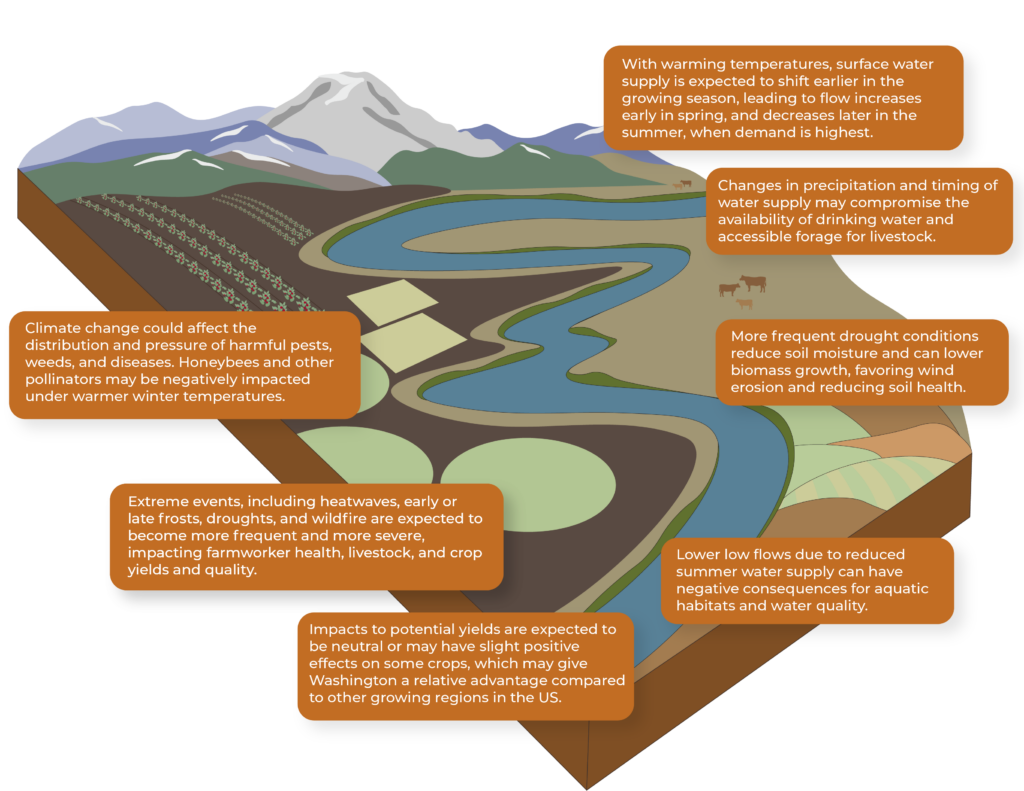
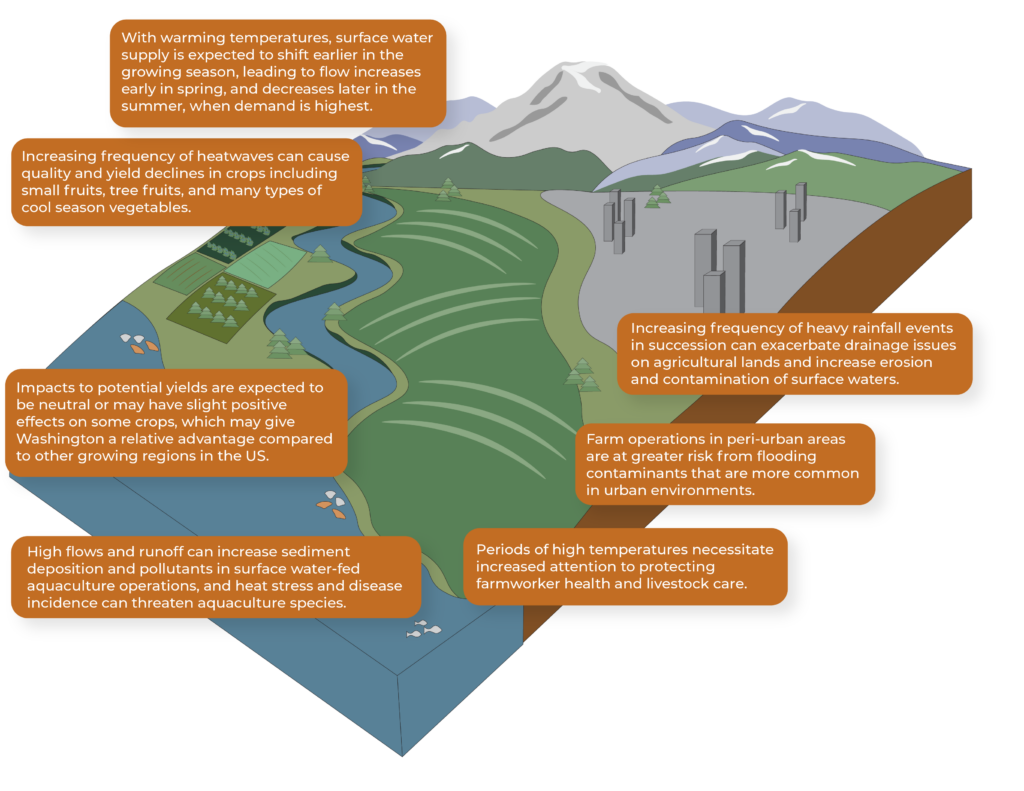
The investigation into climate change impacts on agriculture—including impacts on cropland, livestock, and aquaculture systems—is relatively new, with most studies produced in the last fifteen years. This article summarizes what is known about the anticipated climate impacts to the agricultural sector in Washington State. The literature is far from comprehensive, with some geographic areas and types of production systems better covered than others. Given the diversity of conditions, agricultural products, and production systems across the state, it is unsurprising—yet noteworthy—that there is significant complexity in the anticipated impacts. Climatic differences east and west of the Cascade Range, in combination with other factors, have led to distinct production systems. The biggest or most studied climate change impacts are therefore sometimes different east (Figure 1) and west (Figure 2) of the mountains. While some overall patterns can be discerned, there is an ongoing need for research that provides a more complete understanding, and better supports adaptation to a changing climate.
Changing Temperatures, Precipitation, Carbon Dioxide Levels, and Their Impacts to Crops and Animal Agriculture
Increased temperatures can accelerate crop growth and maturity, which ultimately reduces crop biomass and therefore potential yields (Rajagopalan et al. 2018; Stöckle et al. 2010). However, the carbon dioxide (CO2) effect, in which increased atmospheric CO2 increases the rate of photosynthesis and improves crop water use efficiency for many crops, generally improves plant yields (Stöckle et al. 2010, 2018; Rajagopalan et al. 2018). Combined with potential management adaptations, such as changing planting dates or crop varieties, the effect of a warming planet (with increased atmospheric CO2) is generally positive for potential crop yields in Washington. Similarly, rangeland net primary productivity is expected to increase through the end of the century (Reeves et al. 2014). It is important to note that studies cited above are limited in multiple ways. They assume ideal conditions—meaning adequate availability of irrigation water, nutrients, and other factors. They also do not account for impacts from extreme weather, weed and pest pressures, or reductions in crop quality, all of which can reduce actual crop yields or performance.
For the shellfish aquaculture industry, elevated atmospheric levels of CO2 are more problematic and can cause acidification of the water (i.e., ocean acidification), which reduces the availability of carbonate minerals that are necessary for bivalve shell deposition (Clements and Chopin 2017; Tan and Zheng 2020). Ocean acidification has been shown to negatively impact shell calcification, early embryonic development, growth, attachment, and survival (Morris and Humphreys 2019; Swezey et al. 2020; Duarte et al. 2022). The economic losses attributed to ocean acidification are estimated to be in the billions of dollars annually for the global shellfish industry. Farmers in Washington State will be impacted by increasingly acidic waters in the coming decades (Mangi et al. 2018).
Changes in precipitation and the resulting agricultural impacts are more difficult to predict (Mote et al. 2013). Tubiello et al. (2002) reported that simulations with increased precipitation led to higher yields for dryland production systems. Stöckle et al. (2010) used regional climate projections which indicated increases in both annual and growing season precipitation for multiple dryland sites across Washington; however, these increases in precipitation were not as impactful on potential yields compared to increases in temperature and CO2 concentrations. Overall, Stöckle et al. (2010) projected potential yield increases for the main agricultural commodities in eastern Washington through mid- to late century, primarily due to the positive influence of the CO2 effect. For irrigated systems, the effect of precipitation is largely dependent on watershed type, which is discussed in the Impacts on Water Supply section below.
Although the CO2 effect may benefit crop yields and rangeland production, higher CO2 levels may decrease certain nutrients and proteins in some plants as accelerating maturation affects nutrient accumulation (McGrath and Lobell 2013; Dong et al. 2018; Uddling et al. 2018; Jin et al. 2019). This could negatively impact nutrition for both humans (Myers et al. 2014) and livestock (Augustine et al. 2018).
Elevated temperatures can also change certain phenological processes, such as chill accumulation in tree fruit (Noorazar et al. 2022b), which can impact yields. While chill accumulation is expected to decrease in the fruit and berry growing regions of the Southwest (Baldocchi and Wong 2008; Payero 2024) and Southeast, the Pacific Northwest is, in comparison, more resilient (Noorazar et al. 2022b). Changing crop phenology can also increase the risk of frost and cold damage (Rigby and Porporato 2008), especially for varieties that have lower chill requirements. For example, recently introduced blueberry varieties in Washington have lower chill requirements but also bloom earlier and are therefore more susceptible to cold damage.
Impacts on Water Supply
Impacts on water supply for Washington State will be influenced by three main factors: warmer temperatures, reduced precipitation in summer months, and increased precipitation in winter months (Tohver et al. 2014). How these changes impact specific areas will largely depend on the watershed type (i.e., snow-dominated, rain-dominant, or mixed rain/snow), the extent to which the watershed is currently experiencing water supply-related issues, the type of agricultural production (dryland versus irrigated, perennial versus annual, etc.), access to water storage infrastructure, and the seniority of producer water rights.
Streamflow—an important determinant for the surface water supplies that irrigated agriculture relies on—is expected to increase in the fall, winter, and spring, and decrease in the summer (Hall et al. 2021). Effects will be most pronounced for mixed rain/snow and warmer snow-dominated watersheds, where small changes in temperatures can substantially impact snow accumulation and melt.
Streamflow reductions in rivers with instream flow rules could prompt more frequent and deeper curtailments (i.e., temporary shutoffs of full or partial access to water) for junior rights holders (Hall et al. 2024), which could limit irrigation water for these producers. Hall et al. (2024) concluded that in the future, curtailments are more likely to occur and may occur over a longer time frame within a given year. Even with increased curtailments, rivers may have insufficient flows to support fish populations and riverine function in affected river basins. In addition, low flows could exacerbate water quality issues, such as by increasing water temperatures or by concentrating nutrients or other pollutants (Kormos et al. 2016; Lee et al. 2020; Scott et al. 2023). Enhanced planning at multiple levels (e.g., statewide, basin-wide, on-farm) will be necessary to adequately store and deliver water for irrigated agriculture as the amount and timing of water availability shifts earlier in the growing season, and droughts and floods potentially become more common (Tohver et al. 2014).
In Washington, state law requires that enough water be kept in streams and rivers to protect and preserve fish, wildlife, water quality, recreation, aesthetics, and navigation. Instream flow rules (which have a seniority date of the year they were implemented) set minimum levels at which rivers should flow, ensuring rivers are protected from excess withdrawal of water by more junior water users. Instream flow rules cover nearly half of Washington’s watersheds and the Columbia River.
Dryland agriculture will also be impacted by changes in the amount and timing of precipitation. Effects on soil moisture at seeding time will be especially important for water-limited dryland systems (Kruger et al. 2011; Karimi et al. 2018). Increased atmospheric evaporative demands and early season evapotranspiration (Rajagopalan et al. 2018; Scarpare et al. 2022) can also impact the timing and magnitude of soil moisture availability for plant growth during the growing season. In response, growers may have to fallow more land (Zhang et al. 2017). However, there are many site-specific factors and constraints that will determine how individual growers can best respond to changes in precipitation patterns and soil moisture (Maaz et al. 2017).
Rangelands will also be impacted by shifting precipitation patterns coupled with increasing temperatures. Decreased precipitation in the summer months and the potential for increased evapotranspiration pose a risk to forage availability in the later growing season through limited soil water availability (Polley et al. 2017). This in turn can pose challenges in maintaining historical stocking rates (Polley et al. 2017; Augustine et al. 2018; Petersen et al. 2019). Water access—and the availability of forage in sufficient proximity to drinking water—may become more limited throughout grazing areas. This could increase the need for additional water infrastructure and greater feed supplementation in the traditional forage grazing season to support animal growth (Chambers and Pellant 2008; Polley et al. 2017; Neibergs et al. 2018; Petersen et al. 2019).
Extreme Weather
Extreme weather events have and will continue to cause severe disruptions to agricultural systems. The Northwest chapter of the Fifth National Climate Assessment notes increasing crop insurance loss payments due to extreme events and impacts, an indicator associated with economic disruption of agricultural production (Reyes and Elias 2019; Diffenbaugh et al. 2021; Chang et al. 2023). The following sections discuss particular types of extreme events that are relevant to Washington agriculture.
Heat
As temperatures warm, heat waves are becoming more frequent, more extreme, and longer lasting (Perkins-Kirkpatrick and Lewis 2020). The June 2021 Pacific Northwest heat wave reduced yields of many crops in nearby British Columbia, including spring wheat, barley, canola, cherries, grapes, and raspberries, by roughly 20%–30% of expected yields (White et al. 2023). Many crops grown in Washington, such as blueberries, apples, and many types of Brassicas, have been shown to suffer quality and yield reductions from various forms of heat damage when temperatures reach certain thresholds (Morrison and Stewart 2002; Darbyshire et al. 2015; Yang et al. 2019; Willsea et al. 2023). Impacts usually begin occurring around 90°F and include sunburn, sun spotting, shriveling or wrinkling, and cell death. Heat waves can also affect crop quality by raising nighttime temperatures. In apples, for example, red color development—a key marketability trait—is lessened when fall night temperatures are too high (Willsea et al. 2023).
As temperatures warm, heat waves are becoming more frequent, more extreme, and longer lasting.
The higher temperatures expected in the western United States under climate change increase the likelihood of reaching the critical heat-humidity thresholds, where heat stress impacts animal health and productivity (Crescio et al. 2010; Lacetera 2019; Godde et al. 2021). Vulnerability varies depending on the species, breed, life stage, nutritional status, genetic potential, size, and previous exposure of the animal. However, high-yielding individuals and breeds tend to be more susceptible, with dairy cows among the most vulnerable (Godde et al. 2021). Projected changes in heat stress events for dairy cows (Mauger et al. 2015) and cattle on rangelands (Reeves et al. 2017) are anticipated to be impactful but less severe in Washington than in other regions of the United States.
The cold-water finfish and shellfish aquaculture species cultured in Washington State are particularly vulnerable to elevated water temperatures as they cannot regulate their internal body temperature (i.e., they are ectotherms) and are adapted to the natural cool water of the region. The salmon and trout cultured in river systems across the state are already experiencing summer high water temperatures that can induce stress (Siegel and Crozier 2020). Marine shellfish aquaculture has also experienced severe high mortality events associated with the recent marine heat waves, with the heat wave of June 2021 representing a particularly devastating event (Miller 2022; Beck et al. 2024). Shellfish are not only vulnerable to elevated water temperatures (Li et al. 2007; Chi et al. 2024) but can experience mortality events when extreme low tides occur during days with abnormally high air temperatures. This can expose the animals to high air temperatures for an extended period of time (Miller 2022).
Droughts and Floods
As discussed in the Impacts on Water Supply section, droughts, heavy rainfall, and flooding may become more common in the future. Though relatively understudied, these events are expected to reduce crop yields (Malek et al. 2021; Kim et al. 2023). Washington’s 2021 drought, for example, reduced access to irrigation water and resulted in yield loss for several crops (Ansah and Walsh 2021; Chang et al. 2023). Tohver et al. (2014) predict that some rain-dominated and mixed rain/snow basins in the state are expected to experience summer low flows around half of their historical minimum, as early as the 2040s, an indication that future droughts may be more severe.
Flooding is also likely to increase in frequency and severity across both mixed rain/snow basins and in warm, rain-dominated basins where peak flows occur in the late fall or winter (Salathé et al. 2014; Tohver et al. 2014; Safeeq et al. 2015). Tohver et al. (2014) found that by 2080, shifts in climate in some mixed rain/snow basins are projected to lead to floods that are between 1.5 and 2 times greater in magnitude than the historical baseline. Flooding can devastate agricultural operations, as illustrated in the Chehalis Basin of western Washington in 2007, in which 19 out of 30 dairies were flooded (Yorgey et al. 2017). Two operations suffered a complete loss of animals, despite being sheltered in barns that were historically safe from flooding.
Changes to hydrology and precipitation patterns, including sea level rise, more winter precipitation, and higher intensity rainfall events, could also exacerbate preexisting agricultural drainage issues already prevalent in western Washington by overwhelming drainage infrastructure, flooding fields, and increasing runoff from agricultural lands (Lee and Hamlet 2011; Jobe 2021). Increasing runoff can cause a variety of compounding concerns, including topsoil loss (Halecki et al. 2018), nutrient and pesticide contamination of water bodies (Rashmi et al. 2022), and deterioration of salmon spawning habitat (Grant et al. 2019).
To understand the impacts of flooding on shellfish aquaculture, it is important to recognize these animals’ influence on water quality. As filter feeders, shellfish have important ecological functions and can improve water quality in enclosed ecosystems. Shellfish aquaculture can reduce the impacts of terrestrial nutrient inputs that can increase eutrophication of the water. However, flooding and the associated runoff from urban or agricultural land can degrade water quality in marine culture environments by promoting harmful algal blooms or introducing wastewater effluents. This may contaminate shellfish with harmful fecal bacteria or result in increased levels of pollutants bioaccumulated in shellfish (Webber et al. 2021; Frith et al. 2022; Ferreira et al. 2023).
Coastal Storms
The increased prevalence and intensity of coastal storms associated with climate change will add additional challenges to shellfish farmers. Storms can damage aquaculture equipment or tidal beds which can result in economic losses and increased labor costs to growers.
Wildfire and Wildfire Smoke
Wildfires across the western United States, including in Washington, have become larger, hotter, more severe, and more deadly over the last several decades, due to a suite of factors that includes, but is not limited to, climate change (Halofsky et al. 2020; Ostoja et al. 2023). Wildfires pose a threat to animal safety (Neibergs et al. 2018; O’Hara et al. 2021) and can have enterprise-threatening impacts on ranchers in the region (Hall et al. 2020). Rangelands and surrounding areas can take 3–15 years to recover after a wildfire, depending on weather patterns (especially precipitation) and rangeland vegetation composition (Applestein et al. 2021; Coop et al. 2023). Resting those lands as they recover takes significant acreage out of production for that period. Finding alternative grazing land or supplemental feed to offset this loss is a significant economic burden. Forage composition can also be permanently altered, as invasive annual grasses can recover from wildfires more effectively than native species (Archer et al. 2023). Invasive grasses—most notably cheatgrass—also become a fuel source for future fires, as their abundance creates a continuous fuel bed, and they senesce and dry out earlier than perennial grasses. In this way, invasives and wildfires reinforce each other, creating a positive feedback loop that leads to the ongoing loss of productive forage in affected rangelands (D’Antonio and Vitousek 1992; Chambers and Pellant 2008; Balch et al. 2013; Pilliod et al. 2021).
Even for crops and animals not directly in harm’s way, indirect impacts from smoke can be consequential. For livestock, smoke inhalation and the stress from confinement or evacuation have not been well studied, but are likely to reduce productivity. Potential impacts include poor weight gain, reduced milk production and milk quality, respiratory illnesses, and negative immune and reproductive impacts (O’Hara et al. 2021; Anderson et al. 2022; Pace et al. 2023). Heat stress compounds these negative effects, which can persist even after air quality improves. Impacts to young animals are particularly concerning given potential for long term impacts (Buczinski et al. 2021; Pace et al. 2023). Wildfire smoke can also impact crops, such as wine grapes (Krstic et al. 2015). Wine made from smoke-tainted grapes will have compromised aroma and flavor but may require additional processing to restore quality (Mirabelli-Montan et al. 2021).
Impacts on Pests, Weeds, and Disease
Overall, there is limited information on how pests, weeds, and disease may impact cropping systems in a climate-changed future. Generally, warmer temperatures increase threats from insect pests (Eigenbrode et al. 2013). For example, Stöckle et al. (2010) and Noorazar et al. (2022a) modeled the impacts of climate change on codling moths in the Pacific Northwest, concluding that moths will emerge earlier and have the potential for additional generations within each growing season, exerting additional pressures on apple production systems.
Stöckle et al. (2010) also modeled changes in the occurrence of cherry and grape powdery mildew, two common crop diseases in the Pacific Northwest. Results varied by climate model, though most projections predicted no change or only a slight increase in disease incidence. Though Northwest-specific research is sparse, climate change is likely to lead to changes in some livestock infectious diseases, particularly those with pathogens or vectors whose development or transmission is influenced by climatic factors (Hristov et al. 2017; Godde et al. 2021). Impacts could include changes in spatial distributions, annual and seasonal cycles, disease incidence and severity, and susceptibility of livestock to illness (Godde et al. 2021). Changes in climate could cause new or currently uncommon crop or livestock diseases to spread in the region, though this requires further investigation and monitoring.
Elevated water temperatures can increase the susceptibility of cold-water aquaculture species to diseases, as thermal stress has negative impacts on immune function and may promote the growth of some pathogens. More studies are needed to fully understand how aquatic pests and diseases will impact the aquaculture industry. Clear associations between the prevalence of Vibrio bacteria and water temperature have been identified in Washington State (Davis et al. 2021; Fries et al. 2022). Vibrio are pathogenic to humans and prevent the harvest of shellfish during outbreaks, which results in economic losses to growers (Freitag et al. 2022). Changes in Washington State marine water conditions have also been linked to the increased occurrence of harmful algal blooms that can kill shellfish or make them toxic to humans (Trainer et al. 2020; King et al. 2021; Trainer and King 2023).
Climate change is expected to benefit many weed species (Stöckle et al. 2010). For example, increased temperatures and elevated CO2 benefit invasive annual grasses over native grasses in rangeland systems, which could reduce forage quality (Reeves et al. 2017; Archer et al. 2023). Lawrence and Burke (2015) found that climate change impacts to cheatgrass, a common Washington weed in dryland systems, could make current herbicide regimens less effective in the future, as herbicide-resistant biotypes spread further and the weed reaches seed maturity earlier in the spring when precipitation is expected to increase.
Impacts on Pollinators
Many berry, fruit, and vegetable crops are reliant on managed honeybees and native pollinators. Climate change can alter the species distribution of native pollinators (Shi et al. 2021), create a mismatch between the timing of forage availability and foraging needs (Willmer 2012; Goulson et al. 2015), and result in an increased risk of honeybee colony failure (Rajagopalan et al. 2024). For example, warmer winters cause premature physiological aging in bees that were previously less active during colder winters. Cold storage for hives may become important in the future (Rajagopalan et al. 2024).
Washington’s Relative Position
Though climate impacts will be mixed and will differ by location and cropping system, Washington may fare better overall than many other regions of the United States (Hsiang et al. 2017; Guo et al. 2022). Drought risk may be increasing more for other regions compared to the Northwest, with the Southwest United States experiencing an increasing trend in meteorological drought severity (Apurv and Cai 2021).
Other influences beyond climate change are also contributing factors. For example, California’s San Joaquin Valley could see as much as a 20% reduction in irrigation water supplies by 2040 due to the combination of climate change and changes in policy that drastically reduce groundwater withdrawals and require greater water releases for environmental flows (Escriva-Bou et al. 2023). Without intervention, these changes could lead to losses of more than 50,000 jobs in the region and reductions in agricultural revenue of more than $10 billion in a worst-case scenario. Even in the best-case scenario, nearly 500,000 more acres will be fallowed compared to baseline (2003–2010) conditions.
Comparatively, most regions with irrigated agriculture in Washington are more dependent on surface water and not under environmental pressures of the same magnitude (with some notable exceptions). Thus, the state’s relatively temperate climate, surface water availability, extensive irrigation systems, and variety of crops bolster its potential to become a more agriculturally important region in a climate-changed future. However, there are still many consequential impacts from climate change that will affect Washington agriculture. Strategic management will be vital to realize potential production increases.
Though climate impacts will be mixed and will differ by location and cropping system, Washington may fare better overall than many other regions of the United States.
Considerations Beyond Impacts to Crops, Livestock, and Aquaculture
Impacts to Human Health
Increasing temperatures under climate change expose agricultural workers to more dangerous levels of heat (Tigchelaar et al. 2020) and contribute to negative health outcomes, including heat-related illness, kidney injury, adverse pregnancy and birth outcomes, and mental health effects, as well as increased risk for traumatic injury (Spector et al. 2016; Fenske and Pinkerton 2021). In Washington, workers’ compensation claims for heat-related illness spike during years with higher average maximum outdoor temperatures (Washington State Department of Labor & Industries 2023a), a trend that is expected to worsen under climate change (Hesketh et al. 2020). Areas in eastern Washington, such as in Yakima, Okanogan, and Benton Counties, are expected to experience an increase in the number of days with a heat index greater than or equal to 90°F by midcentury, compared to historical (1971–2000) conditions (approximately +35 days; The Climate Toolbox), representing a sharp increase in dangerous working conditions.
Increased frequency or severity of wildfires, and the resulting decline in air quality, can create additional negative impacts, sometimes occurring concurrently (Ebi et al. 2021). Heat and drought can also drive increased rates of wind erosion which can elevate levels of particulate matter in the air (Sharratt et al. 2015), exposure to which has been linked to increased chronic respiratory symptoms and the worsening of lung and heart disease (United States Environmental Protection Agency 2017). Rules and protocols related to agriculture, human health, and workers’ exposure to hazards have recently been updated to include requirements for shade, rest, and acclimatization, while lowering the temperatures at which some preventive actions must be taken (Washington State Department of Labor & Industries 2023b). However, there is an ongoing need to support implementation and further adaptation, especially the development and implementation of strategies that do not reduce farm productivity and profits or worker earnings (Tigchelaar et al. 2020).
Impacts to Environmental Quality
Climate change, specifically through its potential to increase floods and droughts, may impact environmental quality by increasing issues with soil erosion. Climate change driven increases in droughts may lead to increased wind erosion (Duniway et al. 2019) and associated air quality decline (Tian et al. 2021). Though increased biomass growth due to warmer temperatures and higher CO2 concentrations could temper water- (Farrell et al. 2007) and wind-driven erosion (Sharratt et al. 2015), in the inland Pacific Northwest, Farrell et al. (2007) projected more than a doubling of soil erosion in conventionally tilled dryland systems by mid-century. Droughts also lead to reductions in crop biomass and corresponding residue inputs to soil, which may translate to declines in soil organic matter and degraded soil structure, negatively affecting crop yields and further increasing rates of erosion (Lal 2011).
Changes in precipitation patterns can also impact manure management needs and strategies for dairy operations (Burkholder et al. 2007), particularly in western Washington. Over the last decade or more, dairy farmers in western Washington and Oregon have anecdotally noted changes in seasonal rainfall patterns that align with regional climate change projections for increased winter and spring season precipitation (Mote et al. 2013). A preliminary analysis in Whatcom County indicated an increased frequency of large storms that surpass the capacity of current required lagoon design, and therefore, an increased risk of lagoon overflow is likely (Rajagopalan, unpublished data). Understanding these climate change-related impacts is critical, as lagoons are long-term infrastructure investments that can last as long as 40–50 years.
Regulatory and Market Considerations
Although climate change will impact agricultural systems, it is just one of many factors that producers must consider and may not be of most concern (Antle et al. 2017; Galambos et al. 2025). In a survey of Pacific Northwest wheat producers, changes in cost of inputs and crop prices were ranked ahead of any climate-related considerations in terms of the risk they posed (Gantla et al. 2015). Furthermore, most producers in this survey perceived climate change-related policies as posing a higher risk to their operations than less reliable precipitation, despite the fact that most wheat producers lack irrigation. In a similar vein, supporting processing and other agricultural businesses and infrastructure will be important to ensure ongoing viability of agriculture in Washington.
Most agricultural markets are global, and these markets have a substantial impact on the economic outlook of agriculture in Washington. This reinforces the conclusion that impacts on production in Washington need to be assessed alongside the likely impacts on production elsewhere in the United States and world (Hsiang et al. 2017; Bolster et al. 2023). This includes an analysis of cross-border, policy-related impacts. Climate change is also likely to impact food consumers in Washington and elsewhere, with the potential for increasing food prices; negative impacts on those who rely on hunting, fishing, foraging, and subsistence farming; and adverse impacts to culturally important foods, including but not limited to salmon (Bolster et al. 2023; Seagrest 2024).
Meanwhile, some agricultural systems face pressures from consumers and buyers to meet regulatory standards for emissions reductions or otherwise implement environmentally friendly production practices (Nyoni 2024; Galambos et al. 2025), or, in the case of cropping systems, to move toward production of specialty crops (Gustafson et al. 2021). In some cases this may complement and in other cases this may complicate efforts to adapt systems to address climate impacts. It will be key to recognize these other factors when prescribing policy or promoting programs that intend to support producer adaption to projected climate impacts (Gelardi et al. 2023a).
Although climate change will impact agricultural systems, it is just one of many factors that producers must consider and may not be of most concern (Antle et al. 2017; Galambos et al. 2025). In a survey of Pacific Northwest wheat producers, changes in cost of inputs and crop prices were ranked ahead of any climate-related considerations in terms of the risk they posed.
Specific Challenges for Small Operations and Socially Disadvantaged Farmers
There is some evidence that smaller farms may be more economically vulnerable to climate change impacts (e.g., Antle et al., 2017, for wheat-based systems) likely due to their relatively limited financial base and lack of other resources (e.g., irrigation) to help them ameliorate impacts (International Fund for Agricultural Development 2014; Happ 2021). This can be expected to extend to other small farm situations, including those that produce livestock, livestock products, or diversified vegetables or fruits. A growing number of small farmers in Washington represent historically underserved and socially disadvantaged populations, including women, Latino, Asian, and immigrant farmers, who possess additional vulnerabilities that can make it even harder to adapt to climate change (Ostrom et al. 2010).
Many diversified small farms participate in direct-to-consumer markets, typically providing products on a weekly or even more frequent basis. In western Washington, many of the operations growing vegetables and fruit have traditionally grown cool-season crops, such as cabbages, broccoli, kale, and spinach, during summer months, as well as other specialty crops, like warm-season vegetables, berries, or apples. As the climate warms and heat waves become more intense, cool-season crops could become less viable (Morrison and Stewart 2002; Yang et al. 2019; Willsea et al. 2023), perhaps necessitating adaptation for these small farms.
There is some evidence that small operations have been able to adapt quickly during previous disruptions, including during the COVID-19 pandemic (Ladyka et al. 2022). However, small, under-resourced, and socially disadvantaged farmers and farmworkers are less likely to qualify for—or use—government support programs (Happ 2021; Todd et al. 2024; Luciano et al. 2025), causing them to bear more of the economic burden of adapting. Farmers and farmworkers with limited literacy or limited English proficiency may also struggle to successfully navigate support programs, even when they are made available. Similar issues arise with many conventional farming education models that are not tailored to farmers with limited access to land, water, and capital, or who lack English proficiency (Ostrom et al. 2010). This underscores the need for governments to keep small and socially disadvantaged farmers and farmworkers in mind when crafting policy to help adapt to climate change.
Additionally, lack of capacity to address climate change impacts may push small farmers to a higher reliance on off-farm income. While this can buffer potential losses (Antle et al. 2017), it may also be a concerning symptom of economic distress and reduced economic viability of small-scale agriculture.
Areas for Future Study and Climate Adaptation
Climate change impacts on Washington’s agriculture are varied and complex and interact with other existing risks and uncertainties. Simultaneously, some climate-driven changes may result in new opportunities or benefits.
Key messages from the literature include the need to plan for ongoing shifts in water supply to rangelands, irrigated agriculture, and dryland agriculture. While there is a larger body of work on water supply impacts on irrigated agriculture, knowledge gaps remain, such as understanding the additional water demand that may be required to supply an increased use of overhead evaporative cooling. These systems, sometimes used in orchards or vineyards, utilize overhead irrigation to lower the temperature of the air or of fruit surfaces as water is converted to vapor. Additional study on the impacts to—and mitigation strategies for—rangeland and dryland systems is also required.
Climate science used to identify the probability of exposure to extreme weather events has advanced rapidly over recent years. Advances have increased the understanding of likely risks. However, knowledge of exact impacts and of the best adaptation strategies remains limited and warrants further exploration. This includes impact assessments and adaptation studies that are more specific to extreme weather exposure-related challenges. Large ensemble datasets and downscaled datasets from regional climate models will support these efforts.
Additional work is needed to fully understand potential impacts on crop and forage quality and to pests, weeds, diseases, and beneficial insects, including pollinators, given the complexity of interconnected risks. This work must go beyond understanding the impacts of climate change to identify management strategies that mitigate the deleterious effects.
While climate change presents clear challenges to Washington’s agriculture, there is also the potential that negative impacts may be less severe than elsewhere in the western United States. With successful management of negative impacts, there is the potential that the state could become more important in terms of national agricultural production. There is a strong need for ongoing work that positions agricultural producers at all scales to take advantage of opportunities where they exist and that proactively identifies and addresses any unintended negative impacts.
With successful management of negative impacts, there is the potential that the state could become more important in terms of national agricultural production.
Adaptive Responses to Climate Impacts Across Scales
Many climate impacts are unavoidable, thus response and recovery efforts are needed alongside climate change mitigation efforts. Unfortunately, robust studies that provide concrete evidence of the effectiveness of climate adaptation solutions for agriculture are scarce. There is a pressing need for additional work evaluating climate adaptation responses, including strategies to prepare for changes in water supply, pest pressures, and in some cases, shifts to novel crops that may be suitable in Washington’s future. Investigation into adaptation should include strategies for state, regional, and local entities as well as for commodity groups and individual farmers and farmworkers.
Some impacts can be avoided or mitigated through implementing farm-scale management practices. Examples of these strategies include adjusting planting dates of dryland crops as growing seasons lengthen (Stöckle et al. 2010) or installing shade netting or evaporative cooling for fruit trees to reduce physiological disorders from heat stress (Willsea et al. 2023). In some cases, decision-support tools may be for individual producer adaptation, especially when decisions are complex (Yorgey et al. 2017). This may occur by enhancing existing decision support systems (such as Washington State University’s AgWeatherNet or Decision Aid System; Jones et al., 2010) or the development of new tools (such as StockSmart; Hudson et al., 2021, 2024). There are also opportunities to implement on-farm practices with multiple co-benefits to producers and the environment. For example, practices that increase soil organic matter can increase the soil’s water holding capacity (Minasny and McBratney 2018; Bagnall et al. 2022) while supporting other essential soil functions and overall resilience. However, it is important to acknowledge the limits of these strategies in terms of their ability to consistently deliver benefits across regions, soil textures, and cropping systems, as well as the barriers to implementing these practices across cultural, social, and economic contexts (Sulman et al. 2018; Happ 2021; Stephenson et al. 2022; Wongpiyabovorn et al. 2022; Gelardi et al. 2023b).
There is a pressing need for additional work evaluating climate adaptation responses, including strategies to prepare for changes in water supply, pest pressures, and in some cases, shifts to novel crops that may be suitable in Washington’s future.
Other adaptation strategies may be most appropriately implemented by people or entities working in support of growers and ranchers. One example is the increased adoption by beekeepers of indoor temperature-controlled hive storage during winter, to reduce physiological aging and the consequent increased colony failure risks. Another example is expansion of educational efforts by a variety of agricultural support entities on worker safety requirements (e.g., required acclimatization, rest, shade, and water availability) and strategies (e.g., hydration, light and ventilated clothing), especially in areas that have not historically experienced extreme high temperatures.
Still other impacts will require solutions that involve shared infrastructure, policy, extensive incentive programs, or other support. These solutions are largely outside the decision space of individual growers and ranchers and will require engagement from a variety of decision-makers. Examples of this type of adaptation include addressing many water supply challenges: aquifer recharge projects, better and earlier drought and seasonal forecasts, supporting effective water markets, shifting the time-of-use rules on water rights, and infrastructure improvements (Meinke and Stone 2005; Hall et al. 2021; Khanal et al. 2021; Malek et al. 2021; Zhao et al. 2021; Kondal et al. 2023; O’Connor et al. 2023; Deol et al., under review). Other examples address the need to strengthen institutional responses that prepare for—and respond to—extreme weather impacts, and to enhance weed, pest, and disease risk surveillance of crops and animals (Hristov et al. 2017; Subedi et al. 2023). Related activity in Washington includes the establishment of the Agricultural Pest and Disease Response Account that can rapidly distribute funds during an invasive species crisis (WA State Legislature 2024) and a Drought Preparedness Account to mitigate existing and anticipated drought impacts (WA State Legislature 2023).
Given the complexity involved, it is important that decision-makers explore the limits of particular adaptation strategies (Yorgey et al. 2017; Gelardi et al. 2023a), as well as the potential unanticipated consequences of the solutions themselves and the trade-offs they pose. For example, Hall et al. (2021, 2024) found that surface water declines frequently coincide with groundwater declines. This convergence suggests that preparing for and mitigating water supply changes must include options beyond switching to alternative water sources.
While climate change is likely to exacerbate existing challenges, it also emphasizes the need for creative, new solutions that holistically support viable, sustainable agricultural systems. For example, innovations are needed to better manage invasive species on rangelands (Archer et al. 2023) or to protect farmworker health without negative impacts on worker earnings, farm profitability, and agricultural viability (Luciano et al. 2025). In addition, developing adaptation strategies will require enhanced collaboration across entities, and increased research and Extension capacity that is production system-specific.
Prior stakeholder engagement efforts have identified the need for enhanced partnership along the research–Extension–practice continuum to explore the economic and environmental costs and benefits of climate change adaptation and mitigation strategies (Yorgey et al. 2017). Novel methods have been proposed to strengthen Extension capacity for supporting local agricultural adaptation planning, such as identifying production practices from other climatic regions to envision Washington’s future opportunities and challenges (Chaudhary et al. 2023). As more examples arise of successful adaptation actions across scales, and as our understanding of climate impacts on agriculture continues to improve, agricultural stakeholders can collaboratively address the complex impacts of a changing climate on Washington’s agricultural systems.
Acknowledgements
This work was supported by the WSU Agricultural Research Center, the USDA National Institute of Food and Agriculture McIntire Stennis project 1019284, and the Washington State Department of Agriculture with funding from Washington’s Climate Commitment Act (CCA). The CCA supports Washington’s climate action efforts by putting cap-and-invest dollars to work reducing climate pollution, creating jobs, and improving public health. Information about the CCA is available at Washington Climate Action.
A version of this manuscript was first published in March 2025 as part of the Washington State Department of Agriculture’s Climate Resilience Plan for Washington Agriculture (Gelardi 2025).
References
Anderson, A., P. Rezamand, and A.L. Skibiel. 2022. Effects of Wildfire Smoke Exposure on Innate Immunity, Metabolism, and Milk Production in Lactating Dairy Cows. J. Dairy Sci. 105(8): 7047–60. doi: 10.3168/jds.2022-22135.
Ansah, E.O., and O.S. Walsh. 2021. Impact of 2021 Drought in the Pacific Northwest. Crops Soils 54(6): 46–49.
Antle, J.M., J.E. Mu, H. Zhang, et al. 2017. Design and Use of Representative Agricultural Pathways for Integrated Assessment of Climate Change in US Pacific Northwest Cereal-Based Systems. Front. Ecol. Evol. 5: 99.
Applestein, C., T.T. Caughlin, and M.J. Germino. 2021. Weather Affects Post-Fire Recovery of Sagebrush-Steppe Communities and Model Transferability Among Sites. Ecosphere 12(4): e03446. doi: 10.1002/ecs2.3446.
Apurv, T., and X. Cai. 2021. Regional Drought Risk in the Contiguous United States. Geophys. Res. Lett. 48(5): 2020 092200.
Archer, D., D. Toledo, D.M. Blumenthal, et al. 2023. Invasive Annual Grasses—Reenvisioning Approaches in a Changing Climate. J. Soil Water Conserv. 78(2): 95–103. doi: 10.2489/jswc.2023.00074.
Augustine, D.J., D.M. Blumenthal, T.L. Springer, et al. 2018. Elevated CO2 Induces Substantial and Persistent Declines in Forage Quality Irrespective of Warming in Mixed-Grass Prairie. Ecol. Appl. 28(3): 721–735. doi: 10.1002/eap.1680.
Bagnall, D.K., C.L. Morgan, M. Cope, et al. 2022. Carbon‐Sensitive Pedotransfer Functions for Plant Available Water. Soil Sci. Soc. Am. J. 86: 612–629.
Balch, J.K., B.A. Bradley, C.M. D’Antonio, and J. Gómez‐Dans. 2013. Introduced Annual Grass Increases Regional Fire Activity Across the Arid Western USA (1980–2009). Glob. Change Biol. 19(1): 173–183. doi: 10.1111/gcb.12046.
Baldocchi, D., and S. Wong. 2008. Accumulated Winter Chill Is Decreasing in the Fruit-Growing Regions of California. Clim. Change 87: 153–166.
Beck, E.L., J. Ruesink, S. Troyer, and M. Behrens. 2024. Wild Populations of Pacific Oysters (Magallana gigas) Emerge During the Blob Heatwave in South Puget Sound.
Bolster, C.H., R. Mitchell, A. Kitts, et al. 2023. Ch. 11. Agriculture, Food Systems, and Rural Communities. Crimmins, A.R., Avery, C.W., Easterling, et al., eds., Fifth National Climate Assessment. U.S. Global Change Research Program.
Buczinski, S., D. Achard, and E. Timsit. 2021. Effects of Calfhood Respiratory Disease on Health and Performance of Dairy Cattle: A Systematic Review and Meta-Analysis. J. Dairy Sci. 104(7): 8214–8227. doi: 10.3168/jds.2020-19941.
Burkholder J., B. Libra, P. Weyer, et al. 2007. Impacts of Waste from Concentrated Animal Feeding Operations on Water Quality. Environ. Health Perspect. 115(2): 308–312. doi: 10.1289/ehp.8839.
Chambers, J.C., and M. Pellant. 2008. Climate Change Impacts on Northwestern and Intermountain United States Rangelands. Rangelands 30(3): 29–33. doi: 10.2111/1551-501X(2008)30.
Chang, M., L. Erikson, K. Araújo, et al. 2023. Ch. 27. Northwest. In: A.R., C.W.A., Easterling, D.R., Kunkel, K.E., Stewart, B.C., and Maycock, T.K., eds., Fifth National Climate Assessment. Crimmins. U.S. Global Change Research Program.
Chaudhary, S., K. Rajagopalan, and C.E. Kruger. 2023. Climate Analogs Can Catalyze Cross-Regional Dialogs for U.S. Specialty Crop Adaptation. Sci. Rep. 13: 9317. doi: 10.1038/s41598-023-35887-x.
Chi, Y., C. Xu, and Q. Li. 2024. Evaluating Survival After Heat Challenges and Investigating Their Correlations with Field Summer Survival for the Juvenile Pacific Oyster (Crassostrea gigas). Aquaculture 584: 740643.
Clements, J.C., and T. Chopin. 2017. Ocean Acidification and Marine Aquaculture in North America: Potential Impacts and Mitigation Strategies. Rev. Aquac. 9: 326–341.
Coop, J.D., S.A. Parks, C.S. Stevens-Rumann, et al. 2023. Prediction and Projection of Heatwaves. Nat. Rev. Earth Environ. 4(1): 36–50.
Crescio, M.I., F. Forastiere, C. Maurella, F. Ingravalle, and G. Ru. 2010. Heat-Related Mortality in Dairy Cattle: A Case Crossover Study. Spec. Sect. Calvin W Schwabe Symp. 2009 97(3): 191–197. doi: 10.1016/j.prevetmed.2010.09.004.
D’Antonio, C.M., and P.M. Vitousek. 1992. Biological Invasions by Exotic Grasses, the Grass/Fire Cycle, and Global Change. Annu. Rev. Ecol. Syst. 23(1): 63–87.
Darbyshire, R., L. McClymont, and I. Goodwin. 2015. Sun Damage Risk of Royal Gala Apple in Fruit-Growing Districts in Australia. N. Z. J. Crop Hortic. Sci. 43(3): 222–232.
Davis, B.J.K., A.E. Corrigan, Z. Sun, et al. 2021. A Case-Control Analysis of Traceback Investigations for Vibrio parahaemolyticus Infections (Vibriosis) and Pre-Harvest Environmental Conditions in Washington State, 2013–2018. Sci. Total Environ. 752: 141650.
Deol, S., G.G. Yorgey, J. Yoder, et al. under review. Water Markets, Regulation, and Technology: A survey of irrigators in Washington State. J. Am. Water Resour. Assoc.
Diffenbaugh, N.S., F.V. Davenport, and M. Burke. 2021. Historical Warming Has Increased US Crop Insurance Losses. Environ. Res. Lett. 16(8): 084025. doi: 10.1088/1748-9326/ac1223.
Dong, J., N. Gruda, S.K. Lam, X. Li, and Z. Duan. 2018. Effects of Elevated CO2 on Nutritional Quality of Vegetables: A Review. Front. Plant Sci. 9: 367384.
Duarte, J.A., R. Villanueva, J.C. Seijo, and M.A. Vela. 2022. Ocean Acidification Effects on Aquaculture of a High Resilient Calcifier Species: A Bioeconomic Approach. Aquaculture 559: 738426.
Duniway, M.C., A.A. Pfennigwerth, S.E. Fick, et al. 2019. Wind Erosion and Dust from US Drylands: A Review of Causes, Consequences, and Solutions in a Changing World. Ecosphere 10(3): 02650.
Ebi, K.L., J. Vanos, J.W. Baldwin, et al. 2021. Extreme Weather and Climate Change: Population Health and Health System Implications. Annu. Rev. Public Health 42(1): 293–315.
Eigenbrode, S.D., S.M. Capalbo, L.L. Houston, et al. 2013. Agriculture. In Climate Change in the Northwest: Implications for Our Landscapes, Waters, and Communities. Dalton, M.M., Mote, P.W., and Snover, A.K., eds., 149–180. Island Press/Center for Resource Economics.
Escriva-Bou, A., E. Hanak, S. Cole, and J. Medellín-Azuara. 2023. The Future of Agriculture in the San Joaquin Valley. Public Policy Institute of California.
Farrell, P., J. Abatzoglou, and E. Brooks. 2007. The Impact of Climate Change on Soil Erosion.
Fenske, R.A., and K.E. Pinkerton. 2021. Climate Change and the Amplification of Agricultural Worker Health Risks. J. Agromedicine 26(1): 15–17.
Ferreira, J.G., L. Bernard-Jannin, A. Cubillo, et al. 2023. From Soil to Sea: An Ecological Modeling Framework for Sustainable Aquaculture. Aquaculture 577: 739920.
Freitag, A., A. Ellett, H. Burkart, and J. Jacobs. 2022. Estimating the Economic Burden of Vibrio Parahaemolyticus in Washington State Oyster Aquaculture: Implications for the Future. J. Shellfish Res. 40: 555–564.
Fries, B., B.J.K. Davis, A.E. Corrigan, A. DePaola, and F.C. Curriero. 2022. Nested Spatial and Temporal Modeling of Environmental Conditions Associated with Genetic Markers of Vibrio Parahaemolyticus in Washington State Pacific Oysters. Front. Microbiol. 13.
Frith, A., J. Henseler, S. Badri, et al. 2022. Multiple Indicators of Wastewater Contamination to Shellfish Farms Near a Tidal River. Estuaries Coasts 45: 1502–1516.
Galambos, K., K. Zamora Delgado, M. Harris, P. Taraghi, and D.L. Gelardi. 2025. Impacts of Climate Change on Producers and Other Agricultural Stakeholders. In Climate Resilience Plan for Washington Agriculture, Gelardi, D.L., ed., 99–114. AGR2-2502nd–003 ed. Washington State Department of Agriculture.
Gantla, S., L. Bernacchi, J.D. Wulfhorst, et al. 2015. Climate Change Risk Perceptions and Adaptive Strategies Among Inland Pacific Northwest Wheat Producers, Regional Approaches to Climate Change.
Gelardi, D.L., ed. 2025. Climate Resilience Plan for Washington Agriculture. AGR2-2502nd–003 ed. Washington State Department of Agriculture.
Gelardi, D.L., D. Rath, and C.E. Kruger. 2023a. Grounding United States Policies and Programs in Soil Carbon Science: Strengths, Limitations, and Opportunities. Front. Sustain. Food Syst. 7: 1188133. doi: 10.3389/fsufs.2023.1188133.
Gelardi, D.L., M. Roy, and J. Hancock. 2023b. Soil Management in Washington’s Dryland Wheat: WSDA Survey Results.
Godde, C.M., D. Mason-D’Croz, D.E. Mayberry, P.K. Thornton, and M. Herrero. 2021. Impacts of Climate Change on the Livestock Food Supply Chain; A Review of the Evidence. Glob. Food Secur. 28: 100488. doi: 10.1016/j.gfs.2020.100488.
Goulson, D., E. Nicholls, C. Botías, and E.L. Rotheray. 2015. Bee Declines Driven by Combined Stress from Parasites, Pesticides, and Lack of Flowers. Science 347(6229): 1255957.
Grant, S.C., B.L. MacDonald, and M.L. Winston. 2019. State of the Canadian Pacific Salmon: Response to Changing Climate and Habitats. 61. Department of Fisheries and Oceans.
Guo, H., Y. Xia, J. Jin, and C. Pan. 2022. The Impact of Climate Change on the Efficiency of Agricultural Production in the World’s Main Agricultural Regions. Environ. Impact Assess. Rev. 97: 106891.
Gustafson, D., S. Asseng, J. Kruse, et al. 2021. Supply Chains for Processed Potato and Tomato Products in the United States Will Have Enhanced Resilience with Planting Adaptation Strategies. Nat. Food 2(11): 862–872.
Halecki, W., E. Kruk, and M. Ryczek. 2018. Loss Of Topsoil and Soil Erosion by Water in Agricultural Areas: A Multi-Criteria Approach for Various Land Use Scenarios in the Western Carpathians Using A SWAT Model. Land Use Policy 73: 363–372.
Hall, S.A., J.C. Adam, M.A. Yourek, et al. 2021. Columbia River Basin Long-Term Water Supply and Demand Forecast. Washington Department of Ecology.
Hall, S.A., T.D. Hudson, K.S. Jensen, et al. 2020. Building a Tradition of Adaptive Rangeland Management: Brenda and Tony Richards. Washington State University Extension.
Hall, S.A., A. Whittemore, J. Padowski, et al. 2024. Concurrently Assessing Water Supply and Demand Is Critical for Evaluating Vulnerabilities to Climate Change. J. Am. Water Resour. Assoc.
Halofsky, J.E., D.L. Peterson, and B.J. Harvey. 2020. Changing Wildfire, Changing Forests: The Effects of Climate Change on Fire Regimes and Vegetation in the Pacific Northwest, USA. Fire Ecol. 16(1): 1–26.
Happ, M. 2021. Closed Out: How U.S. Farmers Are Denied Access to Conservation Programs. Institute for Agriculture and Trade Policy.
Hesketh, M., S. Wuellner, A. Robinson, et al. 2020. Heat Related Illness Among Workers in Washington State: A Descriptive Study Using Workers’ Compensation Claims, 2006–2017. Am. J. Ind. Med. 63(4): 300–311. doi: 10.1002/ajim.23092.
Hristov, A.N., A.T. Degaetano, C.A. Rotz, et al. 2017. Climate Change Effects on Livestock in the Northeast US and Strategies for Adaptation. Clim. Change 146(1–2): 33–45. doi: 10.1007/s10584-017-2023-z.
Hsiang, S., R. Kopp, A. Jina, et al. 2017. Estimating Economic Damage from Climate Change in the United States. Science 356(6345): 1362–1369.
Hudson, T., S.A. Hall, M. Reeves, et al. 2024. StockSmart: Big Landscapes Meet Big Data. Decision Support Tool for Grazing Management in a Variable and Changing World. www.stock-smart.com.
Hudson, T.D., M.C. Reeves, S.A. Hall, G.G. Yorgey, and J.S. Neibergs. 2021. Big Landscapes Meet Big Data: Informing Grazing Management in a Variable and Changing World. Rangelands 43(1): 17–28.
International Fund for Agricultural Development. 2014. Small Farms, Big Impacts: Mainstreaming Climate Change for Resilience and Food Security.
Jin, J., R. Armstrong, and C. Tang. 2019. Impact of Elevated CO2 on Grain Nutrient Concentration Varies with Crops and Soils—A Long-Term FACE Study. Sci. Total Environ. 651: 2641–2647.
Jobe, J. 2021. Does Stormwater Runoff in Near-Urban Agricultural Areas Impact Soil or Plant Health? Washington State University Extension.
Jones, V.P., J.F. Brunner, G.G. Grove, et al. 2010. A Web-Based Decision Support System to Enhance IPM Programs in Washington Tree Fruits. Pest Manag. Sci. 66: 587–595. doi: 10.1002/ps.1913.
Karimi, T., C.O. Stöckle, S. Higgins, and R. Nelson. 2018. Climate Change and Dryland Wheat Systems in the US Pacific Northwest. Agric. Syst. 159: 144–156.
Khanal, R., M.P. Brady, C.O. Stockle, et al. 2021. The Economic and Environmental Benefits of Partial Leasing of Agricultural Water Rights. Water Resources Research.
Kim, W., T. Iizumi, N. Hosokawa, M. Tanoue, and Y. Hirabayashi. 2023. Flood Impacts on Global Crop Production: Advances and Limitations. Environ. Res. Lett. 18(5): 054007.
King, T.L., N. Nguyen, G.J. Doucette, et al. 2021. Hiding in Plain Sight: Shellfish-killing Phytoplankton in Washington State. Harmful Algae 105: 102032.
Kondal, A., M. Liu, K. Hegewisch, et al. 2023. Assessment of Seasonal Forecast Skill for Agricultural Decisions. AGU Fall Meeting Abstracts, 31–01.
Kormos, P.R., C.H. Luce, S.J. Wenger, and W.R. Berghuijs. 2016. Trends and Sensitivities of Low Streamflow Extremes to Discharge Timing and Magnitude in Pacific Northwest Mountain Streams. Water Resour. Res. 52(7): 4990–5007.
Krstic, M.P., D.L. Johnson, and M.J. Herderich. 2015. Review Of Smoke Taint in Wine: Smoke‐Derived Volatile Phenols and Their Glycosidic Metabolites in Grapes and Vines as Biomarkers for Smoke Exposure and Their Role in the Sensory Perception of Smoke Taint. Aust. J. Grape Wine Res. 21: 537–553.
Kruger, C.E., G. Yorgey, and C. Stockle. 2011. Climate Change and Agriculture in the Pacific Northwest. Rural Connect 5(2): 51–54.
Lacetera, N. 2019. Impact of Climate Change on Animal Health and Welfare. Anim. Front. 9(1): 26–31. doi: 10.1093/af/vfy030.
Ladyka, D., Y. Sipos, M. Spiker, and S. Collier. 2022. A Qualitative Investigation of Resilience Among Small Farms in Western Washington State: Experiences During the First Growing Season of COVID-19. J. Agric. Food Syst. Community Dev. 11(4): 1–25.
Lal, R. 2011. Soil Health and Climate Change: An Overview. Soil Health and Climate Change, 3–24.
Lawrence, N., and I.C. Burke. 2015. Variation in Phenology of Downy Brome. Proc. West. Soc. Weed Sci. 68: 40.
Lee, S.Y., A.H. Fullerton, N. Sun, and C.E. Torgersen. 2020. Projecting Spatiotemporally Explicit Effects of Climate Change on Stream Temperature: A Model Comparison and Implications for Coldwater Fishes. J. Hydrol. 58: 125066.
Lee, S.-Y., and A.F. Hamlet. 2011. Skagit River Basin Climate Science Report. A summary report prepared for Skagit County and the Envision Skagit Project by the. Department of Civil and Environmental Engineering and The Climate Impacts Group at the University of Washington.
Li, Y., J.G. Qin, C.A. Abbott, X. Li, and K. Benkendorff. 2007. Synergistic Impacts of Heat Shock and Spawning on the Physiology and Immune Health of Crassostrea gigas: An Explanation for Summer Mortality in Pacific Oysters. Am. J. Physiol.-Regul. Integr. Comp. Physiol. 293: 2353–2362.
Luciano, J., W. Luciano, N. Godinez, et al. 2025. Impacts of Climate Change on Farmworkers in Eastern Washington. In Climate Resilience Plan for Washington Agriculture, Gelardi, D.L., ed. 115–123. AGR2-2502nd–003. Washington State Department of Agriculture.
Maaz, T.M., W.F. Schillinger, S. Machado, et al. 2017. Impact of Climate Change Adaptation Strategies on Winter Wheat and Cropping System Performance Across Precipitation Gradients in the Inland Pacific Northwest, USA. Front. Environ. Sci. 5: 23.
Malek, K., J. Adam, J. Yoder, et al. 2021. Impacts of Irrigation Efficiency on Water-Dependent Sectors Are Heavily Controlled by Region-Specific Institutions and Infrastructures. J. Environ. Manage. 300: 113731. doi: 10.1016/j.jenvman.2021.113731.
Mangi, S.C., J. Lee, J.K. Pinnegar, et al. 2018. The Economic Impacts of Ocean Acidification on Shellfish Fisheries and Aquaculture in the United Kingdom. Environ. Sci. Policy 86: 95–105.
Mauger, G., Y. Bauman, T. Nennich, and E. Salathé. 2015. Impacts of Climate Change on Milk Production in the United States. Prof. Geogr. 67(1): 121–131. doi: 10.1080/00330124.2014.921017.
McGrath, J.M., and D.B. Lobell. 2013. Reduction of Transpiration and Altered Nutrient Allocation Contribute to Nutrient Decline of Crops Grown in Elevated CO2 Concentrations. Plant Cell Environ. 36(3): 697–705.
Meinke, H., and R. Stone. 2005. Seasonal and Inter-Annual Climate Forecasting: The New Tool for Increasing Preparedness to Climate Variability and Change in Agricultural Planning And Operations. Clim. Change 70: 221–253.
Miller, B. 2022. The Effect of Crassostrea gigas Size on Survival Following Pacific Northwest Heat Dome.
Minasny, B., and A. McBratney. 2018. Limited Effect of Organic Matter on Soil Available Water Capacity. Eur. J. Soil Sci. 69: 39–47.
Mirabelli-Montan, Y.A., M. Marangon, A. Graça, C.M. Mayr Marangon, and K.L. Wilkinson. 2021. Techniques for Mitigating the Effects of Smoke Taint While Maintaining Quality in Wine Production: A Review. Molecules 26(6): 1672.
Morris, J.P., and M.P. Humphreys. 2019. Modeling Seawater Carbonate Chemistry in Shellfish Aquaculture Regions: Insights into CO2 Release Associated with Shell Formation and Growth. Aquaculture 501: 338–344.
Morrison, M.J., and D.W. Stewart. 2002. Heat Stress During Flowering in Summer Brassica. Crop Sci. 42(3): 797–803.
Mote, P.W., M.M. Dalton, and A.K. Snover. 2013. Climate: Variability and Change in the Past and the Future. In Climate Change in the Northwest: Implications for Our Landscapes, Waters, and Communities, 25–40. Island Press.
Myers, S.S., A. Zanobetti, I. Kloog, et al. 2014. Increasing CO2 Threatens Human Nutrition. Nature 510(7503): 139–142.
Neibergs, J.S., T.D. Hudson, C.E. Kruger, and K. Hamel-Rieken. 2018. Estimating Climate Change Effects on Grazing Management and Beef Cattle Production in the Pacific Northwest. Clim. Change 146(1–2): 5–17. doi: 10.1007/s10584-017-2014-0.
Noorazar, H., V.P. Jones, G.G. Yorgey, et al. 2022a. Codling Moth Pest Pressures and Pest Control Efficacy Under Climate Change.
Noorazar, H., L. Kalcsits, V.P. Jones, M.S. Jones, and K. Rajagopalan. 2022b. Climate Change and Chill Accumulation: Implications for Tree Fruit Production in Cold-Winter Regions. Clim. Change 171(3): 34.
Nyoni, N. 2024. Environmental Stewardship: A Dairy Perspective.
O’Connor, R., K. Suttles, E. McLellan, et al. 2023. Scarcity and Excess: Tackling Water-Related Risks to Agriculture in the United States. The Environmental Defense Fund.
O’Hara, K.C., J. Ranches, L.M. Roche, et al. 2021. Impacts from Wildfires on Livestock Health and Production: Producer Perspectives. Anim. Open Access J. MDPI 11(11): 3230. doi: 10.3390/ani11113230.
Ostoja, S.M., A.R. Crimmins, R.G. Byron, et al. 2023. Focus on Western Wildfires. In: Crimmins, A.R., Avery, C.W., Easterling, D.R., Kunkel, K.E., Stewart, B.C., et al., eds., Fifth National Climate Assessment. U.S. Global Change Research Program.
Ostrom, M., B. Cha, and M. Flores. 2010. Creating Access to Land Grant Resources for Multicultural and Disadvantaged Farmers. J. Agric. Food Syst. Community Dev. 1(1): 89–105.
Pace, A., P. Villamediana, P. Rezamand, and A.L. Skibiel. 2023. Effects of Wildfire Smoke PM2.5 on Indicators of Inflammation, Health, and Metabolism of Preweaned Holstein Heifers. J. Anim. Sci. 101: skad246. doi: 10.1093/jas/skad246.
Payero, J.O. 2024. Temperature Trends and Accumulation of Chill Hours, Chill Units, and Chill Portions in South Carolina. Atmospheric Clim. Sci. 14(2): 173–190.
Perkins-Kirkpatrick, S.E., and S.C. Lewis. 2020. Increasing Trends in Regional Heatwaves. Nat. Commun. 11(1): 3357.
Petersen, S., A. Basaraba, S. Hauser, J. Kesling, and A. Malcom. 2019. Climate Change Adaptation Strategies for Rangeland Managers. A Literature Review. Funded by the USDA Northwest Climate Hub.
Pilliod, D.S., M.A. Jeffries, J.L. Welty, and R.S. Arkle. 2021. Protecting Restoration Investments from the Cheatgrass‐Fire Cycle in Sagebrush Steppe. Conserv. Sci. Pract. 3(10). doi: 10.1111/csp2.508.
Polley, H.W., D.W. Bailey, R.S. Nowak, and M. Stafford-Smith. 2017. Ecological Consequences of Climate Change on Rangelands. Rangeland Systems: Processes, Management and Challenges. Springer International Publishing.
Rajagopalan, K. n.d. Preliminary Analysis of Washington Dairy Lagoon Storage Requirements Under Climate Change. Biological Systems Engineering, Washington State University.
Rajagopalan, K., K.J. Chinnayakanahalli, C.O. Stockle, et al. 2018. Impacts of Near‐Term Climate Change on Irrigation Demands and Crop Yields in the Columbia River Basin. Water Resour. Res. 54(3): 2152–2182.
Rajagopalan, K., G. DeGrandi-Hoffman, M. Pruett, et al. 2024. Warmer Autumns and Winters Could Reduce Honey Bee Overwintering Survival with Potential Risks for Pollination Services. Sci. Rep. 14(1): 5410.
Rashmi, I., K.S. Karthika, T. Roy, et al. 2022. Soil Erosion and Sediments: A Source of Contamination and Impact on Agriculture Productivity. Agrochem. Soil Environ. Impacts Remediat. 313–345.
Reeves, M.C., K.E. Bagne, and J. Tanaka. 2017. Potential Climate Change Impacts on Four Biophysical Indicators of Cattle Production from Western US Rangelands. Rangel. Ecol. Manag. 70(5): 529–539. doi: 10.1016/j.rama.2017.02.005.
Reeves, M.C., A.L. Moreno, K.E. Bagne, and S.W. Running. 2014. Estimating Climate Change Effects on Net Primary Production of Rangelands in the United States. Clim. Change 126(3–4): 429–442. doi: 10.1007/s10584-014-1235-8.
Reyes, J.J., and E. Elias. 2019. Spatio-Temporal Variation of Crop Loss in the United States from 2001 to 2016. Environ. Res. Lett. 14(7): 074017. doi: 10.1088/1748-9326/ab1ac9.
Rigby, J.R., and A. Porporato. 2008. Spring Frost Risk in a Changing Climate. Geophys. Res. Lett. 35(12).
Safeeq, M., G.E. Grant, S.L. Lewis, and B. Staab. 2015. Predicting Landscape Sensitivity to Present and Future Floods in the Pacific Northwest, USA. Hydrol. Process. 29(23): 5337–5353.
Salathé, E.P., A.F. Hamlet, C.F. Mass, et al. 2014. Estimates of Twenty-First-Century Flood Risk in the Pacific Northwest Based on Regional Climate Model Simulations. J. Hydrometeorol. 15: 1881–1899.
Scarpare, F.V., K. Rajagopalan, M. Liu, R.L. Nelson, and C.O. Stöckle. 2022. Evapotranspiration of Irrigated Crops under Warming and Elevated Atmospheric CO2: What Is the Direction of Change? Atmosphere 13(2). doi: 10.3390/atmos13020163.
Scott, M.H., S.A. Talke, D.A. Jay, and H.L. Diefenderfer. 2023. Warming of the Lower Columbia River, 1853–2018. River Res. Appl. 39: 1828–1845. doi: 10.1002/rra.4177.
Seagrest, V. 2024. Native Foods of the Northwest. Convening on Regenerative and Organic Food Systems.
Sharratt, B.S., J. Tatarko, J.T. Abatzoglou, F.A. Fox, and D. Huggins. 2015. Implications of Climate Change on Wind Erosion of Agricultural Lands in the Columbia Plateau. Weather Clim. Extrem. 10: 20–31.
Shi, Y., Z. Ren, Y. Zhao, and H. Wang. 2021. Effect of Climate Change on the Distribution and Phenology of Plants, Insect Pollinators, and Their Interactions. Biodivers. Sci. 29(4): 495.
Siegel, J.E., and L.G. Crozier. 2020. Impacts of Climate Change on Salmon of the Pacific Northwest: A Review of the Scientific Literature Published in 2017. Northwest Fisheries Science Center.
Spector, J.T., D.K. Bonauto, L. Sheppard, et al. 2016. A Case-Crossover Study of Heat Exposure and Injury Risk in Outdoor Agricultural Workers. PLOS ONE 11(10): 0164498. doi: 10.1371/journal.pone.0164498.
Stephenson, G., L. Gwin, C. Schreiner, and S. Brown. 2022. Perspectives on Organic Transition from Transitioning Farmers and Farmers Who Decided Not to Transition. Renew. Agric. Food Syst. 37(6): 633–643. doi: 10.1017/S1742170521000119.
Stöckle, C.O., S. Higgins, R. Nelson, et al. 2018. Evaluating Opportunities for an Increased Role of Winter Crops as Adaptation to Climate Change in Dryland Cropping Systems of the US Inland Pacific Northwest. Clim. Change 146: 247–261.
Stöckle, C.O., R.L. Nelson, S. Higgins, et al. 2010. Assessment of Climate Change Impact on Eastern Washington Agriculture. Clim. Change 102(1–2): 77–102.
Subedi, B., A. Poudel, and S. Aryal. 2023. The Impact of Climate Change on Insect Pest Biology and Ecology: Implications for Pest Management Strategies, Crop Production, and Food Security. J. Agric. Food Res. 14: 100733.
Sulman, B.N., J.A.M. Moore, R. Abramoff, et al. 2018. Multiple Models and Experiments Underscore Large Uncertainty in Soil Carbon Dynamics. Biogeochemistry 141: 109–123. doi: 10.1007/s10533-018-0509-z.
Swezey, D.S., S.E. Boles, K.M. Aquilino, et al. 2020. Evolved Differences in Energy Metabolism and Growth Dictate the Impacts of Ocean Acidification on Abalone Aquaculture. Proceedings of the National Academy of Sciences 26513–26519.
Tan, K., and H. Zheng. 2020. Ocean Acidification and Adaptive Bivalve Farming. Sci. Total Environ. 701: 134794.
Tian, M., J. Gao, L. Zhang, et al. 2021. Effects of Dust Emissions from Wind Erosion of Soil on Ambient Air Quality. Atmospheric Pollut. Res. 12(7): 101108.
Tigchelaar, M., D.S. Battisti, and J.T. Spector. 2020. Work Adaptations Insufficient to Address Growing Heat Risk for US Agricultural Workers. Environ. Res. Lett. 15(9): 094035.
Todd, J.E., C. Whitt, N. Key, and O. Mandalay. 2024. An Overview of Farms Operated by Socially Disadvantaged, Women, and Limited Resource Farmers and Ranchers in the United States. Economic Research Service, US Department of Agriculture.
Tohver, I.M., A.F. Hamlet, and S.Y. Lee. 2014. Impacts of 21st‐Century Climate Change on Hydrologic Extremes in the Pacific Northwest Region of North America. J. Am. Water Resour. Assoc. 50(6): 1461–1476.
Trainer, V.L., and T.L. King. 2023. SoundToxins: A Research and Monitoring Partnership for Harmful Phytoplankton in Washington State. Toxins 15: 189.
Trainer, V.L., S.K. Moore, G. Hallegraeff, et al. 2020. Pelagic Harmful Algal Blooms and Climate Change. Lessons Nature’s Exp. Extrem. Harmful Algae 91: 101591.
Tubiello, F.N., C. Rosenzweig, R.A. Goldberg, S. Jagtap, and J.W. Jones. 2002. Effects of Climate Change on US Crop Production: Simulation Results Using Two Different GCM Scenarios. Part I: Wheat, Potato, Maize, and Citrus. Clim. Res. 20(3): 259–270.
Uddling, J., M.C. Broberg, Z. Feng, and H. Pleijel. 2018. Crop Quality Under Rising Atmospheric CO2. Curr. Opin. Plant Biol. 45: 262–267.
United States Environmental Protection Agency. 2017. Our Nation’s Air: Status and Trends through 2016.
WA State Legislature. 2023. Washington State House Bill 1138: Concerning Drought Preparedness.
WA State Legislature. 2024. Washington State House Bill 1147: Concerning Agriculture Pest and Disease Response.
Washington State Department of Labor & Industries. 2023a. 2022 Washington Accepted State Fund Heat-Related Illness Workers’ Compensation Claims. Safety & Health Assessment & Research for Prevention (SHARP).
Washington State Department of Labor & Industries. 2023b. Permanent Changes to Outdoor Heat Exposure Rules.
Webber, J.L., C.R. Tyler, D. Carless, et al. 2021. Impacts of Land Use on Water Quality and the Viability of Bivalve Shellfish Mariculture in the UK: A Case Study and Review for SW England. Environ. Sci. Policy 126: 122–131.
White, R.H., S. Anderson, J.F. Booth, et al. 2023. The Unprecedented Pacific Northwest Heatwave of June 2021. Nat. Commun. 14(1): 727.
Willmer, P. 2012. Ecology: Pollinator–Plant Synchrony Tested by Climate Change. Curr. Biol. 22(4): 131–132.
Willsea, N., V. Blanco, K. Rajagopalan, et al. 2023. Reviewing the Tradeoffs Between Sunburn Mitigation and Red Color Development in Apple Under a Changing Climate. Horticulturae 9(4): 492.
Wongpiyabovorn, O., A. Plastina, and J.M. Crespi. 2022. Challenges to Voluntary Ag Carbon Markets. Appl Econ Perspect Policy 45: 1154–1167. doi: 10.1002/aepp.13254.
Yang, F.H., D.R. Bryla, and B.C. Strik. 2019. Critical Temperatures and Heating Times for Fruit Damage in Northern Highbush Blueberry. HortScience 54(12): 2231–2239.
Yorgey, G., S.A. Hall, E. Allen, et al. 2017. Northwest U.S. Agriculture in a Changing Climate: Collaboratively Defined Research and Extension Priorities. Front. Environ. Sci. 5: 121–141. doi: 10.3389/fenvs.2017.00052.
Zhang, H., J.E. Mu, and B.A. McCarl. 2017. Adaption to Climate Change Through Fallow Rotation in the US Pacific Northwest. Climate 5(3): 64.
Zhao, M., J. Boll, J.C. Adam, and A. Beall King. 2021. Can Managed Aquifer Recharge Overcome Multiple Droughts? Water 13(16): 2278.
By,
Aaron Whittemore, Research Associate, Center for Sustaining Agriculture and Natural Resources, Washington State University
Chad E. Kruger, Director, Center for Sustaining Agriculture and Natural Resources, Washington State University
Kirti Rajagopalan, Assistant Professor, Department of Biological Systems Engineering, Washington State University
Kathryn Doonan, Communications Consultant, Center for Sustaining Agriculture and Natural Resources, Washington State University
Michael P. Phelps, Assistant Professor, Animal Sciences Department, Washington State University
Sonia A. Hall, Agricultural Climate Resilience Specialist, Center for Sustaining Agriculture and Natural Resources, Washington State University
Gabriel LaHue, Associate Professor of Soil Science, Department of Crop and Soil Sciences, Washington State University
Danielle L. Gelardi, Senior Soil Scientist, Washington State Department of Agriculture, and Adjunct Faculty, Department of Crop and Soil Sciences, Washington State University
Georgine G. Yorgey, Senior Research Fellow at the Center for Sustaining Agriculture and Natural Resources and Energy Program Director, Washington State University

EM134E