Anaerobic Digestion for Waste Management and Energy Generation in the Pacific Northwest
Description
Anaerobic digestion technologies can generate renewable energy and have the potential for widespread adoption. In this Extension publication, commonly asked questions about these technologies are answered, and diagrams and figures further break down the process.
Table of Contents
- What Is Anaerobic Digestion?
- Why Anaerobic Digestion?
- What Are the Different Types of Anaerobic Digesters?
- What Kinds of Waste Can Anaerobic Digesters Accept?
- Where Are Anaerobic Digesters Found in the Northwest, and What Types of Organics Do They Process?
- How Are Anaerobic Digester Systems Operated and What Kind Of Expertise Is Needed?
- What Are the Outputs of the Anaerobic Digestion Process?
- Do Anaerobic Digestion Systems Generate Greenhouse Gases?
- How Much Do Anaerobic Digestion Systems Cost?
- Can I Make Money from an Anaerobic Digestion System?
- Is There Funding Available to Support an Anaerobic Digester Project?
- How Do I Know if I Should Invest in an Anaerobic Digester?
- Is It Possible for Anaerobic Digesters to Serve Larger Regions or Communities?
- What Is the Difference Between Anaerobic Digestion and Composting?
- Do Anaerobic Digesters Produce Odors?
- Is There Special Permitting Needed for Anaerobic Digesters?
- Are Anaerobic Digestion Systems Dangerous?
- Are There Examples of Thriving Anaerobic Digestion Systems?
- References
Anaerobic digestion is a sustainable waste management process that breaks down organic matter and generates renewable energy and a nutrient rich substrate called digestate. While composting is a well-known method for managing organic wastes such as food scraps, yard wastes, and agricultural materials, anaerobic digestion may be more appropriate in some cases given either the feedstock composition or desired outputs. Anaerobic digestion’s ability to generate renewable energy that can reduce the climate-intensity of our current energy mix is an increasingly important benefit that may support more widespread adoption of the technology.
As part of a US Environmental Protection Agency-funded study, the WSU Center for Sustaining Agriculture and Natural Resources interviewed a variety of stakeholders in the organic waste management space within Washington. This publication covers some of the more commonly asked questions we encountered about anaerobic digestion. For those who would like more technical information, see the publication Anaerobic Digestion Effluents and Processes: The Basics (Mitchell et al. 2015).
What Is Anaerobic Digestion?
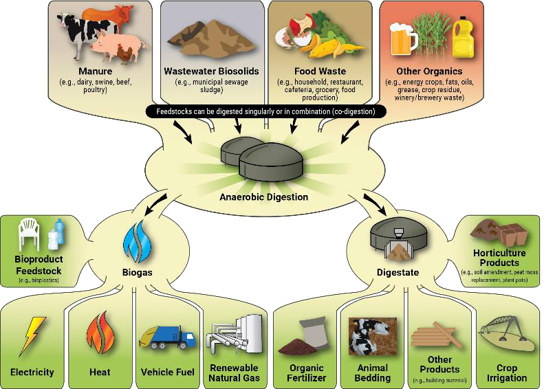
Anaerobic digestion is a biological process that breaks down organic matter in an oxygen-free environment (Figure 1). An anaerobic digester (AD) is an engineered version of a digestive system, comprised primarily of vessels or tanks designed to promote the anaerobic breakdown of waste. During anaerobic digestion, complex organic compounds are converted into simpler compounds by microorganisms through a series of biochemical reactions, resulting in two primary byproducts: biogas and a nutrient-rich material called digestate. Biogas can be used as a renewable energy source for many applications, including electricity generation, heat, and vehicle fuel. For some uses, additional processing of the gas is needed. The digestate product can be used alone or further processed and used as a fertilizer or soil amendment, or as a method for carbon sequestration.
Why Anaerobic Digestion?
Microorganisms decompose organic waste and produce methane in anaerobic environments in nature, such as wetlands. Human-created systems that contain significant organic material, such as landfills, are also sources of methane. Anaerobic digestion provides an alternative method for containing organic wastes and generating methane in a more controlled environment, enabling the efficient capture and use of methane as renewable biogas. This biogas is comprised mostly of methane and carbon dioxide and can be cleaned and used as a drop-in fuel replacement for fossil-fuel-derived natural gas. Biogas serves as an alternative energy source that will be an important piece of the increasing share of renewables in the existing US energy mix. It is especially useful for hard-to-electrify sectors, such as heavy transport, farm equipment, and industrial heating, among others.
The digestate, or residual organic material left after digestion, is frequently used as a beneficial soil amendment either on its own or after composting. In some cases, anaerobic digesters can be the core technology within a biorefinery that produces other renewable products using the biogas or digestate produced from anaerobic digestion. This could include products from plant pots to animal bedding to particle board or even clean water (Yorgey et al. 2019; Mountraki et al. 2016; Astill and Shumway 2016; Bell et al. 2014; Jungmeier et al. 2014). Production of numerous saleable products can help offset capital costs for digester construction.
What Are the Different Types of Anaerobic Digesters?
Anaerobic digesters come in many variations and differ based on four factors: their operating temperature, whether they accept one or multiple types of feedstocks, whether they accept wet (low-solids) or dry (high-solids) waste, and if feedstocks are fed into the digester in batches or continuously.
What Kinds of Waste Can Anaerobic Digesters Accept?
Anaerobic digesters can accept a variety of different organic wastes. The most common include human fecal waste, animal manure, and food waste. Digesters can also accept fats, oils, and grease (FOG), waste from food and beverage processing, and certain types of crop residuals. It is essential to ensure a proper mix of feedstocks to maintain the processing of the digester system and to produce desired outputs (digestate and gas). If the mix of feedstocks is not closely monitored, the digester’s microbial process could be hindered, resulting in poor performance. It is helpful to think of an anaerobic digester like a human digestive system; without the right mix of inputs, stomach upset can occur.
While an anaerobic digester can accept a wide variety of inputs, it is also important to know what they cannot accept. Conventional anaerobic digesters have difficulty breaking down woody materials, making leaves, branches, wood chips, etc. undesirable as a digester feedstock without appropriate pretreatment. Anaerobic digesters and the equipment associated with them (pumps, mixers, etc.) also will have trouble with waste streams that are contaminated by inorganic material, such as rocks, pebbles, dirt, glass, plastic, and other debris including compostable dishware and packaging.
Proper feedstock selection is essential to the performance of an anaerobic digestion system. A feedstock characterization study is important to establish the type of organic waste going into the anaerobic digester, characteristics of the waste stream, and what contaminants exist, in order to design the most appropriate anaerobic digestion system, including any equipment required to screen or otherwise treat the incoming organic stream.
Where Are Anaerobic Digesters Found in the Northwest, and What Types of Organics Do They Process?
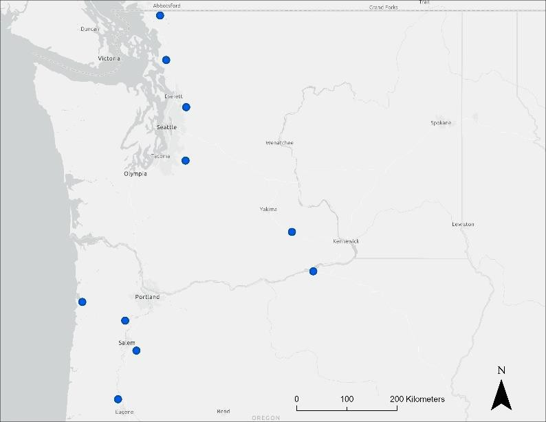
Anaerobic digesters have been used at water resource recovery facilities (i.e., wastewater treatment plants) since the early 1900s to treat wastewater solids. Many digesters at wastewater treatment plants use the biogas they produce for on-site electricity or heating purposes. While it is uncommon for these anaerobic digesters to accept other waste streams, like food waste or FOG, it is possible, and it increases biogas production. See the Anaerobic Digestion Treatment Plants website for a map of anaerobic digester locations.
On-farm anaerobic digesters help farmers process animal waste (manure) and vary depending on the size of the farm and the type of livestock. On-farm anaerobic digesters may also receive outside sources of organics, such as food waste, to increase the amount of biogas produced. Figure 2 shows on-farm digesters in the Pacific Northwest.
How Are Anaerobic Digester Systems Operated and What Kind Of Expertise Is Needed?
The first step in running any anaerobic digester (once installed) is to set up a system for collecting and separating the waste that will be used as feedstock. For some waste streams such as manure or food and beverage processing waste, there may not need to be any separation as the entirety of the waste stream will be fed to the anaerobic digester. However, other waste streams, like household and commercial food waste, will need to be separated to ensure that no packaging (including compostable packaging or dishware) is contained in the waste stream and to remove any unwanted types of food waste. The separation needs will vary based on the type of anaerobic digester and the needs of the system, but there are useful guides for these steps. It is also necessary to consider the collection of waste streams for digestion, as they may be spread out across an area. Designing an efficient process for aggregating waste streams will be key to the success of anaerobic digester (AD) operation.
Once waste has been collected and properly separated, the next step is to load and mix the material into the AD unit itself. Mixing ensures that nutrients and microorganisms are evenly spread throughout the AD reactor. As the AD begins processing the waste, it is important to monitor and control process parameters like temperature, pH, and mixing to maintain optimal conditions for microbial activity and biogas production. The biogas will need to be captured using the AD’s gas collection systems and further processed according to its intended use. The remaining leftover material (the digestate) will need to be properly managed so that it can be used as a fertilizer or soil amendment. Finally, it will be necessary to monitor the AD system to ensure that it is functioning properly and no maintenance or repairs are needed. Monitoring is also crucial for reducing any dangers related to anaerobic digestion (see the Are Anaerobic Digester Systems Dangerous? section below).
All of these operational steps will vary considerably based on each individual AD approach and the desired outputs. Some AD systems may require minimal supervision to operate, while others may require multiple trained staff members to ensure safe and continual operation. Operating an AD system can be fairly complex, but there are existing guides to help operators.
What Are the Outputs of the Anaerobic Digestion Process?
There are two main outputs of anaerobic digestion: biogas and digestate (the residual organic material remaining after digestion).
With little to no processing, the biogas can be used for on-site heating and energy purposes. This could mean heating a building or the AD reactor itself, or converting the gas into electricity that can be used on-site or sold to the electrical grid. With further processing, the gas can be turned into renewable natural gas (RNG), liquified natural gas (LNG), or compressed natural gas (CNG). RNG can be used in the existing natural gas grid, while CNG and LNG can provide fuel for vehicles. The best use of the biogas will depend on a number of factors, including but not limited to, how much feedstock is being processed, the type of feedstock (which relates to gas production), energy markets, and site considerations and constraints, such as proximity to natural gas infrastructure.
The digestate is the slurry material remaining after the digestion process. It can be used as is or separated into a solid and liquid fraction. Both the solids and liquids can be used as fertilizer or soil amendments, but the solids fraction can also be used as animal bedding and organic rich compost.
Do Anaerobic Digestion Systems Generate Greenhouse Gases?
The biogas produced from anaerobic digestion is comprised primarily of methane and carbon dioxide, which are both greenhouse gases. However, since the gas is flared, used to offset fossil fuel natural gas, or used to offset electricity produced from more carbon intensive sources, overall greenhouse gas emissions are less than what would occur if the input feedstocks were left to decompose. Because of this, anaerobic digestion is recognized as a process that can help lower greenhouse gas emissions.
How Much Do Anaerobic Digestion Systems Cost?
There is no getting around the cost of an anaerobic digestion system. Capital costs—the fixed, one-time expenses of designing and constructing an AD system—include the AD reactor itself, associated pumps, mixing, heating, and other ancillary equipment, construction, and any other costs related to installing and setting up the system. While household level systems can cost less than $1,000, costs for on-farm digesters can be in the millions of dollars. Anaerobic digesters also require on-going maintenance and monitoring which incurs operating costs that include staff time, lab testing, equipment repair and replacement, etc. These costs too will vary widely based on the system. One study showed that operating costs of large-scale anaerobic digestion systems ranged from $18 to $100 per ton of feedstock processed (Vasco-Correa et al. 2018).
Can I Make Money from an Anaerobic Digestion System?
While costs for anaerobic digestion systems can be high, digesters can also generate revenues that can help an AD system generate net income. For example, biogas can be upgraded and sold to a natural gas utility when it is injected into a pipeline. A digester might also generate revenues from selling credits via low carbon fuel standards or carbon offsets (via regulatory or voluntary markets). Anaerobic digestion systems that take in waste from outside sources (such as pre- or postconsumer food waste from municipalities or other businesses) may charge tipping fees to generate revenue. Additionally, because of their environmental benefit through reducing waste and lowering emissions, anaerobic digesters also perform environmental and social services that can be factored into the “cost” of the system. In other cases, a digester can make sense because it reduces other costs that existed prior to the digester installation: for example, if the digested solids can be utilized as a soil amendment and reduce the need for purchased fertilizers. In some cases, digestate material can also be sold for additional revenue. A digester project’s life cycle cost analysis should take these revenue streams into consideration when evaluating the return on investment. Read this BioCycle article for an example of an AD project at a wastewater treatment plant in Wooster, Ohio, that provides a positive return on investment for the city.
Is There Funding Available to Support an Anaerobic Digester Project?
AD projects often have potential to be supported by grants and other funding that can improve the economic feasibility of the system. Efforts to divert organic waste or reduce greenhouse gas emissions are receiving increasing support in the form of federal and state funding opportunities. Anaerobic digestion falls into both of these categories. Some existing forms of funding at the federal level include tax credits within the Inflation Reduction Act, the Solid Waste Infrastructure for Recycling Grant Program and Consumer Recycling Education and Outreach Grant Program within the Bipartisan Infrastructure Law, and other federal funding for projects that address food waste. There is also funding available for anaerobic digestion projects through state-run programs in Washington. These include the Local Solid Waste Financial Assistance (LSWFA) program, Waste Reduction and Recycling Education (WRRE) Grants Program, programs within the Clean Energy Fund—and specifically the Rural Clean Energy Innovation program, the Sustainable Farms and Fields program, and the currently evolving Climate Commitment Act. This list of funding opportunities is not exhaustive but could be a good starting point to scan for potential financial assistance for digester projects. Funding is ever evolving, and it will be critical to check back over time for new possibilities.
How Do I Know if I Should Invest in an Anaerobic Digester?
A feasibility study is a helpful first step in determining whether it is worthwhile to pursue an anaerobic digester system. While a feasibility study itself is a cost, it helps identify and define the critical parameters associated with a digester project and potentially saves money and time later. Feasibility studies should include factors, such as potential feedstock sources and types, funding mechanisms, site constraints, etc., as well as help identify the people or organizations responsible for design and operation of the system. Assessing both the finances of developing a digester project and the associated costs and contracting required for maintaining the digester, as well as other relevant considerations, will allow better decision-making around starting a digester project.
Is It Possible for Anaerobic Digesters to Serve Larger Regions or Communities?
While many AD systems are designed for use by a single entity (a wastewater treatment facility, dairy farm, food processing facility, etc.), others may take waste from a variety of sources and function as a regional waste processor. Collaborative, regional systems may develop at a digester already being used to process a specific waste stream such as biosolids or manure. Because resources and feedstocks are shared in a regional system, they offer several benefits, including enhanced economic scale, reduced infrastructure cost, and the ability to accept organic waste from various sources (agricultural, food waste, industrial byproducts, etc.), which can improve digester functioning and biogas production. However, the introduction of additional wastes can also increase the risk of digester upset, so care is usually needed to plan the mix of digester feedstocks. Collaborative systems can take different forms, but there will ultimately need to be a primary party in charge of operating the system and making use of the gas and digestate generated by the digester.
One example of a successful regional system is Werkhoven Dairy’s anaerobic digester in Monroe, Washington. The digester, which is operated by Qualco Energy, takes in dairy manure, other livestock wastes, trap grease, pulp, whey, and expired beer, wine, and soda, among other organic wastes. It produces enough energy to provide renewable power for nearly 700 homes and a high-quality liquid fertilizer sold to local farmers. The digester is also representative of a successful partnership between tribes and farmers in the region who both admire the digester for its ability to generate renewable energy and reduce manure runoff into the nearby Skykomish and Snoqualmie Rivers.
The links below contain more examples of regional systems and useful related material:
- EPA anaerobic digestion innovate business models
- USDA Cooperative Approaches for Implementation of Dairy Manure Digesters (PDF document)
- Michigan State University dairy digester
What Is the Difference Between Anaerobic Digestion and Composting?
Anaerobic digestion and composting are often conflated when discussing options for organic waste management. While they do both provide a good option for turning organic waste into valuable byproducts, there are key differences (Table 1).
- Anaerobic Digestion = No Oxygen
- Microorganisms break down organic in the absence of oxygen in an enclosed structure.
- Composting = With Oxygen
- Microorganisms break down organic matter in a controlled, open-air setting.
| Variables | Anaerobic Digestion | Composting |
|---|---|---|
| Inputs | Varied but limited. Anaerobic digestion can use a variety of feedstocks as inputs including manure, biosolids, and food waste, among others. | More varied. Composting can use an even wider variety organic waste streams than anaerobic digestion including yard trimmings and other debris that would upset a digester. |
| Greenhouse Gas Emissions | Low. Methane (CH₄) in biogas is captured and used to create energy. Some CO₂ is released, but it is a less potent GHG than CH₄. | Low. Properly managed compost will mainly release CO₂, usually in greater quantities than from anaerobic digestion. |
| Energy | Large source. Biogas produced from anaerobic digestion is a renewable energy source used to power homes, fuel vehicles, provide heating fuel, and meet other energy. | Not a source. There is no usable byproduct from composting that can be turned into an energy source. |
| Environmental Benefits | Closed loop life cycle. Anaerobic digestion creates both a renewable source of energy and nutrient-rich byproduct called digestate that can be used as a soil amendment or processed further for conversion into sustainable materials. Anaerobic digestion is an example of closed loop system. | Waste reduction. Organic wastes and residuals are converted efficiently into beneficial products. |
| Cost and Operation | High cost, operationally complex. Anaerobic digestion systems are typically quite expensive and require substantial investments in both capital and operational costs. Operation of digesters requires diligent monitoring and upkeep to ensure efficient and safe processing of wastes. | Lower cost, easier operation. Composting systems generally have less upfront costs than anaerobic digesters. However, large scale systems will still require substantial costs and proper monitoring and aeration to ensure breakdown of organic matter. |
Composting is generally a more recognizable form of dealing with organic waste for most people, likely due to its ease of implementation, especially at smaller scales. There is no specialized equipment needed to start small-scale operations, and many cities and counties across the US provide a composting service. Further, composting operations are sometimes less costly up front, allowing for an easier start to operations. However, at larger scales expensive equipment is needed, and regardless of size, it is still essential to monitor and aerate composting piles for ideal breakdown of organic matter.
People also often ask about the relative emissions of composting versus anaerobic digestion and assume that anaerobic digestion produces greater emissions because of the biogas generation. However, since digester projects usually seek to capture and beneficially use biogas, most emissions from anaerobic digestion come from the application of the digestate material. Compost, on the other hand produces greenhouse gasses that are not captured during its breakdown of organic material, which often leads to compost producing greater amounts of greenhouse gas emissions than anaerobic digestion.
Anaerobic digestion and composting have their own advantages and disadvantages, and the best choice for a given waste stream or streams will be determined by the unique and specific needs of a community, business, or household. However, anaerobic digestion and composting can also be used in tandem, first by running organic waste through an anaerobic digester and then composting the leftover digestate material; in fact, the predigestion of organic wastes often benefits the downstream composting process. Despite often being compared as mutually exclusive alternatives, these processes are actually very capable of working as a team, and both provide beneficial options for organic waste management.
Do Anaerobic Digesters Produce Odors?
Many people worry about the smells that may come from an anaerobic digester system. However, a properly controlled anaerobic digester should not be very odorous as the microbial process occurs in sealed containers. As long as the resulting biogas is properly contained and processed, smells should be no worse than other organic waste management facilities, and in many cases, odor can even be reduced.
Is There Special Permitting Needed for Anaerobic Digesters?
Anaerobic digesters must meet local, state, and federal permitting requirements to be legally operated. Permitting is often viewed as an impediment to starting a digester project, but helpful information specifically for Washington anaerobic digesters is available through the State of Washington Department of Ecology. Further, Washington dairies may qualify for a solid waste handling permit exemption which can help make the prospect of starting a digester project more feasible (Yorgey et al. 2011).
Are Anaerobic Digestion Systems Dangerous?
The operation of an anaerobic digestion system should always be carried out with caution. There are risks associated with anaerobic digestion, including fire or explosions, gas leaks, risks in operating equipment, and exposure to pathogens. The most dramatic risks are the explosions that have occurred at biogas facilities in the past. While rare, these explosions can be very dangerous and even fatal. However, a safely operating system should pose little risk for explosions or any of the other dangers associated with anaerobic digestion. When undertaking a digester project, safety should be a priority and integrated into every step in the process. There are resources that can help inform digester operators on how to reduce risk throughout the entire chain of their digester’s operations.
Are There Examples of Thriving Anaerobic Digestion Systems?
There are many successful digester operations in the Pacific Northwest, in the US, and across the globe. In Washington, such examples include the numerous dairy-based anaerobic digesters, digesters at wastewater treatment plants, and stand-alone digesters (PDF Document) that serve the needs of specific communities and industries. The EPA hosts a webpage dedicated to anaerobic digester project profiles and case studies in the US, and the Global Methane Initiative has produced a report (PDF Document) that highlights global anaerobic digestion projects.
References
- Astill, G.M., and C.R. Shumway. 2016. Profits from Pollutants: Economic Feasibility of Integrated Anaerobic Digester and Nutrient Management Systems. Journal of Environmental Management 184:353–362.
- Bell, G., S. Schuck, G. Jungmeier, M. Wellisch, C. Felby, H. Jorgensen, and J. Spaeth. 2014. IEA Bioenergy Task42 Biorefining. IEA Bioenergy.
- Jungmeier, G., R. van Ree, E. de Jong, H. Stichnothe, I. De Bari, H. Jorgensen, M. Wellisch, et al. 2014. Facts, Figures and Integration of Biorefineries in a Future BioEconomy—Findings in IEA Bioenergy Task 42 “Biorefining.”
- Mitchell, S.M., N.P. Kennedy, J. Ma, G.G. Yorgey, C.E. Kruger, J.L. Ullman, and C.S. Frear. 2015. Anaerobic Digestion Effluents and Processes: The Basics. Washington State University Extension Publication FS171E. Washington State University.
- Mountraki, A., M. Tsakalova, A. Panteli, A.I. Papoutsi, and A.C. Kokossis. 2016. Integrated Waste Management in Multiproduct Biorefineries: Systems Optimization and Analysis of a Real-Life Industrial Plant. Industrial and Engineering Chemistry Research 55:3478–3492.
- Vasco-Correa, J., A. Manandhar, and A. Shah. 2018. Economic Implications of Anaerobic Digestion for Bioenergy Production and Waste Management. Ohio State University Extension Publication FABE-661.1. Ohio State University.
- Yorgey, G., C. Kruger, K. Steward, C. Frear, and N. Mena. 2011. Anaerobic Co-Digestion on Dairies in Washington State: The Solid Waste Handling Permit Exemption. Washington State University Extension Publication FS040E. Washington State University.
- Yorgey, G., C. Frear, N. Kennedy, and C. Kruger. 2019. The Dairy Manure Biorefinery. Washington State University Extension Publication FS316E. Washington State University.
By Aaron Whittemore, Associate in Research, Center for Sustaining Agriculture and Natural Resources, Washington State University
Embrey Bronstad, Wastewater Engineer, Brown and Caldwell
Georgine Yorgey, Energy Program Director, Washington State University
Copyright © Washington State University
WSU Extension publications contain material written and produced for public distribution. Alternative text descriptions for select complex images were generated using ChatGPT (OpenAI), then reviewed and adapted to ensure compliance with Web Content Accessibility Guidelines (WCAG) accessibility standards.
Issued by Washington State University Extension and the US Department of Agriculture in furtherance of the Acts of May 8 and June 30, 1914. Extension programs and policies are consistent with federal and state laws and regulations on nondiscrimination regarding race, sex, religion, age, color, creed, and national or ethnic origin; physical, mental, or sensory disability; marital status or sexual orientation; and status as a Vietnam-era or disabled veteran. Evidence of noncompliance may be reported through your local WSU Extension office. Trade names have been used to simplify information; no endorsement is intended.