Description
Table of Contents
- Introduction
- Club Leader Checklist
- Club Treasurer Checklist
-
Section 1: Develop Your System
- Account(s)

Abstract
Fund development is crucial to WSU Extension programming and, especially, to the 4-H Youth Development club delivery model. Lack of an effective and efficient approach to educating members on proper methods of accruing, spending, and recording funds could result in noncompliance with the IRS and state requirements, inappropriate spending of public funds, and, ultimately, legal implications. The 4-H Treasurer’s Handbook Leader Guide is intended as a reference for 4-H Club leaders to use while coaching youth in managing 4-H Club funds. This publication and the 4-H Treasurer’s Handbook direct the spending and accounting of 4-H funds.
Introduction
Congratulations! Your fellow 4-H’ers have shown their confidence in you, selecting you for an important job—handling the club or group’s money. There are many types of groups within the 4-H program. Throughout this handbook, the term “club” is used to mean club, program, group, etc. As treasurer, your responsibilities include managing the money, maintaining the bank account, and providing your club with regular reports regarding their funds. This officer position requires honesty, integrity, and cooperation with your club leader.
Congratulations! You have the opportunity of a lifetime to change a young person’s life. Consider yourself a guide as you work with your club treasurer. Let the treasurer take the lead and, rather than point out mistakes, ask questions that will help the youth determine where they may have to correct their records or actions. For example, try asking, “I’m curious about why you charged that expense to hospitality?” instead of “That shouldn’t have been charged to awards, it needs to be charged to hospitality!” Be sure to take time to develop questions that will help youth develop the ability to think through future situations.
As the treasurer, you will:
- Work with the club to determine how much money it will spend and how it will raise the money (develop a budget).
- Receive the money that is raised and maintain an accurate record of how much money has been collected and how it was raised.
- Deposit all money into the bank account within one week of receiving the money.
- Pay expenses after you have received receipts.
- Provide a Treasurer’s Report for each business meeting that details all money received and spent since the last meeting.
As you begin your job, you will need to know, or be willing to learn how to:
- Make a budget;
- Receive money;
- Write a check;
- Document receipts and expenses;
- Balance a bank statement;
- Prepare report; and
- Prepare records for the annual peer review/audit (for completion of the Audit Report).
You should think of your 4-H Club as a small business; it has a separate identity and legal requirements for handling funds and reporting financial activity, different from the way a person manages their personal funds. Your club, as a chartered 4-H Club, is a nonprofit organization and is not required to pay income taxes. Because of this, there are specific tasks that must be completed at each club meeting and at the end of the 4-H program year.
Your club will receive donations from the community. There is a specific way to thank donors that also gives them a record of their donation. You will learn more about these processes later in this handbook.
This publication was developed to help you learn your job. Each section of this handbook includes either examples to follow, sample activities to practice your job, or both. Additionally, you should go to any training provided in your county or region for club officers.
Club Leader Checklist
- Attend your county’s financial trainings as required.
- Encourage your club treasurer to participate in financial trainings also, if available.
- Change signers on the bank account if necessary.
- Discuss options for a record keeping system with your club treasurer.
- With your club treasurer, review requirements for financial record keeping in 4-H (see 4-H Policy and Procedure Handbook); review the Club Treasurer Checklist section found in this publication and in the companion publication 4-H Treasurer’s Handbook.
- Ensure there is appropriate time available for budgeting activities during club meetings.
- Periodically sit down with the treasurer and go through the club records to make sure requirements are being met.
- Embrace those instances when your club treasurer reminds you of the financial requirements.
- Make sure a Treasurer’s Report is given at each business meeting.
- Work with the club president to select an audit committee.
- Submit all required paperwork to your 4-H Extension office by December 1.
Club Treasurer Checklist
The checklist below was developed to be used once a year to reflect upon your activities. You should work with your club leader and officers to develop a monthly checklist to assist you with your duties.
- A budget was developed and approved by the club.
- All revenues have receipts that document how the funds were raised or collected.
- All deposits were recorded in the ledger.
- All expenses have receipts that document who was paid, what they were paid for, how much they were paid, when they were paid, and how they were paid. All expenses were recorded in the ledger.
- All expenses were approved by the club through either an approved budget or a motion approved in a business meeting.
- All checks included two signatures.
- If an expense was paid by debit card, all debit card receipts have a second signature.
- All exchanges of cash were documented with signatures and receipts.
- A Treasurer’s Report was presented at each business meeting.
- Bank statements were available at each business meeting.
- An audit was conducted after the end of the 4-H year (September 30).
- A Property Inventory List was developed and new property was added to the list.
- The Annual Financial Summary, Audit Report, and Property Inventory List were submitted to the WSU Extension office (December 1).
Section 1: Develop Your System
When you begin, you may be the first treasurer for the group, or you may replace a prior treasurer. If you are the first, you and your club leader will work together to design a system of record keeping that assists you in tracking money coming into and going out of the club. If you are not the first, you may have new ideas; share these with your club leader.
Such a system must include at least:
- A record of all accounts;
- A receipt book;
- Documentation of revenue received;
- Receipts for all expenses and payments;
- Bank statements (if your bank requires electronic bank statements, you will need to print them each month to include in your records);
- A ledger that maintains a record of funds;
- A copy of bank signature file (some banks will not provide this copy; a letter or other documentation from the bank that identifies the signors on the account can be used in place of the signature card); and
- A copy of an Employer Identification Number (EIN) letter from the IRS (your club leader will provide this).
If you are replacing a previous treasurer, arrange to review the record keeping system with your club leader to ensure all the above requirements are met.
Arrange a binder with the following tabs:
- Budget (one for each month, January–December) with space for the following:
- Bank statement with reconciliation (you’ll learn more about this in Section 2)
- Monthly ledger
- Revenue documentation
- Expense documentation
- Treasurer’s Report
- Bank records (including a copy of the signature card or letter from the bank identifying signors on the account[s])
- Donation letters
- Audit Report
- Employer Identification Number (EIN) letter
- EIN Letter
- Property Inventory List
You may choose to use a computer-based system like Excel, Word, Quicken, MYOB, Simple Accounting, etc. Be consistent and use the same system all year. No matter what system you use, consider using a binder system the first year as you get to know the components of your system.
Account(s)
If you are the first treasurer, work with your group leader to open a 4-H financial account. All 4-H accounts must have at least two club or group members authorized to sign checks. These members cannot be in the same family. Whether your group is
opening its first account, or you are taking over for last year’s treasurer, you will need to get a new bank signature card. The treasurer should be one of the signers. Some banks do not allow minors to sign checks; check with your bank to learn its requirements for opening a bank account.
To change, add, or delete signers, some financial institutions require a letter from the club president and adult club leader. If a letter is required, it should be written by the secretary of the club and submitted with a copy of the meeting minutes listing the club’s authorized signers.
Maintain a current list of authorized signers in your accounts with your financial records. (Remember to update this whenever you change signers at the bank.) Always keep a copy of your signature card with your records.
Employer Identification Number (EIN)
As a nonprofit organization, 4-H is not required to pay income tax. But we are required to report income to the Internal Revenue Service (IRS). An Employer Identification Number (EIN) is used for reporting income to the IRS. Your club leader will work with your Extension office to obtain an EIN for your club.
You are responsible for keeping the EIN letter with your club’s records.
Section 2: Financial Skills
As the treasurer, you will need to develop many financial skills. If you are unsure of how to do any of your duties as treasurer, work with your club leader and they will help you learn.
Deposits
Before you deposit checks that are written to your 4-H Club, they must be endorsed (signed) on the back. Write “For Deposit Only.” Sign the club’s name (as written on the front of the check) and then sign your name followed with a comma (,) and the word “Treasurer.” If someone writes a check payable to you that is intended for your 4-H club, endorse it by writing “Pay to the order of (your club’s name)” and sign it. If your club receives many checks, you may want to have a rubber stamp made with the 4-H Club’s name and account number on it. You can buy a stamp from many office supply stores.
Deposit all funds within one week. Total the receipts you have written since your last deposit and compare the receipt totals with the total amount of cash (bills and coins) and checks you intend to deposit. The two figures must agree. If they do not, repeat the process. When the two totals match, prepare a deposit slip if you will be making the deposit at your financial institution.
Deposit slips are usually found in the back of a checkbook or you may get a supply from your financial institution. When you fill out a deposit slip (Figure 1), list each check number and its amount separately (use the back of the deposit slip if necessary). The checks are usually
listed by the code number, which may be found in the upper right corner of the check. It looks something like this: 19-2/1250. Some financial institutions no longer require this number. If this is the case, use the check number to help you keep track of deposited checks. If you will be depositing funds electronically through an ATM, select the option to “print receipt with images of items deposited” and maintain any receipts you receive.

Checks
Follow these steps when writing checks:
- Always use ink.
- If you make a mistake, write “VOID” on the check and prepare a new one. Keep the voided check with the treasurer’s records. Do not throw it away; the voided check is your proof that shows it was not used or lost.
- Leave as little space as possible between the figures and words when filling in the amount lines. This helps prevent someone else from changing a $15.00 check into a $115.00 check, for example.
- Begin writing the amount at the far left of the amount line.
- Be sure the written amount agrees with the numeric amount.
- Avoid writing a check for less than one dollar ($1.00). If necessary, start the amount line by writing the word “Only” and then the amount as follows, for example: “Only 73/100.”
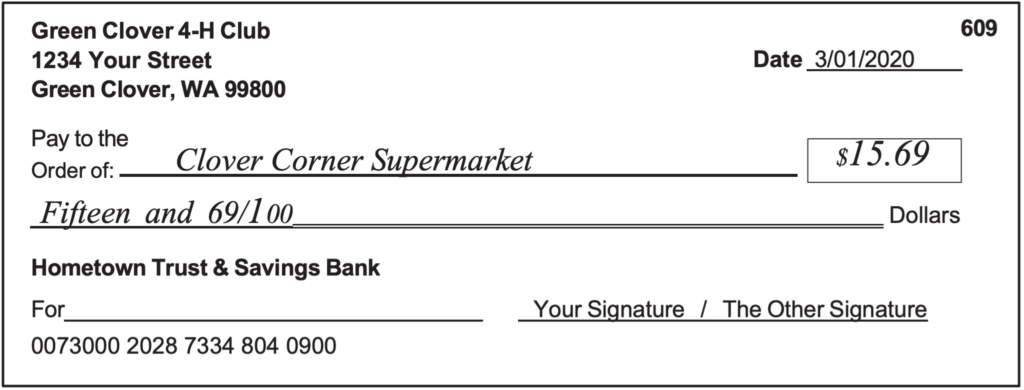
- Sign the check with your “authorized” signature—the same way you signed the signature card at the bank when you became treasurer. There must be two signatures on each check, the second signature can be placed in the memo line or next to the other signature. The second signature can be from a 4-H member (for example your club treasurer) or a certified volunteer; this person does not need to be on the signature card. An example of a check is provided in Figure 2.
- Do not pre-sign checks.
Debit Card Transactions
When making a debit card transaction, always make certain to keep the receipt. After the transaction has been made, show another member or certified volunteer in the club the items purchased and the receipt. Once this other person has verified the purchase, ask them to sign the receipt and record the transaction in your check register and ledger.
Maintaining the Check Register
To keep your 4-H Club’s check register current, follow these steps:
- Write the check number or debit transaction number and the date it was written in the appropriate columns.
- Write the name of the person or company the check was made out to in the “Paid To” column.
- Write what the check or debit paid for in the “Description of Transaction” column.
- Enter the check/debit amount in the “Payment/Debit column.
- Subtract the check or debit amount from the current balance amount in the line above and enter the new balance in the far right “Balance” column.
- When you start a new sheet in the check register, the “Balance” column begins with the ending balance from the last sheet you used. If one sheet is used per month, last month’s ending balance will become this month’s beginning balance (see Figure 3).
- At the end of each month, reconcile the account. This means you will compare your records with the bank statement. Mark off all deposits and checks or debits from your check register that have cleared your financial institution (this information is listed on your statement of account). Sometimes there is a form on the back of the statement that can be used to reconcile your statement.

Section 3: Prepare a Budget
Each year, your club will present a plan describing what it wants to do and how the goals in the plan will be met. Plans may include attending clinics or workshops, paying club management fees, buying club T-shirts or awards, sending club members to camp, doing service projects, or participating in other activities.
This plan will show how much each activity will cost and how your club will raise the funds to pay for these activities. As the club treasurer, you will write a report that lists estimates of both costs and fundraising. This plan, or report, is called a budget.
Budget Activity
With your club leader, facilitate the budgeting activities in Appendix A with your club or group. This will help everyone in your club learn how to set goals and prepare a budget.
Write Your Budget
Part 1: Make a Plan.
As a club, talk about the activities your club wants to do this year. Create a list and prioritize it from most important to least important. Ask club members to do a little bit of research to figure out how much each activity will cost. List your activities and the estimated costs in the Budget Template in Appendix C. Add up the total cost of all projects to estimate your total expenses for the year.
Part 2: Identify Your Current Financial Status.
Determine if your club has money left over from last year. If so, subtract that amount from your total estimated expenses to decide how much money you need to raise this year. If your club maintains a balance that is greater than one half of your overall budget, your club will need to request approval to maintain such a high balance. The club’s financial goals may require you to save money over time if you are planning a large purchase, club trip, or other activity that costs a lot of money. Complete the Request to Maintain Excess Funds form in Appendix C when your balance reaches more than one half of your budget and send it to your Extension 4-H office.
Part 3: Create Income.
Now that you know how much money your club needs, it is time to decide how you are going to create income. Earning money takes time and planning. With your club, talk about ways they want to earn money. This can include product sales, hosting events, car washes, club dues, etc. Estimate how much can be raised with each event. Your club’s income should match your club’s projected expenses.
Part 4: Finish Your Budget.
Using the Budget Template in Appendix C, or a software program the club has chosen to use, finalize your budget. See Figure 4 for a sample budget.
Figure 4. A sample 4-H Club budget
Expenses
| Description | Amount |
|---|---|
| Management Fees ($10 per member) | $100.00 |
| T-shirts ($15 per member) | $150.00 |
| 4-H Horse Clinic | $200.00 |
| Fair Passes | $300.00 |
| Fund Raising Expenses | $200.00 |
| Total Expenses: | $950 |
Income
| Description | Amount |
|---|---|
| Car Wash | $100.00 |
| Cookie Dough Sales | $200.00 |
| Wrapping Presents | $250.00 |
| Tree Sales | $400.00 |
| Total Income: | $950 |
Section 4: Keeping Records
As treasurer, you are responsible for keeping records of all money the club receives and spends. Regardless of the system you and your club leader have chosen, you will need to keep and maintain records. Keep your records in a safe place where they cannot be damaged or lost. Keep all of your records together.
Ledger
A ledger is where you record money received by the club and any expenses that have been paid by the club. The ledger should include an entry for anything you record in your check register (some clubs may choose to use their ledger as the check register). Make ledger entries for payments, deposits, and fees each month. You may choose to keep these records in a binder.
Each entry should include the following information:
- The date
- Check or receipt number
- Who was paid (payee) or who paid you (payer)
- Description or purpose of receipt or payment (item)
- Budget category (from budget)
- Amount received (income)
- Amount spent (expense)
- Balance
The amounts in the check register and the ledger will match unless club funds are deposited into or paid from an account other than the club’s account. Receiving and paying money outside of the club’s account is not a good idea, as it is very easy to lose track of the club’s funds.
Project Ledgers
Some clubs may maintain additional ledgers for large projects and fundraising events.
The purpose of a project ledger is to keep track of larger, less routine projects or fundraising activities. Keeping track of these items separately will make it easier to tell if the project paid for its own expenses or cost the club money. The project ledger should look similar to the club ledger (Figure 5) but should be clearly labeled with the project’s name and also include the deposits and expenses related only to that project.

Check Register.
A check register is the book the bank gives you to keep track of the checks you write and deposits made to the account.
Checks.
Checks are issued by your bank and should be kept in a safe place until you need to use them. Only give checks to an authorized signer after you have filled the checks out. Only use checks that have the check number printed on them.
Debit Card.
You may use a debit card for purchases. Receipts for these transactions should be reviewed and signed by a non-cardholder to ensure the expense was related to club business. Note: expenses paid with a debit card should be individually recorded in the check register or club ledger (depending on the system your club uses)—just like checks—as a deduction from the checking account balance. If the debit card is checked out to someone other than the treasurer to use, a debit card log sheet should be used. A sample Debit Card Check Out/Log Sheet (Figure 6) is included in Appendix C. The log sheet includes who checked the card out, where they used the card, what the totals for each use were, and whether a receipt was submitted. Receipts are recorded and kept in the same way as a check.
Date Stamp.
You may use a date stamp to date bills. This can also be done by hand. If you are dating a lot of bills, a stamp can save you some time.
Numbered Receipt Book.
A prenumbered receipt book should be used to record all revenue received and can be purchased at any stationery or office supply store.
Cash Box.
If you plan to organize activities that will require a change fund, have the club or unit authorize the purchase of a cash box with a lock. At the end of each activity, all funds collected will be deposited into your bank account.

Record Your Revenue and Income
Revenue is any money you receive for the club. This includes club dues (Figure 7), fundraising income, donations, or refunds on prior purchases. These transactions are required to be documented to show where the money came from.

Fundraising Event.
For fundraising income, the Fundraiser/Event Report will indicate how much money was
returned to you after the event. The person in charge of the fundraiser should sign the report,
and you should sign it as well, to show that you received the money. Figure 8 shows a sample
of a Fundraiser/Event Report.
If your club chooses to host a raffle as a fundraiser, there are specific guidelines that have to
be followed due to Washington State laws. Work with your club leader and members of your
club to review these guidelines before you finalize plans for your raffle

Record Your Donations
If the club receives a donation, record the donation on a donor ledger (Figure 9). To thank the donor, your club secretary and your club leader will send the donor a letter, signed by both of them. This letter is a more formal thank-you and provides the donor with a donation receipt. In addition, your club should provide the donor with a handwritten thank-you note (this could be signed by all members) to show your appreciation for their generosity. If someone wants to donate an animal to your club, contact your county Extension staff before accepting the donation for specific guidelines on how to handle this type of donation. More information about donor communication and sample form letters for this purpose are included in Appendix B.

Other Income.
Any other income, such as refunds from prior purchases or miscellaneous income (such as anonymous donations), should include some sort of written documentation, like a return receipt or handwritten note from the person who received the income.
Record Your Expenses

When your club spends money, this is an expense. Expenses can include club meeting supplies, clinic registration costs, club T-shirts, or anything else you are buying with club funds. It is important that you keep track of all expenses. All of your expenses should be made using a check.
Keep your receipts and put them in your club finances binder or input them into whichever organizational system your club is using. You should have a receipt for every expense your club makes. Every expense should be recorded in your ledger. It is helpful to keep a running balance every time your club receives income or makes an expense.
One method you can use to keep track of your club’s receipts is to tape the receipt to a blank piece of paper. Once the receipt is on the piece of paper, punch holes in the side and put it in the binder. Receipts come in all different shapes and sizes. Taping them onto a piece of paper will keep them neat and organized. Once an expense has been paid, mark the receipt so it cannot be reused at a later date (Figure 10). This can be done by marking it “Paid, Ck and
MM/DD/YY.”
Property Inventory List
A club may purchase equipment and supplies necessary for club activities. If the items purchased are not consumed or “used up,” they are club assets and must be recorded. All assets remain the property of WSU 4-H Youth Development. As such, the treasurer will need to keep track of what items are owned, their original value (what you paid for them), and where they are located or being stored. This list will be used to prepare your year-end reports. Each year, the club should review their Property Inventory List to make sure all equipment and other property is listed. Once reviewed, this list must be submitted to the Extension 4-H office. A Property Inventory List form template can be found in Appendix C.
Section 5: Reporting
The 4-H organization is a public entity and all funds raised are public funds. Reporting how the money is earned and spent is important for the organization and helps us keep in good standing. All 4-H clubs who raise and spend money must report the use of their funds locally and nationally.
Regular Reporting
The 4-H Club treasurer is responsible for tracking how the funds are raised and spent and then reporting to the club. At your regular club business meetings, you are responsible for submitting a Treasurer’s Report (Figure 11) for the 4-H Club to review. Your report should include a report of the money earned and money spent since the last meeting. Additionally, a copy of the most current bank statement should be present for review if requested by anyone at the meeting. Upon review of the report, the president will ask if there are any questions. After all questions have been answered, the president will announce that the report will be placed on file for audit.

Annual Reporting
At the end of each 4-H year (September 30), each club is required to submit reports to the 4-H Extension office. Your club leader bears the responsibility to submit the reports, but you can be instrumental in making sure they are completed. Keeping accurate and organized records assists in easy completion of annual reports.
Audit
At the end of the year, your club will need to complete an audit, also called a peer review. With your club leader, recruit at least three people to complete the audit. These people cannot be related to anyone who has had access to the treasurer’s records or bank account at any time throughout the year. These people do not even have to be in your club.
Some clubs have swapped books with another club for auditing. Club A audits the records of Club B and Club B audits the records of Club A. If errors are found in your club’s records, the audit committee will make suggestions for improvements or corrections in their report. An example of the auditing process is included in Appendix C, titled Audit Committee Procedure. Once the Audit Report (also found in Appendix C) is completed, it must be submitted to the Extension 4-H office.
Annual Financial Summary
Once the audit is completed and necessary corrections are made, the club must complete an Annual Financial Summary Report. This form can be found in Appendix C. Once the financial summary is complete it must be submitted to the Extension 4-H office.
Appendix A: Activities
Budgeting Activity #1: Needs vs. Wants
OBJECTIVE: Determining whether something is a need or a want is a vital life skill and especially important when you are talking about 4-H Club finances. In this activity, 4-H Club members will discuss and identify needs and wants. Keep in mind that club members should feel safe to have an open discussion throughout this activity. This activity will set the stage for 4-H Club members to set financial goals.
What Is a Need or a Want?
Deciding whether or not something is a need or a want can be tricky. What one person may feel is a want, someone else may decide is a need, or vice versa. The important thing to remember in
this activity is that a want or need is based on the values that can come from our families, teachers, or other places we develop values. For example, let’s consider a notebook. A notebook is a need
if you are talking about school supplies but might be a want if you are using it as craft supplies. When your club is doing this activity, help your club members know that they need to remember that other members of their club might not think the same things are important but they should be respectful of the others’ suggestions.
Materials Needed:
- Enough small slips of paper for each club member to have three (3×5 cards cut in half work really well)
- Pencils for every club member
- A hat or little basket to collect the strips of paper
Time Needed: about 30 minutes
Activity:
- Give everyone in the club three pieces of paper and a pencil. Have every club member think about three things they either need or want that someone can buy. You might need to help the members in your club think of something to write down. Some suggestions could be shoes, bread, a cell phone, or even things like halters, new boots, and feed for animals. They should only write down the item on the piece of paper and should not write down if it is a need or want.
- Once everyone has written down their ideas, have someone collect the pieces of paper and put them in the hat or basket. Shake up the basket. Now ask everyone to draw out three slips of paper. Have everyone get a partner or split up into small groups of two or three people. Read through the slips of paper and decide if each item is a need or a want.
- If you have a lot of time, you can have a big group discussion about it. Ask someone to read one of their slips of paper and instruct the member not to tell the group if the item is a need or a want. Now, have the group vote on whether they think it is a need or a want.
- When the group votes, have club members talk about why they think it is a need or want. If you have enough room, you can have the club members stand up and go to one side of the room if they think that item is a want and the other side of the room if it is a need.
- Go around the room to help facilitate discussions within groups. Ask leading questions, such as “How many of you think this would be a want? How many of you think this would be a need? Explain why you picked want or need?”
Budgeting Activity #2: Setting Club Spending Goals
OBJECTIVE: This activity is meant to follow the Needs vs. Wants budgeting activity. In this activity, your 4-H Club will decide what your club values and set some financial goals for your club year.
Materials Needed:
- Pencils, markers, or crayons for everyone
- Paper for everyone
- A copy of the Club Financial Goals Worksheet (also in Appendix A)t for everyone
Time Needed: About 30 minutes
Activity:
Determine Your Values. Give everyone a piece of paper and something to write with. Ask everyone to draw a picture of their dream 4-H Club. Give the club members about five minutes to draw their picture using provided materials.
After everyone has had a chance to draw their picture, ask for volunteers to talk about their picture. Ask them questions about their picture. What are the club members doing? What are the club members wearing? What makes the club members happy in the picture? Have a person in your club take notes about what club members are saying about the pictures they drew. This discussion will help your club decide what is meaningful to them.
Determine Your Needs. Now that you know what your values are as a club, you can talk about what your club wants to do this year. The next part of this activity is deciding if there are things your club needs money for to support these goals and how much money you will need.
Use the Club Financial Goals Worksheet to help you with this. As a club, talk about what you want to accomplish this year.
Here are some questions you can ask to start the conversation:
- Will your club have club T-shirts?
- Will your club participate in a community service project?
- Does your county have club management fees or participation dues?Do you want to have things for club meetings or the Fair (for example, pitch forks, buckets, clippers, decorations, or tickets to the Fair)?
- Are you having a year-end club party?
Once you have discussed all ideas mentioned, decide which ones you want to set as your goals.
Estimate Your Cost. Now estimate how much your club thinks those activities will cost. This will help you determine how much money you need to earn this year as a club.
The final step is deciding how your club will raise the money.
Club Financial Goals Worksheet
What is important to our 4-H Club?
What does our club plan to accomplish this year?
Our Club Financial Goals
Document goals and amount of money needed to achieve each goal. Example:

Appendix B: Donation Communications
Examples: Donation Communications
Introduction
Of course we want to thank our donors for their contributions, but what are our duties and the next steps when it comes to providing our donor with a receipt and other tax documentation? Some donors may ask for our EIN prior to donating to ensure we are recognized as a 501(c)(3) organization.
Frequently Asked Questions
What if we do not show up as a 501(c)(3) organization?
More than likely this is due to a time lag between when the club, program, or group received its EIN, when it was included in the annual statement to the IRS (March 31 of each year), and when the IRS processed the annual report and placed the club’s EIN on the approval list. Sometimes this can take up to one year to process. For example, if the club receives its EIN in May, it will be included in the annual report on March 31. The IRS may not then add the club’s EIN to the approval list until the following May. If this should happen, contact your county Extension 4-H office for guidance on accepting donations.
What if the donor asks for our EIN prior to giving the donation?
Send the donor a letter providing the EIN, but clearly indicate in the letter that you have not yet received the donation (see sample Donor Letter #1, also in Appendix B).
How do we send receipts for donations?
Once the donation has been received, send a letter to the donor acknowledging exactly what they donated. If they donated money, the receipt reflects the actual dollar amount of money. If they donated goods, the receipt provides a description of the goods they gave, etc. (See sample Donor Letter #2, #3, or #4, also found in Appendix B.)
Our donor has asked for a W-9. What should we do?
A W-9 form can be obtained by contacting your county Extension office.
Donor Letter #1—Providing the EIN to a Potential Donor
[Date]
[NAME]
[STREET ADDRESS]
[CITY, STATE, ZIP]
Dear [NAME]:
Thank you for your interest in donating to the XYZ County 4-H Program. The XYZ County 4-H Program [EIN xx-xxxxxxx] is a recognized 501(c)(3) organization, and your donation may be tax deductible; please consult your tax consultant for determination.
Should you have any difficulty verifying our 501(c)(3) status, please contact us at email@email.com or xxx-xxx-xxxx. Additionally, once we receive your donation, we will be happy to provide a donation receipt.
Again, thank you for your interest.
Sincerely,
Susie 4-H Clover [TITLE]
Donor Letter #2—Cash Donation
[Date]
[NAME]
[STREET ADDRESS]
[CITY, STATE, ZIP]
Dear [NAME]:
Thank you for your generous donation of $100 dollars to the XYZ County 4-H Program. Your donation will help us provide [scholarships, supplies, equipment, etc.] for our [program, event, trip, etc.]. The XYZ County 4-H Program [EIN xx- xxxxxxx] is a recognized 501(c)(3) organization, and your donation may be tax deductible; please consult your tax consultant for determination.
XYZ County 4-H teaches life skills to over x,xxx youth in our neighborhoods and communities. It is through generous donations such as yours that these youth are learning, forming relationships with others, and developing responsible life skills that will benefit them and their communities throughout their lives.
Again, thank you for your contribution.
Sincerely,
Susie 4-H Clover [TITLE]
Donor Letter #3—In-Kind Donation
[Date]
[NAME]
[STREET ADDRESS]
[CITY, STATE, ZIP]
Dear [NAME]:
Thank you for your generous donation of 25 collars and 25 leashes to the XYZ County 4-H Dog Program. Your donation will help us provide [scholarships, supplies, equipment, etc.] for our [program, event, trip, etc.]. The XYZ County 4-H Dog Program [EIN xx-xxxxxxx] is a recognized 501(c)(3) organization, and your donation may be tax deductible; please consult your tax consultant for determination.
XYZ County 4-H teaches life skills to over x,xxx youth in our neighborhoods and communities. It is through generous donations such as yours that these youth are learning, forming relationships with others, and developing responsible life skills that will benefit them and their communities throughout their lives.
Again, thank you for your contribution.
Sincerely,
Susie 4-H Clover [TITLE]
Donor Letter #4—Gift Card Donation
[Date]
[NAME]
[STREET ADDRESS]
[CITY, STATE, ZIP]
Dear [NAME]:
Thank you for your generous donation of a $100 gift card to the XYZ County 4-H Livestock Program. Your donation will help us provide [scholarships, supplies, equipment, etc.] for our [program, event, trip, etc.]. The XYZ County 4-H Livestock Program [EIN xx-xxxxxxx]
is a recognized 501(c)(3) organization, and your donation may be tax deductible; please consult your tax consultant for determination.
XYZ County 4-H teaches life skills to over x,xxx youth in our neighborhoods and communities. It is through generous donations such as yours that these youth are learning, forming relationships with others, and developing responsible life skills that will benefit them and their communities throughout their lives.
Again, thank you for your contribution.
Sincerely,
Susie 4-H Clover [TITLE]
Appendix C: Resources and Forms
Request to Maintain Excess Funds
The Washington State University 4-H Youth Development Policy and Procedures Handbook directs each 4-H club/group to maintain no more funds needed than to cover six months of expenses (Section 11.3.1). If your club has plans that require maintaining a higher balance, complete this form to request such permission.
Property Inventory Form
Audit Committee Procedure
The financial reports of every group should be reviewed and audited on a yearly basis as part of a sound fiscal management practice. The audit should be a simple but careful check on how well the treasurer and the group are handling money. The president and group leader will appoint an audit committee. Make it a practice to always audit the books when transferring responsibility from one person to another for the protection of all parties involved.
Procedures for 4-H Club Audit Committee
- Check each month’s reconciled bank statement and canceled checks. If the treasurer found differences during the month, ask what was done to make corrections. Verify that two authorized, unrelated 4-H members or adult volunteers signed all checks. Verify that the signer is not the same person as the person paid.
- Check the ledger entries and make sure that the entries are complete and up-to-date. Compare the ledger postings to checks, bills, receipts, and deposits. If there are missing items, or differences between receipts and payments or deposits, ask the treasurer to explain.
- Review all voided checks. If a voided check is not on file, verify that the check has not cleared the bank by examining the bank statement to make sure the voided check number is not listed.
- Total all money (cash and checks) received. Receipts must be written for all funds collected. Verify that receipts are in order by date and that all funds are listed on the ledgers.
- Total all deposits made to the bank account. The total should equal the total of all funds received as recorded in the ledgers, club monthly treasurer reports, and receipt book.
- Total all money spent. The total should equal the total of all expenses as recorded in the ledgers, club monthly treasurer reports, and check book. Verify that a written bill or receipt is on file for each expense. Verify that all expenses paid by cash are recorded in a petty cash ledger.
- Check the current balance. Verify that the treasurer’s total balance at the beginning of the year, plus all funds received and minus all expenses, equals the treasurer’s total current balance for the year.
- Complete the questionnaire on the next page. If any of your answers are NO, your 4-H group financial record keeping practices are not consistent with 4-H policy. Please attach a brief statement to this form indicating what corrective action will be taken.