Description
Anatomy of the Horse
Good Conformation
Part of this section should merely be a review of what you have already learned in your previous project books. It is repeated, however, because of its importance in the overall picture of judging horses. A thorough knowledge of a horse’s anatomy (Figure 1) is the primary step in being able to judge accurately.
The Head
In all types of horses, the size of the head should be in proportion to the size of the body. In the case of foals, yearlings, and two-year-olds, a big head that is balanced in its proportions is an indication of growthiness and overall size outcome.
Good breed type and attractiveness of the head in all its features are primary qualifications in horses. Horses intended for breeding should show masculinity or femininity in the head.
Long, narrow heads with deeply dished faces or Roman noses are undesirable because of their plainness. Width of muzzle and jaw is taken to indicate good disposition and intelligence. Straight-faced horses are preferred over dishedface or Roman-nosed types in most breeds. When viewed from the side the head should have a triangular shape. That is, it should taper to a fine muzzle.
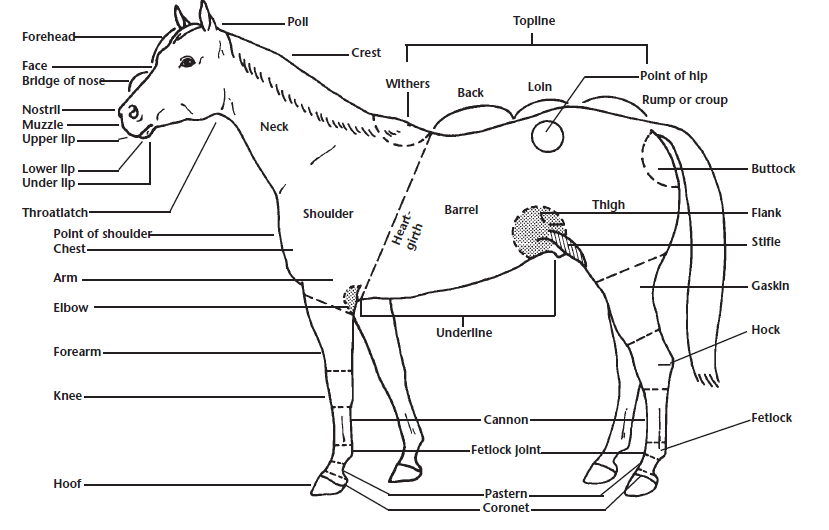
Figure 1 labels parts of a horse including forehead, face, bridge of nose, nostril, muzzle, lips, throatlatch, poll, crest, neck, withers, shoulder, chest, arm, elbow, forearm, knee, hoof, topline, back, loin, point of hip, rump or croup, buttock, barrel, flank, thigh, stifle, gaskin, hock, fetlock, cannon, fetlock joint, pastern, coronet, underline, and heart girth.
Ears
The size, length, set, direction, and movement of the ear are important. Extremes in size of ear detract from the appearance of the head. A medium-sized ear, clean cut in design, that shows the blood vessels clearly outstanding, is characteristic of horses with high quality and refinement.
Set or location of the ears helps determine the beauty of the head. Ears set well apart, not too low down over the eyes or too far back on the poll of the head, contribute to good looks.
The movements of the ears are an indication of temperament. Ears kept in a constant state of unrest may signal a nervous temperament, impaired eyesight, or total blindness. Motionless ears are an indication of a slow, lazy, sluggish disposition.
Eyes
Big, full, prominent eyes of a dark, rich, hazel color are desired in all types of horses.
“Walleyes,” sometimes called glass eyes, are those in which the iris is a pearly white color. Such eyes are objectionable on the basis of looks but are functional and not considered disqualifications.
“Pig-eye” is the term applied if the eye is too small, narrow, and squinty. Such eyes usually have thick eyelids and are commonly associated with coarseness and a sluggish temperament.
Nostrils
Good-sized nasal passages are considered indications of good breathing ability. Small nostrils are usually associated with short, flat ribs and, consequently, a chest that lacks lung capacity.
The normal nostril should be large, the skin clear, and the mucous membrane rose colored at rest and a deep red after exercise. The liquid discharged should be clear and transparent, the breath should be odorless, and the breathing noiseless. The nostrils should be large, because the nasal passages are the only avenues of air intake to the lungs.
Mouth
The jaws of the mouth should meet evenly. Not only are protruding or receding lower jaws unsightly, but they interfere with the horse’s eating. The terms applied are: “parrot mouth,” which means the upper jaw protrudes over the lower; and “monkey mouth,” which means the lower jaw protrudes beyond the upper. Alternate terminology would be “overshot” and “undershot” jaws or mouths, respectively.
Teeth
The teeth are classified as incisors, canines, and molars. They are organs of mastication. Age can be estimated by inspection of the incisors.
The bars of the mouth occupy the space on each side of the lower jaw between the incisor and the premolar teeth or between the canine and the first molar teeth. The bars are covered only with mucous membrane.
It is against the bars of the mouth that bit pressure is brought to bear in the control of horses by the reins. Horses are said to be “hardmouthed” when the mucous membrane of the bars becomes toughened and thickened, and the sensitivity of the mouth is deadened because of the calloused condition of the bars.
Neck
Long, trim necks are associated with athletic ability in all types of horses. A trim throat-latch is very desirable, since it permits the horse to flex the head easily. Both vertical and lateral flexion are required in good head carriage. Horses with long, trim necks and well-defined throats usually learn collection more readily and are more agile.
Short necks—bulky, thick, and staggy in proportions—are undesirable in saddle horses because they mean a lack of suppleness and mobility. Commonly, a short neck makes a horse heavy-headed and less subject to control. In race horses, short, bulky necks mean short elevator muscles in the shoulders and less length of stride.
The neck is straight when the crest line from the poll of the head to the withers approaches a straight line. The neck is arched when the crest line is convex from poll to withers. “Swan-necked” is the term applied when the crest line of the neck is strongly convex and the whole neck imitates in form and carriage that of a swan.
“Ewe-necked” is the term used when the crest line of the neck shows a distinct depression just in front of the withers. Ewe-neck and swan-neck are the reverse of the form desired; hence, horsemen refer to them by the expression “set on upside down.”
“Lop-neck,” “fallen-neck,” and “broken-crest” are terms applied when the crest of the neck becomes invaded with adipose (fatty) tissue, resulting in so much weight that the neck cannot sustain itself, and it breaks over or falls to one side.
“Ewe-necked” and “broken-crested” horses are unsightly and undesirable. The crest of neck is demanded in all types of horses where impressive fronts are a requirement. The degree of crest differs with the breed and specific use of the horse.
Withers
These comprise the region between the shoulders on top, behind the crest of the neck, and in front of the back. They are formed by the spinous processes of the first five or six thoracic vertebrae. The height of a horse is measured from the highest point of the withers to the ground. Equine stature is stated in hands and inches; four inches constitute a hand.
Prominent withers are desired because they ensure maximum length of spinal and shoulder muscles, also a longer stride to the forefoot. Horses with low, thick, rounded withers which lack definition move out awkwardly and clumsily in front. Such horses are usually low-headed, too heavy on the bit, inclined to forge and interfere, and are undesirable for rapid movement.
“Mutton withers” is the term applied to this low, flat, rounded conformation over the shoulder top. In saddle horses, such withers are objectionable not only because they affect performance, but also because they fail to provide a good seat for the saddle; consequently, it is difficult to keep a saddle in place.
Back
The back is bounded in front by the withers, behind by the loin and laterally by the ribs. In saddle horses, it is the part of the top which receives the weight of the rider. In all horses, its function is to transmit to the front end of the body the efforts of propulsion, which are communicated to it from the back legs through the loin.
A straight back of proportionate length is most desirable. It is always a sign of strength and provides for the greatest freedom of movement of the legs. A convex back is termed a “roach-back.” Such backs are shorter than straight backs and do not permit sufficient extension and flexion of the legs in taking long, rapid strides. “Roach-backs” and long legs are a combination which results in forging.
The back that is concave or hollow is referred to as “sagging” or as a “sway-back.” It is objectionable because it detracts from appearance and suggests weakness. The short, straight back supported by ribs that are well sprung, long, and deep provides a middle that has ample breathing and digestive space. Such proportions indicate good wind as well as good feeding and staying qualities. Short, flat ribs are characteristic of horses that are poor keepers and have poor wind and staying power.
Loin Region
The loin includes the portion of the top which extends from the last ribs to the hips. Short, heavy loin muscles are needed because they furnish the chief means of support for the lumbar vertebrae. Shortness of the loin is necessary for the best functioning of this part in carrying power from the hind legs forward.
All types of horses should have an abundance of muscling over the loin. “Coupled up good and close” is the phrase that describes ideal muscling of the loin. Horses that break across the top in front of the hips and that are long, narrow and weak in loin conformation are spoken of as being “slack in their coupling.”
Topline and Underline
The topline should be short in relationship to the underline. This allows the horse to move with more collection and impulsion. The wither should be long and extended well into the back. When a perpendicular line is dropped from the top of the wither to the ground, the greater the distance from this line (where it intersects the underline) to the point of the elbow, the greater the top to bottom line ratio.
Croup or Rump
This includes the region from the hips back to the tail-head. In conformation, the croup may be too steep, it may be too nearly level, or it may incline upward from the point of the hip to the tail.
If a horse is too steep in the croup, the top line looks plain. Furthermore, the steep croup tends to displace the hind legs too far forward beneath the body, causing them to bear too much of the body weight. If the croup is too nearly horizontal or is set up a bit at the tail-head, the hind legs are displaced rearward. In the latter case, the back is not well supported because the front and rear bases are spread farther apart. A short, steep croup is undesirable in a mare as this makes her prone to reproductive problems, especially a tipped vulva.
There are very definite breed characteristics associated with croup carriage. For example, Arabian horses are associated with a very flat, level croup and thoroughbreds with a sharp, steep croup.
The croup should carry the width as uniformly as possible from the hips rearward. “Goose-rumped” is the term applied to horses that taper from the hips to the tail-head, displaying peaked-ness and angularity in this region. Owners of western horses like to see the croups of their horses deeply creased. They associate this feature with heavy muscling and with easy-keeping and good feeding qualities.
The length of hip is measured from the point of the hip to the buttocks. A longer hip affords a horse a longer stride and the ability to move with more impulsion. The length of croup and the length of hip should be relatively of the same length.
Flank
To give balance to the middle, horses should be deep in the fore and rear flanks. Depth of flank in front and behind contributes to the balance of conformation. The best flanks are seen in horses that are well fleshed and highly fitted.
Flank movements, which are indicative of a horse’s wind and breathing, should be slow and regular without any signs of jerkiness. The normal number of movements when at rest are 12 to 14 per minute.
Age and physical condition are factors causing a variation in the number of flank movements. Excessive movement is quite commonly called panting. A horse that is easily winded and stays winded a long time is probably narrow in its chest, shallow in its rib, and cut up in its flank.
Chest and Heart-Girth
Proportionate width is demanded in all types of horses. Too much width, even in draft horses, where width is greatly emphasized as a feature in conformation, constitutes a real defect. When the front legs are set too far out on the corners, a rolling, rocking, laboring, and ungainly gait results. With front legs so placed, horses are unfit for work at speed.
The narrow-chested horse whose front legs appear to have the same point of junction to the body is spoken of as being pinched or too close in front. A narrow chest commonly accompanies a lack of muscling and constitution.
The depth of heart-girth is measured from the top of the withers to the point of the elbow. Depth of heart-girth coupled with spring of ribs and width through the chest floor, affords the horse more heart, lung, and chest capacity. This capacity gives the heart and lungs more room for expansion and contraction, thus increasing the athletic ability of a horse to work harder, longer, and faster.
Shoulder
The scapula is the skeletal base of the shoulder. The chief duties of the foreleg are to support weight, to preserve the stability and balance of body, to aid the hind legs in propelling the body forward, and to resist injurious effect of wear and tear on their own structures.
Following are reasons why the shoulders should be long and sloping, rather than short, straight, and steep: (1) they make possible a greater extension of the forearms; (2) they allow the front leg to be raised higher so the stride can be fully completed before the foot strikes the ground; (3) they give power and strength to the swing of the forearm; (4) they contribute to ease, freedom and style of action; and (5) they help disperse the damaging effects of concussion.
Straight shoulders, on the other hand, are objectionable because: (1) they are commonly accompanied by short, straight pasterns, resulting in a stilty set to the front legs (a conformation which causes shorter steps and harder concussion); (2) they produce a rough gait; and (3) they retard rotation of the scapulae causing the horse to work its front legs with less freedom. Shoulders are sometimes referred to as “pegged” when shoulder action seems retarded rather than free.
Arms
The humerus bone transverses the arm region. To permit a sufficient extension and rapidity of action of the thoracic limb, the bone of the arm should be short in comparison with that of the shoulder. If the length of the arm is excessive in comparison with the shoulder (especially if the shoulder is short and straight), the foot will cover less ground at a single stride, and action will not be reachy, free, and easy.
A long shoulder, a short arm, plus a long forearm makes possible maximum extension of stride and speed. The arm should operate in a plane parallel to the plane occupied by the horse’s body. If the arm deviates inward too much, a horse will stand toe-wide at the ground. If the arm deviates outward too much, a horse will stand toe-narrow or pigeon-toed.
Forearm
This is the name given to the region between the elbow and knee joints. Length of stride depends largely upon the length of the forearm, because the forearm carries the knee forward and upward. Hence, the longer the forearm, the longer the stride.
Short forearms in comparison with the cannon regions are objectionable because they result in shorter strides. A short forearm will augment height rather than extension as a feature of the stride. Long forearms and short cannons not only favor speed, but contribute to stability on feet and legs. With short cannons, knees are brought closer to the ground, making the support of the body easier and more certain during travel.
Chestnut
These are semi-horny formations varying in size with the type of horse in question. On the front legs, they are located upon the inside face of the forearm a few inches above the knee. On the hind legs, they are located on the lower inside face of the hock. They are not nearly as well developed in light-leg types as they are in draft horses. They are thought to be the rudiments of one of the four toes which once characterized the species.
Knee
This joint should be wide, thick, deep and clean-cut in outline, properly placed and directed.
Thickness of the knee is measured from side to side, width from front to rear. Width and thickness are desirable features because they increase the supporting area of the joint and furnish a more stable support for the body.
To distribute wear and tear properly, the knee must be correctly placed. If the joint breaks or deviates forward, a horse is termed “knee-sprung,” “over at the knees,” or “buck-kneed.” If length of toe accompanies the “knee-sprung” conformation, there is a strong disposition to stub the toes, stumble, and fall.
If horses stand back on their knees, they are termed “calf-kneed.” Such horses in motion usually bring their feet down hard, increasing concussion. When viewed from the front, if knees break inward, they are termed “knock-kneed.” If its knees break outward, a horse is said to be “bow-kneed” or to stand “open in its knees.” Both the “knock-kneed” and “bow-kneed” conditions are types of “bench-knee” (any lateral deviation, in or out, of the knee when viewed from the front).
Comparison of Front and Rear Legs (Figures 2a and 2b)
The arm of the front leg corresponds to the thigh of the hind leg. The femur is the anatomical base of the thigh. The elbow, forearm, and knee of the front leg are the counterparts of the stifle, gaskin, and hockbehind. Heavy muscling through the thigh, stifle, and gaskin is demanded. The hind legs are the propellers, so these muscles are required.
Horses that are turned out a trifle in the set of the stifle are preferred. This permits maximum extension of the hind leg, allows freedom of action, and turns the hocks inward beneath the body, permitting a horse to work his hocks close together (as opposed to wide apart) and go collectively. The gaskin should equal the forearm in length and, like the forearm, should be heavily muscled.
Hock Joint
The hock joint is referred to as the “pivot of action” in a horse. It plays an important part in propulsion and helps to decrease the harmful effects of concussion. It is called the “pivot of action” because it is the region upon which the extensor muscles concentrate their propulsive efforts. As the feet, carrying the body forward, rapidly strike the ground, the reaction from the movement bears mainly upon the hock joint. It is the hock joint that bears the burden of the weight when a horse rears from the ground.
The hock joint is satisfactory when it is clearly outlined, appears lean in quality, is wide and deep in its proportions, is well opened as viewed from the side, and is properly directed as viewed from the rear. A hock is lean and dry in appearance when its prominences and depressions are well marked and when the skin is fine and close fitting.
Horses that stand with the points of the hocks turned inward and base wide at the ground are termed “cow-hocked.” Horses with hocks that turn outward are called “opened in the hocks.” Such hocks may cause a twisting, rotating action on the move and are also termed “rotating hocks”.
If the angle formed by the hock as viewed from the side is too acute, a horse is called “crooked in his hocks,” is said to have too much set to the hocks, or is called “sickle-hocked.” If hocks are rounding on the back side, they are called “curby” or “saber-hocked.”
A hock may have lack of set and be too straight and is termed “post-legged.” This condition is objectionable because it tends to shorten the stride. Improper set of the hock joint results in improper distribution of body weight and may lead to early unsoundness.
Cannon Region
The cannon region extends from the knee and hock to the fetlock joints. The three bones (one large and two small) which traverse each front cannon are the metacarpals. The small metacarpals are commonly termed “splint bones.” The three corresponding bones in each of the rear cannons are the metatarsals. In general form and arrangement, they resemble each other closely, but the metatarsals are longer.
Size of the cannons depends not only upon the size of the metacarpal or metatarsal bones but also upon the size and set of the tendons that traverse the region. Horses that are constricted, “chopped away,” or “tied in” beneath the knee are criticized by horsemen as “lacking bone.” Bone is an indication of substance and contributes to ruggedness.
Big cannon bones and strong, clearly-set tendons are required to furnish ample support to knees and hocks. Cannons should be characterized by being clean-cut and defined. Well developed flexor tendons produce the desirable appearance of “flat bone.”
Fetlock Joint
The fetlock joint involves the articular or adjoining portions of the cannon bone, the first phalanx, and the proximal sesamoid bones. The joint is stabilized by a series of tendons and ligaments. The fetlock joints and correct pasterns help provide springiness to the gait and disperse concussion.
Some breeds of horses have long hair at the fetlock called feathering. The ergot is a semi-horny projection which protrudes from the rear base of the fetlock joint.
Pasterns
A sound set of pasterns is a primary requirement in both light and heavy horses. Extremely long, low pasterns are weak pasterns. Such pasterns, in company with shallow heels, characterize horses that are termed “coon-footed.” Short, straight pasterns increase concussion, stilty action, and rob the gait of spring and freedom, which are important features of the stride.
Straight pasterns and small, boxy feet with their narrow heels and straight, upright hoof walls often lead to unsoundness. The pasterns serve as a base of attachment for extensor and flexor tendons, functioning in locomotion as agents of extension and flexion. Snap, as a feature of the stride, is due in no small part to the working of the pastern joints.
Foot
A working knowledge of the hoof is necessary to understand the principles of good hoof care. The hoof is a highly-specialized horny shell that covers sensitive bones, nerves, and blood vessels and tissues.
Structure of the Foot
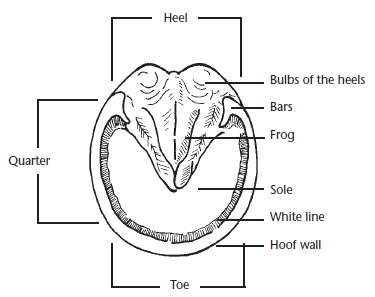
Figure 3 labels the underside of a horse hoof, including the heel, bulbs of the heels, bars, frog, sole, white line, hoof wall, toe, and quarter.
The visible covering of the hoof, seen when the horse is in a standing position, is the wall. If the horse’s leg is picked up, the bottom of the hoof is seen to consist of the wall and bars (an inward continuation of the outer wall), the sole (a concave area inside the wall), and the frog (a V-shaped cushion in the middle of the hoof).
Each portion of the hoof has a specific function. The wall is designed to carry the bulk of the horse’s weight as well as protect the underlying structures. The bars act as a brace to control
over-expansion and contraction of the hoof. The sole covers softer tissues and is somewhat concave to give grip and allow for expansion. The frog aids in absorbing concussions, circulation, and regulating moisture in the hoof.
Conformation of the hoof plays a big part in its ability to stand up under a long life of varied wear and tear. Selective breeding is one way to get good hooves. Also, a good balanced diet, composed of sufficient essential vitamins and minerals, helps maintain structural soundness of the hoofs. Front hooves should be larger, rounder, and stronger than those of the hind legs, because the forelegs support about two-thirds of the horse’s body weight.
The coffin bone, also called the third phalanx, gives shape to the hoof. If shape is not consistent, damage or disease may have altered the normal growth of the bone. All hoof growth starts from the coronary band, the junction of the hoof with the hair line. If this area is not smooth, regular, and healthy, there is little chance of having a sound hoof.
The wall of the hoof should be smooth and solid, continuing at the same slope as the pastern. The inside wall may be slightly steeper than the outside wall and still be normal. The wall, usually thicker at the toe and heel than at the quarter, should be free of any deep cracks or scars.
The next part of the hoof is the sole, just inside the wall. The wall and the sole unite at the white line. This line is important. All horseshoe nails should be driven directly into or just outside the white line and stay in the outer wall. The white line is also the junction between the sensitive and insensitive tissues of the foot. This line can be separated or injured by infection or inflammation.
The sole should be concave, strong, and free of deep depressions; any discoloration would indicate excessive bruising or inflammation. Flat-footed horses, and particularly those that have had a case of laminitis or any degree of a dropped sole, bruise the sole more frequently, especially at the toe.
Another common location of bruising is the angle formed by the hoof wall and the bars. Bruising in this area of the sole is known as a “corn.” Corns are very often found after shoes have been left on too long. As the foot grows out, the heel of the shoe moves forward inside the hoof wall, causing pressure on the sole and development of a corn at that point. A corn can become tender, abscess, and hemorrhage.
The V-shaped, spongy wedge in the center of the hoof—the frog—is a great indicator of the general health of the hoof. Without a good, full, flexible frog, contraction of the hoof and normal physiology of all the other hoof parts may be harmed. The frog should be a firm, full, elastic cushion for the horse.
Any puncture wounds which penetrate the frog are particularly serious, because the frog overlies very delicate structure. Any puncture of the sensitive tissue of the hoof certainly deserves protection, particularly against tetanus infection.
When judging, look for hooves which are in proportion to the body size and leg structure of the horse. You want a hoof full and rounding at the toe and quarter, and wide and deep at the heel. A foot which is narrow at the heel with straight upright hoof walls is called “mule foot.” This is objectionable because of appearance and is also very hard to shoe properly. The hoof wall should have enough flare to permit the driving of nails safely and easily.
Correlated Features
Relations of Form and Function
- The proportions of the head in all kinds of horses are a rather accurate index of the body proportions to be expected. That is, long, narrow heads are commonly correlated with long, shallow, narrow bodies.
- Long, sloping shoulders are correlated with long, sloping pasterns.
- Short, straight shoulders are correlated with short, straight pasterns.
- Long, trim necks and clean throatlatches are associated with balance, agility, and ability to work off the hocks.
- A deeply-creased croup is correlated with easy keeping, good doing, and satisfactory feeding qualities.
- Depth of heart-girth and spring of rib are associated with lung capacity and endurance.
Structural Features That Enhance Action
- Long forearms are correlated with long strides.
- Horses that stand toes straight away on their front feet are likely to have true action.
- Sloping shoulders and sloping pasterns of the front leg are correlated with a graceful, springy stride.
- When horses stand with the points of their hocks turned slightly inward, hind toes turned slightly outward and hind cannon bones occupying parallel planes, their hocks will be carried close together instead of wide apart. Such a position on the hind legs is correlated with collected action instead of spraddled action behind. A more pronounced turning inward (cow-hocked) is undesirable.
Way-of-Going That Helps Determine Function
The term “way-of-going” is self-defining. The pace refers to the rate at which a horse moves. Action implies flexion of knees and hocks.
- Length—distance from the point of breaking over to the point of contact of the same foot.
- Directness or trueness—he line in which the foot is carried forward during the stride.
- Rapidity or promptness—time consumed in taking a single stride.
- Spring—manner in which the weight is settled upon the supporting structures at the completion of the stride.
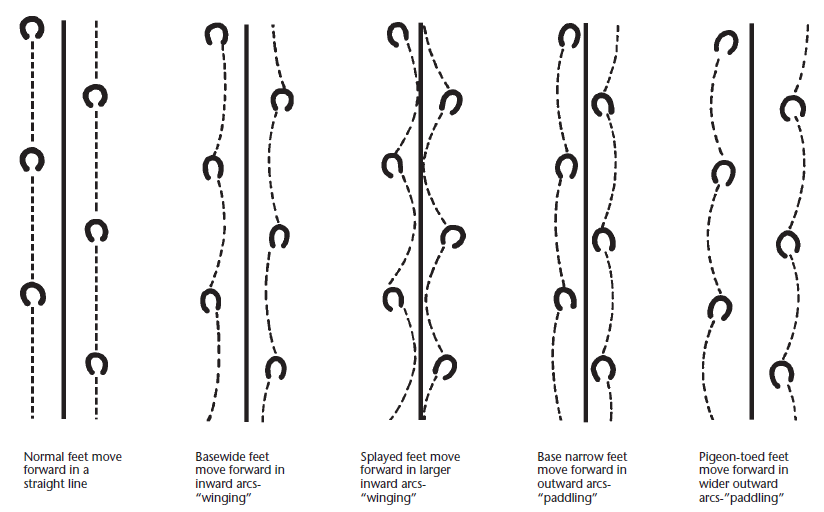
Figure 3a. shows hoofprint tracks and movement paths for five foot movement patterns. Normal feet move forward in a straight line. Basewide feet move forward in inward arcs, called winging. Splayed feet move forward in larger inward arcs, also called winging. Base narrow feet move forward in outward arcs, called paddling. Pigeon-toed feet move forward in wider outward arcs, also called paddling.
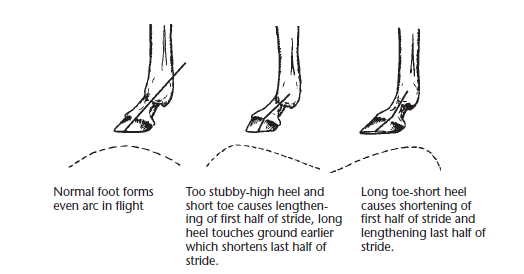
Figure 3b. shows three hoof movement arcs. A normal foot forms an even arc in flight. A too-stubby, high-heel, short-toe foot causes the first half of the stride to lengthen, because the long heel touches the ground earlier, shortening the last half of the stride. A long-toe, short-heel foot shortens the first half of the stride and lengthens the last half.
Unsoundnesses and Blemishes of the Horse
An important part of judging a horse is your ability to recognize common blemishes and unsoundnesses, and to rate the importance of each. A thorough knowledge of normal, sound structure makes it easy to recognize imperfections.
Any deviation in structure or function that interferes with the intended use of a horse constitutes an unsoundness. You must know the difference between abnormalities that do and those that do not affect the serviceability of the animal. Blemishes include abnormalities that do not affect serviceability. Examples can be wire cuts, rope burns, shoe boils, and capped hocks.
Be sure to consider the use to which you intend to put the animal before you purchase a blemished or unsound horse. Hereditary unsoundnesses are disqualifications in breeding classes.
Following are the definitions of 46 abnormalities in the horse that constitute unsoundnesses and blemishes. Many of these are further illustrated in Figures 4–8.
- Bandy legs (Figure 6b)—When a horse stands pigeon-toed on its hind feet, with the points of its hocks turned outward, it is said to stand bandy—legged behind. Such horses usually go wide at the hocks, making collected performance impossible. (A horse should work with its hocks fairly close together instead of wide apart.) Also, it is impossible for a horse so positioned on its hind legs to rock its hind feet forward, upward, break them over at the toes, and carry the hind legs directly forward. The bandy-legged horse gives a lateral twist to its hocks, often referred to as “rotating hocks,” which often cause early unsoundness of the hock joints because they cannot withstand the increased strain imposed upon them.
- Bench knees (Figure 4e)—When the cannons (as viewed from the front) fail to meet the center of the knees and are offset to the outside of the center of the knee. This fault very often causes large splints to develop.
- Blindness—Partial or complete loss of vision in either or both eyes. A blind horse usually has very erect ears and a hesitant gait. Frequently, blindness can also be detected by the discoloration of the eye. Furthermore, certain verification can be obtained by moving the hand gently in close proximity to the eye.
- Blood spavin—A varicose vein enlargement which appears on the inside of the hock and immediately above the location of a bog spavin.
- Bog spavin (Figure 8)—A soft filling of the natural depression on the inside and front of the hock. A bog spavin is much larger than a blood spavin.
- Bone spavin (Figure 8)—A bony enlargement on the inside and front of the hock where the base of the hock tapers into the cannon bone of the lower leg. Also called jack spavin, it is a heritable weakness and one of the most destructive conditions affecting the usefulness of a horse. The lameness is most evident when the animal is used following rest.
- Bow-knees (Figure 4c)—Bow-kneed (or bow-legged) horses often stand over the outside of the front feet. This faulty position brings undue weight upon the outside portions of the front feet, especially the outside lateral cartilages, often causing early formation of “side bones.” The length of serviceability of a horse so positioned on his legs is usually decreased.
- Bowed tendons (Figure 8)—A thickened enlargement of any one or all of a group of tendons and ligaments (usually the super-flexor tendon, deep flexor tendon, and suspensory ligament) which occupy the posterior space in the cannon region between knee and fetlock joint or between hock and fetlock joint. Bowed tendon is the name horsemen apply to ruptured tendon tissue, and is more commonly seen on front legs than on rear legs. Sprains which result in bowed tendons are not uncommon in horses that work at speed.
- Buck-knees (Figure 5b)—Buck-kneed (or knee-sprung) horses are ones over-at-the-knee or whose knees protrude too far forward when viewed from the side. They are less stable on their front legs than horses whose knees (as viewed from the side) are perfectly straight and squarely placed beneath the body for purposes of support. If buck-knees are accompanied by long toes, such horses usually stumble, particularly if the going is a little soft.
- Calf-knees (Figure 5c)—Knees (when viewed from the side) that break backward, Calf-knees are objectionable because bowed tendons and knee ailments often develop. The gaits will likely be accentuated by pounding.
- Capped hocks, knees, and elbows (Figure 8)—Swellings located on the point of the hock, front of the knee, and tip of the elbow, respectively. These swellings are caused by injuries that result in excess secretion of the synovial fluid.
- Cocked ankles—A condition usually limited to the hind feet. A horse with cocked ankles will stand with the fetlocks bent forward in a cocked position.
- Contracted feet—A condition most often occurring in the forefeet and characterized by a drawing-in or contracting of the heels. A tendency toward contracted feet may be inherited, but improper shoeing usually aggravates the condition.
- Corn—A bruise of the soft tissue underlying the horny sole of the foot which is seen
- as a reddish discoloration of the sole immediately below the affected area. Fast work on hard or rough surfaces, flat soles, weakened bars, and poor shoeing may cause corns.
- Cow-hock (Figure 6c)—A condition that, depending on severity, may or may not predispose the horse to unsoundness. A cow-hocked horse stands with the points of the hocks turned inward, while being base-wide
- and splay-footed at the hoofs (not to be confused with simply being narrow or close behind, in which hocks point in but the horse is also base-narrow). A cow-hocked horse moves its rear legs through an inward-then-outward arc while traveling.
- Curbed hock or curbs (Figure 8)—The condition in which there is a fullness on the upper rear of the cannon area just below the point of the hock. “Curbs” is due to enlargement of the ligament or tendon.
- Fistula (Figure 8)—An inflamed condition in the region of the withers, commonly thought to be caused by bruising. Fistula and “poll evil” are very similar except for location.
- Forging—A defect in the way-of-going, characterized by the striking of the supporting forefoot by the striding hindfoot on the same side.
- Founder (laminitis)—A serious and painful ailment of the hoof. It can be caused by over-eating, overwork, giving hot animals too much cold water or inflammation of the uterus following foaling. All feet may be affected, but the front ones are more susceptible.
- Heaves—A difficulty in forcing air out of the lungs. It is characterized by a jerking of the flanks (double-flank action) during exhaling. There is no satisfactory treatment, although affected animals are less bothered if turned to pasture, if used only at light work, if the hay is lightly watered at time of feeding, or if the entire ration is pelleted.
- Hernia or rupture (Figure 8)—The protrusion of any internal organ through the wall of its containing cavity, but it usually means the passage of a portion of the intestine through an opening in the abdominal muscle.
- Interfering—A defect in the way-of-going, characterized by the striking of the fetlock or cannon of the supporting leg by the opposite foot that is in motion. This condition is more prevalent in horses with splay-footed conformation in their front legs.
- Knock-knees (Figure 4f)—Horses that stand in at the knees or that are too close at the knees. Knock-kneed condition is caused by the bones of the upper and lower leg not entering and leaving the knee squarely. Knock-kneed horses, if worked at high speed, usually have interference problems.
- Moon blindness (periodic ophthalmia)—A cloudy or inflamed condition of the eye which disappears and returns in cycles often completed in about one month. It is also characterized by tearing and squinting of the affected eye or eyes.
- Navicular lameness (navicular disease)—Inflammation and/or fracture of the navicular or distal sesamoid bone. There is a characteristic defect in gait resulting from the lame animal trying to protect its sore heels. Each stride is ended with the final portion being shortened, because the animal tries to land each foot toe first. It is especially associated with contracted heels.
- Osselets—An inclusive term referring to a number of abnormal conditions around the fetlock joints. Generally, it denotes a well-defined swelling slightly above or below the center of the joint and off center of the exact front of the leg. Affected horses travel with a short, choppy stride and show evidence of pain when the ankle is flexed.
- Quarter, toe, and heel cracks (Figure 8)—A vertical split in the wall of the hoof that extends from the bearing surface of the hoof upward for some distance or extends from the coronary band downward. These types of cracks (sometimes called sand cracks) are usually caused by poor hoof care, such as allowing hoofs to become too long, dry, and brittle. In the case of cracks originating at the coronary band, some type of injury to the band itself, resulting in a weakened segment of the hoof wall, is the likely cause.
- Quittor—An active, seeping sore at the coronet of the hoof, usually over the area of the lateral cartilage. Normally confined to the forefeet, this condition can cause a long-lasting lameness.
- Parrot mouth—An hereditary imperfection in the way in which the teeth come together. It is caused by the lower jaw being shorter than the upper jaw (also known as “over-bite”). The reverse of this condition, “monkey mouth” or “underbite,” is caused by the lower jaw being longer than the upper jaw.
- Pigeon-toed (Figure 4g)—A pigeon-toed horse appears to be standing with the aim of the hoof turned toward the center of the body. Such a horse commonly exhibits paddling as a result of this imperfection.
- Poll evil (Figure 8)—An inflamed condition in the region of the poll usually caused by bruising the top of the head. The swelling usually contains pus or straw-colored fluid.
- Ringbone (Figure 8)—A bony outgrowth involving one or more bones and/or joints of the pastern region. It affects the forefoot, although occasionally the hindfoot is involved. This condition usually causes a progressive lameness, as the bony outgrowth completely rings the pastern region (hence the name “ringbone”). It is usually accompanied by a stiffened ankle if either the pastern joint or coffin joint is involved.
- Roaring—A whistling or wheezing when respiration is speeded up with exercise. This condition involves a faulty throat cartilage and can generally be corrected surgically.
- Scratches (grease-heel)—A dermatological inflammation of the posterior surfaces of the fetlocks and pastern.
- Shoe boil (Figure 8)—A soft fleshy swelling caused by an irritation at the point of the elbow (also called capped elbow). The two most common causes are injury from the heel caulk of the shoe and injury from contact with a hard surface.
- Sickle-hock (Figure 7b)—A term, together with “set to the hocks,” applied when a horse’s hind feet (as viewed from the side) are set too far forward in relation to his hocks. Horses which have this definite angle in the set of their hocks have an advantage in collection, stopping, and turning on the hindquarters. If the angle is too acute, however, the unsoundness called “curb” can develop. Compare sickle-hocked condition with “leg too straight” and “camped out behind” (Figures 7c and 7d). No unsoundness is directly related to these conditions, but extreme deviation in leg set should be avoided. Distance horses typically have “legs too straight.”
- Side bones (Figure 8)—Ossified lateral cartilage seen to protrude immediately above and toward the rear quarter of the hoof head. They are most commonly in the forefeet, and the condition may occur on one or both feet and on one or both sides of the foot. Lameness may or may not be present. Side bones are one of the most common potential unsoundnesses in the feet of horses.
- Splay-foot (Figures 4b and 4d)—A term applied when a horse stands with the toes of his front legs turned outward. A horse with this defect cannot rock his front feet upward from the heel, break over at the toe and carry straightforward. The striding foot of a splay-footed horse will swing inward toward the supporting leg, and he or she will be guilty of “winging.” Interference is almost inevitable.
- Splints (Figure 8)—Abnormal bony growths which can occur on the inside and/or outside of the cannon bone. They are most common on the inside of the front leg; when found on the hind cannon, they are usually on the outside. Splints may enlarge or be high enough to interfere with normal knee or hoof movement and thereby cause irritation and lameness.
- Stifled (Figure 8)—The stifle corresponds to the knee in man. A horse is said to be stifled when the patella of the stifle joint has been displaced. Occasionally, the patella can manually be placed back in normal position, but more often the affected horse is rendered useless without surgical corrections.
- Sweeney (Figure 8)—A depression in the muscle mass of the shoulder caused by an injury to a nerve resulting in a lack of innervation or control of muscle tone. Atrophy or muscle degeneration results.
- Thoroughpin (Figure 8)—A puffy condition in the hollow of the hock. The puff can be seen mostly on the outside, but is movable when palpated. Thoroughpin rarely causes lameness.
- Thrush—A disease of the frog of the foot, characterized by a black, thick, foul-smelling discharge. It is caused by unsanitary conditions.
- Undershot or overshot jaw—A hereditary imperfection in the way the upper and lower jaw meet. An undershot horse has a lower jaw longer than the upper jaw (also known as “underbite” or “monkey-mouth”).
- Winding—A twisting of the striding leg around and in front of the supporting leg so as to resemble a tight-rope walker (also called “rope-walking”).
- Windpuff—A puffy enlargement of the pastern joint, also referred to as “windgall.” The enlargement is a fluid filled distension of the bursa (joint sac or capsule).
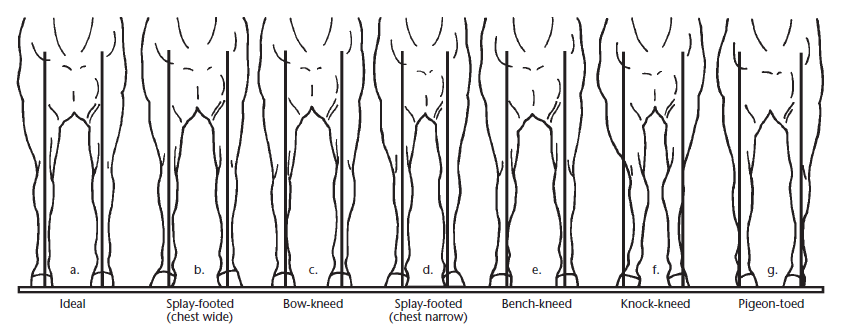
Figure 4 shows front views of horse legs labeled a through g. The conformation types shown are: ideal; splay-footed, chest wide; bow-kneed; splay-footed, chest narrow; bench-kneed; knock-kneed; and pigeon-toed.
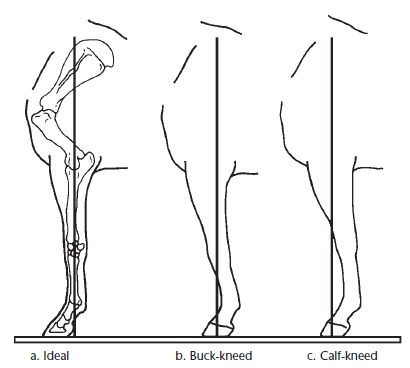
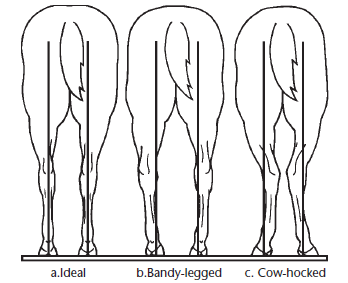
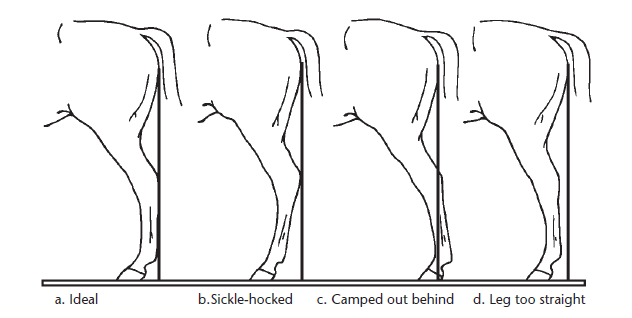
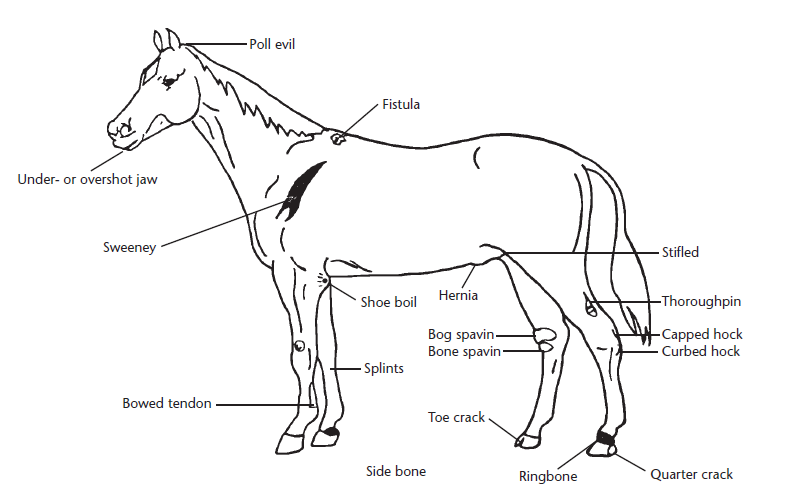
Figure 8 labels common horse blemishes and unsoundnesses, including poll evil, under- or overshot jaw, fistula, sweeney, shoe boil, hernia, stifled, thoroughpin, capped hock, curbed hock, bog spavin, bone spavin, splints, bowed tendon, toe crack, side bone, ringbone, and quarter crack.
Correlated Structural Features That Lead to Defective Gait or Unsoundness
- The calf-kneed position on the front legs is correlated with hard concussion of the feet at completion of the stride. The calf-kneed position tends to make a horse pounding-gaited on the move.Low, rounded withers are correlated with the defect in gait known as “forging.” Thick-withered horses commonly hang in the bridle, go low-headed, and handle their front legs awkwardly and clumsily.
- The pigeon-toed position on the front feet is correlated with a defect in gait known as “paddling” or “winging out.”
- The toe-wide or splay-footed position on the front feet is correlated with the defect in gait known as “winging in” or “dishing.”
- Horses that stand with the points of their hocks turned outward will exhibit a defect in stride known as “limber hocks” or “rotating hocks.”
- Short, straight shoulders and short forearms are features of the front legs correlated with short strides and hard concussion.
- Buck knees and long toes are features of the front legs correlated with stumbling.
- Short straight shoulders, short straight pasterns and narrow contracted heels are correlated with many unsoundnesses, including ringbone and sidebone.
- Long, low, weak pasterns and shallow heels are correlated with the unsoundness known as “ringbone,” a bone deposit which appears on the pastern bone.
- “Sickle hocks,” a term which applies to hocks that have too much set as viewed from the side, are correlated with the hock unsoundness known as curbiness (curbs).
Judging the Halter Horse
In judging the Halter Class, Keep in Mind the Particular Class You Are Judging
Example: Quarter Horse Broodmares.
All sex classes, mares, geldings, and stallions, are unique in that several different factors must be considered for each sex class.
Mares
- They must give an overall feminine appearance particularly in the head neck and bone size.
- They must be sound and free from any problem which would prevent a mare from carrying foal to parturition.
- They must conform to the “ideal” type and conformation accepted by the breed.
- They should be discriminated against if their external genitals show some predisposition toward breeding unsoundness. Example: A mare with a recessed anus, exposing the vulva more prominently, will usually have fecal material lodged on and in the vulva. This will eventually cause vaginal infection.
- They must be physically developed for their age.
- They must have a disposition which is suited for a mare of her particular breed.
- They should have a full spring of fore and rear ribs for foal carrying capacity
Geldings
- They must display masculine characteristics without having a disposition similar to a stallion.
- They must be sound, as geldings are of no value if they are lame.
- They must conform to the “ideal” type and conformation accepted by the breed.
Stallions
- They must have masculine appearance and be physically developed for their age.
- They must be sound; otherwise they may not be suitable for breeding and/or riding purposes.
- They must have a disposition which is suited for a stallion of particular breed.
- They should be discriminated against for not having properly developed external genitals for a stallion of that age. Example: A stallion which has a retained testicle.
- They must conform to the “ideal” type and conformation accepted by the breed.
Descriptions and Regulations for Different Breeds
A breed of horse represents a group of animals that have descended from common ancestors. More importantly, this group possesses features and characteristics, both physical and psychological, that are unique to itself.
Each breed has been developed to fulfill a particular need or to perpetuate certain characteristics. Registration (recording) of individual animals is usually handled by the breed association or registry.
This association, registry or otherwise called governing body, also describes the standard of perfection for their breed. The descriptions of some of our more popular breeds follow.
Appaloosa
Type and Conformation. In general appearance the Appaloosa horse is symmetrical and smooth.
Weight ranges from 950 to 1,250 pounds and height from 14 to 16 hands. The typical pattern shows a dark front and white with dark spots over loin and hips. Others may be dark in front and solid white over the hips. Some are white with dark spots over the entire body or dark with white spots over the entire body.
The three identifiable Appaloosa characteristics are: (1) white sclera encircling the eye, (2) vertically striped hooves, and (3) mottled or particolored skin.
The head is straight and lean showing particolored skin about the nostrils and lips.
The forehead is wide. The sclera of the eye is white, giving the eye prominence and adding distinctiveness to the appearance of the head. The ears are pointed and of medium size.
Halter Classes. Do not sacrifice conformation, action, or anything of importance for coat markings, but people do expect winners and champions to “look like Appaloosas.” Coat markings do contribute to Appaloosa breed type the same as a Hereford’s markings contribute to Hereford breed type. Therefore, if a pair is equal in points, the nod should go to the one that is “more easily recognizable” as an Appaloosa.
Arabian
Type and Conformation. The Arabian is commonly between 14.1 and 15.1 hands at the withers and ranges in weight from about 950 to 1,100 pounds. It has a dark skin, and the hair coat is not marked with white except for leg and face markings.
The Arabian is noted for its overall stylishness. It has a relatively small, dished head, with a small muzzle, large nostrils and large, dark, wide-set eyes. The distance between eyes and muzzle is comparatively short, accentuating its deep muscular jowls. The short, thin ears add a look of alertness and intelligence. The pride of the Arabian is displayed in his long, arched neck, which is set high and joins into high withers. When viewed from the side, the classic Arabian horse exhibits long, sloping shoulders, well-sprung ribs, long forearms and short cannons. His short back blends well into the comparatively horizontal croup. High tail carriage is natural and adds to the beauty of the animal when moving. The Arabian should move straight, quickly and smoothly, with a high head and tail carriage.
Entries must be serviceably sound and in good condition and must wear long, natural unbraided mane and natural, unset, ungingered tail. Horses shall be shown without artificial appliances.
Halter Classes. Horses to be shown in hand at a walk and trot, should stand on all four feet, not stretched, and be handled and shown throughout an entire class by only one person. A suitable headstall equipped with throat-latch is mandatory. Excessive use of the whip or actions that may disturb other entries shall be penalized. Emphasis shall be placed upon type, conformation, substance and quality; transmissible weaknesses and/or unsoundness to be counted strongly against breeding stock.
Morgan
Type and Conformation. The Morgan generally stands between 14.1 and 15.2 hands and weighs from 1,050 to 1,250 pounds. Its size and scale display much power and development. Noted for stamina, vigor, personality, and eagerness to work, the Morgan is an ideal all-around horse.
The Morgan has an alert, straight or slightly dished face with large, wide-set eyes and small ears. It has a large, prominent jaw that blends into a narrow muzzle with large nostrils and firm lips. The head is carried high on a powerful, slightly-crested neck.
The body of the Morgan also displays the power bred into these horses. The shoulders are deep and show great angulation. The shoulders blend into a short back with broad loins and a muscular, well-developed, level croup. The legs of a Morgan are straight and sound with short cannons, flat bones, medium pasterns, and overall strength and refinement.
Except for weanlings and yearlings, which must be shown barefoot, horses may be shod or barefoot. If shod, shoes must be open heeled without bars, burn-buckles or bands.
Halter Classes. Entries are to be judged individually, by standing, then at a walk and trot on the line and must be serviceably sound. Horses must stand squarely on all four feet. Emphasis shall be on type and conformation, with consideration given to horse’s ability to move correctly on the lead.
Paint
Type and Conformation. The Paint horse is a stock-type horse. The head is relatively short and wide with a small muzzle and shallow, firm mouth. The nostrils are full and sensitive; ears are short and active, and set wide apart.
The neck should be of sufficient length, with a trim throatlatch and not too much thickness or depth. The girth should be deep with well-sprung ribs, with broad, deep, well-muscled quarters that are full through the thigh, stifle, and gaskin.
Halter Classes. Horses are to be shown in hand at a walk and jog. They will be judged on type, conformation, quality, substance, and soundness. Color will not be considered by the judge. No discrimination shall be made towards light or dark skin or color of eyes or pattern of horses. Coat markings do contribute to the Paint breed type. If a pair is equal in all respects, the top placing should go to the one that is “more easily recognizable” as a Paint.
Pony of the Americas
Type and Conformation. Three-year-olds and over must be at least 11.2 hands (46 inches) and shall not exceed 13.2 hands (54 inches).
Ponies of the Americas are a happy medium of Arabian and Quarter horses in miniature with Appaloosa coloring. They should show style and substance, beauty and symmetry. The head should be proportionate to the body with cleancut features. The eyes should be large, kind, and prominent, and the ears medium in size, alert, and well carried. A slight dish in the profile will help accentuate the Arabian characteristics. The throatlatch should be well-defined and the neck slightly arched, running back to a sloping shoulder and a prominent wither. The chest should be fairly wide; the forelegs, set well forward, should have a muscular forearm and a lean, flat cannon bone. The pasterns should be set at a 45-degree angle and the feet should be rounded and proportionate to size of pony. The body should be heavily muscled, with well-sprung ribs, back and loin short, wide and well muscled, but not extreme. The tail should come out high on the croup which should be long, level, and muscular. The quarters and gaskins should be deep and muscular. The hocks should be clean-cut and well-supporting.
A pony must show Appaloosa color at a distance of 40 feet to be eligible to show. All ponies must have white or partially white sclera and some mottled skin. Striped hooves are desirable, but not necessary. Halter Classes. Ponies must be serviceably sound, in good condition, and well-groomed. Manes should be roached or pulled to five inches; tails pulled to near top of the hock; however, this is optional. Ponies of the Americas should be shown in halter or bridle; any other tack, artificial appliances, and tail setting of any kind are prohibited.
Quarter Horse
Type and Conformation. The first point to consider is Quarter Horse type. In general, there have been three distinct types: the bull dog type—an extremely heavy muscled, short, compact horse; the racing type—a lighter muscled, longer-legged, longer-bodied horse; and the middle-of-the-road (or medium) type.
To be of true Quarter Horse type, a horse must be medium to medium-large in size (14.2 to 15.2 hands), have a typical head, be long and sloping in the shoulders, long in the croup, and have a fairly short back and strong coupling. The cannon bones should be fairly short. With a short back, the shoulder and croup must be long and slope at a 45-degree angle to give the horse a long bottom line, resulting in a long stride. There is a pronounced muscular appearance in both the fore and rear quarter.
The amount and kind of muscling are important. The points of indication of muscling are the quarter, stifle, and gaskin, the arm and forearm, and the V-muscle of the chest. These muscles first of all should be evident in quantity, and also should be of the right kind-that is, long, smooth, and well attached. Long tapering forearm and gaskin muscles that tie well down into the knee or hock on both inside and outside are preferred to short bunchy muscles. The Quarter Horse should be widest through the stifle region as in other species; all the muscling should be rippling, or well defined.
The Quarter Horse head should be moderately short and broad and should be topped by small fox-like ears. The eyes are fairly wide apart and are large and alert. The distance from the eyes down to the muzzle should be moderately short, and the nostrils should be fairly large with small lips. The jaw should be fairly large and suggest strength. The head should be clean-cut in its appearance. Halter Classes. Horses to be shown in hand at a walk or jog are to be judged on type, conformation, quality, substance, and soundness. Hereditary or transmissible unsoundness shall disqualify a horse.
Saddlebred
Type and Conformation. The ideal American Saddlebred has a well-shaped head carried relatively high with small, alert, pointed ears set close, large eyes set well apart with thin lids, and a fine muzzle with large nostrils and a straight face line. Its long neck is nicely arched with a fine clean throatlatch. It has high withers with long sloping shoulders and a short back with well-sprung ribs. The croup is level with a well-carried tail coming out high. The forearms and hindquarters are well-muscled to the knees and hocks. Legs are straight with broad flat bone and sharply defined tendons and sloping pasterns. This breed has good sound hooves, open at the heels.
Action should be straight and true. The average height is 15 to 16 hands and the weight is from 1,000 to 1,200 pounds. Any color is acceptable, but the most prominent are chestnuts, bays, browns, and blacks, with some greys, roans, palominos, and pintos.
American Saddlebreds must be serviceably sound and shall be shown without artificial appliances, except inconspicuously applied hair in mane or tail, a tail brace, and mouth controls. Quarter boots are allowed in five-gaited performance classes and fine harness classes only. Any artificial change of color or markings other than mane or tail is prohibited.
Shetland Pony
Type and Conformation. No Shetland shall exceed 11.2 hands (46 inches) in height. The height limit for yearlings is 10.3 hands (43 inches) and under, and the limit for two-year-olds is 11.0 to 11.5 hands (441/2 inches).
The head should be refined with prominent, wide-set eyes, nose slightly concave, with broad, flat bridge carrying width to the muzzle. The ears should be short and fine and set well on the head. The head should be carried high on a refined, well-arched neck which supports a thick mane. The body should be strong and high, with sloping withers, a short back, and nearly level croup. Legs should be muscular with fine flat bone. Ponies should stand squarely, and the feet should be wider at the base than at the coronary band. There is no discrimination on the basis of eye color.
Halter Classes. Shetlands on entering the ring are to be lined up and worked as requested—usually at a walk and trot.
Stallions, three years old and older, to qualify in breeding classes, must have all the fully developed physical characteristics of a stallion.
All appliances, including false tails and metal braces, are prohibited.
Thoroughbred
Type and Conformation. The typical Thoroughbred stands 15.2 to 16.2 hands and weighs from 1,100 to 1,250 pounds. Overall appearance makes the horse look taller, more lean and angular, with the body longer, deeper chested and more narrow when compared with other breeds. The head is tapered, from large, wide-set eyes to a firm muzzle. It is small with a straight, flat face. The large, thin nostrils, good windpipe and wide, deep jaw (which gives room for the larynx) allow maximum air exchange. The ears should be wide set, small, and well-formed.
The neck should be lean, without coarseness or heavy appearance; length and a slight arch are also desirable. The neck joins well into the shoulder. The shoulder should be long, well-sloped, and covered with lean, flat, powerful muscles. The depth of the shoulders should carry through to the heart-girth.
The ribs should be flat immediately behind the shoulders, well-rounded, and full over the rib cage. The thighs and quarter should be powerful, showing long, smooth muscling. The legs should be flat and strong with long, sloping pasterns.
The entire makeup of the Thoroughbred shows quality, stamina, and durability. Temperament is active and energetic. Thoroughbreds are considered by many as one of the hotter or higher-psyched breeds of horses. Their action is characterized by a low-going, pointed trot, but a smooth gallop with long, easy strides.
Welsh Pony
Type and Conformation. The color of Welsh ponies may include any color except piebald and skewbald. The head should be small and clean cut, well set, tapering to the muzzle; a slight dish is desirable. Eyes should be bold, set wide apart, ears well-placed, small and pointed, well up on the head. The neck should be lengthy, well-carried, and moderately lean in the case of mares, but inclined to be cresty in the case of stallions. No Welsh Pony shall exceed 14.2 hands in height.
Halter Classes. Ponies are to be shown in hand at a walk and trot in halter or bridle. Emphasis shall be on breed characteristics. A natural reaching action is desirable.
Judging the Performance Horse
This section will include English and Western Pleasure, Showmanship at Halter, Stock Seat Equitation, English Equitation, Western Riding, English Riding, and Reining. Keep in mind that note taking and oral reason presentations are identical to the halter division, with the obvious exception of terminology used to describe equitation or the horse’s way-of-going.
The Pleasure Horse
A pleasure horse cannot be simply defined due to differences in breed requirements. These differences complicate the job of judging; thus, a full knowledge of the breed descriptions of pleasure horses is necessary. However, the breeds do agree that the pleasure horse should give the appearance of an enjoyable drive or ride.
In general, the “ideal” pleasure horse is the horse that gives you the appearance of the most pleasurable and relaxed ride, a horse that you could ride all day and enjoy every minute. A pleasure horse should look pleasant and go with the least amount of effort from the rider. The “ideal” horse should not be mouthing the bit, wringing its tail, kicking at other horses, or exhibiting other undesirable traits.
Guides for Judging the Pleasure Class
- The rules of the class must be fixed in your mind prior to and as you judge the class.
- Remember, when judging the pleasure class the rider is not being judged. Do not let a rider completely influence your decision. A good rider can make any horse give a pleasurable appearance, mainly by sitting with a firm seat. A bouncing or loose-legged rider can give an appearance of a non-pleasurable ride. Be sure to look through the rider’s faults or complements.
- Position yourself at a vantage point where you can always keep the majority of the class before you. You can do this usually by standing at one end or corner in the show ring. You can rapidly make comparisons of horses this way.
- Do not speak to other contestants during the contest. It could result in the immediate disqualification of you or your team.
- Listen for wind soundness after and during the performance.
- If you have the opportunity, be sure to examine the eyes in the lineup to make sure the horse is not blind or has impaired eyesight.
- The head should not be “nosed” out nor should there be extreme flexion at the poll as a Park Horse. The ears should be erect or semi-erect, giving a pleasant appearance.
- At the walk the horse should move reasonably “free” at the shoulder. In other words, the horse should move without the appearance of restriction.
- When advancing to the faster gaits, jog and lope, you must watch for the transitions. This means watch to see which horse easily and quickly changes gaits without undue restraint. Once the horse jogs or lopes, he or she should settle back to a walk without problems. The rider should not “run” the horse into the lope. The rider should not require the entire length of the ring to walk the horse from the lope. (Western Pleasure only.) The same may be applied to English Pleasure, by simply replacing English terminology for Western.
- The reverse should be accomplished without the rider using two hands turning the horse. (Western Pleasure only.)
- When the horses are asked to line up in the center, they should stand quietly. They should not be “dancing around,” rather standing quietly with all feet placed squarely on the ground.
- Look for faults such as wrong leads, turning the incorrect direction on the reverse, cross cantering, throwing the head, mouthing the bit, bucking, or kicking out.
- Keep in mind the neck and head position as well as the ease and freedom in the movement of the legs, shoulders, and rear quarters.
- Never forget the pleasure horse should give an overall appearance of ease and comfort.
- The horse must be sound.
Descriptions and Regulations for English Pleasure by Breeds (as quoted from the AHSA Rule Book)
Appaloosa English Pleasure
Shall be shown at the walk, trot, and canter.
- Walk: true and flat-footed for pleasure classes.
- Trot. brisk, smart, cadenced, and balanced without loss of form. Smoothness more essential than extreme speed.
- Canter: smooth, slow, collected, and straight on both leads with the ability to push on if so required.
Horse shall be shown at all gaits both ways of the ring as directed by the judge. Special emphasis shall be placed on a reasonably loose rein at all gaits, but still maintaining contact with mouth so that the horse is under control at all times.
To be judged 60 percent on performance and manners, 30 percent on type, conformation, quality, and substance, and 10 percent on appointments. No martingale, tie-down, or draw reins are permitted.
Arabian English Pleasure
In English Pleasure classes, light contact must be maintained with all reins at all gaits. It is imperative that the horse give the distinct appearance of being a pleasure to ride. To this end, all gaits must be performed with willingness and obvious ease, cadence, balance, and smoothness.
To enter ring at a normal trot. To be shown at a walk, normal trot, strong trot, canter, and hand gallop.
- 4-beat walk: brisk, true, and flat-footed with good reach.
- Normal trot (2-beat gait): to be performed at medium speed with moderate collection. The normal trot must be mannerly, cadenced, balanced, and free moving. Posting is required.
- Strong trot (2-beat gait): The strong trot is faster and stronger than the normal trot. It is performed with a lengthened stride powerful and reaching, at a rate of speed which may vary between horses since each horse should attain its own strong trot in harmony with its own maximum natural stride. The horse must not be strung out behind. It should show moderate collection without exaggerated high action in front. It must present a willing attitude while maintaining form. The strong trot must be mannerly, cadenced, balanced and free moving. Posting is required.
- Canter (3-beat gait): smooth, unhurried, with moderate collection, correct and straight on both leads.
- Hand gallop: The hand gallop is performed with long, free, ground covering stride under control. The amount of ground covered may vary between horses due to the difference in natural length of stride. The hand gallop is not a fast collected canter, but a true lengthening of stride, correct and straight-on both leads. Extreme speed to be penalized.
Hunter Division-Bridle Path Hacks (Hunter Type)
To be shown at a walk, trot, canter, and hand gallop. To back easily and stand quietly while rider dismounts and mounts. Emphasis shall be placed on actual suitability to purpose. Judging percentages are left to the discretion of show management.
Morgan English Pleasure
Stallions are prohibited in Ladies’ and Junior exhibitors’ classes.
To be shown at a walk, pleasure trot, road trot, and canter, with light rein, but still maintaining contact with the horse’s mouth. To be judged on performance and apparent ability to give a good pleasure ride, with emphasis on manners and gait-60 percent; type and conformation-40 percent.
- Walk: flat-footed, rapid, elastic.
- Trot: square, collected, and balanced.
- Pleasure trot: easy-going trot with elasticity and freedom of movements.
- Road trot: balanced ground covering form should not be sacrificed for speed. Excessive speed should be penalized.
- Canter. smooth, collected, and straight on both leads.
Easy ground covering motion is desired in Pleasure and Working events. judges must severely penalize any horse with laboring motion, at any gait, resulting from excessive weight, or any horse that shows a tendency to pace.
Quarter Horse Bridle Path Hack (Hunt Seat)
Horses are to be shown at a walk, trot, and canter both ways of the ring. Horses are required to back. Emphasis shall be placed on actual suitability to purpose.
Horses are to be reversed to the inside (away from rail). They may be required to reverse at the walk or trot, but shall not be asked to reverse at the lope.
Horses are to back easily and stand quietly.
Horses must be brought to a flat-footed walk before changing gaits. Light contact with the horse’s mouth is recommended. The following gaits and traits should be demonstrated:
- Walk: true and flat-footed for pleasure classes.
- Trot: brisk, smart, cadenced, and balanced without loss of form. Smoothness more essential than extreme speed. Extreme speed shall be penalized.
- Canter: smooth, collected, and straight on both leads with the ability to push on if so required in a hand gallop.
- Hand gallop: The hand gallop should be a brisk gallop with horses under control, after which the horses will pull up (not a sliding stop) and stand quietly on the rail for a few moments, before being asked to line up for final inspection.
Descriptions and Regulations for Western Pleasure by Breeds
Appaloosa Western Pleasure
Shall be shown at the walk, jog trot, and lope.
- Walk: true and flat-footed.
- Jog trot: square, slow, and easy. (A ground covering gait.)
- Lope: smooth, slow, easy, and straight on both leads.
- Hand gallop: a real hand gallop, not merely an extended lope, extreme speed to be penalized.
Qualifying gaits: To enter ring at walk or jog trot at judge’s discretion. To be shown at a walk, jog trot, lope, and hand gallop.
Morgan Horse Western Pleasure
To be shown at a walk, jog trot, and lope, with light rein, but still maintaining contact with horse’s mouth. To be judged on performance and apparent ability to give a good pleasure ride, with emphasis on manners and gait-60 percent; type and conformation-40 percent. (Prize lists to specify whether or not horses are to be tested on obstacles.)
Easy ground covering motion is desired in Pleasure and Working events. Judges must severely penalize any horse with laboring motion at any gait resulting from excessive weight, or any horse that shows a tendency to pace.
In pleasure classes horses may be asked to back. Qualifying gaits:
- Walk: flat-footed, rapid, elastic.
- Jog trot: free, slow, easy without a tendency to mix gaits.
- Lope: smooth, slow, straight, with a 3-beat cadence.
Quarter Horse Western Pleasure
To be judged on the performance and conformation of the horse at the discretion of the judge. Entries will be penalized for excessive speed or wrong leads.
Horses are to be shown at a walk, trot, and lope on a reasonably loose rein without undue restraints. Horses must work both ways of the ring at all three gaits to demonstrate their ability with different leads. Horses shall not be asked to extend the lope. Horses are to be reversed to the inside (away from the rail).
They may be required to reverse at the walk or trot at the discretion of the judge, but shall not be asked to reverse at the lope. judge must ask that horses be backed.
Showmanship at Halter (English and Western)
Showing a horse at halter is an art and should be considered as such by the exhibitor and judge. Proper halter showing testifies to the obvious pride the exhibitor has in the animal being exhibited. This pride is evident by the condition and appearance of the horse and by the actions of the exhibitor and horse in the ring which indicate previous training to form a coordinated team. Conformation of the horse is not judged since the horse is considered a means of displaying the abilities of the exhibitor.
Technical points and minor infractions of rules should not be overemphasized to the extent they outweigh an effective job of presenting a clean, well-conditioned, trained animal.
Guides for Judging the Showmanship Class
Further details on showmanship at halter can be found in EM4727, Performance Horse Member Manual and Class Rules.
- The appearance of the horse including cleanliness, condition, grooming, and tack should represent 20 percent of the total score.
- The ability of the exhibitor to properly and safely show the horse, including ring deportment, correct leading, and posing should represent 70 percent of the total score.
- The remaining 10 percent should include the appearance and attitude of the exhibitor.
Stock Seat Equitation
Guides for Judging Stock Seat Equitation
Further details on rules and regulations for stock seat equitation can be found in EM4727, Performance Horse Member Manual and Class Rules.
- In stock seat equitation the rider is being judged on his or her ability to make the horse perform the routine required for the class. Judging emphasis will be placed upon seat, hands, responsive performance of the horse, appointments of horse and rider, and suitability of horse to rider. Good hands are paramount.
- The methods used in obtaining results in the performance of the horse are of more importance than the performance of the horse itself. Conformation and breed characteristics are not judged in this class.
- The rider should demonstrate proper mounting and dismounting techniques.
- The hands and arms should be held in a relaxed manner. Only one hand is to be used for reining and the hands should not change while riding. In general, the hand is to be around the reins, with one finger between the reins when using split reins. When using a romal, no finger is permitted between the reins. The free hand and arm should be relaxed, but not sloppy.
- The rider’s body should always appear balanced, relaxed, and flexible. All movements of the horse should be governed by imperceptible aids.
- The following appointments and tack are required:
- Personal: Protective headgear, cowboy boots, belt, and long-sleeved shirt with buttons or snaps and collar required.
- Tack: Western stock saddle; western bridle with a standard western bit of the grazing, curb-snaffle, curb, half-breed, bar, or spade varieties; romal or split reins.
English Equitation
This section will deal with saddle seat equitation, hunt seat equitation (not to jump), and hunt seat equitation (over jumps).
In general, judging emphasis is placed upon the rider in equitation classes. Riders will be judged on seat, hands, performance of horse, appointments of horse and rider, and suitability of horse to rider.
The results as shown by the performance of the horse are NOT to be considered more important than the methods used in obtaining them.
Unsoundness should not be penalized unless it is severe enough to impair the required performance.
The seat should not be exaggerated. It should be efficient and comfortable for riding the type of horse called for at any gait and for any length of time. The hands should be held in an easy position and should show sympathy, adaptability, and control. Further details on rules and regulations for these divisions can be found in EM4727, Performance Horse Member Manual and Class Rules. Several major differences are apparent in these divisions. They will be discussed below.
- In saddle seat equitation the rider is required to demonstrate proper equitation at the walk, trot, canter, slow gait, and rack.
Informal personal appointments include a black, blue, gray, green, beige, or brown jacket with matching jodhpurs (white jacket in season), protective headgear, and jodhpur boots.
Proper tack will include full bridles (curb and snaffle). Martingales and similar tie-downs are prohibited. Saddles shall be of the flat English type. - In hunt seat equitation (not to jump) the rider is being judged on ability rather than attire. However, riders should wear suitable hunt seat attire consisting of a coat of any tweed or melton for hunting (conservative wash jackets in season); breeches or jodhpurs; appropriate boots; and protective headgear is mandatory.
Permissible tack includes regular snaffles, pelhams, and full bridles, all with cavesson nose bands. A judge may penalize a rider using non-conventional types of bits or nose bands. Type of saddle is optional. Martingales are prohibited. - In hunt seat equitation (over jumps), the rider is being judged on ability rather than attire. However, riders should wear suitable hunt seat attire consisting of a coat of any tweed or melton for hunting (conservative wash jackets in season); breeches or jodhpurs; appropriate boots; and a dark blue, black, or brown mandatory hunting helmet.
Permissible tack is the same as hunt seat equitation (not to jump).
The performance begins as the horse enters the ring or is given the signal to proceed after entering ring. Except for refusals, jumping faults of the horse are not to be considered unless it is the result of the rider’s ability.
Each contestant may circle once if desired before approaching first jump. He or she shall then proceed around the course keeping an even pace throughout. Three cumulative refusals will eliminate. If a refusal occurs in a double or triple, riders shall rejump all elements of the combination.
Western Riding (Control Class)
The rider should be judged upon the skills demonstrated in good Western equitation, reining and trail. judging emphasis should be placed on the following points: basic position in the saddle; lightness of hands; correct and imperceptible use of aids; response of the horse as indicative of the horsemanship of the rider; the smoothness of performance and steadiness of the gaits. Preference should be given to flying changes of lead between the markers. Conformation should not be considered.
Any horse not following the exact pattern should be penalized. Knocking down markers or obstacles should not disqualify a contestant, but should be scored accordingly.
A rider is penalized if he or she loses a stirrup, uses two hands on the reins, changes hands on the reins (except when necessary on the gate), or touches any part of the saddle with his or her free hand.
Required appointments include protective headgear, cowboy boots, belt, long-sleeved shirt with buttons or snaps and collar; western saddle, western bridle with any standard western bit (grazing, curb-snaffle, curb, half-breed, bar or spade, etc.).
Further details on rules and regulations for western riding can be found in EM4727, Performance Horse Member Manual and Class Rules.
English Riding (Control Class)
The rider should be judged on the skills demonstrated for good English equitation and performance. Judging emphasis should be placed on the following points: basic position in the saddle; lightness of hands; correct and imperceptible use of aids; response of the horse as indicative of the horsemanship of the rider; smoothness of performance and steadiness of the gaits. Preference should be given to proper changes of leads between the markers. Conformation should not be considered. The rider should present a work-like appearance of being with the horse and in light control at all times. An impression of lightness and suppleness should be conveyed.
Any rider not following the exact pattern should be penalized. Knocking down markers orobstacles should not disqualify a contestant, but should be scored accordingly.
Appointments and tack are the same as for hunt seat equitation (not to jump). Further details on rules and regulations for English Riding can be found in EM4727, Performance Horse Member Manual and Class Rules.
Reining Class
Judging emphasis should stress the abilities of the rider in riding and handling the horse through the pattern. The rider and horse should perform the pattern at a reasonable speed and display control, agility and training.
The rider should perform the routine in a light, fluent manner, indicating a composed, harmonious attitude between horse and rider.
Required appointments include protective headgear, cowboy boots, belt, long-sleeved shirt with buttons or snaps and collar, western stock saddle, and western bridle with any standard western bit (curb snaffle, curb, half-breed, bar, or spade).
Further rules and regulations for reining can be found in EM4727, Performance Horse Member Manual and Class Rules.
Completing the Placing Card
Remember that the four horses in the class are always assigned a number. Number 1 is always on your left and Number 4 on your right as you view the class from the rear. In performance classes the exhibitor will be wearing an identification number.
Contest judging placement cards have space for placing up to ten classes. At the top of the card there is space for your name, club, county, and contestant number. When you receive a card complete the top and write the class name in the box provided as you start each class.
Washington 4-H judging cards require you to mark an (X) or (/) in the space to the right of the placing (2-3-4-1) you choose. After marking your card, hand your card to the group leader to circle your selection.
Junior 4-H Judging Placing Card
Figure 9 shows a completed livestock judging scorecard. At the top, the contestant name is John Jones, the club is Two Forks, the county is Whitman, and the contestant number is 14. The form contains columns for Classes 1 through 10. Classes 1 through 8 list possible four-item placing orders, while Classes 9 and 10 provide numbered lines. In the Class 1 column, the placing “2-4-3-1” has been marked with an X and circled. No selections are marked for the other classes, and the scoring, reasons, award, team score, and team placing fields on the right side are blank.
Oral Reasons
How to Take Notes
A set of short simple notes will help you organize your oral reasons. Notes are to be used as a study aid before giving your reasons to the judge, they are not to be read to him or her. They should help you recall or remake a mental picture of the class. Indicate anything special about the animals which will help you visualize the class later. Examples: color, markings. Do not refer to your notes while giving reasons.
Use a small spiral-type notebook for note taking. A 6- by 9-inch notebook with flexible covers will be large enough and is easily carried. The following is a set of sample notes taken on the Morgan Mare Class discussed in this publication.
Placing 3-1-2-4
| Reasons for Placing | Admit or Grant | Faults |
|---|---|---|
| 3/1 Shorter coupled, stylish front, sharper withers, leveler croup, cleaner in hocks, truer stride. | 1/3 Heavier muscled in rear | 3/ Small, dull, eyes and lacks muscling in rear |
| 1/2 Longer neck, deeper in heart, more muscle in stifle, correct on front legs, | 2/1 Refined head | 1/ Steep in croup |
| 2/4 Head-smaller ear, stronger back croup, flatter loins | 4/2 Moves closer at hocks, heavier bone | 2/ Flat withers, toes—out in front |
Points to Remember When Taking Notes
- Take notes quickly and accurately.
- Take notes on reason classes only.
- Take notes the last half of the time allowed to judge a class.
- Be sure the final placement is at the top of the note page.
- Be sure the class number and/or title is on the note page.
- Be sure the terms used are accurate and correct.
- Be sure to use some term or terms to visualize each horse in the class (e.g., color, markings).
- Be sure not to put more than one set of notes on each page.
- Be sure to use comparative terms in notes.
- Never use notes when giving reasons to a judge.
How to Give Oral Reason
Oral reasons are evaluated and scored in the following areas:
- Knowledge of subject 40%
- Use of appropriate terms 25%
- Presentation 20%
- Organization 15%
Oral reasons may be practiced by speaking to yourself as you look in a mirror, recording your reasons on a tape recorder and playing them back to listen for your mistakes, or presenting your reasons to another person. It is important to practice reasons; you cannot wait until the last minute and bluff your way through a contest.
Suggestions for Giving Oral Reasons
As a contestant you must have a vivid mental picture of the class of horses you are talking about. This means a mental picture of each horse in the class. You must develop a complete vocabulary of horse terms. This can best be developed through study and practice.
- The reasons need not be long. Only two minutes per class is allowed in most contests.
- Do not use your notes when giving reasons. Learn to visualize the horses as you saw them in the class. The notes help to get your reasons organized and ready for presentation.
- Use a logical sequence in giving reasons and give major reasons first.
- Do not learn one set of reasons, as you will find no two horses are the same as well as no two classes.
- Place yourself about 6 to 10 feet, if possible, from the person to whom you are giving your reasons. Look the person in the eyes and appear confident, friendly, and enthusiastic.
- When giving reasons, talk in a slightly louder than ordinary tone of voice. Use emphasis and inflection with comparative terminology.
- Always start your reasons by giving your placement. Examples: I placed this class of Aged Morgan Mares 2-1-3-4, or I placed this class of Arabian Western Pleasure Horses 1-3-4-2. Then go to your reasons.
- If you make a mistake or forget a point, STOP, visualize the class in your mind again. Then continue your reasons.
- Do not bluff or say something that is not true.
- Do not give wordy or meaningless reasons.
- Do not use indefinite words such as: better, good, best, etc. They do not explain why one horse is superior to another.
- Do not skip from one horse in the class to another. Give your reasons on the first place horse, second, third, and fourth, in that order.
- Speak clearly and use appropriate terms for the class of horses. Example: leads, transitions, gaits, colts, fillies, foals.
- Be sure to compare each horse to the one you placed below it.
- Concede or grant good points and faults, regardless of the placing of the horse.
- End your reasons strongly or as strong as you started. There is a natural tendency to end weakly.
- Give a conclusion. Example: For these reasons I place this class of Western Pleasure Horses 2-3-1-4.
Terminology
Suggested Terminology for Halter Horses
It must be remembered when preparing reasons, you must be sure you select the most accurate and concise terms. The terms you use do not necessarily have to come from this list. The list is intended to aid those persons wishing to learn terms, which many horsemen and judges commonly use.
Ideal
- More balanced
- More symmetrical
- More stylish
- Smoother
- More refined
- More femininity
- More masculinity
- More Q.H. (Arabian, Paint, etc.) type
- More Q.H. (Arabian, Paint, etc.) character
- Larger framed
- More skeletal dimension
- Larger, stouter made
- More structural correctness
- More athletic
- Higher quality
- More highly conditioned
- More developed
- More body capacity
- More heart, lung, and chest capacity
- More foal carrying capacity
- More broodmare potential
- More capacious
- More correct in his/her muscle structure
- Longer muscled
- Smoother muscled
- Shows more expression of muscle
- Shows more definition of muscle
- More powerfully muscled
- More expressively muscled
- Ties in more correctly
- Smother blending of parts
- More uniform in body lines
Fault
- Poorly balanced
- Lacks symmetry and style
- Coarse
- Rough
- Plain
- Rangy
- Lacks Q.H. (Arabian, Paint, etc.) type
- Stocky
- Shallow bodied
- Lacks femininity
- Lacks masculinity
- Lacks quality
- Light-muscled
- Bunchy-muscled
- Lacks smoothness of muscling
- Poorly conditioned
Ideal
- Cleaner cut about the head
- Finer featured about the head
- More chisled features about the head
- More femininity
- More masculinity
- More refinement
- Shows more Arabian breed character about the head
- Sharper, chisled features about the head
- Shorter, broader head
- Shorter, foxier ears
- Wider set between the eyes
- Larger, brighter eye
- More intelligent, kinder eye
- Larger nostril
- Shorter from eye to nostril
- A head that tapers to a finer muzzle
- More desirable head set
Fault
- Coarse-headed
- Plain-headed
- Narrow head
- Long head
- Lacks femininity
- Lacks masculinity
- Lacking Arabian breed character
- Heavy, coarse ears
- Long, mule ears
- Poorly set ears
- Dull eye
- Pig eye
- Blind eye
- Close-set eyes
- Small nostril
- Roman nose
- Parrot-mouthed
- Monkey-mouthed
Ideal
- More desirable carriage of the head and neck
- More correct carriage of the head and neck
- More stylish head and neck carriage
- More balanced head and neck carriage
Fault
- High carriage of the head and neck
- Low carriage of the head and neck
Ideal
- Cleaner through the neck and throatlatch
- Trimmer through the neck and throatlatch
- More desirable set to the neck
- Longer neck
- Cleaner neck
- Leaner neck
- More athletic neck
- Longer from poll to wither
- Neck ties in higher to the shoulder
- Higher set neck
- Neck sets higher onto shoulder
- Neck blends more smoothly into shoulder
- Longer from poll to wither
Fault
- Neck too long
- Neck too short
- Neck too thin
- Neck too thick
- Ewe-necked
- Swan-necked
- Low-set neck
- Cresty-necked
- Neck ties in low
- Neck does not blend in smoothly to the shoulder
- Thick throatlatch
Ideal
- Longer shoulder
- Deeper shoulder
- More sloping shoulder
- More heavily muscled shoulder
- More desirably sloped shoulder
- More correct angle to the shoulder
- More expressively muscled shoulder
- Shows more definition of muscle to the shoulder
- More powerfully muscled shoulder
- Exhibits more slope of shoulder
Fault
- Short shoulder
- Steep shoulder
- Rough over shoulder
- Light muscled shoulder
- Lacking depth of shoulder
Ideal
- Wider chest
- Shows more width through the chest
- Wider through the chest floor
- Deeper chest
- More muscling through the pectoral region
- More prominent V
- More powerfully muscled V
- More expressively muscled V
- Strings down into a deeper V between the front legs
Fault
- Narrow chest
- Too wide in chest
- No V muscling
- Chest lacking muscle
Ideal
- Longer muscled arm and forearm
- More powerful arm and forearm
- Forearm carries farther towards knee
- More expression of muscling to arm
- More definition of muscling to forearm
- Smoother muscled arm and forearm
- Heavier muscled arm
- Heavier muscled forearm inside and out forming a more prominent V between the front legs
- Deeper arm
- Longer forearm
Fault
- Light-muscled
- Bunchy-muscled
- Not tied-in
- Shallow arm
- Short forearm
Ideal
- Bolder spring of forerib
- Bolder sprung
- More spring of forerib
- More arch of forerib
- Greater spring of forerib
- Deeper heart-girth
- Deeper hearted
- Deeper barrel
- Longer from point of wither to the elbow
Fault
- Lacks spring of forerib
- Shallow in heart-girth
- Shallow-ribbed
- Lacks depth of barrel
- Straight sided (slab sided)
Ideal
- More level topline
- Stronger topline
- A shorter topline in relation to a longer underline
- Longer underline
- Smoother underline
- More prominent withers
- Cleaner withers
- Sharper over the withers
- Shorter backed
- Shorter coupled
- Stronger backed
- Stronger coupled
- Stronger loin
- Closer coupled
- Longer croup
- More even turn to the croup
- More level croup (Arabians)
- Longer hip
- Deeper hip
- Higher tail set
- More desirable turn over the croup
- Deeper flanked
Fault
- Weak topline
- Sway back
- Long back
- Long coupled
- Long topline
- Short underline
- Light middled
- Wasp-waisted
- Whick over the withers
- Mutton-withered
- Low at the withers
- Too sharp over withers
- Weak loin
- Short croup
- Steep croup
- Short hip
- Low tail set
- Pot-bellied
- Tucked up flank
- Roach-backed
- Higher at croup than withers
- Higher at withers than croup
- Uneven topline
- Lacks prominence of withers
Ideal
- Wider through the stifle
- Heavier muscled thigh
- Heavier muscled quarter
- More powerfully muscled thigh and quarter
- Longer muscled quarter and gaskin
- Smoother muscled quarter and gaskin
- More powerful driving muscle
- More expression of muscle to the inner and outer gaskin
- More definition of muscle to the inner and outer gaskin
- Ties in lower to the gaskin and hock
- A gaskin that ties in higher to the quarter and lower to the hock
- Longer, more athletic muscling through the rear quarter
- Smoother and cleaner over the hips as viewed from the rear
- More expressively muscled gaskin, stifle, and thigh
Fault
- Apple-rumped
- Goose-rumped
- Light-muscled
- Bunchy-muscled
- Not tied in
- Rough over the hip
- Lacks width through the stifle
- Rafter hipped
Ideal
- Set squarer on feet and legs
- Stands squarer on all fours
- Has legs placed more squarely beneath
- Squarer in front
- Straighter behind
- Wider in front
- Stood wider behind
- Higher quality underpinning
- Higher quality bone
- Stands on more substance of bone
- Cleaner bone
- Flatter bone
- Knees and hocks set closer to the ground
- Shorter cannon bone
- Larger knee
- Larger hock
- Cleaner joints
- Longer from knee to arm
- Shorter from knee to pastern
- Shorter from hock to pastern
- More correct set to hock
- Cannons set more squarely into knee
- Cannon comes out more squarely from knee
- More definition of tendon
- More well-defined tendons
- More correct angle to pastern
- Stronger pasterns
- More desirable length of pastern
- More sloping pasterns
- Larger, rounder foot
- Wider at heels
- Tougher hoof
- Broader knees and hocks
- Flatter knees and hocks
Fault
- Stands too close in front
- Stand too wide in front
- Stands too close behind
- Stands too wide behind
- Pinched between front legs
- Base-narrow
- Base-wide
- Post-legged
- Coarse bone
- Round bone
- Lacks substance of bone
- Poor quality bone
- Splints
- High hock and knees
- Long cannon
- Small knee and hock
- Rough joints
- Short forearm
- Straight hock
- Sickle hocked
- Camped under
- Camped out
- Cow-hocked
- Camped under in front
- Calf-kneed
- Buck-kneed
- Bench-kneed
- Offset cannons
- Bow-legged
- Tied in at the knee
- Bowed tendon
- Knee-sprung
- Bog spavin
- Bone spavin
- Capped hocks
- Curb
- Thoroughpin
- Knock-kneed
- Puffy hocks,
- Toes-out
- Toes-in
- Pigeon-toed
- Stocked in the legs
- Weak pasterns
- Stubby pastern
- Coon-footed
- Splay-footed
- Short pasterns
- Steep pasterns
- Cocked ankles
- Sidebones
- Ringbone
- Capped elbow
- Shoe boil
- Long, flat feet
- Narrow foot
- Shallow heel
- Brittle foot
- Club-footed
- Flat-footed
- Shallow-footed
- Pinched at the heels
- Contracted heels
- Boxy feet
- Toe crack Quarter crack
- Coarse in the ankles
- Coarse in the pasterns
- Seedy toe
- Blemishes
Ideal
- Moves out freer and easier
- Moves out with a longer stride
- Moves out with a bolder, more determined stride
- Shows more flexion and action in the knees and hocks
- More collected stride
- Moves straighter both front and rear
- Moves truer behind
- Tracks straighter and truer
- Has more knee and hock action
- Is more stylish on the move
- Moves with more snap to the knees and hocks
- A prompter stride
- More direct stride
- Has more style at the walk and trot
- More coordinated stride
- More flex and spring to the knees and pasterns
- Moves with more animation (Arabians, Morgans)
- More balanced way of going
- Moves with more elasticity at the trot
- More fluid stride
- Longer, farther reaching stride
- Lighter on the forehand
- Engages the hocks to a greater degree
- Steadier stride
- More extension of stride
- Brighter and brisker walk
- Smoother stride
Fault
- Choppy stride
- Short-strided
- Lacks coordination
- Paddles in front
- Paddles behind
- Wings both front and rear
- Rotates the hocks
- Drags the feet
- Travels narrow behind
- Travels wide in front
- Lame
- Rough stride
- Crosses over in front
- Interferes behind
- Lacks knee and hock action
- Over reaches
- Plating
- Forges
- Moves stiff
- Lacks collection
- Heavy on the forehand
- Sore behind
Suggested Terminology for the Pleasure Horse
It must be remembered when preparing reasons, you must be sure you select the most accurate and concise terms. The terms you use do not necessarily have to come from this list. The list is intended to aid those persons wishing to learn terms which many horsemen and judges commonly use.
Ideal
- More attentive
- More alert
- More consistent
- Quieter
- More relaxed
- More agile
- More animation
- More collection
- Smoother
- Well-mannered
- Willing
- Supple
- Brighter
- More finished
- More highly trained
- More stylish
- More balanced
- More responsive
- More athletic ability
- Less anticipation
- Disciplined
- Steadier
Fault
- Unattentive
- Unalert
- Lacks consistency
- Unruly
- Nervous stiff
- Strung out
- Rough
- Lacks finish
- Lacks training
- Lacks animation
- Shows resistance
- Unresponsive
- Anticipates
- Lacks discipline
- Lacks style
- Lacks balance
- Unwilling
- High-strung
Ideal
- More desirable carriage of the head and neck
- More correct carriage of the head and neck
- More stylish head and neck carriage
- More balanced head and neck carriage
- More correct flexion at the poll
- Shows more flexion at the poll
- More collected
- More natural headset
- Higher set neck
Fault
- High carriage of the head and neck
- Low carriage of the head and neck
- Lacks flexion at the poll
- Lacks collection
*Substitute in the blanks the appropriate gaits: walk, jog, trot, extended trot, canter, lope, or hand gallop.
Ideal
- More stylish
- More pleasant way of going
- More balanced way of going
- Moves with more animation
- More supple at the
- Freer moving at the
- Strides out at the
- Covers more ground at the
- Moves more relaxed at the
- A brisker walk
- More flat footed walk
- Freer way of going
- Moves without undue restraint
- Springier
- Truer stride
- More coordinated mover
- Longer stride
- Moves out freer and easier at the
- An easier, freer stride
- Is more stylish on the move
- More style at the
- Goes more collectedly at the
- Moves with more regularity at the
- Smoother, easier lope or canter
- Slow easy jog
- Smooth, free
- Smooth, unhurried Truer hand gallop
- Moves out with a freer, truer extended trot
- More cadenced trot or extended trot
- Covers more ground at the
- Smoother, unhurried, more collected at the
- Moves with more brilliance at the
Fault
- Choppy stride Too short-strided
- A short, choppy stride
- Goes short in front or rear Lacks smoothness
- Rough
- Moves too strong
- Moves too mechanical
- Over animated
- Excessive speed at the
- Lacks consistency at the
- Too bold at the
- Slower transition
- Rougher transition
- Too fast
- Too slow
- Balks at the
- Four beats at the lope
- Cross fires
- Uncontrolled
- Missed a lead
- Lacks regularity
- Hollow backed
- Lacks collection
- Cross canters
- Anticipates commands or aids
- Laboring motion
- Appears to have excessive hoof length or shoe weight
- Moves stiffly
- Disunited
- Heavy on the forehand
- Lacks balance
- Lacks impulsion
Ideal
- More rapid transitions
- Smoother transitions
- More fluid upward and downward transitions
- More prompt in transitions
- Picks up leads smoother and quicker
- Smoother lead changes
- Straighter back
- Backs more readily
- More correct back
- Shows less resistance to the bit while backing
- More desirable headset while backing
- Quieter with the bit on the rail
- On the bit
- Works on a looser rein without loss of contact
- Responds more readily to the rider’s cues
- Smoother reversals
- More correct reversals
- Exhibits more ease of performing the reversal
- Moves without undue restraint
- Required less rein while executing the reversal
- More balanced stop
- More correct stop
- Stopped with less resistance to the bit
- Stands quieter in line
Fault
- Slow transitions
- Rough transitions
- Slow lead pick-up
- Rough lead changes
- Crooked back
- Resists the bit
- Wringing the tail
- Mouthing the bit
- Grabbing the bit
- Behind the bit
- In front of the bit
- Slow back
- Too tight rein
- Too loose rein
- Anticipates commands
- Bouncy stop
- Sliding stop
- Resisting the aids
- Rough reversals
- Not standing quietly in line
- Bucking
- Reversed incorrectly
- Missing correct lead
- Breaking gait
- Bobbing the head
Suggested Terminology for the Equitation Classes
Ideal
- Smoother performance
- More consistent
- Less noticeable cues
- Uses more leg
- Horse and rider more coordinated
- More alert
- More attentive
- More fluid
- More responsive
- More willing
- More highly trained
- More ring etiquette
- More correct performance
- More relaxed
Fault
- Rough performance
- Inconsistent, lacked steadiness
- More obvious cues
- Uses less leg, no leg contact
- Horse and rider not in rhythm
- Dull, sluggish
- Unattentive
- Lacked fluidity of movement
- Lacked responsiveness
- Shows resistance, resists aids
- Lacked training, lacked finish
- Lacked ring etiquette, less considerate of other exhibitors
- Unruly, nervous, stiff
Ideal
- Deeper
- More balanced
- More desirable
- More correct
- More relaxed
- Tighter
Fault
- Loose in the saddle, riding on cantle
- Unbalanced
- Less desirable
- Incorrect
- More rigid, stiff back, nervous rider
- Tense, bouncing seat
Ideal
- Quieter
- More correct hand position
- Lighter
- More supple
Fault
- Rougher, jerking
- Improper hand position, less desirable hand position
- Heavier, more harsh
- Lacked suppleness, showed resistance
Ideal
- Straighter back
- More vertical line from shoulder to hip
- More relaxed
- Squarer shoulders
- Quieter free arm
- More correct free arm position
Fault
- Slouching shoulders
- Breaks the vertical line from shoulder to hip
- Stiff, rigid, nervous
- Rounded shoulders
- More movement of the free arm
- Less correct free arm position, rigid, lifeless free arm position
Ideal
- More leg contact
- More knee contact
- More lower or upper leg contact
- More correct leg position
- Heel further down
- Toe pointed straighter
Fault
- Less leg contact
- Less knee contact
- Less lower or upper leg contact, lacked calf or thigh contact
- Less correct leg position, incorrect leg position
- Heels up
- Toes pointed outward, unparallel toe position
Ideal
- Straighter On the bit
- Smoother
- Move readily
- More responsive
- Horse more collected before backing
- Easier backing
- Quicker
Fault
- Backed crookedly
- Behind the bit, in front of the bit
- Rougher, resisting
- Less fluid, movement, slower
- Resisted the bit
- Horse more strung out before backing, lacked collection
- Required more rein when asked to back
- More hesitation, less promptness in backing
Ideal
- More balanced
- More correct
- More desirable headset
- Less bounce
- On the bit
Fault
- Lacked balance
- Less correct
- Less desirable headset
- Bouncy
- Mouthing the bit, grabbing the bit, behind the bit, in front of the bit
Ideal
- Smoother
- Used more leg when asking for the left lead
- Quicker
- Less anticipation
- Sharper, truer
Fault
- Rougher, strung out
- Less prompt
- Required more leg when cuing for the left lead
- Anticipated more
- Crossfiring, untrue
Ideal
- Smoother
- More correct
- On the bit
Fault
- Less prompt, less balanced
- Slow
- Behind the bit, in front of the bit
Sample Oral Reasons
Sample Oral Reasons for Halter Horses
Morgan Horse Mares. I placed this class of Morgan Horse Mares 1, 2, 3, and 4.
I placed 1 at the top of this class and over 2 because 1 shows more Morgan horse type, style and balance, particularly in the head and neck. One has more muscling in the chest, arm and forearm; more prominent withers; a shorter back and a stronger coupling. One is a more animated mare who moves out with a truer, freer, and more collected stride. However, I will grant 2 shows more refinement throughout, but I fault 2 for being long-backed.
In reference to my middle pair, 2 over 3, 2 is a more refined, higher quality mare. Two has more slope to her shoulder; is sharper over the withers; has a shorter, stronger back; more arch of rib; deeper heart-girth, and is smoother-muscled over the croup and through the thigh, stifle, and gaskin. She has a shorter cannon, and a rounder, tougher foot. I will concede 3 stands somewhat straighter in front, but I criticize 3 for being thick over the withers and moving too wide in the hocks.
Now, coming to my bottom pair, 3 over 4, 3 is a smoother-muscled, nicer-balanced mare. Three has a more feminine head; longer, leaner neck; is shorter in the back and coupling and is nicer turned over the croup. She is cleaner in her hocks and stands on shorter, wider cannons. Three is stronger in her pasterns and has a more shapely foot. I will admit 4 is a larger mare with more prominent withers and moves truer behind; however, I criticize 4 and place her at the bottom of this class because she is off type, and lacks the muscling and balance of the mares I placed above her.
For these reasons I placed this class of Morgan Horse Mares 1, 2, 3 and 4.
Sample Oral Reasons for English Pleasure Horses
My placing of this English Pleasure class is 2, 1, 4, and 3.
In my top pair, I placed 2, the girl on the chestnut, over 1 because 2 had a more fluid, consistent, and supple performance. Two was lighter on the forehand, showed more lateral bend, and had a more desirable headset in that he was on the bit and was steadier at the trot. He showed more extension of stride at the walk and canter and he moved with more rearward impulsion. I criticize 2 for missing a lead, and I grant 1 showed more spring and elasticity at the trot.
Moving to my middle pair, I placed 1, the girl on the bay, over 4 because 1 was smoother, more pleasurable, and agile. Two had a more ground covering walk, showed more flexion and action to the knees and the hocks at the trot and was more united and smoother at the canter. He showed more flexion at the poll and was more responsive to the bit. I criticize 1 for being heavy on the forehand and I grant 4 had a longer stride and worked with more impulsion.
In reference to my bottom pair, I placed 4, the other girl on a bay, over 3 because 4 was more willing, responsive, and alert. Four had a brighter, brisker walk, a freer moving trot, and was lighter on the forehand at the canter. He showed more lateral bend, was smoother in his transitions, worked with more impulsion from the rear and was longer and bolder in his stride. I criticize 3 for not working off the bit, and I grant 4 had a truer three-beat lope.
I placed 4, the girl on the brown, at the bottom of the class. Granting he was quiet and relaxed, he broke gait three times, crossfired once, was rough in his transition, and lacked the impulsion, bend, and responsiveness exhibited by the three horses I placed above him.
Thank you.
Sample Oral Reasons for Stock Seat Equitation
My placing on this stock seat equitation class is 4, 3, 2, and 1.
In my top pair, I placed 4, the lady on the black gelding, over 3 as she had a more fluid performance with more coordination between horse and rider. She had a deeper, more relaxed seat, squarer shoulders, and a more correct free arm position. In addition, 4 showed less movement in the seat in the transitions, while stopping, and used more outside leg in the execution of the reversals. Furthermore, she had her horse standing squarer and quieter in line. I grant 3 had a tighter leg and knee position and I criticize 4 as she had her horse behind the bit at the jog.
In reference to my middle pair, I placed 3, the gentleman and the bay mare, over 2 as he displayed a more correct leg position and had less noticeable cues. The bay required less rein in the execution of the reversals and while backing, and the rider had the horse more on the bit throughout the class. Moreover, he showed a more consistent and desirable lower leg position with greater knee contact, toes pointed straighter, and a more correct set to the heel. I criticize 3 for not standing the horse squarely in line and I grant 2 displayed a more correct upper body position.
Moving to my bottom pair, I placed 2, the gentleman on the Appaloosa mare, over 1 as he had a smoother, more correct and fluid performance. He used more leg and as a result showed sharper, smoother lead changes and more lateral bend in the reversal. Also, 2 had a straighter line from shoulder to hip, a quieter free arm, and a more desirable hand position. In addition, he had a tighter seat, quieter hands, and was more considerate to the other riders in the class. I criticize 2 for not getting his horse on the bit before backing and I grant 1 had a more consistent lower leg position; however, I fault the girl on the gray mare and placed her last as she was loose in her upper body position and seat. Also, she lacked ring etiquette and reversed in the wrong direction.
Thank you.
Contest Regulations and Scoring
Typical Rules and Regulations for 4-H Horse Judging Contest
Entry
Each 4-H horse judging team shall be composed of three or four members. When four are entered, the three team members with the three high scores will make up the team total. The contestants must be certified by the state, county, or local 4-H leader on entry blanks either the day of the contest or a specified date prior to the contest.
Contestants and Eligibility
Contestants must be bona fide 4-H members and approved by Cooperative Extension.
Club members who enter into academic or vocational training beyond high school of the current year are not eligible to compete in the 4-H contest.
Contestants who have served as alternates at a contest are considered as being part of the official team and are ineligible to compete a second time.
Method of Conduct
- Contestants and coaches must receive permission from the contest chair if they wish to visit the grounds prior to the contest.
- All contestants will report to the chair at a specified place and time, where they will receive full instructions regarding the contest. Each will be assigned a number, group and given placing cards. All contestants will remain with the assigned group throughout the contest.
- Follow the directions givenbyyour groupleader.
- No contestant shall wear any clothing, pins, or badges that will in any way reveal his or her identity or that of the state, county, or local club he or she represents.
- While the contest is in progress there shall be no conferring between contestants or anyone else except as directed by the contest chair or his or her representatives.
- Be aware of whether the class you are judging is a class for placement only or for placement and reasons. Take notes on reason classes only.
- Sixteen minutes will be allowed contestants on classes that do not require reasons.
- Eighteen minutes will be given contestants on reason classes, to make their observations, notes, and fill out their placing cards.
- Two minutes will be allowed to give oral reasons to the judge.
- Halter and performance classes will be judged. The following breeds may be represented in the halter classes: Quarter Horses, Thoroughbreds, Paints, POAs, Saddlebreds, Arabians, Welsh and Shetland Ponies, Morgans, and Appaloosas.
- Performance classes may include English and Western Pleasure, Showmanship at Halter, Stock Seat Equitation, English Equitation, Western Riding, English Riding, and Reining.
- The animals will be designated by numbers 1, 2, 3, 4 and numbered from left to right.
- Always approach horses cautiously. All horses are capable of kicking.
- Keep in a position of vantage where the class can be seen at all times. This helps when making comparisons.
- Horses will not be handled by the contestants, but time will be provided for close inspection by the contestants.
Official Judges
The official judges will work with each class of horses.
The judge shall place the classes while the contestants are working in the arena. The judges enter their placing card, indicate the cuts to be made, and file that card with the chair.
Contestants will be handed their placing cards as they appear before each judging committee to give their reasons. When the contestant has finished, the judge will place the official reason score upon the contestant’s placing card.
Contest Scoring
The oral reasons in all contests are rated a value equal that of placements. Thus, for a high score the contestant must give an excellent set of reasons and have properly placed the classes. Usually the total possible points per class are 100-50 for placement and 50 for reasons. Oral reasons that are rated 40 points or more are considered an excellent score.
The placement score is computed on a “cut” system. The official judge will establish by number the margin of difference between each of the three pairs, that being the “cuts.” The three pairs are the top pair (1-2), the middle pair (2-3), and the bottom pair (3-4). If the official judge feels horse 1 is an obvious first and horse 2 is very close to the same type, conformation, etc., the official judge may designate a one-point “cut.” If there is a great difference between horse 2 and horse 3, a four-to-seven point “cut” may be necessary and if horse 4 is an obvious bottom, a “cut” of four to seven points may be used. A total of 15 “cut” points is the maximum possible “cut” per class.
A scoring slide can be obtained which will help speed the scoring procedure. (George A. Hormel and Company, Austin, Minnesota.)
The official individual and team scores should be available to each contestant at the completion of the contest. It is important for the contestant to know his or her scores so that he or she may find his or her areas of weakness and strengths.
The following is an example of a typical score with “cuts” of 1-5-6:
| Placement type | Placing | Score |
|---|---|---|
| Official placing and score | 1234 | 50 |
| Other Possible Placings and Scores | 1243 | 44 |
| Other Possible Placings and Scores | 1324 | 45 |
| Other Possible Placings and Scores | 1342 | 34 |
| Other Possible Placings and Scores | 1423 | 33 |
| Other Possible Placings and Scores | 1432 | 28 |
| Other Possible Placings and Scores | 2134 | 49 |
| Other Possible Placings and Scores | 2143 | 43 |
| Other Possible Placings and Scores | 2314 | 43 |
| Other Possible Placings and Scores | 2341 | 31 |
| Other Possible Placings and Scores | 2413 | 31 |
| Other Possible Placings and Scores | 2431 | 25 |
| Other Possible Placings and Scores | 3124 | 39 |
| Other Possible Placings and Scores | 3142 | 28 |
| Other Possible Placings and Scores | 3214 | 38 |
| Other Possible Placings and Scores | 3241 | 26 |
| Other Possible Placings and Scores | 3412 | 16 |
| Other Possible Placings and Scores | 3421 | 15 |
| Other Possible Placings and Scores | 4123 | 21 |
| Other Possible Placings and Scores | 4132 | 16 |
| Other Possible Placings and Scores | 4213 | 20 |
| Other Possible Placings and Scores | 4231 | 14 |
| Other Possible Placings and Scores | 4312 | 10 |
| Other Possible Placings and Scores | 4321 | 9 |
Adapted for use by Jerry Newman, Extension 4-H/Youth Specialist, Washington State University, from a Colorado State University publication compiled by Dr. Ginger A. Rich, Extension Horse Specialist.
Pacific Northwest extension publications are jointly produced by the three Pacific Northwest states—Washington, Oregon, and Idaho. Similar crops, climate, and topography create a natural geographic unit that crosses state lines. Since 1949, the PNW program has published more than 550 titles. Joint writing, editing, and production prevent duplication of effort, broaden the availability of faculty specialists, and substantially reduce costs for the participating states.
Pacific Northwest Extension Publications contain material written and produced for public distribution. You may reprint written material, provided you do not use it to endorse a commercial product. Please reference by title and credit Pacific Northwest Extension Publications.
Issued by Washington State University Extension, Oregon State University Extension Service, University of Idaho Cooperative Extension System, and the U. S. Department of Agriculture in furtherance of the Acts of May 8 and June 30, 1914. Extension programs and policies comply with federal and state laws and regulations on nondiscrimination regarding race, sex, religion, age, color, creed, national or ethnic origin; physical, mental, or sensory disability; marital status, sexual orientation, and status as a Vietnam-era or disabled veteran. Evidence of noncompliance may be reported through your local Extension office. Trade names have been used to simplify information; no endorsement is intended. Printed September 2004. Previously printed as EM4797. Subject code 814.