Using Cereal Straw Bales in Home Gardens
Description
Straw bale gardening is experiencing a resurgence with home gardeners—find out more about the science- and evidence-based pros and cons.
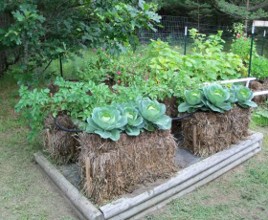
Once a popular commercial method of growing commercial crops, straw bale gardening is experiencing a resurgence among home gardeners. This publication addresses the scientific research behind straw bale gardening and explains the evidence-based benefits and drawbacks for gardeners creating straw bale gardens at home.
A Short History of Straw Bale Gardening
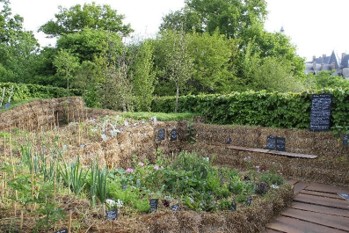
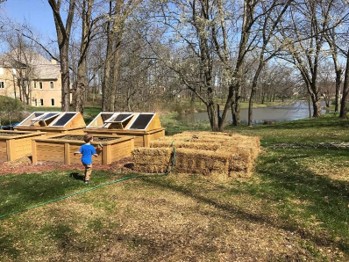
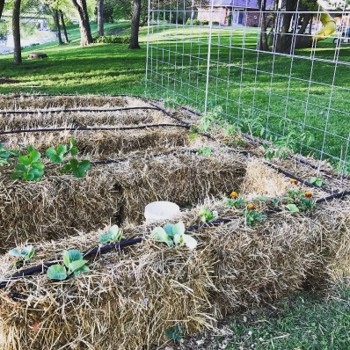
Prior to the advent of heated greenhouses, straw bales were commonly used to insulate hardwood cuttings, early spring vegetable seedlings, and other sensitive plant materials. At some point, the bales themselves became growing platforms for vegetables, fruits, and flowers (Figure 1). This method was actively researched during the mid-1900s.
Research waned after greenhouse production became more common, and particularly when alternative growing media and methods were developed. Forestry residues, such as bark and sawdust, and natural products, including peat and perlite, were composted and used as media in plastic containers (Pudelski 1978; Pudelski and Piróg 1985). Hydroponics used rockwool modules to grow plants in soil-free, nutrient film systems (Bartkowski 1985). With yields as good as (Janowski and Skąpski 1985) or better (Bartkowski 1985; Pudelski 1974; Stokes and Tinley 1981; Variş and Özüyaman 1994) reported in these newer systems, cumbersome straw bales became less popular among farmers and researchers alike. Furthermore, straw bales generally need conditioning (water and nitrogen additions) prior to use. Nevertheless, research on straw bales is limited, particularly in harsh environments with poor soil conditions.
What Can Be Grown on Straw Bales?
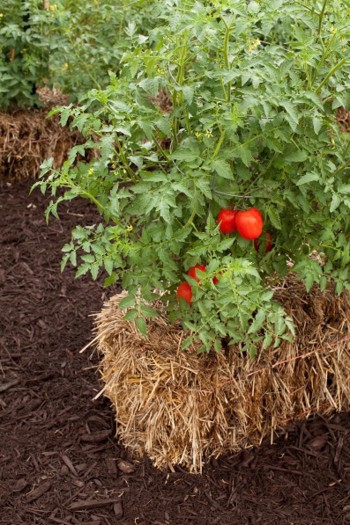
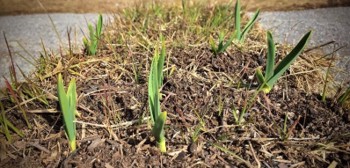
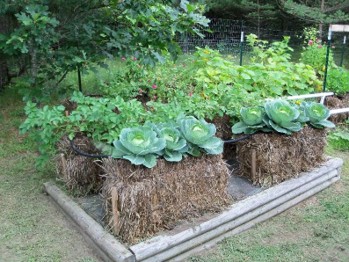
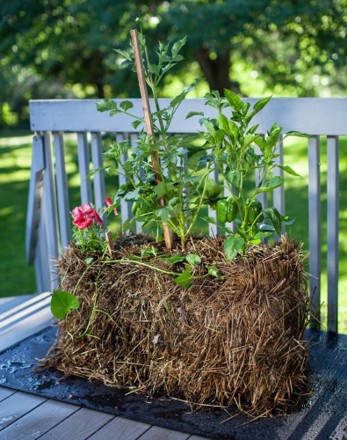
Research on straw bale farming focuses on fruit and vegetable crop plants with relatively short stature, including cucumber (Bartkowski 1985; El-Aidy 1993; Janowski and Skąpski 1985; Pudelski 1978; Pudelski and Piróg 1985; Slusarski et al. 1995; Vatchev and Maneva 2012; Wilson 1978), lettuce (Bal and Altintas 2008; Riad et al. 2017), pepper (El-Marzoky and Abdel-Sattar 2008), strawberry (Abdet-Sattar et al. 2008), and tomato (Figure 2; Variş and Özüyaman 1994). Taller crops, such as corn, tend to fall over and some root crops, such as potatoes, are not well suited. On the other hand, shallow bulb crops, like garlic, can be grown successfully (Figure 3).
The earliest journal articles on straw bale farming are difficult to find, as they exist only in paper form in agricultural university libraries, so the specific methodologies are not easily accessible by the public. Newer work, however, is accessible and can be used to guide gardeners in constructing straw bale gardens.
Preparing Straw Bales for Garden Use
Straw bale gardening resources abound on the internet and elsewhere, but none appear to be based on published research. Instead, unverified instructions are provided, often without explanation or cautionary notes (Tessman et al. 2013). While the guidelines in this publication are taken from research on commercial straw bale use, they have been adapted for home gardeners.
- Tightly baled straw from any cereal crop, such as wheat, rice, and rye, can be used. Bales should be kept dry before use so they are easily moved to the desired location.
- Bales can be left on the surface of the soil (Figure 4), partially buried, or completely dug into the soil. Better results have been seen in partially buried bales, possibly due to increased water retention (compared to unburied) and better aeration (compared to completely buried; El-Aidy 1993). Typically, bales are placed with the baling twine visible on the four vertical surfaces (as seen in the figures), but placement is the gardener’s choice.
- Plastic sheeting is often used to isolate the bales from the surrounding soil (Figure 5). This both reduces water and fertilizer loss into the soil and prevents soilborne pathogens from infesting the straw (Vatchev and Maneva 2012; Wilson 1978).
- Prior to planting, bales will need to be conditioned for approximately three weeks (Vatchev and Maneva 2012). Conditioning entails soaking the bales with water and adding a nitrogen-rich fertilizer. While the timing of water soaking and fertilizer additions will vary with local climate and other environmental conditions, an initial guideline is to thoroughly water every 2–3 days (Vatchev and Maneva 2012) and fertilize as needed.
- Because of their high carbon-to-nitrogen ratio, the bales must be treated with a high nitrogen fertilizer. Inorganic fertilizers are not recommended as salt concentrations will accumulate in the bale (Wilson 1978). Organic fertilizers are less likely to cause problems.
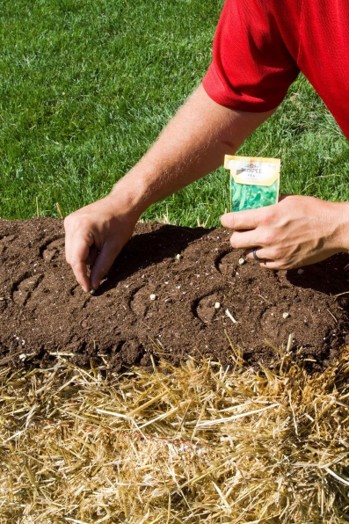
- Apply a thin layer of good soil (Slusarski et al. 1995) or rich organic matter (Pudelski 1974) on top of the bales to encourage plant establishment (Figure 6). Avoid applying too much capping material as this will restrict the growth of roots into the bale itself (Wilson 1978).
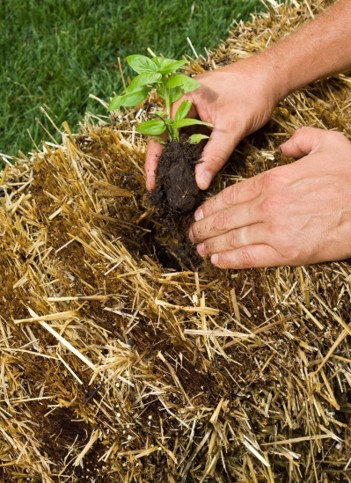
- Alternatively, shallow holes can be dug into the bales and plants inserted into them (Figure 7; Abdet-Sattar et al. 2008).
- Optimal planting density will vary with crop species and environmental conditions. As with any garden situation, the denser the planting the greater the competition among plants for water, nutrients, and space.
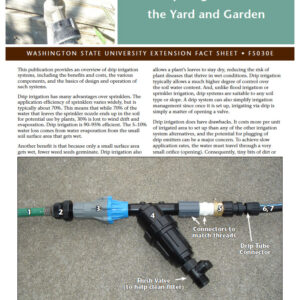
- Consistent irrigation and frequent fertilization is key to the success of straw bale gardens. Drip irrigation is recommended (Figure 8; El-Marzoky and Abdel-Sattar 2008; Riad et al. 2017) as is a high nitrogen liquid feed (Wilson 1978).
Benefits of Straw Bale Gardening
Straw bale gardening is particularly successful in areas with poor soil conditions that are difficult to correct. Alkaline and saline soils can be avoided (Abdet-Sattar et al. 2008) as can common urban soil contaminants, such as heavy metals. Likewise, soilborne diseases and pests are physically isolated from the roots of plants grown in straw bales. Common benefits of straw bale gardening include:
- Vegetable crops have fewer pests (such as nematodes) and diseases compared to those same crops grown in the soil (El-Marzoky and Abdel-Sattar 2008).
- A reduction in pest and disease problems means fewer pesticides are needed (Abdet-Sattar et al. 2008; Riad et al. 2017).
- Roots are protected from cold temperatures via warming from straw bale decomposition (Abdet-Sattar et al. 2008).
- Water is conserved where soils are excessively well-drained and have limited water-holding capacity (Abdet-Sattar et al. 2008).
- Yield is increased compared to soil-grown vegetables (Bal and Altintas 2008; Bartkowski 1985; El-Marzoky and Abdel-Sattar 2008).
- Reduced need to burn, or otherwise dispose of, crop residue (Abdet-Sattar et al. 2008).
Drawbacks of Straw Bale Gardening
- Greater water requirements than traditional, soil-based gardening; as mentioned above, however, straw bale gardening can conserve water use in areas with excessively drained soils.
- Generally greater nutrient input requirements than typical garden soils because of their high carbon-to-nitrogen ratio.
Precautions When Using Straw Bales
- Do not substitute hay bales for straw. Straw consists of cereal stalks after the grain has been harvested. Hay is pasture grass that is harvested for livestock feed and includes the seed heads of those grasses. Hay bales will be full of these seeds which will germinate and become weed problems.
- Avoid straw from fields treated with long-residual herbicides. Certain herbicide residues can injure your crops.
- Bales should not be placed on impermeable surfaces, such as asphalt and concrete. Leachate runoff goes into storm sewers or nearby aquatic systems and contributes to water pollution. Use a plastic mat to contain runoff (Figure 9).
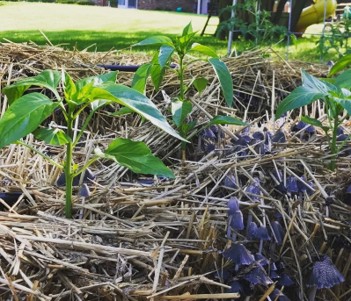
- To avoid future disease or pest problems, do not reuse bales (Vatchev and Maneva 2012). Instead, take them apart and use the straw either as a mulch or as an addition to your compost pile. Straw components will already contain beneficial bacteria and fungi (Figure 10).
Additional Resources
- Cogger, C. 2014. A Home Gardener’s Guide to Soils and Fertilizers. Washington State University Extension Publication EM063E. Washington State University.
- Gardening In Washington State: Vegetable Gardens. 2019. Washington State University.
- Gardening In Washington State: Vegetable Gardens is a website containing hyperlinks to online publications for growing many vegetables in all regions of Washington State. These publications may be used as guidelines for nutrient management of those specific crops grown on straw bales.
Literature Cited
- Abdet-Sattar, M.A., H.A. El-Marzoky, and A.I. Mohamed. 2008. Occurrence of Soilborne Diseases and Root Knot Nematodes in Strawberry Plants Grown on Compacted Rice Straw Bales Compared with Naturally Infested Soils. Journal of Plant Protection Research 48(2):223–235.
- Bal, U. and S. Altintas. 2008. Effects of Trichoderma harzianum on Lettuce in Protected Cultivation. Journal of Central European Agriculture 9(1):63–70.
- Bartkowski, K. 1985. Containers in the Cultivation of Greenhouse Cucumbers. Acta Horticulturae 156:21–26.
- El-Aidy, F. 1993. Preliminary Results on the Possibility of Using Straw as Natural Substrate for Growing Cucumber under Plastic Greenhouses. Acta Horticulturae 323:423–427.
- El-Marzoky, H.A. and M.A. Abdel-Sattar. 2008. Influence of Growing Sweet Pepper in Compacted Rice Straw Bales Compared with Natural Soil, on Infection with Pathogenic Fungi and Nematodes under Greenhouse Conditions. Journal of Agricultural Sciences 16(2):481–492.
- Janowski, G. and H. Skąpski. 1985. Hydro-Peat Method for Greenhouse Cucumber Production. Acta Horticulturae 156:27–33.
- Pudelski, T. 1974. Sphagnum or Lowmoor Peat, Pine Bark and Pine Bark Compost as a Substrate for Greenhouse Cucumber Grown on Straw Bales. Acta Horticulturae 37:2023–2027.
- Pudelski, T. 1978. Using Waste Products of Wood Industry and Paper Mills as Substrates and Organic Fertilizers in Growing Vegetables Under Protection. Acta Horticulturae 82:67–74.
- Pudelski, T. and J. Piróg. 1985. Effect of Four Growing Methods in Wood Waste Substrates on the Yield of Glasshouse Cucumbers. Acta Horticulturae 156:35–42.
- Riad, G.S., A.A. Ghoname, A.M. Hegazi, Z.F. Fawzy, and M.A. El-Nemr. 2017. Cultivation in Rice Straw and Other Natural Treatments as an Eco-Friendly Methyl Bromide Alternative in Head Lettuce Production. Gesunde Pflanzen DOI: 10.1007/s10343-017-0381-0.
- Slusarski, C., J. Dobrzanaka, J. Czapski, and A. Vanachter. 1995. Some Specific Problems Arising from Methyl Bromide Application in Greenhouse Cucumber Growing on Straw Bales. Acta Horticulturae 382:212–220.
- Stokes, D.A. and G.H. Tinley. 1981. Cucumber: Thermal Screen and Growing Media Investigations. Acta Horticulturae 118:135–148.
- Tessman, D., K. Gressley, and R. Gibson. 2013. Straw Bales as a Planting Medium. Journal of Extension 51(6):#6TOT10.
- Variş, S. and T. Özüyaman. 1994. The Comparison of Growth and Yield of Tomatoes Grown in Glasshouse Borders, Bags, Rings, Straw Bales and Top and Bottom Watered Fine and Coarse Perlites in the Cold Glasshouse. Acta Horticulturae 366:417–422.
- Vatchev, T. and S. Maneva. 2012. Chemical Control of Root Rot Complex and Stem Rot of Greenhouse Cucumber in Straw-Bale Culture. Crop Protection 42:16–23.
- Wilson, G.C.S. 1978. Modified Straw Bale Technique for Cucumbers. Acta Horticulturae 82:75–77.
By Linda Chalker-Scott, Associate Professor in Horticulture and Extension Urban Horticulture Specialist, Washington State University
Copyright © Washington State University.
WSU Extension publications contain material written and produced for public distribution. Alternate formats of our educational materials are available upon request for persons with disabilities. Please contact Washington State University Extension for more information.
Issued by Washington State University Extension and the US Department of Agriculture in furtherance of the Acts of May 8 and June 30, 1914. Extension programs and policies are consistent with federal and state laws and regulations on nondiscrimination regarding race, sex, religion, age, color, creed, and national or ethnic origin; physical, mental, or sensory disability; marital status or sexual orientation; and status as a Vietnam-era or disabled veteran. Evidence of noncompliance may be reported through your local WSU Extension office. Trade names have been used to simplify information; no endorsement is intended. Published September 2019.