Why Do Leaves Turn Red? (Home Garden Series)
Description
Spectacular autumnal displays include the crimsons and yellows of changing leaves. But when does the red color associated with fall actually indicate a problem in the garden? Learn how to identify the unusual stressors that can also cause leaf reddening.
Introduction
All gardeners in temperate areas of the world are aware of seasonal changes in leaf color. Many deciduous leaves turn a shade of red before they fall during the autumn months. The red coloration is due to the production of water-soluble leaf pigments called anthocyanins, which are also found in red, blue, and purple flowers and fruits. But leaves can also turn red for reasons unrelated to autumn color development, such as genetic programming (Figure 1). This publication outlines these reasons and explains when red leaves indicate the need for corrective action by gardeners.
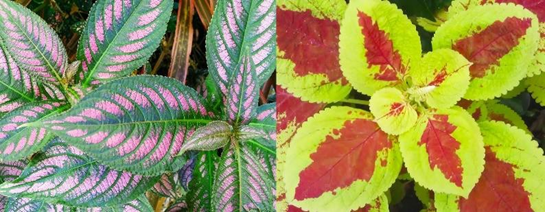
Figure 1. Some plants are genetically programmed to have red leaves. Left: Strobilanthes spp.; right: Coleus spp.
Functions of Anthocyanins in Leaves
Plants use anthocyanins to protect their leaves from environmental stress. Anthocyanins are powerful antioxidants, meaning that they can prevent as well as help repair environmental damage to plant cells. Although research continues to clarify leaf anthocyanin functions, we know that these pigments can protect leaves from high levels of light and drought. They may have protective roles against other stresses as well, many of which are related to conserving leaf water.
- Juvenile leaves. Young leaves are particularly sensitive to environmental stresses like heat and drought because they are actively expanding. Until expansion is complete, the protective waxy cuticle cannot be deposited on the leaf surface. The juvenile leaves of some species, however, are red and remain so until they reach mature size (Figure 2, left photo). The anthocyanins are thought to increase the ability of leaf cells to retain water, reducing evaporation.
- Aging leaves. Anthocyanins take on a scavenging role in deciduous leaves undergoing fall senescence, a natural aging process (Figure 2, right photo). Leaves are full of important resources, like carbohydrates, that plants can store for the next year’s growth. Before the leaves are killed by cold temperatures, they manufacture anthocyanins that bind sugars and transport these to the woody, overwintering parts of the plant. In addition to this transport function, the anthocyanins also protect the leaves from environmental stresses as discussed below.
- Bright light exposure. Leaves in full sun are often redder than those in shadier areas of the same plant. The sun bombards the leaves with high intensity radiation and heats them as well. Anthocyanins both protect against solar damage and help maintain ideal water levels inside the leaf.
- Cold exposure. Some broad-leaved evergreens turn red during the winter months; Oregon grape (Mahonia aquifolium) is a good example. Again, the anthocyanins can protect the leaves from solar damage on sunny winter days. They may also serve as a cellular antifreeze, preventing dehydration stress that otherwise results when water leaves the cell and forms ice in the spaces between cells.
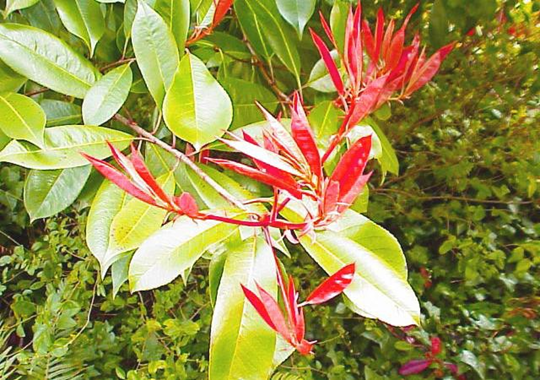
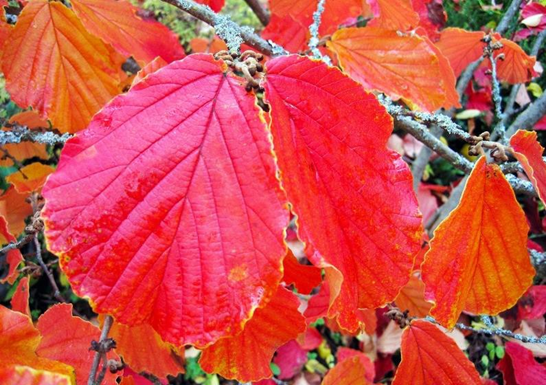
Figure 2. Left photo: juvenile reddening in Photinia protects expanding leaves. Right photo: autumn coloration in Corylus occurs with the onset of winter dormancy.
All of these are normal situations that induce anthocyanin production in leaves every year and require no special attention from gardeners. Other causes of leaf reddening, however, can be signs of unusual environmental stress, pests, or disease.
- Nutrient deficiency. Red leaves caused by a deficiency in phosphorus or some other nutrient is a common problem seen in intensively grown agricultural crops, but rarely in home gardens. Unfortunately, many nonscientific sources in print and on the web suggest that red leaves are symptomatic of nutrient deficiency. Before adding any fertilizer containing phosphorus, be sure to have your soil tested. Adding excess phosphorus unnecessarily harms plants, soil life, and downstream aquatic systems.
- Salts and heavy metals. Exposure to excessive levels of fertilizer or deicing salts can induce leaf reddening. So can high levels of metals in soil, such as aluminum and zinc. A soil testing lab can help determine whether these chemicals are present in your garden soil and suggest what, if anything, you should do.
- Chronic drought. Whether caused by unusual local weather conditions, poorly established roots, or improper planting and management, trees and shrubs that cannot move enough water into their leaves will often show red long before autumn. The reddening process normally starts along the margins and tips of the leaves. Sometimes this can be relieved by irrigation, but often the plant will become dormant prematurely.
- Poor drainage. Many gardeners are unaware that, while their soil may be fully hydrated, their plants are not. Soils that have poor drainage have low levels of oxygen (hypoxia). Lack of sufficient oxygen harms and often kills fine roots, resulting in less water uptake for the leaves. Leaf reddening when water is available is often due to soil compaction or improper soil amendment (Figure 3, left photo). New leaves also tend to be smaller than normal under hypoxic conditions.
- Mechanical damage. Bending, crushing, or otherwise physically damaging leaves can cause them to accumulate anthocyanins in the damaged area.
- Pathogen attack. Bacteria, fungi, and some viruses create red “battle zones” on leaves as the leaves fight the infection. Unlike leaf reddening from other environmental stresses, pathogen-induced anthocyanins often appear in patches on the surface of the leaf rather than along the margins and tips (Figure 3, right photo).
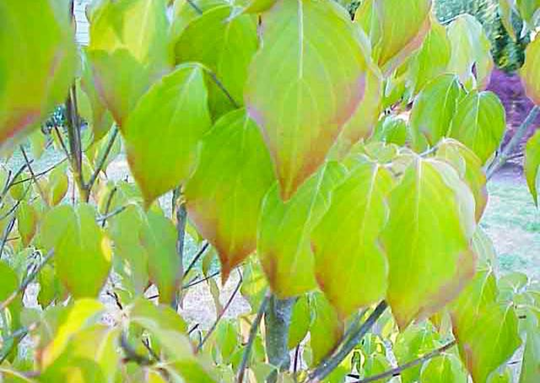
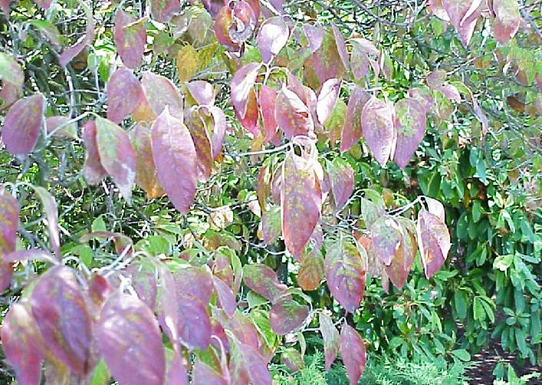
Figure 3. Left photo: poor drainage conditions cause marginal leaf reddening in this Cornus kousa. Right photo: pathogen attack on these Cornus leaves induces anthocyanin production.
Action Items for Gardeners
- Do not assume that red foliage indicates a problem.
- Remember that some plants are genetically programmed to have red leaves, either while the leaves are young or throughout the lifetime of the leaf.
- Use the photos in this publication to help in preliminary red leaf diagnosis. Is the leaf redness attributable to a developmental or climatic condition? Is the reddening isolated or widespread? Does it occur earlier in the season (more likely nutrient related) or later (more likely pathogenic if not autumn senescence)? Treat the plant accordingly.
- Consider all environmental reasons that leaves might be red before attempting a “cure.” This includes checking soil moisture conditions, winter cold pockets, wind, and other environmental factors that might contribute to leaf reddening.
- Do a soil test if you are wondering why your plant’s leaves are abnormally red. You will get information on nutrient levels, soil pH, and heavy metal contamination all in one simple report.
- Be aware that sunlight is often needed to trigger anthocyanin production, so shaded plants may not accumulate this pigment as easily. Consider sun exposure in your landscape when you are planting naturally red-leaved species: more sun means redder leaves.
- Avoid pruning deciduous trees and shrubs when their leaves have begun changing color. You are removing vital nutrients that are on their way from leaves to winter storage.
- Add fertilizer only if a soil test reveals deficient levels of phosphorus or another nutrient. It is a common myth that red leaves mean a deficiency in phosphorus or another nutrient.
Gardeners can take advantage of plants that naturally produce foliar anthocyanins. They can add aesthetic interest year-round, from new spring leaves to autumn foliage to winter reddening (Figure 4).
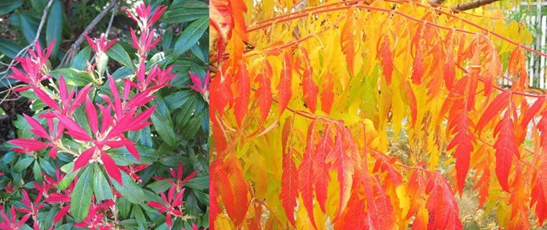
Figure 4. Foliar anthocyanins provide vibrant garden color from spring through fall. Left: Photinia spp.; right: Sumac spp.
Additional Resources
Chalker-Scott, L. 1999. Environmental Significance of Anthocyanins in Plant Stress Responses. Photochemistry and Photobiology 70: 1–9.
Chalker-Scott, L. 2002. Do Anthocyanins Function as Osmoregulators in Leaf Tissues? Advances in Botanical Research 37: 103–27.
Lee, D.W., and K.S. Gould. 2002. Why Leaves Turn Red. American Scientist 90(6): 524–531.
By
Linda Chalker-Scott, Professor and Extension Specialist, Department of Horticulture, Washington State University
All photos are the work of the author.

FS209E

Copyright © Washington State University
WSU Extension publications contain material written and produced for public distribution. Alternative text descriptions for select complex images were generated using ChatGPT (OpenAI), then reviewed and adapted to ensure compliance with Web Content Accessibility Guidelines (WCAG) accessibility standards.
Issued by Washington State University Extension and the US Department of Agriculture in furtherance of the Acts of May 8 and June 30, 1914. Extension programs and policies are consistent with federal and state laws and regulations on nondiscrimination regarding race, sex, religion, age, color, creed, and national or ethnic origin; physical, mental, or sensory disability; marital status or sexual orientation; and status as a Vietnam-era or disabled veteran. Evidence of noncompliance may be reported through your local WSU Extension office. Trade names have been used to simplify information; no endorsement is intended.