Washington Lamb of Merit
Description
Online Only For info on purpose of the program, requirements, changes in merit requirements, placement of carcasses, and procedure and definition of terms. ...
Table of Contents
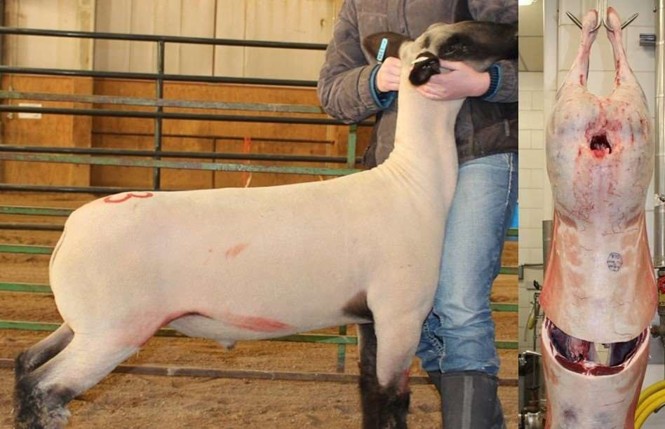
Purpose of Program
- To create an awareness of current market demands.
- To recognize exhibitors and breeders for producing high-value carcasses.
- To provide information about carcasses produced in youth shows.
- To identify selection, breeding, nutrition, and management practices that result in desirable carcasses.
- To promote and improve the educational value and public image of youth shows.
| Hot Carcass Weight (lb) | Minimum Ribeye Area Requirement (sq. in.) |
|---|---|
| 55 | 2.6 |
| 60 | 2.7 |
| 65 | 2.8 |
| 70 | 2.9 |
| 75 | 3.0 |
| 80 | 3.1 |
| 85 | 3.2 |
Ribbed and unribbed carcasses must have a leg conformation grade of High Choice or better. (Carcasses should be ribbed, if possible, because ribeye area can be determined more objectively than leg conformation grade. Ultrasound measurements can be used if a carcass measurement is not available.)
Requirements for the Washington Lamb of Merit
- Hot Carcass Weight. Must weigh 55 to 85 pounds.
- Adjusted 12th Rib Fat Thickness. Must have an adjusted fat thickness of 0.16 to 0.25 inch.
- Muscling. If ribbing or measurement by ultrasound is possible, the minimum ribeye area requirement is equal to 2.5 + [(hot carcass weight – 55) × 0.02]. Consult Table 1 for more detailed calculations.
- Yield Grade. 2.9 or lower; reported to the tenth of a yield grade (the 1/100th decimal digit is dropped; for example: a yield grade of 2.99 is reported as 2.9).
- Quality Grade. Low Choice through High Prime.
- Carcass Acceptability. Carcasses must have acceptable color and firmness of fat and lean, and must be free from defects that may significantly reduce carcass value. For example, carcasses with excessive (greater than 5%) muscle, fat, or bone removal due to bruises or localized infections should be eliminated.
- Average Daily Gain. Minimum of 0.60 pound per day. Lambs must be fed a minimum of 60 days before the show.
Requirements for the Washington Lamb Carcass of Merit
Identical to the Washington Lamb of Merit except Average Daily Gain is not included. Use Lamb Carcass of Merit if an initial live weight cannot be obtained at least 60 days before the show.
Changes in Merit Requirements
Individual programs may need to adjust the requirements outlined in this bulletin. If requirements are changed, add the local county or area name to the name of the merit program.
Placement of Carcasses
Neither the Washington Lamb of Merit nor Lamb Carcass of Merit programs have been designed to rank carcasses. Instead, these programs award a superior level of achievement in producing high cutability and quality carcasses. Many good ranking systems are available and can be designed to use Lamb of Merit data. Select a ranking system that is consistent with demands of local markets and packers. You can obtain ranking systems through your county Extension office. It is not recommended that you rank carcasses when measurements are collected from different plants because variation in slaughter and chilling procedures can significantly affect carcass measurements.
To aid producers in evaluation of carcasses, a WSU Livestock Carcass Grade & Cutability Calculator has been developed (Smith and Busboom 2015). The app is free to download for your iPhone or Android phone.
Procedure and Definition of Terms Recorded or Used in Washington Lamb and Lamb Carcass of Merit Programs
- Initial and Final Live Weight. Use similar pre-weighing conditions for both initial and final live weights. The initial weight should be taken at least 60 days before the final weight at the show. Final weights are not as critical since hot carcass weight divided by 0.50 is used as the final weight for average daily gain calculations. A typical dressing percentage for lambs with the kidney fat removed is 50%. However, slick sheared, correctly finished, heavy-muscled lambs typically dress between 52–56% because of decreased pelt weight and increased muscle on the carcass.
- Average Daily Gain. [(Hot carcass weight ÷ 0.50) – initial live weight] ÷ days on test.
- Kidney and Pelvic Fat. Fat accumulated in the abdominal cavity of the carcass. As of June 1992, kidney and pelvic fat should be removed prior to obtaining hot carcass weight. The amount of kidney and pelvic fat remaining in the carcass should not exceed 1% of carcass weight.
- Hot Carcass Weight. Weigh dressed carcass immediately after slaughter prior to chill. If chilled weights are recorded, convert to a hot carcass weight basis by dividing by 0.98 (most carcasses shrink about 2% during the chilling process).
- Dressing Percent. (Hot carcass weight ÷ actual final live weight) × 100.
- Adjusted Fat Thickness. Measured between the 12th and 13th rib over the midpoint of the longissimus (ribeye) muscle perpendicular to the outside surface of the fat. This measurement may be adjusted to reflect an unusual distribution of fat on other parts of the carcass, such as the lower rib.
- Ribeye Area. For carcasses ribbed between the 12th and 13th rib, ribeye area is the cross-sectioned area of the longissimus (ribeye) muscle (Use a plastic lamb and pork grid to measure). All adjacent secondary muscles are excluded in the measurement. Ultrasound measurements can also be used if carcass measurement is not available.
- Leg Conformation. Visual estimate of the proportion of edible meat to bone in the leg. Superior leg conformation is reflected in legs that are very wide and thick in relation to their length and very plump, full, and well-rounded in appearance. Leg conformation scores are coded as follows: 15 = Prime+, 14 = Average Prime, 13 = Prime-, 12 = Choice+, 11 = Average Choice, etc.
- Yield Grade. Value determined by a formula using adjusted fat thickness. Carcasses with a lower yield grade number will yield higher percentage of salable red meat.
- Yield grade = 0.4 + (10 × adjusted fat thickness, inches).
- Quality Grade. A composite evaluation of the quality or palatability-indicating characteristics of the lean and the conformation of the carcass. A USDA grader (or another qualified and experienced person) should determine the final quality grade and quality grade factors of conformation, maturity, flank streaking, firmness of lean, and external fat. If graded by anyone other than a federal grader, make a notation to that effect. Prime lambs have no advantage over Choice lambs because there is little or no advantage in eating quality/palatability, and market prices between Prime and Choice lambs are usually similar.
Additional Resources
Information about lamb carcass evaluation:
- American Meat Science Association. 2013. Meat Evaluation Handbook.
- Boggs, D.L., R.A. Merkel, M.E. Doumit, and K. Bruns. 2010. Livestock and Carcasses: An Integrated Approach to Evaluation, Grading, and Selection, 6th Ed. Kendall/Hunt Publishing Company. Dubuque, Iowa 52002.
- Romans, J.R., W.J. Costello, C.W. Carlson, M.L. Greaser, and K.W. Jones. 2001. The Meat We Eat, 14th Ed. The Interstate Printers and Publishers, Inc., P.0. Box 50, Danville, Illinois 61834-0050.
Lamb carcass evaluation equipment and resources:
- Lamb and Pork Loineye (Ribeye) Grid. Iowa State University Extension and Outreach – Extension Store. Phone: 515-294-5247, Fax: 515-294-2945.
- Smith, S.M., and J.R. Busboom. 2015. WSU Carcass Calculator: Livestock Carcass Grade & Cutability Calculator (Version 1.0 #30). [Mobile application software]. Free to download on Apple and Android phones. For lambs, the WSU Carcass Calculator will calculate dressing percentage and yield grade.
By Jan R. Busboom, Ph.D., WSU Extension Animal Scientist, Washington State University; Donald A. Llewellyn, Ph.D., WSU Regional Animal Science Specialist, Washington State University; Sarah M. Smith, M.S., WSU Regional Animal Science Educator, Washington State University
Copyright © Washington State University
WSU Extension publications contain material written and produced for public distribution. Alternate formats of our educational materials are available upon request for persons with disabilities. Please contact Washington State University Extension for more information.
Issued by Washington State University Extension and the US Department of Agriculture in furtherance of the Acts of May 8 and June 30, 1914. Extension programs and policies are consistent with federal and state laws and regulations on nondiscrimination regarding race, sex, religion, age, color, creed, and national or ethnic origin; physical, mental, or sensory disability; marital status or sexual orientation; and status as a Vietnam-era or disabled veteran. Evidence of noncompliance may be reported through your local WSU Extension office. Trade names have been used to simplify information; no endorsement is intended. Published May 2018.